www.ijiset.com
Effect of Yeast Species on Total Soluble Solids, Total Polyphenol Content
and Fermentation Index during Simulation Study of Cocoa
Fermentation
Ooi, T. S.1
, Sepiah, M.2 and Khairul Bariah, S.3
1,2
Department of Plant Science and Environmental Ecology, Faculty of Resource Science and Technology, Universiti Malaysia Sarawak, 94300 Kota Samarahan, Sarawak. Malaysia.
3 Cocoa Research and Development Centre (Hilir Perak), Malaysian Cocoa Board, P. O. Box 30, Sg. Dulang Road, 36307 Sg. Sumun, Perak, Malaysia.
Abstract
The polyphenols has potential of health beneficial and its changes in cocoa are related to fermentation index. However, relationship of yeast species to total soluble solids, total polyphenols and fermentation index changes during cocoa fermentation is still unclear. This study focused on effect of yeast as starter culture during cocoa fermentation towards those parameters. Sixteen species of yeast were used as starter cultures during simulation study of cacao fermentation in the laboratory. Study revealed that Candida ethanolica give the highest correlation with fermentation index whereas Candida jaroonii is the lowest correlation. None of the yeast species showed high correlation with total polyphenols content compared to the control. Conversely, all of the yeasts especially Pichia kudriavzevii showed higher correlation with total soluble solids compared to control. The study also exhibited that cacao simulation media method can be useful to predict yeast performance during cacao fermentation prior to field application.
Keywords: yeast species, total polyphenols content, fermentation index, sugar content of pulp, cacao simulation media
1. Introduction
Cacao is particularly rich in polyphenols and acts as one of the richest sources of antioxidants. Therefore, cocoa products such as chocolate can be a major source of dietary antioxidants and have protective effects against cardiovascular disease (Suzana & Emad, 2013). During cocoa fermentation, the colour of cocoa bean cotyledon changes from purple into brown colour (Lopez, 1986). Fresh cocoa beans have purple colour in the bean cotyledon. The purple colour is caused by anthocyanidin pigments, 3- β-D-galactosyl- and 3-α-L-arabinosyl-cyanidins. These pigments are hydrolysed by glycosidases during the cocoa fermentation, causing a paler purple colour in the cocoa bean. The glycosidases have not been characterized but maximum destruction of polyphenol pigments occur at 45 ˚ C in the pH of 3.8 to 4.5 (Biehl et al., 1989). Changes of colour in cocoa bean are commonly used to determine
flavour potential of cocoa beans and their suitability for chocolate processing. Furthermore, fermentation index and cut test are also based on the colour changes of cocoa cotyledons after cocoa fermentation is completed.
Polyphenols are stored in pigment cells or polyphenolic storage cells of the cotyledons. The polyphenolic storage cells in cocoa bean are white to deep purple in colour, depending on the amount of anthocyanins (a minor class of cocoa bean polyphenols) ( Lopez, 1986; Camu et al., 2008). Polyphenolic storage cell in cocoa beans are made of 14-20% dry bean weight and contain a large vacuole filled with polyphenols and alkaloids which including caffeine (0.1-0.2%), theobromine (2.5-3.2%), and theophylline (Osman et al., 2004). The major polyphenolic compounds in cocoa seeds are catechins (3.0-6.0%), leucocyanidins (2.5%) and tannins (2.0-3.5%). The polyphenols have bitter, astringent flavours and antioxidant properties that help protect the cocoa seed from damage and disease (Kyi et al., 2005).
www.ijiset.com
critical because this process decreases the flavan-3-ol content to produce full cocoa flavour (Wollagast&Anklam, 2000; Rodriguez-Campos et al., 2011). Wollgast and Anklam (2000) have mentioned three groups of polyphenols which are catechins or flavan-3-ols, anthocyanins and proanthocyanidins. The main catechin is (-)-epicatechin which is up to 35% of polyphenol content. During cocoa fermentation, the polyphenols react with sugar and amino acids to contribute to flavour and colour of cocoa bean (Lehrian& Patterson, 1983; Afoakwa& Paterson, 2010).
Yeast has been found dominating the cocoa fermentation for the first 24 hours of the microbial succession (Schwan, 1998). The predominance and importance of yeast in cocoa fermentation is well recognized (Graham & Hugh, 2007). Wine yeast is well known to cause decrease in the phenolic content of wines (Caridi et al.,
2004). In wine research, phenolics play a major role in determining the quality of wine. Nevertheless, very little is known about the level of cacao polyphenols in cacao beans during cacao fermentation and how yeast species influence cocoa polyphenols. This experiment is to correlate the relationship of selected yeast species towards the total soluble solids of pulps, total polyphenols content and fermentation index of nibs during cocoa fermentation by using cacao simulation media prior to field application.
2.Materials and methods
2.1 Simulation of Cocoa Fermentation 2.1a Cocoa Media
Media for cocoa fermentation in the laboratory was prepared according Pereira et al., (2012) with slight modification. A total of 500 mL of cocoa pulp medium which consist of 17g/1 of fructose (Hamburg Chemicals), 25g/1 of glucose (GLUCOLIN), 10 g/l of citric acid (Bendosen), 5g/l of yeast extract (USB Corporation Cleveland, USA), 5g/l of peptone (Thermo Scientific) and 20% (w/v) fresh cocoa seeds were prepared in Erlenmeyer flasks.
2.1b Yeast Starter Culture
A total of 16 species of yeast were used as the starter cultures, which were Saturnispora diversa (KT175190),
Candida ethanolica (KT175192), Candida jaroonii
(KT175172), Candida quarcitrusa (KT175173), Candida tropicalisi (KT175184), Candida xylopsoci (KT175174),
Geotrichum candidum (KT175200), Hanseniaspora
opuntiae (KT175183), Hanseniaspora species (KT175196),
Hanseniaspora thailandica (KT175194), Pichia kluyveri
(KT175195), Pichia kudriavzevii (KT175182),
Wickerhamomyces onychis (KT175197), Rhodotorula
mucilaginosa (KT175177), Saccharomyces cerevisiae
(KT175189) and Wickerhamomyces anomalus (KT175180). The yeasts were cultured according to modified method of Singh et al., (1997) in 1.5ml YEPD broth containing 1%
peptone (Thermo Scientific), 2% dextrose (Fisher Scientific) and 0.3% yeast extract (USB Corporation Cleveland, USA). The cultures were incubated in incubator (Binder, Germany) for 12 hours at 30 ˚C. The numbers of yeast cells in suspension were counted by haemocytometer (Hirschmann, Germany) in cells/ml unit and diluted with distilled water to concentration of 106 cells ml-1 prior to use.
2.1c Cocoa Fermentation
A total of 1.5 mL of yeast starter culture was mixed with 500 ml of cocoa pulps media in the Erlenmeyer flask. The mixture was allowed to ferment for 120 hours in oven sterilized with 99% ethanol at 30 ˚C. The experiment was done in triplicate and samples were collected at 0, 24, 48, 72, 96 and 120 hours.
2.2a Total Soluble Solids of pulp
Total soluble solids of the fermented cocoa pulp were measured according to Khairul Bariah (2014) by using Atago Digital Hand-held Pocket Refractometer PAL-1. The cocoa pulp was separated from nib by scalpel and weighed using balance weight (Metler Toledo, PL 4002) before placed into a Falcom tube. Distilled water was added volume per volume (v/v) into the tube and vortexed. The amount of total soluble solids content of pulp was recorded in Brix unit. Triplicate samples were prepared.
2.2b Total polyphenols content of nibs
www.ijiset.com
Excel. Total polyphenols content of sample was calculated using R2 value and reported as milligram gallic acid equivalents (GAE) per gram defatted cocoa.
2.2c Fermentation index of nibs
Fermentation index (FI) was determined according to Khairul Bariah (2014) with slight modification. Wet fermented cocoa beans were used and it shells were removed to obtain nibs. The nibs were grinded into powder form using blender. About 0.5 grams of the cocoa powder was weighed by using a weight balance (Metler Toledo, PL 4002) and put into a 100 ml of volumetric flask. Then, a mixture of methanol (Hamburg Chemicals) and hydrochloric acid (Hamburg Chemicals) (97: 3) was added into the volumetric flask until reached the line of the flask. The mixture was vortexed a while and kept at 40C overnight. Next, the sample was filtered by using Whatman filter paper No.4 and absorbance measured at wavelengths of 460 nm and 530 nm, respectively using UV-visible spectrophotometer (SHIDMAZU uv-2401). Triplicate samples were prepared. The FI was obtained by calculating the ratio between absorbance 460 nm and 530 nm of the cocoa beans.
2.3 Statistical analysis
The effect of starter culture on total soluble solids of pulps, total polyphenols content and fermentation index of nibs at every sampling time were determined. Data were analyzed using one way ANOVA followed by mean comparison using Turkey test at p <0.05 levels with SPSS version 20.
3. Results
3.1 Total soluble solids content of pulps
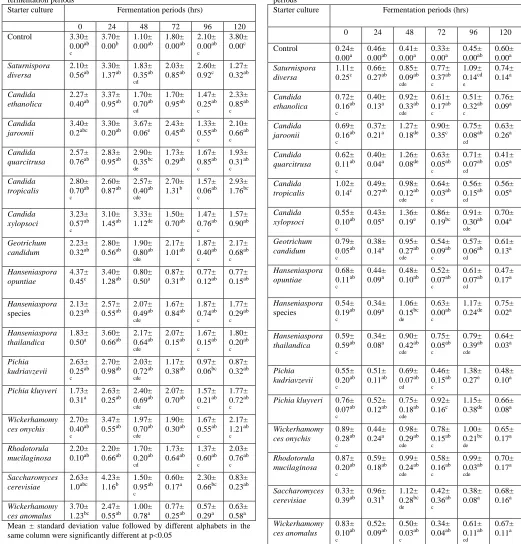
The total soluble solids (TSS) content of the cocoa pulp for all the 17 samples including control during simulation of cocoa fermentation were shown in Table 3.1. At the beginning, the TSS content of fresh beans used in this study varied from 1.73±0.31 brix to 4.37±0.45 brix. The TSS content of cocoa beans added with H. opuntiae was the highest (4.37± 0.45 brix) whereas cocoa beans added with
P. kluyveri (1.73± 0.31 brix) or H. thailandica (1.83± 0.50 brix) had the lowest TSS content. Statistical analysis indicated that no significant different except for samples added with H. opuntiae, P. kluyvei or H. thailandica. At the end of fermentation, the TSS content of cocoa pulps for all samples including control ranging between 0.63 to 3.80 brix. The highest TSS amount was from control while sample added with W. anomalus has the lowest. Statistical analysis also indicated that no significant effect at the end of fermentation (120 hours) except for control and cocoa beans added with W. anomalus.
During fermentation process, the total soluble solids contents for all the 17 samples including control were fluctuated during the whole fermentation period. In control
sample, the TSS of cocoa pulp was begun with increasing trend to 3.70 ± 0.00 brix after 24 hours of fermentation. Then after 48 hours of fermentation, the TSS content has decreased to 1.10 ± 0.00 brix before continue to increase until 3.80 ± 0.00 brix when fermentation ended at 120 hours. However, the TSS content of the cocoa pulp for all the 16 treatments was inconsistent with the control. Most of the treatments showed increasing of total soluble solids amount at the first 24 hours except for samples added with
C. jaroonii, C. tropicalis, C. xylopsoci, H. opuntiae and W. anomalus. While, the TSS of cocoa pulp in samples added with R. Mucilaginosa remains unchanged. Afterwards, TSS cocoa pulp in most treatment experienced a decreased trend in between the fermentation (48 hours to 96 hours) and increased again when the fermentation ended at 120 hours. Moreover, the TSS content in three samples (added with C. jaroonii, C. quarcitrusa, and C. xylopsoci) were increased at 48 hours and another three (added with C. tropicalis, G. candidum and R. Mucilaginosa) at 72 hours of fermentation. While the TSS content of sample added with P. kudriavzevii
was decreased when the fermentation terminated at 120 hours. In spite of that, the fluctuated trends of TSS content over the period of fermentation were similar in samples either added with Hanseniaspora sp. or S. cerevisiae.
3.2 Total polyphenols content of nibs
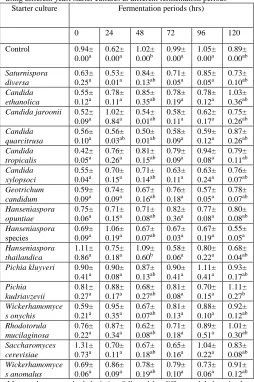
The total polyphenols content for all of the 17 samples including control at different fermentation periods was shown in Table 3.2. The total polyphenols content of the fresh cocoa beans used in this study was varied in between 0.24 ± 0.00 to 1.11± 0.25 mg GAE/g. The lowest content was in the control sample, while the highest was in the sample added with S. Diversa. During fermentation, the total polyphenols content was also varied where sample added with S. cerevisiae showed the highest (0.96±0.31 mg GAE/g), followed by C. xylopsoci (1.36 ± 0:19 mg GAE/g),
P. kluyveri (0.92 ± 0.16 mg GAE/g) and P. kudriavzevii
www.ijiset.com
Table 3.1 Comparisons of total soluble solids content of pulps in cocoa simulation media treated with different starter cultures at different fermentation periods
Starter culture Fermentation periods (hrs)
0 24 48 72 96 120
Control 3.30±
0.00ab c 3.70± 0.00b 1.10± 0.00ab 1.80± 0.00ab 2.10± 0.00ab c 3.80± 0.00c Saturnispora diversa 2.10± 0.56ab 3.30± 1.37ab 1.83± 0.35ab cd 2.03± 0.85ab 2.60± 0.92c 1.27± 0.32ab Candida ethanolica 2.27± 0.40ab 3.37± 0.95ab 1.70± 0.70ab cd 1.70± 0.95ab 1.47± 0.25ab c 2.33± 0.85ab c Candida jaroonii 3.40± 0.2abc 3.30± 0.20ab 3.67± 0.06e 2.43± 0.45ab 1.33± 0.55ab c 2.10± 0.66ab c Candida quarcitrusa 2.57± 0.76ab 2.83± 0.95ab 2.90± 0.35bc de 1.73± 0.29ab 1.67± 0.85ab c 1.93± 0.31ab c Candida tropicalis 2.80± 0.70ab c 2.60± 0.87ab 2.57± 0.40ab cde 2.70± 1.31b 1.57± 0.06ab c 2.93± 1.76bc Candida xylopsoci 3.23± 0.57ab c 3.10± 1.45ab 3.33± 1.12de 1.50± 0.70ab 1.47± 0.76ab c 1.57± 0.90ab Geotrichum candidum 2.23± 0.32ab 2.80± 0.56ab 1.90± 0.80ab cde 2.17± 1.01ab 1.87± 0.40ab c 2.17± 0.68ab c Hanseniaspora opuntiae 4.37± 0.45c 3.40± 1.28ab 0.80± 0.50a 0.87± 0.31ab 0.77± 0.12ab 0.77± 0.15ab Hanseniaspora species 2.13± 0.23ab 2.57± 0.55ab 2.07± 0.49ab cde 1.67± 0.84ab 1.87± 0.74ab c 1.77± 0.29ab c Hanseniaspora thailandica 1.83± 0.50a 3.60± 0.66ab 2.17± 0.64ab cde 2.07± 0.15ab 1.67± 0.15ab c 1.80± 0.20ab c Pichia kudriavzevii 2.63± 0.25ab c 2.70± 0.98ab 2.03± 0.72ab cde 1.17± 0.38ab 0.97± 0.06bc 0.87± 0.32ab
Pichia kluyveri 1.73± 0.31a 2.63± 0.25ab 2.40± 0.69ab cde 2.07± 0.70ab 1.57± 0.21ab c 1.77± 0.72ab c Wickerhamomy ces onychis 2.70± 0.40ab c 3.47± 0.55ab 1.97± 0.70ab cde 1.90± 0.30ab 1.67± 0.55ab c 2.17± 1.21ab c Rhodotorula mucilaginosa 2.20± 0.10ab 2.20± 0.66ab 1.70± 0.20ab cd 1.73± 0.64ab 1.37± 0.60ab c 2.03± 0.76ab c Saccharomyces cerevisiae 2.63± 1.0abc 4.23± 1.16b 1.50± 0.95ab c 0.60± 0.17a 2.30± 0.66bc 0.83± 0.23ab Wickerhamomy ces anomalus 3.70± 1.23bc 2.47± 0.55ab 1.00± 0.78a 0.77± 0.25ab 0.57± 0.29a 0.63± 0.58a Mean ± standard deviation value followed by different alphabets in the same column were significantly different at p<0.05
The total polyphenols content in the control was increased to 0.46±0.00 mg GAE/g after 24 hours of fermentation, but the content was decreased after the fermentation progressed to period of 48 and 72 hours.
Table 3.2 Comparisons of total polyphenols content (mg GAE/g) in cocoa simulation media treated with starter cultures at different fermentation periods
Starter culture Fermentation periods (hrs)
0 24 48 72 96 120
Control 0.24±
0.00a 0.46± 0.00ab 0.41± 0.00a 0.33± 0.00a 0.45± 0.00ab 0.60± 0.00a Saturnispora diversa 1.11± 0.25c 0.66± 0.27ab 0.85± 0.09ab cde 0.77± 0.37ab c 1.09± 0.14cd e 0.74± 0.14a Candida ethanolica 0.72± 0.16ab c 0.40± 0.13a 0.92± 0.33ab cde 0.61± 0.17ab c 0.51± 0.32ab c 0.76± 0.09a Candida jaroonii 0.69± 0.16ab c 0.37± 0.21a 1.27± 0.18de 0.90± 0.35c 0.75± 0.08ab cd 0.63± 0.26a Candida quarcitrusa 0.62± 0.11ab c 0.40± 0.04a 1.26± 0.08de 0.63± 0.05ab c 0.71± 0.07ab cd 0.41± 0.05a Candida tropicalis 1.02± 0.14c 0.49± 0.27ab 0.98± 0.12ab cde 0.64± 0.03ab c 0.56± 0.15ab cd 0.56± 0.05a Candida xylopsoci 0.55± 0.10ab c 0.43± 0.05a 1.36± 0.19e 0.86± 0.19bc 0.91± 0.30ab cde 0.70± 0.04a Geotrichum candidum 0.79± 0.05ab c 0.38± 0.14a 0.95± 0.27ab cde 0.54± 0.09ab c 0.57± 0.06ab cd 0.61± 0.13a Hanseniaspora opuntiae 0.68± 0.11ab c 0.44± 0.09a 0.48± 0.10ab 0.52± 0.07ab c 0.61± 0.07ab cd 0.47± 0.17a Hanseniaspora species 0.54± 0.19ab c 0.34± 0.09a 1.06± 0.15bc de 0.63± 0.00ab c 1.17± 0.24de 0.75± 0.02a Hanseniaspora thailandica 0.59± 0.59ab c 0.34± 0.08a 0.90± 0.42ab cde 0.75± 0.05ab c 0.79± 0.39ab cde 0.64± 0.03a Pichia kudriavzevii 0.55± 0.20ab c 0.51± 0.11ab 0.69± 0.07ab cd 0.46± 0.15ab c 1.38± 0.27e 0.48± 0.10a
Pichia kluyveri 0.76± 0.07ab c 0.52± 0.12ab 0.75± 0.18ab cde 0.92± 0.16c 1.15± 0.38de 0.66± 0.08a Wickerhamomy ces onychis 0.89± 0.28ab c 0.44± 0.24a 0.98± 0.29ab cde 0.78± 0.15ab c 1.00± 0.21bc de 0.65± 0.17a Rhodotorula mucilaginosa 0.87± 0.20ab c 0.59± 0.18ab 0.99± 0.24ab cde 0.58± 0.16ab c 0.99± 0.03ab cde 0.70± 0.17a Saccharomyces cerevisiae 0.33± 0.39ab 0.96± 0.31b 1.12± 0.28bc de 0.42± 0.36ab c 0.38± 0.08a 0.68± 0.16a Wickerhamomy ces anomalus 0.83± 0.10ab c 0.52± 0.09ab 0.50± 0.03ab c 0.34± 0.04ab 0.61± 0.11ab cd 0.67± 0.11a
Mean value ± standard deviation followed by different alphabets in the same column were significantly different at p<0.05
www.ijiset.com
However, the total polyphenols content in the samples fluctuated over the fermentation periods where, most of the treatments showed decreasing of total polyphenols content at the initial period of fermentation but increased in between the fermentation (24 hours to 96 hours) before it reduced again at the end of the fermentation. The total polyphenol content was increased in samples added with S. cerevisiae
after 24 hours and H. opuntiae or P. kluyveri after 72 hours of fermentation, respectively. The total polyphenols content in the following four samples added C. ethanolica, G. candidum, S. cerevisiae and W. anomalus were also increased at the end of the fermentation, while total polyphenols content in sample added with C. tropicalis
remained unchanged.
3.3 Fermentation index of nibs
The values of fermentation index at different fermentation periods for all 17 samples including control were shown in Table 3.3. Initially, the value of fermentation index for all the 17 samples including control were ranged between 0.42 ± 0.05 to 1.31± 0.73. The lowest values of fermentation index was from samples added with C. tropicalis, while samples added with S. cerevisiae was the highest. It was also observed that the value of fermentation index from samples added with H. thailandica or S. cerevisiae was already attained more 1.00 even though at the start of fermentation process. However, based on statistical analysis, there were no significant differences of the fermentation index for all the samples although the few samples including control have quite high value of fermentation index at 0 hours of fermentation.
4. Discussions and Conclusions
Based on the total soluble solids content of pulps recorded after 120 hours, control had the highest total soluble solids content increment compared to media added with C. tropicalis, P. kluyveri, C. ethanolica or combination of H. opuntiae and S. cerevisiae. The total soluble solids content of pulps in cocoa simulation media added with other yeast starter cultures decreased after 120 hours. This study indicated that cocoa fermentation applied with yeast starter culture was more effective in metabolizing total soluble solids content of pulps compared to control. Yeasts would cause alcoholic fermentation where they metabolized citric acid and converted sugar content to produce by products such as alcohol and carbon dioxide (Roelofsen & Geisburger, 1947). Subsequently, some strains of yeasts were capable of producing pectinolytic enzymes which would break down the mucilage pulp and ran off as cocoa sweating (Roelofsen & Geisburger, 1947).
Table 3.3 Comparisons of fermentation index of cocoa simulation media using different yeast starter cultures at different fermentation periods
Starter culture Fermentation periods (hrs)
0 24 48 72 96 120
Control 0.94±
0.00a 0.62± 0.00a 1.02± 0.00b 0.99± 0.00a 1.05± 0.00a 0.89± 0.00ab Saturnispora diversa 0.63± 0.25a 0.53± 0.01a 0.84± 0.13ab 0.71± 0.05a 0.85± 0.05a 0.73± 0.10ab Candida ethanolica 0.55± 0.12a 0.78± 0.11a 0.85± 0.35ab 0.78± 0.19a 0.78± 0.12a 1.03± 0.36ab
Candida jaroonii 0.52± 0.09a 1.02± 0.84a 0.54± 0.01ab 0.58± 0.11a 0.62± 0.17a 0.75± 0.26ab Candida quarcitrusa 0.56± 0.10a 0.56± 0.03ab 0.50± 0.01ab 0.58± 0.09a 0.59± 0.12a 0.87± 0.26ab Candida tropicalis 0.42± 0.05a 0.76± 0.26a 0.81± 0.15ab 0.79± 0.09a 0.94± 0.08a 0.79± 0.11ab Candida xylopsoci 0.55± 0.04a 0.70± 0.15a 0.71± 0.14ab 0.63± 0.11a 0.63± 0.24a 0.76± 0.07ab Geotrichum candidum 0.59± 0.09a 0.74± 0.09a 0.67± 0.16ab 0.76± 0.18a 0.57± 0.05a 0.78± 0.07ab Hanseniaspora opuntiae 0.75± 0.06a 0.71± 0.15a 0.71± 0.08ab 0.82± 0.36a 0.77± 0.08a 0.80± 0.08ab Hanseniaspora species 0.69± 0.09a 1.06± 0.19a 0.67± 0.07ab 0.67± 0.03a 0.67± 0.19a 0.55± 0.05a Hanseniaspora thailandica 1.11± 0.86a 0.75± 0.18a 1.09± 0.60b 0.58± 0.06a 0.80± 0.22a 0.68± 0.04ab
Pichia kluyveri 0.90± 0.41a 0.90± 0.08a 0.87± 0.13ab 0.90± 0.41a 1.11± 0.41a 0.93± 0.17ab Pichia kudriavzevii 0.81± 0.27a 0.88± 0.17a 0.68± 0.27ab 0.81± 0.08a 0.70± 0.15a 1.11± 0.27b Wickerhamomyce s onychis 0.59± 0.21a 0.95± 0.35a 0.67± 0.07ab 0.81± 0.13a 0.88± 0.10a 0.92± 0.12ab Rhodotorula mucilaginosa 0.76± 0.22a 0.87± 0.34a 0.62± 0.08ab 0.71± 0.18a 0.89± 0.51a 1.01± 0.30ab Saccharomyces cerevisiae 1.31± 0.73a 0.70± 0.11a 0.67± 0.18ab 0.65± 0.16a 1.04± 0.22a 0.83± 0.08ab Wickerhamomyce s anomalus 0.69± 0.06a 0.86± 0.09a 0.78± 0.19ab 0.79± 0.10a 0.73± 0.06a 0.91± 0.12ab Mean value ± standard deviation followed by different alphabets in the same column were significantly different at p<0.05
The inconsistent of total polyphenols content of fermenting cocoa beans in cocoa simulation media might due to several factors. One of the major factors for the reduction of total polyphenols content was lost of some chemical compounds such as (-)-epicatechin and (+)-catechin during fermentation but the lost of (+)-(+)-catechin was compensated with the formation of (-)-catechin (Hurst et al.,
www.ijiset.com
There are numerous internal and external factors affecting the quantity of polyphenolic compounds in plants such as genetic (varietal and regional) diversity and environmental factors such as growing condition (light intensity, humidity, temperature, the use of fertilizers, wounding, infections and other stress factors) (Bruna et al.,
2009). The polyphenols content of cocoa relied on cocoa bean variety. Fine varieties that are grown in Madagascar, Trinidad and Venezuela are proved to contained more procyanidins and the bean required shorter period of fermentation processes (Bruna et al., 2009).
The usage of different cultivars could also influence the inconsistency of total polyphenols content as different cultivars had variation of phenolics compounds and tannins which could later influence the chocolate flavour (Cruz et al., 2013). Thus, the fluctuations of total polyphenols content recorded in this study may be closely related to the genetic traits of each clones used where mix cocoa clones were used in this present study. Bruna et al. (2009) reported that the contents of pectin and polyphenolic substances content in cocoa beans are determined by genetic traits of each specific cocoa clones. Thus, the variety of cocoa clones used for cocoa fermentation may be influencing the total polyphenols content of cocoa beans.
The inconsistent of fermentation index of fermenting cocoa beans was because cacao fermentation process was a spontaneous process. In this experiment, beans of mixed cocoa clones were used for the fermentation. The ratio of cultivars involved was uncertain and not being taking into account because it was not a standard practice in Malaysian Cocoa Board. According to Cruz et al., (2013) different cultivars showed different characteristics with regards to pH, acidity, temperature and different reduction in tannins and total phenolics content. The different reduction in tannins and total phenolics content could affect the fermentation index as it was closely associated with the browning process (Lopez, 1986). It was recommended that fermentation should be carried out separately for each cultivar in order to achieve uniform and high quality of cocoa beans.
Based on the correlation study of using identified yeast species to determine their effects on total soluble solids of pulps, total polyphenols content and fermentation index of nibs in cacao simulation media, result showed that
C. ethanolica (KT175192) and C. tropicalis (KT175184) had strong correlations with fermentation index of nibs in cacao simulation media. C. jaroonii (KT175172), C.
quercitrusa (KT175173), C. xylopsoci (KT175174), H.
opuntiae (KT175183), Hanseniaspora species (KT175196),
P. kudriavzevii (KT175182)and W. anomalus (KT175180) showed strong correlations with total soluble solids of pulps in the tested cacao simulation media. Cacao simulation media test is considered useful as a method to predict yeast
performance during cacao bean fermentation prior to application in the field which involved using a large quantity of cocoa pods. The wastage of pods can be minimized by using this simulation method.
Acknowledgements
This research was supported by University of Malaysia Sarawak (UNIMAS) and Cocoa Research and Development Centre (Hilir Perak), Malaysian Cocoa Board (MCB) Hilir Perak, Perak. The help of MCB Samarahan, Sarawak is highly appreciated.
References
[1] Afoakwa, E. O., & Paterson, A. (2010). Cocoa
Fermentation: Chocolate Flavour Quality. Encyclopedia of Biotechnology in Agriculture and Food (pp. 457-468). Oxford, U.K: Taylor & Francis Publishing Inc. [2] Afoakwa, E. O., Quao, J., Takrama, F. S., Budu, A. S.,
& Saalia, F. K. (2012). Changes in total polyphenols, o-diphenols and anthocyanin concentrations during fermentation of pulp pre-conditioned cocoa
(Theobroma cacao) beans. International Food
Research Journal, 19(4), 1071-1077.
[3] Bariah, K. S. (2006). Determination of Fermentation
Index and pH. Kertas Kerja VII, Kursus Penggredan
Biji Koko Kering (Lanjutan). Tawau, Sabah, Malaysia. [4] Biehl, B., Meyer, B., Crone, G., Pollmann, L., & Said,
M. B. (1989). Chemical and physical changes in the pulp during ripening and post-harvest storage of cocoa pods. Journal of Science of Food and Agriculture, 48,
189-208.
[5] Bruna, C., Eichholz, I., Rohn, S., Kroh, L. W., & Huyskens-Kell, S. (2009). Bioactive compounds and antioxidant activity of cocoa hulls (Theobroma cacao
L.) from different origins. Journal of Applied Botany and Food Quality, 83, 9-13.
[6] Camu, N., Winter, T. D., Addo, S. K., Takrama, J. S., Bernaert, H., & Vuyst, L. D. (2008). Fermentation of cocoa beans: Influence of microbial activities and polyphenol concentrations on the flavor of chocolate.
Journal of the Science of Food and Agriculture, 88,
2288-2297.
[7] Caridi, A., Cufari, A., Lovino, R., Palumbo, R., & Tedesco, I. (2004). Influence of yeast on polyphenol composition of wine. Food Technology,
Biotechnology, 42(1), 37-40.
[8] Cruz, J. F. M., Leite, P. B., Soares, S. E., & Bispo, E. D. S. (2013). Assessment of the fermentative process from different cocoa cultivars produced in Southern Bahia, Brazil. African Journal of Biotechnology, 12(33), 5218-5225.
www.ijiset.com
glycosidase and colour changes during fermentation.
Journal Science Food Agriculture, 8, 505-509. [10] Gertner, J. (October, 2004). Eat chocolate, live
longer? The New York Times. Retrieved from http://query.nytimes.com/gst/fullpage.html?res=9407E1 DC1E38F933A25753C1A9629C8B63
[11] Gourieva, K.B., & Tserrevitinov, O.B. (1979).
Method of evaluating the degree of fermentation of cocoa beans. USSR Patent no. 646254.
[12] Graham, F., & Hugh, D. (2007). Yeast, cocoa beans and chocolate. Microbiology Australia, Official Journal of the Australian Society for Microbiology Inc, 28(2), 49-51.
[13] Hurst, W. J., Krake, S. H., Bergmeier, S. C., Payne, M. J., Miller, K. B., & Stuart, D. A. (2011). Impact of fermentation, drying, roasting and Dutch processing on flavon-3-ol stereochemistry in cacao beans and cocoa ingredients. Chemistry Central Journal, 5(53), 1-8. [14] Kyi, T. M., Wan Ramli, W. D., Abu, B. M., Mohd,
W. S., Abdul Amir, H. K., & Meor Zainal, M. T. (2005). The kinetics of polyphenol degradation during the drying of Malayisian cocoa beans. International Journal of Food Science and Technology, 40, 323-331. [15] Lehrian, D. W., & Patterson, G. R. (1983). Cocoa
fermentation. In Reed. G. (Ed.), Food and Feed Production with Microorganisms. Biotechnology, 5th volume (pp. 529-575). Verlag Chemie, Weinheim. [16] Lopez, A. S. (1986). Chemical changes occurring
during the processing of cacao. In Dimick. P. S. (Ed.),
Proceedings of the Symposium (pp. 19-53).
Pennsylvania, PA: Pennsylvania State University. [17] Osman, H., Nazaruddin, R., & Lee, S. L. (2004).
Extracts of cocoa (Theobroma cacao L.) leaves and their antioxidation potential. Food Chemistry, 86, 41-45.
[18] Pereira, G. V. M., Miguel, M. G. C. P., Ramos, C. L., & Schwan, R. (2012). Microbiological and physiochemical characterization of small-scale cocoa fermentations and screening of yeast and bacteria strains to develop a defined starter culture. Applied and Environmental Microbiology, 78, 5395-5405.
[19] Rodriguez-Campos, J., Escalona-Buendia, H. B., Orozco-Avila, I., Lugo-Cervantes, E., & Jaramillo-Flores, M. E. (2011). Dynamics of volatile and non-volatile compounds in cocoa (Theobroma cacao L.) during fermentation and drying processes using principal components analysis. Food Research International, 44, 250-258.
[20] Roelofsen, P. A., & Giesberger, H. (1947).
Onderzoekingen over cacao bereiding. Archief voor de Koffiecultuur in Nerderlandsch-Indie, 16(1), 119- 159. [21] Rusconi, M., & Conti, A. (2009). Theobroma cacao
L., the Food of the Gods: A scientific approach beyond myths and claims. Alpine Foundation for Life Sciences (AFLS), 6718, Olivone, Switzerland.
[22] Schwan, R. F. (1998). Cocoa fermentation conducted with a defined microbial cocktail inoculum. American Society for Microbiology, 64 (4), 1477-1483.
[23] Schwan, R. F., & Wheals, A. E. (2004). The
microbiology of cocoa fermentation and its role in chocolate quality. Critical Review in Food Science and Nutrition, 44, 205-221.
[24] Singh, Rameshwar., Choudhary, L. C., Kamra, D. N., & Pathak, N. N. (1997). Effect of Dietary Supplementation with Yeast Cell Suspension
(Saccharomyces cerevisiae) on Nutrient Utilisation and Growth Response in Crossbred Calves. Asian-Australasian Journal of Animal Sciences, 11(3), 268-271.
[25] Suzana, A., & Emad, A. (2013). Polyphenol-Rich Cocoa and Chocolate: Potential Role in the Prevention of Diabetes. In Ronald. R. W. Victor. R. P. & Sherma. Z. (Eds.), Chocolate in Health and Nutrition, (327-336). London: Humana Press.
[26] Wollgast, J., & Anklam, E. (2000). Review on