Midrapidity
and
Production in
Au
Au
Collisions at
p
s
NN130 GeV
C. Adler,11Z. Ahammed,23C. Allgower,12J. Amonett,14B. D. Anderson,14M. Anderson,5G. S. Averichev,9J. Balewski,12 O. Barannikova,9,23L. S. Barnby,14J. Baudot,13S. Bekele,20V. V. Belaga,9R. Bellwied,31J. Berger,11H. Bichsel,30 A. Billmeier,31L. C. Bland,2C. O. Blyth,3B. E. Bonner,24A. Boucham,26A. Brandin,18A. Bravar,2R. V. Cadman,1 H. Caines,33M. Caldero´n de la Barca Sa´nchez,2A. Cardenas,23J. Carroll,15J. Castillo,26M. Castro,31D. Cebra,5 P. Chaloupka,20S. Chattopadhyay,31Y. Chen,6S. P. Chernenko,9M. Cherney,8A. Chikanian,33B. Choi,28W. Christie,2
J. P. Coffin,13T. M. Cormier,31J. G. Cramer,30H. J. Crawford,4W. S. Deng,2A. A. Derevschikov,22L. Didenko,2 T. Dietel,11J. E. Draper,5V. B. Dunin,9J. C. Dunlop,33V. Eckardt,16L. G. Efimov,9V. Emelianov,18J. Engelage,4
G. Eppley,24B. Erazmus,26P. Fachini,2V. Faine,2J. Faivre,13K. Filimonov,15E. Finch,33Y. Fisyak,2D. Flierl,11 K. J. Foley,2J. Fu,15,32C. A. Gagliardi,27N. Gagunashvili,9J. Gans,33L. Gaudichet,26M. Germain,13F. Geurts,24 V. Ghazikhanian,6O. Grachov,31V. Grigoriev,18M. Guedon,13E. Gushin,18T. J. Hallman,2D. Hardtke,15J. W. Harris,33 T. W. Henry,27S. Heppelmann,21T. Herston,23B. Hippolyte,13A. Hirsch,23E. Hjort,15G. W. Hoffmann,28M. Horsley,33
H. Z. Huang,6T. J. Humanic,20G. Igo,6A. Ishihara,28Yu. I. Ivanshin,10P. Jacobs,15W. W. Jacobs,12M. Janik,29 I. Johnson,15P. G. Jones,3E. G. Judd,4M. Kaneta,15M. Kaplan,7D. Keane,14J. Kiryluk,6A. Kisiel,29J. Klay,15 S. R. Klein,15A. Klyachko,12A. S. Konstantinov,22M. Kopytine,14L. Kotchenda,18A. D. Kovalenko,9M. Kramer,19 P. Kravtsov,18K. Krueger,1C. Kuhn,13A. I. Kulikov,9G. J. Kunde,33C. L. Kunz,7R. Kh. Kutuev,10A. A. Kuznetsov,9
L. Lakehal-Ayat,26M. A. C. Lamont,3J. M. Landgraf,2S. Lange,11C. P. Lansdell,28B. Lasiuk,33F. Laue,2J. Lauret,2 A. Lebedev,2R. Lednicky´,9V. M. Leontiev,22M. J. LeVine,2Q. Li,31S. J. Lindenbaum,19M. A. Lisa,20F. Liu,32L. Liu,32
Z. Liu,32Q. J. Liu,30T. Ljubicic,2W. J. Llope,24G. LoCurto,16H. Long,6R. S. Longacre,2M. Lopez-Noriega,20 W. A. Love,2T. Ludlam,2D. Lynn,2J. Ma,6R. Majka,33S. Margetis,14C. Markert,33L. Martin,26J. Marx,15H. S. Matis,15
Yu. A. Matulenko,22T. S. McShane,8F. Meissner,15Yu. Melnick,22A. Meschanin,22M. Messer,2M. L. Miller,33 Z. Milosevich,7N. G. Minaev,22J. Mitchell,24V. A. Moiseenko,10C. F. Moore,28V. Morozov,15M. M. de Moura,31 M. G. Munhoz,25J. M. Nelson,3P. Nevski,2V. A. Nikitin,10L. V. Nogach,22B. Norman,14S. B. Nurushev,22G. Odyniec,15
A. Ogawa,21V. Okorokov,18M. Oldenburg,16D. Olson,15G. Paic,20S. U. Pandey,31Y. Panebratsev,9S. Y. Panitkin,2 A. I. Pavlinov,31T. Pawlak,29V. Perevoztchikov,2W. Peryt,29V. A Petrov,10M. Planinic,12J. Pluta,29N. Porile,23J. Porter,2
A. M. Poskanzer,15E. Potrebenikova,9D. Prindle,30C. Pruneau,31J. Putschke,16G. Rai,15G. Rakness,12O. Ravel,26 R. L. Ray,28S. V. Razin,9,12D. Reichhold,8J. G. Reid,30G. Renault,26F. Retiere,15A. Ridiger,18H. G. Ritter,15
J. B. Roberts,24O. V. Rogachevski,9J. L. Romero,5A. Rose,31C. Roy,26V. Rykov,31I. Sakrejda,15S. Salur,33 J. Sandweiss,33A. C. Saulys,2I. Savin,10J. Schambach,28R. P. Scharenberg,23N. Schmitz,16L. S. Schroeder,15
A. Schu¨ttauf,16K. Schweda,15J. Seger,8D. Seliverstov,18P. Seyboth,16E. Shahaliev,9K. E. Shestermanov,22 S. S. Shimanskii,9V. S. Shvetcov,10G. Skoro,9N. Smirnov,33R. Snellings,15P. Sorensen,6J. Sowinski,12H. M. Spinka,1
B. Srivastava,23E. J. Stephenson,12R. Stock,11A. Stolpovsky,31M. Strikhanov,18B. Stringfellow,23C. Struck,11 A. A. P. Suaide,31E. Sugarbaker,20C. Suire,2M. Sˇumbera,20B. Surrow,2T. J. M. Symons,15A. Szanto de Toledo,25
P. Szarwas,29A. Tai,6J. Takahashi,25A. H. Tang,15J. H. Thomas,15M. Thompson,3V. Tikhomirov,18M. Tokarev,9 M. B. Tonjes,17T. A. Trainor,30S. Trentalange,6R. E. Tribble,27V. Trofimov,18O. Tsai,6T. Ullrich,2D. G. Underwood,1
G. Van Buren,2A. M. VanderMolen,17I. M. Vasilevski,10A. N. Vasiliev,22S. E. Vigdor,12S. A. Voloshin,31F. Wang,23 H. Ward,28J. W. Watson,14R. Wells,20G. D. Westfall,17C. Whitten, Jr.,6H. Wieman,15R. Willson,20S. W. Wissink,12
R. Witt,33J. Wood,6N. Xu,15Z. Xu,2A. E. Yakutin,22E. Yamamoto,15J. Yang,6P. Yepes,24V. I. Yurevich,9 Y. V. Zanevski,9I. Zborovsky´,9H. Zhang,33W. M. Zhang,14R. Zoulkarneev,10and A. N. Zubarev9
(STAR Collaboration)
1Argonne National Laboratory, Argonne, Illinois 60439 2Brookhaven National Laboratory, Upton, New York 11973
3University of Birmingham, Birmingham, United Kingdom 4University of California, Berkeley, California 94720
5University of California, Davis, California 95616 6University of California, Los Angeles, California 90095 7Carnegie Mellon University, Pittsburgh, Pennsylvania 15213
10Particle Physics Laboratory (JINR), Dubna, Russia 11University of Frankfurt, Frankfurt, Germany 12Indiana University, Bloomington, Indiana 47408 13Institut de Recherches Subatomiques, Strasbourg, France
14Kent State University, Kent, Ohio 44242
15Lawrence Berkeley National Laboratory, Berkeley, California 94720 16Max-Planck-Institut fuer Physik, Munich, Germany 17Michigan State University, East Lansing, Michigan 48824
18Moscow Engineering Physics Institute, Moscow Russia 19City College of New York, New York, New York 10031
20The Ohio State University, Columbus, Ohio 43210
21Pennsylvania State University, University Park, Pennsylvania 16802 22Institute of High Energy Physics, Protvino, Russia
23Purdue University, West Lafayette, Indiana 47907 24Rice University, Houston, Texas 77251 25Universidade de Sao Paulo, Sao Paulo, Brazil
26SUBATECH, Nantes, France 27Texas A & M, College Station, Texas 77843
28University of Texas, Austin, Texas 78712 29Warsaw University of Technology, Warsaw, Poland 30University of Washington, Seattle, Washington 98195
31Wayne State University, Detroit, Michigan 48201
32Institute of Particle Physics, CCNU (HZNU), Wuhan, 430079 China 33Yale University, New Haven, Connecticut 06520
(Received 22 March 2002; published 12 August 2002)
We report the first measurement of strange () and antistrange () baryon production from sNN
p
130 GeV AuAu collisions at the Relativistic Heavy Ion Collider (RHIC). Rapidity density and transverse mass distributions at midrapidity are presented as a function of centrality. The yield of
and hyperons is found to be approximately proportional to the number of negative hadrons. The production ofhyperons relative to negative hadrons increases very rapidly with transverse momentum. The magnitude of the increase cannot be described by existing hadronic string fragmentation models alone.
DOI: 10.1103/PhysRevLett.89.092301 PACS numbers: 25.75.Dw
Ultrarelativistic nucleus-nucleus collisions provide a unique means to create nuclear matter of high energy density (temperature) and/or baryon density over an ex-tended volume [1]. The first results from the Relativistic Heavy Ion Collider (RHIC) have shown that the large charged particle multiplicity, measured inAuAu colli-sions at sNN
p
130 GeV, corresponds to an energy den-sity significantly higher than that previously achieved in heavy ion collisions [2–4]. The yield of baryons and anti-baryons produced in relativistic nuclear collisions is very important because it is sensitive to two fundamental, not yet fully understood aspects of hadron production dynam-ics: baryon/antibaryon pair production and the transport of baryon number from beam rapidity to midrapidity. The nature of baryon/antibaryon production itself is the subject of much interest, with theoretical conjecture addressing a range of possible mechanisms from string fragmentation [5] to exotic mechanisms involving quantum chromody-namics (QCD) domain walls [6]. The physical nature of the entity which carries the baryon number and the means by which the baryon number is transported over a large rap-idity gap into the midraprap-idity region are also subjects of considerable experimental and theoretical interest [7–9].
Strange baryon/antibaryon production is particularly in-teresting due to the increased sensitivity to the availability of strange/antistrange quarks, which is expected to be sup-pressed relative to light quarks in hadronic matter due to the strange quark mass. Strangeness production has long been predicted to be a signature of quark gluon plasma formation [10]. The strangeness production in previous generations of heavy ion experiments has been observed to be significantly increased compared to those from p
p,pA, and light ion collisions [11–14], although ques-tions remain about the exact strangeness production mechanism. In particular, the relative importance of strange baryon production from hadronic rescattering dif-fers between calculations [15,16], depending on both the evolution of the system and the scattering cross sections assumed. Exotic dynamical mechanisms that have been proposed for strange baryon production include, for ex-ample, color string ropes [17], string fusion [18], and multimesonic reactions [19]. All require a high local en-ergy density and therefore suggest that strangeness pro-duction occurs early in the collision.
collisions atpsNN 130 GeV. The data were taken with the STAR (Solenoidal Tracker At RHIC) detector. The main components of the detector system for this analysis have been described in detail elsewhere [20]. They in-cluded a large volume time-projection chamber (TPC) [21], a pair of zero-degree calorimeters located at 18 meters from the center of the TPC, and a central trigger barrel constructed of scintillator paddles surround-ing the TPC.
Data from both the minimum-bias trigger and the central trigger have been used for this analysis. Similar to a previous analysis [4], the collision centrality was defined offline using the total charged particle multiplicity within a pseudorapidity window ofj j<0:5. The charged particle multiplicity distribution was divided into five centrality bins, corresponding to approximately the most central
5%, 5%–10%, 10%–20%, 20%–35%, and 35%–75%
of the total hadronic inelastic cross section of AuAu
collisions.
The and particles were reconstructed from their weak decay topology, !p and !p, using charged tracks measured in the TPC [22]. Particle assign-ments forp (p) and () candidates were based on charge sign and the mean energy loss,hdE=dxi, measured for each track. Candidate tracks were then paired to form neutral decay vertices, which were required to be at least 5 cm in distance from the primary vertex. The recon-structed momentum vector at the decay vertex was re-quired to point back by a straight line to the primary vertex within 0.5 cm.
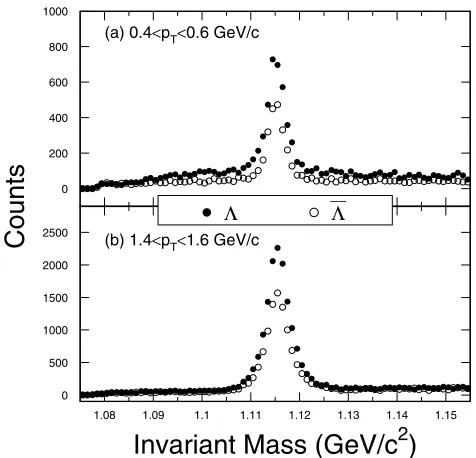
Figure 1 shows the invariant mass distributions for the reconstructed and candidates in jyj<0:5 for two typicalpTbins from the data sample. The mass resolutions () for reconstructed and are typically about
3–4 MeV=c2 based on a Gaussian fit to the peak. The
background beneath thepeak is dominated by com-binatoric pairs of charged particles. Decays of K0
s !
also contribute to the smooth background due to pions misidentified as protons. The yield is obtained from the invariant mass distribution in each transverse momen-tum (pT) and rapidity (y) bin, where the shape of the
background near thepeak is fit with a second order polynomial function. Variations in the yield due to differ-ent fits for the background have been included in the estimate of systematic errors. The raw yield for eachpT
y bin was then corrected for finite detection efficiency, which was calculated from embedding simulated and
particles in real collision events. Hadronic scatterings and antiparticle annihilations are included in the simula-tion. The combined acceptance and efficiency forand
ranges from0:8%to5:8%as a function ofpTfor the most
central collision sample.
The measured spectra contain contributions from primordial , 0 decays, and feed-down from multiply
strange hyperons—notably0 and. The primordial
and the 0 decay products cannot be separated in our
analysis and have been treated as primary. We estimate the contributions of feed-down from multiply strange hy-perons, mostlyanddecays, to be approximately27
6% of the measured and yields, respectively. The estimate was based on the fact that the distance of the closest approach distribution offromdecays is differ-ent from that of primaryproduction, which we quantified by extensive comparisons between simulations and real data [22]. The spectra presented in this Letter include the decay contribution.
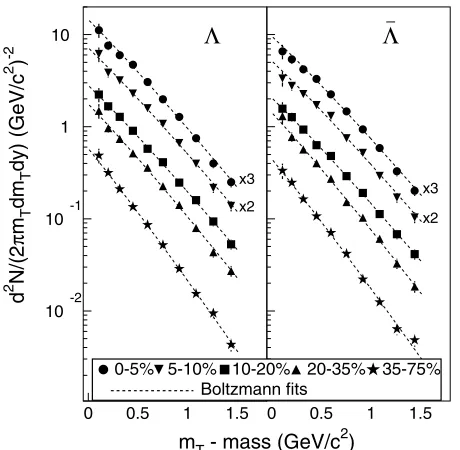
Figure 2 presents themT spectra (invariant distributions)
of and for five selected centrality bins. Combined systematic errors from various methods of yield extraction, reconstruction efficiencies, and uncorrected sector by sec-tor variations in the TPC performance are estimated to be
10%. Both exponential (emTm=TE) and Boltzmann
(mTemTm=TB) functions have been used to fit the data.
The slope parameter obtained from the exponential fit is systematically higher than that for the Boltzmann by ap-proximately 40–65 MeV. However, overall the integrated yields from both fit functions are consistent within the statistical errors. The slope parameters and the dN=dy
from these fits are presented in Table I. The Boltzmann form was adopted in Fig. 2 because it typically provides a better 2 and gives a reasonable description of the m
T
spectra over the entire range of centrality and tranverse momenta investigated.
Within the systematic error, the slope parameters meas-ured for theandmT distributions are the same. There
is a systematic increase in the slope parameters from approximately 254 MeV for the least central (35%–75%)
0 200 400 600 800 1000
(a) 0.4<pT<0.6 GeV/c
0 500 1000 1500 2000 2500
1.08 1.09 1.1 1.11 1.12 1.13 1.14 1.15 (b) 1.4<pT<1.6 GeV/c
Invariant Mass (GeV/c
2)
Counts
Λ Λ−−
FIG. 1. Invariant mass distribution of(solid circles) and
to 312 MeV for the most central (0%–5%) bin. Similar behavior as a function of centrality is found for the p
transverse mass distributions [23]. Assuming the tempera-ture at which particle interactions cease (the ‘‘freeze-out temperature’’ [24]) is constant independent of collision centrality, the increase in the slope parameter may be interpreted as an increase in the collective radial veloc-ity [25,26].
A possible indication of hydrodynamic flow is the in-crease of the observed mean transverse momenta for vari-ous species with increasing particle mass. The transverse momentum distributions of negatively charged hadrons, as well as p and, are shown in Fig. 3. The p and pT
distributions are similar in shape in the region where they can be compared (below1 GeV=c), even though the data
sets cover somewhat different ranges inpT. Both
distribu-tions are qualitatively different from and much less steep than the corresponding h distribution, which is domi-nated by pions. Qualitatively similar behavior was ob-served in heavy ion collisions at the CERN Super Proton Synchrotron (SPS) [25–27]. As predicted, the slope pa-rameters for all species are observed to be larger at RHIC [28]. The increase was also described by thermal model fits, e.g., [29].
Figure 3 indicates that at higherpT (pT >1 GeV=c) the ratio of to negative hadrons increases rapidly. The baryon to meson ratio at RHIC forpT >1 GeV=cexceeds expectations from perturbative QCD inspired string frag-mentation models which were tuned to fit ee collision
TABLE I. Fit parameters from Boltzmann and exponential fits of the mT spectra for and at midrapidity (jyj<0:5). Only
statistical errors are presented. The systematic errors ondN=dyandTare estimated to be10%.
Centrality 0%–5% 5%–10% 10%–20% 20%–35% 35%–75%
dN=dy 17:00:4 13:00:3 10:10:2 5:90:2 1:610:05
(Boltz) 9:60:3 7:40:2 4:60:1 1:260:04
TB 2985 3046 3036 2896 2545
(MeV) 3126 3106 3056 2806 2585
dN=dy 17:40:4 13:30:3 10:40:2 6:10:2 1:660:05
(exp fit) 12:30:3 9:80:3 7:60:2 4:70:1 1:300:04
TE 3558 3649 3628 3438 2957
(MeV) 3749 3738 3668 3318 3017
(GeV/c)
T
p
0 0.20.4 0.60.8 1 1.21.41.61.8 2 2.22.4
-2
dy) (GeV/c)
T
dp
T
p
π
N/(2
2
d
10-1 1 10 102 103
-h p
Λ
FIG. 3. The midrapidity (jyj<0:5) transverse momen-tum distribution from the top 5% most central collisions. For comparison the distributions for negative hadrons [d2N=2p
TdpTd ,j j<0:1] and antiprotons (jyj<0:1) for
the similar centrality bin are included. Statistical errors are less than the size of the data points.
10-2 10-1 1 10
0 0.5 1 1.5
mT - mass (GeV/c2)
Λ
x3
x2
d
2 N/(2
π
mT
dm
T
dy) (GeV/c
2 )
-2
0 0.5 1 1.5
Λ
−x3
x2
0-5% 5-10% 10-20% 20-35% 35-75%
Boltzmann fits
data and are the basis for modeling particle production in hadronic collisions as well [5,30,31]. For example, theto
h ratio is approximately 0.35 at pT of 2 GeV=c. Data from ee collisions and calculations from string frag-mentation models, however, indicate that, although the baryon to meson ratio from quark and gluon fragmentation increases as a function of Feynman x, the ratio never exceeds 0.2 [32]. As mentioned above, a natural explan-ation for the increase at highpTwould be a large collective
radial flow at RHIC [24,27]. Alternatively, it has also been suggested that the energy loss of high pT partons could
modify the baryon to meson ratio [30].
The average ratio of pT integrated yield to is
0:740:04stat 0:03systwith no significant variation over the measured range of centrality. Given that there is a net excess of baryons at midrapidity, it is reasonable to conclude that there is more than one process contributing to production and that significant baryon number from the colliding beams is transported tohyperons at mid-rapidity. A question in that regard is why the shapes ofmT
spectra forandare the same within errors. It has been suggested that significant rescattering of and during the evolution of the collision can lead to equilibration [16,33]. Our measurement provides important constraints for modeling the mechanism of baryon number transport, which itself requires further study.
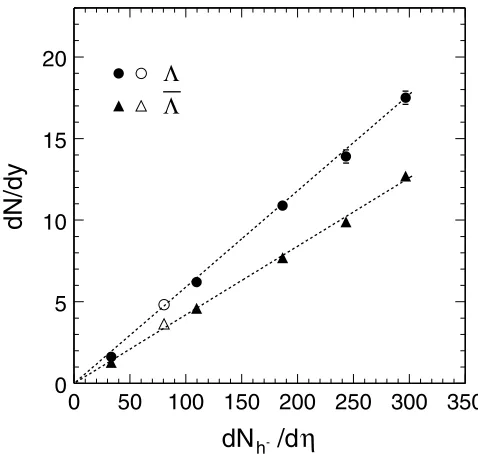
Figure 4 shows the dN=dy of and from the Boltzmann fit as a function of the h pseudorapidity density [4]. At midrapidity the hyperon production is ap-proximately proportional to the primaryhmultiplicity in
AuAucollisions at RHIC. The dashed lines in the figure correspond to 0:054h and 0:040h from a linear fit to the data. The systematic errors on the hyperon yields and the h are 10%and6%, respectively. Similar centrality dependence of the lambda production was ob-served at the SPS energies. The toh ratio at RHIC is much larger than that at the SPS while thetohratio is smaller at RHIC [13]. This may be understood from the fact that at the SPS most of the observedhyperons carry baryon number transported from the colliding nuclei through associated production, rescattering, and fragmen-tation processes. In this case, the yield oftoh ratio is larger than that at RHIC due to the relatively high fraction of the yield not resulting from pair production. Conversely, the increased importance of baryon pair production at RHIC energies must contribute to the ob-served increase of the to h ratio relative to the SPS measurement.
In conclusion, we have presented the first inclu-sive midrapidity (jyj<0:5) and spectra as a function of centrality from AuAu collisions at the sNN
p
130 GeV energy. Salient features of the data include (i) large slope parameters of transverse mass spec-tra probably resulting from increased collective radial velocity at RHIC, (ii) similar shapes forand spectra despite the fact that a significant fraction of thehyperons
at midrapidity carry a baryon number from the incoming nuclei while the hyperons are primarily pair produced, and (iii) a significant increase in the yield relative to negatively charged primary hadrons at moderatepT above
1 GeV=cwhich cannot be described by existing perturba-tive QCD inspired string fragmentation models alone. Collective dynamics and/or modified string particle pro-duction schemes are needed. The pT integrated rapidity
densities ofandare approximately proportional to the number of negative hadrons at midrapidity.
We thank the RHIC Operations Group at Brookhaven National Laboratory for their tremendous support and for providing collisions for the experiment. This work was supported by the Division of Nuclear Physics and the Division of High Energy Physics of the Office of Science of the U.S. Department of Energy, the United States National Science Foundation, the Bundesministerium fuer Bildung und Forschung of Germany, the Institut National de la Physique Nucleaire et de la Physique des Particules of France, the United Kingdom Engineering and Physical Sciences Research Council, Fundacao de Amparo a Pesquisa do Estado de Sao Paulo, Brazil, the Russian Ministry of Science and Technology, the Ministry of Education of China, and the National Natural Science Foundation of China.
[1] J. P. Blaizot, Nucl. Phys.A661, 3c (1999), and references therein.
[2] B. B. Backet al., Phys. Rev. Lett.85, 3100 (2000).
η
/d
-h
dN
0 50 100 150 200 250 300 350
dN/dy
0 5 10 15 20
Λ
Λ
[3] K. Adcoxet al., Phys. Rev. Lett.86, 3500 (2001). [4] C. Adleret al., Phys. Rev. Lett.87, 112303 (2001). [5] B. Anderssonet al., Phys. Scr.32, 574 (1985). [6] J. R. Elliset al., Phys. Lett. B233, 223 (1989).
[7] W. Busza and R. Ledoux, Annu. Rev. Nucl. Part. Sci.38, 119 (1988).
[8] H. Z. Huang, inProceedings of the Relativistic Heavy Ion Symposium APS Centennial Meeting ’99, edited by R. Seto (World Scientific, Singapore, 1999), pp. 3–12. [9] D. Kharzeev, Phys. Lett. B378, 238 (1996).
[10] J. Rafelski and B. Mu¨ller, Phys. Rev. Lett. 48, 1066 (1982);56, 2334(E) (1986).
[11] T. Abbottet al., Phys. Rev. Lett.64, 847 (1990). [12] S. Ahmadet al., Phys. Lett. B382, 35 (1996). [13] F. Antinoriet al., Eur. Phys. J. C11, 79 (1999). [14] H. Appelsha¨useret al., Phys. Lett. B444, 523 (1998). [15] P. Kochet al., Phys. Rep.142, 167 (1986).
[16] R. Bellwiedet al., Phys. Rev. C62, 054906 (2000). [17] H. Sorge, Phys. Rev. C52, 3291 (1995).
[18] N. Amelinet al., Phys. Lett. B306, 312 (1993).
[19] R. Rapp and E. Shuryak, Phys. Rev. Lett.86, 2980 (2001). [20] K. H. Ackermannet al., Phys. Rev. Lett.86, 402 (2001). [21] K. H. Ackermannet al., Nucl. Phys.A661, 681c (1999). [22] H. Long, Ph.D. thesis, University of California, Los
Angeles (2002); M. A. C. Lamont, Ph.D. thesis, University of Birminghan (2002).
[23] C. Adleret al., Phys. Rev. Lett.87, 262302 (2001). [24] E. Schnedermann, J. Sollfrank, and U. Heinz, Phys. Rev. C
48, 2462 (1993).
[25] I. Beardenet al., Phys. Rev. Lett.78, 2080 (1997). [26] H. Appelsha¨useret al., Eur. Phys. J. C2, 661 (1998). [27] H. van Heckeet al., Phys. Rev. Lett.81, 5764 (1998). [28] S. Bass and A. Dumitru, Phys. Rev. C61, 064909 (2000). [29] N. Xu and M. Kaneta, Nucl. Phys.A698, 306c (2002). [30] I. Vitev and M. Gyulassy, nucl-th/0104066.
[31] X. N. Wang, Phys. Rep.280, 287 (1997).