A preliminary version of this paper appears in the proceedings of CRYPTO 2012. This is the full version.
Multi-Instance Security and its Application to
Password-Based Cryptography
Mihir Bellare∗ Thomas Ristenpart† Stefano Tessaro‡
May 2013
Abstract
This paper develops a theory of multi-instance (mi) security and applies it to provide the first proof-based support for the classical practice of salting in password-based cryptography. Mi-security comes into play in settings (like password-based cryptography) where it is computationally feasible to compromise a single instance, and provides a second line of defense, aiming to ensure (in the case of passwords, via salting) that the effort to compromise all of some large number mof instances grows linearly withm. The first challenge is definitions, where we suggest LORX-security as a good metric for mi security of encryption and support this claim by showing it implies other natural metrics, illustrating in the process that even lifting simple results from the si setting to the mi one calls for new techniques. Next we provide a composition-based framework to transfer standard single-instance (si) security to mi-security with the aid of a key-derivation function. Analyzing password-based KDFs from the PKCS#5 standard to show that they meet our indifferentiability-style mi-security definition for KDFs, we are able to conclude with the first proof that per password salts amplify mi-security as hoped in practice. We believe that mi-security is of interest in other domains and that this work provides the foundation for its further theoretical development and practical application.
Keywords: Passwords, security amplification, indifferentiability, random oracles.
∗Department of Computer Science & Engineering, University of California San Diego, 9500 Gilman Drive, La Jolla, California 92093, USA. URL: cseweb.ucsd.edu/~mihir/. Supported in part by NSF grants CCF-0915675, CNS-0904380 and CNS-1116800.
†Department of Computer Sciences, University of Wisconsin - Madison, 1210 West Dayton Street, Madison, WI 53715. URL:pages.cs.wisc.edu/~rist/. Supported in part by NSF grant CNS-1065134.
‡ CSAIL, Massachusetts Institute of Technology, 32 Vassar Street, Cambridge MA 02139, USA. URL:
Contents
1 Introduction 3
2 The Multi-Instance Terrain 6
2.1 Metrics of mi security . . . 6 2.2 Relations . . . 9
3 Password-based Encryption via KDFs 11
3.1 Simulation-based Security for KDFs . . . 13 3.2 Security of PBE . . . 14
A Brute-force Password-recovery Attacks 18
B Problems in the Proofs of Yao and Yin 19
C Proofs for Section 2 19
D Multi-user Encryption Security 21
E More KDFs 21
F Proof of Theorem 3.2 21
G Security Analysis of KD1 23
1
Introduction
This paper develops a theory of multi-instance security and applies it to support practices in password-based cryptography.
Background. Password-based encryption (PBE) in practice is based on the PKCS#5 (equivalently,
RFC 2898) standard [51]. It encrypts a message M under a password pw by picking a random s-bit salt sa, deriving a key L ← KD(pw∥sa) and returning C′ ← C∥sa where C←$E(L, M). Here E
is a symmetric encryption scheme, typically an IND-CPA AES mode of operation, and key-derivation function (KDF) KD: {0,1}∗ → {0,1}n is the c-fold iterationKD=Hc of a cryptographic hash function H: {0,1}∗ → {0,1}n. However, passwords are often poorly chosen [44], falling within a set D called a “dictionary” that is small enough to exhaust. A brute-force attack now recovers the target passwordpw (thereby breaking the ind-cpa security of the encryption) using cN hashes where N =|D| is the size of the dictionary.1 Increasingcincreases this effort, explaining the role of this iteration count, butccannot be made too large without adversely impacting the performance of PBE.
Consider nowmusers, thei-th with passwordpwi. If the salt is absent (s= 0), the number of hashes
for the brute force attack to recover all m passwords remains around cN, but if s is large enough that salts are usually distinct, it rises to mcN, becoming prohibitive for large m. Salting, thus, aims to make the effort to compromise m target passwords scale linearly in m. (It has no effect on the security of encryption under any one, particular target password.)
New directions. This practice, in our view, opens a new vista in theoretical cryptography, namely
to look at the multi-instance (mi) security of a scheme. We would seek metrics of security under which an adversary wins when it breaks all of m instances but not if it breaks fewer. This means that the mi security could potentially be much higher than the traditional single-instance (si) security. We would have security amplification.
Why do this? As the above discussion of password-based cryptography shows, there are settings where the computational effort t needed to compromise a single instance is feasible. Rather than give up, we provide a second line of defense. We limit thescale of the damage, ensuring (in the case of passwords, via the mechanism of salting) that the computational effort to compromise all ofm instances is (around)tm and thus prohibitive for largem. We can’t prevent the occasional illness, but we can prevent an epidemic. We initiate the study of multi-instance security with a foundational treatment in two parts. The first part is agnostic to whether the setting is password-based or not, providing definitions for different kinds of mi-security of encryption and establishing relations between them, concluding with the message that what we call LORX-security is a good choice. The second part of our treatment focuses on password-based cryptography, providing a modular framework that proves mi-security of password-based primitives by viewing them as obtained by the composition of a mi-secure KDF with a si-secure primitive, and yielding in particular the first proof that salting works as expected to increase multi-instance security under a strong and formal metric for the latter.
Multi-instance security turns out to be challenging both definitionally (providing metrics where the adversary wins on breaking all instances but not fewer) and technically (reductions need to preserve tiny advantages and standard hybrid arguments no longer work). It also connects in interesting ways to security amplification via direct products and xor lemmas, eg. [58, 24, 29, 45, 20, 42, 54, 43, 55]. (We import some of their methods and export some novel viewpoints.) We believe there are many fruitful directions for future work, both theoretical (pursuing the connection with security amplification) and applied (mi security could be valuable in public-key cryptography where steadily improving attacks are making current security parameters look uncomfortably close to the edge for single-instance security). Let us now look at all this in some more detail.
LORX. We consider a setting with m independent target keys K1, . . . , Km. (They may, but need not,
be passwords.) In order to show that mi-security grows with m we want a metric (definition) where the
1
LORX RORX
AND UKU
Th. 2.3 2m Th. 2.2
Th 2.5 2m
Th 2.1
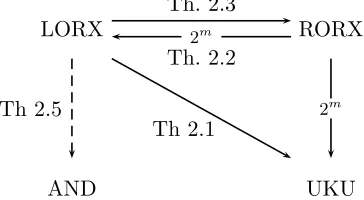
Figure 1: Notions of multi-instance security for encryption and their relations. LORX (left-or-right xor indistinguishability) emerges as the strongest, tightly implying RORX (real-or-random xor indistinguishability) and UKU (universal key-unrecoverability). The dashed line indicates that under some (mild, usually met) conditions LORX also implies AND. RORX implies LORX and UKU but with a 2mloss in advantage wheremis the number
of instances, making LORX a better choice.
adversary wins if it breaks allminstances of the encryption but does not win if it breaks strictly fewer. If “breaking” is interpreted as recovery of the key then such a metric is easily given: it is the probability that the adversary recovers all m target keys. We refer to this as the UKU (Universal Key Unrecoverability) metric. But we know very well that key-recovery is a weak metric of encryption security. We want instead a mi analog of ind-cpa. The first thing that might come to mind is multi-user security [3, 2]. But in the latter the adversary wins (gets an advantage of one) even if it breaks just one instance so the mu-advantage of an adversary can never be less than its si (ind-cpa) advantage. We, in contrast, cannot “give up” once a single instance is broken. Something radically different is needed.
Our answer is LORX (left-or-right xor indistinguishability). Our game picksmindependent challenge bits b1, . . . , bm and gives the adversary an oracle Enc(·,·,·) which given i, M0, M1 returns an encryption
of Mbi under Ki. The adversary outputs a bitb′ and its advantage is 2 Pr[b′ =b1⊕ · · · ⊕bm]−1.2 Why
xor? Its well-known “sensitivity” means that even if the adversary figures out m−1 of the challenge bits, it will have low advantage unless it also figures out the last. This intuitive and historical support is strengthened by the relations, discussed below, that show that LORX implies security under other natural metrics.
Relations. The novelty of multi-instance security prompts us to step back and consider a broad choice
of definitions. Besides UKU and LORX, we define RORX (real-or-random xor indistinguishability, a mi-adaptation of the si ROR notion of [4]) and a natural AND metric where the challenge bitsb1, . . . , bm
and oracle Enc(·,·,·) are as in the LORX game but the adversary output is a vector (b′1, . . . , b′m) and its advantage is Pr[(b′1, . . . , b′m) = (b1, . . . , bm)]−2−m. The relations we provide, summarized in Figure 1,
show that LORX emerges as the best choice because it implies all the others with tight reductions. Beyond that, they illustrate that the mi terrain differs from the si one in perhaps surprising ways, both in terms of relations and the techniques needed to establish them.
Thus, in the si setting, LOR and ROR are easily shown equivalent up to a factor 2 in the advantages [4]. It continues to be true that LORX easily implies RORX but the hybrid argument used to prove that ROR implies LOR [4] does not easily extend to the mi setting and the proof that RORX implies LORX is not only more involved but incurs a factor 2m loss.3 In the si setting, both LOR and ROR are easily shown to imply KU (key unrecoverability). Showing LORX implies UKU is more involved, needing a boosting argument to ensure preservation of exponentially-vanishing advantages. This reduction is tight
2 This is a simplification of our actual definition, which allows the adversary to adaptively corrupt instances to reveal
the underlying keys and challenge bits. This capability means that LORX-security implies threshold security where the adversary wins if it predicts the xor of the challenge bits of some subset of the instances of its choice. See Section 2 for further justification for this feature of the model.
3
but, interestingly, the reduction showing RORX implies UKU is not, incurring a 2m-factor loss, again indicating that LORX is a better choice. We show that LORX usually implies AND by exploiting a direct product theorem by Unger [55], evidencing the connections with this area. Another natural metric of mi-security is a threshold one, but our incorporation of corruptions means that LORX implies security under this metric.
Mi-security of PBE. Under the LORX metric, we prove that the advantage ϵ′ obtained by a time t
adversary against m instances of the above PBE schemeE′ is at most ϵ+ (q/mcN)m (we are dropping negligible terms) where q is the number of adversary queries to RO H andϵis the advantage of a time t ind-cpa (si) adversary against E. This is the desired result saying that salting works to provide a second line of defense under a strong mi security metric, amplifying security linearly in the number of instances.
Framework. This result for PBE is established in a modular (rather than ad hoc) way, via a
frame-work that yields corresponding results for any password-based primitive. This means not only ones like password-based message authentication (also covered in PKCS#5) or password-based authenticated en-cryption (WinZip) but public-key primitives like password-based digital signatures, where the signing key is derived from a password. We view a password-based scheme for a goal as derived by composing a key-derivation function (KDF) with a standard (si) scheme for the same goal. The framework then has the following components. (1) We provide a definition of mi-security for KDFs. (2) We provide compo-sition theorems, showing that composing a mi-secure KDF with a si-secure scheme for a goal results in a mi-secure scheme for that goal. (We will illustrate this for the case of encryption but similar results may be shown for other primitives.) (3) We analyze the iterated hash KDF of PKCS#5 and establish its mi security.
The statements above are qualitative. The quantitative security aspect is crucial. The definition of mi-security of KDFs must permit showing mi-security much higher than si-security. The reductions in the composition theorems must preserve exponentially vanishing mi-advantages. And the analysis of the PKCS#5 KDF must prove that the adversary advantage in q queries to the RO H grows as (q/cmN)m,
not merely q/cN. These quantitative constraints represent important technical challenges.
Mi-security of KDFs. We expand on item (1) above. The definition of mi-security we provide for KDFs is a simulation-based one inspired by the indifferentiability framework [41, 18]. The at-tacker must distinguish between the real world and an ideal counterpart. In both, target passwords pw1, . . . , pwm and salts sa1, . . . , sam are randomly chosen. In the real world, the adversary gets input
(pw1, sa1,KD(pw1∥sa1)), . . . ,(pwm, sam,KD(pwm∥sa1)) and also gets an oracle for the RO hash
func-tion H used by KD. In the ideal world, the input is (pw1, sa1, L1), . . . ,(pwm, sam, Lm) where the keys
L1, . . . , Lm are randomly chosen, and the oracle is a simulator. The simulator itself has access to a Test
oracle that will take a guess for a password and tell the simulator whether or not it matches one of the target passwords. Crucially, we require that when the number of queries made by the adversary to the simulator isq, the number of queries made by the simulator to itsTestoracle is onlyq/c. This restriction is critical to our proof of security amplification and a source of challenges in the proof.
Related work. Previous work which aimed at providing proof-based assurances for password-based key-derivation has focused on the single-instance case and the role of iteration as represented by the iteration countc. Our work focuses on the multi-instance case and the roles of both salting and iteration. The UNIX password hashing algorithm maps a passwordpw toEcpw(0) whereE is a blockcipher and 0 is a constant. Luby and Rackoff [39] show this is a one-way function when c= 1 and pw is a random blockcipher key. (So their result does not really cover passwords.) Wagner and Goldberg [56] treat the more general case of arbitrary c and keys that are passwords, but the goal continues to be to establish one-wayness and no security amplification (meaning increase in security with c) is shown. Boyen [11, 12] suggests various ways to enhance security, including letting users pick their own iteration counts.
the adversary’s advantage is at most q/cN plus a negligible term. This would establish single-instance security amplification by showing that iteration works as expected to increase attacker effort.4 However, even though salts are considered, this does not consider instance security let alone establish multi-instance security amplification, and their definition of KDF security does not adapt to allow this. (We use, as indicated above, an indifferentiability-style definition.) In fact the KDF definition of [59] is not even sufficient to establish si security of password-based encryption in the case the latter, as specified in PKCS#5, picks a fresh salt for each message encrypted.
Kelsey, Schneier, Hall and Wagner [36] investigate the time for password-recovery attacks as a function of the time to compute the KDF. The security goal being password unrecoverability, this is insufficient to establish security of password-based key-derivation applications even in the si setting.
Stebila, Kuppusamy, Rangasamy, Boyd and Gonz´alez Nieto [53] study multi-instance security for client puzzles, giving a game like our password guessing game of Figure 3 without corruptions. The bound they give on the adversary advantage was shown to be wrong by Groza and Warinschi [27]. In Section 3 we explain why the counter-example of [27] does not apply in our case.
KDFs are for use in non-interactive settings like encryption with WinZip. The issues and questions we consider do not arise with password authenticated key exchange (PAKE), where two parties in joint possession of a password interact to agree on a cryptographic session key in a way that resists off-line dictionary attack [6, 13, 22]. PAKE definitions already guarantee that the session key may be safely used for encryption. There are no salts and no amplification issues.
Abadi and Warinschi [1] provide a si, key-recovery definition for PBE security and connect this with symbolic notions. They do not consider mi security.
Dodis, Gennaro, H˚astad, Krawczyk and Rabin [19] treat statistically-secure key derivation using hash functions and block ciphers. As discussed in-depth by Kracwzyk [38], these results and techniques aren’t useful for password-based KDFs because passwords aren’t large enough, let alone have the sufficient amount of min-entropy. Krawczyk [38] also notes that his two-stage KDF approach could be used to build password-based KDFs by replacing the extraction stage with a key-stretching operation. Our general framework may be used to analyze the mi-security of this as well.
XOR lemmas and direct product theorems [58, 23, 26, 42] analyze the ability of the xor operation to amplify unpredictability. More generally, amplification results taking an instance of a primitive with “weak” security and constructing an instance of the same primitive with “strong” security are known for many primitives including OWFs and OWPs [58, 24, 29], two-party protocols [5, 49, 50, 57, 30, 28, 31, 16, 17], symmetric primitives [45, 20, 42, 54, 43], one-way PKE and key-agreement [21, 32, 33, 10], CAPTCHAs [14, 34] and collision-resistant hash functions [15]. This literature has considered the problem of breaking multiple instances of a cryptographic primitive, in general as an intermediate step to amplifying security in the single-instance setting. In particular mi-xor-security is used as an intermediate step in [42].
2
The Multi-Instance Terrain
This section defines metrics of multi-instance encryption security and explores the relations between them to establish the notions and results summarized in Figure 1. Our treatment intends to show that the mi terrain is different from the si one in fundamental ways, leading to new definitions, challenges and connections.
2.1 Metrics of mi security
Recall that a symmetric encryption scheme is a triple of algorithms SE= (K,E,D). The key generation algorithm K outputs a key. The encryption algorithm E takes a keyK and a messageM and outputs a
4
mainUKUASE,m K[1], . . . ,K[m]←$K
K′←$AEnc
RetK′=K
proc. Enc(i, M)
RetE(K[i], M)
proc. Cor(i)
RetK[i]
mainLORXASE,m K[1], . . . ,K[m]←$K
b←${0,1}m b′←$AEnc
Ret (b′=⊕ib[i])
mainANDASE,m K[1], . . . ,K[m]←$K
b←${0,1}m b′←$AEnc
Ret (b′=b)
proc. Enc(i, M0, M1)
If|M0| ̸=|M1|then Ret⊥ C←$E(K[i], Mb[i])
RetC
proc. Cor(i)
Ret (K[i],b[i])
mainRORXASE,m
K[1], . . . ,K[m]←$({0,1}k)m b←${0,1}m
b′←$AEnc
Ret (b′=⊕ib[i])
proc. Enc(i, M)
C1←$E(K[i], M) M0←${0,1}|M|
C0←$E(K[i], M0) RetCb[i]
proc. Cor(i)
Ret (K[i],b[i])
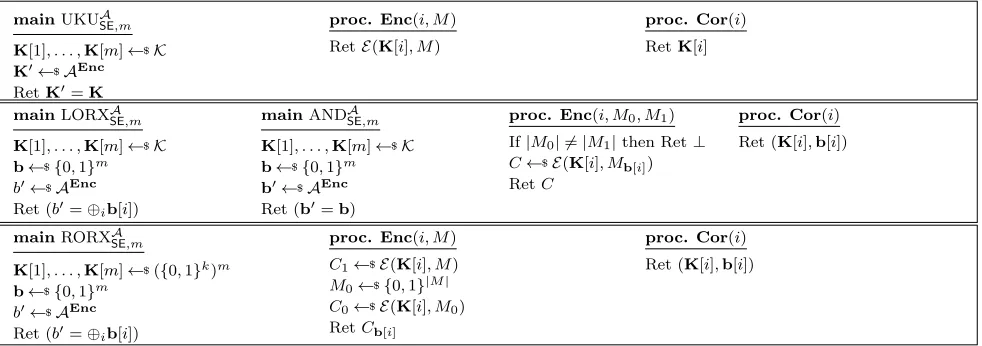
Figure 2: Multi instance security notions for encryption.
ciphertext C←$E(K, M). The deterministic decryption algorithm D takes the key K and a ciphertext
C to return either a string or⊥. Correctness requires that Pr[D(K,E(K, M)) =M] for all M where the probability is over K←$K and the coins of E.
To illustrate the issues and choices in defining mi security, we start with key unrecoverability which is simple because it is underlain by a computational game and its mi counterpart is easily and uncon-tentiously defined. When we move to stronger notions underlain by decisional games, definitions will get more difficult and more contentious as more choices will emerge.
UKU.Single-instance key unrecoverability is formalized via the game KUSE where a target keyK←$K
is initially sampled, and the adversary A is given an oracle Enc which, on input M, returns E(K, M). Finally, the adversary is asked to output a guessK′ for the key, and the game returnstrueifK=K′, and false otherwise. An mi version of the game, UKUSE,m, is depicted in Figure 2. It picks an m-vectorKof
target keys and the oracleEncnow takesi, M to returnE(K[i], M). TheCororacle gives the adversary the capability of corrupting a user to obtain its target key. The adversary’s output guess is also am-vector K′ and the game returns the boolean (K=K′), meaning the adversary wins only if it recovers all the target keys. (The “U” in “UKU” reflects this, standing for “Universal.”) The advantage of adversaryAis AdvukuSE,m(A) = Pr[UKUASE,m⇒true]. Naturally, this advantage depends on the adversary’s resources. (It could be 1 if the adversary corrupts all instances.) We say thatAis a (t,q, qc)-adversary if it runs in time
tand makes at mostq[i] encryption queries of the formEnc(i,·) and makes at mostqccorruption queries.
Then we let AdvukuSE,m(t,q, qc) = maxAAdvukuSE,m(A) where the maximum is over all (t,q, qc)-adversaries.
AND. Single-instance indistinguishabilty for symmetric encryption is usually formalized via left-or-right
security [4]. A random bit band keyK←$Kare chosen, and an adversaryA is given access to an oracle
Enc that given equal-length messagesM0, M1 returns E(K, Mb). The adversary outputs a bit b′ and its
advantage is 2 Pr[b =b′]−1. There are several ways one might consider creating an mi analog. Let us first consider a natural AND-based metric based on game ANDSE,m of Figure 2. It picks at random a
vectorb←${0,1}m of challenge bits as well as a vectorK[1], . . . ,K[m] of keys, and the adversary is given
access to oracle Enc that on input i, M0, M1, where |M0| = |M1|, returns E(K[i], Mb[i]). Additionally,
the corruption oracle Cor takes iand returns the pair (K[i],b[i]). The adversary finally outputs a bit vector b′, and wins if and only if b =b′. (It is equivalent to test that b[i] = b′[i] for all uncorrupted i.) The advantage of adversary A is AdvandSE,m(A) = Pr[ANDSEA,m ⇒ true]−2−m. We say that A is a (t,q, qc)-adversary if it runs in timet and makes at most q[i] encryption queries of the formEnc(i,·,·)
and makes at most qc corruption queries. Then we let AdvandSE,m(t,q, qc) = maxAAdvandSE,m(A) where the
maximum is over all (t,q, qc)-adversaries.
AND metric also has weaknesses that in our view make it inadequate as the primary choice. Namely, it does not capture the hardness of breakingallthe uncorrupted instances. For example, an adversary that corrupts instances 1, . . . , m−1 to get b[1], . . . ,b[m−1], makes a random guess g forb[m] and returns (b[1], . . . ,b[m−1], g) has the high advantage 0.5−2−m without breaking all instances. We prefer a metric where this adversary’s advantage is close to 0.
LORX.To overcome the above issue with the AND advantage, we introduce the XOR advantage measure
and use it to define LORX. Game LORXSE,m of Figure 2 makes its initial choices the same way as game
ANDSE,mand provides the adversary with the same oracles. However, rather than a vector, the adversary
must output a bit b′, and wins if this equals b[1]⊕ · · · ⊕b[m]. (It is equivalent to test thatb′ =⊕i∈Sb[i]
where S is the uncorrupted set.) The advantage of adversary A is AdvlorxSE,m(A) = 2 Pr[LORXASE,m ⇒ true]−1. We say that A is a (t,q, qc)-adversary if it runs in time t and makes at most q[i] encryption
queries of the form Enc(i,·,·) and makes at mostqccorruption queries. Then we let AdvlorxSE,m(t,q, qc) =
maxAAdvlorxSE,m(A) where the maximum is over all (t,q, qc)-adversaries. Returning to the example we
gave for the AND case, if an adversary corrupts the first m−1 instances to get back b[1], . . . ,b[m−1], makes a random guess g forb[m] and outputs b′ =b[1]⊕ · · · ⊕b[m−1]⊕g, it will have advantage 0.
RORX. A variant of the si LOR notion, ROR, was given in [4]. Here the adversary must distinguish
between an encryption of a message M it provides and the encryption of a random message of length |M|. This was shown equivalent to LOR up to a factor 2 in the advantages [4]. This leads us to define the mi analog RORX and ask how it relates to LORX. Game RORXSE,m of Figure 2 makes its initial
choices the same way as game LORXSE,m. The adversary is given access to oracle Enc that on input
i, M, returns E(K[i], M) if b[i] = 1 and otherwise returns E(K[i], M1) where M1←${0,1}|M|. It also
gets the usual Cor oracle. It outputs a bit b′ and wins if this equals b[1]⊕ · · · ⊕b[m]. The advantage of adversary A is AdvrorxSE,m(A) = 2 Pr[RORXSEA,m ⇒ true]−1. We say thatA is a (t,q, qc)-adversary if
it runs in time tand makes at most q[i] encryption queries of the form Enc(i,·) and makes at most qc
corruption queries. Then we let AdvrorxSE,m(t,q, qc) = maxAAdvrorxSE,m(A) where the maximum is over all
(t,q, qc)-adversaries.
Discussion. The multi-user security goal from [3] gives rise to a version of the above games without
corruptions and where all instances share the same challenge bit b, which the adversary tries to guess. But it is easy to see that this does not measure mi security, since recovering a single key, for example, suffices to learn b.
The above approach extends naturally to providing a mi counterpart to any security definition based on a decisional game, where the adversary needs to guess a bit b. For example we may similarly create mi metrics of CCA security.
Why does the model include corruptions? The following example may help illustrate. SupposeSE is entirely insecure when the key has first bit 0 and highly secure otherwise. (From the si perspective, it is insecure.) In the LORX game, an adversary will be able to figure out around half the challenge bits. If we disallow corruptions, it would still have very low advantage. From the application point of view, this seems to send the wrong message. We want LORX-security to mean that the probability of “large scale” damage is low. But breaking half the instances is pretty large scale. Allowing corruptions removes this defect because the adversary could corrupt the instances it could not break and then, having corrupted only around half the instances, get a very high advantage, breaking LORX-security. In this way, we may conceptually keep the focus on an adversary goal of breakingall instances, yet cover the case of breaking some threshold number via the corruption capability.
2.2 Relations
We provide formal result statements and proofs in support of the implications claimed in Figure 1.
LORX implies UKU.In the si setting, it is easy to see that LOR security implies KU security. The LOR
adversary simply runs the KU adversary. When the latter makes oracle query M, the LOR adversary queries its own oracle withM, M and returns the outcome to the KU adversary. When the latter returns a keyK′, the LOR adversary submits a last oracle query consisting of a pairM0, M1 of random messages
to get back a challenge ciphertextC, returning 1 ifD(K′, C) =M1 and 0 otherwise. A similar but slightly
more involved proof shows that ROR implies KU.
It is important to establish analogs of these basic results in the mi setting, for they function as “tests” for the validity of our mi notions. The following shows that LORX security implies UKU. Interestingly, it is not as simple to establish in the mi case as in the si case. Also, as we will see later, the proof that RORX implies UKU is not only even more involved but incurs a factor 2m loss, making LORX a better choice as the metric to target in designs.
Theorem 2.1 [LORX ⇒ UKU] Let SE = (K,E,D) be a symmetric encryption scheme with message space M, and letℓ be such that{0,1}ℓ ⊆ M. Letm≥1. Then, for allt,qc, and q, and for all k≥1,
AdvukuSE,m(t,q, qc)≤AdvSElorx,m(t′,q′, qc) +m· (
1 2ℓ−1
)k
,
where t′=t+O(m·k), andq′[i] =q[i] +kfor all i= 1, . . . , m.
The proof is given in Appendix C. Here, let us stress Theorem 2.1 surfaces yet another subtlety of the mi setting. At first, it would seem that proving the case k = 1 of the theorem is sufficient (this is what usually done in the si case). However, it is crucial to remark that AdvlorxSE,m(t′,q′, qc) may be very
small. For example, it is not unreasonable to expect 2−128·m ifSEis secure in the single-instance setting. Yet, assume that E encrypts 128-bit messages, then we are only able to set ℓ = 128, in turn making m/(2ℓ−1)≈m·2−128 by far the leading term on the right-hand side. The parameterkhence opens the door to fine tuning of the additive extra term at the cost of an additive complexity loss in the reduction. Also note that the reduction in the proof of Theorem 2.1 is not immediate, as an adversary guessing all the keys in the UKU game with probabilityϵonly yields an adversary recovering all the bitsb[1], . . . ,b[m] in the LORX game with probability ϵ. Just outputting the xor of these bits is not sufficient, as we have to boost the success probability to 1+ϵ2 in order to obtain the desired relation between the two advantage measures.
In analogy to the si setting, UKU does not imply LORX. Just take a schemeSE= (K,E,D) encrypting n-bit messages which is UKU-secure, and modify it into a scheme SE′ = (K′,E′,D′) where K =K′ and E′(K, M) =E′(K, M)∥M[0], withM[0] being the first bit ofM. Clearly, SE′ is still UKU-secure but not LORX-secure
As indicated above, a proof that RORX implies UKU is much more involved and incurs a factor 2m loss. Roughly speaking, this is because in the si case, in the reduction needed to prove that ROR implies KU, the ROR adversary can only simulate the execution of the KU adversary correctly in the case where the bit is 1, i.e., the encryption oracle returns the actual encryption of a message. This results in a factor two loss in terms of advantage. Upon translating this technique to the mi case, the factor 2 becomes 2m, asallbits need to be 1 for the UKU adversary to output the right keys with some guaranteed probability. However, we will not follow this route for the proof of this result. Instead, we can obtain the same result by combining Theorem 2.2 and Theorem 2.1.
LORXversus RORX.In the si setting, LOR and ROR are the same up to a factor 2 in the advantage [4].
Theorem 2.2 [RORX⇒LORX]LetSE= (K,E,D) be a symmetric encryption scheme. Letm≥1. For all t, qc>0, and all vectorsqwe have AdvSElorx,m(t,q, qc)≤2m·AdvrorxSE,m(t′,q, qc), where t′ =t+O(1).
As discussed in Section 1, the multiplicative factor 2mis often of no harm because advantages are already
exponentially small in m. The factor is natural, being the mi analogue of the factor 2 appearing in the traditional si proof, and examples can be given showing that the bound is tight.
Proof:LetAbe (t,q, qc)-distinguisher for LORXSE,m. We build a (t′,q, qc)-distinguisherBfor RORXSE,m
which simulates the execution ofA in LORXSE,musing the oracles of RORXSE,m. More in detail, Bfirst
selects random bit-vectors c,d←${0,1}m, and whenever A asks a query Enc(i, M0, M1), adversary B
queries Enc(i, Mc[i]), returning the resulting ciphertext C[i] to A. When A makes corruption query Cor(i), adversary B does too, getting back (K[i],b[i]). If b[i] = 1 then it returns (K[i],c[i]) to A. If b[i] = 0, however, it instead returns (K[i],d[i]) to A. Thus A is getting back a correct reply when b[i] = 1. When b[i] = 0, the bit d[i] it gets is unrelated to c[i] and, given that the ciphertext C[i] is also not correlated toc[i] in this case, the latter bit remains entirely unpredictable toA. We will exploit this below. Finally, when Aterminates and outputs a bitc′, adversaryB terminates and outputs the bit b′ =c′⊕⊕mi=1c[i]⊕(mmod 2), with mmod 2 denoting the parity of m.
For the analysis, letb=⊕mi=1b[i] denote the challenge bit thatBis trying to predict and letc=⊕mi=1c[i] denote the challenge bit that Ais trying to predict. If the challenge vector bof B isb= 1m, the all-one vector, then c′ = c iff b′ = b, because, in this case, b = mmod 2. On the other hand if b ̸= 1m then c′⊕c is random and uncorrelated to b and thus b′ = b with probability 1/2. To see this, let i be such thatb[i] = 0. ThenAhas no information aboutc[i]. This is true whether or not instanceiis corrupted. Thus,A will have no advantage in predictingc in this case. Putting all this together we have
1 2 +
1 2Adv
rorx
SE,m(B) = Pr [
RORXBSE,m⇒true]
= 2−m·Pr[b′ =b | b= 1m]+ 2−m· ∑
b′̸=1m
Pr[b′ =b | b=b′]
= 2−m·Pr[LORXASE,m⇒true]+ 2−m· ∑
b′̸=1m
1 2 = 2−m·
(
1 2 +
1 2Adv
lorx SE,m(A)
)
+ 1−2 −m
2 = 1
2 + 2−m
2 Adv
lorx SE,m(A)
as desired.
We omit the much simpler proof of the converse.
Theorem 2.3 [LORX ⇒ RORX] Let SE = (K,E,D) be a symmetric encryption scheme. Let m ≥ 1. For allt, qc>0, and all vectorsq we have AdvrorxSE,m(t,q, qc)≤AdvlorxSE,m(t′,q, qc), wheret′ =t+O(1).
LORX implies AND. Intuitively, one might expect AND security to be a stronger requirement than
LORX security, as the former seems easier to break than the latter. However we show that under a fairly minimal requirement, LORX implies AND. This brings another argument in support of LORX: Even if an application requires AND security, it turns out that proving LORX security is generally sufficient. The proof relies on the following probabilistic lemma, due to Unger [55].
Lemma 2.4 [55] LetY1, . . . , Ym∈ {0,1}be random variables such that there existβ1, . . . , βm ∈[−1,1]
and C, γ >0 with Pr[ ⊕i∈SYi= 0 ]
≤(1 +C·∏i∈Sβi+γ)/2 for allS ⊆ {1, . . . , m}. Then,
Pr [∑mi=1Yi =m] ≤ γ+C· ∏
i∈S
1 +βi
The following theorem is to be interpreted as follows: In general, if we only know that AdvlorxSE,m(t,q, qc)
is small, we do not know how to prove AdvandSE,m(t′,q, qc) is also small (fort′ ≈t), or whether this is true
at all. As we sketched above, the reason is that we do not know how to use an adversaryAfor which the ANDSE,m advantage is large to construct an adversary for which the LORXSE,m advantage is large. Still,
one would expect that such an adversarymightmore easily yield one for which the LORXSE,k advantage
is sufficiently large, forsomek≤m. The following theorem uses the above probabilistic lemma to confirm this intuition.
Theorem 2.5 Let SE= (K,E,D) be a symmetric encryption scheme. Let m ≥1. Let t, q, and qc be
given, and assume that there exist C, ϵ, and γ such that for all 1≤i≤m, max
S⊆{1,...,m},|S|=iAdv lorx
SE,i(t∗S,q[S], qc)≤C·ϵi+γ ,
whereq[S] is the projection ofqon the components inS, andt∗S =t+O(tE·∑i /∈Sq[i]), withtE denoting the running time needed for one encryption with E. Then,AdvandSE,m(t,q, qc) ≤ γ+C·
∏m
i=1(1 +ϵi)/2.
Does the converse also hold true? It is worth mentioning that in general we are not able to prove that AND implies LORX. Still, we note that in the corruption-free case, one can upper boundAdvlorxSE,m(t,q,0) in terms of AdvandSE,m′(t′,q′,0) form′ ≈2m and t′ and q′ being much larger thant,q. The proof, which we omit, follows the lines of the proof of the XOR Lemma from the Direct Product Theorem given by Goldreich, Nisan, and Wigderson [26], and relies on the Goldreich-Levin theorem [25]. As the loss in concrete security in this reduction is very large, and it only holds in the corruption-free statement, we find this an additional argument to support the usage of the LORX metric.
3
Password-based Encryption via KDFs
We now turn to our main motivating application, that of password based encryption (PBE) as specified in PKCS#5 [51]. The schemes specified there combine a conventional mode of operation (e.g., CBC mode) with a password-based key derivation function (KDF). We start with formalizing the latter.
Password-based KDFs. Formally, a (k, s, c)-KDF is a deterministic map KD: {0,1}∗ × {0,1}s →
{0,1}k that may make use of an underlying ideal primitive. Herec is the iteration count, which specifies the multiplicative increase in work that should slow down brute force attacks.
PKCS#5 describes two KDFs [51]. We treat the first in detail and discuss the second in Appendix E. Let KD1H(pw, sa) = Hc(pw∥sa) where Hc is the function that composes H with itself c times. To generalize beyond concatenation, we can define a function Encode(pw, sa) that describes how to encode its inputs onto {0,1}∗ with efficiently computable inverseDecode(W).
PBE schemes. A PBE scheme is just a symmetric encryption scheme where we view the keys as
passwords and key generation as a password sampling algorithm. To highlight when we are thinking of key generation as password sampling we will use P to denote key generation (instead of K). We will also write pw for a key that we think of as a password. Let KD be a (k, s, c)-KDF and let SE = (K,E,D) be an encryption scheme withK outputting uniformly selected k-bit keys. Then we define the PBE scheme SE[KD,SE] = (P,E,D) as follows. Encryption E(pw, M) is done via sa←${0,1}s; K ←
KD(pw, sa) ; C←$E(K, M), returning (sa, C) as the ciphertext. Decryption recomputes the key K by
reapplying the KDF and then applies D. If the KDF is KD1 and the encryption scheme is CBC mode, then one obtains the first PBE scheme from PKCS#5 [51].
Password guessing. We aim to show that security of the above constructions holds up to the amount
mainGUESSP,m pw[1], . . . ,pw[m]←$P
y←$BTest,Cor
Ret∧mi=1wini
proc. Test(i, pw)
If (pw=pw[i]) thenwini←true Retwini
proc. Cor(i)
wini←true Retpw[i]
mainsaGUESSP,m,ρ pw[1], . . . ,pw[m]←$P
Fori= 1 tomdo Forj= 1 toρdo
sa[i, j]←${0,1}s y←$BTest,Cor(sa) Ret∧mi=1wini
proc. Test(pw, sa)
Fori= 1 tomdo Forj= 1 toρdo
If (pw, sa) = (pw[i],sa[i, j]) then wini←true
Ret (i, j) Ret (⊥,⊥)
proc. Cor(i)
wini←true Retpw[i]
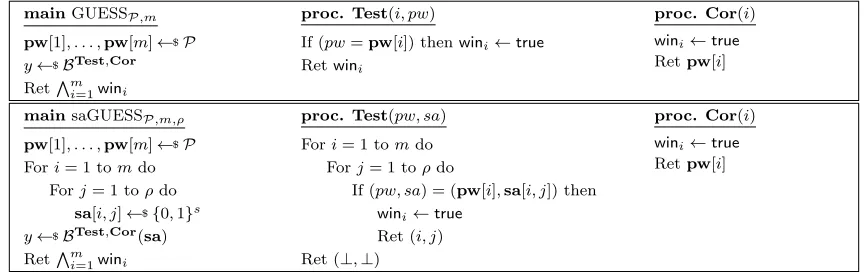
Figure 3: An adaptive password-guessing game.
Concretely, let GUESSP,m be the game defined in Figure 3.5 Boolean flags win1, . . . ,winm are assumed
initialzed to false. An adversary B’s guessing advantage isAdvguessP,m(B) = Pr[GUESSBP,m⇒true]. The output y of the adversary is disregarded, its advantage depending only on the setting of the wini flags
to true via its Test queries. We assume without loss of generality that A does not make any pointless queries: (1) repeated queries toCoron the same value; (2) a queryTest(i,·) following a query ofCor(i); and (3) a query Cor(i) after a query Test(i, pw) that returned true. We say thatB is a (q, qc)-guessing
adversary if it makes at most q[i] queries to Test(i,·) (1≤i≤m) and at mostqc queries to Cor. We
say that B is a (qt, qc)-guessing adversary if it makes at mostqt queries to Testand at most qc queries
to Cor. (We note that if B is a (q, qc)-guessing adversary then it is a (qt, qc)-guessing adversary for
qt=q[1] +· · ·+q[m], but if B is a (qt, qc)-guessing adversary for some qt then there need not exist a q
such that Bis a (q, qc)-guessing adversary withqt=q[1] +· · ·+q[m].)
We also define a variant of the above guessing game that includes salts and allows an attacker to test password-salt pairs against all m instances simultaneously. This will be useful as an intermediate step when reducing to guessing advantage. The game saGUESSP,m,ρ is shown in Figure 3 and we define
advantage via Advsa-guessP,m (B) = Pr[saGUESSBP,m ⇒true]. Again we say that B is a (qt, qc)-guessing
adversary if it makes at mostqtqueries toTestand at mostqcqueries toCor. An easy argument proves
the following lemma.
Lemma 3.1 Let m, ρ > 0 and P be a password sampler. Let A be an (qt, qc)-guessing GUESSP,m
adversary. Then there exists a (qt, qc)-guessing saGUESSP,m,ρ adversary B such thatAdvsa-guessP,m,ρ (A) ≤
AdvguessP,m(B) +m2ρ2/2s.
Samplers with high min-entropy. Even though the guessing advantage precisely quantifies strength
of password samplers, good upper bounds in terms of the adversary’s complexity and of some simpler relevant parameters of a password sampler are desirable. One interesting case is samplers with high min-entropy. Formally, we say that P has min-entropy µif for all pw′ it holds that Pr[pw=pw′]≤2−µ over the coins used in choosing pw←$P.
Theorem 3.2 Let m ≥ 1 and qc ≥ 0 satisfy m ≥qc. Let P be a password sampler with min-entropy
µ. Let B be a (q, qc)-adversary for GUESSP,m and let qt=q[1] +· · ·+q[m]. Letδ =qt/(m2µ) and let
γ = (m−qc)/m. ThenAdvguessP,m(B)≤e−m∆(γ,δ) where ∆(γ, δ) =γln( γ
δ) + (1−γ) ln( 1−γ 1−δ).
Using ∆(γ, δ) ≥ 2(γ −δ)2, we see that to win the guessing game for qc corruptions, qt ≈(m−qc)·2µ
Test queries are necessary, and the brute-force attack is optimal. Note that the above bound is the best
5 We note that the games of Figure 3 are slightly different from the ones in our proceedings version [7]. In the latter, the
we expect to prove. Indeed, assume for a moment that we restrict ourselves to adversaries that want to recover a subset of m−qc passwords, without corruptions, where q[i] =qt/mfor all 1≤i≤m. eachi,
which are independent from queries Test(j,·) for other j̸=i. Then, each individual password is found, independently, with probability at mostqt/(m·2µ), and if one applies the Chernoff bound, the probability
that a subset of size m−qc of the passwords are retrieved is upper bounded by e−m∆(γ,δ). In our case,
we have additional challenges: Foremost, queries for each i are not independent. Also, the number of queries may not be the same for each indexi. And finally, we allow for corruption queries.
The full proof of Theorem 3.2 is given in Appendix F. At a high level, it begins by showing how to move to a simpler setting in which the adversary wins by recovering a subset of the passwords without the aid of a corrupt oracle. The resulting setting is an example of a threshold direct product game. This allows us to apply a generalizedChernoff bound due to Panconesi and Srinivasan [48] (see also [35]) that reduces threshold direct product games to (non-threshold) direct product games. Finally, we apply an amplification lemma due to Maurer, Pietrzak, and Renner [40] that yields a direct product theorem for the password guessing game. Let us also note that using the same technique, the better bound AdvguessP,m(B)≤(qt/m2µ)m can be proven for the special case of (q,0)-adversaries forqt=q[1]+· · ·+q[m].
Discussion. We note that although the bound in Theorem 3.2 depends only on qt, qc, we are not
claiming that it holds for any (qt, qc)-guessing adversary, but only for a (q, qc)-guessing adversary with
qt = q[1] +· · ·+q[m]. The same is true for the better bound we just quoted for the qc = 0 case. An
example from [27] shows that our bound of (qt/m2µ)m for the qc = 0 case in fact does not hold for
arbitrary (qt, qc)-guessing adversaries. For qt= 11, m = 2 and P which picks random, 3-bit passwords,
they present an attack with advantage higher than (qt/m2µ)m. Obtaining a (good) bound for (qt, qc
)-guessing adversaries is an interesting open question.
Correlated passwords. By taking independent samples from P we have captured only the setting of
independent passwords. In practice, of course, passwords may be correlated across users or, at least, user accounts. Our results extend to the setting of jointly selecting a vector of m passwords, except of course the analysis of the guessing advantage (whose proof fundamentally relies upon independence). This last only limits our ability to measure, in terms of simpler metrics like min-entropy, the difficulty of a guessing game against correlated passwords. This does not decrease the security proven, as the simulation-based paradigm we introduce below allows one to reduce to the full difficulty of the guessing game.
3.1 Simulation-based Security for KDFs
We define an ideal-functionality style notion of security for KDFs. Figure 4 depicts two games. A message sampler M is an algorithm that takes input a number r and outputs a pair of vectors (pw,sa) each having r elements and with|sa[i]|=s for 1≤i≤r. A simulatorS is a randomized, stateful procedure. It expects oracle access to a procedure Test to which it can query a message. Game RealKD,M,r gives a
distinguisherDthe messages and associated derived keys. Also,Dcan adaptively query the ideal primitive H underlyingKD. Game IdealS,M,r givesD the messages and keys chosen uniformly at random. NowD
can adaptively query a primitive oracle implemented by a simulator S that, itself, has access to a Test oracle. Then we define KDF advantage by
AdvkdfKD,M,r(D, S) = Pr[RealDKD,M,r ⇒1]−Pr[IdealDS,M,r ⇒1].
To be useful, we will require proving that there exists a simulator S such that for any D,M pair the KDF advantage is “small”.
mainRealKD,M,r (pw,sa)←$M(r)
Fori= 1 tordo K[i]←$KDH(pw[i],sa[i]) b′←$DPrim(pw,sa,K)
Retb′
proc. Prim(X)
RetH(X)
mainIdealS,M,r (pw,sa)←$M(r)
Fori= 1 tordo K[i]←${0,1}k b′←$DPrim(pw,sa,K) Retb′
proc. Prim(X)
RetSTest(X)
sub. Test(pw, sa)
Fori= 1 tordo
If (pw[i],sa[i]) = (pw, sa) then RetK[i]
Ret⊥
Figure 4: Games for the simulation-based security notion for KDFs.
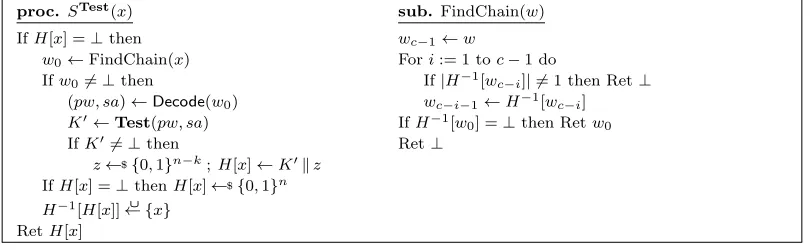
from the distinguisher. This rules out showing security amplification due to the iteration count c. Our approach solves both issues, since we will show KDF security for simulators that make one call to Test for every c made to it. For example, our simulator for KD1 will only query Test if a chain of c hashes leads to the being-queried pointXand this chain is not a continuation of some longer chain. We formally capture this property of simulators next.
c-amplifying simulators. Let τ = (X1, Y1), . . . ,(Xq, Yq) be a (possibly partial) transcript of Prim
queries and responses. We restrict attention to (k, s, c)-KDFs for which we can define a predicate finalKD(Xi, τ) which evaluates to true if there exists exactly one sequence of c indices j1 < · · · < jc
such that (1) jc = i, (2) there exist unique (pw, sa) such that evaluating KDH(pw, sa) when H is such
that Yj =H(Xj) for 1 ≤j ≤ iresults exactly in the queries Xj1, . . . , Xjc in any order where Xi is the
last query, and (3) finalKD(Xjr, τ) =falsefor all r < c.
Our simulators only query Test on queries Xi for which finalKD(Xi, τ) = true; we call such queries
KD-completion queries and simulators satisfying this are called c-amplifying. Note that (3) implies that there are at most q/ctotalKD-completion queries in a q-query transcript.
Hash-dependent passwords. We do not allowMaccess to the random oracleH. This removes from
consideration hash-dependent passwords. Our results should extend to cover hash-dependent passwords if one has explicit domain separation between use ofH during password selection and during key derivation. Otherwise, an indifferentiability-style approach as we use here will not work due to limitations pointed out in [52]. A full analysis of the hash-dependent password setting would therefore appear to require direct analysis of PBE schemes without taking advantage of the modularity provided by simulation-based approaches.
Security of KD1. For a message samplerM, let γ(M, r) := Pr[∃i̸=j : (pw[i],sa[i]) = (pw[j],sa[j])]
where (pw,sa)←$M(r). We prove the following theorem in Appendix G.
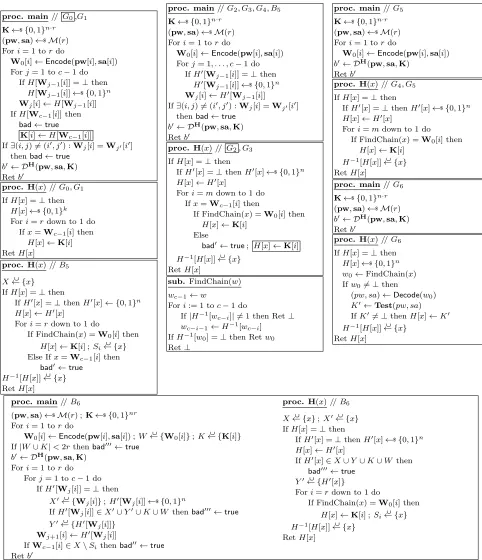
Theorem 3.3 Fixr >0. LetKD1 be as above. There exists a simulator S such that for all adversaries D making q RO queries, of which qc areKD1-completion queries, and all message samplersM,
AdvkdfKD1,M,r(D, S)≤4γ(M, r) +2r
2+ 7 (2q+rc)2
2n .
The simulatorS makes at mostqc Test queries, and answers each query in timeO(c).
3.2 Security of PBE
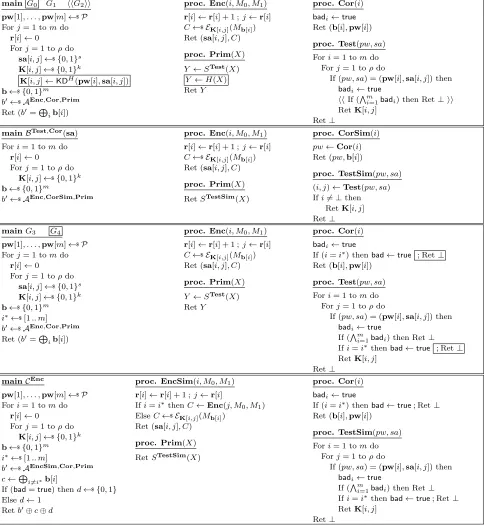
We are now, finally, in a position to analyze the security of password based encryption as used in PKCS#5. The following theorem uses the multi-user left-or-right security notion from [3], that measures secu-rity when given access to multiple left-or-right oracles each using the same bit b. It is formalized in Appendix D. The proof of the following theorem appears in Appendix H.
queries to Enc(i,·,·) for each i∈ {1, . . . , m} and making at mostqc< m corruption queries. LetS be a
c-amplifying simulator. Then there exists message sampler Mand adversaries D,C, and Bsuch that AdvlorxSE,m(A)≤m·Advmu-lorSE,ρ (C) + 2·Advsa-guessP,m,ρ (B) + 2·AdvkdfKD,M,mρ(D, S)
IfAmakesqqueries toH, then: Dmakes at mostqqueries to itsH oracle;Bmakes at most⌈q/c⌉queries to Test and at most qc corruption queries; and C makes a single query Enc(i,·,·) for each 1 ≤ i ≤ ρ.
Moreover,C’s running time equalstA+q·tS plus a small, absolute constant, and wheretA is the running
time of A, and tS is the time needed byS to answer a query. Finally, γ(M, mρ)≤m2ρ2/2s.
Note that the theorem holds even whenSEis only one-time secure (meaning it can be deterministic), which implies that the analysis covers tools such as WinZip (c.f., [37]). In terms of the bound we achieve, Theorem 3.3 for KD1 shows that an adversary that makes AdvkdfKD,P∗,mρ(D, S) large requires q ≈ 2n/2 queries to H, provided salts are large. IfH is SHA-256 then this is about 2128 work. Likewise, a good choice of SE will ensure that Advmu-lorSE,ρ (C) will be very small. Thus the dominating term ends up the guessing advantage of B againstP, which measures its ability to guess m−qc passwords.
Acknowledgments
We thank Douglas Stebila for drawing our attention to [53, 27] and for discussions about the implications of the latter for our work. We thank Qiushi Wang for pointing out a bug in the proof of Theorem 2.2 in a previous version of this paper.
References
[1] M. Abadi and B. Warinschi. Password-based encryption analyzed. In L. Caires, G. F. Italiano, L. Monteiro, C. Palamidessi, and M. Yung, editors,ICALP 2005: 32nd International Colloquium on Automata, Languages and Programming, volume 3580 ofLecture Notes in Computer Science, pages 664–676. Springer, July 2005.
[2] O. Baudron, D. Pointcheval, and J. Stern. Extended notions of security for multicast public key cryptosystems. In U. Montanari, J. D. P. Rolim, and E. Welzl, editors, ICALP 2000: 27th International Colloquium on Automata, Languages and Programming, volume 1853 of Lecture Notes in Computer Science, pages 499–511. Springer, July 2000.
[3] M. Bellare, A. Boldyreva, and S. Micali. Public-key encryption in a multi-user setting: Security proofs and improvements. In B. Preneel, editor, Advances in Cryptology – EUROCRYPT 2000, volume 1807 of Lecture Notes in Computer Science, pages 259–274. Springer, May 2000.
[4] M. Bellare, A. Desai, E. Jokipii, and P. Rogaway. A concrete security treatment of symmetric encryption. In 38th Annual Symposium on Foundations of Computer Science, pages 394–403. IEEE Computer Society Press, Oct. 1997.
[5] M. Bellare, R. Impagliazzo, and M. Naor. Does parallel repetition lower the error in computationally sound protocols? In38th Annual Symposium on Foundations of Computer Science, pages 374–383. IEEE Computer Society Press, Oct. 1997.
[6] M. Bellare, D. Pointcheval, and P. Rogaway. Authenticated key exchange secure against dictionary attacks. In B. Preneel, editor,Advances in Cryptology – EUROCRYPT 2000, volume 1807 ofLecture Notes in Computer Science, pages 139–155. Springer, May 2000.
[7] M. Bellare, T. Ristenpart, and S. Tessaro. Multi-instance security and its application to password-based cryptography. In Advances in Cryptology – CRYPTO 2012, Lecture Notes in Computer Science. Springer, Aug. 2012.
[8] M. Bellare and P. Rogaway. Random oracles are practical: A paradigm for designing efficient protocols. In V. Ashby, editor, ACM CCS 93: 1st Conference on Computer and Communications Security, pages 62–73. ACM Press, Nov. 1993.
[10] E. Biham, Y. J. Goren, and Y. Ishai. Basing weak public-key cryptography on strong one-way functions. In R. Canetti, editor,TCC 2008: 5th Theory of Cryptography Conference, volume 4948 of Lecture Notes in Computer Science, pages 55–72. Springer, Mar. 2008.
[11] X. Boyen. Halting password puzzles: hard-to-break encryption from human-memorable keys. In Proceedings of 16th USENIX Security Symposium on USENIX Security Symposium, page 9. USENIX Association, 2007.
[12] X. Boyen. New paradigms for password security (keynote lecture). In Y. Mu, W. Susilo, and J. Seberry, editors, ACISP 08: 13th Australasian Conference on Information Security and Privacy, volume 5107 ofLecture Notes in Computer Science, pages 1–5. Springer, July 2008.
[13] R. Canetti, S. Halevi, J. Katz, Y. Lindell, and P. D. MacKenzie. Universally composable password-based key exchange. In R. Cramer, editor,Advances in Cryptology – EUROCRYPT 2005, volume 3494 ofLecture Notes in Computer Science, pages 404–421. Springer, May 2005.
[14] R. Canetti, S. Halevi, and M. Steiner. Hardness amplification of weakly verifiable puzzles. In J. Kilian, editor, TCC 2005: 2nd Theory of Cryptography Conference, volume 3378 ofLecture Notes in Computer Science, pages 17–33. Springer, Feb. 2005.
[15] R. Canetti, R. L. Rivest, M. Sudan, L. Trevisan, S. P. Vadhan, and H. Wee. Amplifying collision resistance: A complexity-theoretic treatment. In A. Menezes, editor,Advances in Cryptology – CRYPTO 2007, volume 4622 ofLecture Notes in Computer Science, pages 264–283. Springer, Aug. 2007.
[16] K.-M. Chung and F.-H. Liu. Parallel repetition theorems for interactive arguments. In D. Micciancio, editor, TCC 2010: 7th Theory of Cryptography Conference, volume 5978 ofLecture Notes in Computer Science, pages 19–36. Springer, Feb. 2010.
[17] K.-M. Chung, F.-H. Liu, C.-J. Lu, and B.-Y. Yang. Efficient string-commitment from weak bit-commitment. In M. Abe, editor, Advances in Cryptology – ASIACRYPT 2010, volume 6477 of Lecture Notes in Computer Science, pages 268–282. Springer, Dec. 2010.
[18] J.-S. Coron, Y. Dodis, C. Malinaud, and P. Puniya. Merkle-Damg˚ard revisited: How to construct a hash function. In V. Shoup, editor, Advances in Cryptology – CRYPTO 2005, volume 3621 of Lecture Notes in Computer Science, pages 430–448. Springer, Aug. 2005.
[19] Y. Dodis, R. Gennaro, J. H˚astad, H. Krawczyk, and T. Rabin. Randomness extraction and key derivation using the CBC, cascade and HMAC modes. In M. Franklin, editor,Advances in Cryptology – CRYPTO 2004, volume 3152 ofLecture Notes in Computer Science, pages 494–510. Springer, Aug. 2004.
[20] Y. Dodis, R. Impagliazzo, R. Jaiswal, and V. Kabanets. Security amplification for interactive cryptographic primitives. In O. Reingold, editor,TCC 2009: 6th Theory of Cryptography Conference, volume 5444 ofLecture Notes in Computer Science, pages 128–145. Springer, Mar. 2009.
[21] C. Dwork, M. Naor, and O. Reingold. Immunizing encryption schemes from decryption errors. In C. Cachin and J. Camenisch, editors, Advances in Cryptology – EUROCRYPT 2004, volume 3027 of Lecture Notes in Computer Science, pages 342–360. Springer, May 2004.
[22] R. Gennaro and Y. Lindell. A framework for password-based authenticated key exchange. In E. Biham, editor, Advances in Cryptology – EUROCRYPT 2003, volume 2656 of Lecture Notes in Computer Science, pages 524–543. Springer, May 2003.
[23] O. Goldreich. Three XOR-Lemmas — An exposition, 1995. Available at: http://www.wisdom.weizmann.ac. il/.
[24] O. Goldreich, R. Impagliazzo, L. A. Levin, R. Venkatesan, and D. Zuckerman. Security preserving amplification of hardness. In31st Annual Symposium on Foundations of Computer Science, pages 318–326. IEEE Computer Society Press, Oct. 1990.
[25] O. Goldreich and L. A. Levin. A hard-core predicate for all one-way functions. In21st Annual ACM Symposium on Theory of Computing, pages 25–32. ACM Press, May 1989.
[27] B. Groza and B. Warinschi. Revisiting difficulty notions for client puzzles and dos resilience. In D. Gollman and F. Freiling, editors,ISC 2012: 15th International Conference on Information Security, Lecture Notes in Computer Science. Springer, Sept. 2012.
[28] I. Haitner. A parallel repetition theorem for any interactive argument. In50th Annual Symposium on Foun-dations of Computer Science, pages 241–250. IEEE Computer Society Press, Oct. 2009.
[29] I. Haitner, D. Harnik, and O. Reingold. On the power of the randomized iterate. In C. Dwork, editor,Advances in Cryptology – CRYPTO 2006, volume 4117 ofLecture Notes in Computer Science, pages 22–40. Springer, Aug. 2006.
[30] S. Halevi and T. Rabin. Degradation and amplification of computational hardness. In R. Canetti, editor, TCC 2008: 5th Theory of Cryptography Conference, volume 4948 of Lecture Notes in Computer Science, pages 626–643. Springer, Mar. 2008.
[31] J. H˚astad, R. Pass, D. Wikstr¨om, and K. Pietrzak. An efficient parallel repetition theorem. In D. Micciancio, editor,TCC 2010: 7th Theory of Cryptography Conference, volume 5978 ofLecture Notes in Computer Science, pages 1–18. Springer, Feb. 2010.
[32] T. Holenstein. Key agreement from weak bit agreement. In H. N. Gabow and R. Fagin, editors,37th Annual ACM Symposium on Theory of Computing, pages 664–673. ACM Press, May 2005.
[33] T. Holenstein and R. Renner. One-way secret-key agreement and applications to circuit polarization and immunization of public-key encryption. In V. Shoup, editor,Advances in Cryptology – CRYPTO 2005, volume 3621 ofLecture Notes in Computer Science, pages 478–493. Springer, Aug. 2005.
[34] R. Impagliazzo, R. Jaiswal, and V. Kabanets. Chernoff-type direct product theorems. Journal of Cryptology, 22(1):75–92, Jan. 2009.
[35] R. Impagliazzo and V. Kabanets. Constructive proofs of concentration bounds. In M. J. Serna, R. Shaltiel, K. Jansen, and J. D. P. Rolim, editors, APPROX-RANDOM, volume 6302 of Lecture Notes in Computer Science, pages 617–631. Springer, 2010.
[36] J. Kelsey, B. Schneier, C. Hall, and D. Wagner. Secure applications of low-entropy keys. In E. Okamoto, G. I. Davida, and M. Mambo, editors,1st Information Security Workshop (ISW ’97), volume 1396 ofLecture Notes in Computer Science, pages 121–134. Springer, Sept. 1998.
[37] T. Kohno. Attacking and repairing the winZip encryption scheme. In V. Atluri, B. Pfitzmann, and P. McDaniel, editors,ACM CCS 04: 11th Conference on Computer and Communications Security, pages 72–81. ACM Press, Oct. 2004.
[38] H. Krawczyk. Cryptographic extraction and key derivation: The HKDF scheme. In T. Rabin, editor,Advances in Cryptology – CRYPTO 2010, volume 6223 ofLecture Notes in Computer Science, pages 631–648. Springer, Aug. 2010.
[39] M. Luby and C. Rackoff. A study of password security. In C. Pomerance, editor, Advances in Cryptology – CRYPTO’87, volume 293 ofLecture Notes in Computer Science, pages 392–397. Springer, Aug. 1988.
[40] U. M. Maurer, K. Pietrzak, and R. Renner. Indistinguishability amplification. In A. Menezes, editor,Advances in Cryptology – CRYPTO 2007, volume 4622 ofLecture Notes in Computer Science, pages 130–149. Springer, Aug. 2007.
[41] U. M. Maurer, R. Renner, and C. Holenstein. Indifferentiability, impossibility results on reductions, and applications to the random oracle methodology. In M. Naor, editor,TCC 2004: 1st Theory of Cryptography Conference, volume 2951 ofLecture Notes in Computer Science, pages 21–39. Springer, Feb. 2004.
[42] U. M. Maurer and S. Tessaro. Computational indistinguishability amplification: Tight product theorems for system composition. In S. Halevi, editor, Advances in Cryptology – CRYPTO 2009, volume 5677 of Lecture Notes in Computer Science, pages 355–373. Springer, Aug. 2009.
[43] U. M. Maurer and S. Tessaro. A hardcore lemma for computational indistinguishability: Security amplifi-cation for arbitrarily weak PRGs with optimal stretch. In D. Micciancio, editor, TCC 2010: 7th Theory of Cryptography Conference, volume 5978 ofLecture Notes in Computer Science, pages 237–254. Springer, Feb. 2010.