Forward and small-x physics at CMS
Paolo Gunnellini1a
on behalf of the CMS Collaboration
1Deutsches Elektronen-Synchrotron (DESY) Notkestrasse 85, 22607, Hamburg (Germany)
Abstract. A review of experimental measurements from the Compact Muon Solenoid
Experiment at the LHC Run 1 is presented. A particular focus is given to jet results in the central and forward regions, and to measurements sensitive to the behaviour of small-x gluons inside the proton and to double parton scattering.
1 Introduction
The study of the dynamics of hadron jets in proton-proton collisions yields important information
about underlying partonic processes. The production of jets with large transverse momenta pT is
thought to be originated from scatterings of partons which can be described by the theory of strong interactions. The cross section of such a proton-proton collision process is factorized in a convolu-tion of the cross secconvolu-tion for a partonic subprocess and the parton distribuconvolu-tion funcconvolu-tions (PDF). The QCD semi-hard interactions experienced by quarks and gluons are treated analytically through the
so-called parton shower calculations. Different approaches to perform the parton evolution have been
developed, depending on which kinematic region of the phase space is probed and several evolution
equations are available for the calculations. At large splitting scalesQ2 and not too large
longitu-dinal momentum fractionx, the Dokshitzer-Gribov-Lipatov-Altarelli-Parisi (DGLAP) equations [5]
are good tools to calculate the partonic evolution with great success in reproducing a wide range of
measurements. In the regime of low-x, though, the approximations used by the DGLAP approach
break down and the formalism needs to be improved by the Balitsky-Fadin-Kuraev-Lipatov (BFKL) evolution scheme. Furthermore, at high factorization scales, the gluon distributions become large at low values of longitudinal momentum fractions of the colliding protons. In this regime, on the one hand parton recombination, i.e. saturation (see e.g. [1]), may occur. On the other hand, the probability to have more than one partonic interaction becomes non-negligible, leading to the production of pairs of physics objects at high transverse momentum via double parton scattering (DPS).
2 Jet measurements
At the Large Hadron Collider (LHC), various jet measurements, such the inclusive [2, 3] or the
mul-tijet [4] cross section for high pT jets, have been measured at a collision energy √s=7 TeV by the
CMS experiment and are in good agreement with predictions obtained at next-to-leading order (NLO)
quantum chromodynamics (QCD). This good description of data represents a nice success of the cur-rent formalism used for calculating partonic interactions in pp collisions. Many attempts have been
tried in multijet measurements to reach regions of the phase space where BFKL effects might appear
but so far, no stringent evidence has been observed yet. In particular, by looking at more sophisticated scenarios than inclusive jets, e.g. by measuring jets at high pseudorapidities or by requiring
correla-tions among selected jets, one has the possibility to be sensitive to lower and lowerxvalues. Some of
these scenarios have been measured by the CMS experiment to investigate different evolution models
and are presented in the following.
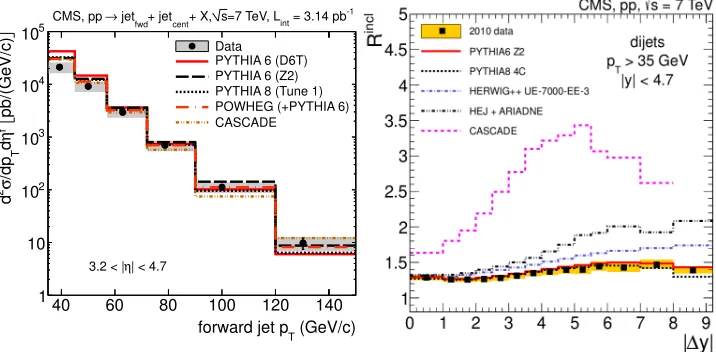
The single-jet cross section has been measured [6] for the two leading, i.e. with highestpT, jets
in inclusive dijet events containing at least one forward (in the pseudorapidity range 3.2<|η|<4.7)
and one central jet (defined by the region|η|<2.8). The data are based on 3.14 pb−1 of integrated
luminosity at √s=7 TeV. Jets are reconstructed using the anti-kT algorithm (R=0.5) in the pT
range 35-150 GeV. The single-jet cross section is shown in Figure 1, as a function of thepT of the
forward jet. The total systematic uncertainties are of the order of 20-30%, dominated by the abso-lute jet energy scale. The measurement, compared to perturbative QCD calculations, as implemented
in the parton-shower event generators PYTHIA [7, 8] and HERWIG++ [9] at leading order (LO)
or POWHEG+PYTHIA [10] at NLO, is found to be in agreement within the current experimental
and theoretical uncertainties. Predictions from Monte Carlo (MC) event generators implementing
different kinds of parton evolution, such the combined DGLAP+BFKL resummation model of
CAS-CADE [11], are also found to be in good agreement with the measured dijet cross section.
(GeV/c)
T
forward jet p 40 60 80 100 120 140
pb/(GeV/c)
f
η
d
T
/dp
σ
2d
1 10
2
10
3
10
4
10
5
10
Data PYTHIA 6 (D6T) PYTHIA 6 (Z2) PYTHIA 8 (Tune 1) POWHEG (+PYTHIA 6) CASCADE
| < 4.7
η
3.2 < |
-1
= 3.14 pb
int
=7 TeV, L s + X,
cent
+ jet
fwd
jet
→
CMS, pp
Figure 1.Differential cross sections as a function of the forward jetpT for dijet events with at least one central
jet and one forward jet, compared to predictions from several models (left). Ratios of the inclusive to exclusive dijet cross sections as a function of the rapidity separationΔybetween the two jets compared to the predictions
of the DGLAP-based MC generators PYTHIA6, PYTHIA8 and HERWIG++, as well as of CASCADE and
HEJ+ARIADNE which incorporate elements of the BFKL approach (right).
A production of at least two jets is also studied in pp collisions at √s=7 TeV as function of the
rapidity separationΔybetween the jets [12], for jets with pT >35 GeV and|y|<4.7. Two classes of
• inclusive events, with at least one pair of jets;
• exclusive events, with exactly one pair of jets.
The ratio Rinclof the cross section of all pairwise combinations of jets from the inclusive sample
to the exclusive dijet cross section is shown on Figure 1(right) as a function ofΔy. This observable is
expected to be sensitive to effects beyond collinear factorization, as the radiation probability increases
with|Δ|y. The predictions of the MC event generators PYTHIA6 and PYTHIA 8 agree with the
measurements, while predictions from the HERWIG++event generator exhibit a more pronounced
rise with|Δy|. The BFKL-motivated generators CASCADE and HEJ+ARIADNE [13] predict for
these ratios a significantly stronger rise than observed.
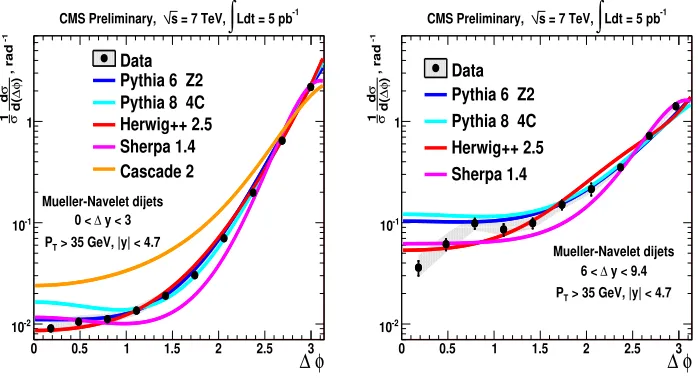
Finally, for a further investigation of possible BFKL effects, correlations in azimuthal angle of the
most forward and most backward in rapidity jets, (the so-called Mueller-Navelet jets) are measured
with data collected in pp collisions with the CMS detector at the LHC at √s=7 TeV. The
azimutal-angle distributions between Mueller-Navelet jets are measured for jets withpT>35 GeV and|y|<4.7.
The results are presented as a function of the difference in azimuthal angle between the two selected
jets in different ranges of rapidity separationΔy, reaching aΔyup to 9.4 in Figure 3. The results are
compared to predictions of various Monte-Carlo event generators and analytical predictions based on the DGLAP and BFKL parton evolution schemes.
φ Δ
0 0.5 1 1.5 2 2.5 3
-1
, rad )
φ
Δ
d(
σ
d
σ
1
-2 10
-1 10
1
Data Pythia 6 Z2 Pythia 8 4C Herwig++ 2.5 Sherpa 1.4 Cascade 2
-1 Ldt = 5 pb
∫
= 7 TeV, s CMS Preliminary,
> 35 GeV, |y| < 4.7 T
P
y < 3 Δ 0 <
Mueller-Navelet dijets
φ Δ
0 0.5 1 1.5 2 2.5 3
-1
, rad )
φ
Δ
d(
σ
d
σ
1
-2 10
-1 10
1
Data Pythia 6 Z2 Pythia 8 4C Herwig++ 2.5 Sherpa 1.4
-1 Ldt = 5 pb
∫
= 7 TeV, s CMS Preliminary,
> 35 GeV, |y| < 4.7 T
P
y < 9.4 Δ 6 <
Mueller-Navelet dijets
Figure 2.Distribution of azimuthal angle difference,Δφ, between MN jets in rapidity intervalΔy <3.0 (left) and
6<Δy <9.4 and its comparison to the predictions from LL based MC generators PYTHIA 6 tune Z2, PYTHIA
8 tune 4C, HERWIG++2.5, SHERPA 1.4 and LL BFKL motivated MC generator CASCADE.
From these measurements, no clear evidence of BFKL effects or of measurements deviating from
DGLAP evolution scheme is obtained. MC event generators which are based on the DGLAP for-malism are able to reproduce well a wide range of jet measurements. On the one hand, this might
be due to the fact that the sensitivity to sufficiently small xvalues is not yet achieved reached at √s
=7 TeV; if this is the case, measurements at a higher collision energy during LHC RunII will scan
a still unexplored phase space which might reveal BFKL signals. On the other hand, BFKL effects
difficult to select and isolate a “pure” gluonic ladder in a regime where the BFKL scheme should rule
the parton evolution. At highpT, the DGLAP approach is expected to dominate, while for decreasing
pT, increasing activity from MPI contributes to the final state. Independently on the pT threshold,
quark ladders following a DGLAP-based evolution add a major background and make the search of
BFKL effects very complicated. New strategies for tackling these issues are under discussion and are
summarized in the following:
• measurements of more exclusive scenarios, e.g. rapidity gap in dijet inclusive or exclusive
ra-tios [14];
• measurements of more inclusive scenarios selecting corners of the phase space, e.g. jets in the
forward region, in final states with a high jet multiplicity or associated to heavy-flavour production;
By pursuing these ideas, the new LHC phase will surely be an exciting and vivid period for
searching BFKL effects.
3 Small-x gluon studies
A large set of measurements has been also performed by the CMS experiment for investigation of the
dynamics of gluons at small longitudinal fractional momentax. The integrated yields of events with
a leading charged particle or a leading charged-particle jet withpTabove a given threshold have been
measured in pp collisions at √s=8 TeV in a data sample corresponding to an integrated luminosity
of 45μb−1 [15]. The yields are found to be relatively flat in the p
T region around 1 GeV (where
the fixed-order perturbative parton-parton cross section diverges in the absence of any mechanism
that saturates or unitarises the perturbative QCD scattering), followed by a steep decrease for pT >
10 GeV. The flattening behaviour observed at very low pT is reproduced by models which apply a
cutoffof the partonic cross section at values between 3 and 5 GeV, with the best description provided
by the EPOS event generator [16]. Further comparisons of this measurement with various other phenomenological predictions of hadronic interaction models will help to improve the description of the transition between the perturbative and non-perturbative QCD regimes, which is believed to be
dominated by the effects of parton density saturation and MPI.
A study at generator level, aiming for an investigation of the small-xgluon behaviour, has shown
an interesting feature. Even though demonstrated only at a qualitative level, an increase of the
gluon density at small-xvalues tends to be preferred for a consistent description of measurements
at central and forward pseudorapidities. In particular, it has been observed that the description of charged-particle multiplicity at high pseudorapidities [17] provided by tunes using the NNPDF2.3LO PDF [18], e.g. Monash [19] and CUETP8M1 [17], is better than tunes using other PDF sets. This
is due to the different small-xbehaviour between NNPDF2.3LO and the other PDF. In fact, at low
parton scales Q2, the NNPDF2.3LO PDF has a gluon distribution at smallxvalues that is larger than
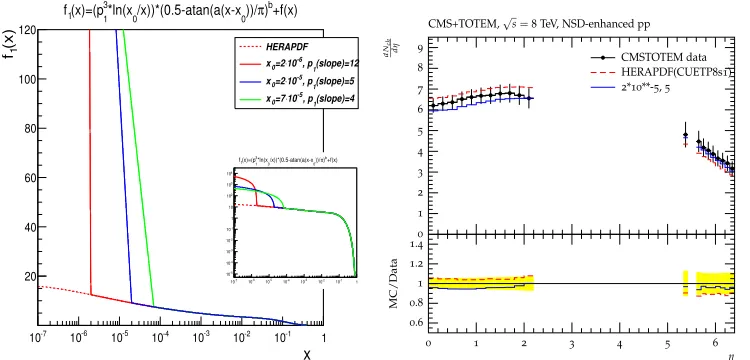
in HERAPDF1.5LO [20]. This contributes to more particles (and more energy) in the forward region. An investigation performed within the CMS collaboration confirmed this conclusion. By taking the HERAPDF1.5LO PDF set as a default, the low-x gluon distribution has been artificially increased
according to a function (see Figure 1(left)) with two free parameters,x0andp1.
The x0 parameter sets the initial point of thex gluon increase, while the steepness of the rise
is ruled by thep1parameter. The nominal gluon distribution in HERAPDF1.5LO and various
dis-tributions obtained by applying different modifications are shown in Figure 4(left). A tune based
on a parton distribution function usingx0 =2·10−5 andp1 =5, resulted to improve the description
x
-7
10 10-6 10-5 -4
10 10-3 -2
10 -1 10 1 (x ) 1 f 20 40 60 80 100 120 HERAPDF (slope)=12 1 , p -6 10 ⋅ =2 0 x (slope)=5 1 , p -5 10 ⋅ =2 0 x (slope)=4 1 , p -5 10 ⋅ =7 0 x +f(x) b ) π ))/ 0 /x))*(0.5-atan(a(x-x 0 *ln(x 3 1 (x)=(p 1 f -7
10 10-6 10-5 10-4 10-3 10-2 10-1 1
-5 10 -4 10 -3 10 -2 10 -1 10 1 10 2 10 3 10 4 10 +f(x) b ) π ))/ 0 /x))*(0.5-atan(a(x-x 0 *ln(x 3 1 (x)=(p 1 f CMSTOTEM data HERAPDF(CUETP8s1)
2*10**-5,5
0 1 2 3 4 5 6 7 8 9
CMS+TOTEM,√s=8 TeV, NSD-enhanced pp
dN
ch
d
η
0 1 2 3 4 5 6
0.6
0.8
1
1.2
1.4
η
MC/
D
at
a
Figure 3. Gluon distribution as a function of the longitudinal fractional momentumxfor the nominal
HERA-PDF1.5LO PDF set and for the modified sets with different values ofx0and (left). Comparison of charged-particle
multiplicity as a function ofηfor the CUETP8S1-HERAPDF tune and a tune performed with modified low-x
gluon behaviour (right).
set. Note that the range of modifiedxvalues in the considered gluon distributions are below the range
of the HERA deep inelastic scattering data. Future measurements sensitive to this low-xregime are
strictly needed to confirm the results of this qualitative study and to further constrain the behaviour of the gluon density.
4 Double parton scattering measurements
A wide range of measurements sensitive to DPS contributions has been also carried out within the
CMS physics program for different physics channels. The investigated channels are characterized by
a high number of physics objects in the final state, e.g. jets. Measurements related to the W+
two-jet [21], four-two-jet [22],γ+three-jet [23] and two-b+two-light-jet [24] final states have been released by
the CMS experiment. The current strategy for DPS-extraction analyses is based on the association of
the selected objects in two pairs and on the measurement of differential cross sections as a function
of correlation observables defined by the kinematical topology of the final state. The two pairs can be produced by two independent scatterings in case of a DPS event and the correlation observables are expected to be able to disentangle this occurrence. Studies at generator level have shown that variables which are most sensitive to a DPS contribution are the ones which consider the relative topology of all selected objects, not only of the objects of one of the two pairs [25]. One of such observables is
ΔS, which corresponds to the azimuthal angle between the two selected pairs and is defined as:
ΔS=arccos
pT(pair1)·pT(pair2) |pT(pair1)| · |pT(pair2)|
(1)
For the W+two-jet channel, pair1 and pair2 are, respectively, the reconstructed W and the dijet
and soft (light) dijet systems. In Figure 4, the differential cross section normalized to the number of
selected events as a function of theΔS observable measured by CMS is shown for various final states.
S Δ
0 0.5 1 1.5 2 2.5 3
Data / MC
0.6 0.81 1.2 1.4 1.6 1.82 2.2 Uncertainty
Data / MC
0.6 0.81 1.2 1.4 1.6 1.82 2.2 Uncertainty
Data / MC
0.6 0.81 1.2 1.4 1.6 1.82 2.2 Uncertainty S) Δ d( evt dN . evt N 1 -2 10 -1 10 1 -1
Ldt = 5 fb ∫ = 7 TeV s CMS
PYTHIA8 MADGRAPH5 + PYTHIA8 MADGRAPH5 + PYTHIA8, no MPI POWHEG2 + PYTHIA6 POWHEG2 + PYTHIA6, no MPI Data T p soft rel Δ
0 0.1 0.2 0.3 0.4 0.5 0.6 0.7 0.8 0.9 1
MC/Data 0.4 0.6 0.8 1 1.2 1.4 1.6 1.8 2 SHERPA POWHEG+P6 Z2' MADGRAPH+P6 Z2* PYTHIA8 4C HERWIG++ UE-EE-3 POWHEG+P6 Z2' MPI off Total Uncertainty T p soft re l Δ /d σ ) d σ (1/ 1 10 4j+X → , pp -1
= 7 TeV, L = 36 pb s
CMS,
| < 4.7 η | jet: nd , 2 st 1 > 50 GeV
T p jet: th , 4 rd 3 > 20 GeV
T p SHERPA POWHEG+P6 Z2' MADGRAPH+P6 Z2* PYTHIA8 4C HERWIG++ UE-EE-3 POWHEG+P6 Z2' MPI off Data
Total Uncertainty
S (rad) Δ
0 0.5 1 1.5 2 2.5 3
MC/Data 0.4 0.6 0.8 1 1.2 1.4 1.6 1.8 2 SHERPA POWHEG+P6 Z2' MADGRAPH+P6 Z2* PYTHIA8 4C HERWIG++ UE-EE-3 POWHEG+P6 Z2' MPI off Total Uncertainty S (1/rad) Δ /d σ ) d σ (1/ -1 10 1 10 4j+X → , pp -1
= 7 TeV, L = 36 pb s
CMS,
| < 4.7 η | jet: nd , 2 st 1 > 50 GeV
T p jet: th , 4 rd 3 > 20 GeV
T p SHERPA POWHEG+P6 Z2' MADGRAPH+P6 Z2* PYTHIA8 4C HERWIG++ UE-EE-3 POWHEG+P6 Z2' MPI off Data
Total Uncertainty
S (rad) Δ
0 0.5 1 1.5 2 2.5 3
MC/data 0.2 0.4 0.6 0.81 1.2 1.4 1.6 S [1/rad] Δ /d σ ) d σ (1/ -2 10 -1 10 1 10 2 10
2 b + 2 j + X → (7 TeV), pp -1 3 pb
| < 2.4 η > 20 GeV, | T 2 b-j: p
| < 4.7 η > 20 GeV, | T 2 j: p CMS Preliminary MADGRAPH+P6 Z2* POWHEG+PYTHIA6 Z2' CUETP8S1-CTEQ6L1 HERWIG++ UE-EE-5-CTEQ6L1 CUETP8S1-CTEQ6L1 MPI off DATA
Total Uncertainty
Figure 4.CMS data on theΔS observable for various measured final states: W+two-jet (left), four-jet (center),
γ+three-jet (right) channels.
In each of them, the measured cross sections have a similar shape with a falling distribution from correlated configurations at high values, down to uncorrelated jet topologies at low values. The mea-sured cross sections have been also compared to predictions obtained with various MC event
genera-tors, implementing different matrix elements (ME) interfaced with parton shower (PS) and underlying
event (UE) simulation. The PYTHIA 8 and HERWIG++event generators simulate Leading Order
(LO) 2→2 processes, SHERPA [26] and MADGRAPH [27] generate LO diagrams with higher
num-ber of partons in the final state, while POWHEG produces Next-to-Leading-Order (NLO) processes, with real and virtual corrections included in the ME. Predictions without the contribution of MPI are also considered in the comparison. All predictions include a simulation of parton-shower and
underlying-event effects generated according to updated tunes.
In general, for all considered channels, predictions of multileg or NLO event generators are able to reproduce reasonably well the measured distributions. However, some room for improvement is available for the simulation of hard MPI contribution in the current models, in order to achieve a
better description of the cross section at low values ofΔS. Predictions from event generators without
the simulation of MPI do not reproduce the measured points, mainly in the region at low values of
ΔS, where a DPS contribution is expected. This comparison clearly indicates the need for MPI in
the current models to achieve a correct description of the DPS-sensitive observables. A quantitative extraction of the DPS contribution necessarily relies on the measurement of correlation observables and can be carried out through the so-called template [21] or the fitting [17] methods.
5 Summary and conclusions
over different regions of phase space shows that current predictions based on the DGLAP evolution scheme are able to reproduce the data with a very good level of agreement. Investigations on
observ-ables sensitive to small-xgluon dynamics did not give clear evidence of BFKL effects, yet. Various
ideas and alternative approaches to tackle them in future measurements are under discussion. The measurement of the integrated jet cross section performed with the CMS experiment as a function of the leading charged-particle and jet can be used as a probe of the transition from the per-turbative to the non-perper-turbative region. The distributions, steeply falling at large transverse momenta
and flattening out atpTvalues between 1 and 10 GeV, show effects of parton density saturation which
are reproduced by models applying a cutoffof the partonic cross section at around 3–5 GeV.
How-ever, qualitative studies at generator level show that a better description of measurement at central and
forward rapidities is achieved in case an increase at small-xvalues is introduced for the gluon density.
Measurements sensitive to hard multiple interactions are available in many different physics
chan-nels. Observables investigating correlations in azimuthal angle between the objects selected in the considered final states can not be described by current models without implementing a simulation of multiple-parton interactions. These measurements can be used in the future to study the dependence
of the double parton scattering contribution on the partonic initial state in terms ofxand flavour, and
on the scale of the process.
References
[1] A. H. Mueller, Nucl. Phys. B335(1990) 115
[2] CMS Collaboration [CMS Collaboration], section at sqrt(s)=8 TeV,” CMS-PAS-SMP-14-001
[3] S. Chatrchyanet al.[CMS Collaboration], Phys. Rev. Lett.107(2011) 132001
[4] P. Kokkas [CMS Collaboration], PoS EPS-HEP2011(2011) 277
[5] G. Altarelli and G. Parisi, Nucl. Phys. B126(1977) 298
[6] S. Chatrchyanet al.[CMS Collaboration], JHEP1206(2012) 036
[7] T. Sjostrand, S. Mrenna and P. Z. Skands, JHEP0605(2006) 026
[8] T. Sjöstrand, S. Mrenna and P. Z. Skands, Comput. Phys. Commun.178(2008) 852
[9] S. Gieseke, D. Grellscheid, K. Hamilton, A. Papaefstathiou, S. Platzer, P. Richardson, C. A. Rohr
and P. Ruzickaet al., arXiv:1102.1672 [hep-ph]
[10] J. M. Campbell, R. K. Ellis, P. Nason and G. Zanderighi, JHEP1308(2013) 005
[11] H. Junget al., Eur. Phys. J. C70(2010) 1237
[12] S. Chatrchyanet al.[CMS Collaboration], Eur. Phys. J. C72(2012) 2216
[13] J. R. Andersen and J. M. Smillie, JHEP1106(2011) 010
[14] C. Royon, AIP Conf. Proc.1654(2015) 070002
[15] V. Khachatryanet al.[CMS Collaboration], arXiv:1507.00233 [hep-ex]
[16] T. Pierog, I. Karpenko, J. M. Katzy, E. Yatsenko and K. Werner, Phys. Rev. C92 (2015) 3,
034906
[17] CMS Collaboration [CMS Collaboration], CMS-PAS-GEN-14-001
[18] R. D. Ballet al.[NNPDF Collaboration], Nucl. Phys. B877(2013) 290
[19] P. Skands, S. Carrazza and J. Rojo, Eur. Phys. J. C74(2014) 8, 3024
[20] A. M. Cooper-Sarkar, PoS DIS2014(2014) 032
[21] S. Chatrchyanet al.[CMS Collaboration], JHEP1403(2014) 032
[22] S. Chatrchyanet al.[CMS Collaboration], Phys. Rev. D89(2014) 9, 092010
[25] P. Gunnellini, DESY-THESIS-2015-010
[26] T. Gleisberg, S. Hoeche, F. Krauss, M. Schonherr, S. Schumann, F. Siegert and J. Winter, JHEP
0902(2009) 007