Making Semantic Topicality Robust Through Term Abstraction
∗Paul M. Heider
Department of Linguistics University at Buffalo The State University of New York
Buffalo, NY 14260, USA
Rohini K. Srihari
Janya, Inc. 1408 Sweet Home Road
Suite 1 Amherst, NY 14228
Abstract
Despite early intuitions, semantic similarity has not proven to be robust for splitting multi-party interactions into separate conversations. We discuss some initial successes with using thesaural headwords to abstract the seman-tics of an utterance. This simple profiling technique showed improvements over base-line conversation threading models.
1 Introduction
Topic segmentation is the problem of dividing a document into smaller coherent units. The seg-ments can be hierarchical or linear; the topics can be localized or distributed; the documents can be newswire or chat logs. Of course, each of these variables is best analyzed as continuous rather than discrete. Newswire, for instance, is a more formal, monologue-style genre while a chat log tends to-wards the informal register with different conversa-tions interwoven.
We present a topic segmenter which uses seman-tics to define coherent conversations within a larger, multi-party document. Using a word’s thesaurus en-try as a proxy for its underlying semantics provides a domain-neutral metric for distinguishing conver-sations. Also, our classifier does not rely on met-alinguistic properties that may not be robust across genres.
∗The first author was partially funded through a fel-lowship from the SUNY at Buffalo Department of Linguis-tics and partially through a research assistantship at Janya, Inc. (http://www.janyainc.com, Air Force Grant No.s FA8750-07-C-0077 and FA8750-07-D-0019, Task Order 0004)
2 Background
Most work on lexical cohesion extends from Halli-day and Hasan (1976). They formalize a text as any semantic unit realized through sentences. Linguistic features found to justify binding sentences together into Halliday and Hasan’s notion of a text include pronouns (Hobbs, 1979; Kehler, 2000), lexical over-lap (Hearst, 1997; Kozima, 1993; Morris and Hirst, 1991), cue phrases (Manning, 1998), and discourse markers (Power et al., 2003; Reynar, 1999; Beefer-man et al., 1999), among others. Of course, most of this earlier work assumes the sentences constitut-ing any text are contiguous. Thus, a document is comprised of a series of semantic units that progress from one to the next with no returns to old topics.
Multi-party interactions1 abide by a different set
of assumptions. Namely, a multi-party interaction can include multiple floors (Aoki et al., 2006). Much like at a cocktail party, we can expect more than a single conversation at every given time. These dif-ferent conversational floors are the major semantic units a topic segmentation algorithm must recog-nize. Spoken chat models (Aoki et al., 2006; Aoki et al., 2003) can make a simplifying assumption that speakers tend to only participate in one conversation at a time. However, in text chat models, Elsner and Charniak (2008) show that speakers seem to partici-pate in more conversations roughly as a function of how talkative they are (cf. Camtepe et al., 2005). In both modalities, speaker tendency to stay on the same topics is a robust cue for conversational
coher-1See O’Neill and Martin (2003) for an analysis of
differ-ences between two- and multi-party interactions.
ence (Elsner and Charniak, 2008; Acar et al., 2005). Despite the initial intuitions of Halliday and Hasan (1976), semantic similarity has not proven to be a robust cue for multi-party topic segmen-tation. For instance, Acar et al. (2005) and Gal-ley et al. (2003) used word repetition in their defi-nition of coherence but found that words common to too many conversations hurt modeling perfor-mance. Elsner and Charniak (2008) used frequency binning based on the entire document to reduce the noise introduced by high-frequency words. Un-fortunately, binning requires a priori knowledge of the relative frequencies of words.2 Additionally,
those authors used an on-topic/off-topic word list to bifurcate technical and non-technical utterances. Again, this technique assumes prior knowledge of the strongest on-topic cue words.
Since semantic repetition is clearly useful but simple word repetition is not a reliable measure, we investigated other measures of semantic relatedness. Elsner and Charniak (2008) conceded that context-based measures like LSA (Deerwester et al., 1990) require a clear notion of document boundary to func-tion well. Dicfunc-tionary-based models (Kozima and Furugori, 1993) are a step in the right direction be-cause they leverage word co-occurrence within defi-nitions to measure relatedness. The richer set of con-nections available in WordNet models should pro-vide an even better measure of relatedness (Sussna, 1993; Resnik, 1995). Unfortunately, these mea-sures have unequal distribution by part-of-speech and uneven density of lemmas by semantic domain.3
Thesaurus-based models (Morris and Hirst, 1991) provide many of the same advantages as dictionary-and WordNet-based models.4 In addition to the
hier-archical relations encoded by the thesaurus, we can treat each thesaural category as one dimension of a topicality domain similar to the way Elsner and Charniak leveraged their list of technical terms. In sum, our model focuses on the abstraction of lem-mas that is inherent to a thesaurus while limiting the domain-specific and a priori knowledge required
2One could use frequencies from a general corpus but that
should only perform as well as a graded stop-word list.
3As one reviewer noted, some parts-of-speech may
con-tribute more to a topic profile than others. Unfortunately, this empirical question must wait to be tested.
4Budanitsky and Hirst (2006) review the advantages.
by a classifier to divide multi-party interactions into separate conversational floors.
3 Model
At a high level, our chat topic segmenter works like most other classifiers: each input line is tokenized5,
passed to a feature analyzer, and clustered with re-lated lines. Unlike traditional topic segmentation models, each input represents a new utterance in the chat log. These utterances can range from single words to multiple sentences. Another aspect of our model (although not unique to it) is the on-line clas-sification of text. We aim to model topic segmenta-tion as if our classifier were sitting in a chat room, and not as a post-process.
While our feature analyzer focuses on semantic markers, interlocutor names are also recorded. Two intuitions were implemented with respect to individ-uals’ names: continued affiliation with old conver-sations and naming interlocutors to focus attention. All else being equal, one would assume a speaker will continue in the conversations she has already participated in. Moreover, she will most likely con-tinue with the last conversation she was part of. As the total number of conversations increases, the like-lihood of sticking to the last conversation will de-crease.
The second intuition derives from the observa-tion in O’Neill and Martin (2003) that speakers ac-commodate for cocktail-style conversations by using direct mentions of interlocutors’ names. We only model backward referencing names. That is, if a speaker uses the name of another user, we assume that the speaker is overtly affiliating with a conver-sation of the other user. Forward referencing is dis-cussed under future work (see Section 6).
Following Budanitsky and Hirst (2006), we base our notion of semantic topicality on thesaural rela-tions. Broadly speaking, two utterances are highly related if their tokenized words (hereafter, lemmas) co-occur in more of the same thesaural categories than not. We will defer further explanation of these features until we have explained our reference the-sauri in Subsection 3.1. Unfortunately, many desir-able and robust features are missing from our classi-fier. See Section 6 for a discussion of future work.
In the final stage of our processing pipeline, we use a panel of experts to generate a simple weighted classification. Each feature described above con-tributes a roughly equal vote towards the final sort-ing decision. Barrsort-ing a ssort-ingle strong preference or a cohort of weak preferences for one conversation, the model assumes the incoming utterance introduces a new conversational floor.
3.1 Thesauri
We chose two machine-readable and public-domain thesauri for our model: Roget’s Thesaurus (1911) and Moby Thesaurus II (2002). Both are avail-able from Project Gutenberg (gutenberg.org). In the compilation notes for Roget’s Thesaurus, the editor mentions a supplement of 1,000+ words to the orig-inal work. A rough count shows 1,000 headwords (the basic grouping level) and 55,000 synonyms (any word listed under a headword). The second edi-tion of Moby Thesaurus contains some 30,000 head-words and 2.5 million synonyms. Moby Thesaurus includes many newer terms than Roget’s Thesaurus. Structurally, Roget’s Thesaurus has a distinct advan-tage over Moby Thesaurus. The former includes a six-tiered category structure with cross-indexing be-tween headwords. The latter is only organized into headword lists.
3.2 Metrics
As we mentioned above, our model uses three pri-mary metrics in classifying a new utterance: con-versation affiliations of the current speaker, conver-sation affiliations of any explicitly mentioned inter-locutors, and semantic similarity. In the end, all the conversation affiliation votes are summed with the one conversation preferred by each of the three the-saural measures.6 The input line is then merged with
the conversation that received the most votes. De-tails for deriving the votes follow.
Every conversation a speaker has participated in receives a vote. Moreover, his last conversation gets additional votes as a function of his total number of conversations (see Equation 1). Likewise, every conversation a named interlocutor has participated in receives a vote with extra votes given to her last conversation as a function of how gregarious she is.
6In the long run, a list of conversations ranked by similarity
score would be better than a winner-takes-all return value.
Headword Type Weight Change
Direct Match 1
Co-hyponymous Headword 0.25
Cross-indexed Headword 0.75
Table 1: Spreading Activation Weights.
V ote= 3
ln(|Conversationsspeaker|) + 1 (1)
Each utterance is then profiled in terms of the-saural headwords. Every lemma in an utterance matching to some headword increments the activa-tion of that headword by one.7 A conversation’s
se-mantic profile is a summation of the profiles of its constituent sentences. In order to simulate the drift of topic in a conversation, the conversation’s seman-tic profile decays with every utterance. Thus, more recent headwords will be more activated than head-words activated near the beginning of a conversa-tion. Decay is modeled by halving the activation of a headword in every cycle that it was not topical.
Moreover, a third profile was kept to simulate spreading activation within the thesaurus. For this profile, each topical headword is activated. Every cross-indexed headword listed within this category is also augmented by a fixed degree. Finally, every headword that occupies the same thesaurus section is augmented. An overview of the weight changes is listed in Table 1. The specific weights fit the au-thors’ intuitions as good baselines. These weights can easily be trained to generate a better model.
The similarity between a new line (the test) and a conversation (the base) is computed as the sum of match bonuses and mismatch penalties in Table 2.8
Table 3 scores an input line (TEST) against two con-versations (BASE1 and BASE2) with respect to four
headwords (A, B, C, andD). In order to control for text size, we also computed the average headword
7Most other models include an explicit stop-word list to
re-duce the effect of function words. Our model implicitly relies on the thesaurus look-up to filter out function words. One ad-vantage to our approach is the ability to preferentially weight different headwords or lemma to headword relations.
8Like with Table 1, these numbers reflect the authors’
Headword Test
Present Yes No
Avg? Above Below
Base
Yes AboveBelow +0.5+1 +0.5+1 -0.05-0.1
No -1 -0.5 +0.0001
Table 2: Similarity Score Calculations.
A B C D Score
TEST high high low 0 –
BASE1 high+1 low+.5 low+1 high-.1 2.4
BASE2 -10 high+1 -.50 +.0001 -.49990
Table 3: A Example Similarity Scoring for Two Conver-sations. ‘High’ and ‘low’ refers to headword activation.
activation in a conversation. Intuitively, we consider it best when a headword is activated for both the base and test condition. Moreover, a headword with equally above average or equally below average acti-vation is better than a headword with above average activation in the base but below average activation in the test. In the second best case, neither condition shows any activation in a headword. The penulti-mately bad condition occurs when the base contains a headword that the test does not. We do not want to penalize the test (which is usually smaller) for not containing everything that the base does. Finally, if the test condition contains a headword but the base does not, we want to penalize the conversation most.
4 Dataset
Our primary dataset was distributed by Elsner and Charniak (2008). They collected conversations from the IRC (Internet Relay Chat) channel ##LINUX, a very popular room on freenode.net with widely ranging topics. University students then annotated these chat logs into conversations. We take the col-lection of these annotations to be our gold standard for topic segmentation with respect to the chat logs.
4.1 Metrics
Elsner and Charniak (2008) use three major mea-sures to compare annotations: a 1-to-1 comparison,
E&C Annotators Our Model Mean Max Min
Conversations 81.33 128 50 153
Avg. Length 10.6 16.0 6.2 5.2
Table 4: General statistics for our model as compared with Elsner and Charniak’s human annotators. Some numbers are taken from Table 1 (Elsner and Charniak, 2008).
Mean Max Min
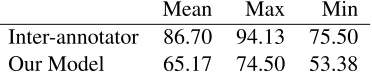
Inter-annotator 86.70 94.13 75.50 Our Model 65.17 74.50 53.38
Table 5: Comparative many-to-1 measures for evaluating differences in annotation granularity. Some numbers are taken from Table 1 (Elsner and Charniak, 2008).
a loc3 comparison, and a many-to-1 comparison.
The 1-to-1 metric tries to maximize the global con-versation overlap in two annotations. Theloc3scale
is better at measuring local agreement. This score calculates accuracy between two annotations for each window of three utterances. Slight differences in a conversation’s start and end are minimized. Fi-nally, the many-to-1 score measures the entropy dif-ference between annotations. In other words, sim-plifying a fine-grained analysis to a coarse-grained analysis will yield good results because of shared major boundaries. Disagreeing about the major con-versation boundaries will yield a low score.
5 Analysis
Compared with the gold standard, our model has a strong preference to split conversations into smaller units. As is evident from Table 4, our model has more conversations than the maximally splitting hu-man annotator. These results are unsurprising given that our classifier posits a new conversation in the absence of contrary evidence. Despite a low 1-to-1 score, our many-to-1 score is relatively high (see Ta-ble 5). We can interpret these results to mean that our model is splitting gold standard conversations into smaller sets rather than creating conversations across gold standard boundaries.
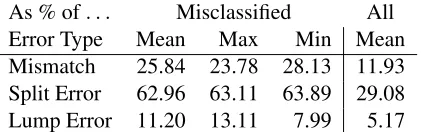
As % of. . . Misclassified All Error Type Mean Max Min Mean Mismatch 25.84 23.78 28.13 11.93 Split Error 62.96 63.11 63.89 29.08 Lump Error 11.20 13.11 7.99 5.17
Table 7: Source of misclassified utterances as a percent-age of misclassified utterances and all utterances.
hand, our loc3 measure jumps much closer to the
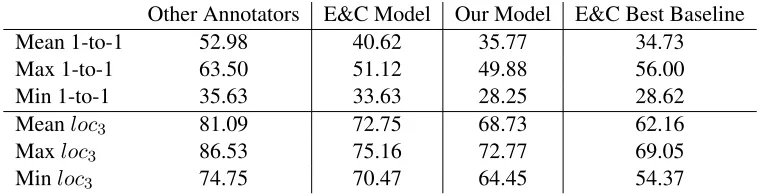
human annotators. In other words, the maximum an-notation overlap of our model and any given human is poor9while the local coherence of our annotation
with respect to any human annotation is high. This pattern is symptomatic of over-splitting, which is ex-cessively penalized by the 1-to-1 metric.10
We also analyzed the types of errors our model made while holding the conversation history con-stant. We simulated a consistent conversation his-tory by treating the gold standard’s choice as an un-beatable vote and tabulating the number of times our model voted with and against the winning conversa-tion. There were five numbers tabulated: matching new conversation votes, matching old conversation votes, mismatching old conversation votes, incorrect split vote, and incorrect lump vote. The mismatch-ing old conversation votes occurred when our model voted for an old conversation but guessed the wrong conversation. The incorrect split vote occurred when our model wanted to create a new conversation but the gold standard voted with an old conversation. Finally, the incorrect lump vote occurred when our model matched the utterance with a old conversation when the gold standard created a new conversation.
Across all six gold standard annotations, nearly two-thirds of the errors arose from incorrect splitting votes (see Table 7). In fact, nearly one-third of all utterances fell into this category.
6 Future Work
The high granularity for what our model considers a conversation had a huge impact on our performance
9Elsner and Charniak (2008) found their annotators also
tended to disagree on the exact point when a new conversation begins.
10Aoki et al. (2006) present a thorough analysis of
conver-sational features associated with schisming, the splitting off of new conversations from old conversations.
scores. The high many-to-1 scores imply that more human-like chunks will improve performance. The granularity may be very task dependent and so we will need to be careful not to overfit our model to this data set and these annotators. New features should be tested with several chat corpora to better under-stand the cue trading effects of genre.
At present, our model uses only a minimal set of features. Discourse cues and temporal cues are two simple measures that can be added. Our current fea-tures can also use refinement. For instance, even par-tially disambiguating the particular sense of the lem-mas should reduce the noise in our similarity mea-sures. Ranking the semantic similarity, in contrast with the current winner-takes-all approach, should improve our results. Accounting for forward refer-encing, when a speaker invokes another’s name to draw them into a conversation, is also important.
Finally, understanding the different voting pat-terns of each feature system will help us to better understand the reliability of the different cues. To-wards this end, we need to monitor and act upon the strength and type of disagreement among voters. Acknowledgments
Harish Srinivasan was great help in tokenizing the data. The NLP Group at Janya, Inc., Jordana Heller, Jean-Pierre Koenig, Michael Prentice, and three anonymous reviewers provided useful feedback.
References
Evrim Acar, Seyit Ahmet Camtepe, Mukkai S. Kr-ishnamoorthy, and Blent Yener. 2005. Model-ing and multiway analysis of chatroom tensors. In Paul B. Kantor, Gheorghe Muresan, Fred Roberts, Daniel Dajun Zeng, Fei-Yue Wang, Hsinchun Chen, and Ralph C. Merkle, editors, ISI, volume 3495 of
Lecture Notes in Computer Science, pages 256–268. Springer.
Paul M. Aoki, Matthew Romaine, Margaret H. Szyman-ski, James D. Thornton, Daniel Wilson, and Allison Woodruff. 2003. The Mad Hatter’s cocktail party: A social mobile audio space supporting multiple simul-taneous conversations. InCHI 03: Proceedings of the SIGCHI Conference on Human Factors in Computing Systems, pages 425–432, New York, NY, USA. ACM Press.
Other Annotators E&C Model Our Model E&C Best Baseline
Mean 1-to-1 52.98 40.62 35.77 34.73
Max 1-to-1 63.50 51.12 49.88 56.00
Min 1-to-1 35.63 33.63 28.25 28.62
Meanloc3 81.09 72.75 68.73 62.16
Maxloc3 86.53 75.16 72.77 69.05
Minloc3 74.75 70.47 64.45 54.37
Table 6: Metric values for our model as compared with Elsner and Charniak’s human annotators and classifier. Some numbers are taken from Table 3 (Elsner and Charniak, 2008).
2006. Where’s the “party” in “multi-party”? Ana-lyzing the structure of small-group sociable talk. In
ACM Conference on Computer Supported Coopera-tive Work, pages 393–402, Banff, Alberta, Canada, November. ACM Press.
Doug Beeferman, Adam Berger, and John Lafferty. 1999. Statistical models for text segmentation. In Ma-chine Learning, pages 177–210.
Alexander Budanitsky and Graeme Hirst. 2006. Evalu-ating WordNet-based measures of lexical semantic re-latedness.Computational Linguistics, 32(1):13–47. Seyit Ahmet Camtepe, Mark K. Goldberg, Malik
Magdon-Ismail, and Mukkai Krishnamoorty. 2005. Detecting conversing groups of chatters: A model, al-gorithms, and tests. InIADIS AC, pages 89–96. S. Deerwester, S. T. Dumais, G. W. Furnas, T. K.
Lan-dauer, and R. Harshman. 1990. Indexing by Latent Semantic Analysis. Journal of the American Society of Information Science, 41:391–407.
Micha Elsner and Eugene Charniak. 2008. You talk-ing to me? A corpus and algorithm for conversa-tion disentanglement. InThe Association for Compu-tational Linguistics: Human Language Technologies (ACL-HLT 2008), Columbus, Ohio.
Michel Galley, Kathleen McKeown, Eric Fosler-Lussier, and Hongyan Jing. 2003. Discourse segmentation of multi-party conversation. InProceedings of the ACL, pages 562–569.
Michael Halliday and Ruqaiya Hasan. 1976. Cohesion in English. Longman Group, New York.
Marti A. Hearst. 1997. TextTiling: Segmenting text into multi-paragraph subtopic passages. Computational Linguistics, 23(1):33–64.
J. R. Hobbs. 1979. Coherence and coreference. Cogni-tive Science, 3:67–90.
A. Kehler. 2000. Coherence, Reference, and the Theory of Grammar. CSLI Publications.
Hideki Kozima and Teiji Furugori. 1993. Similarity between words computed by spreading activation on an English dictionary. In Proceedings of 6th Con-ference of the European Chapter of the Association
for Computational Linguistics (EACL–93), pages 232– 239, Utrecht.
Hideki Kozima. 1993. Text segmentation based on sim-ilarity between words. In Proceedings of ACL’93, pages 286–288, Ohio.
C. D. Manning. 1998. Rethinking text segmentation models: An information extraction case study. Tech-nical Report SULTRY–98–07–01, University of Syd-ney.
Jane Morris and Graeme Hirst. 1991. Lexical cohe-sion computed by thesaural relations as an indicator of the structure of text. Computational Linguistics, 17(1):21–48.
Jacki O’Neill and David Martin. 2003. Text chat in ac-tion. InGROUP ‘03: Proceedings of the 2003 Inter-national ACM SIGGROUP Conference on Supporting Group Work, pages 40–49, New York, NY, USA. ACM Press.
R. Power, D. Scott, and N. Bouayad-Agha. 2003. Document structure. Computational Linguistics, 29(2):211–260.
Philip Resnik. 1995. Using information content to evalu-ate semantic similarity in a taxonomy. InProceedings of the 14th International Joint Conference on Artificial Intelligence, pages 448–453.
Jeffrey C. Reynar. 1999. Statistical models for topic seg-mentation. InProceedings of the 37th Annual Meeting of the ACL, pages 357–364, Maryland, USA, June. Peter Mark Roget, editor. 1911. Roget’s Thesaurus.
Project Gutenberg.
R. K. Srihari, W. Li, C. Niu, and T. Cornell. 2008. Infox-tract: A customizable intermediate level information extraction engine.Journal of Natural Language Engi-neering, 14(1):33–69.
Michael Sussna. 1993. Word sense disambiguation for free-text indexing using a massive semantic net-work. In Proceedings of the Second International Conference on Information and Knowledge Manage-ment (CIKMA–93), pages 67–74, Arlington, VA. Grady Ward, editor. 2002.Moby Thesaurus List. Project