Exploring Miscommunication and Collaborative Behaviour in
Hu-man-Robot Interaction
Theodora Koulouri
Department of Information Systems and
Computing
Brunel University
Middlesex UB8 3PH
[email protected]
Stanislao Lauria
Department of Information Systems
and Computing
Brunel University
Middlesex UB8 3PH
[email protected]
Abstract
This paper presents the first step in de-signing a speech-enabled robot that is ca-pable of natural management of mis-communication. It describes the methods and results of two WOz studies, in which dyads of naïve participants interacted in a collaborative task. The first WOz study
explored human miscommunication
management. The second study investi-gated how shared visual space and moni-toring shape the processes of feedback and communication in task-oriented inte-ractions. The results provide insights for the development of human-inspired and robust natural language interfaces in ro-bots.
1
Introduction
Robots are now escaping laboratory and indus-trial environments and moving into our homes and offices. Research activities have focused on offering richer and more intuitive interfaces, leading to the development of several practical systems with Natural Language Interfaces (NLIs). However, there are numerous open chal-lenges arising from the nature of the medium itself as well as the unique characteristics of Human-Robot Interaction (HRI).
1.1 Miscommunication in Human-Robot
Interaction
HRI involves embodied interaction, in which humans and robots coordinate their actions shar-ing time and space. As most speech-enabled ro-bots remain in the labs, people are generally un-aware of what robots can understand and do re-sulting in utterances that are out of the functional
and linguistic domain of the robot. Physical co-presence will lead people to make strong but misplaced assumptions of mutual knowledge (Clark, 1996), increasing the use of underspeci-fied referents and deictic expressions. Robots operate in and manipulate the same environment as humans, so failure to prevent and rectify errors has potentially severe consequences. Finally, these issues are aggravated by unresolved chal-lenges with automatic speech recognition (ASR) technologies. In conclusion, miscommunication in HRI grows in scope, frequency and costs, im-pelling researchers to acknowledge the necessity to integrate miscommunication in the design process of speech-enabled robots.
1.2 Aims of study
The goal of this study is two-fold; first, to incor-porate “natural” and robust miscommunication management mechanisms (namely, prevention and repair) into a mobile personal robot, which is capable of learning by means of natural language instruction (Lauria et al., 2001). Secondly, it aims to offer some insights that are relevant for the development of NLIs in HRI in general. This research is largely motivated by models of hu-man communication. It is situated within the lan-guage-as-action tradition and its approach is to explore and build upon how humans manage miscommunication.
2
Method
guided the robot to six designated locations in a simulated town. The user had full access to the map whereas the wizard could only see the sur-rounding area of the robot. Thus, the wizard re-lied on the user’s instructions on how to reach the destination. In this section we outline the aim and approach of each WOz study, the materials used and the experimental procedure. Sections 4 and 5 focus on each study individually and their results.
2.1 The first WOz study
This study is a continuation of previous work by the authors (Koulouri and Lauria, 2009). In that study, the communicative resources of the wizard were incrementally restricted, from “normal” dialogue capabilities towards the capabilities of a dialogue system, in three experimental condi-tions:
x The wizard simulates a super-intelligent robot capable of using unconstrained, natural language with the user (henceforth, Unconstrained Condition).
x The wizard can select from a list of de-fault responses but can also ask for clarifi-cation or provide task-related information (henceforth, Semi-Constrained condition).
x The wizard is restricted to choose from a limited set of canned responses similar to a typical spoken dialogue system (SDS). The current study investigates the first two con-ditions and presents new findings.
2.2 The second WOz study
The second round of WOz experiments explored the effects of monitoring and shared visual in-formation on the dialogue.
2.3 Set-up
A custom Java-based system was developed and was designed to simulate the existing prototype (the mobile robot). The system consisted of two applications which sent and received coordinates and dialogue and were connected using the TCP/IP protocol over a LAN. The system kept a log of the interaction and the robot’s coordinates.
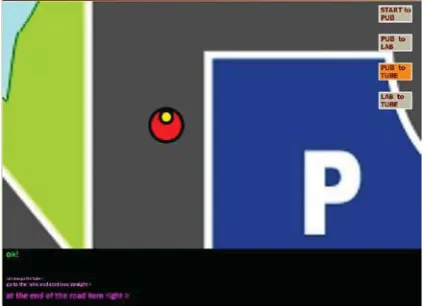
The user’s interface displayed the full map of the town (Figure 1). The dialogue box was below the map. Similar to an instant messaging applica-tion, the user could type his/her messages and see the robot’s responses appearing on the lower part of the box. In the first WOz study, the user’s in-terface included a small “monitor” on the upper
[image:2.595.310.520.136.296.2]right corner of the screen that displayed the cur-rent surrounding area of the robot, but not the robot itself. Then, for the purposes of the second study, this feature was removed (see Figure 1 in Appendix A).
Figure 1. The user’s interface.
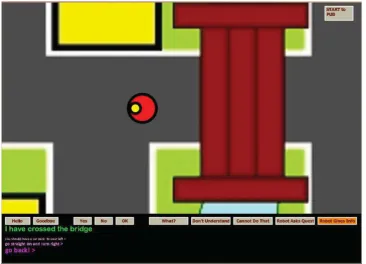
The wizard’s interface was modified accord-ing to the two experimental conditions. For both conditions, the wizard could only see a fraction of the map- the area around the robot’s current position. The robot was operated by the wizard using the arrow keys on the keyboard. The dialo-gue box of the wizard displayed the most recent messages of both participants as well as a history of the user’s messages. The buttons on the right side of the screen simulated the actual robot’s ability to remember previous routes: the wizard clicked on the button that corresponded to a known route and the robot automatically ex-ecuted. In the interface for the Unconstrained condition, the wizard could freely type and send messages (Figure 2).
Figure 2. The wizard’s interface in the Uncon-strained condition.
[image:2.595.308.523.519.672.2]“Hel-lo”, “Goodbye”, “Yes”, “No”, “Ok” and the problem-signalling responses, “What?”, “I don’t understand” and “I cannot do that”. The second way was to click on the “Robot Asks Question” and “Robot Gives Info” buttons which allowed the wizard to type his/her own responses (see Figure 2 in Appendix A).
2.4 Procedure
A total of 32 participants were recruited, 16 users and 16 wizards. The participants were randomly assigned to the studies, experimental conditions and to the roles of wizard or user. The pairs were seated in different rooms equipped with a desk-top PC. The wizards were given a short demon-stration and a trial period to familiarise with the operation of the system and were also informed about whether the users would be able to monitor them. The users were told that they would inte-ract with a robot via a computer interface; this robot was very fluent in understanding spatial language and could give appropriate responses, it could learn routes but had limited vision. The users were asked to begin each task whenever they felt ready by clicking on the links on their computer screen, start the interaction with “Hel-lo”, which opened the wizard’s application, and end it with “Goodbye” which closed both appli-cations. The participants received verbal and written descriptions of the experiment. They were not given any specific guidelines on how to interact or what routes to take. However, the us-ers were asked not to use directions such as “north”, “south”, “up”, “down” etc. The wizards were also advised not to try to “sound like a ro-bot”, but respond normally.
3
Data analysis
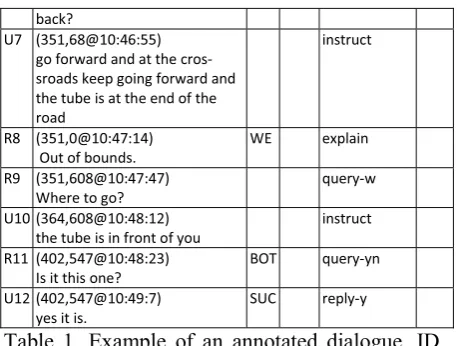
The dialogues collected were annotated on the basis of dialogue acts (DAs), miscommunication, and task status. An example of an annotated di-alogue is shown in Table 1.
ID (x,y@TIME) MESSAGE
T.S. MISC HCRC TAG
U1 (899,445@10:44:34) go straight on.
instruct
R2 (880,286@10:44:59) There is a wall straight on.
Rej explain Imp
U3 (884,286@10:45:28) ok turn left here then take the third right
acknowledge/ instruct
R4 (352,216@10:45:58) Before the bridge?
Non check Imp
U5 (351,68@10:46:17) this is the wrong place
WE Corr explain
R6 (351,68@10:46:39)
Wrong place. Should Robot go
acknowledge/ query-yn
back?
U7 (351,68@10:46:55) go forward and at the cros-sroads keep going forward and the tube is at the end of the road
instruct
R8 (351,0@10:47:14) Out of bounds.
WE explain
R9 (351,608@10:47:47) Where to go?
query-w
U10 (364,608@10:48:12) the tube is in front of you
instruct
R11 (402,547@10:48:23) Is it this one?
BOT query-yn
U12 (402,547@10:49:7) yes it is.
[image:3.595.303.532.68.241.2]SUC reply-y
Table 1. Example of an annotated dialogue. ID denotes the speaker (User or Robot), T.S. stands for task status and MISC for miscommunication.
3.1 Annotation of dialogue acts
The DAs in the corpus were annotated following the HCRC coding scheme (Carletta et al., 1996). Motivated by Skantze (2005), the last column in Table 1 contains information on the explicitness of the response. This feature was only relevant for repair initiations by the wizards. For instance, responses like “What?” and the the ones in Table 3 were considered to be explicit (EX) signals of miscommunication, whereas lines 2 and 4 in the dialogue above were labelled as implicit (IMP).
3.2 Annotation of task execution status
The coordinates (x,y) of the robot’s position re-corded for every exchanged message were placed on the map of the town (of dimensions 1024x600 pixels) allowing the analysts to retrace the movements of the robot. Wrong executions (WE) were determined by juxtaposing the user’s in-struction with the robot’s execution, as indicated by the coordinates. Back-on-Track (BOT) was tagged when the first user instruction after a wrong execution was executed correctly. Finally, task success (SUC) was labelled when the robot reached the destination and it was confirmed by the user.
3.3 Annotation of miscommunication
tagged when the user (who was monitoring the understanding) signalled a wrong execution (see line 5 in Table 1). These correction tags (Corr) did not always coincide with wrong execution tags, but were used when the user became aware of the error (after receiving visual or verbal in-formation). Following the same definition, mis-understandings were also tagged as rejections (tag: Rej) when the wizard expressed inability to execute the instruction (for instance, given the robot’s current location, as shown in line 2 in the dialogue), although he/she was able to interpret it. Secondly, non-understandings (tag: Non, line 4) occurred when the wizards obtained no inter-pretation at all or too many. Non-understandings also included cases in which wizards were uncer-tain about their interpretation (as suggested by Gabsdil, 2003). Lastly, misconceptions happen when the beliefs of the interlocutors clash, and are outside the scope of this study.
4
First WOz study
Skantze (2005) and Williams and Young (2004) performed variations of WOz studies to explore how humans handle ASR errors, using a real or simulated speech recogniser. They discovered that even after highly inaccurate recognition out-put, the participants rarely signalled non-understanding explicitly. Accordingly, the expe-rimental hypothesis of the present study is that wizards in both conditions will not choose expli-cit responses to signal miscommunication (such as “I don’t understand” or “What?”) but res-ponses that contribute with information.
ASR is a major source of errors in SDS. But as miscommunication is ubiquitous in interaction, there are many other sources of ambiguity that give rise to problematic understanding. Thus, for the current purposes of this work, it was decided that ASR would have an overwhelming effect on the interaction that might prevent the observation of other interesting dialogue phenomena.
This section describes further work on the Un-constrained and Semi-Constrained conditions (see Section 2.1). Twenty participants were re-cruited and randomly allocated to each condition.
4.1 Results
Analysis of the dialogues of the Unconstrained condition reinforced previous findings and con-firmed the experimental hypothesis. In particular, wizards never used explicit repairs, but preferred to describe their location, request clarification and further instructions. Integrating finer
classi-fication of clariclassi-fication requests (CRs) and the original dialogue act tagging, the DAs used by the wizards to signal non-understandings and rejections were categorised as shown in Table 2.
Dialogue Act Explanation
Explain The wizard gives description of robot’s location. E.g., “I crossed the bridge.”, “I am at a cross-road”.
Check This category covers CRs. The corpus contained two types of CRs: first, task-level reformulations (as in line 4 in Table 1), which reformulate the utterance on the basis of its effects on the task, showing the wizard’s subjective understanding (Gabsdil, 2003). Second, alternative CRs which occur when the wizard gives two alternative interpretations, trying to resolve referential ambiguity. For instance, “back to the bridge or to the factory”, to resolve “go back to last loca-tion”.
Query-w The wizard asks for further instructions. E.g., “Please give me further instructions.”
Explain+Query-w
A combo of actions; the wizard provides infor-mation on location and asks for further instruc-tions. E.g., “crossroads, now where?”
Table 2.Wizard DAs after miscommunication.
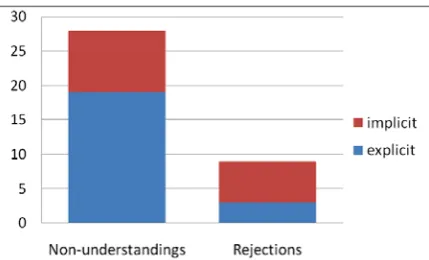
[image:4.595.306.523.483.605.2]Figure 3 illustrates the distribution of these re-sponses to signal non-understandings and rejec-tions (columns labelled “Uncons-NON” and “Uncons-REJ”, respectively). Evidently, there is a much greater variety of CRs than the two CR types reported here, as described in the work of Purver (2006) and Schlangen (2004). However, for a navigation task and having excluded ASR errors, problems occurred mainly in the meaning recognition level (explained below) and aimed for reference resolution.
Figure 3. Use of strategies to signal non-understandings or rejections, for either condition.
In the Semi-Constrained condition, a degree of restrain and control over the error handling ca-pacity of the wizards was introduced. In particu-lar, the wizards could explicitly signal communi-cation problems in the utterance, meaning and action level using three predefined responses. This is inspired by the models of Clark (1996) and Allwood (1995), according to which, mis-communication can occur in any of these levels and people select repair initiations that point to the source of the problem. The model (adapted from Mills and Healey, 2006) and the responses are schematically shown in Table 3 below.
Levels of Communication Wizard Responses Level 1 Securing Attention - Level 2 Utterance Recognition “What?”
Level 3 Meaning Recognition “Sorry, I don’t understand.” Level 4 Action Recognition “I cannot do that.”
Table 3. Levels of communication.
Moreover, based on the classification of the wizard’s error handling strategies in the Uncon-strained condition (Table 2), we collapsed the observed strategies in two categories of re-sponses which resulted in adding two more error handling buttons; namely, the button denoted as “Robot Asks Question” corresponded to the “Check” and “Query-w” strategies. The “Robot Gives Info” was associated with “Explain”. This clear labelling of error handling actions pre-sented to the wizards of the Semi-Constrained condition aimed to “coerce” them to use the strategies in a more transparent way. This could allow us a glimpse to the mechanisms and proc-esses underlying human miscommunication management.
Analysis of the dialogues revealed that in the Semi-Constrained condition wizards employed both explicit and implicit strategies. Figure 4 shows the distribution of explicit and implicit responses to signal non-understandings and re-jections. Figure 3 shows the frequency of each implicit strategy to signal non-understandings (Semi-NON) and rejections (Semi-REJ).
[image:5.595.307.522.69.199.2]The initial prediction was that wizards will not use explicit signals of problems in the dialogue. This was contradicted by the results. It can be argued that the physical presence of the buttons and the less effort required account for this phe-nomenon. On the other hand, it is also plausible to assume that these strategies matched what the wizards wanted to say. Finally, there were no significant differences between conditions in terms of user experience, task success and time on task (as reported in Koulouri and Lauria, 2009).
Figure 4. Occurrence of implicit and explicit miscommunication signals (Semi-Constrained).
4.2 Discussion and future work
The findings of this study could be extrapolated to HRI. Classification of the responses of the wizards resulted in a limited set of error signal-ling strategies. Therefore, in the presence of mis-communication the robot could use the static, explicit strategies. But these strategies alone are inadequate (as shown by Koulouri and Lauria, 2009). They need to be supplemented, but not entirely replaced, with dynamic error handling strategies; namely, posing relevant questions and providing descriptions of location. Yet this en-tails several challenges. Gabsdil (2003) identifies the complexity of adding clarification requests to systems with deep semantic processing. With regard to alternative clarifications, systems would need to generate two alternative interpre-tations for one referent. Task-level reformula-tions would also require the system to have the capability to identify the effects of all possible executions of the instruction. As a next step, we will focus on issues concerning the implementa-tion of such funcimplementa-tionality.
Schlangen (2004) suggests that “general-purpose” repair initiations, such as “What?”, which request repetition of the whole utterance, are more severe for the dialogue compared to reprise fragments (e.g., “Turn where?”) that ac-cept part of the utterance. Mills and Healey (2006) also found that “What’s” were more dis-ruptive to the dialogue than reprise fragments. Guided by these insights, our current work looks at how each error strategy affects the subsequent unfolding of the dialogue.
5
The second WOz study
Brennan (2005) explored different communica-tion tasks and compared a condicommunica-tion, in which visual and verbal information was available, with a speech-only condition. In their experiments, a person gave instructions to another participant on how to complete a task. Their findings seem to resonate. In terms of time for task completion and number of words per turn, the interactions in the visual information condition were more effi-cient. The physical actions of the person follow-ing the instructions functioned as confirmations and substituted for verbal grounding. Regarding errors, no significant differences were observed between visual and speech-only conditions. Mo-tivated by these findings in human-human inte-raction, the second study aims to identify the dif-ferences in the processes of communication de-pending on whether the user can or cannot moni-tor the actions of the robot.
5.1 Experimental design
The study followed a between-subjects factorial design. Experiments were performed for four different conditions, as illustrated in Table 4. The conditions “Monitor, Unconstrained” and “Moni-tor, Semi-Constrained” were the same as in the first study. Five pairs of participants were re-cruited to each of the Monitor Conditions and three pairs to each of the No Monitor Conditions.
Unconstrained Semi-Constrained
Monitor Monitor, Uncon-strained
Monitor, Semi-Constrained
No Monitor No Monitor, Uncon-strained
[image:6.595.305.537.454.549.2]No Monitor, Semi-Constrained
Table 4. The design of the 2ndstudy.
5.2 Results
The data collection resulted in 96 dialogues, 93 of which were used in the analysis. The data were analysed using a two-way ANOVA. All effects that were found to be significant were verified by T-tests. The efficiency of interaction was determined using the following measures: time per task, number of turns, words, miscom-munication-tagged turns, wrong executions and task success.
Time per task:The second column of Table 5 displays the average completion time per task in the four conditions. As expected, a main effect of the Monitor factor was found (F=4.879, df=1,11, p<0.05). Namely, when the user could monitor the robot’s area the routes were completed faster. The interaction effect between factors was also marginally significant (F=4.225, df=1,11, p<0.1); pairs in the No Monitor, Semi-Constrained
con-dition could not compensate for the lack of visual information and took longer for each task.
Number of turns and words: The aforemen-tioned studies correlate task efficiency with number of turns and words. In terms of the mean number of turns per interaction, no significant differences were found across the groups. Nev-ertheless, we measured the number of words used per task and in accordance with previous research, we observed that pairs in the No Moni-tor conditions used more words (F=4.602, df=1,11, p=0.05). However, it was the wizards under the No Monitor conditions that had to be more “talkative” and descriptive (F=10.324, df=1,11, p<0.01). Figure 5 shows the “word-possession” rates attributed to wizards in the four conditions. Moreover, there seems to be a differ-ence (F=4.397, df=1,11, p=0.05) in the mean number of words per turn. In particular, when the wizards’ actions were visible to the users, the wizards required fewer words per turn. There is also an interaction effect showing more signifi-cant differences between the Monitor, Semi-Constrained condition and the No Monitor, Semi-Constrained condition (F=5.970, df=1,11, p<0.05); in the former, wizards managed with less than 2 words per utterance, taking full ad-vantage of the luxury of the buttons and the fact that they were supervised. In the latter, wizards used more than 6 words per turn.
Figure 5. Words used by wizards over total.
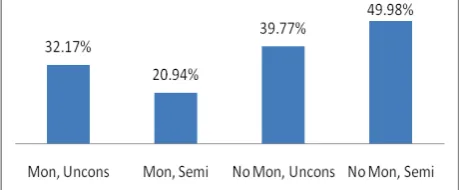
Frequency of miscommunication:We meas-ured the number of turns that were tagged as con-taining miscommunication. Surprisingly, mis-communication rates were much lower in the No Monitor conditions (F=13.316, df=1,11, p<0.01) and not in the conditions in which the user could check at all times the actions and understanding of the robot. The same pattern was found for us-er-initiated and robot-initiated miscommunica-tion. The rates of miscommunication are in-cluded in the third column of Table 5.
the users (F=6.046, df=1,11, p<0.05). They made on average 1 mistake per task, whereas the average number of wrong executions for the pairs in the Monitor conditions was 5 (fourth column in Table 5).
Task success rates:There were no differences in the number of interrupted or aborted tasks.
Condition
Time per Task (min)
Miscommunication Turns/Total Turns
#Wrong Executions
per Task Mon, Uncons 4.57 8.21% 4.2 Mon, Semi 4.63 8.82% 5.8 No Mon, Uncons 5.67 2.55% 1.0 No Mon, Semi 7.41 1.71% 0.7
Table 5. Summary of results (mean values).
5.3 Discussion and future work
These results are consistent with previous re-search. The conditions in which the user could see exactly what the robot saw and did resulted in faster task completion and shorter dialogues. However, a finding emerged which was not ex-pected based on the aforementioned studies: in the conditions in which users could not monitor the robot’s actions, the wizards were more accu-rate, leading to low occurrence of wrong execu-tions and miscommunication (see column 3 and 4 in Table 5). The “least collaborative effort” is balanced and compromised against the need to ensure understanding. Thus, wizards provided rich and timely feedback to the users in order to compensate for the lack of visual information. This feedback acted in a proactive way and pre-vented miscommunication and wrong executions. In the Monitor conditions, asymmetries in per-ceived responsibility and knowledge between the participants could have encouraged wizards to be less cautious to act. In other words, as the user had access to the full map and the location of the wizard, the wizard felt less “obliged” to contri-bute to the interaction. However, due to the com-plex nature of the task, unless the wizard could sufficiently communicate the relevant position of the robot, the directions of the user would more likely be incorrect. It could also be assumed that since visual feedback is instant, the users were also more inclined to issue commands in a “trial and error” process. Irrespectively to the underly-ing motives, these findunderly-ings show that despite higher costs in time and word count, linguistic resources were adequate for completing complex tasks successfully. The findings also resonate with the collaborative view of communication. The wizards adapted their behaviour in response to variations in the knowledge state of their part-ners and made up for the lack of visual
informa-tion with rich verbal descripinforma-tions of their loca-tions.
We are currently performing more experi-ments to balance the data sets of the study and validate the initial results. Moreover, a fine-grained analysis of the dialogues is under way and focuses on the linguistic content of the inte-ractions. The aim is identical to the first WOz study, that is, to identify the strategies of the wi-zards in the presence and absence of visual in-formation.
These results have important implications for HRI. As in human collaborative interaction, the robot’s communicative actions have direct im-pact on the actions of the users. In real-world settings, there will be situations in which the us-ers cannot monitor the robot’s activities or their information and knowledge are either con-strained or outdated. Robots that can dynamically determine and provide appropriate feedback could help the users avoid serious errors. Never-theless, this is not a straightforward process; pro-viding excessive, untimely feedback compromis-es the “naturalncompromis-ess” and efficiency of the interac-tion. The amount and placement of feedback should be decided upon several knowledge sources, combined in a single criterion that is adaptive within and between interactions. These issues are the object of our future work and im-plementation.
6
Concluding remarks
quantita-tive and followed established methods from pre-vious research. Finally, the results of the study matched and extended these findings and pro-vided useful information for the next version of the system as well as some insight into the processes of conversation and social psychology.
The next step in our research is to develop the dialogue manager of the robot to incorporate the feedback and miscommunication management strategies, as observed in the collected data. This holds the promise for a robust NLI that can han-dle uncertainties arising from language and the environment. However, miscommunication in HRI reaches beyond preventing and repairing recognition errors. Mills and Healey (2008) demonstrate that miscommunication does not inhibit but, on the contrary, it facilitates semantic coordination. Martinovsky and Traum (2003) suggest that through miscommunication, people gain awareness of the state and capabilities of each other. Miscommunication, thus, is seen as an opportunity for communication. Under this light, natural miscommunication management is not only the end, but also the means to shape and advance HRI, so that robots are not tools but partners that play a positive, practical and long-lasting role in human life.
References
Bilyana Martinovsky and David Traum. 2003.The Error Is the Clue: Breakdown in Human-Machine Interaction. In Proceedings of the ISCA Workshop on Error Handling in Dialogue Systems.
Dan Bohus and Alexander I. Rudnicky. 2005. Sorry, I Didn’t Catch That! – An Investigation of Non-understanding Errors and Recovery Strategies. In Proceedings of SIGdial2005. Lisbon, Portugal.
Darren Gergle, Robert E. Kraut and Susan E. Fussell. 2004. Language Efficiency and Visual Technolo-gy: Minimizing Collaborative Effort with Visual Information. Journal of Language and Social
Psy-chology,23(4):491-517. Sage Publications, CA.
David Schlangen. 2004. Causes and Strategies for Requesting Clarification in dialogue. In Proceed-ings of the 5th Workshop of the ACL SIG on
Dis-course and Dialogue (SIGdial04), Boston, USA.
Gabriel Skantze. 2005. Exploring Human Error Re-covery Strategies: Implications for Spoken Dialo-gue Systems. Speech Communication, 45(3):207-359.
Graeme Hirst, Susan McRoy, Peter Heeman, Philip Edmonds, Diane Horton.1994. Repairing Conver-sational Misunderstandings and Nonunderstand-ings. Speech Communication 15:213–230.
Gregory Mills and Patrick G. T. Healey. 2008. Nego-tiation in Dialogue: Mechanisms of Alignment. In Proceedings of the 8th SIGdial workshop on
Dis-course and Dialogue, Columbus, OH, USA.
Gregory Mills and Patrick G. T. Healey. 2006. Clari-fying Spatial Descriptions: Local and Global Ef-fects on Semantic Co-ordination. In Procs. of the
10thWorkshop on the Semantics and Pragmatics of
Dialogue.
Herbert H. Clark. 1996. Using Language. Cambridge University Press, Cambridge, UK.
Herbert H. Clark and Meredyth A. Krych. 2004. Speaking While Monitoring Addressees for Under-standing. Journal of Memory and Language, 50:62-81.
Jason D. Williams and Steve Young. 2004. Characte-rizing Task-Oriented Dialog Using a Simulated ASR Channel. ICSLP. Jeju, South Korea.
Jean Carletta, Amy Isard, Stephen Isard, Jacqueline Kowtko, Gwyneth Doherty-Sneddon and Anne H. Anderson.1996. HCRC Dialogue Structure Coding Manual(HCRC/TR-82). Human Communication Research Centre, University of Edinburgh.
Jens Allwood. 1995. An Activity based Approach to Pragmatics. Gothenburg Papers in Theoretical Lin-guistics, 76, Göteborg University,Sweden.
Kenny Coventry, Thora Tenbrink and John Bateman, 2009. Spatial Language and Dialogue: Navigating the Domain. In K. Coventry, T. Tenbrink, and J. Bateman (Eds.) Spatial Language and Dialogue. 1-8. Oxford University Press. Oxford, UK.
Malte Gabsdil. 2003. Clarification in Spoken Dialo-gue Systems. In: Proceedings of 2003 AAAI Spring Symposium on Natural Language Generation in
Spoken and Written Dialogue, Stanford, USA.
Matthew Purver. 2006. CLARIE: Handling Clarifica-tion Requests in a Dialogue System. Research on
Language and Computation. 4(2-3):259-288.
Stanislao Lauria, Guido Bugmann, Theocharis Kyria-cou, Johan Bos and Ewan Klein. 2001. Training Personal Robots Using Natural Language Instruc-tion. IEEE Intelligent Systems. 38–45.
Susan E. Brennan . 2005. How Conversation is Shaped by Visual and Spoken Evidence. In J. Trueswell & M. Tanenhaus (Eds.) Approaches to Studying World-situated Language Use: Bridging the Language-as-product and Language-action
Traditions. 95-129. MIT Press, Cambridge, MA.
Theodora Koulouri and Stanislao Lauria. 2009. A WOz Framework for Exploring Miscommunication in HRI, In Procs. of the AISB Symposium on New
Frontiers in Human-Robot Interaction. Edinburgh,
Appendix A. Screenshot images of the
in-terface
Figure 1. The interface of the user without the monitor (as used in the second WOz study).
[image:9.595.64.431.426.690.2]