Multi-level Association Graphs –
A New Graph-Based Model for Information Retrieval
Hans Friedrich Witschel NLP department University of Leipzig 04009 Leipzig, P.O. Box 100920 [email protected]
Abstract
This paper introducesmulti-level associa-tion graphs(MLAGs), a new graph-based framework for information retrieval (IR). The goal of that framework is twofold: First, it is meant to be a meta model of IR, i.e. it subsumes various IR models under one common representation. Sec-ond, it allows to model different forms of search, such as feedback, associative re-trieval and browsing at the same time. It is shown how the new integrated model gives insights and stimulates new ideas for IR algorithms. One of these new ideas is presented and evaluated, yielding promis-ing experimental results.
1 Introduction
Developing formal models for information retrieval has a long history. A model of information retrieval “predicts and explains what a user will find relevant given the user query” (Hiemstra, 2001). Most IR models are firmly grounded in mathematics and thus provide a formalisation of ideas that facilitates dis-cussion and makes sure that the ideas can be imple-mented. More specifically, most IR models provide a so-calledretrieval functionf(q, d), which returns – for given representations of a documentdand of a user information needq– a so-called retrieval status value by which documents can be ranked according to their presumed relevance w.r.t. to the queryq.
In order to understand the commonalities and dif-ferences among IR models, this paper introduces the
notion of meta modeling. Since the word “meta model” is perhaps not standard terminology in IR, it should be explained what is meant by it: a meta model is a model or framework that subsumes other IR models, such that they are derived by specifying certain parameters of the meta model.
In terms of IR theory, such a framework conveys what is common to all IR models by subsuming them. At the same time, the differences between models are highlighted in a conceptually simple way by the different values of parameters that have to be set in order to arrive at this subsumption. It will be shown that a graph-based representation of IR data is very well suited to this problem.
IR models concentrate on the matchingprocess, i.e. on measuring the degree of overlap between a query q and a document representation d. On the other hand, there are the problems of finding suit-able representations for documents (indexing) and for users’ information needs (query formulation). Since users are often not able to adequately state their information need, some interactive and asso-ciative procedures have been developed by IR re-searchers that help to overcome this problem:
• Associative retrieval, i.e. retrieving informa-tion which is associated to objects known or suspected to be relevant to the user – e.g. query terms or documents that have been retrieved al-ready.
top-ranked documents to be relevant (pseudo feedback) and learns better query formulations from this information.
• Browsing, i.e. exploring a document collec-tion interactively by following links between objects such as documents, terms or concepts.
Again, it will be shown that – using a graph-based representation – these forms of search can be sub-sumed easily.
2 Related work 2.1 Meta modeling
In the literal sense of the definition above, there is a rather limited number of meta models for IR, the most important of which will be described here very shortly.
Most research about how to subsume various IR models in a common framework has been done in the context of Bayesian networks andprobabilistic inference(Turtle and Croft, 1990). In this approach, models are subsumed by specifying certain proba-bility distributions. In (Wong and Yao, 1995), the authors elaborately show how all major IR models known at that time can be subsumed using proba-bilistic inference. Language modeling, which was
notknown then was later added to the list by (Met-zler and Croft, 2004).
Another graph-based meta modeling approach uses the paradigm ofspreading activation(SA) as a simple unifying framework. Given semantic knowl-edge in the form of a (directed) graph, the idea of spreading activation is that a measure of relevance – w.r.t. a current focus of attention – is spread over the graph’s edges in the form ofactivation energy, yielding for each vertex in the graph a degree of re-latedness with that focus (cf. (Anderson and Pirolli, 1984)). It is easy to see how this relates to IR: us-ing a graph that contains vertices for both terms and documents and appropriate links between the two, we can interpret a query as a focus of attention and spread that over the network in order to rank docu-ments by their degree of relatedness to that focus.
A very general introduction of spreading activa-tion as a meta model is given in the early work by (Preece, 1981) All later models are hence special
cases of Preece’s work, including the multi-level as-sociation graphs introduced in section 3. Preece’s model subsumes the Boolean retrieval model, coor-dination level matching and vector space processing. Finally, an interesting meta model is described by (van Rijsbergen, 2004) who uses a Hilbert space as an information space and connects the geometry of that space to probability and logics. In particular, he manages to give the familiar dot product between query and document vector a probabilistic interpre-tation.
2.2 Graph-based models for associative retrieval and browsing
The spreading activation paradigm is also often used for associative retrieval. The idea is to reach vertices in the graph that are not necessarily directly linked to query nodes, but are reachable from query nodes via a large number of short paths along highly weighted edges.
Besides (Preece, 1981), much more work on SA was done, a good survey of which can be found in (Crestani, 1997). A renewed interest in SA was later triggered with the advent of the WWW where hyper-links form a directed graph. In particular, variants of the PageRank (Brin and Page, 1998) algorithm that bias a random searcher towards some starting nodes (e.g. an initial result set of documents) bear close re-semblance to SA (Richardson and Domingos, 2002; White and Smyth, 2003).
Turning to browsing, we can distinguish three types of browsing w.r.t. to the vertices of the graph: index term browsing, which supports the user in for-mulating his query by picking related terms (Doyle, 1961; Beaulieu, 1997), document browsing which serves to expand result sets by allowing access to similar documents or by supporting web browsing (Smucker and Allan, 2006; Olston and Chi, 2003) and combined approaches where both index terms and documents are used simultaneously for brows-ing.
(Agosti and Crestani, 1993) – a data structure con-sisting of three levels, for documents, index terms and concepts. Each level contains objects and links among them. There are also connections between objects of two adjacent levels. An MLHT is meant to be used for interactive query formulation, brows-ing and search, although (Agosti and Crestani, 1993) give no precise specification of the processing pro-cedures.
2.3 Contribution of this work
Compared to Preece’s work, the MLAG framework makes two sorts of modifications in order to reach the goals formulated in the introduction: in order to subsume more IR models, the flexibility and power of Preece’s model is increased by adding real-valued edge weights. On the other hand, a clearer distinc-tion is made between local and global informadistinc-tion through the explicit introduction of “level graphs”.
With the introduction oflevels, the MLAG data structure becomes very closely related to the MLHT paradigm of (Agosti and Crestani, 1993), MLAGs, however, generalise MLHTs by allowing arbitrary types of levels, not only the three types proposed in (Agosti and Crestani, 1993). Additionally, links in MLAGs are weighted and the spreading activation processing defined in the next section makes exten-sive use of these weights.
All in all, the new model combines the data struc-ture of multi-level hypertexts (Agosti and Crestani, 1993) with the processing paradigm of spreading ac-tivation as proposed by Preece (Preece, 1981), re-fining both with an adequate edge weighting. The framework is an attempt to beas general as neces-saryfor subsuming all models and allowing for dif-ferent forms of search, while at the same time being
as specific as possibleabout the things that are really common to all IR models.
3 The MLAG model 3.1 Data structure
Formally, the basis of a multi-level association
graph (MLAG) is a union of n level graphs
L1, ..., Ln. Each of these ndirected graphs Li =
G(V Li, ELi, W Li) consists of a set of vertices
V Li, a setELi ⊆V Li×V Liof edges and a func-tionW Li :ELi→Rreturning edge weights.
In order to connect the levels, there are n −
1 connecting bipartite graphs (or inverted lists)
I1,2, ..., In−1,n where each inverted listIj,j+1 con-sists of vertices V Ij,j+1 = V Lj ∪V Lj+1, edges
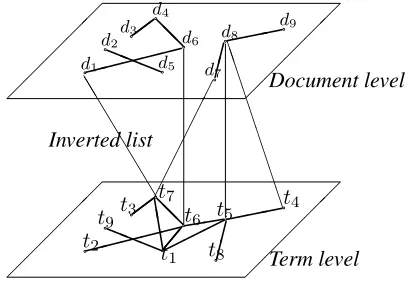
EIj,j+1 ⊆(V Lj×V Lj+1)∪(V Lj+1×V Lj)and weightsW Ij,j+1 :EIj,j+1 → R. Figure 1 depicts
a simple example multi-level association graph with two levelsLdandLtfor documents and terms.
Term level Document level
Inverted list
t`1
t`2
t3` t`6 t5` t`4
t7
`
t8`
t9`
a a a ( ( %% @ @ E E E
d`5
d`1
d3` d`8 d`9
d`6
d`4
d7`
d`2
[image:3.612.330.534.185.327.2]a a a @ @ B B B B B B B B B T T T T T T T
Figure 1: A simple example MLAG
Assuming that the vertices on a given level cor-respond to objects of the same type and vertices in different levels to objects of different types, this data structure has the following general interpreta-tion: Each level represents associations between ob-jects of a given type, e.g. term-term or document-document similarities. The inverted lists, on the other hand, represent associations between different types of objects, e.g. occurrences of terms in docu-ments.
3.2 Examples
3.2.1 Standard retrieval
The simplest version of a multi-level association graph consists of just two levels – a term levelLtand a document levelLd. This is the variant depicted in figure 1.
The graph Itd that connectsLt andLd is an in-verted list in the traditional sense of the word, i.e. a term is connected to all documents that it occurs in and the weight W I(t, d)of an edge (t, d) connect-ing term t and document d conveys the degree to whichtis representative ofd’s content, or to which
The level graphs Lt andLd can be computed in various ways. As for documents, a straight-forward way would be to calculate document similarities, e.g. based on the number of terms shared by two documents. However, other forms of edges are pos-sible, such as hyperlinks or citations – if available. Term associations, on the other hand, can be com-puted using co-occurrence information. An alterna-tive would be to use relations from manually created thesauri or ontologies.
3.2.2 More levels
In order to (partly) take document structure into account, it can be useful to introduce a level for doc-ument parts (e.g. headlines and/or passages) in be-tween the term and the document level. This can be combined with text summarisation methods (cf. e.g. (Brandow et al., 1995)) in order to give higher weights to more important passages in the inverted list connecting passages to documents.
In distributed or peer-to-peer environments, databases or peers may be modeled in a separate layer above the document level, inverted lists in-dicating where documents are held. Additionally, a peer’s neighbours in an overlay network may be modeled by directed edges in the peer level graph. More extensions are possible and the flexibility of the MLAG framework allows for the insertion of ar-bitrary layers.
3.3 Processing paradigm
The operating mode of an MLAG is based on the spreading activation principle. However, the spread of activation between nodes of two differentlevels is not iterated. Rather, it is carefully controlled, yet allowing non-linear modifications at some points.
In order to model spreading activation in an MLAG, we introduce an activation function Ai :
V Li→Rwhich returns the so-calledactivation en-ergies of vertices on a given levelLi. The default value of the activation function isAi(v) = 0for all verticesv∈V Li.
In the following, it is assumed that the MLAG processing is invoked byactivatinga set of vertices
Aon a given levelLiof the MLAG by modifying the activation function of that level so thatAi(v) =wv for eachv∈A.
A common example of such activation is a query
being issued by a user. The initial activation is the result of the query formulation process, which se-lects some verticesv ∈Aand weights them accord-ing to their presumed importancewv. This weight is then the initial activation energy of the vertex.
Once we have an initial set of activated vertices, the following general procedure is executed until some stopping criterion is met:
1. Collect activation values on current level Li, i.e. determineAi(u)for allu∈V Li.
2. (Optionally) apply a transformation to the acti-vation energies ofLi-nodes, i.e. alterAi(u)by using a – possibly non-linear – transformation function or procedure.
3. Spread activation to the next levelLi+1 along the links connecting the two levels:
Ai+1(v) = X
(u,v)∈Ii,i+1
Ai(u)·W I(u, v) (1)
4. SetAi(u) = 0 for allu ∈ V Li, i.e. “forget” about the old activation energies
5. (Optionally) apply a transformation to the acti-vation energies ofLi+1-nodes (see step 2).
6. Go to 1, increment i (or decrement, depend-ing on its value and the configuration of the MLAG)
If we take a vector space view of this process-ing mode and if we identify levelLiwith terms and levelLi+1 with documents, we can interpret the ac-tivation energies Ai(u) as a query vector and the edge weights W I(u, v) of edges arriving at vertex
v∈V Li+1as a document vector for documentv. This shows that the basic retrieval function re-alised by steps 1, 3 and 4 of this process is a simple dot product. We will later see that retrieval functions of most IR models can actually be written in that form, provided that the initial activation of query terms and the edge weights ofIi,i+1are chosen cor-rectly (section 4).
of the activation values based on whatever evidence may be available on the current level or globally – butnotin the inverted list. This will later also allow to include feedback and associative retrieval tech-niques.
4 The MLAG as a meta model
In this section, examples will be shown that demon-strate how existing IR models of ranked retrieval1 can be subsumed using the simple MLAG of figure 1 and the processing paradigm from the last section. This is done by specifying the following parameters of that paradigm:
1. How nodes are activated in the very first step
2. How edges of the inverted list are weighted
3. Which transformation is used in 2 and 5.
For each model, the corresponding retrieval func-tion will be given and the parameter specificafunc-tion will be discussed shortly. The specification of the above parameters will be given in the form of triplets hactivationinit, edge weights, transf ormi.
4.1 Vector space model
In the case of the vector space model (Salton et al., 1975), the retrieval function to be mimicked is as follows:
f(q, d) = X
t∈q∩d
wtqwtd (2)
wherewtq andwtd are a term’s weight in the query
q and the current document d, respectively. This can be achieved by specifying the parameter triplet hwtq, wtd, nonei. This simple representation reflects the closeness of the MLAG paradigm to the vector space model that has been hinted at above.
4.2 Probabilistic model
For the probabilistic relevance model (Robertson and Sparck-Jones, 1976), the MLAG has to realise the following retrieval function
f(q, d) =X
i
dilog
pi(1−ri)
ri(1−pi)
(3)
1This excludes the Boolean model, which can, however, also be subsumed as shown in section 5.5 of (Preece, 1981)
wheredi ∈ {0,1}indicates whether term iis con-tained in documentd,piis the probability that a rele-vant document will contain termiandriis the prob-ability that an irrelevant document will contain it. This retrieval function is realised by the parameter triplethlogpi(1−ri)
ri(1−pi), di, nonei.
Now there is still the question of how the esti-mates ofpiandriare derived. This task involves the use of relevance information which can be gained via feedback, described in section 6.1.
4.3 Language models
The general language modeling retrieval function (cf. e.g. (Zhai and Lafferty, 2001)) is – admittedly – not in the linear form of equation 1. But using log-arithms, products can be turned into sums without changing the ranking – the logarithm being a mono-tonic function (note that this is what also happened in the case of the probabilistic relevance models).
In particular, we will use the approach of com-paring query and document language models by Kullback-Leibler divergence (KLD) (Lafferty and Zhai, 2001) which results in the equation
KLD(Mq||Md) = X
t∈q
P(t|Mq) log
P(t|Mq)
P(t|Md)
∝ −X
t∈q
P(t|Mq) logP(t|Md)
whereP(t|Mq)andP(t|Md) refer to the probabil-ity that termtwill be generated by the unigram lan-guage model of queryqor documentd, respectively. Note that we have simplified the equation by drop-ping a term P
tP(t|Mq) logP(t|Mq), which de-pends only on the query, not on the documents to be ranked.
Now, the triplet hP(t|Mq),−logP(t|Md), ti can be used to realise this retrieval func-tion where t stands for a procedure that adds −P(t|Mq) logP(t|Md) to the document node’s activation level for terms t not occurring in d and sorts documents by increasing activation values afterwards.
5 Combining IR models
appears in the documentdor not – contributes some-thing that may be interpreted as a “penalty” for the document. The magnitude of this penalty depends on the smoothing method used (cf. (Zhai and Laf-ferty, 2001)). A popular smoothing method uses so-called Dirichlet priors to estimate document lan-guage models:
P(t|Md) =
tf +µp(t|C)
µ+|d| (4)
wheretf ist’s frequency ind, p(t|C)is the term’s relative frequency in the whole collection andµ is a free parameter. This indicates that if a rare term is missing from a document, the penalty will be large, P(t|Md) being very small because tf = 0 andp(t|C)small.
Conceptually, it is unproblematic to model the retrieval function by making Itd a complete bipar-tite graph, i.e. specifying a (non-zero) value for
P(t|Md), even iftdoes not occur ind. In a practical implementation, this is not feasible, which is why we add the contribution of terms not contained in a document, i.e. −P(t|Mq) logP(t|Md), for terms that do not occur ind. 2
This transformation indicates an important differ-ence between language modeling and all other IR models: language models penalise documents for theabsenceof rare (i.e. informative) terms whereas the other models reward them for the presence of these terms.
These considerations suggest a combination of both approaches: starting with an arbitrary “pres-ence rewarding” model – e.g. the vector space model – we may integrate the “absence penalising” philos-ophy by subtracting from a document’s score, for each missing term, the contribution that one occur-rence of that term would have earned (cf. (Witschel, 2006)).
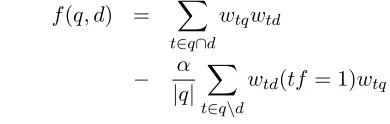
For the vector space model, this yields the follow-ing retrieval function:
f(q, d) = X
t∈q∩d
wtqwtd
− α
|q| X
t∈q\d
wtd(tf = 1)wtq
2In order to do this, we only need to know|d|and the relative frequency oftin the collectionp(t|C), i.e. information that is availableoutsidethe inverted list.
where α is a free parameter regulating the relative influence of penalties, comparable to theµ parame-ter of language models above.
[image:6.612.84.279.608.670.2]5.1 Experimental results
Table 2 shows retrieval results for combining two weighting schemes, BM25 (Robertson et al., 1992) and Lnu.ltn (Singhal et al., 1996), with penalties. Both of them belong to the family oftf.idf weight-ing schemes and can hence be regarded as represent-ing the vector space model, although BM25 was de-veloped out of the probabilistic model.
Combining them with the idea of “absence penal-ties” works as indicated above, i.e. weights are ac-cumulated for each document using the tf.idf-like retrieval functions. Then, from each score, the con-tributions that one occurrence of each missing term would have earned is subtracted. More precisely, what is subtracted consists of the usualtf.idfweight for the missing term, wheretf = 1is substituted in thetf part of the formula.
Experiments were run with queries from TREC-7 and TREC-8. In order to study the effect of query length, very short queries (using only the title field of TREC queries), medium ones (using title and de-scription fields) and long ones (using all fields) were used. Table 1 shows an example TREC query.
<top>
<num>Number: 441
<title>Lyme disease
<desc>Description:
How do you prevent and treat Lyme disease?
<narr>Narrative:
Documents that discuss current prevention and treatment techniques for Lyme disease are relevant [...]
</top>
Table 1: A sample TREC query
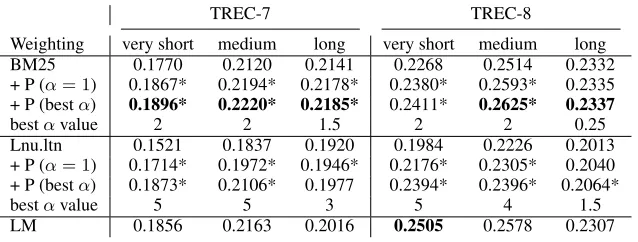
Table 2 shows that both weighting schemes can be significantly improved by using penalties, espe-cially for short queries, reaching and sometimes sur-passing the performance of retrieval with language models. This holds even when the parameter α is not tuned and confirms that interesting insights are gained from a common representation of IR models in a graph-based environment. 3
TREC-7 TREC-8
Weighting very short medium long very short medium long
BM25 0.1770 0.2120 0.2141 0.2268 0.2514 0.2332
+ P (α= 1) 0.1867* 0.2194* 0.2178* 0.2380* 0.2593* 0.2335 + P (bestα) 0.1896* 0.2220* 0.2185* 0.2411* 0.2625* 0.2337
bestαvalue 2 2 1.5 2 2 0.25
Lnu.ltn 0.1521 0.1837 0.1920 0.1984 0.2226 0.2013
+ P (α= 1) 0.1714* 0.1972* 0.1946* 0.2176* 0.2305* 0.2040 + P (bestα) 0.1873* 0.2106* 0.1977 0.2394* 0.2396* 0.2064*
bestαvalue 5 5 3 5 4 1.5
[image:7.612.157.476.53.174.2]LM 0.1856 0.2163 0.2016 0.2505 0.2578 0.2307
Table 2: Mean average precision of BM25 and Lnu.ltn and their corresponding penalty schemes (+ P) for TREC-7 and TREC-8. Asterisks indicate statistically significant deviations (using a paired Wilcoxon test on a 95% confidence level) from each baseline, whereas the best run for each query length is marked with
boldfont. Performance of language models (LM) is given for reference, where the value of the smoothing parameterµwas set to the average document length.
6 Different forms of search with MLAGs
In order to complete the goals stated in the intro-duction of this paper, this section will briefly ex-plain how feedback, associative retrieval and brows-ing can be modeled within the MLAG framework.
6.1 Feedback
Using the simple term-document MLAG of figure 1, feedback can be implemented by the following procedure:
1. Perform steps 1 – 4 of the basic processing.
2. Apply a transformation to the activation values ofLd-nodes, e.g. let the user pick relevant doc-uments and set their activation to some positive constantβ.
3. Perform step 3 of the basic processing with
Li = Ld and Li+1 = Lt, i.e. let activation flow back to term level.
4. Forget about activation levels of documents.
5. Apply transformation on the term levelLt, e.g. apply thresholding to obtain a fixed number of expansion terms.
6. Spread activation back to the document level to obtain the final retrieval status values of docu-ments.
lower than MAP scores achieved by systems actually partici-pating in TREC.
In order to instantiate a particular feedback algo-rithm, there are three parameters to be specified:
• The transformation to be applied in step 2
• The weighting of document-term edges (if dif-ferent from term-document edges) and
• The transformation applied in step 5.
Unfortunately, due to space constraints, it is out of the scope of this paper to show how different spec-ifications lead to well-known feedback algorithms such as Rocchio (Rocchio, 1971) or the probabilistic model above.
6.2 Associative retrieval
Associative retrieval in MLAGs exploits the infor-mation encoded in level graphs: expanding queries with related terms can be realised by using the term level graphLtof a simple MLAG (cf. figure 1) in step 2 of the basic processing, whereas the expan-sion of document result sets takes place in step 5 on the document level Ld. In order to exploit the rela-tions encoded in the level graphs, one may again use spreading activation, but also simpler mechanisms. Since relations are used directly, dimensionality re-duction techniques such as LSI cannot and need not be modeled.
6.3 Browsing
a suitable data structure for browsing. The level graphs can be used as a flat graphical representa-tion of the data, which can be exploited directly for browsing. Depending on their information need, users can choose to browse either on the term level
Ltor on the document levelLdand they can switch between both types of levels at any time using the inverted listItd. This applies, of course, also to pas-sage or any other type of levels if they exist.
7 Conclusions
In this paper, a new graph-based framework for in-formation retrieval has been introduced that allows to subsume a wide range of IR models and algo-rithms. It has been shown how this common rep-resentation can be an inspiration and lead to new insights and algorithms that outperform the origi-nal ones. Future work will aim at finding similar forms of synergies for the different forms of search, e.g. new combinations of feedback and associative retrieval algorithms.
References
M. Agosti and F. Crestani. 1993. A methodology for the au-tomatic construction of a hypertext for information retrieval. InProceedings of SAC 1993, pages 745–753.
J. R. Anderson and P. L. Pirolli. 1984. Spread of activa-tion. Journal of Experimental Psychology: Learning, Mem-ory and Cognition, 10:791–799.
M. Beaulieu. 1997. Experiments of interfaces to support query expansion.Journal of Documentation, 1(53):8–19. R. Brandow, K. Mitze, and L. F. Rau. 1995. Automatic
con-densation of electronic publications by sentence selection.
Information Processing and Management, 31(5):675–685. S. Brin and L. Page. 1998. The anatomy of a large-scale
hyper-textual Web search engine. InProceedings of WWW7, pages 107–117.
F. Crestani. 1997. Application of spreading activation tech-niques in information retrieval. Artificial Intelligence Re-view, 11(6):453–482.
W. B. Croft and R. H. Thompson. 1987. I3R : a new approach to the design of document retrieval systems. Journal of the american society for information science, 38(6):389–404. L. B. Doyle. 1961. Semantic Road Maps for Literature
Searchers.Journal of the ACM, 8(4):553–578.
D. Hiemstra. 2001. Using language models for information retrieval. Ph.D. thesis, University of Twente.
J. Lafferty and C. Zhai. 2001. Document language mod-els, query modmod-els, and risk minimization for information re-trieval. InProceedings of SIGIR 2001, pages 111–119. D. Metzler and W. B. Croft. 2004. Combining the language
model and inference network approaches to retrieval. Infor-mation Processing and Management, 40(5):735–750. R. N. Oddy. 1977. Information retrieval through man-machine
dialogue.Journal of Documentation, 33(1):1–14.
C. Olston and E. H. Chi. 2003. ScentTrails: Integrating browsing and searching on the Web. ACM Transactions on Computer-Human Interaction, 10(3):177–197.
S. E. Preece. 1981. A spreading activation network model for information retrieval. Ph.D. thesis, Universtiy of Illinois at Urbana-Champaign.
M. Richardson and P. Domingos. 2002. The intelligent surfer: Probabilistic combination of link and content information in pagerank. InProceedings of Advances in Neural Informa-tion Processing Systems.
S. E. Robertson and K. Sparck-Jones. 1976. Relevance Weight-ing of Search Terms.JASIS, 27(3):129–146.
S. E. Robertson, S. Walker, M. Hancock-Beaulieu, A. Gull, and M. Lau. 1992. Okapi at TREC-3. InProceedings of TREC, pages 21–30.
J.J. Rocchio. 1971. Relevance feedback in information re-trieval. In G. Salton, editor,The SMART Retrieval System : Experiments in Automatic Document Processing. Prentice Hall Inc., Englewood Cliffs, New Jersey.
G. Salton, A. Wong, and C. S. Yang. 1975. A vector space model for automatic indexing.Communications of the ACM, 18(11):613–620.
A. Singhal, C. Buckley, and M. Mitra. 1996. Pivoted document length normalization. InProceedings of SIGIR 1996, pages 21–29.
M. D. Smucker and J. Allan. 2006. Find-similar: similarity browsing as a search tool. InProceedings of SIGIR 2006, pages 461–468.
H. Turtle and W. B. Croft. 1990. Inference networks for docu-ment retrieval. InProceedings of SIGIR 1990, pages 1–24. C. J. van Rijsbergen. 2004. The Geometry of Information
Re-trieval. Cambridge University Press.
Scott White and Padhraic Smyth. 2003. Algorithms for esti-mating relative importance in networks. InProceedings of KDD 2003, pages 266–275.
H. F. Witschel. 2006. Carrot and stick: combining information retrieval models. InProceedings of DocEng 2006, page 32. S. K. M. Wong and Y. Y. Yao. 1995. On modeling information
retrieval with probabilistic inference.ACM Transactions on Information Systems, 13(1):38–68.