Practical Grammar-Based NLG from Examples
David DeVault and David Traum and Ron Artstein USC Institute for Creative Technologies
13274 Fiji Way Marina del Rey, CA 90292
{devault,traum,artstein}@ict.usc.edu
Abstract
We present a technique that opens up grammar-based generation to a wider range of practical applications by dramatically re-ducing the development costs and linguis-tic expertise that are required. Our method infers the grammatical resources needed for generation from a set of declarative exam-ples that link surface expressions directly to the application’s available semantic represen-tations. The same examples further serve to optimize a run-time search strategy that gener-ates the best output that can be found within an application-specific time frame. Our method offers substantially lower development costs than hand-crafted grammars for application-specific NLG, while maintaining high output quality and diversity.
1 Introduction
This paper presents a new example-based genera-tion technique designed to reduce the development costs and linguistic expertise needed to integrate a grammar-based generation component into an ex-isting application. We believe this approach will broaden the class of applications in which grammar-based generation may feasibly be deployed.
In principle, grammar-based generation offers significant advantages for many applications, when compared with simpler template-based or canned text output solutions, by providing productive cov-erage and greater output variety. However, realiz-ing these advantages can require significant devel-opment costs (Busemann and Horacek, 1998).
One possible strategy is to exploit a wide-coverage realizer that aims for applicability in mul-tiple application domains (White et al., 2007; Cahill and van Genabith, 2006; Zhong and Stent, 2005; Langkilde-Geary, 2002; Langkilde and Knight, 1998; Elhadad, 1991). These realizers provide a sound coverage grammar (or robust wide-coverage language model) for free, but demand a specific input format that is otherwise foreign to an existing application. Unfortunately, the devel-opment burden of implementing the translation be-tween the system’s available semantic representa-tions and the required input format can be quite sub-stantial (Busemann and Horacek, 1998). Indeed, im-plementing the translation might require as much ef-fort as would be required to build a simple custom generator; cf. (Callaway, 2003). Thus, there cur-rently are many applications where using a wide-coverage generator remains impractical.
Another strategy is for system builders to hand craft an application-specific grammar for genera-tion. This approach can be initially attractive to system builders because it allows syntactic cover-age and semantic modeling to be tailored directly to application needs. However, writing grammati-cal rules by hand ultimately requires a painstaking, time-consuming effort by a developer who has de-tailed linguistic knowledge as well as dede-tailed appli-cation knowledge. Further, the resulting coverage is inevitably limited to the set of linguistic construc-tions that have been selected for careful modeling.
between available application semantic representa-tions and desired output utterances is specified by example. Example-based approaches aim to allow system builders to specify a productive generation capacity while leaving the representations and rea-soning that underlie that productive capacity mostly implicit in a set of training examples. This method-ology insulates system builders from the detailed ex-pertise and technical infrastructure needed to imple-ment the productive capacity directly, and has made example-based approaches attractive not only in text generation but also in related areas such as concate-native speech synthesis and motion capture based animation; see, e.g., (Stone et al., 2004).
The technique we present in this paper is a new example-based approach to specifying application-specific text generation. As in other hand-crafted and example-based approaches, our technique al-lows syntactic coverage and semantic modeling to follow the needs and available semantic representa-tions in an application. One contribution of our tech-nique is to relieve the generation content author of the burden of manual syntactic modeling by lever-aging an off-the-shelf parser; defects in the syntax provided by the parser are effectively overcome us-ing a machine learnus-ing technique. Additionally, our technique organizes the authoring task in a way that relieves the generation author of carefully modeling the connections between particular syntactic con-structions and available semantic representations.
Together, we argue, these features dramatically reduce the linguistic expertise and other develop-ment costs that are required to integrate a grammar-based generation component into an existing system. In a case study application, we show that our ap-proach allows an application developer who lacks detailed linguistic knowledge to extend grammatical coverage at an expense of less than one minute per additional lexical entry.
2 Case Study: Doctor Perez
Our approach has been tested as a replacement for the generation component of interactive virtual hu-mans used for social training purposes (Swartout et al., 2006). Virtual humans are embodied conversa-tional agents that play the role of people in simula-tions or games. The case study we present in this
paper is the generation of output utterances for a particular virtual human, Doctor Perez, who is de-signed to teach negotiation skills in a multi-modal, multi-party, non-team dialogue setting (Traum et al., 2008). The human trainee who talks to the doctor plays the role of a U.S. Army captain named Cap-tain Kirk. The design goals for Doctor Perez create a number of requirements for a practical NLG com-ponent. We briefly summarize these requirements here; see (DeVault et al., 2008) for more details.
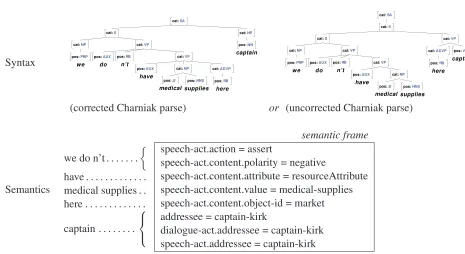
Doctor Perez has a relatively rich internal mental state including beliefs, goals, plans, and emotions. He uses an attribute-value matrix (AVM) semantic representation to describe an utterance as a set of core speech acts and other dialogue acts. Speech acts generally have semantic contents that describe propositions and questions about states and actions in the domain. To facilitate interprocess communi-cation, and statistical processing, this AVM structure is linearized into a “frame” of key values in which each non-recursive terminal value is paired with a path from the root to the final attribute. Figure 1 shows a typical frame. See (Traum, 2003) for addi-tional details and examples of this representation.
While only hundreds of frames currently arise in actual dialogues, the number of potential frames is orders of magnitude larger, and it is difficult to pre-dict in advance which frames might occur. The ut-terances that realize these frames need to take a va-riety of syntactic forms, including simple declar-ative sentences, various modal constructions relat-ing to hypothetical actions or plans, yes/no and wh-questions, and abbreviated dialogue forms such as elliptical clarification and repair requests, ground-ing, and turn-taking utterances. Highly fluent out-put is not a necessity for this character, since Doc-tor Perez is designed to simulate a non-native En-glish speaker. However, in order to support com-pelling real-time conversational interaction and ef-fective training, the generation module must be able to identify an utterance for Doctor Perez to use within approximately 200ms on modern hardware.
discov-ers a bug or disfluency in the NLG output, it is better if she can fix it directly rather than requiring a (com-putational) linguist to do so.
3 Technical Approach
Our approach builds on recently developed tech-niques in statistical parsing, lexicalized syntax mod-eling, generation with lexicalized grammars, and search optimization to automatically construct all the resources needed for a high-quality run-time generation component. In particular, we leverage the increasing availability of off-the-shelf parsers such as (Charniak, 2001; Charniak, 2005) to automati-cally (or semi-automatiautomati-cally) assign syntactic anal-yses to a set of suggested output sentences. We then draw on lexicalization techniques for statistical language models (Magerman, 1995; Collins, 1999; Chiang, 2000; Chiang, 2003) to induce a probabilis-tic, lexicalized tree-adjoining grammar that supports the derivation of all the suggested output sentences, and many others besides.
The final step is to use the training examples to learn an effective search policy so that our run-time generation component can find good output sen-tences in a reasonable time frame. In particular, we use variants of existing search optimization (Daumé and Marcu, 2005) and ranking algorithms (Collins and Koo, 2005) to train our run-time component to find good outputs within a specified time window; see also (Stent et al., 2004; Walker et al., 2001). The result is a run-time component that treats generation as an anytime search problem, and is thus suitable for applications in which a time/performance trade-off is necessary (such as real-time dialogue).
3.1 Specification of Training Examples
Each training example in our approach speci-fies a target output utterance (string), its syn-tax, and a set of links between substrings within the utterance and system semantic representa-tions. Formally, a training example takes the form
(u,syntax(u),semantics(u)). We will illustrate
this format using the training example in Figure 1. In this example, the generation content author suggests the output utterance u = we don’t have medical supplies here captain. Each utteranceu is accom-panied by syntax(u), a syntactic analysis in Penn
Treebank format (Marcus et al., 1994). In the fig-ure, we show two alternative syntactic analyses that might be specified: one is the uncorrected output of the Charniak parser on this sentence, and the other a hand-corrected version of that parse; we evaluate the utility of this hand correction in Section 4.
To represent the meaning of utterances, our ap-proach assumes that the system provides some set M = {m1, ..., mj} of semantic representations.
The meaning of any individual utterance is then identified with some subset ofM. For Doctor Perez, M comprises the 232 distinct key-value pairs that appear in the system’s various generation frames. In this example, the utterance’s meaning is captured by the 8 key-value pairs indicated in the figure.
Our approach requires the generation content author to link these 8 key-value pairs to con-tiguous surface expressions within the utterance. The technique is flexible about which surface ex-pressions are chosen (e.g. they need not corre-spond to constituent boundaries); however, they do need to be compatible with the way the syntactic analysis tokenizes the utterance, as follows. Let t(u) = ht1, ..., tni be the terminals in the
syn-tactic analysis, in left-to-right order. Formally,
semantics(u) = {(s1, M1), ...,(sk, Mk)}, where
t(u) = s1@· · ·@sk (with @ denoting
concatena-tion), and whereMi ⊆ M for alli ∈ 1..k. In this
example, the surface expressionwe don’t, which to-kenizes ashwe,do,n′ti, is connected to key-values
that indicate a negative polarity assertion.
This training example format has two features that are crucial to our approach. First, the semantics of an utterance is specifiedindependentlyof its syntax. This greatly reduces the amount of linguistic exper-tise a generation content author needs to have. It also allows making changes to the underlying syn-tax without having to re-author the semantic links.
lex-Utterance we don’t have medical supplies here captain
(corrected Charniak parse) or (uncorrected Charniak parse)
Semantics
we do n’t . . . .
have . . . . medical supplies . . here . . . .
Figure 1: A generation training example for Doctor Perez. If uncorrected syntax is used, the generation content author only writes the utterance and the links to the semantic frame.
ical level. An important feature of our approach is that it allows an arbitrary semantic granularity to be employed, by mapping the representations available in the system to appropriate multi-word chunks.
3.2 Automatic Grammar Induction
We adopt essentially the probabilistic tree-adjoining grammar (PTAG) formalism and grammar induc-tion technique of (Chiang, 2003). Our approach makes three modifications, however. First, while Chiang’s model includes both full adjunction and sister adjunction operations, our grammar has only sister adjunction (left and right), exactly as in the TAGLET grammar formalism of (Stone, 2002). Sec-ond, to support lexicalization at an arbitrary gran-ularity, we allow Chiang’s tree templates to be as-sociated with more than one lexical anchor. Third, to unify syntactic and semantic reasoning in search, we augment lexical anchors with semantic informa-tion. Formally, wherever Chiang’s model has a lex-ical anchor w, ours has a pair (hw1, ..., wni, M′),
where M′ ⊆ M is connected to lexical anchors hw1, ..., wniby the generation content author, as in
Figure 1. The result is that the derivation
probabili-ties the grammar assigns depend not only on the im-plicated syntactic structures and lexical anchors but also on thesensesof those lexical anchors in appli-cation terms.
We induce our grammar from training exam-ples such as Figure 1 using heuristics to assign derivations to the examples, exactly as in (Chiang, 2003). The process proceeds in two stages. In the first stage, a collection of rules is used to au-tomatically “decorate” the training syntax with a number of features. These include deciding the lexical anchor(s) for each non-terminal constituent and assigning complement/adjunct status for non-terminals which are not on their parent’s lexical-ization path; see (Magerman, 1995; Chiang, 2003; Collins, 1999). In addition, we deterministically add features to improve several grammatical aspects, in-cluding (1) enforcing verb inflectional agreement in derived trees, (2) enforcing consistency in the finite-ness of VP and S complements, and (3) restricting subject/direct object/indirect object complements to play the same grammatical role in derived trees.
re-syntax:
cat:SA
fin:other, cat:S
cat:NP, apr:VBP,
apn:other
pos:PRP
w e
fin:yes, cat:VP
apn:other, pos:VBP
do
pos:RB
n’t
fin:yes, cat:VP,
gra:obj1
fin:yes, cat:VP,
gra:obj1
pos:VBP have
cat:NP, gra:obj1
operations: initial tree comp
semantics: speech-act.action = assert
speech-act.content.polarity = negative
speech-act.content.attribute = resourceAttribute
syntax:
cat:NP, apr:VBP,
gra:obj1, apn:other
pos:JJ
medical
pos:NNS
supplies
cat:ADVP, gra:adj
pos:RB
here
cat:NP, apr:VBZ, gra:adj, apn:3 p s
pos:NN
captain
operations: comp left/right adjunction left/right adjunction
semantics: speech-act.content.value = medical-supplies
speech-act.content.object-id = market
addressee = captain-kirk
dialogue-act.addressee = captain-kirk speech-act.addressee = captain-kirk
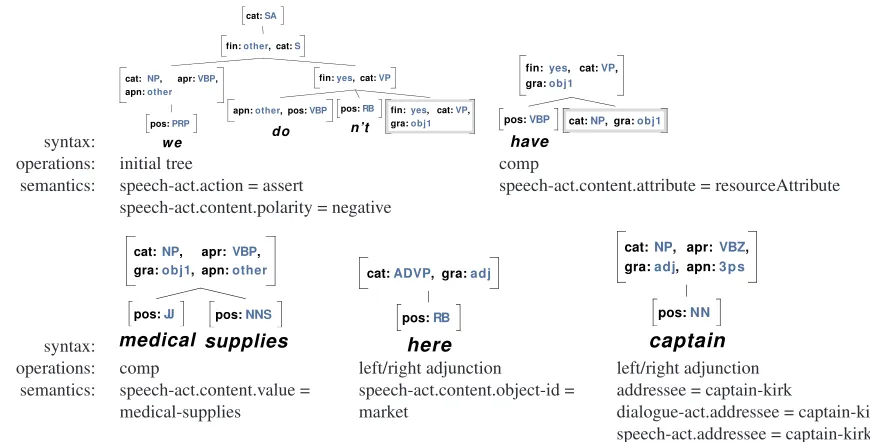
Figure 2: The linguistic resources inferred from the training example in Figure 1.
moved, yielding the reusable linguistic resources in the grammar, as illustrated in Figure 2, as well as the maximum likelihood estimates needed to com-pute operation probabilities.
Our approach uses this induced grammar to treat generation as a search problem: given a desired se-mantic representation M′ ⊆ M, use the grammar
to incrementally construct an output utteranceuthat expressesM′. We treat generation as anytime search
by accruing multiple goal states up until a specified timeout (for Doctor Perez: 200ms) and returning a list of alternative outputs ranked by their derivation probabilities.
3.3 Optimizing the Search Strategy
The search space created by a grammar induced in this way is too large to be searched exhaustively in most applications. The solution we have developed is a beam search strategy that uses weighted features to rank alternative grammatical expansions at each step. In particular, the beam size and structure is op-timized so that, with high probability, the beam can be searched exhaustively before the timeout.1 The second step of automated processing, then, is a train-ing problem of findtrain-ing weighted features such that
1For Doctor Perez, we use a wider beam for initial trees,
since the Doctor’s semantic representation is particularly im-poverished at the level of main verbs. At search depths > 1, we use beam size 1 (i.e. greedy search).
for every training problem, nodes that lead to good generation output are ranked highly enough by those features to make it into the beam.
We use domain-independent rules to automati-cally define a set of features that could be heuris-tically useful for a given induced grammar. These include features for various syntactic structures and operations, numbers of undesired and desired mean-ings of different types added by an expansion, derivation probabilities, etc. (For Doctor Perez, this yields about 600 features.) Our training algo-rithm is based on the search optimization algoalgo-rithm of (Daumé and Marcu, 2005), which updates fea-ture weights when mistakes are made during search on training examples. For the weight update step, we use the boosting approach of (Collins and Koo, 2005), which performs feature selection and iden-tifies weight values that improve the ranking of al-ternative derivation steps when mistakes are made during search. We discuss the resulting success rate and quality in the next section.
4 Cost/Benefit Analysis
ana-lyzing the use of our approach for Doctor Perez. Method. We began with a sample of 220 in-stances of frames that Doctor Perez’s dialogue man-ager had requested of the generation component in previous dialogues with users. Each frame was as-sociated with a hand-authored target output utter-ance. We then constructed two alternative training examples, in the format specified in Section 3.1, for each frame. One example had uncorrected output of the Charniak parser for the syntax, and another had hand-corrected parser output (see Figure 1). The connections between surface expressions and frame key-value pairs were identical in both uncorrected and corrected training sets.
We then built two generators using the two sets of training examples. We used 90% of the data for training and held out 10% for testing. The genera-tors sometimes failed to find a successful utterance within the 200ms timeout. For example, the success rate of the version of our generator trained on uncor-rected syntax was 96.0% for training examples and 81.8% for test examples.
Quality of generated output. To assess output quality, 5 system developers rated each of 494 utter-ances, in relation to the specific frame for which it was produced, on a single 1 (“very bad”) to 5 (“very good”) scale. The 494 utterances included all of the hand-authored (suggested) utterances in the training examples. They also included all the top-ranked ut-terances that were successfully generated by the two generators. We asked our judges to make an over-all assessment of output quality, incorporating both accuracy and fluency, for the Doctor Perez charac-ter. Judges were blind to the conditions under which utterances were produced. We discuss additional de-tails of this rating task in (DeVault et al., 2008).
The judges achieved a reliability of α = 0.708
(Krippendorff, 1980); this value shows that agree-ment is well above chance, and allows for tentative conclusions. We ran a small number of planned comparisons on these ratings. Surprisingly, we found no significant difference between generated output trained on corrected and uncorrected syntax
(t(29) = 0.056, p > 0.9 on test items, t(498) =
−1.1, p > 0.2 on all items).2 However, we did
2
The distribution of ratings across utterances is not normal; to validate our results we accompanied each t-test by a non-parametric Wilcoxon rank sum test, and significance always fell
Hand-authored (N = 1099) Generated:
Training input (N = 949) Test input (N = 90)
Rating
Fr
equenc
y
(%)
0 10 20 30 40 50 60
1 2 3 4 5
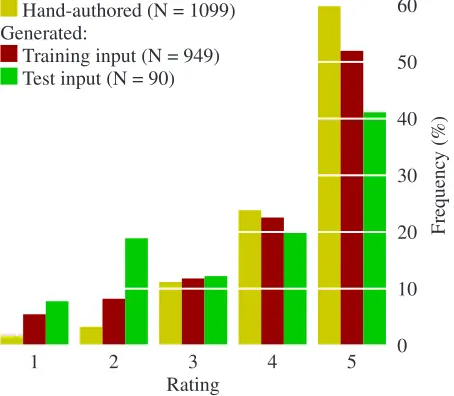
Figure 3: Observed rating frequencies for hand-authored vs. generated utterances (uncorrected syntax).
find that hand-authored utterances (mean rating 4.4) are significantly better (t(388) = 5.9, p < 0.001) than generated utterances (mean rating 3.8 for un-corrected syntax). These ratings are depicted in Fig-ure 3. While the figFig-ure suggests a slight reduction in quality for generated output for test frames vs. train-ing frames, we did not find a significant difference between the two (t(19) = 1.4228, p >0.15).
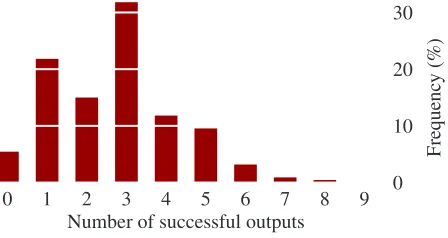
Variety of generated output.In general our any-time algorithm delivers a ranked list of alternative outputs. While in this initial study our judges rated only the highest ranked output generated for each frame, we observed that many of the lower ranked outputs are of relatively high quality. For example, Figure 4 shows a variety of alternative outputs that were generated for two of Doctor Perez’s training examples. Many of these outputs are not present as hand-authored utterances (for any frame); this illus-trates the potential of our approach to provide a va-riety of alternative outputs or paraphrases, which in some applications may be useful even for meanings for which an example utterance is hand-authored. Figure 5 shows the overall distribution in the number of outputs returned for Doctor Perez.
Development costs. The development costs in-cluded implementation of the approach and specifi-cation of Doctor Perez’s training set.
Rank Time (ms) Novel?
1 16 no the clinic is up to standard captain
2 94 no the clinic is acceptable captain(hand-authored for this input) 3 78 yes the clinic should be in acceptable condition captain
4 16 yes the clinic downtown is currently acceptable captain 5 78 yes the clinic should agree in an acceptable condition captain
1 94 no there are no medical supplies downtown captain 2 172 no we don’t have medical supplies downtown captain
3 125 yes well captain i do not think downtown there are medical supplies 4 16 yes i do not think there are medical supplies downtown captain
Figure 4: All the utterances generated (uncorrected syntax) for two examples. Rank is determined by derivation probability. Outputs marked as novel are different from any suggested output for any training example.
Number of successful outputs
Fr
equenc
y
(%)
0 10 20 30
0 1 2 3 4 5 6 7 8 9
Figure 5: Variety of outputs for each input.
tion required an effort of approximately six person months. The developer who carried out the imple-mentation initially had no familiarity with the Doc-tor Perez domain, so part of this time was spent un-derstanding Doctor Perez and his available seman-tic representations. The bulk of the development time was spent implementing the grammar induction and training processes. Grammar induction included implementing the probabilistic grammar model and writing about 40 rules that are used to extract gram-matical entries from the training examples. Of these 40 rules, only 3 are specific to Doctor Perez.3 The
remainder are broadly applicable to syntactic anal-yses in Penn Treebank format, and thus we expect they would transfer to applications of our approach in other domains. Similarly, the training algorithms are entirely domain neutral and could be expected to transfer well to additional domains.
Specification of Doctor Perez’s training data took
3
These 3 rules compensate for frequent errors in Charniak parser output for the wordscaptain,elder, andimam, which are often used to signal the addressee of Doctor Perez’s utterances.
about 6 hours, or about 1.6 minutes per training ex-ample. This time included hand correction of syn-tactic analyses generated by the Charniak parser and definition of semantic links between surface expres-sions and frame key-value pairs. Since we found that hand-correcting syntax does not improve out-put quality, this 1.6 minutes/example figure over-estimates the authoring time required by our ap-proach. The remaining work lies in defining the se-mantic links. For Doctor Perez, approximately half of the semantic links were automatically assigned with simple ad hoc scripts.4 The semantic linking
process might be further sped up through a stream-lined authoring interface offering additional automa-tion, or even using a machine learning approach to suggest appropriate links.
Linguistic expertise required. Since we found that hand-correcting syntax does not improve output quality, a developer who wishes to exploit our ap-proach may use the Charniak parser to supply the syntactic model for the domain. Thus, while one developer with linguistic expertise is required to im-plement the approach, anybody on the application team can contribute by hand authoring additional ut-terances and defining semantic links. The benefit of this authoring effort is the ability to generate high quality output for many novel semantic inputs.
Cost/benefit.The grammar induced from the 198 training examples (with uncorrected syntax) con-tains 426 lexical entries of the type depicted in Fig-ure 2. These 426 lexical entries were produced auto-matically from about 6 hours worth of authoring
ef-4Time to compose these scripts is included in the 1.6
fort together with domain-neutral algorithms. This translates to a rate of grammar expansion of less than 1 minute per lexical entry, on average, for this small application-specific grammar. This constitutes a dramatic improvement over our previous experi-ence hand-crafting grammars. It would be challeng-ing for an expert to specify a lexical entry such as those in Figure 2 in under one minute (and probably impossible for someone lacking detailed linguistic knowledge). In our experience, however, the bulk of development lies in additional time spent con-sidering and investigating possible interactions be-tween lexical entries in generation. Our technique helps with both problems: the grammar induction streamlines the specification of lexical entries, and the training removes the need for a developer to manually trace through the various complex inter-actions between lexical entries during generation.
5 Limitations
Currently, we do not support semantic links from non-contiguous expressions, which means a desired output like “we rely heavily on medical supplies” would be difficult to annotate ifrely...oncorresponds to a single semantic representation. This is not an in-trinsic limitation to our general approach, but rather a simplification in our initial implementation.
As discussed in Section 3.2, our grammar induc-tion process adds syntactic features related to verb inflection, finiteness, and grammatical role to the in-ferred lexical entries. Such features improve the flu-ency and accuracy of output derived with the gram-mar. While we believe such features can always be assigned using domain-independent rules, develop-ing these rules requires ldevelop-inguistic expertise, and it is likely that additional rules and features (not yet implemented) would improve coverage of linguistic phenomena such as control verbs, various kinds of coordination, and relative clauses, inter alia.
A more entrenched limitation of our approach is its assumption that the generator does not need context as a separate input. This means, for ex-ample, that our approach cannot generate referring expressions (by selecting disambiguating semantic properties); rather, all semantic properties must be pre-selected and included in the generation request. Generation of anaphoric expressions is also limited,
since contextual ambiguities are not considered.
6 Related Work
To our knowledge, this is the first implemented generation technique that does all three of the fol-lowing: directly interfaces to existing application semantic representations, infers a phrase structure grammar from examples, and does not require hand-authored syntax as input. (Varges and Mellish, 2001) also aims to reduce the authoring burden of domain-specific generation; however, they seem to use a special purpose semantic annotation rather than pre-existing application semantics, and their task is defined in terms of the Penn Treebank, so hand-authored syntax is used as input. (Wong and Mooney, 2007) also interfaces to existing applica-tion semantics, and does not require hand-authored syntax as input. Their technique infers a syn-chronous grammar in which the hierarchical linguis-tic analysis is isomorphic to the hierarchy in the ap-plication semantics, and differs from phrase struc-ture. It would be interesting to compare their out-put quality with ours; their automated alignment of words to semantics might also provide a way to fur-ther reduce the authoring burden of our approach.
7 Conclusion and Future Work
We have presented a new example-based approach to specifying text generation for an existing appli-cation. We have used a cost/benefit analysis to ar-gue that our approach offers productive coverage and high-quality output with less linguistic expertise and lower development costs than building a hand-crafted grammar. In future work, we will evaluate our approach in additional application settings, and study the performance of our approach as the size and scope of the training set grows.
Acknowledgments
References
S. Busemann and H. Horacek. 1998. A flexible shallow approach to text generation. InProceedings of INLG, pages 238–247.
Aoife Cahill and Josef van Genabith. 2006. Robust PCFG-based generation using automatically acquired LFG approximations. InACL, pages 1033–1040. C. B. Callaway. 2003. Evaluating coverage for large
symbolic NLG grammars.Proceedings of IJCAI. E. Charniak. 2001. Immediate-head parsing for
lan-guage models. InACL, pages 124–131, Morristown, NJ, USA. Association for Computational Linguistics. E. Charniak. 2005. ftp://ftp.cs.brown.edu/pub/nlparser/
parser05Aug16.tar.gz.
D. Chiang. 2000. Statistical parsing with an automatically-extracted tree adjoining grammar. In ACL ’00: Proceedings of the 38th Annual Meeting on Association for Computational Linguistics, pages 456–463, Morristown, NJ, USA. Association for Com-putational Linguistics.
D. Chiang. 2003. Statistical parsing with an automat-ically extracted tree adjoining grammar. In R. Bod, R. Scha, and K. Sima’an, editors,Data Oriented Pars-ing, pages 299–316. CSLI Publications, Stanford. M. Collins and T. Koo. 2005. Discriminative reranking
for natural language parsing. Computational Linguis-tics, 31(1):25–70.
M. Collins. 1999. Head-Driven Statistical Models for Natural Language Parsing. Ph.D. dissertation, Uni-versity of Pennsylvania.
H. Daumé and D. Marcu. 2005. Learning as search optimization: approximate large margin methods for structured prediction. In ICML ’05: Proceedings of the 22nd international conference on Machine learn-ing, pages 169–176, New York, NY, USA. ACM. David DeVault, David Traum, and Ron Artstein. 2008.
Making grammar-based generation easier to deploy in dialogue systems. InNinth SIGdial Workshop on Dis-course and Dialogue (SIGdial).
M. Elhadad. 1991. FUF: the universal unifier user man-ual version 5.0. Technical Report CUCS-038-91. K. Krippendorff, 1980. Content Analysis: An
Introduc-tion to Its Methodology, chapter 12, pages 129–154. Sage, Beverly Hills, CA.
I. Langkilde and K. Knight. 1998. Generation that exploits corpus-based statistical knowledge. In COLING-ACL, pages 704–710.
I. Langkilde-Geary. 2002. An empirical verification of coverage and correctness for a general-purpose sen-tence generator.
D. M. Magerman. 1995. Statistical decision-tree mod-els for parsing. In Proceedings of the 33rd annual meeting on Association for Computational Linguistics,
pages 276–283, Morristown, NJ, USA. Association for Computational Linguistics.
M. P. Marcus, B. Santorini, and M. A. Marcinkiewicz. 1994. Building a large annotated corpus of en-glish: The penn treebank. Computational Linguistics, 19(2):313–330.
A. Stent, R. Prasad, and M. Walker. 2004. Trainable sen-tence planning for complex information presentation in spoken dialog systems. InACL.
Matthew Stone, Doug DeCarlo, Insuk Oh, Christian Ro-driguez, Adrian Stere, Alyssa Lees, and Chris Bregler. 2004. Speaking with hands: creating animated con-versational characters from recordings of human per-formance. ACM Trans. Graph., 23(3):506–513. M. Stone. 2002. Lexicalized grammar 101. In ACL
Workshop on Tools and Methodologies for Teaching Natural Language Processing.
Matthew Stone. 2003. Specifying generation of referring expressions by example. InAAAI Spring Symposium on Natural Language Generation in Spoken and Writ-ten Dialogue, pages 133–140.
W. Swartout, J. Gratch, R. W. Hill, E. Hovy, S. Marsella, J. Rickel, and D. Traum. 2006. Toward virtual hu-mans. AI Mag., 27(2):96–108.
D. R. Traum, W. Swartout, J. Gratch, and S. Marsella. 2008. A virtual human dialogue model for non-team interaction. In L. Dybkjaer and W. Minker, editors, Recent Trends in Discourse and Dialogue. Springer. D. Traum. 2003. Semantics and pragmatics of questions
and answers for dialogue agents. Inproceedings of the International Workshop on Computational Semantics, pages 380–394, January.
Sebastian Varges and Chris Mellish. 2001. Instance-based natural language generation. InNAACL, pages 1–8.
M. Walker, O. Rambow, and M. Rogati. 2001. Spot: A trainable sentence planner. In Proceedings of the North American Meeting of the Association for Com-putational Linguistics.
M. White, R. Rajkumar, and S. Martin. 2007. To-wards broad coverage surface realization with CCG. InProc. of the Workshop on Using Corpora for NLG: Language Generation and Machine Translation (UC-NLG+MT).
Yuk Wah Wong and Raymond Mooney. 2007. Genera-tion by inverting a semantic parser that uses statistical machine translation. InProceedings of NAACL-HLT, pages 172–179.