Volume 6, No. 2, March-April 2015
International Journal of Advanced Research in Computer Science
TRCHNICAL NOTE
Available Online at www.ijarcs.info
Analysis and Classification of Vehicle using KNN and Decision Tree
Vishakha Gaikwad
Dept. of Computer Engineering, PICT, Pune Savitribai phule pune university
Pune, India
Balwant Sonkamble
Dept. of Computer Engineering, PICT, Pune Savitribai phule pune university
Pune, India
Abstract:Classification of vehicles is becoming useful technique of intelligent transportation system for the traffic analysis. Increased number of accidents and busy intersections on road are making traffic analysis more important. The main cause of these problems is avoidance of traffic rules and increased number of vehicles. Intelligent transportation system detects the vehicles which are not following the traffic rules and takes some action before the problem arises. Previous techniques are highly expensive or unsuccessful in some constraints. In case, the number of features to detect vehicle and number of samples in train increases, the performance decreases. Types of feature take performance to another level which is variant and invariant. It becomes difficult to classify vehicle when some features are invariant and some features are variant with one classifier. In this paper, the combination of KNN and Decision tree is proposed to classify the vehicle with its lane allowance on single virtual detection line. KNN is used with the invariant features followed by decision tree applied on variant features to classify vehicle shape and lane wise. Invariant shape based features of vehicle are detected on single virtual detection line instead of multiple virtual detection line. Consideration of combined features gives good performance on the single virtual detection line. Experimental results demonstrates that proposed method improves classification of vehicle with some variant and invariant features.
Keywords— Active Contours, Classification, Computer Vision, Decision tree, Image processing, K- Nearest Neighbor, Pattern recognition.
I. INTRODUCTION
The detection and classification of vehicles are most challeng-ing techniques of intelligent transportation systems. Increased number of accidents and busy intersections on road are mak-ing traffic analysis more important. The main cause of these problems is avoidance of traffic rules and increased number of vehicles. Intelligent transportation system detects the vehicles which are not following the traffic rules and takes some action before the problem arises. Applications of counting vehicle by their classes have been used to detect busy intersection and parking availability. Different classification techniques are available to classify vehicles. Survey of these classification techniques is done in [1][2][3]. For the detection of vehicle, background subtraction and vehicle extraction techniques are required which are described in [4][5][6].
Everybody used different combinations of feature extraction technique and classification technique. The feature extraction defined by the Principal Component Analysis and Adaptive KNN in [4]. It improves the dimensionality and accuracy for the vehicle identification. The self organizing feature map (SOM) is an unsupervised learning algorithm combined with K-means to detect moving objects in traffic video. It con-structs a system to obtain initial background when using the subtraction method to do motion detection. A tracking method is based on bidirectional comparison of centroid to track mov-ing objects. Alternative of principle component analysis and SOM, Active contours is suggested in proposed system which results exact edge detection of vehicle by comparing a de-formable model to an image by energy minimization. It is dy-namic algorithm and combination of algorithms like PCA and B-spline which gives exact feature extraction. Apart from KNN, Vehicle detection and classification is done by Neural
Networks and Support vector machine in [5] and [6] respec-tively. Width and length of the blob is calculated to result area of the vehicle which is passed to NN. Human and vehicle classification is done by Longbin Chane [7].
Object classified by considering motion vector for the speed comparison and shape. Histogram of gradient models self va-riance of objects in vector which is independent of each object location and effectual way of classifying image globally and instances locally is presented by Xin zao et al [8].
Previous methods considered size and velocity for classifica-tion which are invariant features. To improve classificaclassifica-tion invariant features are used. But consideration of lane of ve-hicle is a principle factor to classify and lane is variant feature. On highways lanes are defined to each class. For example, Heavy vehicle should be in third or fourth lane which is found sometimes in first or second lane and presence of two whee-lers on highway. These kinds of rules are neglected by drivers which causes an accident. Proposed system manipulates size, velocity and lane of vehicle to classify and examine. Region of interest counts instances of an object in each frame which counts vehicle many times. But virtual lines optimize the count of vehicle by considering vehicle online only. Line on road neglects the other moving objects, for example, trees or shadows. A novel detection and classification method are pro-posed by Niluthpol et al [9] using multiple time-spatial images (TSIs), each obtained from a virtual detection line on the frames of a video. Multiple TSIs produces time image to detect overlapping of the vehicles and to manipulate differ-ence between the still and moving objects to increase the ac-curacy of detection. Each instance is passed to classifier to classify object which decreases performance by calculating class each time.
possible consequences to find out cost of solution set which gives maximum outcome [10]. Hang yang gives optimized so-lution to reduce time complexity of deciding levels of decision tree by an adaptive tie evaluation and extra pruning condi-tions. Therefore for exact decision of vehicle class, Decision tree is used in proposed system.
Following section 2 is an overview of the system Section 3 is elaboration of classification methods. Results are shown in section 4. The paper is concluded fin section 5.
II. OVERVIEWOFTHESYSTEM
The videos of vehicles are taken from the camera of resolu-tion. To detect vehicle from camera, it requires setting of cam-era. The angle of camera (ac) and height of camera (hc) is very important, as they affect on area covered (area).
(1)
(2) As shown in the eq. (1) and (2), the ac and hc affect on the area covered by the camera. ac and hc are important to extract vehicle accurately. In this system ac and hc are selected in such a way that all lanes are visible and environmental illumi-nation is reduced. As area changes, the area of vehicle (av) changes. av is an important feature of vehicle. This feature is used in this system to extract vehicle. Experimental result va-ries with the above parameters. The fig 2 shows the steps of classification vehicles with lane allowance. Preprocessing is required to get exact features set. Extracted features are input for the classification of vehicle. Features belong to known or unknown samples. Known samples are stored in the trained set for the prediction of class of a vehicle.Vehicle present in one frame can be present in the next frame. So, VDL from [9] is used in proposed system to detect vehicles at the line drawn on the frame. To avoid occlusion of vehicle, combination of features and number of VDLs is very important. If features are
very specific and more, then one line is enough to detect the vehicle.
Preprocessing:
Preprocessing of video is very important for the extraction features of vehicles. Steps of preprocessing are as follows, Step1: Access Video
In the H.264 video recorder, the size of buffer is selected. The video from the buffer of 1 minute is accessed to process. Step2: Frame extraction.
Frame extracted from the video is such a way that every ve-hicle is captured. Each frame is extracted from video for analy-sis of detection of key frame analyzed by Guozhu Liu et al [8]. Let pi is any frame and pi+k is next frame, l is length of vehicle and m is maximum speed of vehicle. Difference between the two consecutive frames gives vehicle counted and its speed. Selection of k and time required to pass the vehicle itself with m is calculated by following equation,
tpi+k-pi > l/m (3) Let, t is the time required to pass vehicle itself. It is less than time selected between frames showed in eq. (3).
Step3: Preprocessing
Preprocessing is very important process on which accurate fea-ture extraction is dependent. Faulty feafea-ture extraction leads to wrong classification.
1. Following are the steps of Preprocessing as shown in fig 3. Extracted frames are input to the preprocessing phase. Thre-sholding: It is simplest segmentation method. The segmenta-tion is based on the intensity variasegmenta-tions of object and back-ground. The grayscale image is converted into binary level im-age with the threshold value.
2. Canny Edge Detection: It is combination of Sobel operators with the Gaussian filter to decrease the error rate of edge detec-tion. It uses hysteresis method to find out exact edge of an ob-ject.
3. Morphological Operations: It is collection of operations to structure the shape of an object from the image. It finds the holes in the image by overlapping or convolving. Basic opera-tions of morphological operaopera-tions are dilation and erosion.
4. Dilation: It is convolution of image with the matrix with the maximum values. Overlapped values are calculated and anchor point is replaced with the maximum value.
5. Erosion: This operation is the sister of dilation. It computes a local minimum over the area of the kernel.
6. Contour Detection: It is done by the dynamic active contour algorithm. From each frame objects are identified. The objects are extracted and stored in to the contour vector. Then contour vector is used to extract features of an object.
area is calculated. Likewise other features are extracted in this step. Here, if extracted features are of known samples, it is stored in to the trained data set with class. Otherwise, those are classified by the classification algorithm.
The features considered in this system are as follows,
1) Width: Rectangle is drawn around the detected vehicle. Width of rectangle is taken by rectangle around the vehicle.
2) Length: Same as to width length of vehicle is also calculated. 3) Area: Area of contours is found from the vector of linked
contours. Area of vehicle is very important feature to identify the class of vehicle. Classes are done on the basis of small, medium and large.
4) Rectangular boundary (b): Rectangular boundary is bounded around the vehicle when it touches the virtual line drawn on the road. That time position of vertical axis is also identified to decide the lane of vehicle.
5) Ratio of width and length: Ratio of width and length creates importance in presence of occlusion of vehicles.
6) Position: This attribute is measured to find lane of the vehicle. 7) Lane: From position of vehicle, lane of the vehicle is decided
by setting range on vertical axis.
III. VEHICLECLASSIFICATION
[image:3.595.47.549.424.508.2]Extracted features are input for the classification as shown in fig 3. Features are represented as Input= {A, position} Where,
A= {area, length, width, ratio}. A is a set of invariant features
of vehicle and position of a vehicle is variant feature. A classi-fied vehicle with the lane allowance is Output= {Class, Lane,
D}. Vehicles are classified in Class= {class1, class2, class3} Where, class1=Car, class2=Two Wheeler, class3=Truck. For each class lanes are defined from Lane= {lane1, lane2, lane3}. Class has Lane decided by the D= {Yes, no} Where, Yes= Ve-hicle is allowed on Lane and No=Vehicle is not allowed on Lane. Vehicle of Class is not allowed in Lane are detected which is an Output=Class X Lane When D= No.
Input for unknown and known samples is same. But known samples are stored with its class in the trained data T= {TC, TD} Where, TC=Trained class TD=Trained class. TD has size
M X N. Where, M=Number of attributes A and N=Number of
samples. Total number of known samples is equal to (n1+n2+n3). Where, n1=Number of samples of Class1, n2=Number of samples of Class2 and n3=Number of samples of Class3. As trained data has all number of samples of each class same n1=n2=n3. TC is of size 1 X N Where, TC →Class.
Class of features stored in TD is indexed in TC.
1. Now, all the sets are ready to get classified by KNN and Decision Tree. Following are the phases of classification. K-Nearest Neighbor Algorithm(KNN):
KNN is simplest supervised classification algorithm. It pre-dicts class of unknown sample by using trained data TD and TC. The accuracy of classification is sensitive to the number of neighbors K selected. Nearest neighbor Nearest= {distance,
TC, TD, I, accuracy, K, Class} is calcu-
lated by minimum distance between the unknown and known sample.Nearest is a vector of K nearest neighbors. There are many types of distance calculation. Among them Euclidean distance is popular and efficient which is shown in following eq.(3).
(3)
Unknown sample is represented as I. Number of Nearest matched with particular class is accuracy. It should be greater than K/2. Reference R pattern for each class is as follows,
R is different for each Class R= {Rclass1, Rclass2, Rclass3}.
Toler-ance for each feature is described as follows,
±Tolerance is bounding for the feature values of each class.
As number of classes increases and becomes specific, Toler-ance range decreases. If feature of unknown sample belongs to tolerance range of particular class, that class is decided of
unknown sample. Range for each K nearest neighbor is ana-lyzed to detect class of a vehicle.
2. Decision Tree:
Decision tree is also a supervised learning algorithm. It has many types ID3, C4.5, CART, and CHAID. Induced Decision tree (ID3) is the basic algorithm for constructing decision trees. Other types of decision tree are extension of ID3. The key idea of ID3 is to choose attributes with the biggest infor-mation gain based on entropy as current classification attribute and then recursively expand the branches of decision tree until whole tree has been built completely.
Suppose, Decision= {Class, Lane} is the set of possible com-binations C, and the number of equivalence class constructed by relation is number classes i.e. 3 then entropy is defined as:
the homogeneity of a sample. If the sample is completely ho-mogeneous the entropy is zero and if the sample is an equally divided it has entropy of one. Gain from the possible combi-nations of Lane and Class is identified. Entropy decreases af-ter splitting the data set. The splinted dataset which gives highest information gain is found out by eq. (7) and eq. (8). A decision tree finds attribute that returns the highest informa-tion gain (i.e., the most homogeneous branches).
The table 1 shows all the possible combinations of Lane and
Class which the output of the system. Where Yes and No
[image:4.595.309.544.58.276.2]represents vehicle of Class on Lane is not allowed and not al-lowed respectively.
Table 1. Possible combinations of classes and lanes.
Class of vehicle
Lane1 Lane 2 Lane 3
Two Wheeler
No No Yes
Car Yes Yes Yes
Heavy Vehicles
No Yes Yes
IV. EXPERIMENTALSETUPANDRESULTS
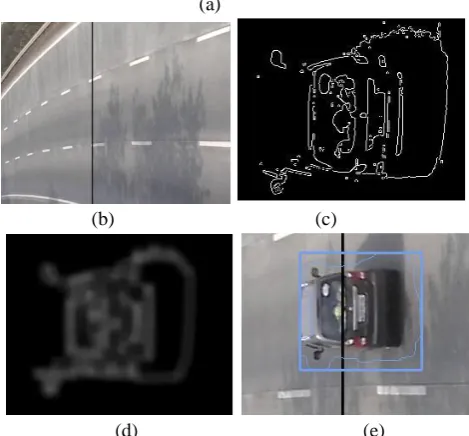
The System is designed in QT 4.7 using Opencv 2.4.0 libraries. Opencv is well known library set for image processing. QT is cross platform framework and UI development framework. C++ object oriented language is experimented for system se-tup. MPEG 4 video file format of resolution 1280*720. Cam-era is at 2 meter from the surface of the road with the angle 45. Features are conscious with these values. But the proposed sys-tem will be same for variant and invariant features of a vehicle. Preprocessing of extracted frames gives result as shown in the fig. As discussed about the steps of preprocessing, fig (a)(b)(c) are results of those steps. Thresholding converts grayscale im-age in to binary imim-age. Fig. (a) Shows output of canny edge detection and Fig (b) is output of morphological operations. Instead of using manual method of area calculation, Active contour is used. It detects vehicles dynamically and gives accu-rate area as shown in fig (c). Training and classification is car-ried out by the system and shows results in Table 2 and Table 3.
(a)
(b) (c)
(d) (e)
Fig.3 Output of different operations (a) Canny edge detection. (b) Closing operation. (c)Virtual line on road and three lanes on highway.(d) Vehicle detected on virtual line by active con-tour.
Average is taken to calculate response of the classifier. If any sample gives major difference gets replaced by another sample. 10 known samples are taken to enumerate class accurately with 15 unknown samples. Table 2 Shows result of probability of class and number of nearest K.
[image:4.595.319.565.526.632.2]The probability of classifying a certain type of vehicle among the three types considered in the experiments is empirically calculated for single-step classification approach and the re-sults are shown in Table 3. From this table, it can be seen that the probability of identifying any of the three types of vehicles maximum accuracy. Then decision tree is used for vehicle al-lowance on particular lane. The entropy of decision tree is 0.92 with highest information gain 0.657.
Table 2. Probability of finding class of vehicle with different K values.
Class of vehicle
K=1 K=3 K=5
Class 1 0.86 0.76 0.61
Class 2 0.9 0.69 0.45
Class 3 0.83 0.72 0.65
Table 3. Probability of each class misclassified by another class.
Class1 Class2 Class3
Class1 0.866667 0.133333
Class2 0.05 0.9 0.05
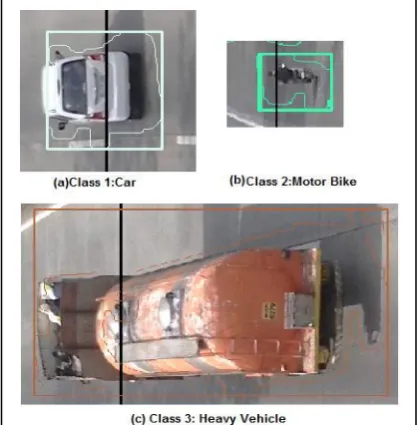
[image:4.595.42.271.681.780.2]Fig.6. Outcome of System shows (a) class1 is of car (b) class2 is of bikes and (c) is heavy vehicle class3.
Fig. 6 is outcome of the system with classified vehicles. Each figure shows each class with the contour drawn around the de-tected vehicle. With these dede-tected and classified vehicles, the system represents allowance of vehicle with the lane allowance on the road.
V. CONCLUSIONANDFUTUREWORK
Classes and lanes of vehicles identified accurately by the sys-tem. Result shows increased performance by the decision tree combined with KNN. Earlier detection of position of classes avoids accidents and useful in secured transportation system. Presence of illegal vehicles can be avoided.
Analysis of lane and speed comparison by using optical flow will result avoidance of maximum speed on highway in future. Maximum speed cannot be analyzed by simple inter frame dif-ference methods.
Relative motion analysis is required for prevention of acci-dents. Three lanes and vehicle speed manipulation is possible by relative motion analysis. Time required to reach destination is related to relative motion. In future speed comparison and relative motion will create new level of self driving system.
VI. REFERENCES
[1] Pooja Kamvisdar, Sonam Saluja, “A survey on Image classifica-tion approaches and techniques”, Internaclassifica-tionalJournal of Ad-vanced Research in Computer and Communication Engineering Vol. 2, Issue 1, January 2013, pp. 1-5.
[2] R.R Darlin Nisha, V.Gowri, A Survey on Image Classification Methods and Techniques for Improving Accuracy, International Journal of Advanced Research in Computer Engineering & Technology (IJARCET) Vol. 3, Issue 1, January 2014, pp. 1-4.
[3] Jipsa Kurian, V.Karunakaran, “A Survey on Image Classifica-tion Methods”, InternaClassifica-tional Journal of Advanced Research in Electronics and Communication Engineering (IJARECE) Vol. 1 October 2012, pp. 1-5.
[4] Fabrzia Medeiros de Sousa Matos,” An Image Vehicle Classifi-cation Method Based on Edge and PCA Applied to Blocks”, 2012 IEEE International Conference on Systems, Man, and Cy-bernetics October 14-17, 2012, COEX, Seoul, Korea, pp. 1-7. [5] Jie Xia, Jian Wu, Yan-yan Cao, Zhi-ming Cui, “SOM based
Classification Method for Moving Object in Traffic Video”, 2010 IEEE Third International Symposium on Intelligent In-formation Technology and Security Informatics, pp. 1-5. [6] P.M. Daigavane, Preeti R. Bajaj and M.B. Daigavane, “Vehicle
Detection and Neural Network Application for Vehicle Classifi-cation” ,2011 IEEE International Conference on Computational Intelligence and Communication Systems, pp. 1-5.
[7] Longbin Chen, Rogerio Feris, Yun Zhai,” An Integrated System for Moving Object Classification in Surveillance Videos”, IEEE Fifth International Conference on Advanced Video and Signal Based Surveillance 2008, pp. 2-6.
[8] Xin Zhao, “Global and Local Training for Moving Object Clas-sification in Surveillance-Oriented Scene”, IEEE International Conference on image processing November 2011, pp. 1-4. [9] Niluthpol Chowdhury Mithun, Nafi Ur Rashid,” Detection and
Classification of Vehicles From Video Using Multiple Time-Spatial Images”, IEEE Transaction on intelligent transportation system, VOL. 13, NO. 3, SEPTEMBER 2012, pp. 1-9.
[10] B A Sonkamble, Navada A, “Overview of use of Decision tree algorithms in machine learning”, IEEE Control and System Graduate Research Colloquium (ICSGRC), 2011, pp. 1-4 [11] Guozhu Liu, and Junming Zhao,” Key Frame Extraction from
MPEG Video Stream”, IEEE Proceedings of the Second Sym-posium International Computer Science and Computational Technology(ISCSCT 09) Huangshan, P. R. China,Dec. 2009, pp.7-11.
[12] Qian Yu and Gerard,” Motion Pattern Interpretation and Detec-tion for Tracking Moving Vehicles in Airborne Video”, Institute for Robotics and Intelligent Systems University of Southern California Los Angeles 2010, pp.1-7.
[13] Richard Hartley, Andrew Zisserman, “Multiple View Geometry in Computer Vision”, Second Edition, Australian National Uni-versity, Canberra, Australia and University of Oxford UK, pp.1-7.
[14] Rafael Gonzalez and RichardWoods,” Digital Image Processing”, Second Edition, Prentice Hall, 2002.
[15] Opencv 2.0 Manual, “http://docs.opencv.org/”
[16] QT 4.7 Manual,” http://qt-project.org/doc/qt-4.8/qthelp-framework.html”.
[17] Mark Nixon, Alberto Agoudo, Feature Extraction and Image Processing, Second Edition, Elsevier Publications, 2008. [18] Anil K. Jain,” Fundamentals of Digital Image Processing”,