Volume 10, No. 6, November-December 2019
International Journal of Advanced Research in Computer Science
RESEARCH PAPER
Available Online at www.ijarcs.info
ISSN No. 0976-5697 ISSN No. 0976-5697
TOPOLOGICAL PROPERTIES OF NETWORK AND INFORMATION FLOW
FOR PARALLEL AND DISTRIBUTED SYSTEM
Rakesh Kumar Katare1, Shrinivash Premikar1, and Charvi K2, Department of Computer Science, APS University, Rewa (MP)1,
Jawaharlal Nehru College of Technology, Ratahra, Rewa (MP)2
Abstract: In this paper we are analyzing and developing algorithms for the connectivity and complexity of point to point network. For the development of communication network algorithms we will convert the point to point network into its connectivity matrix. These connectivity matrix relations will be depending on the Processors to Processors relation or processor to edge relation or edge to edge relations. The logical operations will be performed between the vectors of nodes or edges of the connectivity matrix. These operations will be used to explore the topological properties of the architecture for information flow.
Keywords: Interconnection Network, Point to Point network, Connectivity matrix algorithms.
INTRODUCTION
Let G = (v, e) is a graph where v is the set of vertexes of a point-to-point communication
network and eis the set of edges. The information
can be sent noiselessly from node i to node j (for
all (i, j)∊ e) through edges of this communication network.
Now we are analyzing the connectivity and complexity of point to point network by converting the network into its equivalent connectivity matrix so that communication algorithm to connectivity can be developed. Here
Table.1 (a) vertex to edges relation of figure 1.
STRUCTURAL RELATION OF NODES AND VECTORS
Here we are representing the structural relation between nodes & edges of any graph by converting matrices. We are assuming that the relation between node to itself or edge to itself is possible and we will take 1 for self node/self edge in our connectivity matrix.
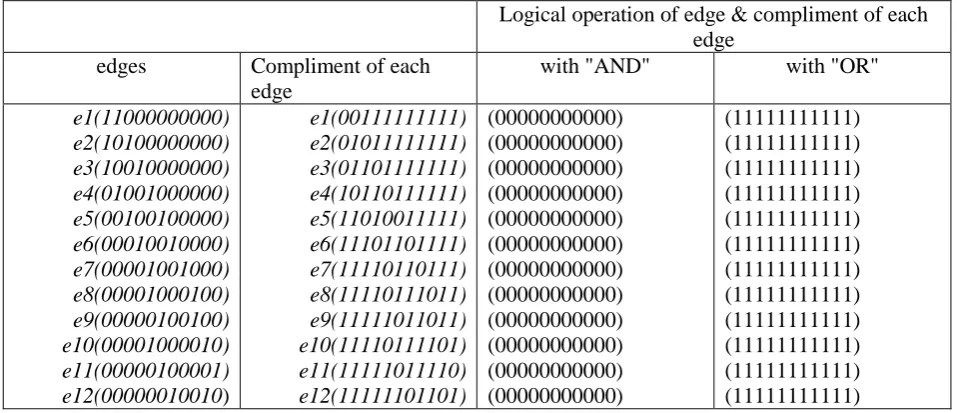
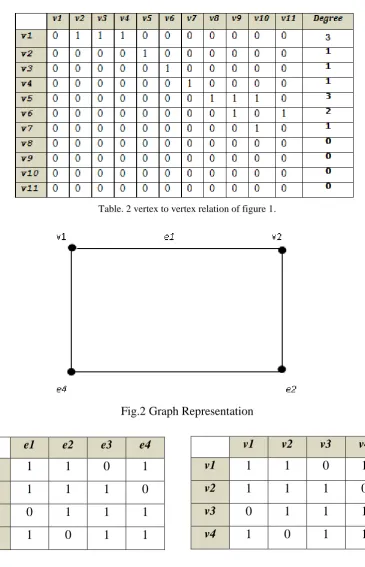
The table 1 gives us degree of each node and number of vertexes connected with each edge. The table 2 shows vertex to vertex relation of figure 1. In table 3 we have represented edge to edge & vertex to vertex relations of figure 2 and figure 3. Table 1(b) shows the logical operation of edges with its compliments to shows tautology or contradiction for the purpose to validate the connectivity.
Logical operation of edge & compliment of each edge
edges Compliment of each edge
with "AND" with "OR"
e1(11000000000) e2(10100000000) e3(10010000000) e4(01001000000) e5(00100100000) e6(00010010000) e7(00001001000) e8(00001000100) e9(00000100100) e10(00001000010) e11(00000100001)
e12(00000010010)
e1(00111111111) e2(01011111111) e3(01101111111) e4(10110111111) e5(11010011111) e6(11101101111) e7(11110110111) e8(11110111011) e9(11111011011) e10(11110111101) e11(11111011110) e12(11111101101)
(00000000000) (00000000000) (00000000000) (00000000000) (00000000000) (00000000000) (00000000000) (00000000000) (00000000000) (00000000000) (00000000000) (00000000000)
(11111111111) (11111111111) (11111111111) (11111111111) (11111111111) (11111111111) (11111111111) (11111111111) (11111111111) (11111111111) (11111111111) (11111111111)
[image:2.595.53.504.89.336.2] [image:2.595.59.538.491.697.2]Table. 2 vertex to vertex relation of figure 1.
Fig.2 Graph Representation
Table.3 edge - edge & vertex – vertex Operation.
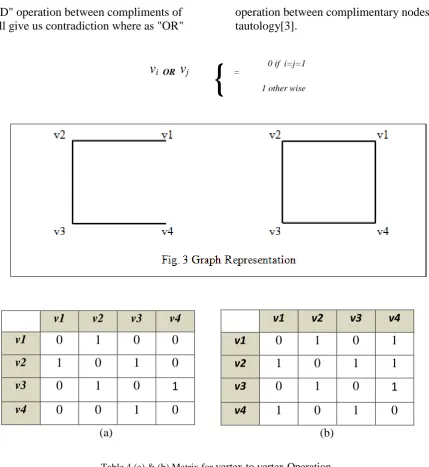
Table 5 shows the logical relation between processors of figure 3. In figure 3 we have two graph which are converted in vertex – vertex relations as tables shown in table3. Now we are
using logical operation "AND" between vectors of matrix shown in table3. We have shown that "AND" gives common connectivity between two nodes.
e1 e2 e3 e4
e1 1 1 0 1
e2 1 1 1 0
e3 0 1 1 1
e4 1 0 1 1
v1 v2 v3 v4
v1 1 1 0 1
v2 1 1 1 0
v3 0 1 1 1
v
i ANDv
j =1 where i=j=1
0 other wise
The "AND" operation between compliments of nodes will give us contradiction where as "OR"
operation between complimentary nodes gives tautology[3].
vi OR vj =
0 if i=j=11 other wise
Table.4 (a) & (b) Matrix for vertex to vertex Operation.
Possible Connectivity of nodes with AND Operation:
Nodes (a) AND Possible
Connectivit y of nodes
(b)AND Possible
Connectivit y of nodes
v1,v2 v1,v3 v1,v4 v2,v3 v2,v4
v1(0 1 0 0) ^ v2(1 0 1 0) = {0 0 0 0} v1(0 1 0 0) ^ v3(0 1 0 1) = {0 1 0 0} v1(0 1 0 0) ^ v4(0 0 1 0) = {0 0 0 0} v2(1 0 1 0) ^ v3(0 1 0 1) = {0 0 0 0} v2(1 0 1 0) ^ v4(0 0 1 0) = {0 0 1 0}
Nil (2)=1 Nil Nil (3)=1
v1(0 1 0 1) ^ v2(1 0 1 0) = {0 0 0 0} v1(0 1 0 1) ^ v3(0 1 0 1) = {0 1 0 1} v1(0 1 0 1) ^ v4(1 0 1 0) = {0 0 0 0} v2(1 0 1 0) ^ v3(0 1 0 1) = {0 0 0 0} v2(1 0 1 0) ^ v4(1 0 1 0) = {1 0 1 0}
Nil (2,4)=2 Nil Nil (1,3)=2
v1 v2 v3 v4
v1 0 1 0 0
v2 1 0 1 0
v3 0 1 0 1
v4 0 0 1 0
(a)
v1 v2 v3 v4
v1 0 1 0 1
v2 1 0 1 1
v3 0 1 0 1
v4 1 0 1 0
(b)
{
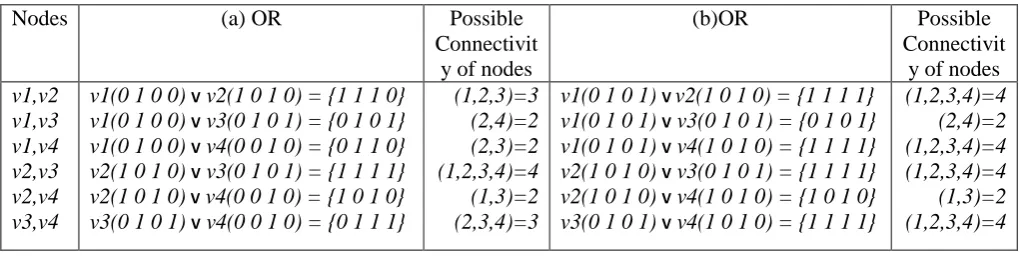
[image:4.595.80.510.111.579.2] [image:4.595.44.558.632.759.2]Possible Connectivity of Nodes with OR operation
Nodes (a) OR Possible
Connectivit y of nodes
(b)OR Possible
Connectivit y of nodes
v1,v2 v1,v3 v1,v4 v2,v3 v2,v4 v3,v4
v1(0 1 0 0) Vv2(1 0 1 0) = {1 1 1 0}
v1(0 1 0 0) V v3(0 1 0 1) = {0 1 0 1}
v1(0 1 0 0) Vv4(0 0 1 0) = {0 1 1 0}
v2(1 0 1 0) Vv3(0 1 0 1) = {1 1 1 1}
v2(1 0 1 0)Vv4(0 0 1 0) = {1 0 1 0} v3(0 1 0 1) V v4(0 0 1 0) = {0 1 1 1}
(1,2,3)=3 (2,4)=2 (2,3)=2 (1,2,3,4)=4 (1,3)=2 (2,3,4)=3
v1(0 1 0 1) V v2(1 0 1 0) = {1 1 1 1}
v1(0 1 0 1) V v3(0 1 0 1) = {0 1 0 1}
v1(0 1 0 1) V v4(1 0 1 0) = {1 1 1 1}
v2(1 0 1 0) V v3(0 1 0 1) = {1 1 1 1}
v2(1 0 1 0) V v4(1 0 1 0) = {1 0 1 0} v3(0 1 0 1) V v4(1 0 1 0) = {1 1 1 1}
[image:5.595.43.557.84.213.2](1,2,3,4)=4 (2,4)=2 (1,2,3,4)=4 (1,2,3,4)=4 (1,3)=2 (1,2,3,4)=4
Table 6 Matrix relation with OR operation.
CONCLUSION AND FUTUREWORK
In this paper we are trying to establish the connectivity and complexity of nodes for the development of algorithms. The following are the conclusion of vector operations between nodes of connectivity matrix.
1. The logical operation "AND" shows the
connectivity of nodes in "Race" condition.
2. 2. The logical operation "OR" shows the
connectivity of nodes when any of the node is active.
3. The complimentary nodes with "AND" not
possible because of contradiction where as complements nodes with is always possible because of tautology.
4. The use of logical operations shows the
validity of possible communication
between nodes. The algorithms will
validate the communication is possible or not at some point. We will show that binary relations are always possible in our future studies.
REFERENCES
[1] N. Deo, Graph Theory with Applications to Engineering and Computer Science.
[2] Ellis Horowitz and Sartaj Sahni, Fundamentals of Data Structures and Fundamental of Data Structure in C, Computer Science.
[3] Katare R K and Chaudhary N S, “Study of topological property of interconnection networks and its mapping to Sparse Matrix model” International journal
[4] I. Foster, C. Kesselman, and S. Tuecke, “The Anatomy
of the Grid: Enabling Scalable Virtual Organizations,” Int. J. of High Performance Computing Applications, Vol. 15, No. 3, 2001, pp. 200 - 222.