Volume 4, No. 4, March-April 2013
International Journal of Advanced Research in Computer Science
RESEARCH PAPER
Available Online at www.ijarcs.info
ISSN No. 0976-5697
Real Time Static Hand Gesture Recognition System Using Hci For Recognition Of
Numbers
Prof J.R.Pansare, Ziyaan Dadachanji*, Jay Shrotriya, Rahul Durrani and Sonam Jaisinghani
Dept. of Computer Engineering M.E.S. College of Engineering Pune, India [email protected], [email protected], [email protected],
[email protected], [email protected]
Abstract: In this paper, we introduce a static hand gesture recognition system to recognize numbers from 0 to 9. This system uses a single camera without any marker or glove on the hand. This work proposes an easy-to-use and inexpensive approach to recognize single handed static gestures accurately. The system helps millions of deaf people to communicate with other normal people. It describes a hand gesture recognition system (HGRS) which recognizes hand gestures in a vision based setup that includes capturing an image using a webcam. It is mainly divided into the following stages: image capturing, image pre-processing, region extraction, feature extraction and matching and gesture recognition. The image is first captured in RGB format. The image pre-processing module transforms the raw image into the desirable feature vector which mainly includes converting the colour images into the HSV images and reducing noise. The region extraction module extracts the skin region from the whole image and eliminates the forearm region giving the region of interest. The feature extraction module extracts a set of distinct parameters to represent each gesture and distinguish the different gestures. Finally the features are matched and the corresponding gesture is recognized. 100 images for each hand gesture representing different numbers are used to train the system and then it is tested for a different set of images. Images for the training set are taken, keeping the hand at a distance of 15 inches from a 720p HD web camera.
Keywords: Region Extraction, Feature extraction, Histogram, Euclidean Distance, Gesture recognition
I. INTRODUCTION
Hand gesture recognition has various applications like computer games, machinery control and thorough mouse replacement. One of the most structured sets of gestures belongs to sign language. The proposed static hand gesture recognition system makes use of Human Computer Interaction (HCI) and computer vision.
Human–computer Interaction (HCI) involves the study, planning, and design of the interaction between people (users) and computers. A basic goal of HCI is to improve the interactions between users and computers by making computers more usable and receptive to the user's needs.
Computer vision is a field that includes methods for acquiring, processing, analysing, and understanding images and, in general, high-dimensional data from the real world in order to produce numerical or symbolic information. Computer vision is also described as the enterprise of automating and integrating a wide range of processes and representations for vision perception.
Nowadays, the majority of the human-computer interaction (HCI) is based on devices such as keyboard and mouse. Physically challenged people may have difficulties with such input devices and may require a new means of entering commands or data into the computer. Gesture, Speech and touch inputs are few possible means of addressing such user's needs to solve this problem. Using computer vision, a computer can recognize and perform the user's gesture command, thus alleviating the need for a keyboard.
Sign language is the most natural and expressive way for the hearing impaired. The Indian Sign Language was proposed
by Government of India so that there is a uniform sign language that can be used by all the deaf and dumb people in the country. Automatic sign language recognition offers enhancement of communication capabilities for the deaf and dumb.[1].
Prof. J.R.Pansare [2] proposed a method in which the minimum Euclidian distance would determine the perfect matching gesture from the training data set. This method gave high accuracy at a comparatively low cost. Panwar [3] presented a real time hand gesture recognition system on the basis of detection of some meaningful shape based features like orientation, centre of mass, status of fingers, thumb in terms of raised or folded fingers of hand and their respective location in the image. This approach is simple, easy to implement and does not require significant amount of training or processing and providing high recognition rate with minimum computation time.
Dardas and Georganas proposed a system which detected and tracked bare hands in a cluttered background using skin detection and hand posture contour comparison after removing the face, recognized hand gestures via bag of features and multiclass support vector machines and building a grammar that generates gesture commands to control an application [4].
F.Ullah [5] presented a hand gesture recognition system that used Cartesian Genetic Programming (CGP), an evolutionary programming technique that is faster in contrast to conventional Genetic Programming.
Fernando [7] presented a less costly approach to develop a computer vision based sign language recognition application in real time with motion recognition.
In [8] a vision based human computer interface system was proposed which can interpret a user’s gestures in real time for manipulating games and windows using a 3D depth camera, which is more robust than the method using a general camera.
A new sub-gesture modelling approach was proposed in [9] which represents each gesture as a sequence of fixed sub-gestures and performs gesture spotting where the gesture boundaries are identified. It outperforms the Hidden Conditional Random Fields (HCRF) based methods and baseline gesture plotting techniques.
In [10] a hand gesture recognition system using a stereo camera was implemented in real time. It performed hand detection using a depth map, used the convex hull to detect the region of interest (ROI), calculated the depth of the object in ROI to obtain more accurate hand images and used a blob labelling method to obtain a clean hand image. Finally Zhang and Suen’s thinning algorithm was used to obtain the feature points to recognize the gestures.
Zhang and Yun [11] use skin colour segmentation and distance distribution feature to realize the gesture recognition and added the colour marker to get rid of the independent regions. This method has good robustness and it can detect and recognize the hand gestures in varying illumination conditions, hand distance and hand angles efficiently.
Choras [12] proposed using geometrical and Radon Transform (RT) features for the recognition of hand gestures. The hand gesture recognition is realized based on the gesture blob and texture parameters extracted with the blocks, RT image and also invariant moments giving a detection rate of 94%.
In [13] a hand gesture recognition system to translate hand gestures into Urdu alphabets using colour segmentation and a comprehensive classification scheme.
Liu, Gan and Sun [14] proposed an algorithm based on Hu moments and Support Vector Machines (SVM). Firstly, feature vectors are obtained using Hu invariant moments and then an SVM is used to find a decision border between the integrated hand and the defected hand. It brings a 3.5% error rate of identifying the hand.
A simple recognition algorithm that uses three shape-based features of a hand to identify what gesture it is conveying is proposed in [15]. This algorithm takes an input image of a hand gesture and calculates three features of the image, two based on compactness and one based on radial distance.
II. FLOWOFHANDGESTURERECOGNITION SYSTEM
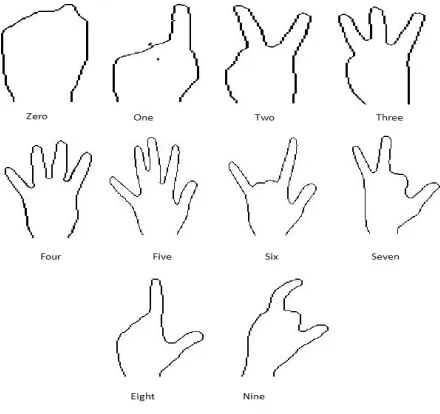
In this section, the flow of our hand gesture recognition system is presented as shown in Figure 2. The hand image is first captured using a Microsoft HD Webcam shown in Figure 1. It is converted to a resolution of 160x120. The image is then pre-processed and the hand region is extracted. Feature vector is obtained from the filtered binary image and feature matching compares the training set images with the test image. Figure 3 shows the gestures used by the system for numbers 0-9.
ote that the equation is centered using a center tab stop. Be sure that the symbols in your equation have been defined before or immediately following the equation. Use “(1)”, not “Eq. (1)” or “equation (1)”, except at the beginning of a sentence: “Equation (1) is . . .”
III. PROPOSEDSYSTEM
A. Image Capturing:
Different colour space methods can be used for capturing an image. Colour is affected by changing lighting conditions and it differs among people.
The image is captured in RGB format since RGB images do not use a palette. The images are captured using an HD web camera. In our database, the image size is 160 × 120. If this size of image is used for the processing, the computation time will be very high.
B. Normalization of Image:
Normalization is done in order to change the range of pixel intensity values for the images with poor contrast due to glare.
C. Conversion from normalized RGB to YCbCr:
The normalized image is converted to YCbCr since unlike RGB it is insensitive to luminescence and hence can detect all shades of skin.
D. Gray thresholding:
The graythresh function uses Otsu's method, which chooses the threshold to minimize the intraclass variance of the black and white pixels by reduction of a graylevel image to a binary image.
E. Noise Removal:
Median filter is used to reduce the "salt and pepper" noise. Salt and pepper noise is a form of noise typically seen on images. It is represented as randomly occurring white and black pixels.
F. Extraction of Region of Interest:
In order to extract the hand from the image, we use the concept of largest blob detection. We find the largest blob in the image i.e. the hand and extract it from the image.
G. Edge Detection:
Edge detection is used for identifying points in the digital image at which the image brightness changes sharply or, more formally, has discontinuities. Canny Edge detector is used to detect the edges of the hand.
H. Histogram Calculation:
I. Pattern Recognition using Euclidean distance:
The histogram of the test image is compared with the histogram of the images in the training set to recognize the gesture using Euclidean distance given by the formula:
Figure. 1 Microsoft 3000HD web camera
Figure. 2 Flow of hand gesture recognition
Figure. 3 Gestures used in the system
IV. EXPERIMENTALSETUP
Our experimental set-up consists of a Microsoft HD web camera mounted on top of the laptop. The camera is adjusted in a way that it is parallel to the floor. The gestures which are considered should be taken with dark background as light background interferes with the skin pixels. The hand is at a distance of 20-30 cm from the camera. It is positioned in such a way that the camera gets the complete view of the hand.
V. EXPERIMENTALRESULTS
In this section, the performance of real time static hand gesture recognition system is evaluated for each of the 10 hand gestures. 100 samples for each gesture are stored in the training set. Real-time test image is used for the performance evaluation.
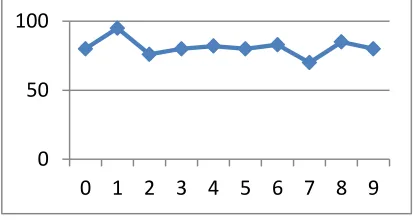
Based on the proposed algorithm the recognition results are reported in Table 1 and a graph of the recognition results of the hand gestures is shown in Figure 4. The overall success rate is 81.1% with the recognition time about 0.5 seconds using a 720p HD webcam and MATLAB 2010a.
Table I. Recognition results of each gesture
Gesture Recognition Percentage
0 1 2 3 4 5 6 7 8 9
80 95 76 80 82 80 83 70 85 80
0 50 100
0 1 2 3 4 5 6 7 8 9
Figure. 4 Graph of recognition percentages.
VI. CONCLUSION
This paper describes the design and implementation of a static hand gesture recognition system using a single hand and single camera. The developed system can obtain a high recognition rate of hand gestures, which could reach to 93.1% of the cases. Our current research mainly focuses on the single hand static gestures for simplicity and works well for dark backgrounds.
VII. REFERENCES
[1] Jayashree R. Pansare, Shravan H. Gawande, Maya Ingle, Department of Computer Engineering, M. E. Society’s College of Engineering, Pune, India; Department of Mechanical Engineering, M. E. Society’s College of Engineering, Pune, India; Department of Computer Engineering, School of Computer Engineering, Devi Ahilya University, Indore, India, “Real-Time Static Hand Gesture Recognition for American Sign Language (ASL) in Complex Background”, Journal of Signal and Information Processing, 2012, 3, 364-367 doi:10.4236/jsip.2012.33047 Published Online August 2012
[2] Archana S. Ghotkar, Rucha Khatal , Sanjana Khupase, Surbhi Asati & Mithila Hadap Department of Computer Engineering, Pune Institute of Computer Technology, Pune, India “Hand Gesture Recognition for Indian Sign Language”, 2012 International Conference on Computer Communication and Informatics (ICCCI -2012), Jan. 10 – 12, 2012, Coimbatore, India.
[3] Meenakshi Panwar, Centre for Development of Advanced Computing, Noida, Uttar Pradesh, India, “Hand Gesture Recognition based on Shape Parameters”, 2012 IEEE Conference in Dindigul, Tamilnadu,978-1-4673-0270-8, 12655227, Digital Object Identifier : 10.1109/ICCCA.2012.6179213
[4] Nasser H Dardas and Nicolas D. Georganas, “Real-time Hand Gesture Detection and Recognition Using Bag-of-Features and Support Vector Machine Techniques”, IEEE Transactions on Instrumentation and measurement, Vol 60, No 11, November 2011
[5] Fahad Ullah, Department of Computer System Engineering, University of Engineering and Technology, Peshawar,
Pakistan, “American Sign Language Recognition System for Hearing Impaired People Using Cartesian Genetic Programming”, Proceedings of the 5th International Conference on Automation, Robotics and applications, December 6-8, 2011, Wellington, New Zealand.
[6] Sayed Akhlaq Hussain Shah, Ali Ahmed, Iftekhar Mahmood, Khurram Khurshid, Communication Systems Engineering, Institute of Space Technology, Islamabad Highway, near Rawat, Islamabad, Pakistan, “Hand Gesture based user interface for computer using a camera and projector”, 2011 IEEE International Conference on Signal and Inage Processing Applications (ICSIPA2011).
[7] D. Kumarage, S. Fernando, P. Fernando, D. Madushanka & R. Samarasinghe, “Real-Time Sign language Gesture Recognition using Still-Image and Comparison and motion Recognition”, 2011, 6th International Conference on Industrial and Information Systems, ICIIS 2011, August 16-19, 2011, Sri Lanka.
[8] Guan-Feng He, Sun-Kyung Kang, Won-Chang Song, Sung-Tae Jung, Dept. of Computer Engineering Wonkwang University, Iksan, Jeonbuk 570-749, Korea, “Real-time Gesture Recognition using 3D Depth Camera” 2011 IEEE Conference, Beijing, pp 187-190, 978-1-4244-9699-0, 15-17 July 2011.
[9] Manavender R. Malgireddy, Jason J. Corso, Srirangaraj Setlur, University of Buffalo, “A Framework for Hand Gesture Recognition and Spotting Using Sub-gesture Modeling”, Pattern Recognition (ICPR), 2010 20th International Conference, Istanbul, pp 3780—3783, 978-1-4244-7542-1, 23-26 Aug. 2010.
[10] Xianghua Li, Jun-ho An, Jin-hong Min and Kwang-Seok Hong, School of Information and Communication Engineering Sungkyunkwan University Suwon, South Korea, “Hand Gesture Recognition by Stereo Camera Using the Thinning Method”, 2011 IEEE International Conference, Hanghzou, pp 3077-3080, 978-1-61284-771-9, 26-28 July 2011.
[11] Baoyun Zhang, Ruwei Yun, Digital Environment Research Center, Nanjing Normal University, Nanjing, China, “Robust Gesture Recognition Based on Distance Distibution Feature and Skin-Color Segmentation”, Audio Language and Image Processing (ICALIP), 2010 International Conference, pp 886-891, 978-1-4244-5856-1, 23-25 Nov. 2010.
[12] Choras R.S.,Inst. of Telecommun., Univ. of Technol. & Life Sci., Bydgoszcz, Poland,” Hand shape and hand gesture recognition”, Industrial Electronics & Applications, 2009. ISIEA 2009. IEEE Symposium, pp 145-149, 978-1-4244-4683-4, 4-6 Oct. 2009, Kuala Lumpur.
[14] Yun Liu, Zhijie Gan and Yu Sun, Department of Information Science and Technology, Qingdao University of Science and Technology, Qingdao, Shandong Province 266061, China, “Static Hand Gesture Recognition and Its Application based on Support Vector Machines”, Software Engineering, Artificial Intelligence, Networking, and Parallel/Distributed Computing, 2008. SNPD '08 Ninth ACIS International Conference, pp 517-521, 978-0-7695-3263-9, 6-8 Aug. 2008, Phuket.