WORKING PAPER SERIES
A Structural Model of Professional
Commitment from the Perspective
of Characteristics of a Professional
Community
Xiaojin Wang
Anona Armstrong
10/2001
s
C
H
O
O
L
O
F
M
A
N
A
G
E
M
E
N
A Structural Model of Professional Commitment from the
Perspective of Characteristics of a Professional Community
Xiaojin Wang, Anona Armstrong
Abstract
Professional commitment has been previously measured using the same methods as those used to measure organisational commitment. Ignoring a professional difference from an employing organisation represents a major deficiency in the measurements. On the basis of the defining characteristics of a professional community, this paper proposes a model of professional commitment which is described by the three components: career pursuit commitment, reference group commitment, and leisure time commitment. Ten items, which formed three scales in a questionnaire mailed to Australian project management professionals, were analysed using SPSS and AMOS. The results showed that the model fitted the data well, although there existed an error factor representing a general attitude towards work-leisure relations. The reliability and validity of the scales were also examined.
Introduction
Professional commitment (PC) can be generally defined as a career focus form of work commitment that emphasizes the importance of a profession in one’s “total life” (Morrow, 1993: 33). As one of the important factors determining people’s work behaviour, PC is a topic attracting much attention from academics and managers, e.g., Lee, Carswell and Allen (2000), Hoff (2000), Dwyer, Welker and Friedberg (2000), Irving, Coleman and Cooper (1997), and Meyer, Allen and Smith (1993), just to name a few. Previous studies have contributed to aspects of the literature such as the measurement of PC, relationships between PC and organisational commitment (OC), and relationships between PC and its antecedent and consequence variables. However, in most cases, PC is measured in a unidimensional way and/or in the same way as OC without any consideration of how a professional community differs from an employing organisation. For example, two widely-used measurements, a unidimensional scale Aranya, Pollock and Amernic (1981) and a three-component model of PC Meyer, Allen and Smith (1993), are modified from their OC versions. Recently, it has become apparent that PC is a complex and multi-dimensional concept (Irving, Coleman & Cooper, 1997). Recognising PC as a multi-dimensional construct, the purpose of this study was to establish a structural model of PC from the perspective of the defining characteristics of a professional community, independently from the concept and measurements of OC, using data from a survey of Australian project management (PM) professionals.
Necessity of the new perspective
A professional community has different characteristics from an employing organisation. Firstly, a professional community is formed purely around the work itself but work is only a small part of the relationships in an organisation and work has different meanings in a professional community and in an organisation (Van Maanen & Barley, 1984). According to Van Maanen and Barley (1984):
• In a professional community, work has its major meaning for those who do it; but in an organisation, work has its major meaning for others (employers);
• In a professional community, work itself is a focal concept; but in an organisation, work is a concept subsidiary to the more abstract relationships that engender the economic and social order of an organisation; and
• In a professional community, people’s assessments of work and career are cast in terms of their getting better at what they do; but in an organisation, people regard their work career largely in terms of movement (or lack thereof) within a set sequence of hierarchically ascending positions.
associated with organisational changes, such as mergers, acquisitions, downsizing, restructuring, and layoffs, have caused many employees not to take a particular organisation as their permanent career (Lee, Carswell, & Allen, 2000).
Thirdly, unlike in an organisation, the extension of professional activities and interests into non-work (leisure) time is an important matter in a professional community (Salaman, 1974; Van Maanen & Barley, 1984). Many profession-related activities, such as seminars, SIG (Special Interest Groups) activities, INTERNET discussions, etc, are conducted in informal ways during leisure time. Also, development of a profession’s esoteric knowledge requires professionals to contribute some leisure time to continuously improve and update their professional knowledge through reading professional magazines, journals and books.
However, the literature tends to ignore these differences between a professional community and an organisation and consequently to define and measure PC in the same way as to define and measure OC. For example,
• Aranya, Pollock and Amernic (1981: 271-272) define PC as the relative strength of their “professionals identification with and involvement in their profession” and measure it with a 15-item scale. Their definition and scale are virtually from Porter, Steers, Mowday and Boulian’s (1974) definition and scale of OC, with the only change substitution of the words “organisation” and “profession”.
• Meyer, Allen and Smith (1993) use Meyer and Allen (1991) three components of OC as exactly that of PC. The three components are: affective commitment (people stay at an organisation or a profession because they want to), continuance commitment (people stay because of their perceived cost of leaving), and normative commitment (people stay because they feel like they ought to).
This traditional way of defining and measuring PC is deficient because it regards a professional community as just another employing organisation in spite of the fact that they are not the same. The application of a scale of OC to PC may cause extra noises” which distort survey results of PC and their interpretation or lead to confusing results. A careful examination of Meyer, Allen and Smith’s (1993) normative commitment and continuance commitment can show some evidence of the problems.
it rather than others (Van Maanen & Barley, 1984), professionals’ normative commitment to their profession is of little sense. Explaining their findings of normative commitment, Irving, Coleman and Cooper (1997: 450) state that “whereas various occupations provide differential benefits for continuing in those roles, individuals feel little obligation to do so”.
The continuance commitment leads to confusing results for PC. As stated by Meyer, Allen and Smith (1993), continuance commitment develops as an individual makes investments (e.g., the time and effort put into acquiring profession-specific knowledge and skills) that would be lost or reduced in value if he/she leaves the profession. They expect and find that continuance commitment negatively correlates with affective commitment. Here is the problem. According to this kind of negative correlation, people with a higher level of professional education develop a higher continuance commitment, and consequently a lower affective commitment. However, this is obviously in conflict with the statements about a positive correlation between professional education and professional identity in the sociology of professions (Merton, 1957), which has been evidenced by empirical studies (e.g., Gerstal, 1969; Berger & Grimes, 1973). A possible explanation is that Meyer, Allen and Smith’s (1993) scale ignores the difference between an organisation and a profession. It is much easier for professionals to move from organisation to organisation than from profession to profession. With an orientation to cross-organisational professional markets (Martin, Riemens, & Wajcman, 2000), professionals are likely to view investments in an organisation as a negative force for leaving the organisation. But with the common view of seeing their profession as a permanent career (Goode, 1957), professionals are likely to see investments in professional knowledge and skills as a positive force for staying at the profession.
Another deficiency in the traditional way of defining and measuring PC is that it neglects a profession’s requirements for members extending professional activities and interests into leisure time. No previous scale of PC has included a measurement of this component.
In addition, previous measurements of PC cannot produce appropriate indices as part of the measurement of the degree to which an occupation is professionalised. One of the fundamental aspects determining the degree of the professionalism of an occupation is the degree to which a professional community is formed among members on the basis of their common commitment to the profession (Turner & Hodge, 1970). However, without any consideration of a professional community’s characteristics, previous OC-based measurements of PC cannot be used for this purpose. This may partly explain the literature’s lack of the study of professionalism from a PC perspective.
Therefore, in order to overcome the deficiencies in OC-based measurements of PC, there is a need to define and measure PC from the perspective of professional community itself instead of simply borrowing the definition and measurement of OC.
Theory and Hypothesis
measurement of PC should focus on professional work itself. Under this guidance, two components that define PC are professionals’ pursuit of their profession as a permanent career and their willingness to extend their professional activities and interests into leisure time. For the sake of convenience, the former is named as career pursuit commitment and the later as Leisure Time Commitment. These two kinds of commitment are consistent with Morrow’s (1993) definition of PC that stresses a profession’s central position in one’s “career focus” and “total life”. They are also consistent with other relevant statements in the literature, such as,
• Career pursuit commitment: (1) It is essential for any profession that its members view it as a permanent career instead of a stepping stone to another occupation (Goode, 1957); (2) Attitude to the job (work) itself is a central concern in committing to one’s profession (Lee, Carswell, & Allen, 2000); and (3) Career commitment is “one’s attitude towards one’s profession or vocation” (Blau, 1985: 280).
• Leisure time commitment: Professionals carry their professional work and interests into leisure time (Salaman, 1974; Van Maanen & Barley, 1984). This kind of work-leisure relationship is consistent with Parker’s (1972) theory of work-work-leisure relationships. Parker’s (1972) theory identifies three patterns of work-leisure relationships, ie., extension, opposition, and neutrality, and relates each of them to a set of associated variables. From the theory, it is clear that professionals are expected to be extension-pattern-oriented, that is, they have a strong tendency to extension of work into leisure.
Neglected by previous research, leisure time commitment deserves more words. For professionals, a main function of leisure is continuation of personal development rather than entertainment (Parker, 1972). While work goals and demands placed upon an individual are normally from an outside agency, leisure activities are decided and any control of them are manipulated by the individual himself/herself (Dunkerley, 1975). In leisure time, one can do what he/she wants to do. If he/she is highly committed to a profession, he/she is expected to carry professional activities and interests into leisure time. So, the degree to which an individual’s content of leisure is similar to that of work and his/her leisure has an imprint left by work is one of indices of his/her commitment to the profession. This leisure time commitment is an essential aspect of PC.
A professional community has one more characteristic, that is, professionals use other members of the same profession as their primary reference group (Salaman, 1974; Van Maanen & Barley, 1984), with which they compare themselves in making a self-judgment (Turner, 1956). For professionals, the reference group acts as the source of their work-related values or perspectives. They look to one another for support and confirmation of the meanings they ascribe to events around them, for approval and disapproval of patterns of behaviours, and for evaluation of their work performance. Through the reference group, the membership of a profession comes to share a distinct pattern of values, beliefs, norms, and interpretations for judging the appropriateness of one another’s actions and reactions (Van Maanen & Barley, 1984).
This study used the three kinds of commitment, ie., career pursuit commitment, leisure time commitment, and reference group commitment, as the main themes in the definition of PC and hypothesised that:
• The three kinds of commitment together constitute a multi-dimensional model of the PC construct.
• Each of the three kinds of commitment is positively related to the PC construct.
To test the hypotheses, this study developed three scales, each representing one of the three kinds of commitment. So, another purpose of this study was to test the scales’ reliability and validity to see if they could be recommended for future use.
Method
Measurement
This study designed the following items as indicators of each of the three kinds of commitment: (For the convenience of formatting the questionnaire, the sequence of
leisure time commitment and reference group commitment has been changed) • Career Pursuit Commitment (CPC):
♦ Item 1: Build my professional reputation in project management
♦ Item 2: Have an adequate level of salary relative to other PM professionals outside my employing organisation
♦ Item 3: Improve my knowledge in project management
♦ Item 4: Have adequate career prospects within the PM profession • Reference Group Commitment (RGC):
♦ Item 5: Keep contact with others in the PM profession
♦ Item 6: Earn excellence in the eyes of PM colleagues outside my employing organisation
♦ Item 7: Belong to the professional community of project management • Leisure Time Commitment (LTC):
♦ Item 8: When necessary, I am willing to extend my professional work into my leisure time. (Its opposite statement: It is important for me to have a clear point where my professional work ends and leisure begins.)
♦ Item 9: In my leisure time, project management is one of my favourite topics to talk about. (Its opposite statement: In my leisure time, I do not like to talk about project management.)
♦ Item 10: In my leisure time, I like to participate in professional activities (such as seminars, discussions, conferences, etc.). (Its opposite statement: In my leisure time, I do not like to participate in professional activities.)
The 10 items were part of a questionnaire used in a major study of PM professionals’ work-related values and beliefs. Items 1-7 were measured with a scale from 1 = Very Unimportant to 5 = Very Important, and Items 8-10 required a respondent to choose between two logically-opposite statements on a five-point scale to show the extent to which he/she agreed with the statements.
Data collection
fact that project management has become a profession increasingly demanded by clients across a wide range of industries (Australian Institute of Project Management, 1999) and also the researchers’ familiarity with the PM profession.
The questionnaire was mailed to 790 Australia-based AIPM (Australian Institute of Project Management) members with the membership grades of Member and Fellow who had valid post addresses at AIPM on July 31, 2000. This selection of the survey participants was to ensure that the participants formed a homogeneous professional group and had a certain level of PM education and experience. As the only association dedicated to PM in Australia, AIPM’s membership was a reasonable criterion for defining such a homogeneous group. Also, AIPM had enforced membership requirements of education and experience for the grades of Member and Fellow. It was assumed that professional education and experience were important to the development of PC.
The data collection process produced 323 useable responses, representing a response rate of 41 percent. Of the respondents, 96% were men, 66% were aged between 31-50, 63% had PM experience between 6-20 years, 60% were postgraduate educated, 47% had completed PM training at postgraduate level, 36% were project managers, 52% were from the construction industry.
Statistical analysis
This study used (1) confirmatory factor analysis (CFA) to test the research hypotheses, (2) the computation of composite reliability and extracted variance (Hair, Anderson, Tatham, & Black, 1998) to test the reliability of the scales, and (3) traditional descriptive statistics and independent samples t-test to test the validity of the scales. The statistical analyses were conducted on the softwares SPSS 10.0 for social science statistics and AMOS 4.0 for structural equation modeling.
This study followed the CFA steps suggested by Hair et al. (1998) to specify and test a second-order factor model, ie., from initial model specification and estimation through model-data fit examination and model modification to obtaining a final model. As suggested by Hair et al. (1998), a second-order factor model is an effective means to examine the dimensionality of a complex construct. In the model of this study, the second-order factor was the PC construct (variance was set as the unity), the first-order factors were the three kinds of commitment, and the indicators were the questionnaire items. Among the paths from each of the three kinds of commitment to indicator items, the parameter of one path was fixed to the unity. Measurement errors were allowed for all the endogenous variables.
AMOS’ diagnostics did not encourage the researchers to believe that the sample came from a multivariate normal population. So this study used the “asymptotically distribution free” (ADF) estimation method instead of the frequently-used “maximum likelihood” (ML). The ADF technique has recently received particular attention due to its insensitivity to non-normality of data (Hair et al., 1998).
AMOS output, this study used the measures and their values of acceptable fit as follows (Source: Hair et al., 1998: 660-661; Arbuckle, 1997: 551-572):
• Likelihood ratio Chi-square statistic (p): greater than 0.05 or 0.01; • Goodness-of-fit index (GFI): greater than 0.90;
• Root mean square residual (RMR): the closer to zero, the better fit;
• Root mean square error of approximation (RMSEA): under 0.08 or preferably 0.05; • Tucker-Lewis index (TLI): greater than 0.90;
• Normed fit index (NFI): greater than 0.90;
• Adjusted goodness-of-fit index (AGFI): greater than 0.90; • Comparative Fit Index (CFI): greater than 0.90; and
• Normed Chi-square (CMIN/DF): between 1.00 – 2.00 or 3.00.
It should be noted that, among these measures, p is quite sensitive to sample size (Hair
et al., 1998) and NFI often leads to excessive rejection of models in an ADF estimation (Hu & Bentler, 1995).
Model modification was conducted under the guidance of a theoretical consideration in accordance with empirical indicators of possible re-specification produced by AMOS, such as offending estimates, modification indices, and standardised residual covariances (Hair et al., 1998), in order to obtain a true structure of PC model.
Once a final model was obtained, this study conducted a significance test for estimated parameters between variables. Also composite reliability and extracted variance were computed for each of the three scales to test their reliability (Hair et al., 1998). In addition, the scales’ validity was tested by the descriptive statistics for calculating means and standard deviations and the independent samples t-tests for comparing means between groups with different demographics.
CFA Process and result
Exploratory factor analysis (EFA) of all the items in the questionnaire showed that the items which were designed to measure PC clustered around a single factor. During the EFA process, item 8 was deleted due to its low loading on the factor.
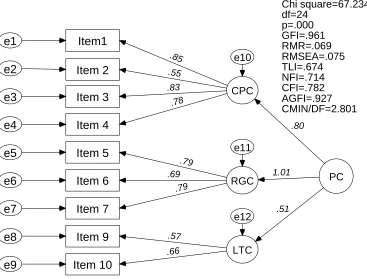
Figure 1 is the standardised estimation of the initial model. All the parameter estimates are consistent with the theory-based expectations. In the model, GFI = 0.961, RMR = 0.069, RMSEA = 0.075, AGFI = 0.927, and CMIN/DF = 2.801. These values of goodness-of-fit measures indicate that the present model already has an acceptable fit. However, the values of the remaining fit measures, ie., p, TLI, NFI, and CFI are not satisfactory, and this means potential for improvement of the model.
--- INSERT FIGURE 1 ABOUT HERE ---
CMIN/DF=1.757).
CFA permits specification of a correlation among measurement errors when there is sufficient reason to believe that a factor not explicitly-identified in the model influences responses to two or more indicator variables (Mueller, 1996). However, the model improvement caused by the addition of this correlation may mask a true underlying model structure (Gerbing & Anderson, 1984). For this reason, an error correlation must be carefully examined from the perspective of a theoretical rationale. On the basis of this examination, an error correlation may be treated in the following ways (Source: archives of the SEMNET electronic discussion network for structural equation modelling at www.gsu.edu/~mkteer/semnet.html):
• If a reasonable explanation and a meaningful name can be given to the unidentified factor, a new latent variable should be introduced to replace the error correlation; • If a new latent variable cannot be added but there is a good reason to believe the
existence of the error correlation, the correlation could be accepted as it is; otherwise, • The error correlation is unacceptable and must not be allowed and a true underlying
structure of the model must be sought through other ways.
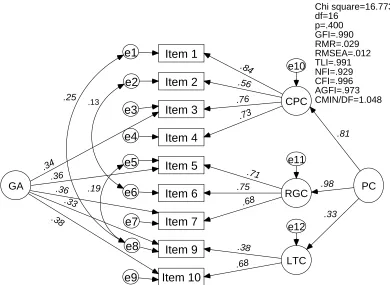
In the case of this study, the three positive error correlations (e1-e8, e2-e6 and e5-e8) are justifiable, but the negative correlations between e1 and e5/e9 need further examination. From the positive correlations among the three constructs (CPC, RGC, and LTC), it is clear that PC causes people, in the same direction, to establish their professional reputation and to conduct professional activities in leisure time. But the negative error correlations imply a factor with opposite influences on item 1 and item 5/10. This factor must represent something that is irrespective of PC. It could be a general attitude towards “working in leisure time”. This general attitude could make an individual contribute his/her leisure time to PM activities even though his/her commitment to the profession is low and vice versa. According to Parker’s (1972) theory of work-leisure relationships, people’s attitudes to work-leisure relationships are connected with their general philosophies of life (segmentalism or holism). Segmentalists tend to see work and leisure as separate or even contrasting activities, but holists tend to extend their work into leisure even though they may not see work as one of their central life interests. Due to differences in their general philosophy, people equally committed to the PM profession could be different in their willingness to contribute leisure time to professional activities. A careful examination of the items revealed that items 3, 5, 7, 9 and 10 might be significantly affected by the general philosophy. Therefore, an error factor, General Attitude towards Working in Leisure (GA) was added into the model. As an error factor, GA must have no correlation with any of the three constructs (CPC, RGC, and LTC).
As shown in Figure 2, the addition of the GA error factor significantly improves the model-data fit. All the fit measures reach an excellent level. All the parameter estimates are in the direction as expected and there are no offending estimates. Furthermore, in the final model, all the values of standardised residual covariances between indicators are below the threshold of 2.58 which means that a residual is significant at 0.05 level. This is a further evidence about the model-data fit (Hair et al., 1998). The confirmed final model supports the hypothesis that the three kinds of commitment together constitute a multi-dimensional model of the PC construct.
INSERT FIGURE 2 ABOUT HERE ---
All estimated parameters (except correlations between measurement errors) in Figure 2 are significant at 0.01 level. Actually, the majority of the parameters have a p value below 0.001. In the model, CPC, RGC, and LTC produce respectively a standardised coefficient of 0.81 (p<0.001), 0.98 (p<0.001), and 0.33 (p<0.001). These results support the hypothesis that each of the three kinds of commitment is positively related to the PC construct.
The composite reliability and variance extracted for each of the scales are as follows: • Career pursuit commitment: composite reliability = 0.82, variance extracted = 0.53; • Reference group commitment: composite reliability=0.78, variance extracted=0.51; • Leisure time commitment: composite reliability = 0.45, variance extracted = 0.30. The first two scales have a composite reliability above the 0.70 threshold and an extracted variance above the 0.50 threshold recommended by Hair et al. (1998). The third scale has a low composite reliability and a low extracted variance.
Validity of the Constructs
This study used participants’ demographics to test the validity of the three scales of PC. To be valid, the scales should be able to discriminate among those groups of participants whose commitment was theoretically expected to be different from each other.
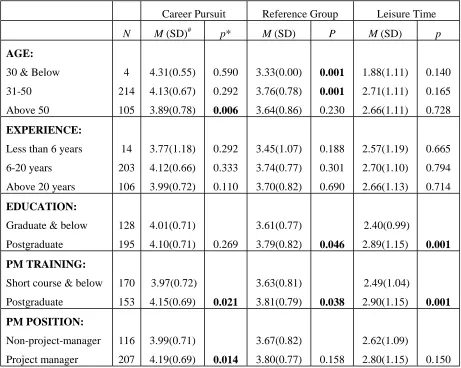
Scale scores were computed by the method of summated scales (Hair et al., 1998), that is, raw scores on relevant items were summed and then divided by the number of items. Table 1 shows the means, standard deviations and significance levels of independent samples t-tests for comparing the means.
--- INSERT TABLE 1 ABOUT HERE ---
Young PM professionals with age 30 and below have the strongest career pursuit in PM, while their sense of PM reference group and leisure time for PM are the weakest among the groups. These are consistent with the researcher’s expectation. Young professionals pay a lot of attention to aspects of building their professional reputation, improving their PM knowledge, and pursuing good career prospects in PM. However, they need more time to establish their PM reference group and become part of PM professional activities.
The comparison between groups with different PM experience shows that PM professionals who are at the peak of their career are the highest in commitment to the PM profession in terms of all the three constructs. Both age and experience comparisons show that PM professionals’ commitment would to some degree decrease as they approach the end of career. These findings are reasonable.
postgraduate PM training have significantly higher scores on all the three kinds of commitment than others who are short-course trained or without any formal training. These findings are consistent with the statements in the sociology of professions about the role of professional education/training in internalising professional values and beliefs into students and trainees.
The comparison between project managers and non project managers shows that the PM professionals who are in the position of project manager obtain higher scores than others without such a position on all the three kinds of commitment. These findings are reasonable, because the PM profession puts much more emphasis on the role of a project manager than on the other roles.
Discussion
The standard textbooks (e.g., Hair et al., 1998) suggest that once a model has been modified, the modified model should be tested with new data for its validity. This rigorous step in re-assessment has not been followed in this study given that the modification did not distort the structure of the original measurement model. The modification produced an error factor, representing professionals’ general philosophy towards work-leisure relationships, which was irrelevant to PC. The extraction of this error factor is consistent with Parker’s (1972) theory of work-leisure relationships.
In spite of the existence of the error factor in the model, the CFA result confirms that professional commitment is a concept including three distinguishable dimensions: career pursuit commitment, reference group commitment, and leisure time commitment. It recognises that an individual with high commitment to a profession would pursue the profession as his/her permanent career, use other members of the profession as his/her primary reference group, and extend his/her professional activities and interests into leisure time. The measurements of these three aspects are indices of the degree to which an individual is committed to the profession.
like to participate in PM professional activities in leisure time. These results imply that the PM profession has well established the career pursuit commitment, but it needs to do a lot to develop the reference group and leisure time commitment.
Two scales for CPC and RGC have acceptable reliability. These two scales are recommended for use in future research. However, the scale for LTC is not satisfactory. It needs further work to become a reliable and valid scale. For example, it may need the addition of one or two items about reading professional magazines or journals and the extent to which they like to have friends from the same profession. The difficulty is not only in that leisure may mean different things to different people (Parker, 1972) but also in that people are likely to disagree about work-leisure relationships because of their values/beliefs (e.g., the error factor in the model) irrespective of their commitment to the profession. In addition, the descriptive and t-test results of PM professionals show that all the three scales can discriminate as expected among groups of professionals.
Conclusion
The results of this study have provided some evidence to support the model of PC which is described by the three components: career pursuit commitment, reference group commitment, and leisure time commitment. Several major conclusions are as follows: • The CFA results confirm the three component model of PC that was developed on
the basis of the defining characteristics of a professional community, differing from the previous methods of borrowing the definitions and measurements of OC. In the final model, all the goodness-of-fit measures show an excellent model-data fit. Also, all the estimated parameters (except error correlations) are significant at 0.01 or 0.001 level. In addition, all the standardised residual covariances are small. Also, the descriptive and t-test results of PM professionals show that all the three scales can discriminate as expected among professionals with different demographics. The three-component model of PC can be used for future research.
• People’s general philosophy of work-leisure relationships has an impact on their willingness to extend professional interests into leisure time, irrespective of their commitment to professions. It is an error factor in the three-component model of PC. • The scales for career pursuit commitment and reference group commitment have
sufficient values of the composite reliability and extracted variance. The are recommended for future use.
• The scale for leisure time commitment needs further work to increase its values of reliability and extracted variance. However, despite its unsatisfactory reliability, the current 2-item scale is able to distinguish as expected among groups of professionals.
Reference
Aranya, N., Pollock, J., & Amernic, J. (1981). An examination of professional
commitment in public accounting. Accounting, Organizations and Society, 6 (4), 271-280.
Arbuckle, J. (1997). Amos Users’ Guide Version 3.6. Chicago: SmallWaters Corporation.
Berger, K., & Grimes, A.J. (1973). Cosmopolitan-local: A factor analysis of the construct. Administrative Science Quarterly, 18 (2), 223-235.
Blau, G. (1985). The measurement and prediction of career commitment. Journal of Occupational Psychology, 58 (4), 277-288.
Dunkerley, D. (1975). Occupation and Society. London: Routledge & Kegan Paul. Dwyer, P.D., Welker, R.B., & Friedberg, A.H. (2000). A research note concerning the
dimensionality of the professional commitment scale. Behavioral Research in Accounting,12, 279-296.
Gerbing, D.W., & Anderson, J.C. (1984). On the meaning of within-factor correlated measurement errors. Journal of Consumer Research, 11, 572-580.
Gerstal, J.E. (1969). Profession without Community: Engineers in American Society.
New York: Random House.
Goode, W.J. (1957). Community within a community: the professions. American Sociological Review, 22 (2), 194-200.
Hair, J.F. Jr., Anderson, R.E., Tatham, R.L., & Black W. C. (1998). Multivariate Data Analysis (5th ed.). Upper Saddle River, New Jersey: Prentice Hall.
Hiremath, S.L., Gudagunti, R., & Kulkarni, J. (1996). Professionalism among Indian executive. In H. Z. Lopata and A.E. Figert (eds.), Current Research on Occupations and Professions (Vol. 9). Greenwich, Connecticut: JAI Press. Hoff, T.J. (2000). Professional commitment among US physician executives in managed
care. Social Science & Medicine, 50 (10), 1433-1444.
Hu, L., & Bentler, P.M. (1995). Evaluating model fit. In R.H. Hoyle (Ed.), Structural Equation Modeling: Concepts, Issues, and Applications (pp. 76-99). Thousand Oaks, CA: Sage.
Irving, P.G., Coleman, D.F., & Cooper, C.L. (1997). Further assessments of a three-component model of occupational commitment: Generalizability and differences across occupations. Journal of Applied Psychology, 82 (3), 444-452.
Lee, K., Carswell, J.J., & Allen, N.J. (2000). A meta-analytic review of occupational commitment: Relations with person- and work-related variables. Journal of Applied Psychology,85 (5), 799-811.
Martin, B., Riemens, W., & Wajcman, J. (2000). Managerial and professional careers in an era of organisational restructuring. Journal of Sociology, 36 (3), 329-344. Merton, R.K. (1957). Some preliminaries to a sociology of medical education. In R.K.
Meyer, J.P., & Allen, N.J. (1991). A three-component conceptualization of
organizational commitment. Human Resource Management Review, 1, 61-98. Meyer, J.P., Allen, N.J., & Smith, C.A. (1993). Commitment to organizations and
occupations: Extension and test of a three-component conceptualization. Journal of Applied Psychology,78 (4), 538-551.
Morrow, P.C. (1993). The Theory and Measurement of Work Commitment. Greenwich, Connecticut: JAI Press Inc.
Mueller, R.O. (1996). Basic Principles of Structural Equation Modeling. New York: Springer.
Parker, S. (1972). The Future of Work and Leisure. London: Paladin.
Porter, L.W., Steers, R.M., Mowday, R.T., & Boulian, P.V. (1974). Organizational commitment, job satisfaction and turnover among psychiatric technicians.
Journal of Applied Psychology, 59 (5), 603-609.
Salaman, G. (1974). Community and Occupation: An Exploration of Work/Leisure Relationships. London: Cambridge University Press.
Turner, R.H. (1956). Role-taking and reference-group behavior. The American Journal of Sociology, 61 (4), 316-328.
Turner, C., & Hodge, M.N. (1970). Occupations and professions. In J.A. Jackson (ed.),
Professions and Professionalization (pp. 17-50). London: Cambridge University Press.
Wallace, J.E. (1993). Professional and organizational commitment: Compatible or incompatible?. Journal of Vocational Behavior, 42 (3), 333-349.
Van Maanen, J., & Barley, S.R. (1984). Occupational communities: culture and control in organizations. In B.M. Staw and L.L. Cummings (Eds.), Research in
Table 1: Means, Standard Deviations and Independent Samples t-test
Career Pursuit Reference Group Leisure Time
N M (SD)# p* M (SD) P M (SD) p
AGE:
30 & Below
31-50 Above 50 4 214 105 4.31(0.55) 4.13(0.67) 3.89(0.78) 0.590 0.292 0.006 3.33(0.00) 3.76(0.78) 3.64(0.86) 0.001 0.001 0.230 1.88(1.11) 2.71(1.11) 2.66(1.11) 0.140 0.165 0.728 EXPERIENCE:
Less than 6 years
6-20 years
Above 20 years
14 203 106 3.77(1.18) 4.12(0.66) 3.99(0.72) 0.292 0.333 0.110 3.45(1.07) 3.74(0.77) 3.70(0.82) 0.188 0.301 0.690 2.57(1.19) 2.70(1.10) 2.66(1.13) 0.665 0.794 0.714 EDUCATION:
Graduate & below
Postgraduate
128
195
4.01(0.71)
4.10(0.71) 0.269
3.61(0.77)
3.79(0.82)
0.046
2.40(0.99)
2.89(1.15) 0.001 PM TRAINING:
Short course & below
Postgraduate
170
153
3.97(0.72)
4.15(0.69) 0.021
3.63(0.81)
3.81(0.79)
0.038
2.49(1.04)
2.90(1.15) 0.001 PM POSITION: Non-project-manager Project manager 116 207 3.99(0.71)
4.19(0.69) 0.014
3.67(0.82)
3.80(0.77)
0.158
2.62(1.09)
2.80(1.15) 0.150
Note: # Means: on a scale from 1 (no commitment) to 5 (high commitment);
Item1
Item 7 Item 3
Item 4
Item 5
Item 6 Item 2
Item 9
Item 10 e1
e2
e3
e4
e5
e6
e7
e8
e9
CPC
RGC
LTC .85
.83
.78
.79
.69
.57
.66
Chi square=67.234 df=24
p=.000 GFI=.961 RMR=.069 RMSEA=.075 TLI=.674 NFI=.714 CFI=.782 AGFI=.927 CMIN/DF=2.801
.79
.55
PC
.80
1.01
.51
e10
e11
e12
Figure 1: Standardised Estimation of Initial Model
Item 1
Item 7 Item 3
Item 4
Item 5
Item 6 Item 2
Item 9
Item 10 e1
e2
e3
e4
e5
e6
e7
e8
e9
CPC
RGC
LTC .84
.76
.73
.71
.75
.38
.68
Chi square=16.773 df=16
p=.400 GFI=.990 RMR=.029 RMSEA=.012 TLI=.991 NFI=.929 CFI=.996 AGFI=.973 CMIN/DF=1.048
.19
GA
.34
.38
.25
.68
.56
.13
.36
.33
PC
.81
.98
.33
e10
e11
e12 .36
Figure 2: Standardised Estimation of Final Model