IJEDRCP1502004
International Journal of Engineering Development and Research (www.ijedr.org)1
A Secure Approach for E-Voting Using Encryption
and Digital Signature
1Jena Catherine Bel.D, 2Savithra.K , 3Divya.M 1Assistant Professor , 2III-Year BE CSE , ,3 III-Year BE CSE
1
Velammal Engineering college, 1Ambattur-Redhills Road,Chennai -600 066.
________________________________________________________________________________________________________
Abstract - Technology moulds the life style of human in a promoting manner. We prefer reducing time and efforts in all our chores. One of the systems used majorly for this purpose is ON-LINE where security is the major concern. This paper provides a secure approach for online voting system using the concept of encryption and digital signature. We have implemented the concept of AES and RSA algorithm.
Keywords - online voting, digital signature, web server
________________________________________________________________________________________________________
I.INTRODUCTION
In today‟s modern world of democracy election and voting plays a vital role. Electronic online voting over the Internet would be much more profitable since many voters would appreciate the possibility of voting from anywhere. Electronic voting, as the name implies, is the voting process held over electronic media, i.e. computers. A company having their offices in different locations can use internet voting for their election where employees from all offices will take part in election from their o wn office. An internet voting system should satisfy the following requirements.
1. Accuracy 2. Simplicity 3. Democracy 4. Verifiability 5. Privacy 6. Security.
Among these, security and privacy are main concerns. Therefore, an implementation of secure Internet voting system appears to be another application of cryptography and network security. Many e-voting systems, have been proposed in the last several decades and both the security as well as the effectiveness has been improved. Nevertheless, to the best of our knowledge, no practical and complete solution has been found for large scale elections over a network, say Internet. Our approach suggests a practical application of the existing cryptographic schemes and digital signature that ensures integrity of the vote cast by voter and authentication of voter at the two levels. Design of secure e-voting system over a network is indeed a very difficult task as all the requirements of the voting system have to be met. Failure to ensure even one of the specifications can lead to chinks and glitches that can be exploited by a middleman to forge or manipulate the intricate details. Therefore a voting scheme must ensure that the voter can keep his vote private.
II. LITERATUREREVIEW
This paper[1],review the currently deployed vote verification methods by discussing their weaknesses with the aim of proposing a more reliable and robust vote verification method. Authors in this paper, sought to propose a vote verification technique which would able to verify vote against major possible threats and enables all election participants to verify votes. For this purpose, they need to investigate a combination of both technological and procedural solutions.
Author[2] proposed design for e-voting systems based on dependable web services. The results got from the analysis of the evaluation of the proposed design, presented that solution , increase the dependability to a great extent. They also explained that this design can respond to main requirements of e-voting. The availability is one of key attributes and the most important requirement for e-voting as important as security, which is fulfilled. Considering that the security is a very important requirement of e-voting systems, author has used the existing solutions to achieve web service security.
IJEDRCP1502004
International Journal of Engineering Development and Research (www.ijedr.org)2
components fail and both availability and security as the most important specification of voting systems will be addressed. As voting via internet is very easy and has no time and money costs for voters system can encourage people to take part in the election.Author[4] proposed an E-voting procedure which ensures voters and candidate‟s confidentiality and accuracy. Many issues still exist, For example, when large number of voters cast their ballots at the same time, will it cause denial of service(DOS) in the Internet? How to design an efficient and secure online voting system? Nevertheless, atleast for the counting procedure, different levels of measurements introduced in our proposal have decreased the risk for unfairness in actual elections.
The proposed design in paper [5]contains that the voting can be done only at the places where the voting places are installed. Though voting can be done using mobile terminals at any places if the wireless network develops further in the forthcoming day, the additional requirements for security will be required depending on the wireless circumstances. And the way of authentication must be provided more strongly and there should not be coercive voting or exposure of data in the wireless network. Voting is a key way of democracy reflecting the nation‟s intention. Therefore, a study on security technology applied to the electronic voting system should be progressed continuously in the future.
Author[6] proposed an internet voting protocol .The proposed internet voting protocol adopts blind signature to protect the content of the ballot during casting. As we believe that a secure electronic voting system do not only allow all voters to verify the voting result but also avoid ballot buying, the proposed internet voting protocol is verifiable and discourages ballot buying at the same time. Any unauthorized candidate or party can still try to buy ballots during the election. However, no voter can prove which ballot was cast by him/her after the declaration of the election result. In other words, ballot buying may still exist, but the ballot buyer cannot be assured that the voter will mark the ballot as the buyer want.
This paper[9], review the various security attacks in computer networks such as active and passive attacks. Once the local area networks get connected to internet, all the attacks exploit the network security breaches. The network security is very complex, difficult to be designed and-more than all-difficult to be assured. It is easier to prove that a network can be penetrated, than to prove that it is completely sure. Security system is expensive and introduces unpleasant user limitations. The security system does not grow the network performance, but the threats are real and the risk is too big without a proper security policy.
III.PARTTAKERS
The participants are voter, voting client, voting server, voting authority. The system will be comprised of the following phases. 1. Registration
2. Authentication 3. Voting 4. Counting
Registration phase:
An authorized person of an organization will go to each office of the company and after verifying the valid identity of the employee the authorized person will register him/her for voting and give him/her PASSWORD and USERNAME. The voter later can change his/her PASSWORD online for security purpose just like we do when we get ATM card and PIN from bank for the first time.
Authentication phase:
When voter login using user name and password, the voting system will check authentication of the voter.
Voting phase:
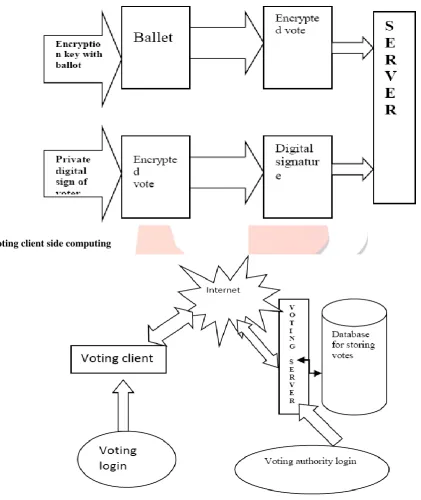
In this phase first request for ballet is done. Voter will get ballet and public encryption key. The vote will encrypt using this key. Again that encrypted vote is digitally sign using voter private key. Encrypted vote and digital signature is sent to voting server. Voting server first check digital signature and then store that encrypted vote.
Counting phase:
In this phase all the encrypted votes are decrypted and then counting is done. The authorized person will enter the private decryption key for decryption. The counting is done and the result will be declared.
IV.SYSTEM DESIGN
IJEDRCP1502004
International Journal of Engineering Development and Research (www.ijedr.org)3
signature is checked by digital signature verifier of that voter which is publicly known. For this purpose each voter should have a private digital signature and a public digital signature verifier, for this we are using a pair of asymmetric keys for each registered voter. As figure 2 consist of voting sever, voting client, voter and voting authority. A registered voter connects to voting server by using his login identification and password. Voting client and voting server communicate by internet.When a voter wishes to cast the vote he needs to request for ballet to the server. The server sends the ballet with public encryption key. Voter encrypts casted vote using this key, then voter digitally sign on encrypted vote by using his private key. And send both to the server. On server side, voting server verifies digital signature of voter by applying decryption on voter signature using public signature verifier of voter. If signature is valid vote is store for counting otherwise vote is discarded. ON CLIENT SIDE
Fig 1.Voting client side computing
Fig 2.shows computation on client side.
V.ALGORITHM
IJEDRCP1502004
International Journal of Engineering Development and Research (www.ijedr.org)4
Fig 3. Overall Structure of AESThe steps of AES algorithm,
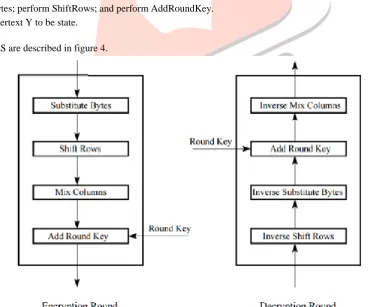
1. Given a plaintext X, initialize state to be X and perform an operation. Add round key, which x-ors the round key with state. 2. For each of the first r − 1 rounds, perform a substitution operation called SubBytes on state using an S-box; perform a permutation ShiftRows on state; perform an operation MixColumns on state; and perform AddRoundKey.
3. Perform SubBytes; perform ShiftRows; and perform AddRoundKey. 4. Define the ciphertext Y to be state.
Each round in AES are described in figure 4.
Fig 4.steps in each round of AES
IJEDRCP1502004
International Journal of Engineering Development and Research (www.ijedr.org)5
2. Calculate n=pq.-1)(q-1). .
i.e = 1.
5. Compute „d‟ to satisf ie:
RSA's biggest advantage is that it uses Public Key encryption. This means that your text will be encrypted with someone's Public Key. However, only the person it is intended for can read it, by using their private key. Attempting to use the Public Key to decrypt the message would not work. RSA can also be used to "sign" a message, meaning that the recipient can verify that it was sent by the person they think it was sent by.
VI.RESULTS AND IMPLEMENTATION
The authorized voting authority will visit to each office of company and do registration of voter by manually verifying the identification of employee. During registration voter generate a pair of asymmetric keys in which one is private and other is public voter keep his private key secrete and other public key goes to server along with other registration details of voter.
For security purpose voter can change his/her password by login on the website. On the day of election voter logs in using own username and password. When a voter request for ballet, server send ballet along with public encryption key. Voter cast his vote and encrypts it using public encryption key. We have internally assigned an Id with each candidate competing for election when voter cast his vote that Id is encrypted by public encryption key provided with ballet. After that, voter signs digitally on that vote using own private digital signature. And send both these to server. If the casted vote is access by passive intruder, he cannot know to whom voter has voted because vote is in encrypted form. If active intruder altered the vote and send it to voting server, server easily knows about alteration of vote because vote digitally signed, active intruder alter vote signature also altered and server when verifies signature, server came to know that vote altered and server inform voter about it. After election is over, on the day of counting authorize voting officer, decrypt the encrypted vote to normal vote by using private decryption of voting system and counting is done and result is declared.
VI.CONCLUSION
We conclude that this system provide security from all type of attacks, when vote is travelling from voting client to voting server from our experimentation. These attacks include security threats from passive as well as active intruder. We can use this system also for taking opinion of employee on certain issue. In future, for authentication of voter instead of USERNAME, if we can use thumb impression of voter or capture photo of his/her face and compare it with photo stored in our database, it will be more secure. This system saves money, time requirement in traditional voting system. Also it is eco-friendly and avoid wastage of paper.
REFERENCES
[1] Ali Fawzi Najm Al-Shammari, Sergio Tessaris" Vote Verification through Open Standard: A Roadmap”, 978-1-4577-0953-1/11IEEE2011.
[2] Amir Omidi and Mohammad Abdollahi Azgomi, “An Architecture for E-Voting Systems Based on Dependable Web Services” 978-1-4244-5700-7/10 ©2009 IEEE
[3] Amir Omidi, Saeed Moradi “Modeling and Quantitative Evaluation of an Internet Voting System Based on Dependable Web Services”, 978-1-4673-0479-5/12/©2012 IEEE
[4] Haijun Pan, Edwin Hou and Nirwan Ansari” Ensuring Voters and Candidates‟ Confidentiality in E-voting Systems” 978-1-61284-680-4/11/$26.00 ©2011 IEEE
[5] Seo-Il Kang and Im-Yeong Lee “A Study on the Electronic Voting System using blind Signature for Anonymity”, IEEE 2006 International Conference on Hybrid Information Technology (ICHIT'06) 0-7695-2674-8/06
[6] Chun-Ta Li, Min-Shiang Hwang , Yan-Chi Lai “A Verifiable Electronic Voting Scheme Over the Internet”,2009 Sixth International Conference on Information Technology: New Generations
[7] Lazaros Kyrillidis, Sheila Cobourne, Keith Mayes, Song Dongy and Konstantinos Markantonakis” Distributed e-Voting using the Smart Card Web Server” 978-1-4673-3089-3/12@ 2012 IEEE
[8] YousfiSouheib,DerrodeStephane, “Watermarking in e-voting for large scale election”, 978-1-4673-1520-3/12/$31.00 ©2012 IEEE