Article
Exploring Multi-Disciplinary Communication Based on
Generative Modeling at the Early Architectural Design Stage
Yi Feng Chang 1*, Shen Guan Shih 2
1 Department of Architecture, National Taiwan University of Science and Technology, Taipei 106, Taiwan;
2 Department of Architecture, National Taiwan University of Science and Technology, Taiwan;
* Correspondence: [email protected]; Tel.: +886-988-765-076
Featured Application: This study discuss multi-disciplinary communication from architect’s viewpoint, and uses generative modeling as a key information integration technology.
Abstract: The purpose of interdisciplinary communication during the early architectural design stage is to achieve the early integration of knowledge in different professional fields, which can help architects to choose correct design development strategies during the early architectural design stage. However, because there is too little information at the early design stage, and design solutions are still rapidly changing and developing, the uncertainties at this stage make it difficult for consultants in other disciplines to provide their views and analysis. In spite of this situation, the emergence of generative modeling is changing design procedures and methods of communication and cooperation for architectural teams, and has brought about a shift in the way architects transmit design information from "what" (declarative information) to "how" (procedural information). Generative modeling is like an aircraft's dashboard: It can provide a basis for interdisciplinary communication, provide interdisciplinary knowledge packages, and bring about a shift in interdisciplinary communication that will reduce the architectural team's communication needs and cost. This study uses a real design case to show the feasibility of generative modeling. Employing generative modeling as a basis, architects can enhance the efficiency of design change and multi-disciplinary communication during the early design stage, integrate specialized knowledge in relevant fields, use this knowledge to formulate design criteria for the next stage, and effectively transmit design decisions. As a consequence, the changes to the cost structure of design revisions and communication between different disciplines has initiated a paradigm shift toward multi-disciplinary communication in architectural design.
Keywords: interdisciplinary communication; early architectural design stage; procedural information; generative modeling; dashboard
1. Introduction
The model of professional division of labor currently employed in the construction industry does not facilitate interdisciplinary knowledge integration during the early architectural design stage. It can be seen from Eastman's[6] citing of Patrick Mac Leamy's (2007) chart of design resource inputs and effect versus time that design decisions made near the start of the design process come at the smallest cost, but have the largest influence on overall construction price and building performance. If professional consultants' opinions can be adopted during the early design stage, this will help architects to maintain a correct development strategy throughout the building plan development process, which can effectively reduce subsequent engineering conflicts and problems.
Architects must constantly revise their design plans during the early design stage. At that time, architects' working costs are low, revisions are easy to make and require little working time, and architects chiefly use 2-D drawings to express design plans and 3-2-D models to express appearance. Nevertheless, as far as engineering consultants are concerned, little information conveyed in architects' design plans, the design plans are constantly being changed, and the engineering consultants themselves must provide any project information lacking in the plans. In order to collaborate with architects during the design stage, engineering consultants must sustain high working costs and commit extensive drawing production time; they must review many kinds of engineering systems and resolve 3-D geometric problems. When design plans are constantly in flux, architects and engineering consultants cannot collaborate effectively, which causes interdisciplinary communication difficulties.
The largest difficulty facing the integration of disciplinary information is the cost of multi-disciplinary communication. Whenever drawings and documents are received from another discipline, it is necessary to convert the data format, fill in information, and perform specialized analysis and feedback, and these steps must be repeated for every design change, until integration has been completed and the next design stage has begun. Because a professional division of labor is an essential means of effectively implementing design procedures, design decision-making procedures should be appropriately separated, and disciplinary communication interfaces should be clearly defined. However, the adoption of effective multi-disciplinary communication and design decision-making models will depend on the design communication cost structure.
2. Review of the literature
2.1 Interdisciplinary communication in the construction industry
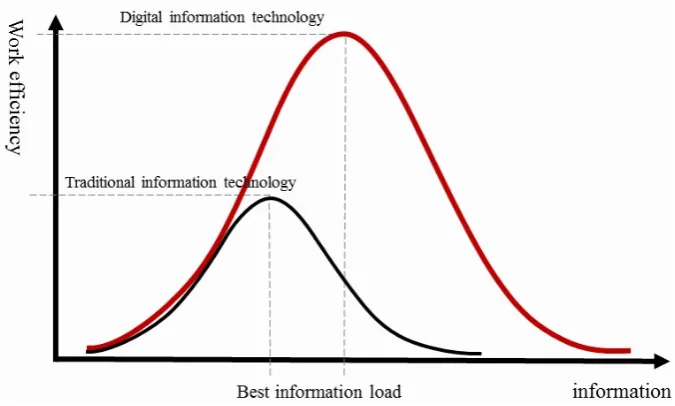
Figure 1. Relationship between the information load and working efficiency of organizational members.
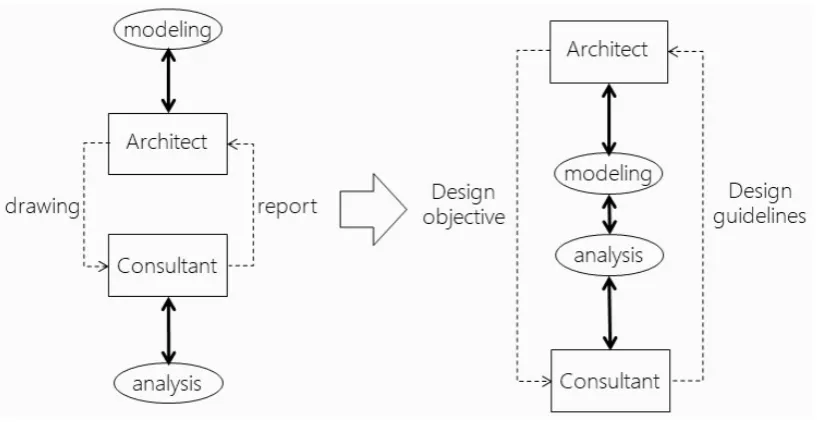
Figure 2. organization structure change.
Advances in information technology have led to the phenomena of growing organizational and procedural flattening. The diagram on the right hand corner of Fig. 1 shows that, after improvements in information technology, in an organizational structure in the most efficient state, because each unit or working has strong information processing ability, the organization as a whole will tend to be reorganized with a flattened structure, which will allow organizational members to fully provide advanced information technology functions, and achieve even higher efficiency. Apart from flattening of organizational structure, project implementation will also tend to become more flattened after strong information processing capabilities have been acquired, and there will be greater integration of originally separate project tasks and stages.
relies on contracts and relationships of mutual trust to allow each participant to work as they see fit with a level of risk exposure that they can withstand. The development of information technology has inevitably had an impact on these time-honored professional conventions, and architectural design-related knowledge supply chains will undergo structural changes[14].
2.2 Procedural information processing versus declaratory information processing
Traditionally, building designs are conveyed as building form, construction, and materials specifications. The mission of the architect is to express the key specifications of a building as they are expected to be after completion in the form of construction contracts and documents, such as drawings. Architects typically convey designs through the use of declaratory information, which emphasizes the final appearance of the completed product. Most current architectural drawing programs employ descriptions consisting of declaratory information, however. Moreover, even BIM-related tools based on object-oriented concepts and methods keep only a fragmentary record of procedural information.
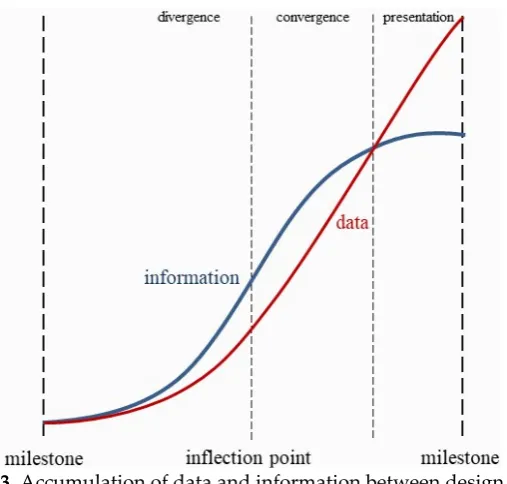
Although large amounts of procedural information is involved in architectural design processes, due to the restrictions of existing drawing tools, only a fragrance record is kept of this information, and only the final drawing results are actually retained. The price that must be paid for the loss of procedural information consists of explosive increases in working costs when design changes must be made, as well as the errors, omissions, and contradictions that may occur in subsequent revision processes when interdisciplinary information is integrated via the design communication process. The design process can be considered a process of information and data accumulation and integration. The accumulation of information and data will certainly not be equivalent. Professional operating procedures must involve the use of extremely concise expressive methods, and may seek to express large amounts of information using small quantities of data, in order to maintain the efficiency of the design process. The initial part of each design stage employs professional operating procedures involving the rapid accumulation of information and extremely concise data. And during the latter part of each design stage, the rate at which information is accumulated slows and the quantity of accumulated data increases sharply, which is chiefly because of the need to prepare for communication with the owner and other professional teams prior to the next design stage. At this time, large amounts of data must be input in order to overcome communication barriers, and this data makes no contribution to the input of professional information, but instead increases the design burden without any corresponding benefit. Instead, this data causes the cost of design revisions after communication to increase.
Figure 3. Accumulation of data and information between design stages.
There is already extensive literature on the integration of specialized knowledge from various fields for use in design development and revision during the initial design stage. Building performance oriented architectural design[15] emphasizes analysis of the physical environment, and uses various tools and software to simulate and assess indoor and outdoor results[18; 8; 7]. Alternately, algorithm (such as multi-objective genetic algorithm) settings and technologies can be used to find an optimal design plan[12], and architects can employ parametric settings to calculate an optimal plan (building mass and shape, building orientation, proportion of openings in envelope, and heated area) [4] . Optimization–simulation tools can be used to find building shape and building envelope features[3], and assess the energy conservation performance of different design plans[20]. It is also possible to used connected building structural analysis software to perform dynamic analysis of truss structures in special building types, such as gymnasiums(Shea, Aish, & Gourtovaia, 2005). Jungdae proposed new design procedures for the application of parametric design methods traditional buildings and homes in Korea, implemented parametric settings for each structural element, and defined the constituent relationships of in spaces[16]. The similar concept of "data-driven design" involves the use of data to assist architects' design innovation and decision-making, and can enhance architects' performance and productivity, while enabling them to achieve their service goals. Data can be classified as three types: Inherent geometrical data, external generative data and supplemental BIM data[5], and we can determine which data is provided by architects, which data results from the assistance of specialized consultants, and which data is retained for use by subsequent workers.
However, the foregoing parametric modeling does not provide very appropriate descriptions. All relevant software allows the entry and change of parameters, and a characteristic of this type of software (such as Grasshopper and Dynamo) is the use of procedural information to record users' design processes, and preserve key design information and history. After users change parameters or some portions of a design, they can rely on the software to re-derive drawings and modeling information. Accordingly, this study focuses its attention on generative modeling.
3. Interdisciplinary communication - generative modeling
maturity, architects and professional consultants will increasingly employed procedural information as a means of communication, and will use software tools to transmit information when engaging in preliminary integration. This will represent a major break from the conventional use of paper drawings to exchange information and engage in collaboration. At the design stage, although architects can indirectly make use of the specialized analytical software employed by professional consultants, procedural information processing tools can receive basic interdisciplinary information and help architects avoid erroneous design decisions.
Figure 4. Paradigm shift in an architectural team's communication model
This study proposes that generative modeling be used as an interdisciplinary communication method during the early architectural design stage, and be used to replace past declaratory information processing methods. Generative modeling employs parametric methods to construct virtual building models, and can be used in conjunction with various types of specialized architectural analysis software [15; 18; 3; 7] to facilitate knowledge integration and decision-making [19]. The use of procedural information as an interdisciplinary communication language can help integrate professional knowledge in modeling processes, and allows the use of extremely concise data to express complex geometric forms, while ensuring that subsequent adjustments do not affect earlier decisions. In the modeling process, the computer uses systematic, structured methods to record the designer's design processes. As a consequence, earlier design decisions can be recovered and revised at later stages, and the computer can be used to generate revised drawings and models, which can be used for review and communication purposes [11]. As a consequence, architects have virtually no data processing cost when performing design revision processes.
Generative modeling has the following features:
1. Uses very little data to transmit large amounts of information. 2. Can make very large revisions at very little cost.
3. Key information is preserved in the revision process.
interdisciplinary knowledge, reduce interdisciplinary communication costs, and achieve the goal of design optimization. Compared with the analog model used by Gaudi, procedural information processing methods enable structural consultants and architects to perform data exchange employing customized modeling tools established with digital technology and possessing with wide applicability, which can achieve the goals of knowledge integration and design optimization. Fig. 5 shows a diagram of Gaudi's chain model made using a procedural modeling tool. This tool allows architects to freely adjust the structure's dimensions, and we can see here arches consistent with mechanical behavior that have resulted from physical analysis using the software. In addition, Barrios used the columns in Gaudi's Sagrada Familia as an example to explain how Gaudi used design procedures to integrate design and engineering problems, and resolve construction layout problems [2].
Figure 5. Use of generative modeling tool to model Gaudi's chain model of the Sagrada Familia.
4. Practical cases
conditions, find the direction to the destination, and obtain information assisting decision-making. If the weather is favorable or if the pilot is familiar with the route, the pilot may be able to will lie on experience to accurately and efficiently complete the flight, but if the weather is bad or the pilot is unfamiliar with the route, the dashboard will provide the pilot with an important, dependable tool. The practical design cases discussed below involve the use of Rhino in conjunction with Grasshopper (a representative generative modeling tool) as a key multi-disciplinary integration technology. These cases are accompanied by discussion of various topics during the initial architectural design stage, analysis of changes in communication models and feedback of the results of multi-disciplinary modeling, and discussion of the development of design criteria. The following is a description of example cases:
1. Application to environmental simulation
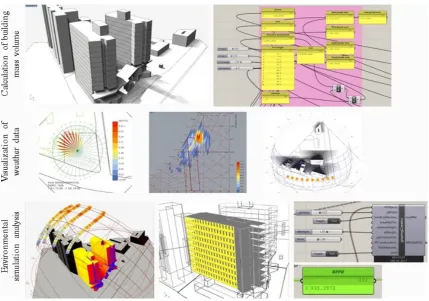
This study took an apartment building project in Taiwan as a research case explaining the use of generative modeling to integrate information, establish how architects can adjust parameter options, and verify the approach's theoretical feasibility. Since architects typically constantly revise building mass design plans during the configuration stage, generative modeling can help architects to quickly revise their plans, and find out such geometric information as floor areas, building coverage ratio, floor area ratios, the area of each façade, overall shell area, and volume, etc. This enables architects to compare the advantages and disadvantages of each plan.
When energy conservation consultants need to provide architects climate information and related professional knowledge, they can use the mass model to analyze the physical environment and provide a design foundation[17]. Generative modeling tools can produce various kinds of climate data maps, and determine the characteristics of the physical environment, along with relevant guidelines, during the winter and summer. At this stage, architects must consider whether a passive design will be able to achieve effective energy conservation, derive possible plans for building facades, and analyze the kinds of equipment and systems that can be employed in the building. Architects and energy conservation consultants can then discuss equipment and system choices for the building based on parameters including the nature and times of human activities in the building, and even the clothing they may wear, which will reflect Taiwan's climate, and can immediately determine the building's performance (including internal comfort).
After the architect has set the date and time to model the sun's path, the system analyzes the scope of shading from the building mass. This allows the architect to review the distance between the exterior of the building mass and adjacent buildings, and thereby ensure that certain spaces are not perpetually shaded. As for shaded areas, the architect can reduce shading by the facades, or choose ordinary materials in order to reduce building costs.
Figure 6 shows analysis of the number of hours of sunlight received by the building envelope, and shows which sides of the building receive long periods of sunlight, and therefore require façade shading and the use of insulating materials. At the same time, this information allows the architect to decide the type of shading (vertical or horizontal) based on the building's orientation. At this stage, the architect can analyze different configuration plans, and reduce the building's energy losses due to suboptimal orientation.
Figure 6. Application of building mass configuration and environmental modeling.
2. Application to lightweight steel frame residential building design and structural analysis
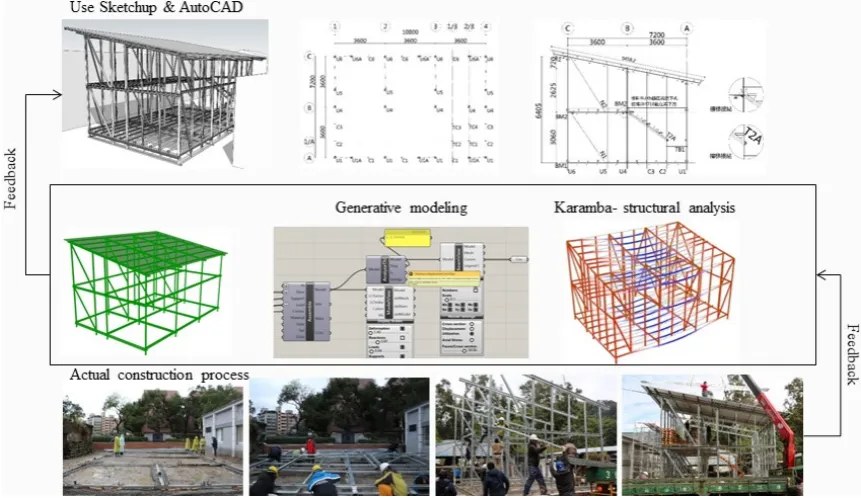
This study also took a residential building built using the lightweight steel frame construction method invented by architect Hsieh Ying-Chun as another example. This lightweight steel frame residential building represents a mature and systematized product; because it can be modified in accordance with the local climate, environmental conditions, and users' needs, it can be used to house disaster victims around the world. The architect has used declarative information (plan, façade, cross-section, and 3D sketchup models) as means of communication, and discussed the development of dedicated drawing communication symbols and design rules with collaborators (structural consultant and manufacturers). Communication within the design team took advantage of simple, specialized symbols, which made communication extremely efficient. After preliminary completion of a design solution, the collaborating structural consultant performed structural calculations.
which we discussed with the architect. Afterwards, during the actual construction process, we checked whether the generative modeling procedures corresponded to actual construction methods, and discussed the constructability of the structure.
Figure 7. Lightweight steel frame structural system and structural analysis.
3. Digital construction -The Serpentine Pavilion (2016) from BIG
Figure 8. Dimensional calculations for the Serpentine Pavilion.
It can be discovered from the foregoing examples that generative modeling can enable an architect to gain a real-time understanding of a design plan's performance, cost, and potential problems. In addition, it also enables the architect to make quick revisions and adjust design strategies at very small cost. When architects use generative modeling, although they will want to construct 3-D models, these models will also be close to actual project construction. This method helps architects think about real structural behavior, construction methods, and characteristics of materials, and allows them to incorporate this professional knowledge in models, which will reduce discrepancies in multi-disciplinary knowledge and facilitate subsequent construction integration.
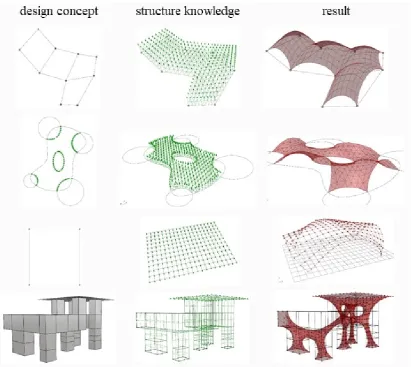
The next case involved a practical design examination involving a team of three university architectural students. The researchers played the roles of special consultants, and provided or helped develop generative modeling tools consistent with the design concept and objectives. This tool used a training approach to show the students how to use the knowledge that needed to be integrated in the design process. The researchers performed observations and took records during the students' design process in order to assess design communication and the integration of specialized knowledge.
4. Digital form-finding building physics and development of a membrane structural system
objectives and structural behavior. This tool consists of a prototype development program, and is not at all suitable for all designs, but can make changes in accordance with the architect's needs, dimensions, and construction materials.
Figure 9. Building physics and membrane structural system development.
5. Envelope panel analysis - The Swiss Re Building
Building envelope design is a subfield with high expertise and technical thresholds, and involves the manufacture of materials and design and manufacture of structural systems. At present, following finalization of design, architects seek assistance from engineering consultants only after issuing contracts for drawing production. At the design stage, architects chiefly focus on explaining the geometric form of the envelope, and generally only explain relevant details, structural systems, and the manufacture of materials at the conceptual level. When collaborating with an architect, an envelope consultant will require a large amount of manpower to handle the amount of work during the initial stage, and performing simulation and analysis after any changes to design plants will impose a huge workload.
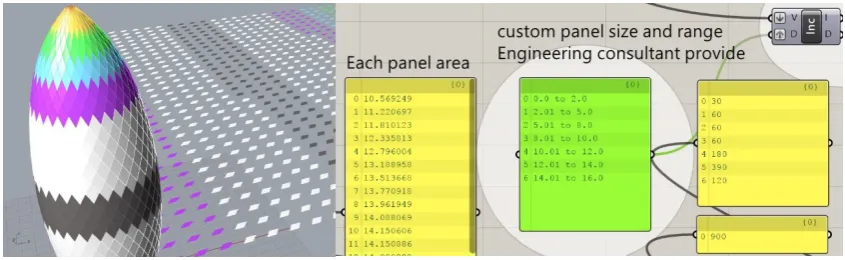
This study used envelope design cases to explore the interdisciplinary communication between architects and engineering consultants and elucidate how procedural information is used to transmit professional knowledge. We used procedural information processing tools (Rhino & Grasshopper or Revit & Dynamo) to record the design process and establish close linkage between the design tool used by the architect and the analytical software used by the professional consultant [18]. This study focused on the rational selection of envelope shape, materials, and structural system while controlling construction costs, and details and the production of project drawings were not discussed.
provided envelope panel manufacturing dimensions, calculations were performed using a generative modeling tool, and different colors were used to distinguish different panel sizes and distribution of locations. The architect's determination of a rational building structure and envelope system during the design stage enabled the types and quantities of panels to be reduced, which lessened building manufacturing costs, enhanced design quality and feasibility, and achieved integration of design and engineering considerations.
Figure 10. Calculation of envelope panel sizes for the Swiss Re Building
5. Conclusions
This study proposed that procedural information can be used as a language of interdisciplinary communication during the preliminary stage of the architectural design process, and employed actual cases to demonstrate the feasibility of this approach. Generative modeling is like the dashboard of an aircraft, and provides a basis for interdisciplinary communication.
Generative modeling has the following features: 1. Adoption during the early design stage
Early adoption of specialized knowledge
Variable professional communication models 2. A modeling tool based on design procedures
Rapid modeling and editing
A small amount of data can express a large amount of information
The integrity of specialized information is maintained throughout the revision process 3. Integration of multi-disciplinary knowledge
It can provide a package of domain knowledge;
It can transform multi-disciplinary communication;
It can reduce communication needs and costs.
In the design process, generative modeling can enable an architect to gain a real-time understanding of a design plan's performance, cost, and potential problems. In addition, it also enables the architect to make quick revisions and adjust design strategies at very small cost. When architects use generative modeling, although they will want to construct 3-D models, these models will also be close to actual project construction. This method helps architects think about real structural behavior, construction methods, and characteristics of materials, and allows them to incorporate this professional knowledge in models, which will reduce discrepancies in interdisciplinary knowledge (design and envelope project) and facilitate subsequent construction integration.
Author Contributions: Shen-Guan Shih and Yi-Feng Chang are conceived and worked together to achieve this work,Yi-Feng Chang wrote the paper and Shen-Guan Shih supervised it.
Acknowledgments: This work was supported by the Ministry of Science and Technology [grant numbers 105-2221-E-011-041-] and the Architecture and Building Research Institute [grant numbers 10262D0003].
References
1. Attaran, M., 2004. Exploring the relationship between information technology and business process reengineering. Information & Management, 41(5): 585-596. Available from
http://www.sciencedirect.com/science/article/pii/S0378720603000983. DOI
https://doi.org/10.1016/S0378-7206(03)00098-3.
2. Barrios Hernandez, C.R., 2006. Thinking parametric design: Introducing parametric gaudi. Design
Studies, 27(3): 309-324. Available from
http://www.sciencedirect.com/science/article/pii/S0142694X05000876. DOI
https://doi.org/10.1016/j.destud.2005.11.006.
3. Choi, J., T. Lee, E. Ahn and G. Piao, 2014. Parametric louver design system based on direct solar radiation control performance. Journal of Asian Architecture and Building Engineering, 13(1): 57-62. DOI 10.3130/jaabe.13.57.
4. Chronis, A., K.A. Liapi and I. Sibetheros, 2012. A parametric approach to the bioclimatic design of large scale projects: The case of a student housing complex. Automation in Construction, 22: 24-35. Available
from http://www.sciencedirect.com/science/article/pii/S0926580511001683. DOI
http://dx.doi.org/10.1016/j.autcon.2011.09.007.
5. Deutsch, R., 2015. Data-driven design and construction : 25 strategies for capturing, analyzing, and applying building data. Hoboken, New Jersey: John Wiley & Sons Inc.
6. Eastman, C.M., 2011. Bim handbook : A guide to building information modeling for owners, managers, designers, engineers and contractors. 2nd ed. Edn., Hoboken, N.J.: Wiley.
7. Ercan, B. and S.T. Elias-Ozkan, 2015. Performance-based parametric design explorations: A method for generating appropriate building components. Design Studies, 38: 33-53. Available from
http://www.sciencedirect.com/science/article/pii/S0142694X15000125. DOI
http://dx.doi.org/10.1016/j.destud.2015.01.001.
8. Ji, S.Y. and H.J. Jun, 2014. Elementary implementation of a parameter-based generative design system considering the user environment. Journal of Asian Architecture and Building Engineering, 13(2): 333-340. DOI 10.3130/jaabe.13.333.
9. Johnson, R.E. and M.J. Clayton, 1998. The impact of information technology in design and construction: The owner's perspective. Automation in Construction, 8(1): 3-14. Available from
http://www.sciencedirect.com/science/article/pii/S0926580598000612. DOI
https://doi.org/10.1016/S0926-5805(98)00061-2.
10. Kalay, Y.E., 2006. The impact of information technology on design methods, products and practices.
Design Studies, 27(3): 357-380. Available from
http://www.sciencedirect.com/science/article/pii/S0142694X05000888. DOI
http://dx.doi.org/10.1016/j.destud.2005.11.001.
11. Mark, E., 2012. Optimizing solar insolation in transformable fabric architecture: A parametric search design process. Automation in Construction, 22: 2-11. Available from
http://www.sciencedirect.com/science/article/pii/S0926580511002068. DOI
http://dx.doi.org/10.1016/j.autcon.2011.11.001.
12. Negendahl, K. and T.R. Nielsen, 2015. Building energy optimization in the early design stages: A simplified method. Energy and Buildings, 105: 88-99. Available from
http://www.sciencedirect.com/science/article/pii/S0378778815300888. DOI
http://dx.doi.org/10.1016/j.enbuild.2015.06.087.
13. Olalla, M.F., 2000. Information technology in business process reengineering. International Advances in Economic Research, 6(3): 581-589. Available from http://dx.doi.org/10.1007/BF02294975. DOI 10.1007/bf02294975.
14. Oxman, R., 2006. Theory and design in the first digital age. Design Studies, 27(3): 229-265. Available
from http://www.sciencedirect.com/science/article/pii/S0142694X05000840. DOI
https://doi.org/10.1016/j.destud.2005.11.002.
15. Oxman, R., 2008. Performance-based design: Current practices and research issues. International Journal of Architectural Computing, 6(1): 1-17. Available from
http://journals.sagepub.com/doi/abs/10.1260/147807708784640090. DOI
16. Park, J., 2011. Bim-based parametric design methodology for modernized korean traditional buildings. Journal of Asian Architecture and Building Engineering, 10(2): 327-334. DOI 10.3130/jaabe.10.327. 17. RoeWu architecture., 2016. Weather formations: An architectural meteorology. Garden City.
18. Shi, X. and W. Yang, 2013. Performance-driven architectural design and optimization technique from a perspective of architects. Automation in Construction, 32(0): 125-135. Available from
http://www.sciencedirect.com/science/article/pii/S0926580513000253. DOI
http://dx.doi.org/10.1016/j.autcon.2013.01.015.
19. Shih, S.-G., 2014. Notes on generative modeling, procedural symmetry, and constructability of architectural design. Computer-Aided Design and Applications, 11(5): 518-525. Available from
http://dx.doi.org/10.1080/16864360.2014.902681. DOI 10.1080/16864360.2014.902681.
20. Tuhus-Dubrow, D. and M. Krarti, 2010. Genetic-algorithm based approach to optimize building envelope design for residential buildings. Building and Environment, 45(7): 1574-1581. Available from
http://www.sciencedirect.com/science/article/pii/S0360132310000077. DOI