Green Infrastructure
Disclaimer: The materials and information contained in this document are provided for informational/guidance purposes only and do not constitute legal advice. Users of this information assume all responsibility and risk for the use of the materials. Victoria University, and any contributors to the development of this document, do not assume any legal liability or responsibility for the accuracy, completeness, or usefulness of any material contained within this package and in no event shall Victoria University be liable for any damages resulting from the application of this information, however caused. You should not act or omit to act on the basis of this publication without first obtaining appropriate advice in respect of your particular circumstances.
Recommended citation: Victoria Institute of Strategic Economic Studies (VISES). (2015). Green Infrastructure Economic Framework Summary Report. Victoria University, Melbourne.
The complete report: Victoria Institute of Strategic Economic Studies (VISES). (2015). Green Infrastructure Economic Framework. Victoria University, Melbourne.
ISBN: 978-1-86272-705-2
© 2015. Victoria Institute of Strategic Economic Studies, Victoria University and the Government of Victoria.
Contributors
Celeste Young, Roger Jones and John Symons.
Green Infrastructure Economic Framework Page 3
‘In Australia, our pressing issues of water, energy, environment, healthcare, productivity, mobility, safety and security all stem from four global megatrends – climate change, demographic change, urbanisation and globalisation.... We look into the future to see what kind of world we want to live in. Then, we work backwards to see how we can bring these big ideas to life.’
— Picture the Future, Siemens Australia and New Zealand The world is changing and so are the cities we live in. Changes in population, demographics, technology and the environment are shaping our communities in a way that is beyond our historical context and require new ways of seeing and thinking. For local government there are a number of emerging challenges such as reduced available revenue, increasing risks as a result of changing internal and external environments and an increasing demand for council services. Decision makers in local government are faced with the daunting task of trying to understand how to make the best decision today within these constraints, in a way that supports the future sustainability of their communities.
Resilient infrastructure (both hard infrastructure such as bridges, roads and buildings, and soft infrastructure such as social systems, connectivity and communication) is recognised as being central to helping communities respond effectively to these changes. Understanding the true worth of all infrastructure and assets is crucial to understanding the choices available and what the best one may be.
What is green infrastructure?
Green infrastructure describes the green spaces and water systems which intersperse, connect and provide vital life support for humans and other species within our urban environments. Green infrastructure exists across a range of scales – from residential gardens to local parks and housing estates, streetscapes and highway verges, services and communications corridors, waterways and regional recreation areas. Green infrastructure includes features that are multifunctional, networked and natural, and they have multiple benefits for society and the environment.
Why is green infrastructure important?
Green infrastructure is a key aspect of our towns and cities. It underpins our economy in areas such as health, liveability and industry. It protects and rejuvenates
communities by providing essential services such as clean air and water and healthy ecosystems. It can also help reduce the impacts of climate events such as flooding and heat waves. Communities who successfully maintain these assets are more likely to be resilient and able to adapt more effectively to future shocks and changes.
Historically, this type of infrastructure has often been developed in response to emerging needs of communities. In some cases, this has been a reactive process that aims to address a specific issue. In other cases, it may
Executive summary
fulfil a particular need at the expense of others. For example, a choice may be made to develop an area of high environmental value to meet the needs of a growing population.
To date, the role and value of green infrastructure has not been well understood in Australia and it is seen in many councils as peripheral to other forms of more established forms of infrastructure. These types of infrastructure and assets also differ from grey infrastructure in that they can offer multiple benefits and services – for example, strategically positioned green areas can reduce heat in surrounding areas, increase property value and improve community health.
Some of the associated benefits are intangible (non-monetary) which are often overlooked as they are difficult to quantify, particularly in relation to future savings. This is, in part, because it is a relatively new area of practice so evaluation tools and methods have not been developed fully. As a result, business cases for this area do not include all the relevant information and can result in decision makers being unable to make fully informed decisions. This has meant that opportunities to improve these assets or maximise their benefits have not been taken up.
Working toward an economic understanding for green infrastructure
Although there are an increasing number of tool kits and methods for valuing green infrastructure, there has not been a clear process outlined for achieving this that aligns with current operational practices in local government in Australia.
This document has three key aspects:
n It provides an economic process-based framework that outlines the key steps needed to value green infrastructure.
n It provides a full life cycle management process that is already established in practice and aligns aspects of the economic process to support integration of the framework into day-to-day operational decision making.
n It provides an explanation of some of the economic methods and approaches that are available to assist practitioners in the area of valuing and evaluating green infrastructure.
The full life cycle management of assets and infrastructure is best practice and aligns with the current federal initiative to improve this area of management in local government bodies. This provides a unique window of opportunity for local government to embed the new knowledge emerging as part of this initiative in a way that can enhance current activities.
Making better decisions for the future
‘Growth is inevitable and desirable, but destruction of community character is not. The question is not whether your part of the world is going to change. The question is how.’
— Edward T McMahon Planning for and providing services that facilitate the development of communities that are resilient to future economic, social and environmental shocks is a key function of local government. Because the risks facing cities and the communities that live in them are systemic and some are increasing, there is a need to think beyond current conditions if this expectation is to be fulfilled. It also requires decision makers to understand the full spectrum of economic values so they can evaluate both monetary and non-monetary values across both short- and long-term time frames. In this way, they can maximise investment opportunities in this area through a more comprehensive understanding of what the benefits and costs are. They can also more clearly assess the possible impact and legacy of their decision.
Integrated infrastructure that incorporates and values green infrastructure is at the heart of the places we make and inhabit, and provides the fabric that supports our economies and our communities. It is an investment that,
once established will, in most cases, increase in value. Well maintained, healthy green infrastructure can continue to provide services and benefits that improve the liveability of our communities in a cost-effective manner. This is why integrating green infrastructure into the established investment processes for general infrastructure is key to being able to develop smart cities that maintain our communities’ liveability, resilience and wellbeing. This framework aims to provide a foundation which will support greater understanding of the value of green infrastructure, in a way that is practical and works with current operational processes. Green infrastructure offers many opportunities because it is an area of innovation that has yet to reach its full potential. Understanding more fully how to develop and manage this effectively will help increase these opportunities. It will also help ensure that communities now and in the future, have the infrastructure they need to continue to grow and prosper in a sustainable way through supporting better decision making and smarter investment.
Green Infrastructure Economic Framework Page 5 The purpose of this framework is to help local
government value the benefits of green infrastructure (GI), especially for the purpose of adapting to climate change. This document outlines a framework that enables local council asset managers and officers to address the multiple benefits of GI projects. It does this by building guidance for developing business cases and asset management into existing decision-making processes for developing GI.
By understanding more fully the costs and benefits of GI, decision-makers can make better informed decisions that are both fiscally and environmentally responsible without sacrificing long-term goals for short-term financial contingencies. In the long run, the entire community will benefit by investing in GI which, by reducing risk and increasing resilience, can provide sustained social returns. It does so by providing better places for people and the rest of nature to live. By addressing a wide portfolio of climate change impacts, local government can make strategic choices about where, when and how to invest in adaptation responses designed to minimise risk and maximise
benefits and liveability.
This framework has two main tasks:
1. To value the benefits of GI on a project and program basis to support the development of business cases for GI investment, and
2. To identify opportunities to incorporate GI into current operational systems, using a life cycle asset management process. This can be used to establish and maintain GI asset quality and service delivery on an ongoing basis.
The purpose of the framework
The framework is designed to fit into the standard project development and asset management systems used by local government with a minimum of extra modification. We have also tried to keep technical terms to a minimum, although speaking the language of economics is a useful skill when putting GI on a similar footing to conventional infrastructure. Its purpose is to provide a foundation which can be developed and added to by local government bodies as their practice matures.
The two approaches being followed are business case development following the full life-cycle from scoping through to the planned life-cycle of the assets developed by the project and the asset management process that aims to maintain asset quality and service delivery.
The document consists of a general introduction, an introduction to the economic framework for GI development along with key policy settings that help classify the diverse values GI provides. The major part of the document outlines a broad, generic process used by councils for developing GI projects and managing assets. Mapped onto this is a procedure for developing business cases at the project or program scale and for assessing asset value, taking into account the full asset life cycle. The following reports provide the evidence base used to develop the process-based economic framework:
n Investing in Growth: Understanding the Value of Green Infrastructure Context Paper (2014)
n Investing in Growth: Understanding the Value of Green Infrastructure Workshop Report (2014)
n Assessing the Economic Value of Green Infrastructure Literature Review (2015)
n Assessing the Economic Value of Green Infrastructure. Green Paper (2015).
purpose
Brooklyn Industrial Precinct –
Integrated Urban Water Management
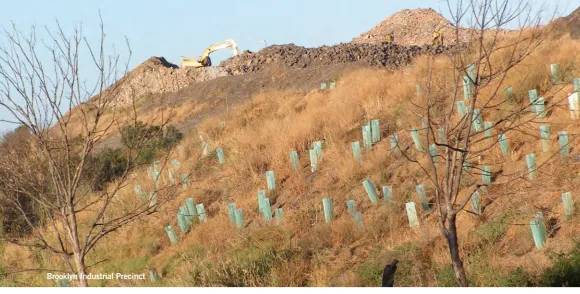
The Brooklyn Industrial Precinct comprisesapproximately 330 ha of industrially-zoned land in Melbourne’s west, 10 km from the CBD. It hosts over 60 industries including quarrying, former landfills, abattoirs, composting, materials recycling, tallow production and logistics. Many of the lots are unsealed, yielding about three times natural runoff, which flows into Kororoit and Stony Creeks. This runoff carries over 110 tonnes of pollutants each year. The air quality from the site is also the poorest in Melbourne. Dust and fine particles emitted by industry and transport on the site result in regulated limits of PM10 fine particles being exceeded on 28 days each year in the residential area south of the precinct. The safe limit is five days exceedance each year. A project funded by the Office of Living Victoria and led by Brimbank City Council was tasked with developing a business case and vision for integrated urban water management for the precinct. The vision aims to manage the pollution problems and catalyse a transformation in industrial activity. Technical assistance was provided by E2 Design (water management and costings) and Victoria University (air quality assessment and economics).
Scoping and initial development
The project took two approaches: developing a vision to assess what potential benefits were valued most and assessing a physical baseline that assessed the current costs to community and the environment. In the scoping stage, workshops and meetings were held with the main stakeholders to determine the main areas of concern and establish a vision for the future. This helped set the core values for the business case.
The second approach was to gather baseline data for the project that looked at the water cycle and air pollution using data from the EPA, City West Water, council and the ABS. From this data, water use, pollution to local waterways, and health and welfare impacts of air pollution on the local population were assessed.
Setting up and establishing the baseline
Investigation of runoff and site water use identified the following statistics:
n Water use on the site averages 1,250 Ml per year, producing 1,198 Ml of trade waste.
n 587 Ml runoff from the site annually is estimated to carry 95 tonnes of sediments (76,000 80%), 225 kg phosphorus (101 45%), 1,645 kg nitrogen (740 45%), 12 tonnes litter, 5.1 tonnes of hydrocarbons, 80 kg lead, 190 kg zinc, and 35 kg copper.
n Air pollution consists of an estimated 308 tonnes PM10 and 40 tonnes PM2.5 emitted from the site each year. PM10 is emitted from crushing machinery and transport within the site and from traffic on roads
Case Study
within the site. PM2.5 is emitted from combustion engines (trucks, cars, incinerators and furnaces) and open fires.
Base case costs totally or partially estimated include: n the market value of water use and waste water, n removal cost for nitrogen pollution from waterways, n the cost of monitoring, compliance and managing air
pollution (see Table 3), and
n direct and indirect health and welfare costs of air pollution on affected residents.
Table 3
Maintenance and compliance 2012–2013 2013–2014
Ongoing ($000) 584 665 One-off actions ($000) 40 185
Noted, but not costed, include:
n pollution effects on approximately 1,700 workers, n reputation damage as being known as the most
polluted site in Melbourne to councils and business, n costs of heavy metals being washed into waterways, n effort expended by community groups in trying to
manage the problem, and
n welfare costs of odour from the site.
Health costs were calculated for asthma hospitalisation and early death by health modelling of the affected population of 17,000 people, using Australian health data for asthma costs and the statistical value of life for mortality. The welfare costs of air pollution were estimated by transferring the results from two US studies to the Brooklyn site (Benefit transfer method). These studies estimate (1) willingness to pay to have clean air and (2) levels of happiness related to air pollution produced through the difference in household income between clean and polluted locations.
Direct health costs total $7.1 million per year, the rest being taken up by the estimated costs of added mortality. The median welfare costs to the broader community are an estimated $15.5 million per year. Over the past twenty years, allowing for changes in the consumer price index, this amounts to $431 million with estimates ranging from $364 million to $736 million, mostly based as welfare losses (see Table 4).
Collate project benefits
Monetary benefits were calculated from the following actions:
n substitution of potable water by recycled water and rainwater
n increases in human welfare by reducing air pollution levels
n decreased health care and mortality losses n benefits (increased welfare, decreased health and
Green Infrastructure Economic Framework Page 7 Table 4
Low Median High
Total health cost PM10 ($m) 2.5 2.7 4.3
Total health cost PM25 ($m) 2.2 4.4 7.1
Total health cost ($m) 4.8 7.1 11.4
Welfare losses PM10 ($m) 13.0 15.5 28.7
Total losses ($m) 17.8 22.5 40.1
Health losses 1994–2013 ($m) 97 135 209
Welfare losses 1994–2013 ($m) 267 296 527
Total losses 1994–2013 ($m) 364 431 736
n limited benefits of dust suppression through street sweeping/watering
n benefits of nutrient removal costed according to costs of direct removal methods.
Qualitative benefits identified were: n improved neighbourhood image n improved business image n improved visual amenity
n increased residential and commercial property values n options on future improvements in water quality within
catchment (by removing large pollution source), and n pollutant removal not costed (e.g., ozone, nitrous oxide,
lead, copper).
While a general level of benefit could be estimated by addressing various best practice relationships, specific benefits could not be estimated without having an overview of specific projects. Instead various scenarios for integrated urban water management were proposed.
Examples of benefits and methods used to calculate them include:
n Street sweeping removes sediment from roads. If the two dirtiest roads are cleaned or watered at a nominal cost of $225 (three hours of truck time), the benefit is estimated to be $1,845 reduction in health costs and $25,080 in welfare costs for reducing one day’s pollution. This was calculated by taking the difference between dust emitted from the dirtiest and cleanest roads through dust modelling carried out for the EPA. n Tree benefits for health and welfare per year were
estimated as being $13,800 per hectare. PM10 and PM2.5 removal rates were taken from US studies of urban pollution removal and benefit transfer as described above. Other pollutants (ozone, nitrous oxide, sulphates and carbon monoxide) were not included, so would add further value. The polluted nature of the site means also that capture rates will be underestimated.
n Removing 55% of the pollution by keeping all roads as sediment free as the cleanest road would return $184 million in health and welfare benefits over 30 years at 3.5% discount rate.
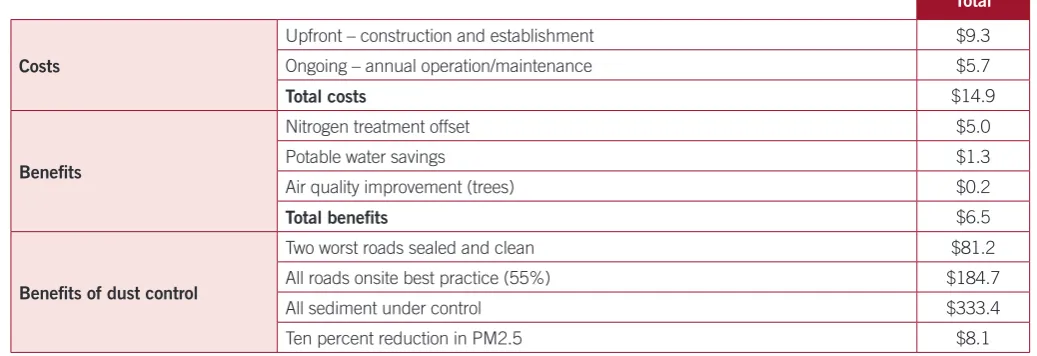
Table 6 Estimated costs and benefits of the projects proposed in the medium scenario over a 30-year period in $million using a 3.5% discount rate. Note that dust control is for PM10 unless stated otherwise.
Total
Costs
Upfront – construction and establishment $9.3
Ongoing – annual operation/maintenance $5.7
Total costs $14.9
Benefits
Nitrogen treatment offset $5.0
Potable water savings $1.3
Air quality improvement (trees) $0.2
Total benefits $6.5
Benefits of dust control
Two worst roads sealed and clean $81.2
All roads onsite best practice (55%) $184.7
All sediment under control $333.4
Ten percent reduction in PM2.5 $8.1
Table 5
Project Priority
Perimeter greening – swales and tree-lined High On-site stormwater detention and reuse High Perimeter greening – swales only Medium
Rain gardens Medium
Rainwater tanks Medium
Green roofs Low
Evaluation options for integrated urban water management
n A number of project components aiming to manage the sediment and water cycle on the site assessed for their relative costs and benefits in terms of water use. These included site transport, sediment and erosion management plans, strategic planning for redevelopment, on-site stormwater detention and reuse, perimeter greening, rain gardens, rainwater tanks, green roofs, roadway management and streetscape greening.
n Options were rated high, medium and low based on a multi-criteria analysis that included a limited benefit cost ratio but also assessed physical effectiveness in managing pollution and water conservation and support amongst stakeholders (Table 5).
Business plan
A master plan was constructed for the site that treated 216 hectares of catchment, reducing potable water use by 29 Ml per year, stormwater runoff by 162 Ml per year, reducing total suspended solids by 50 tonnes, nitrogen by 700 kg, litter by ten tonnes and increasing green space by 47 hectares. It was not possible to estimate the total health and welfare benefits of these actions, but they are considered to be a large proportion of current pollution (Table 6).
Clearly, the social returns from implementing this project would be overwhelmingly positive. Ongoing barriers are provided by who pays and who benefits? Ideally, a project such as this would involve private industry, local
government, state government and the community, all who stand to benefit in different ways.
Acknowledgements: City of Brimbank, Victorian Government (funding), E2Designlab, EPA Victoria, The Brooklyn Residents Action Group, and private industries within the Brooklyn Industrial Precinct.
Kororoit Creek, Brooklyn Industrial Precinct