OBJECT TRACKING BASED ON MOVING OBJECT
DETECTION
Varsha B. Bagal
1and Sagar A. More
21,2
P.G., Department of Electronics & Telecommunication Engineering,
R.C.P.I.T, Shirpur, M.S. (India)
ABSTRACT
Now days in the aggressive field security matters have increases rapidly. That’s why it is necessary of one which is capable to save anyone’s personal estate from damage such as theft, demolition of property, people with awful
commitment etc. Hence, it is imperative for the surveillance methodologies to also augment with the developing
world. We are using Background Subtraction and Self Organizing Background Subtraction (SOBS) algorithm for
moving object detection, Morphological method for tracking of moving object. In Background Subtraction
establishing a reliable background updating model based on statistical and use a dynamic optimization threshold
method to obtain a more complete moving object. While in SOBS an approach to moving object detection based on
neural background model automatically generated by a self-organizing method.
Keywords-
Background Subtraction, Motion Detection, Neural Network, Self Organization, visual
surveillance.
I INTRODUCTION
Moving object detection and tracking algorithms arean important research area of computer vision and comprise
building blocks of various high-level techniques in video analysis that include tracking and classification of
trajectories. In video surveillance system, detection and tracking of object is lower level task that provides support to
higher level tasks such as event detection. Categorizing moving objects is a critical task which requires video
segmentation, which is used in number of computer vision applications such as video surveillance, traffic monitoring,
and remote sensing There are three major steps in video surveillance analysis: detection of moving objects, tracking
of interested objects from consecutive frames, and the third is analysis of these tracked objects to identify its behavior,
and also to identify normal/abnormal events. In this paper we are using two different methods for moving object
detection.[1][3]
The background subtraction method is to use the difference method of the current image and background image to
detect moving objects, with simple algorithm, but very sensitive to the changes in the external environment and has
poor ant interference ability. However, it can provide the most complete object information in the case of the
background is known. In this method, in a single static camera condition, combine dynamic background modeling
with dynamic threshold selection method based on the background subtraction, and update background on the basis of
Figure 1: Framework of Moving Object Detection
In the Self-Organizing Background Subtraction (SOBS) algorithm has been proposed, which implementsan approach
to change detection based on the neural background model automatically generated by a self-organizing method
without prior knowledge about the involved patterns . Such adaptive model can handle scenes containing moving
backgrounds, gradual illumination variations, and camouflage, can include into the background model shadows cast
by moving objects, and achieves robust detection for different types of videos taken with stationary cameras.[2][10]
II BACKGROUND SUBTRACTION METHOD
The background subtraction method is the common method of motion detection. It is a technology that uses the
difference of the current image and the background image to detect the motion region, and it is generally able to
provide data included object information. The key of this method lies in the initialization and update of the
background image. The effectiveness of both will affect the accuracy of test results. Therefore, this paper uses an
effective method to initialize the background, and update the background in real time.[7]
2.1Background Modelling& Update:
In the background training process, the reference background image and some parameters associated with
normalization are computed over a number of static background frames. The background is modeled statistically on
a pixel by pixel basis.
𝐸𝑖
The expected color value of pixel i is given by𝐸𝑖 = [𝜇
𝑅𝑖 , 𝜇
𝐺𝑖 , 𝜇
𝐵𝑖 ]
[𝜇
𝑅𝑖 , 𝜇
𝐺𝑖 , 𝜇
𝐵𝑖 ]
are the arithmetic means of the ith pixel's red, green, blue values computed over Nbackground frames. In detection of the moving object, the pixels judged as belonging to the moving object maintain
the original background gray values, not be updated. For the pixels which are judged to be the background, we
update the background model according to following rules:
𝐵
𝑘+1𝑥, 𝑦 = 𝛽𝐵
𝑘𝑥, 𝑦 + (1 − 𝛽)𝐹
𝑘(𝑥, 𝑦)
Bk(x,y) and Bk+1(x,y) are respectively theBackground value of the current frame and the next frame.
2.2 Moving Object Extraction:
After the background image 𝐵(𝑥, 𝑦) is obtained, subtract the background Image 𝐵(𝑥, 𝑦) from the current frame
𝐹𝑘 (𝑥, 𝑦). if the pixel difference is greater than the set threshold T, then determines that the pixels appear in the
moving object, otherwise, as the background pixels. The moving objectcan be detected after threshold operation. Its
expression is as follows:
𝐷𝑘 𝑥, 𝑦 = 1 𝐹𝑘 𝑥, 𝑦 − 𝐵𝑘 𝑥, 𝑦 > 𝑇
0 𝑜𝑡ℎ𝑒𝑟𝑠
.
Where 𝐷𝑘 (𝑥, 𝑦) is the binary image of differential results.T is gray-scale threshold; its size determines the accuracy
of object identification. In this paper the dynamic threshold method, we dynamically changes the threshold value
according to the lighting changes of the two images obtained. On this basis, add a dynamic threshold T to the
above.. Its mathematical expression is as follows:
∆𝑇 = 𝜆 ∗ | 𝐹 𝑖, 𝑗 − 𝐵 𝑖, 𝑗 | 𝑀−1 𝑗 =0 𝑁−1 𝑖=0 Then
𝐷𝑘 𝑥, 𝑦 = 1 𝐹𝑘 𝑥, 𝑦 − 𝐵𝑘 𝑥, 𝑦 > 𝑇 + ∆𝑇
0 𝑜𝑡ℎ𝑒𝑟𝑠
2.2 Preprocessing
As the complexity of the background, the difference image obtained contains the motion region, in addition, also a
large number of noises. Therefore, noise needs to be removed. This paper adopts median filter with the 3 X 3
window and filtersout some noise.After the median filter, in addition the motion region, includes not only body
parts, but also may include moving cars, flying birds, flowing clouds and swayingtrees and other nobody parts.
Firstly, corrosion operation is taken to effectively filter out non-human activity areas. Secondly , using the
expansion operation to filter out most of the non-body motion regions while preserving the shape of human motion
withoutinjury. After expansion and corrosion operations, some isolated spots of the image and some interference of
small pieces are eliminated, and we get more accurate human motion region.
2.3 Extraction of Moving Human Body
After median filtering and morphological operations, some accurate edge regions will be got, but the region belongs
to the moving human body could not be determined. Through observation, we can find out that when moving object
appears, shadow will appear in some regions of the scene. The presence of shadow will affect the accurate extraction
of the moving object. By analyzing the characteristics of motion detection, we combine the projection operator with
the previous methods.
III SELF ORGANIZING BACKGROUND SUBSTRACTION
Fig 3: SOBS Algorithm
The background model constructed and maintained in SOBS algorithm is based on the idea of building the image
sequence neural background model by learning in a self-organizing manner image sequence variations, seen as
trajectories of pixels in time. The network behaves as a competitive neural network that implements a winner-take
all function, with an associated mechanism that modifies the local synaptic plasticity of neurons, allowing learning
to be spatially restricted to the local neighborhood of the most active neurons. Therefore, the neural background
Figure 4: (Left) Simple image and the (right) neuronal map structure
3.1 Neural Model Representation
An image sequence {It}, for each pixel pin the give domain D , a neuronal map consisting of n×n weight vectors
𝑚 𝑖 𝑡 𝑗(𝑝), 𝑖, 𝑗 = 0 … … , 𝑛 − 1is called model for pixel p . Every frame sequence has N rows and P columns.
Complete set of models Mt(p) for all pixels p of the tth sequence frame It is organized as a 2D neuronal map Bt with
𝑛 × 𝑁 rows and n ×P columns, where the weight vectorsm i t j(p), for the generic pixel p = (x; y) are at neuronal
mapposition (𝑛 × 𝑥 + 𝑖 , 𝑛 × 𝑦 + 𝑗), 𝑖; 𝑗 = 0, … … … 𝑛 − 1:
𝐵𝑡 (𝑛 × 𝑥 + 𝑖 , 𝑛 × 𝑦 + 𝑗) = 𝑚 𝑖 𝑡 𝑗(𝑝), 𝑖, 𝑗 = 0 … … , 𝑛 − 1.
3.2 Neural Model Initialization
In the case of our background modeling application, wehave at our disposal a fairly good means of initializing
theweight vectors of the network, because the first image of thesequence I0 is indeed a good initial approximation of
thebackground. Therefore, for each pixel p, the correspondingweight vectors of the model M0(p) are initialized with
the pixel brightness value at time t = 0:
𝑚 𝑖 0 𝑗(𝑝) = 𝐼0(𝑝), 𝑖 , 𝑗 = 0, … . . , 𝑛 − 1
3.3 Background Subtraction and Model Update:
Background subtractionis achieved by comparing each pixel p, at each subsequent time step t of the tth sequence
frame It with the current pixel model 𝑀𝑡_1(𝒑), in orderto determine if there exists a best matching weight vector
𝐵𝑀(𝒑) that is close enough to it. If no acceptable matchingweight vector exists, p is detected as belonging to a
movingobject (foreground). Otherwise, if such weight vector isfound, it means that p is a background pixel.
3.3.1 Finding the Best Match
Given the current pixel pat time t, the value 𝐼𝑡(𝑝) is comparedto the current pixel model, given by 𝑀𝑡_1(𝒑), to determinethe weight vector 𝐵𝑀(𝒑) that best matches it:
d(BM(p),It(p)) = min i; j = 0,……,n-1 d(m i t-1j(p), It(p)),
could be the Euclidean distance in RGB color space, or theEuclidean distance of vectors in the HSV color hexcone.
The distance between two HSV pixel values 𝐼𝑡(𝑝) = (ℎ𝑝, 𝑠𝑝, 𝑣𝑝)and 𝐼𝑡(𝑞) = (ℎ𝑞, 𝑠𝑞, 𝑣𝑞) as:
𝑑(𝐼𝑡(𝑝), 𝐼𝑡(𝑞)) = || (𝑣𝑝 𝑠𝑝 𝑐𝑜𝑠(ℎ𝑝), 𝑣𝑝 𝑠𝑝 𝑠𝑖𝑛(ℎ𝑝), 𝑣𝑝) − (𝑣𝑞 𝑠𝑞 𝑐𝑜𝑠(ℎ𝑞), 𝑣𝑞 𝑠𝑞 𝑠𝑖𝑛(ℎ𝑞), 𝑣𝑞) ||22
3.3.2 Updating the Model:
In order to adapt the background model to scene modifications,including gradual light changes, the model for
currentpixel p, given by 𝑀 𝑡 − 1(𝒑),should be updated. To this end,the weight vectors of Bt-1 in a neighborhood of
𝐵𝑀(𝒑)are updated according to weighted running average. In details,if 𝐵𝑀(𝒑)is found at position p in 𝐵𝑡 − 1, then
weightvectors of 𝐵𝑡 − 1 are updated according to:
𝐵𝑡(𝑞) = (1 𝛼𝑡𝐵𝑡 − 1 (𝑞) + 𝛼𝑡 𝐼𝑡(𝑝) ∀𝑞 ℇ 𝑁𝑝.
.
IV RESULTS
4.1 Results for Background Subtraction Method
Fig 5.1: Background Image Fig 5.2 Current Image
4.2 Results for Self Organizing Background Subtraction Method
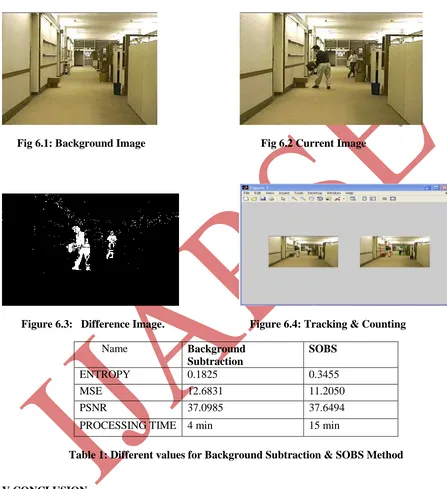
Fig 6.1: Background Image Fig 6.2 Current Image
Figure 6.3: Difference Image. Figure 6.4: Tracking & Counting
Name
Background
Subtraction
SOBS
ENTROPY
0.1825
0.3455
MSE
12.6831
11.2050
PSNR
37.0985
37.6494
PROCESSING TIME 4 min
15 min
Table 1: Different values for Background Subtraction & SOBS Method
V CONCLUSION
We have presented object detection by using Background subtraction & Neuronal Mapping (SOBS) methods. While
Background Subtraction is robust method rather than SOBS method as processing time, noise present in final output
for this method is very less compared to SOBS method. Output SOBS methods are very effective when there are
dynamic scene changes (threshold). Change Detection Challenge allowed to show how they handle well-known
method of object detection, we establish reliable background model, use dynamic threshold method to detect moving
object and update the background in real time by using background subtraction method.
R
EFERENCES1) Mingxin Jiang, Min Li and Hongyu Wang, “ A Robust Algorithm of Object Tracking Based on Moving
Object Detection.” In International Conference on Intelligent Control and Information Processing, 2010.
2) Lucia Maddalena and Alfredo Petrosino ”A Self Organizing Approach to Background Subtraction for
Visual Surveillance Applications.” IEEE Transactions, VOL.17, NO.7, JULY 2008
3) Long Chen ; Long Ren ; BaolongGuo ; Xianxiang Wu ”Objects detecting and tracking with a new particle
filter”, in 2nd IEEE International Conference ,Year:2012
4) Lijing Zhang and Yingli Liang, ”Motion human detection based on background Subtraction”’ Second
International Workshop on Education Technology and Computer Science, 284-287,Year: 2010.
5) M.Dimitrijevic, ”Human body pose detection using Bayesian spatiotemporal templates,”, International
Conference on Intelligent and Advanced Systems, pp.764-9,Year: 2008.
6) Tao Jianguo, Yu Changhong, ”Real-Time Detection and Tracking of Moving Object”, Intelligent
Information Technology Application, 2008. UTA ’08. Second International Symposium on Volume 2,
pp:860 - 863,Year: Dec.2008
7) NiuLianqiang and Nan Jiang, ”A moving objects detection algorithm based on improved background
subtraction”, Intelligent Systems Design and Applications, 2008. ISDA ’08. Eighth International
Conference on Volume 3, pp 604 - 607, Year: Nov. 2008
8) Wang Weiqiang, Yang Jie and Gao Wen, ”Modeling Background and Segmenting Moving Objects from
Compressed Video”, Circuits and Systems for Video Technology, IEEE Transactions on Volume 18, Issue
5, pp 670 - 681,Year: May 2008.
9) Long Chen ; Long Ren ; BaolongGuo ; Xianxiang Wu ”Objects detecting and tracking with a new particle
filter”, in 2nd IEEE International Conference ,Year:2012
10) Lucia Maddalena and Alfredo Petrosino “The SOBS algorithm: what are the limits ?” IEEE 2012.
11) Javed Ahmed, M. N. Jafri, J. Ahmad, and Muhammad I. Khan “Design and Implementation of a Neural
Network for Real Time Object Tracking.” World Academy of Science 6, Engineering and Technology,
2007.
12) Michael W. Roth, ”Survey of Neural Network Technology for Automatic Target Recognition.” IEEE