© 2014, IJCSMC All Rights Reserved
89
Available Online atwww.ijcsmc.com
International Journal of Computer Science and Mobile Computing
A Monthly Journal of Computer Science and Information Technology
ISSN 2320–088X
IJCSMC, Vol. 3, Issue. 3, March 2014, pg.89 – 93
SURVEY ARTICLE
A Survey on Quality of Service for
Optimized Linked State Routing
protocol in Mobile Ad hoc Network
Jalpesh D. Ghumaliya
1, Sandip Chauhan
2Department of Computer Science Engineering1
Assistant Professor, Department of Computer Science Engineering2
Kalol institute of technology and research centre & Gujarat Technological University, Gujarat, India1,2
[email protected]1, [email protected]2
Abstract — A wireless Mobile Ad hoc NETworks (MANETs) is a special type of wireless network that does not have wired infrastructure to support communications between different nodes. Addressing Quality of Service (QoS) support in the Internet has been widely investigated. But, such efforts are unsuitable for MANETs which introduce bandwidth constraints and dynamic network topology. In MANET, routing protocols have a significant role in terms of the performance because they determine the way of sending and receiving packets between mobile nodes where all nodes are free to move about arbitrarily and where all the nodes configure themselves. In MANET, each node acts both as a router and as a host &even the topology of network may also change rapidly. In this paper we have done the study of OLSR routing protocol from various reputed papers. The key concept used in the protocol is that of Multi-Point Relays (MPRs) which are selected nodes that forward broadcast messages during the flooding process. The objective is to make observations about how the network performance with OLSR routing protocol can be enhance.
Keywords— MANET, OLSR, MPR, Quality of Service
I. INTRODUCTION
A Mobile Ad Hoc Network (MANET) is a collection of wireless mobile nodes forming a temporary/short-lived network without any fixed infrastructure. The wireless network can be classified into two types: Infrastructure or Infrastructure less.
© 2014, IJCSMC All Rights Reserved
90
Figure 1: Infrastructured wireless Networks
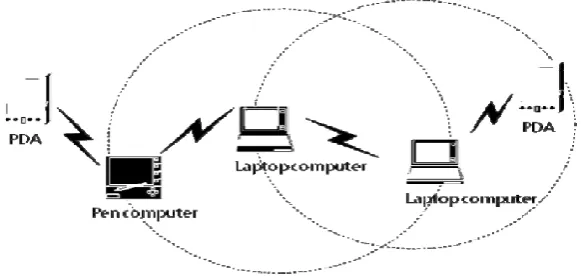
In Infrastructureless or Adhoc wireless network, the mobile node can move while communicating, there are no fixed base stations and all the nodes in the network act as routers. The mobile nodes in the Ad Hoc network dynamically establish routing among themselves to form their own network „on the fly‟. Devices like laptops and personal digital assistants (PDAs) that communicate directly with each other are examples of nodes in an ad hoc network.This type of network can be shown as in figure 2.
Figure 2: Infrastructureless Networks
II. CHARACTERISTICS AND COMPLEXITIES OF MOBILE AD HOC NETWORKS
The specific characteristics and complexities, which are summarized in Table 1, impose many design challenges to the network protocols. In addition, these networks are faced with the traditional problems inherent to wireless communications such as lower reliability than wired media, limited physical security, time-varying channels, interference, etc. Despite the many design constraints, mobile ad hoc networks offer numerous advantages. First of all, this type of network is highly suited for use in situations where a fixed infrastructure is not available, not trusted, too expensive or unreliable. Because of their creating, self-organizing and self-administering capabilities, ad hoc networks can be rapidly deployed with minimum user intervention. There is no need for detailed planning of base station installation or wiring. Also, ad hoc networks do not need to operate in a stand-alone fashion, but can be attached to the Internet, thereby integrating many different devices and making their services available to other users.
Table 1 Characteristics and complexities of mobile ad hoc networks
Ad hoc networks
Autonomous and infrastructure less
Multi-hop routing
© 2014, IJCSMC All Rights Reserved
91
Device heterogeneityEnergy constrained operation
Limited physical security
Network scalability
Bandwidth constrained variable capacity links
Network scalability
Self-creation, self-organization and
self-administration
III. ROUTINGPROTOCOLS
A routing protocol is needed whenever a packet needs to be transmitted to a destination via number of nodes and numerous routing protocols have been proposed for such kind of ad hoc networks. These protocols find a route for packet delivery and deliver the packet to the correct destination. The studies on various aspects of routing protocols have been an active area of research for many years. Many protocols have been suggested keeping applications and type of network in view. Basically, routing protocols can be broadly classified into two types as : (a) Table Driven Protocols or Proactive Protocols and (b) On-Demand Protocols or Reactive Protocols.
Table Driven or Proactive Protocols: In Table Driven routing protocols each node maintains one or more tables containing routing information to every other node in the network. All nodes keep on updating these tables to maintain latest view of the network. Some of the existing table driven or proactive protocols are: DSDV, OLSR.
On Demand or Reactive Protocols: In these protocols, routes are created as and when required. When a transmission occurs from source to destination, it invokes the route discovery procedure. The route remains valid till destination is achieved or until the route is no longer needed. Some of the existing on demand routing protocols are: DSR, AODV.
IV. OPTIMIZED LINK STATE ROUTING (OLSR) PROTOCOL
The IETF MANET Working Group introduces the Optimized Link State Routing (OLSR) protocol for mobile Ad-Hoc networks. The protocol is an optimization of the pure link state algorithm. The key concept used in the protocol is that of Multi Point Relays (MPRs). MPRs are selected nodes that forward broadcast messages during the flooding process. This technique substantially reduces the message overhead as compared to a pure flooding mechanism where every node retransmits messages throughout the network. By doing so, the contents of the control messages flooded in the network are also minimized. So contrary to the classic link state algorithm, instead of all links, only small subsets of links are declared.
OLSR operates as a pro-active protocol. The node n, which is selected as a multipoint relay by its neighbours, periodically announces the information about who has selected it as an MPR. Such a message is received and processed by all the neighbours of n, but only the neighbours who are in n‟s MPR set retransmit it. Using this mechanism, all nodes are informed of a subset of links -- links between the MPR and MPR selectors in the network. For route calculation, each node calculates its routing table using a “Shortest Hops Path” algorithm based on the partial network topology it learned. The algorithm finds the minimum hop paths from the source node to all the destinations. In addition to re-transmitting topology control messages, the MPRs are also used as a backbone network to form the route from a given node to any destination in the network.
© 2014, IJCSMC All Rights Reserved
92
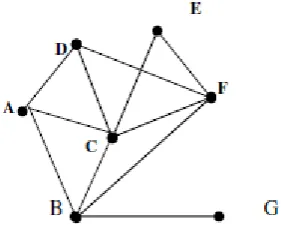
An example of how this algorithm works is shown below based on the network depicted in Figure 3.Nodes 1 hop Neighbours 2 hop Neighbours MPR(s)
B A, C, F, G D, E C
From the perspective of node B, both C and F cover all of node B‟s 2-hop neighbours. However, C is selected as B‟s MPR as it has 5 neighbours while F only has 4 (C‟s degree is higher than F).
V. LITERATURE REVIEW
A Survey of Routing Protocols that Support QoS in Mobile Ad Hoc Networks[1], OLSR-based QoS-aware routing protocol looks more promising than other routing protocols for QoS provisioning. The attractive features of OLSR-based QoS-aware routing are proactive by nature, it does bandwidth estimation, no other additional requirement etc. It has still some open issues which can be worked for future like MPR set setup, selfish nature of MPR nodes, delay estimation is missing etc. So, these open issues have attracted to work on OLSR-based routing protocol for QoS-provisioning in routing.
Quality of Service Routing in a MANET with OLSR [2],Bandwidth calculation is not done. It is assumed that each node knows the bandwidth of communication link which is very difficult to find. Delay estimation is not considered in this paper. Cross layer design is used which is very much challenging and difficult to implement.
Intelligent OLSR Routing Protocol Optimization for VANETs[3] , The proposed algorithm is for VANET not for MANET. MANET has slower mobility than VANET, so proposed algorithm can be suited to MANET. Here, meta-heuristic and ns2 simulator are coupled to generate the solution, but in case of MANET it is very difficult to find proper location for applying and implementing meta-heuristic. This coupling is also very
time-consuming.
Reputation-Based Cooperative Detection Model of Selfish Nodes in Cluster-Based QoS-OLSR Protocol[4] ,Results shows that including reputation as one of the QoS metric does not affect the performance and quality of service QoS of the network, whereas it makes the network more reliable and trustworthy. So by including proposed mechanism we cannot have any enhancement in terms of performance or QoS of the network. It just makes the network more reliable and trustworthy. And As a future work we can consider a punishment system that will punish detected selfish nodes and malicious watchdog nodes that give false detection as it was missing in current proposed mechanism.
The fuzzy based QMPR selection for OLSR routing protocol[5],The combination of FIS and ANN, called Neuro-fuzzy can yield to better results, so in future there is a need to explore the combination of more metrics in QMPR selection and other techniques like Neuro-fuzzy, fuzzy-genetic and other evolutionary approaches for prediction or selection of quality nodes as MPR and other quality attributes of the nodes. Soft computing technique is very challenging to incorporate in MANET, as well as it is difficult to include with simulation tool. It consumes a lot of time to calculate a metric based on soft computing.
VI. CONLUDING REMARKS
The Optimized Link State Routing (OLSR) is a table-driven and proactive routing protocol that was designed for mobile ad hoc network. OLSR protocol is an optimization of the pure link state algorithm. The key concept used in the protocol is that of Multi Point Relays (MPRs) which are selected nodes that forward broadcast messages during the flooding process. This technique substantially reduces the message overhead as compared to a pure flooding mechanism where every node retransmits messages throughout the network.
OLSR-based QoS-aware routing protocol looks more promising than other
© 2014, IJCSMC All Rights Reserved
93
ACKNOWLEDGEMENT
This work could not be completed without the valuable suggestion of various sources. At the very onset I would like to express my sincere gratitude to internal guide Mr. Sandip Chauhan and computer science department for their valuable guidance.
REFERENCES
[1] A Survey of Routing Protocols that Support QoS in Mobile Ad Hoc Networks, by Lei Chen and Wendi B. Heinzelman, IEEE Network, Nov/Dec 2007
[2] Quality of Service Routing in a MANET with OLSR, by Dang-Quan Nguyen, Pascale Minet, Journal of Universal Computer Science, vol. 13, no. 1 (2007), 56-86
[3] Intelligent OLSR Routing Protocol Optimization for VANETs, by Jamal Toutouh, José García-Nieto, and Enrique Alba, IEEE Transactions on Vehicular Technology, Vol. 61, No. 4, May 2012
[4] Reputation-Based Cooperative Detection Model of Selfish Nodes in Cluster-Based QoS-OLSR Protocol, by Nadia Moati, HadiOtrok, AzzamMourad, Wireless PersCommun, Springer Science, Business Media, New York, 2013