© 2016, IJCSMC All Rights Reserved 361 Available Online atwww.ijcsmc.com
International Journal of Computer Science and Mobile Computing
A Monthly Journal of Computer Science and Information Technology
ISSN 2320–088X
IMPACT FACTOR: 5.258
IJCSMC, Vol. 5, Issue. 6, June 2016, pg.361 – 367
MOBILE COMPUTING and SNAPDRAGON
Sakshi Gujral
CSE Department, IGDTUW, Kashmeri Gate Delhi, India
Abstract- Recent years show the new phase of computing. There is shift from desktop to hand-held devices. These devices have changed the era of computing, with the aim of supporting “portability, mobility” to the users, it comes with extensive research issues to the scientists, engineers and other concerned people. In this paper, I have tried to focus on mobile computing, its features, advantages, applications and various issues associated with it. In the subsequent section, Qualcomm’s Snapdragon 820 is discussed with the aim of justifying that it would be best choice of processor selection for smart phones.
Keywords- mobile computing, Snapdragon 820, pervasive computing, distributed computing, Context-aware, Data mining.
I. INTRODUCTION
The inventions of Computers have been done to improve computation and increase efficiency. The term Computation means solving out a task with the help of hardware and software in an elegant manner. Initial computation make use of centralised system, where the entire load of computing program was given to single processor. However, this approach came up with many disadvantages and the most common was frequent failing of this centralised system. To overcome this issue we came across the new term in 1970’s known as Distributed Computing [2]. In this approach group of processors are employed that are linked via computer network, these processors communicate with each other and carry out a task. Hence, load of executing on single processor is decreased and efficiency is burgeoned. However, the recent decades show the size of computers scaling down to mobile phones that account for “mobility” of users. The extensive use of mobile phones has outdated distributed computing and have coined up new term of “mobile and pervasive computing”.
A. Mobile Computing
© 2016, IJCSMC All Rights Reserved 362
II. ARCHITECTURE OF MOBILE COMPUTING
The architecture of mobile computing is 3-tier.This is somehow similar to Model-view-controller architecture (MVC) of web applications. The three layers are being separated from each other to easy the task of development, data storage, presentation and business logic. This 3-tier architecture has many advantages to offer when it comes to management, scalability and fleixibility.The three layers of mobile computing are-
A. Presentation Layer
This is Tier-1 of mobile computing architecture. As the name suggests, this accounts for the presentation of information to the end user. Video and audio means are used to convey information. To visualise information agents are used, these agents are web-browser and sometimes applets. They are generally J2ME enabled web browsers to render information. Various languages like HTML, XML are used for presentation of information in effective manner.[9]
B, Application Layer
This is middle tier or driving engine of mobile computing architecture .It mainly emphasises on software layer of architecture. It contains various middleware that act as interface between clients and business logics. They handle issues of communication, transaction, databases, transcoding, message synchronisations. It may include many technologies like –JSP,.NET services to communicated with databases for retrieval of information and other updates. It mainly accounts for the business logic application.
C. Data Layer
This is third layer of mobile architecture and is responsible for data storage and data management activities. Data plays an important role in any application. The database middleware’s in application layer is responsible for retrieval of data, the act as connector between databases and application layer to carry out the tasks, various technologies like JDBC (java database connectivity); ODBC etc are used for information access.
Fig1-3-Tier Architecture
III. MOBILE COMPUTING ADVANTAGES
A. Mobility
This ensures user can access the network services from any device at any time and any-where. Hence; this is an advantage over conventional systems.
B. Easy Installation
Since, it involves wireless networks, it is easy to install these networks as compared to wired systems. Moreover, they can be installed in difficult terrains where installation of wired networks is not possible.
Presentation HTML, XML, J2ME-ENA BROWSERS
BUSINESS LOGIC TO MANAGE DATA
CONNECTORS
DATA STORAGE OR
© 2016, IJCSMC All Rights Reserved 363 C .High Bandwidth Variability
Contrary to wired systems mobile systems offer greater bandwidth flexibility that would offer great flexibility and better utilisation of offered bandwidths. Hence, many operations can be done with low bandwidth.
D. Low Power Consumption
Mobile computing infrastructure don’t require very high power machines, this is advantage over existing high power consumption systems.
E. Exciting Research Area
Mobile computing is an exciting new area that can found applications in many areas like medical, banking, networks, m-commerce, Internet of things [1].Hence. it opens great scope of employment and research areas to work upon.
IV. APPLICATIONS
Mobile computing has advantages in many fields-
A. Banking
Mobile computing allow users to access their account from anytime, anywhere, banking operations have become distributed, thus fast access is possible within seconds. Large queues in banks are now diminished because of advent of mobile technologies.
B. Medical
Healthcare is now easily available as compared to previous time, Doctors can monitor patient’s health from distance, instruct them. Hence, mobile computing has reduced distances and communication gaps.
C. Entertainment
People can now book movie tickets with sitting at their place in few seconds. This is done with hand –held devices not bulky systems; this is made possible by mobile computing.
D. Context-Aware Applications
Mobile applications can now used to control environment, produce results depending upon the context like switching off lights and increasing cooling of air-conditioners. This has been made possible by mobile and pervasive computing. Hence, automation is also supported.
Among other applications include military, security, business, surveillance systems, baby monitoring systems. Thus mobile computing offers wide range of applications.[4]
V. ISSUES OF MOBILE COMPUTING
A. Disconnected Operations
© 2016, IJCSMC All Rights Reserved 364
B .Security
Mobile computing involves wireless mediums and to attain security in this medium is somehow cumbersome task as compared to wired mediums. Hence, to prevent sensitive data from being hacked various mechanisms need to be look upon once again. Information management need to ensure confidentiality, authentication, integrity to ensure mobile computing must not suffer from security breaches, sophisticated algorithms and techniques must be develop. Hence, it is an important issue to work upon.
C .Privacy
This accounts for what information to be revealed to the user and to whom information has to be provided. To ensure privacy, great deed of work is required by security people. This helps in preventing unauthorised access and hence enhances security. [8]
D .Integration Of Heterogeneous Environment
Mobile computing involves various technologies like 2G, 3G, 4G, wired mediums, wireless mediums, so to account for this heterogeneity and to properly integrate them is itself difficult task. This is a research area to work upon.
E. Context Aware Computing
Mobile computing applications are develop to provide information suiting to the “context”. This is defined as the task related information that is depending upon location, gestures, sensors, environment; results are given to the user. Context aware computing is the sophisticated form of mobile computing and requires significant work to be done for both hardware and software. Aura project of Carnegie Mellon’s University is one such example of extreme computing.
F. Real Time Monitoring
Mobile computing involves real time monitoring of data, this is done often with the help of small intelligent devices called sensors or actuators. This collects real time data from the environment and then passes information to the server for further processing. This data gathering, acquisition and processing in real time scenario is difficult task to work upon.
G. Data Management
Mobile computing involves large data often known as “BIG-DATA”, to store, manage and to retrieve this big data is very tough. Convential Data mining techniques won’t work here, so training technical people about new data mining techniques, would not only increase expenditure but would also be time consuming. This is an issue that is still need to work upon. [5],[7]
VI. SNAPDRAGON 820
Qualcomm’s Snapdragon is the leader in the mobile industry to provide edge-cutting performance. Snapdragon processors are known for their tremendous performance offered over other processors. Snapdragon processors have evolved from series 200 to 400,600 and the latest is Snapdragon 800 series.
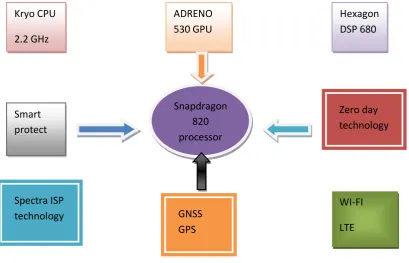
© 2016, IJCSMC All Rights Reserved 365 Fig 2-Features of Snapdragon Processor 820
A. Kryo-CPU
All the predecessors of Snapdragon have krait CPU but with snapdragon 820 series, Kryo CPU that is quite powerful processor, performance is enhanced approximately twice then its previous series. This makes selection of 820 snapdragons to be the best choice for mobile phones. This enhances efficiency of mobile phones. Kryo CPU comes with sophisticated power management techniques, hyper threading, and automatic shut down of caches, voltage scaling, frequency scaling and other software level management techniques to optimise power and to increase performance of processors. It has 64 bit dual core CPU that operates at 2.2 GHZ itself a tremendous features over other mobile processors.
B. Hexagon-DSP
Mobile computing involves “motion or mobility”. Hence, communication plays an important role here. To supplement communication here, we make use of another proprietary processor called digital signal processor. Snapdragon 820 make use of hexagon DSP 680 that is embarked by high performance, supports enrich multi-media processing as well as longer battery life, that is the need of mobile devices.
C. Adreno-GPU
Graphics Processor Unit, this is the heart of display of smart phones. Mobile computing should support visualisation to the users otherwise lay man would not able to comprehend these systems. Hence, user-friendly interfaces should be built up. Not only this, smart phones should support excellent gaming experiences, rich video display that would inculcate users to use mobile devices with great interest. To provide this task, snapdragon 820 comes with adreno GPU that enhances almost 40% enhancement over predecessors. This enhances computing capabilities.
D. Spectra ISP Camera
Smart phones are known for the powerful camera features, present day users want their hand-held device to smart and powerful enough to capture good quality photos, videos whenever required and at the same time support more than one camera to take photographs from more than one view. Snapdragon 820 allows this feature by Spectra ISP technology that support 14 bit intra
Snapdragon 820 processor Kryo CPU
2.2 GHz
ADRENO 530 GPU
Hexagon DSP 680
Smart protect
Zero day technology
Spectra ISP
technology GNSS
GPS
© 2016, IJCSMC All Rights Reserved 366
spectra processor that supports cameras that are three in number that is one front camera and two rear cameras to support these technologies. They have been show to enhance picture quality a lot. Moreover, it also employs better data mining techniques to extract better face detection from the captured data. This is the feature that allows capturing images up to 25 pixels. This makes ideal choice to select this processor for smart phones.
E. Smart Protect
This allows some security mechanism to be enabled at the booting time also. This enables authentication mechanism to be employed at the time of booting. This increases protection of devices. Snapdragon 820 employs this smart protect technology.
F. Zero Day Technology
This technology makes snapdragon extremely distinguished from other processors, it make use of artificial intelligence to detect malwares that are previously not known. This employs data mining, knowledge learning to know the possible threats of new malwares. This enhances security a lot.
G .Wi-FI Technology
Snapdragon 820 series make use of high speed Wi-Fi with 802.11 a/c standards. This makes it quite apt for the mobile devices for better wireless connectivity.
H. Global Navigation Satellite System
Snapdragon 820 comes up with set of clusters of satellite that aims at providing more accurate locations than other GPS Systems available. Hence this is add on advantage for selecting snapdragon 820 for mobile devices.
VII. CONCLUSION
The paper tries to explain mobile computing, its difference from the predecessors like centralised and distributed computing. The architecture is also explained. The paper also focuses on the issues that come into picture when mobile computing is actually used in the real time scenarios. Advantages of this computing over other computing have been also discussed. In the other section of paper I have justified use of snapdragon 820 processor for the smart phone. This processor extremely suits the need of present day smart devices. Snapdragon processors supports Inforce computing that is further enhanced version of mobile computing with loads of other exciting features.So.it can be concluded mobile computing has given paradigm shift to the era of computing.
ACKNOWLEDGEMENT
I would like to acknowledge my mother Mrs.Meenu Gujral for motivating to write this paper. I would also like to thanks my Professor Dr.SRN Reddy for helping me with technical knowledge and creating my interest in this area.
REFERENCES
[1] Xia, Feng, et al. "Internet of things." International Journal of Communication Systems 25.9 (2012): 1101.
[2] Dikaiakos, Marios D., et al. "Cloud computing: Distributed internet computing for IT and scientific research." IEEE Internet computing 13.5 (2009): 10-13. [3] Satyanarayanan, Mahadev. "Pervasive computing: Vision and challenges."IEEE Personal communications 8.4 (2001): 10-17.
[4] Dey, Anind K. "Context-aware computing." Ubiquitous Computing Fundamentals (2010): 321-352.
[5] Witten, Ian H., and Eibe Frank. Data Mining: Practical machine learning tools and techniques. Morgan Kaufmann, 2005. [6] Wee, Alex. "More than 60 new gadgets will be powered by Qualcomm Snapdragon 820." Screen (2015).
© 2016, IJCSMC All Rights Reserved 367
[8] Mamei, Marco, and Franco Zambonelli. "Programming pervasive and mobile computing applications with the TOTA middleware." Pervasive Computing and Communications, 2004. PerCom 2004. Proceedings of the Second IEEE Annual Conference on. IEEE, 2004.