Sub-linear Size Pairing-based Non-interactive Zero-Knowledge Arguments
Jens Groth★
University College London E-mail: [email protected]
Abstract. We construct non-interactive zero-knowledge arguments for circuit satisfiability and arithmetic circuits with perfect completeness, perfect knowledge and computational (co-)soundness. The non-interactive zero-knowledge arguments have sub-linear size and very efficient public verification. Our construction uses bilinear groups and is only proven secure in the generic group model, but does not rely on random oracles.
Keywords:Sub-linear size non-interactive zero-knowledge arguments, circuit satisfiability, pairing-based cryptog-raphy, generic group model.
1 Introduction
Zero-knowledge proofs introduced by Goldwasser, Micali and Rackoff [GMR89] are fundamental building blocks in cryptography that are used in numerous protocols. Zero-knowledge proofs are protocols that enable a prover to convince a verifier of the truth of a statement without leaking any other information. The central properties are captured in the notions of completeness, soundness and zero-knowledge.
Completeness: The prover can convince the verifier if the statement is true. We will in this paper focus on statements of the form𝑥 ∈𝐿, where𝐿is an NP-language, and the efficient-prover case, where the polynomial time prover knows an NP-witness𝑤for𝑥∈𝐿when she creates the zero-knowledge proof. Soundness: A malicious prover cannot convince the verifier if the statement is false. We distinguish be-tween computational soundness that protects against polynomial time cheating provers and statistical or perfect soundness where even an unbounded prover cannot convince the verifier of a false statement. We will call computationally sound proofs forarguments.
Zero-knowledge: A malicious verifier learns nothing except that the statement is true. We distinguish be-tween computational zero-knowledge, where a polynomial time verifier learns nothing from the proto-col interaction and statistical or perfect zero-knowledge, where even a verifier with unlimited resources learns nothing from the proof.
1.1 Non-interactive Zero-Knowledge Proofs
While the first zero-knowledge proofs were interactive, there are many cryptographic tasks that are done off-line, for instance signing messages or encrypting messages. For these situations, it is desirable to have non-interactivezero-knowledge (NIZK) proofs, where there is no interaction and a proof just consists of a single message from the prover to the verifier. Only trivial languages in BPP have NIZK proofs in the plain model without any setup [Ore87,GO94,GK96]. However, Blum, Feldman and Micali [BFM88] introduced NIZK proofs in thecommon reference string model, where both the prover and verifier have access to a common reference string generated in a trusted way. Such NIZK proofs have many applications, ranging from the first chosen ciphertext attack secure construction of public-key encryption [DDN00] to recent advanced
★
signature schemes [CGS07,BW06]. For this reason there has been a lot of research into the underlying assumptions [FLS99,BCNP04,GO07], the efficiency [Dam92,DDP02,KP98], and the security guarantees offered by NIZK proofs [DP92,Sah01,DDO+02].
NIZK proofs based on standard cryptographic assumptions used to be inefficient and not useful in practice. To get around this inefficiency, applied cryptographers have relied on the so-called Fiat-Shamir heuristic for transforming public-coin interactive zero-knowledge proofs into NIZK arguments by using a cryptographic hash-function to compute the verifier’s challenges. The Fiat-Shamir heuristic can give very efficient NIZK arguments that are secure in the random oracle model [BR93], where the cryptographic hash-function is modeled as a random hash-function. Unfortunately, there are several examples of protocols that are secure in the random oracle model, but do not have any secure standard model instantiation no matter which hash-function is used [CGH98,CGH04,MRH04,BBP04,Nie02]. Particularly relevant here is Goldwasser and Kalai’s [GK03] demonstration of a signature scheme built from a public-coin identification scheme that is secure in the random oracle model, but insecure in real life. While it is possible that the Fiat-Shamir heuristic is secure for “natural” protocols, it is worthwhile to investigate alternative approaches.
Another way to get around the inefficiency of traditional NIZK proofs is to use non-interactive desig-nated verifier proofs. In a desigdesig-nated verifier proof, the proof is not publicly verifiable, it can only be verified by a designated verifier. Damg˚ard, Fazio and Nicolosi [DFN06] gave an efficient linear size non-interactive designated verifier proof for circuit satisfiability based on an assumption related to Paillier encryption. There are cases where designated verifier proofs suffice, for instance Cramer and Shoup’s chosen ciphertext attack secure public-key cryptosystem [CS98]. In many other cases, the lack of public verifiability is problematic though. When there is only one designated verifier, it is for instance not possible to use them to construct advanced digital signatures, such as ring signatures and group signatures, since here public verifiability is needed for non-repudiation.
Recent work in NIZK proofs has used bilinear groups to improve efficiency. Groth, Ostrovsky and Sahai [GOS06b,GOS06a] gave NIZK proofs for circuit satisfiability where the proof consists of 𝑂(∣𝐶∣)
group elements, with ∣𝐶∣being the number of gates in the circuit. Their NIZK proofs have the property that they can be set up to give either perfect soundness and computational zero-knowledge, or alterna-tively computational (co-)soundness and perfect zero-knowledge. Works by Boyen, Waters, Groth and Sahai [BW06,BW07,Gro06,GS08] have explored how to build efficient NIZK proofs that are directly applicable in bilinear groups instead of going through circuit satisfiability.
In some special cases, for instance in the ring signature of Chandran, Groth and Sahai [CGS07] these techniques lead to sub-linear size NIZK proofs, but in general the number of group elements in an NIZK proof grows linearly in the size of the statement. Looking at the general NP-complete problem of circuit satisfiability, the reason these NIZK proofs grow linearly in the circuit size is that they encrypt the value of each wire in the circuit. Abe and Fehr [AF07] gave a construction based on commitments instead of encryptions, but since each wire is committed by itself they also get a linear growth in the size of the circuit. The goal in this paper is to break the linear size barrier and propose NIZK arguments with sub-linear size without using the Fiat-Shamir heuristic.
1.2 Our Contribution
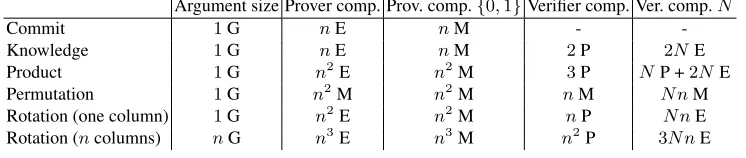
size of a group elements, and M, E, and P, are the costs of respectively multiplication, exponentiation and pairings in a bilinear group (see Section 2.1). We refer to Section 11 for further details on the efficiency of our NIZK argument including the exact constants hidden by the Big-Oh notation.
CRS size Proof size Prover comp. Verifier comp. Soundness Zero-knowledge Assumption Kilian-Petrank [KP98] 𝑂(∣𝐶∣𝜆2)G𝑂(∣𝐶∣𝜆2)G 𝑂(∣𝐶∣𝜆2)E 𝑂(∣𝐶∣𝜆2)M statistical computational trapdoor permutation Groth-Ostrovsky-Sahai 𝑂(1)G 𝑂(∣𝐶∣)G 𝑂(∣𝐶∣)E 𝑂(∣𝐶∣)P perfect computational subgroup decision or [GOS06b,GOS06a] 𝑂(1)G 𝑂(∣𝐶∣)G 𝑂(∣𝐶∣)E 𝑂(∣𝐶∣)E computational perfect linear decision Abe-Fehr [AF07] 𝑂(1)G 𝑂(∣𝐶∣)G 𝑂(∣𝐶∣)E 𝑂(∣𝐶∣)E computational perfect DLog and knowledge of expo. Groth [Gro09] 𝑂(√∣𝐶∣)G𝑂(√∣𝐶∣)G 𝑂(∣𝐶∣)M 𝑂(∣𝐶∣)M computational perfect DLog and Fiat-Shamir This paper 𝑂(∣𝐶∣34)G 𝑂(∣𝐶∣
3
4)G 𝑂(∣𝐶∣ 5
4)M 𝑂(∣𝐶∣)M computational perfect generic bilinear group Table 1.Comparison of NIZK proof and arguments.
TRANSFERABILITY AND EFFICIENCY. Our NIZK arguments are publicly verifiable. This means that unlike interactive zero-knowledge proofs they are transferable; they can be copied and distributed to many different entities that can do their own independent verification.
Due to their transferability, there are many situations where it is reasonable to accept a super-linear com-putational cost for the prover in return for less communication and very efficient verification. In situations where many entities want to verify the same NIZK argument, the one-off cost of creating the NIZK argument may be acceptable due to bandwidth savings in distributing the NIZK argument to many parties. Further, the NIZK argument is as efficient to verify as state of the art interactive zero-knowledge arguments, so the prover’s computational overhead may be offset by many verifiers’ highly efficient verification process. SETUP AND ZERO-KNOWLEDGE/WITNESS-INDISTINGUISHABILITY. We assume a trusted setup, where a common reference string is made available to the prover and verifier. If the trust is violated and the common reference string is adversarially chosen, we are in better shape than with traditional zero-knowledge proofs though. Most NIZK proofs are proofs of knowledge, where the adversary might learn all of the prover’s witness if the prover uses an adversarially chosen common reference string. In contrast, sub-linear size NIZK arguments have the advantage that there is an information theoretic upper bound on how many bits of the witness may be leaked.
The common reference string in our NIZK argument has a particular structure; it is not a uniform random string. The common reference string is verifiable though; the prover can verify that the common reference string does have the right structure. This implies that even if the trust assumption is violated and the common reference string is chosen by the adversary, the argument will still be perfectly witness-indistinguishable, i.e., it will be impossible for the adversary to tell which out of potentially many witnesses the prover used when creating the argument. Dwork and Naor [DN00] introduced the notion of Zaps, 2-move witness-indistinguishable proofs, where the verifier’s initial message can be used over and over again. The results in this paper imply the existence of communication-efficient Zaps with perfect witness-indistinguishability and computational soundness.
Basing security on the generic group model is risky. Just as there exist protocols with no secure instanti-ation that are provably secure in the random oracle model, so there exists a signature scheme with no secure instantiation that is secure in the generic group model as demonstrated by Dent [Den02]. We believe our use of the generic group model is more benign than the typical use of the random oracle model though. To make a sub-linear size NIZK argument in the random oracle model, soundness is usually proved through rewind-ing the protocol and then runnrewind-ing the protocol again with a different output from the random oracle. In real life it is of course not possible for a deterministic hash-function to have two different outputs. In contrast, we do not use rewinding techniques to prove security of our NIZK argument in the generic group model. The issue of rewinding can in theory be overcome though, Pass [Pas03] and Fischlin [Fis05] have given NIZK arguments with straight-line extractors in the random oracle model. While it is quite speculative to argue the merits of one heuristic model over another, we believe in either case that it is desirable to develop a set of techniques that is completely different from the previous random oracle model approach.
Another concern regarding soundness is that any NIZK argument with statistical or perfect zero-knowledge is non-falsifiable in Naor’s terminology [Nao03]. Given an adversary producing a statement and a valid argument, it may be impossible to efficiently check whether the statement is false and therefore impossible to verify that soundness has been broken. Abe and Fehr [AF07] showed that only languages in P/poly can have an NIZK argument with statistical zero-knowledge, where soundness is proved using a “direct black-box” proof to a falsifiable cryptographic assumption. All known NIZK arguments with statis-tical or perfect zero-knowledge, including Abe and Fehr’s NIZK argument, therefore rely on non-falsifiable assumptions. Bellare and Palacio [BP04], have shown that it may be possible to combine a standard cryp-tographic assumption and a falsifiable assumption to get a falsifiable assumption though. So if a NIZK argument is composed with another cryptographic protocol, it may be that the security of this composition is falsifiable.
To capture a falsifiable notion of security that can undergo cryptanalytic scrutiny, Groth, Ostrovsky and Sahai [GOS06b] introduced the weaker notion co-soundness. When defining co-soundness, we restrict ourselves to languages inNP∩coNP. An NIZK argument is co-sound if it is infeasible for the adversary to create a valid argument for a false statementtogether with a coNP witness that the statement is false. The extra requirement of the adversary having to produce a witness for the statement being false, leads to the co-soundness of an NIZK argument being falsifiable. As a consequence, it is possible to prove from natural cryptographic assumptions that the perfect zero-knowledge variants of Groth, Ostrovsky and Sahai’s [GOS06b,GOS06a] NIZK arguments are co-sound. One might worry about the restriction to languages inNP∩coNP, however, in the authors’ experience most statements arising in the design of cryptographic protocols do actually belong toNP∩coNP. Consider for example the setting of verifiable encryption, where we may want to argue that the plaintext contains the string “$ 1,000,000”. Here the decryption key may be a
coNPwitness for the plaintext not containing this string. We remark that in protocols using NIZK arguments with co-soundness, the adversary is not expected toexplicitlyproduce the coNP witness, it suffices that the coNP witness is available in the security reduction when proving security of the protocol.
Finally, it is worth noting the trade-off between soundness and zero-knowledge. It is well-known that it is not possible to have both statistical/perfect soundness and statistical/perfect zero-knowledge at the same time for non-trivial languages in NP. In many applications, soundness is checked shortly after the generation of the NIZK argument whereas confidentiality should be preserved many years into the future. NIZK proofs with statistical/perfect soundness may be the wrong choice since technical advances may lead to a breach of the computational zero-knowledge property. For such situations, it is better to be guaranteed long-term zero-knowledge and have soundness that is based on a cryptographic assumption that nobody knows how to break with current cryptanalytic techniques.
2 Preliminaries
Given two functions𝑓, 𝑔 : ℕ → [0,1]we write𝑓(𝜆) ≈ 𝑔(𝜆)when ∣𝑓(𝜆)−𝑔(𝜆)∣ = 𝑂(𝜆−𝑐) for every constant𝑐 >0. We say that𝑓 isnegligiblewhen𝑓(𝜆)≈0and that it isoverwhelmingwhen𝑓(𝜆)≈1.
We write𝑦 = 𝐴(𝑥;𝑟)when the algorithm𝐴, on input𝑥and randomness𝑟, outputs 𝑦. We write𝑦 ←
𝐴(𝑥) for the process of picking randomness𝑟 at random and setting𝑦 = 𝐴(𝑥;𝑟). We also write𝑦 ← 𝑆 for sampling𝑦 uniformly at random from the set𝑆. We will assume it is possible to sample uniformly at random from sets such asℤ𝑝. We define[𝑛]to be the set{1,2, . . . , 𝑛}.
2.1 Bilinear Groups
Our NIZK argument will use prime order bilinear groups. Let𝒢take a security parameter𝜆written in unary as input and output a description of a bilinear group(𝑝, 𝐺, 𝐺𝑇, 𝑒, 𝑔)← 𝒢(1𝜆)such that
1. 𝑝is a𝜆-bit prime.
2. 𝐺, 𝐺𝑇 are cyclic groups of order𝑝.
3. 𝑒:𝐺×𝐺is a bilinear map (pairing) such that∀𝑎, 𝑏:𝑒(𝑔𝑎, 𝑔𝑏) =𝑒(𝑔, 𝑔)𝑎𝑏. 4. 𝑔generates𝐺and𝑒(𝑔, 𝑔)generates𝐺𝑇.
5. Membership in 𝐺, 𝐺𝑇 can be efficiently decided, group operations and the pairing 𝑒 are efficiently
computable and the descriptions of the groups and group elements each have size𝑂(𝜆)bits.
See for instance Boneh and Franklin’s paper [BF03] for an elliptic curve example of a candidate bilinear group with these properties. Their example has the additional advantage that it is possible to verify whether the output (𝑝, 𝐺, 𝐺𝑇, 𝑒, 𝑔) of 𝒢 actually describes a bilinear group. Furthermore, in their example it is
possible to pick the prime𝑝first and then construct a bilinear group on top of that prime. This latter property is useful in case we have a specific fieldℤ𝑝in mind for which we want to argue satisfiability of an arithmetic
circuit.
EFFICIENCY. When giving efficiency estimates in the paper, we will use the following notation. P is the computational cost of computing a pairing, E is the computational cost of computing an exponentiation and M is the computational cost of computing a multiplication in𝐺. We write G for the size of a group element in𝐺. We will assume membership of 𝐺 is always verified, but ignore the cost of verifying membership of𝐺, since on elliptic curves it can be done with a few multiplications and will therefore be insignificant compared to other computational costs in our NIZK argument.
2.2 The Schwartz-Zippel Lemma
Lemma 1 (Schwartz-Zippel). Letpolybe a non-zero multivariate polynomial of degree𝑑overℤ𝑝, then
the probability ofpoly(𝑥1, . . . , 𝑥𝑚) = 0for randomly chosen𝑥1, . . . , 𝑥𝑚 ←𝑆⊂ℤ𝑝 is at most𝑑/∣𝑆∣.
The Schwartz-Zippel lemma is frequently used in polynomial identity testing. Given two multi-variate poly-nomialspoly1 andpoly2 we can test whether poly1(𝑥1, . . . , 𝑥𝑚)−poly2(𝑥1, . . . , 𝑥𝑚) = 0for random
𝑥1, . . . , 𝑥𝑚 ← 𝑆. If the two polynomials are identical this will always be true, whereas if the two
polyno-mials are different then there is only probabilitymax(𝑑1, 𝑑2)/∣𝑆∣for the equality to hold.
3 Non-interactive Arguments
Let𝑅be an efficiently computable trinary relation. For triples(𝜎, 𝑥, 𝑤) ∈ 𝑅we call𝑥 the statement and 𝑤the witness. Let𝐿𝜎be the NP-language consisting of statements with witnesses in𝑅given𝜎. If𝜎 is the
empty string this is the standard definition of an NP-language. We will use the more general definition where the relation may or may not depend on an input𝜎.
A non-interactive argument for a relation𝑅consists of a common reference string generator algorithm 𝐾, a prover algorithm𝑃 and a verifier algorithm𝑉 that run in probabilistic polynomial time. The common reference string generator takes as input a security parameter𝜆 and may also take additional inputs and produces a common reference string𝜎of length𝛺(𝜆). In our case, the additional input to the key generation algorithm may be a value𝑛 ∈ ℕspecifying the size of statements we are interested in. The prover takes as input (𝜎, 𝑥, 𝑤) and produces an argument 𝜋. The verifier takes as input (𝜎, 𝑥, 𝜋) and outputs 1 if the argument is acceptable and 0 if rejecting the argument. We call(𝐾, 𝑃, 𝑉)an argument for𝑅 if it has the completeness and soundness property described below.
PERFECT COMPLETENESS. For all adversaries𝒜and𝑛=𝜆𝑂(1)we have
Pr
[
𝜎 ←𝐾(1𝜆, 𝑛); (𝑥, 𝑤)← 𝒜(𝜎);𝜋 ←𝑃(𝜎, 𝑥, 𝑤) :𝑉(𝜎, 𝑥, 𝜋) = 1if(𝜎, 𝑥, 𝑤)∈𝑅
]
= 1.
COMPUTATIONAL SOUNDNESS. For all non-uniform polynomial time adversaries𝒜 and𝑛 = 𝜆𝑂(1) we have
Pr[𝜎 ←𝐾(1𝜆, 𝑛); (𝑥, 𝜋)← 𝒜(𝜎) :𝑥 /∈𝐿𝜎and𝑉(𝜎, 𝑥, 𝜋) = 1 ]
≈0.
COMPUTATIONAL ARGUMENT OF KNOWLEDGE. We call(𝐾, 𝑃, 𝑉)an argument of knowledge if there is an extractor that can compute a witness whenever the adversary produces a valid argument. The extractor gets full access to the adversary’s state, including any random coins. Since extraction of a witness implies the existence of such a witness, an argument of knowledge is always sound.
Formally, we require that for all non-uniform polynomial time adversaries𝒜there exists a non-uniform polynomial time extractor𝐸𝒜using the same random coins such that for all𝑛=𝜆𝑂(1) we have
Pr[𝜎 ←𝐾(1𝜆, 𝑛); (𝑥, 𝜋)← 𝒜(𝜎);𝑤←𝐸𝒜(𝜎) : (𝜎, 𝑥, 𝑤)∈/𝑅and𝑉(𝜎, 𝑥, 𝜋) = 1
] ≈0.
COMPUTATIONAL CO-SOUNDNESS. Let𝑅co be a polynomial time decidable relation consisting of state-ments and witnesses𝑤co so(𝜎, 𝑥, 𝑤co) ∈𝑅coimplies𝑥 /∈ 𝐿𝜎. We say the argument is co-sound if for all
non-uniform polynomial time adversaries𝒜and𝑛=𝜆𝑂(1)we have
Pr[𝜎 ←𝐾(1𝜆, 𝑛); (𝑥, 𝜋, 𝑤co)← 𝒜(𝜎) : (𝜎, 𝑥, 𝑤co)∈𝑅coand𝑉(𝜎, 𝑥, 𝜋) = 1
PERFECT WITNESS-INDISTINGUISHABILITY. We say a non-interactive argument (𝐾, 𝑃, 𝑉) is perfectly
witness-indistinguishable if it is impossible to tell which witness the prover used in case there are many possible witnesses. For all stateful interactive adversaries𝒜and𝑛=𝜆𝑂(1)we have
Pr[𝜎←𝐾(1𝜆, 𝑛); (𝑥, 𝑤0, 𝑤1)← 𝒜(𝜎);𝜋 ←𝑃(𝜎, 𝑥, 𝑤0) : (𝜎, 𝑥, 𝑤0),(𝜎, 𝑥, 𝑤1)∈𝑅and𝒜(𝜋) = 1
]
= Pr
[
𝜎←𝐾(1𝜆, 𝑛); (𝑥, 𝑤0, 𝑤1)← 𝒜(𝜎);𝜋 ←𝑃(𝜎, 𝑥, 𝑤1) : (𝜎, 𝑥, 𝑤0),(𝜎, 𝑥, 𝑤1)∈𝑅and𝒜(𝜋) = 1
]
.
PERFECT ZERO-KNOWLEDGE. We say a non-interactive argument(𝐾, 𝑃, 𝑉)is perfect zero-knowledge if
there exists a polynomial time simulator 𝑆 = (𝑆1, 𝑆2) with the following zero-knowledge property. 𝑆1 outputs a simulated common reference string and a simulation trapdoor.𝑆2 takes the common reference string, the simulation trapdoor and a statement as input and produces a simulated argument. For all stateful interactive adversaries𝒜and𝑛=𝜆𝑂(1)we require
Pr
[
𝜎←𝐾(1𝜆, 𝑛); (𝑥, 𝑤)← 𝒜(𝜎);𝜋 ←𝑃(𝜎, 𝑥, 𝑤) : (𝜎, 𝑥, 𝑤)∈𝑅and𝒜(𝜋) = 1
]
= Pr[(𝜎, 𝜏)←𝑆1(1𝜆, 𝑛); (𝑥, 𝑤)← 𝒜(𝜎);𝜋←𝑆2(𝜎, 𝜏, 𝑥) : (𝜎, 𝑥, 𝑤)∈𝑅and𝒜(𝜋) = 1
]
.
4 Common Reference String
We will now describe how to generate the common reference string for our NIZK argument. The common reference string consists of multiple parts, which each serve a particular purpose that will be explained later in the paper. When simulating the NIZK argument, we will be using a common reference string with an identical distribution, so we describe how to generate the simulation trapdoor as well.
Define the multivariate monomial𝑃 of degree𝑛and the𝑛multivariate monomials𝑃𝑗 of degree𝑛−1
as follows
𝑃(𝑥1, . . . , 𝑥𝑛) = ∏
𝑖∈[𝑛]
𝑥𝑖 ∀𝑗 ∈[𝑛] :𝑃𝑗(𝑥1, . . . , 𝑥𝑛) = ∏
𝑖∈[𝑛]∖{𝑗}
𝑥𝑖.
Common Reference String Generation:
1. Generate a bilinear group(𝑝, 𝐺, 𝐺𝑇, 𝑒, 𝑔)← 𝒢(1𝜆)and set𝑔𝑘= (𝑝, 𝐺, 𝐺𝑇, 𝑒).
2. Choose at random𝑥1, . . . , 𝑥𝑛←ℤ∗𝑝and set𝑐𝑘= (𝑔, 𝑔𝑥1, . . . , 𝑔𝑥𝑛).
3. Choose at random𝛼←ℤ∗
𝑝and set𝜎know = (𝑔𝛼, 𝑔𝛼𝑥1, . . . , 𝑔𝛼𝑥𝑛). 4. Set𝜎prod= ({𝑔𝑥𝑖𝑥𝑗}𝑖,𝑗∈[𝑛],𝑖∕=𝑗).
5. Choose at random𝑦1, . . . , 𝑦𝑛←ℤ∗𝑝 and set𝜎perm= ({𝑔𝑃𝑖(𝒙)𝑦𝑗}𝑖,𝑗∈[𝑛],{𝑔𝑥𝑖𝑃𝑗(𝒙)𝑦𝑘}𝑖,𝑗,𝑘∈[𝑛],𝑖∕=𝑗).
6. For𝑘= 1to𝑛:
Choose at random𝑧1𝑘, . . . , 𝑧𝑛𝑘 ←ℤ∗𝑝 and set𝜎rot,𝑘 = ({𝑔𝑧𝑖𝑘}𝑖∈[𝑛],{𝑔𝑥𝑗𝑧𝑖𝑘}𝑖,𝑗∈[𝑛],𝑗∕=𝑘).
The common reference string is𝜎 = (𝑔𝑘, 𝑐𝑘, 𝜎know, 𝜎prod, 𝜎perm,{𝜎rot,𝑘}𝑘∈[𝑛]). The simulation trap-door is𝑡𝑘 = (𝑥1, . . . , 𝑥𝑛).
VERIFIABILITY OF THE COMMON REFERENCE STRING AND ZAPS. The common reference string de-scribed above has a particular mathematical structure and we do not know of an extraction procedure that can generate it from a public string ofrandombits. However, provided one can verify that(𝑝, 𝐺, 𝐺𝑇, 𝑒, 𝑔)
𝑥𝑖, 𝛼, 𝑦𝑖, 𝑧𝑖𝑘 are non-zero. Next, one uses the pairing operation to verify the structure of the common
ref-erence string. For instance,𝑒(𝑔, 𝑔𝛼𝑥𝑖) = 𝑒(𝑔𝛼, 𝑔𝑥𝑖)and𝑒(𝑔, 𝑔𝑥𝑖𝑥𝑗) = 𝑒(𝑔𝑥𝑖, 𝑔𝑥𝑗). This verifiability of the
common reference string gives us 2-move arguments with perfect witness-indistinguishability, also known as Zaps [DN00]. The verifier in the first move sends a common reference string and the prover then can give many publicly verifiable arguments (second moves) for different statements using the same common reference string.
4.1 Generic Group Model
We will provide heuristic evidence for the soundness of our NIZK argument by proving that it cannot be broken by an adversary that only uses generic bilinear group operations. For this purpose, let us define a generic bilinear group model, where the adversary learns what the bilinear group is but instead of seeing any group elements it only sees a random representation of the group elements. More precisely, we choose random permutations[⋅] :𝐺 →𝐺and[⋅]𝑇 :𝐺𝑇 →𝐺𝑇 and instead of seeing for instance𝑔𝑥𝑖 and𝑒(𝑔, 𝑔),
the adversary will only see [𝑔𝑥𝑖]and[𝑒(𝑔, 𝑔)]𝑇. The adversary gets access to an oracle that enables it to
compute the group operations and the pairings even though it only sees random representations of those elements. The oracle𝒪works as follows:
Initialization:
– Pick two random permutations[⋅] :𝐺→𝐺and[⋅]𝑇 :𝐺→𝐺𝑇.
– Pick at random𝑥1, . . . , 𝑥𝑛, 𝛼, 𝑦1, . . . , 𝑦𝑛, 𝑧11, . . . , 𝑧𝑛𝑛 ←ℤ∗𝑝.
– Define
𝜎know= ([𝑔𝛼],{[𝑔𝛼𝑥𝑖]}) 𝜎prod= ({[𝑔𝑥𝑖𝑥𝑗]}𝑖∕=𝑗) 𝜎perm= ({[𝑔𝑃𝑖(𝒙)𝑦𝑗]},{[𝑔𝑥𝑖𝑃𝑗(𝒙)𝑦𝑘]}𝑖∕=𝑗)
𝑐𝑘= ([𝑔],{[𝑔𝑥𝑖]}) 𝜎rot,1 = ({[𝑔𝑧𝑖1]},{[𝑔𝑥𝑗𝑧𝑖1]}𝑗∕=1) . . . 𝜎rot,𝑛= ({[𝑔𝑧𝑖𝑛]}{[𝑔𝑥𝑗𝑧𝑖𝑛]}𝑗∕=𝑛).
– Give𝜎 = (𝑐𝑘, 𝜎know, 𝜎prod, 𝜎perm, 𝜎rot,1, . . . , 𝜎rot,𝑛)as initial input to the adversary.
Operations:
– On(mult,[𝑎],[𝑏])return[𝑎+𝑏]. – On(mult𝑇,[𝑎]𝑇,[𝑏]𝑇)return[𝑎+𝑏]𝑇.
– On(pair,[𝑎],[𝑏])return[𝑎𝑏]𝑇.
The adversary can use the generic group operations to compute a random group element in𝑂(log𝑝)steps by picking a random exponent and using the oracle to go through the square-and-multiply algorithm to get[𝑔𝑟]
starting from[𝑔]. Since the adversary gets no advantage of not knowing the discrete logarithm of a group element, we can without loss of generality assume the adversary only queries the oracle with encodings
[𝑎],[𝑏]or[𝑎]𝑇,[𝑏]𝑇 that has been given to it from the oracle at some point.
Theorem 1. In the generic group model it is infeasible for the adversary to find a non-trivial linear relation between the group elements given in the common reference string using only a polynomial number of queries to the generic group oracle.
Proof.We want to prove
Pr
[
(𝑝, 𝐺, 𝐺𝑇, 𝑒, 𝑔)← 𝒢(1𝜆); (𝑟1, 𝑟𝑥1, . . . , 𝑟𝑥𝑛−1𝑧𝑛𝑛)← 𝒜
𝒪
(𝑝, 𝐺, 𝐺𝑇, 𝑒, 𝑔) :
(𝑟1, . . . , 𝑟𝑥𝑛−1𝑧𝑛𝑛)∕={0} and 𝑔
𝑟1
𝑛 ∏
𝑖=1
(𝑔𝑥𝑖)𝑟𝑥𝑖 ⋅ ⋅ ⋅ ∏ 𝑖∈[𝑛]
∏
𝑗∈[𝑛]∖{𝑛}
Consider an algorithmℬgetting(𝑝, 𝐺, 𝐺𝑇, 𝑒, 𝑔)and the generic𝜎from𝒪as input that runs a copy of 𝒜(𝑝, 𝐺, 𝐺𝑇, 𝑒, 𝑝)simulating all oracle queries made by𝒜. In the end,𝒜makes an output(𝑟1, . . . , 𝑟𝑥𝑛−1𝑧𝑛𝑛) andℬuses this as its output.ℬkeeps two lists𝐿= {(𝑝𝑖, 𝜉𝑖)}and𝐿𝑇 ={(𝑝𝑖,𝑇, 𝜉𝑖,𝑇)}containing pairs of
the form(𝑝𝑖, 𝜉𝑖)∈ℤ𝑝[𝑋1, . . . , 𝑋𝑛, 𝐴, 𝑌1, . . . , 𝑌𝑛, 𝑍11, . . . , 𝑍𝑛𝑛]×ℤ𝑝, where𝜉𝑖, 𝜉𝑖,𝑇 are values the oracle
has given to𝒜.
At first the lists are initialized as follows𝐿={(1, 𝜉1),(𝑋1, 𝜉2),(𝑋2, 𝜉3), . . . ,(𝑋𝑛−1𝑍𝑛𝑛, 𝜉2𝑛3+𝑛2+𝑛+2)} and𝐿𝑇 = ∅, where𝜉1, . . . , 𝜉2𝑛3+𝑛2+𝑛+2 are the values ℬ got from the oracle. The list𝐿thus starts out by containing the polynomials used in the exponents when generating a common reference string and the matching encodings of those group elements.ℬaborts the simulation if there are any collisions, i.e.,𝜉𝑖 =𝜉𝑗
for some𝑖∕=𝑗.
Upon input (mult, 𝜉𝑖, 𝜉𝑗)it looks up (𝑝𝑖, 𝜉𝑖) and(𝑝𝑗, 𝜉𝑗)in𝐿. If there is an entry(𝑝𝑖+𝑝𝑗, 𝜉) ∈ 𝐿it
returns 𝜉. Otherwise, it picks 𝜉 ← 𝐺∖ {𝜉1, . . .}, appends (𝑝𝑖 +𝑝𝑗, 𝜉) to 𝐿 and returns𝜉. Inputs of the
form(mult𝑇, 𝜉𝑖,𝑇, 𝜉𝑗,𝑇)are treated similarly using the list𝐿𝑇. On input(pair, 𝜉𝑖, 𝜉𝑗)it looks up(𝑝𝑖, 𝜉𝑖)and
(𝑝𝑗, 𝜉𝑗)in𝐿. If there is an entry(𝑝𝑖𝑝𝑗, 𝜉𝑇)in𝐿𝑇 it returns𝜉𝑇. Otherwise, it picks𝜉𝑇 ← 𝒢𝑇 ∖ {𝜉1,𝑇, . . .},
appends(𝑝𝑖𝑝𝑗, 𝜉𝑇)to𝐿𝑇 and returns𝜉𝑇.
Let us argue that𝐵’s simulation of the oracle is statistically indistinguishable from𝒪. We can imag-ine𝒪 keeping track of polynomials𝑝𝑖 and answers 𝜉𝑖 corresponding to the oracle queries just as ℬdoes.
It is possible with the concrete choices of 𝑥1, . . . , 𝑧𝑛𝑛 ← ℤ∗𝑝 made by 𝒪 that we have some 𝑖, 𝑗 so
𝑝𝑖(𝑥1, . . . , 𝑧𝑛𝑛) = 𝑝𝑗(𝑥1, . . . , 𝑧𝑛𝑛)and hence𝒪would return𝜉𝑖 = [𝑔𝑝𝑖(𝑥1,...,𝑧𝑛𝑛)] = [𝑔𝑝𝑗(𝑥1,...,𝑧𝑛𝑛)] = 𝜉𝑗,
whereasℬwill always use𝜉𝑖 ∕=𝜉𝑗. A similar problem can occur for𝐺𝑇. The maximal degree of these
poly-nomials is𝑛+ 1in𝐿and2𝑛+ 2in𝐿𝑇, so by the Schwartz-Zippel lemma each pair of polynomials(𝑝𝑖, 𝑝𝑗)
has no more than negligible probability 𝑝2−𝑛1 of giving a collision. With a total of at most a polynomial num-ber of queries there is negligible chance of encountering a collision for any pair of oracle answers. Since𝒪
uses a random permutation to disguise the actual group elements, the answers it returns look random just likeℬ’s answers, as long as no collision happens.
In the generic group model the common reference string 𝜎 contains evaluations of monomials in ℤ𝑝[𝑋1, . . . , 𝑋𝑛, 𝐴, 𝑌1, . . . , 𝑌𝑛, 𝑍11, . . . , 𝑍𝑛𝑛]. It is easy to see that all the monomials are different, so there
is no non-trivial linear combination𝑟+𝑟1𝑥1 +⋅ ⋅ ⋅𝑟𝑛−1,𝑛,𝑛𝑥𝑛−1𝑧𝑛𝑛 that gives us the zero-polynomial in
ℤ𝑝[𝑋1, . . . , 𝑍𝑛𝑛]. The adversary must therefore find a linear combination for the concrete evaluation of the
monomials that the oracle has chosen, when it picked𝑥1, . . . , 𝑧𝑛𝑛at random. The probability of outputting
a non-trivial linear combination(𝑟1, 𝑟𝑥1, . . . , 𝑟𝑥𝑛−1𝑧𝑛𝑛)of the group elements underlying𝜎 is a negligible
𝑛+1
𝑝−1 if we have no information at all about the group elements. By the Schwartz-Zippel lemma there is neg-ligible probability for the oracle outputting a𝜎 with a collision and since the group elements are encoded using a random permutation they give no information away except the fact that there is no collision. This meansℬ has negligible probability of outputting a non-trivial linear combination. Further, since 𝒜 with-out loss of generality can check in a polynomial number of oracle queries whether the linear combination is valid and it cannot distinguish the simulation made byℬ from the oracle, we conclude that𝒜 also has negligible probability of outputting a non-trivial linear combination of the group elements underlying the
common reference string. □
5 Commitment
It is well-known that the Pedersen commitment [Ped91] can be extended to commit to many values. Let𝐺 be a cyclic group of prime order𝑝 and𝑔, 𝑔1, . . . , 𝑔𝑛 be random generators of𝐺. To commit to messages
𝑎1, . . . , 𝑎𝑛using randomness𝑟 ← ℤ𝑝compute the commitment𝑐 =𝑔𝑟∏𝑖∈[𝑛]𝑔
𝑎𝑖
an opening of𝑐. The commitment is computationally binding assuming the discrete logarithm problem is hard, i.e., it is infeasible to find two different openings of a commitment𝑐. The commitment is perfectly hiding, i.e., no matter the choice of 𝑎1, . . . , 𝑎𝑛 the randomizer 𝑟 ensures that the commitment is a
uni-formly distributed group element. Further, the commitment scheme is trapdoor; if the discrete logarithms of 𝑔1, . . . , 𝑔𝑛with respect to𝑔are known, it is possible to create a commitment and later open it to any set of
values.
Common reference string: 𝜎including commitment key𝑐𝑘= (𝑔, 𝑔1, . . . , 𝑔𝑛).
Commitment: To commit to𝑎1, . . . , 𝑎𝑛sample randomness𝑟 ←ℤ𝑝 and compute the commitment
𝑐=𝑔𝑟 ∏
𝑖∈[𝑛] 𝑔𝑖𝑎𝑖.
Trapdoor commitment: To make a trapdoor commitment sample randomness𝑡 ← ℤ𝑝 and compute the
commitment𝑐=𝑔𝑡and the trapdoor randomness𝑡.
Trapdoor opening: The trapdoor opening algorithm takes as input a commitment 𝑐 ∈ 𝐺, messages 𝑎1, . . . , 𝑎𝑛 ∈ ℤ𝑝, trapdoor randomness𝑡 ∈ ℤ𝑃 and trapdoor key𝑡𝑘 = (𝑥1, . . . , 𝑥𝑛) so𝑐 = 𝑔𝑡 and
for all𝑖∈[𝑛] :𝑔𝑖 =𝑔𝑥𝑖. It returns randomizer𝑟 =𝑡−∑𝑖∈[𝑛]𝑎𝑖𝑥𝑖, so we have𝑐=𝑔𝑟∏𝑖∈[𝑛]𝑔
𝑎𝑖 𝑖 .
Theorem 2. The commitment scheme is perfectly hiding and perfectly trapdoor.
Proof.It is easy to see the commitment scheme is perfectly hiding, since no matter what the values𝑎1, . . . , 𝑎𝑛
are, the commitment is uniformly distributed in𝐺. Consider the probability distributions of (𝑐, 𝑟)for re-spectively commitments and trapdoor commitments that are trapdoor opened conditioned on messages 𝑎1, . . . , 𝑎𝑛 ∈ ℤ𝑝. In the first case𝑟 is uniformly random and given𝑟 the commitment𝑐 = 𝑔𝑟∏𝑖∈[𝑛]𝑔
𝑎𝑖 𝑖
is uniquely determined conditioned on 𝑎1, . . . , 𝑎𝑛. In the second case,𝑡 is uniformly random and
condi-tioned on 𝑎1, . . . , 𝑎𝑛 this makes 𝑟 = 𝑡−∑𝑖∈[𝑛]𝑎𝑖𝑥𝑖 uniformly random. The trapdoor opening satisfies 𝑐 = 𝑔𝑡−
∑
𝑖∈[𝑛]𝑎𝑖𝑥𝑖∏
𝑖∈[𝑛]𝑔
𝑎𝑖
𝑖 . In both cases, we therefore have the same probability distribution for(𝑐, 𝑟)
and conclude that the commitment scheme is perfectly trapdoor. □
It is well-known that the Pedersen commitment scheme for multiple messages is computationally bind-ing assumbind-ing the discrete logarithm problem is hard. Here the common reference strbind-ing contains more information about the discrete logarithms𝑥1, . . . , 𝑥𝑛but as the following corollary to Theorem 1 shows the
commitment scheme is still binding in the generic group model.
Corollary 1. In the generic group model it is infeasible to find two different openings (𝑟, 𝑎1, . . . , 𝑎𝑛) ∕=
(𝑠, 𝑏1, . . . , 𝑏𝑛)so
𝑔𝑟 ∏
𝑖∈[𝑛]
𝑔𝑎𝑖𝑖 =𝑔𝑠 ∏
𝑖∈[𝑛] 𝑔𝑖𝑏𝑖.
EFFICIENCY. We summarize the cost of commitments in Table 2. The receiver of a commitment just checks
whether it belongs to 𝐺, which we assume carries negligible cost compared to other parts of the NIZK argument that will be presented in this paper. We note as a special case, the computation involved in making a commitment is cheaper when the values are bits.
6 Argument of Knowledge
Size of𝑐𝑘Commitment size Computation Computation for𝑎𝑖∈ {0,1}Receiver computation
𝑛+ 1G 1G 𝑛+ 1E 1E +𝑛M
-Table 2.Cost of commitments.
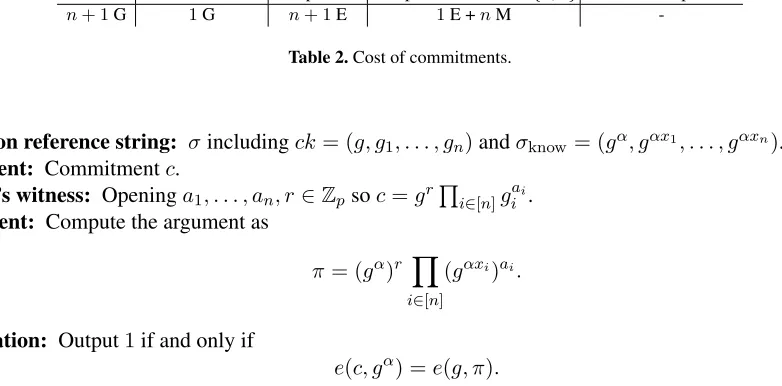
Common reference string: 𝜎including𝑐𝑘= (𝑔, 𝑔1, . . . , 𝑔𝑛)and𝜎know= (𝑔𝛼, 𝑔𝛼𝑥1, . . . , 𝑔𝛼𝑥𝑛).
Statement: Commitment𝑐.
Prover’s witness: Opening𝑎1, . . . , 𝑎𝑛, 𝑟∈ℤ𝑝so𝑐=𝑔𝑟∏𝑖∈[𝑛]𝑔
𝑎𝑖 𝑖 .
Argument: Compute the argument as
𝜋= (𝑔𝛼)𝑟 ∏
𝑖∈[𝑛]
(𝑔𝛼𝑥𝑖)𝑎𝑖.
Verification: Output1if and only if
𝑒(𝑐, 𝑔𝛼) =𝑒(𝑔, 𝜋).
Theorem 3. The non-interactive argument described above has perfect completeness and perfect witness-indistinguishability.
Proof. To argue perfect completeness, observe 𝜋 = 𝑐𝛼 giving us 𝑒(𝑐, 𝑔𝛼) = 𝑒(𝑔, 𝜋). Perfect witness-indistinguishability follows from 𝑔𝛼 being a generator for 𝐺, so there is only one acceptable argument 𝜋. By perfect completeness, any opening of the commitment will result in the same argument 𝜋 and we
therefore have perfect witness-indistinguishability. □
Theorem 4. In the generic group model it is infeasible to construct a commitment𝑐and a valid argument of knowledge𝜋without knowing an opening𝑟, 𝑎1, . . . , 𝑎𝑛of the commitment.
Proof. We will show that there is an polynomial time extractor 𝐸 that takes the adversary’s input
(𝑝, 𝐺, 𝐺𝑇, 𝑒, 𝑔) and the generic common reference string 𝜎, the adversary’s outputs[𝑐],[𝜋], and a list of
inputs and outputs to the generic bilinear group oracle, which with overwhelming probability outputs an opening𝑟, 𝑎1, . . . , 𝑎𝑛of𝑐in case𝜋is a valid argument of knowledge for𝑐.
Let us first consider how𝒜can be successful in producing encodings[𝑐],[𝜋]of a commitment and a valid argument of knowledge. Suppose one or both of[𝑐]and[𝜋]are not part of the generic common reference string or output by the generic group oracle. In that case, since[⋅]is a random permutation over𝐺and𝑔, 𝑔𝛼
are generators for𝐺there is negligible probability of𝑒(𝑐, 𝑔𝛼) = 𝑒(𝑔, 𝜋). We can therefore from now on assume[𝑐],[𝜋]have been generated by the generic group oracle.
Now, let us as in the proof of Theorem 1 keep track of queries made by 𝒜 and the corre-sponding polynomials. The extractor maintains two lists 𝐿 = {(𝑝𝑖, 𝜉𝑖)} and 𝐿𝑇 = {(𝑝𝑖,𝑇, 𝜉𝑖,𝑇)}
containing pairs of the form (𝑝𝑖, 𝜉𝑖) ∈ ℤ𝑝[𝑋1, . . . , 𝑋𝑛, 𝐴, 𝑌1, . . . , 𝑌𝑛, 𝑍11, . . . , 𝑍𝑛𝑛] × ℤ𝑝, where
𝜉𝑖, 𝜉𝑖,𝑇 are values the oracle has given to 𝒜. At first the lists are initialized as follows 𝐿 = {(1, 𝜉1),(𝑋1, 𝜉2),(𝑋2, 𝜉3), . . . ,(𝑋𝑛−1𝑍𝑛𝑛, 𝜉2𝑛3+𝑛2+𝑛+2)} and𝐿𝑇 = ∅, where 𝜉1, . . . , 𝜉2𝑛3+𝑛2+𝑛+2 are the values from the generic common reference string. The list𝐿thus starts out by containing the polyno-mials used in the exponents when generating a common reference string and matching random encodings of those group elements. Upon input(mult, 𝜉𝑖, 𝜉𝑗)giving answer𝜉 the extractor appends(𝑝𝑖+𝑝𝑗, 𝜉)to𝐿
unless it has already been stored in𝐿. Inputs of the form(mult𝑇, 𝜉𝑖,𝑇, 𝜉𝑗,𝑇)are treated similarly using the
list𝐿𝑇. On input(pair, 𝜉𝑖, 𝜉𝑗)giving response𝜉𝑇 it appends(𝑝𝑖𝑝𝑗, 𝜉𝑇)to𝐿𝑇 unless such a tuple already
Consider now the polynomials𝑐(𝑋1, . . . , 𝑍𝑛𝑛)and𝜋(𝑋1, . . . , 𝑍𝑛𝑛)for the adversary’s output[𝑐],[𝜋].
If we have 𝜋(𝑋1, . . . , 𝑍𝑛𝑛) =∕ 𝐴𝑐(𝑋1, . . . , 𝑍𝑛𝑛) we will argue as in Theorem 1 that there is negligible
chance of 𝒜 being successful. Since the generic oracle uses a random permutation to encode the group elements, we can simulate it by picking random distinct values for each new polynomial generated during the queries to the oracle. By the Schwartz-Zippel lemma, there is negligible probability of having a collision, i.e., two distinct polynomials that evaluate to the same group elements for the oracle’s concrete choice of 𝑥1, . . . , 𝑧𝑛𝑛. The simulation is perfect conditioned on no such collision happening, and as the adversary in
the simulation gets no information about𝑥1, . . . , 𝑧𝑛𝑛 in the simulation there is negligible chance over the
choice of𝑥1, . . . , 𝑧𝑛𝑛 ←ℤ∗𝑝 for the event𝜋(𝑥1, . . . , 𝑧𝑛𝑛) =𝛼𝑐(𝑥1, . . . , 𝑧𝑛𝑛).
Remaining is the possibility that𝜋(𝑋1, . . . , 𝑍𝑛𝑛) =𝐴𝑐(𝑋1, . . . , 𝑍𝑛𝑛). Since the two polynomials
be-long to𝐿, which can only grow by adding polynomials in𝐿when the adversary makes a(mult, 𝜉𝑖, 𝜉𝑗)query
to the oracle, we have
𝑐(𝑋1, . . . , 𝑍𝑛𝑛) =𝑐1+𝑐𝑥1𝑋1+⋅ ⋅ ⋅+𝑐𝛼𝐴+𝑐𝛼𝑥1𝐴𝑋1+⋅ ⋅ ⋅+𝑐𝑥1𝑥2𝑋1𝑋2+⋅ ⋅ ⋅𝑐𝑥𝑛−1𝑧𝑛𝑛𝑋𝑛−1𝑍𝑛𝑛 𝜋(𝑋1, . . . , 𝑍𝑛𝑛) =𝜋1+𝜋𝑥1𝑋1+⋅ ⋅ ⋅+𝜋𝛼𝐴+𝜋𝛼𝑥1𝐴𝑋1+⋅ ⋅ ⋅+𝜋𝑥1𝑥2𝑋1𝑋2+⋅ ⋅ ⋅𝜋𝑥𝑛−1𝑧𝑛𝑛𝑋𝑛−1𝑍𝑛𝑛,
for known coefficients𝑐1, . . . , 𝑐𝑥𝑛−1𝑧𝑛𝑛, 𝜋1, . . . , 𝜋𝑥𝑛−1𝑧𝑛𝑛 ∈ℤ𝑝.
The equality𝜋(𝑋1, . . . , 𝑍𝑛𝑛) =𝐴𝑐(𝑋1, . . . , 𝑍𝑛𝑛)implies that we can simplify
𝜋(𝑋1, . . . , 𝑍𝑛𝑛) =𝜋𝛼𝐴+𝜋𝛼𝑥1𝐴𝑋1+⋅ ⋅ ⋅+𝜋𝛼𝑥𝑛𝐴𝑋𝑛,
since all the other parts are distinct monomials with degree 0 in𝐴. This means we have
𝑐(𝑋1, . . . , 𝑍𝑛𝑛) =𝜋𝛼𝐴+𝜋𝛼𝑥1𝑋1+⋅ ⋅ ⋅𝜋𝛼𝑥𝑛𝑋𝑛.
By Theorem 1 this is the only linear combination giving𝑐(𝑋1, . . . , 𝑍𝑛𝑛), so𝑟 = 𝑐1 = 𝜋𝛼, 𝑎1 = 𝑐𝑥1 =
𝜋𝛼𝑥1, . . . , 𝑎𝑛=𝑐𝑥𝑛 =𝜋𝛼𝑥𝑛gives us the desired opening of𝑐. □
EFFICIENCY. We summarize the cost of arguments of knowledge in Table 3. If there are many arguments of knowledge it is possible to use batch-verification techniques to lower the cost of verification. Consider for instance the case, where we have𝑁 commitments and arguments of knowledge𝑐1, 𝜋1, . . . , 𝑐𝑁, 𝜋𝑁. The
verifier picks𝑡1, . . . , 𝑡𝑛←[2ℓ]at random for some security parameterℓ <log𝑝and verifies
𝑒(∏
𝑖∈[𝑛]
𝑐𝑡𝑖𝑖 , 𝑔𝛼) = ∏
𝑖∈[𝑛]
𝑒(𝑐𝑖, 𝑔𝛼)𝑡𝑖 = ∏
𝑖∈[𝑛]
𝑒(𝑔, 𝜋𝑖)𝑡𝑖 =𝑒(𝑔, ∏
𝑖∈[𝑛] 𝜋𝑡𝑖𝑖 ),
which has at most chance2−ℓ of being true unless∀𝑖 ∈ [𝑛] : 𝑒(𝑐𝑖, 𝑔𝛼) =𝑒(𝑔, 𝜋𝑖). The last column in the
table lists the costs of batch-verifying𝑁 arguments of knowledge.
Size of𝜎knowArgument size Prover comp. Prover comp.{0,1}Verifier comp. Verifier comp.𝑁
𝑛+ 1G 1G 𝑛+ 1E 1E +𝑛M 2P 2P +2𝑁E
7 Products of Committed Values
Consider three commitments𝑐, 𝑑and𝑣to values𝑎1, . . . , 𝑎𝑛, 𝑏1, . . . , 𝑏𝑛and𝑢1, . . . , 𝑢𝑛. We will give a
non-interactive perfectly witness-indistinguishable argument for the committed𝑢1, . . . , 𝑢𝑛 being the products
𝑎1𝑏1, . . . , 𝑎𝑛𝑏𝑛.
Common reference string: 𝜎including𝑐𝑘= (𝑔, 𝑔1, . . . , 𝑔𝑛)and𝜎prod= ({𝑔𝑥𝑖𝑥𝑗}𝑖,𝑗∈[𝑛],𝑖∕=𝑗).
Statement: Commitments𝑐, 𝑑, 𝑣 ∈𝐺.
Prover’s witness: Openings𝑟, 𝑎1, . . . , 𝑎𝑛and𝑠, 𝑏1, . . . , 𝑏𝑛and𝑡, 𝑢1, . . . , 𝑢𝑛so
𝑐=𝑔𝑟 ∏
𝑖∈[𝑛]
𝑔𝑖𝑎𝑖 and 𝑑=𝑔𝑠 ∏
𝑖∈[𝑛]
𝑔𝑏𝑖𝑖 and 𝑣=𝑔𝑡 ∏
𝑖∈[𝑛]
𝑔𝑖𝑢𝑖 and ∀𝑖∈[𝑛] :𝑢𝑖 =𝑎𝑖𝑏𝑖.
Argument: Compute the argument as
𝜋=𝑔𝑟𝑠 ∏
𝑖∈[𝑛]
⎛
⎝(𝑔𝑖)𝑎𝑖𝑠+𝑏𝑖𝑟−𝑡 ∏
𝑗∈[𝑛]∖{𝑖}
(𝑔𝑥𝑖𝑥𝑗)𝑎𝑖𝑏𝑗−𝑢𝑖
⎞
⎠.
Verification: Output1if and only if
𝑒(𝑐, 𝑑) =𝑒(𝑣, ∏
𝑗∈[𝑛]
𝑔𝑗)𝑒(𝑔, 𝜋).
Theorem 5. The non-interactive argument described above has perfect completeness and perfect witness-indistinguishability.
Proof.To argue perfect completeness, consider the three pairings the verifier has to compute.
𝑒(𝑐, 𝑑) =𝑒(𝑔𝑟+∑𝑖𝑎𝑖𝑥𝑖, 𝑔𝑠+ ∑
𝑗𝑏𝑗𝑥𝑗) =𝑒(𝑔, 𝑔) ∑
𝑖𝑎𝑖𝑏𝑖𝑥2𝑖𝑒(𝑔, 𝑔)𝑟𝑠+𝑠 ∑
𝑖𝑎𝑖𝑥𝑖+𝑟 ∑
𝑗𝑏𝑗𝑥𝑗+ ∑
𝑖∕=𝑗𝑎𝑖𝑏𝑗𝑥𝑖𝑥𝑗.
𝑒(𝑣, ∏
𝑗∈[𝑛]
𝑔𝑗) =𝑒(𝑔𝑡+ ∑
𝑖𝑢𝑖𝑥𝑖, 𝑔 ∑
𝑗𝑥𝑗) =𝑒(𝑔, 𝑔) ∑
𝑖𝑢𝑖𝑥2𝑖𝑒(𝑔, 𝑔)𝑡 ∑
𝑗𝑥𝑗+ ∑
𝑖∕=𝑗𝑢𝑖𝑥𝑖𝑥𝑗.
𝑒(𝑔, 𝜋) =𝑒(𝑔, 𝑔𝑟𝑠 ∏
𝑖∈[𝑛]
[(𝑔𝑥𝑖)𝑎𝑖𝑠+𝑏𝑖𝑟−𝑡 ∏
𝑗∈[𝑛]∖{𝑖}
(𝑔𝑥𝑖𝑥𝑗)𝑎𝑖𝑏𝑗−𝑢𝑖])
=𝑒(𝑔, 𝑔)𝑟𝑠+
∑
𝑖(𝑎𝑖𝑟+𝑏𝑖𝑠−𝑡)𝑥𝑖+ ∑
𝑖∕=𝑗(𝑎𝑖𝑏𝑗−𝑢𝑖)𝑥𝑖𝑥𝑗
Since𝑢𝑖=𝑎𝑖𝑏𝑖 we see that∑𝑖∈[𝑛]𝑎𝑖𝑏𝑖𝑥2𝑖 = ∑
𝑖∈[𝑛]𝑢𝑖𝑥2𝑖. Looking at the three pairings above we then get
𝑒(𝑐, 𝑑) =𝑒(𝑣, ∏
𝑗∈[𝑛]
𝑔𝑗)𝑒(𝑔, 𝜋)
so the verification accepts the argument𝜋.
Perfect witness-indistinguishability follows from 𝑔 being a generator of 𝐺, since there is exactly one unique argument𝜋that will make the verification accept. By the perfect completeness, all valid witnesses give an accepting argument and therefore for fixed 𝑐, 𝑑, 𝑢all openings with 𝑢𝑖 = 𝑎𝑖𝑏𝑖 result in the same
Theorem 6. In the generic group model it is infeasible to find three commitments with their respective openings and a valid argument unless indeed the third set of values contains the entry-wise product of the first two sets.
Proof.We want to prove
Pr
[
(𝑝, 𝐺, 𝐺𝑇, 𝑒, 𝑔)← 𝒢(1𝜆); (𝑟, 𝑎1, . . . , 𝑠, 𝑏1, . . . , 𝑡, 𝑢1, . . . ,[𝜋])← 𝒜𝒪(𝑝, 𝐺, 𝐺𝑇, 𝑒, 𝑔) :
𝑒(𝑐, 𝑑) =𝑒(𝑣, ∏
𝑗∈[𝑛]
𝑔𝑗)𝑒(𝑔, 𝜋) and ∃𝑖∈[𝑛] :𝑢𝑖 ∕=𝑎𝑖𝑏𝑖 ]
≈0,
where we define𝑐=𝑔𝑟∏ 𝑖∈[𝑛]𝑔
𝑎𝑖
𝑖 , 𝑑=𝑔𝑠 ∏
𝑖∈[𝑛]𝑔
𝑏𝑖
𝑖 and𝑣=𝑔𝑡 ∏
𝑖∈[𝑛]𝑔
𝑢𝑖 𝑖 .
Let us first consider how𝒜can be successful in producing the encoding[𝜋]of a valid argument. Suppose
[𝜋]is not part of the generic common reference string or output by the generic group oracle. In that case, since[⋅]is a random permutation over 𝐺and𝑔 is a generator there is negligible probability of𝑒(𝑐, 𝑑) =
𝑒(𝑣,∏
𝑗∈[𝑛]𝑔𝑗)𝑒(𝑔, 𝜋). We can therefore from now on assume[𝜋]has been generated by the generic group oracle at some point.
Now, let us as in the proof of Theorem 1 keep track of queries made by𝒜and the corresponding polyno-mials. We maintain two lists𝐿={(𝑝𝑖, 𝜉𝑖)}and𝐿𝑇 ={(𝑝𝑖,𝑇, 𝜉𝑖,𝑇)}containing pairs of the form(𝑝𝑖, 𝜉𝑖)∈
ℤ𝑝[𝑋1, . . . , 𝑋𝑛, 𝐴, 𝑌1, . . . , 𝑌𝑛, 𝑍11, . . . , 𝑍𝑛𝑛]×ℤ𝑝, where𝜉𝑖, 𝜉𝑖,𝑇 are values the oracle has given to𝒜. At
first the lists are initialized as follows𝐿={(1, 𝜉1),(𝑋1, 𝜉2),(𝑋2, 𝜉3), . . . ,(𝑋𝑛−1𝑍𝑛𝑛, 𝜉2𝑛3+𝑛2+𝑛+2)}and 𝐿𝑇 = ∅, where 𝜉1, . . . , 𝜉2𝑛3+𝑛2+𝑛+2 are the values from the generic common reference string. The list 𝐿 thus starts out by containing the polynomials used in the exponents when generating a common ref-erence string and matching random encodings of those group elements. Upon input(mult, 𝜉𝑖, 𝜉𝑗) giving
answer𝜉 the extractor appends(𝑝𝑖+𝑝𝑗, 𝜉)to𝐿unless it has already been stored in𝐿. Inputs of the form
(mult𝑇, 𝜉𝑖,𝑇, 𝜉𝑗,𝑇)are treated similarly using the list𝐿𝑇. On input(pair, 𝜉𝑖, 𝜉𝑗) giving response𝜉𝑇 it
ap-pends(𝑝𝑖𝑝𝑗, 𝜉𝑇)to𝐿𝑇 unless such a tuple already exists.
Consider now the polynomial𝜋(𝑋1, . . . , 𝑍𝑛𝑛)for the adversary’s output[𝜋]. If we have
(𝑟+∑
𝑖∈[𝑛]
𝑎𝑖𝑋𝑖)(𝑠+ ∑
𝑗∈[𝑛]
𝑏𝑗𝑋𝑗)∕= (𝑡+ ∑
𝑖∈[𝑛] 𝑢𝑖𝑋𝑖)
∑
𝑗∈[𝑛]
𝑋𝑗+𝜋(𝑋1, . . . , 𝑍𝑛𝑛)
we can argue as in Theorem 1 that there is negligible chance of 𝒜being successful, i.e., there is negligi-ble chance that𝑒(𝑐, 𝑑) =𝑒(𝑣,∏
𝑗∈[𝑛]𝑔𝑗)𝑒(𝑔, 𝜋(𝑥1, . . . , 𝑧𝑛𝑛))for the concrete values of𝑥1, . . . , 𝑧𝑛𝑛 chosen
by the oracle. Since the generic oracle uses a random permutation to encode the group elements, we can simulate it by picking random distinct values for each new polynomial generated during the queries to the oracle. By the Schwartz-Zippel lemma, there is negligible probability of having a collision, i.e., two dis-tinct polynomials that evaluate to the same group elements for the oracle’s concrete choice of𝑥1, . . . , 𝑧𝑛𝑛.
The simulation is perfect conditioned on no such collision happening, and as the adversary in the simula-tion gets no informasimula-tion about 𝑥1, . . . , 𝑧𝑛𝑛 in the simulation there is negligible chance over the choice of
𝑥1, . . . , 𝑧𝑛𝑛 ←ℤ∗𝑝for the event𝑒(𝑐, 𝑑) =𝑒(𝑣, ∏
𝑗∈[𝑛]𝑔𝑗)𝑒(𝑔, 𝜋(𝑥1, . . . , 𝑧𝑛𝑛)). Remaining is the possibility that(𝑟+∑
𝑖∈[𝑛]𝑎𝑖𝑋𝑖)(𝑠+
∑
𝑗∈[𝑛]𝑏𝑗𝑋𝑗) = (𝑡+
∑
𝑖∈[𝑛]𝑢𝑖𝑋𝑖)
∑
𝑗∈[𝑛]𝑋𝑗+ 𝜋(𝑋1, . . . , 𝑍𝑛𝑛). Since 𝜋(𝑋1, . . . , 𝑍𝑛𝑛) belongs to 𝐿, which can only grow by adding polynomials in 𝐿
when the adversary makes a(mult, 𝜉𝑖, 𝜉𝑗)query to the oracle, we have
for known coefficients𝜋1, . . . , 𝜋𝑥𝑛−1𝑧𝑛𝑛 ∈ℤ𝑝. Expanding(𝑟+∑
𝑖∈[𝑛]𝑎𝑖𝑋𝑖)(𝑠+∑𝑗∈[𝑛]𝑏𝑗𝑋𝑗) = (𝑡+∑𝑖∈[𝑛]𝑢𝑖𝑋𝑖)∑𝑗∈[𝑛]𝑋𝑗+𝜋(𝑋1, . . . , 𝑍𝑛𝑛)on
both sides gives us
∑
𝑖∈[𝑛]
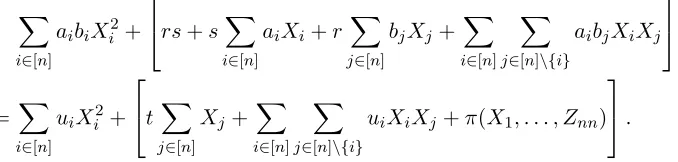
𝑎𝑖𝑏𝑖𝑋𝑖2+ ⎡ ⎣𝑟𝑠+𝑠 ∑ 𝑖∈[𝑛] 𝑎𝑖𝑋𝑖+𝑟 ∑ 𝑗∈[𝑛] 𝑏𝑗𝑋𝑗+ ∑ 𝑖∈[𝑛] ∑ 𝑗∈[𝑛]∖{𝑖} 𝑎𝑖𝑏𝑗𝑋𝑖𝑋𝑗 ⎤ ⎦ = ∑ 𝑖∈[𝑛]
𝑢𝑖𝑋𝑖2+ ⎡ ⎣𝑡 ∑ 𝑗∈[𝑛] 𝑋𝑗+ ∑ 𝑖∈[𝑛] ∑ 𝑗∈[𝑛]∖{𝑖}
𝑢𝑖𝑋𝑖𝑋𝑗 +𝜋(𝑋1, . . . , 𝑍𝑛𝑛) ⎤
⎦.
Since 𝜋(𝑋1, . . . , 𝑍𝑛𝑛) has no 𝑋𝑖2 elements, neither do any of the parts within the brackets. We conclude
that for the two polynomials to be equal, we must have𝑢𝑖 =𝑎𝑖𝑏𝑖for all𝑖∈[𝑛]. □
EFFICIENCY. Table 4 summarizes the cost of product arguments. As is the case with arguments of knowl-edge, batch-verification techniques may reduce the cost of verifying many statements and product argu-ments.
Size of𝜎prodArgument size Prover comp. Prover comp.{0,1} Verifier comp. Verifier comp.𝑁
𝑛2−𝑛G 1G 𝑛2+ 1E 𝑛+ 1E +𝑛2−𝑛M 3P 𝑁P +2𝑁E
Table 4.Cost of product arguments.
8 Permutation of Committed Values within a Commitment
Consider two commitments𝑐and𝑑to values𝑎1, . . . , 𝑎𝑛and𝑏1, . . . , 𝑏𝑛. We will give a non-interactive
per-fectly witness-indistinguishable argument for the committed𝑏1, . . . , 𝑏𝑛being a publicly known permutation
of𝑎1, . . . , 𝑎𝑛.
Common reference string: 𝜎including𝜎perm= ({𝑔𝑃𝑖(𝒙)𝑦𝑗}𝑖,𝑗∈[𝑛],{𝑔𝑥𝑖𝑃𝑗(𝒙)𝑦𝑘}𝑖,𝑗,𝑘∈[𝑛],𝑖∕=𝑗). Statement: Commitments𝑐, 𝑑∈𝐺and permutation𝜌∈𝑆𝑛.
Prover’s witness: Openings𝑟, 𝑎1, . . . , 𝑎𝑛∈ℤ𝑝and𝑠, 𝑏1, . . . , 𝑏𝑛∈ℤ𝑝 so
𝑐=𝑔𝑟 ∏
𝑖∈[𝑛]
𝑔𝑖𝑎𝑖 and 𝑑=𝑔𝑠 ∏
𝑗∈[𝑛]
𝑔𝑖𝑏𝑗 and ∀𝑖∈[𝑛] :𝑏𝑖=𝑎𝜌(𝑖).
Argument: Compute the argument as
𝜋 = ⎛ ⎝ ∏ 𝑖∈[𝑛] 𝑔𝑃𝑖(𝒙)𝑦𝑖 ⎞ ⎠ 𝑟⎛ ⎝ ∏ 𝑖∈[𝑛] 𝑔𝑃𝑖(𝒙)𝑦𝜌(𝑖) ⎞ ⎠ −𝑠 ∏ 𝑖∈[𝑛] ⎡ ⎢ ⎣ ⎛ ⎝ ∏ 𝑗∈[𝑛]∖{𝑖} 𝑔𝑥𝑖𝑃𝑗(𝒙)𝑦𝑗 ⎞ ⎠ 𝑎𝑖⎛ ⎝ ∏ 𝑗∈[𝑛]∖{𝑖} 𝑔𝑥𝑖𝑃𝑗(𝒙)𝑦𝜌(𝑗) ⎞ ⎠ −𝑏𝑖⎤ ⎥ ⎦.
Verification: Output1if and only if 𝑒(𝑐, ∏
𝑗∈[𝑛]
𝑔𝑃𝑗(𝒙)𝑦𝑗) =𝑒(𝑑, ∏
𝑗∈[𝑛]
Theorem 7. The non-interactive argument described above has perfect completeness and perfect witness-indistinguishability.
Proof.To argue perfect completeness, consider the three pairings the verifier has to compute.
𝑒(𝑐, ∏ 𝑗∈[𝑛] 𝑔𝑃𝑗(𝒙)𝑦𝑗) =𝑒(𝑔𝑟+∑𝑖𝑎𝑖𝑥𝑖, 𝑔 ∑ 𝑗𝑃𝑗(𝒙)𝑦𝑗) =𝑒(𝑔, 𝑔) ∑ 𝑖𝑎𝑖𝑦𝑖𝑃(𝒙)𝑒(𝑔, 𝑔)𝑟 ∑ 𝑗𝑃𝑗(𝒙)𝑦𝑗+ ∑ 𝑖∕=𝑗𝑎𝑖𝑥𝑖𝑃𝑗(𝒙)𝑦𝑗. 𝑒(𝑑, ∏ 𝑗∈[𝑛] 𝑔𝑃𝑗(𝒙)𝑦𝜌(𝑗)) =𝑒(𝑔𝑠+∑𝑖𝑏𝑖𝑥𝑖, 𝑔 ∑ 𝑗𝑃𝑗(𝒙)𝑦𝜌(𝑗)) =𝑒(𝑔, 𝑔)∑𝑖𝑏𝑖𝑦𝜌(𝑖)𝑃(𝒙)𝑒(𝑔, 𝑔)𝑠 ∑ 𝑗𝑃𝑗(𝒙)𝑦𝜌(𝑗)+∑𝑖∕=𝑗𝑏𝑖𝑥𝑖𝑃𝑗(𝒙)𝑦𝜌(𝑗). 𝑒(𝑔, 𝜋) =𝑒(𝑔,(∏ 𝑖∈[𝑛] 𝑔𝑃𝑖(𝒙)𝑦𝑖)𝑟(∏ 𝑖∈[𝑛] 𝑔𝑃𝑖(𝒙)𝑦𝜌(𝑖))−𝑠 ∏ 𝑖∈[𝑛] [( ∏ 𝑗∈[𝑛]∖{𝑖} 𝑔𝑥𝑖𝑃𝑗(𝒙)𝑦𝑗)𝑎𝑖( ∏ 𝑗∈[𝑛]∖{𝑖} 𝑔𝑥𝑖𝑃𝑗(𝒙)𝑦𝜌(𝑗))−𝑏𝑖] =𝑒(𝑔, 𝑔)𝑟 ∑ 𝑖𝑃𝑖(𝒙)𝑦𝑖−𝑠 ∑ 𝑖𝑃𝑖(𝒙)𝑦𝜌(𝑖)+ ∑ 𝑖∕=𝑗𝑎𝑖𝑥𝑖𝑃𝑗(𝒙)𝑦𝑗− ∑ 𝑖∕=𝑗𝑏𝑖𝑥𝑖𝑃𝑗(𝒙)𝑦𝜌(𝑗).
Since𝑏𝑖 =𝑎𝜌(𝑖)we have
∑
𝑖∈[𝑛]𝑎𝑖𝑦𝑖 =∑𝑖∈[𝑛]𝑏𝑖𝑦𝜌(𝑖). Looking at the three pairings above we then get
𝑒(𝑐, ∏
𝑗∈[𝑛]
𝑔𝑃𝑗(𝒙)𝑦𝑗) =𝑒(𝑑, ∏
𝑗∈[𝑛]
𝑔𝑃𝑗(𝒙)𝑦𝜌(𝑗))𝑒(𝑔, 𝜋)
so the verification accepts the argument𝜋.
Since𝑔is a generator for𝐺, there is exactly one argument𝜋that will make the verification accept. By the perfect completeness, all valid openings with𝑏𝑖 = 𝑎𝜌(𝑖)give an accepting argument and therefore all
valid witnesses result in the same argument. □
Theorem 8. In the generic group model it is infeasible to find a permutation, two commitments with their respective openings, and a valid argument unless indeed the openings obey the permutation.
Proof.We want to prove
Pr[(𝑝, 𝐺, 𝐺𝑇, 𝑒, 𝑔)← 𝒢(1𝜆); (𝜌, 𝑟, 𝑎1, . . . , 𝑎𝑛, 𝑠, 𝑏1, . . . , 𝑏𝑛,[𝜋])← 𝒜𝒪(𝑝, 𝐺, 𝐺𝑇, 𝑒, 𝑔) :𝜌∈𝑆𝑛and
𝑒(𝑐, ∏
𝑗∈[𝑛]
𝑔𝑃𝑗(𝒙)𝑦𝑗) =𝑒(𝑑, ∏
𝑗∈[𝑛]
𝑔𝑃𝑗(𝒙)𝑦𝜌(𝑗))𝑒(𝑔, 𝜋) and ∃𝑖∈[𝑛] :𝑏
𝑖 ∕=𝑎𝜌(𝑖)
] ≈0,
where we define𝑐=𝑔𝑟∏ 𝑖∈[𝑛]𝑔
𝑎𝑖
𝑖 and𝑑=𝑔𝑠 ∏
𝑖∈[𝑛]𝑔
𝑏𝑖 𝑖 .
Let us first consider how 𝒜 can be successful in producing the encoding [𝜋] of a valid argument. Suppose [𝜋]is not part of the generic common reference string or output by the generic group oracle. In that case, since [⋅]is a random permutation over𝐺and𝑔 is a generator there is negligible probability of 𝑒(𝑐,∏
𝑗∈[𝑛]𝑔𝑃𝑗(𝒙)𝑦𝑗) =𝑒(𝑑,
∏
𝑗∈[𝑛]𝑔𝑃𝑗(𝒙)𝑦𝜌(𝑗))𝑒(𝑔, 𝜋). We can therefore from now on assume[𝜋]has been generated by the generic group oracle at some point.
Now, let us as in the proof of Theorem 1 keep track of queries made by𝒜and the corresponding polyno-mials. We maintain two lists𝐿={(𝑝𝑖, 𝜉𝑖)}and𝐿𝑇 ={(𝑝𝑖,𝑇, 𝜉𝑖,𝑇)}containing pairs of the form(𝑝𝑖, 𝜉𝑖)∈
ℤ𝑝[𝑋1, . . . , 𝑋𝑛, 𝐴, 𝑌1, . . . , 𝑌𝑛, 𝑍11, . . . , 𝑍𝑛𝑛]×ℤ𝑝, where𝜉𝑖, 𝜉𝑖,𝑇 are values the oracle has given to𝒜. At
𝐿 thus starts out by containing the polynomials used in the exponents when generating a common ref-erence string and matching random encodings of those group elements. Upon input(mult, 𝜉𝑖, 𝜉𝑗) giving
answer𝜉 the extractor appends(𝑝𝑖+𝑝𝑗, 𝜉)to𝐿unless it has already been stored in𝐿. Inputs of the form
(mult𝑇, 𝜉𝑖,𝑇, 𝜉𝑗,𝑇)are treated similarly using the list𝐿𝑇. On input(pair, 𝜉𝑖, 𝜉𝑗) giving response𝜉𝑇 it
ap-pends(𝑝𝑖𝑝𝑗, 𝜉𝑇)to𝐿𝑇 unless such a tuple already exists.
Consider now the polynomial𝜋(𝑋1, . . . , 𝑍𝑛𝑛)for the adversary’s output[𝜋]. If we have
(𝑟+∑ 𝑖∈[𝑛] 𝑎𝑖𝑋𝑖)( ∑ 𝑗∈[𝑛] 𝑃𝑗(𝑿)𝑌𝑗)∕= (𝑠+ ∑ 𝑖∈[𝑛] 𝑏𝑖𝑋𝑖)( ∑ 𝑗∈[𝑛]
𝑃𝑗(𝑿)𝑌𝜌(𝑗)) +𝜋(𝑋1, . . . , 𝑍𝑛𝑛)
we will argue as in Theorem 1 that there is negligible chance of𝒜being successful, i.e., there is negligible chance that𝑒(𝑐,∏
𝑗∈[𝑛]𝑔𝑃𝑗(𝒙)𝑦𝑗) = 𝑒(𝑑,
∏ 𝑗∈[𝑛]𝑔
𝑃𝑗(𝒙)𝑦𝜌(𝑗))𝑒(𝑔, 𝜋) for the concrete values of𝑥
1, . . . , 𝑧𝑛𝑛
chosen by the oracle. Since the generic oracle uses a random permutation to encode the group elements, we can simulate it by picking random distinct values for each new polynomial generated during the queries to the oracle. By the Schwartz-Zippel lemma, there is negligible probability of having a collision, i.e., two distinct polynomials that evaluate to the same group elements for the oracle’s concrete choice of𝑥1, . . . , 𝑧𝑛𝑛. The
simulation is perfect conditioned on no such collision happening, and as the adversary gets no information about𝑥1, . . . , 𝑧𝑛𝑛 in the simulation there is negligible chance over the choice of𝑥1, . . . , 𝑧𝑛𝑛 ← ℤ∗𝑝for the
event𝑒(𝑐,∏
𝑗∈[𝑛]𝑔𝑃𝑗(𝒙)𝑦𝑗) =𝑒(𝑑,
∏
𝑗∈[𝑛]𝑔𝑃𝑗(𝒙)𝑦𝜌(𝑗))𝑒(𝑔, 𝜋). Remaining is the possibility that
(𝑟+ ∑ 𝑖∈[𝑛] 𝑎𝑖𝑋𝑖)( ∑ 𝑗∈[𝑛] 𝑃𝑗(𝑿)𝑌𝑗) = (𝑠+ ∑ 𝑖∈[𝑛] 𝑏𝑖𝑋𝑖) ∑ 𝑗∈[𝑛]
𝑃𝑗(𝑿)𝑌𝜌(𝑗)+𝜋(𝑋1, . . . , 𝑍𝑛𝑛).
Since𝜋(𝑋1, . . . , 𝑍𝑛𝑛)belongs to𝐿, which can only grow by adding polynomials in𝐿when the adversary
makes a(mult, 𝜉𝑖, 𝜉𝑗)query to the oracle, we have
𝜋(𝑋1, . . . , 𝑍𝑛𝑛) =𝜋1+𝜋𝑥1𝑋1+⋅ ⋅ ⋅+𝜋𝛼𝐴+𝜋𝛼𝑥1𝐴𝑋1+⋅ ⋅ ⋅+𝜋𝑥1𝑥2𝑋1𝑋2+⋅ ⋅ ⋅𝜋𝑥𝑛−1𝑧𝑛𝑛𝑋𝑛−1𝑍𝑛𝑛,
for known coefficients𝜋1, . . . , 𝜋𝑥𝑛−1𝑧𝑛𝑛 ∈ℤ𝑝. Expanding (𝑟 + ∑
𝑖∈[𝑛]𝑎𝑖𝑋𝑖)( ∑ 𝑗∈[𝑛]𝑃𝑗(𝑿)𝑌𝑗) = (𝑠 + ∑ 𝑖∈[𝑛]𝑏𝑖𝑋𝑖)( ∑ 𝑗∈[𝑛]𝑃𝑗(𝑿)𝑌𝜌(𝑗)) + 𝜋(𝑋1, . . . , 𝑍𝑛𝑛)on both sides gives us
∑ 𝑖∈[𝑛] 𝑎𝑖𝑃(𝑿)𝑌𝑖+ ⎡ ⎣𝑟 ∑ 𝑗∈[𝑛] 𝑃𝑗(𝑿)𝑌𝑗+ ∑ 𝑖∈[𝑛] ∑ 𝑗∈[𝑛]∖{𝑖} 𝑎𝑖𝑋𝑖𝑃𝑗(𝑿)𝑌𝑗 ⎤ ⎦ =∑ 𝑖∈[𝑛] 𝑏𝑖𝑃(𝑿)𝑌𝜌(𝑖)+ ⎡ ⎣𝑠 ∑ 𝑗∈[𝑛] 𝑃𝑗(𝑿)𝑌𝜌(𝑗)+ ∑ 𝑖∈[𝑛] ∑ 𝑗∈[𝑛]∖{𝑖}
𝑏𝑖𝑋𝑖𝑃𝑗(𝑿)𝑌𝜌(𝑗)+𝜋(𝑋1, . . . , 𝑍𝑛𝑛) ⎤
⎦.
Since𝜋(𝑋1, . . . , 𝑍𝑛𝑛)has no elements of the form𝑃(𝑿)𝑌𝑖, neither do any of the parts within the brackets.
We conclude that for the two polynomials to be equal, we must have𝑏𝑖=𝑎𝜌(𝑖)for all𝑖∈[𝑛]. □ EFFICIENCY. Table 5 summarizes the cost of permutation arguments. We note that if we carry out many permutation arguments, it is possible to pre-compute all the products∏
𝑗∈[𝑛]∖{𝑖}𝑔𝑥𝑖𝑃𝑗(𝒙)𝑦𝑗 to reduce the
number of multiplications. Similarly, it is possible to pre-compute∏
Size of𝜎permArgument size Prover comp. Prover comp.{0,1}Verifier comp. Verifier comp.𝑁
𝑛3G 1G 2𝑛+ 2E +𝑛2M 2E +𝑛2M 3P +𝑛−1M𝑁+ 2P +2𝑁E +𝑁 𝑛−𝑁M Table 5.Cost of permutation arguments.
9 Rotating Values between Commitments
Consider two sets of 𝑛 commitments 𝑐1, . . . , 𝑐𝑛 and 𝑑1, . . . , 𝑑𝑛, with openings 𝑎𝑖1, . . . , 𝑎𝑖𝑛, 𝑟𝑖 and
𝑏𝑖1, . . . , 𝑏𝑖𝑛, 𝑠𝑖 for𝑖 = 1, . . . , 𝑛. We can view these committed values as rows of two matrices𝐴 and𝐵.
We will give an argument for the first column of 𝐵 being the first column of 𝐴 rotated one step up, the second column of𝐵 being the second column of 𝐴rotates two steps up, the third column of𝐵 being the third column of𝐴rotated three step up, etc. Since a rotation of𝑛steps corresponds to staying in place the last column remains unchanged. In other words, we want to show that for all𝑖, 𝑗we have𝑏𝑖𝑗 =𝑎𝑖+𝑗mod𝑛,𝑗.
This means each commitment𝑑𝑖 contains exactly one value from each of the commitments𝑐1, . . . , 𝑐𝑛and
vice versa.
We will split the argument into𝑛separate arguments; one for each column. We now give an argument for column𝑘of𝐵 being equal to column𝑘of𝐴rotated𝑘steps upwards.
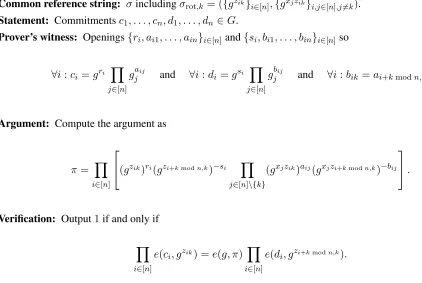
Common reference string: 𝜎including𝜎rot,𝑘= ({𝑔𝑧𝑖𝑘}𝑖∈[𝑛],{𝑔𝑥𝑗𝑧𝑖𝑘}𝑖,𝑗∈[𝑛],𝑗∕=𝑘).
Statement: Commitments𝑐1, . . . , 𝑐𝑛, 𝑑1, . . . , 𝑑𝑛∈𝐺.
Prover’s witness: Openings{𝑟𝑖, 𝑎𝑖1, . . . , 𝑎𝑖𝑛}𝑖∈[𝑛]and{𝑠𝑖, 𝑏𝑖1, . . . , 𝑏𝑖𝑛}𝑖∈[𝑛]so
∀𝑖:𝑐𝑖 =𝑔𝑟𝑖 ∏
𝑗∈[𝑛]
𝑔𝑗𝑎𝑖𝑗 and ∀𝑖:𝑑𝑖=𝑔𝑠𝑖 ∏
𝑗∈[𝑛]
𝑔𝑗𝑏𝑖𝑗 and ∀𝑖:𝑏𝑖𝑘 =𝑎𝑖+𝑘mod𝑛,𝑘.
Argument: Compute the argument as
𝜋 = ∏
𝑖∈[𝑛]
⎡
⎣(𝑔𝑧𝑖𝑘)𝑟𝑖(𝑔𝑧𝑖+𝑘mod𝑛,𝑘)
−𝑠𝑖 ∏ 𝑗∈[𝑛]∖{𝑘}
(𝑔𝑥𝑗𝑧𝑖𝑘)𝑎𝑖𝑗(𝑔𝑥𝑗𝑧𝑖+𝑘mod𝑛,𝑘)−𝑏𝑖𝑗 ⎤
⎦.
Verification: Output1if and only if
∏
𝑖∈[𝑛]
𝑒(𝑐𝑖, 𝑔𝑧𝑖𝑘) =𝑒(𝑔, 𝜋) ∏
𝑖∈[𝑛]
𝑒(𝑑𝑖, 𝑔𝑧𝑖+𝑘mod𝑛,𝑘).
Proof.To argue perfect completeness, consider the three products of pairings the verifier has to compute.
∏
𝑖∈[𝑛]
𝑒(𝑐𝑖, 𝑔𝑧𝑖𝑘) =𝑒(𝑔, 𝑔) ∑
𝑖(𝑟𝑖+ ∑
𝑗𝑎𝑖𝑗𝑥𝑗)𝑧𝑖𝑘)
=𝑒(𝑔, 𝑔)∑𝑖𝑎𝑖𝑘𝑥𝑘𝑧𝑖𝑘𝑒(𝑔, 𝑔) ∑
𝑖𝑟𝑖𝑧𝑖𝑘+ ∑
𝑖 ∑
𝑗∕=𝑘𝑎𝑖𝑗𝑥𝑗𝑧𝑖𝑘. ∏
𝑖∈[𝑛]
𝑒(𝑑𝑖, 𝑔𝑧𝑖+𝑘mod𝑛,𝑘) =𝑒(𝑔, 𝑔) ∑
𝑖(𝑠𝑖+ ∑
𝑗𝑏𝑖𝑗𝑥𝑗)𝑧𝑖+𝑘mod𝑛,𝑘
=𝑒(𝑔, 𝑔)∑𝑖𝑏𝑖𝑘𝑥𝑘𝑧𝑖+𝑘mod𝑛,𝑘𝑒(𝑔, 𝑔)∑𝑖𝑠𝑖𝑧𝑖+𝑘mod𝑛,𝑘+∑𝑖 ∑
𝑗∕=𝑘𝑏𝑖𝑗𝑥𝑗𝑧𝑖+𝑘mod𝑛,𝑘.
𝑒(𝑔, 𝜋) =𝑒(𝑔, ∏
𝑖∈[𝑛]
[(𝑔𝑧𝑖𝑘)𝑟𝑖(𝑔𝑧𝑖+𝑘mod𝑛,𝑘)−𝑠𝑖 ∏ 𝑗∈[𝑛]∖{𝑘}
(𝑔𝑥𝑗𝑧𝑖𝑘)𝑎𝑖𝑗(𝑔𝑥𝑗𝑧𝑖+𝑘mod𝑛,𝑘)−𝑏𝑖𝑗])
=𝑒(𝑔, 𝑔)
∑
𝑖(𝑟𝑖𝑧𝑖𝑘−𝑠𝑖𝑧𝑖+𝑘mod𝑛,𝑘+ ∑
𝑗∕=𝑘(𝑎𝑖𝑗𝑥𝑗𝑧𝑖𝑘−𝑏𝑖𝑗𝑥𝑗𝑧𝑖+𝑘mod𝑛,𝑘))
Since 𝑏𝑖𝑘 = 𝑎𝑖+𝑘mod𝑛,𝑘 we have ∑𝑖∈[𝑛]𝑏𝑖𝑘𝑥𝑘𝑧𝑖+𝑘mod𝑛,𝑘 = ∑𝑖∈[𝑛]𝑎𝑖+𝑘mod𝑛,𝑘𝑥𝑘𝑧𝑖+𝑘mod𝑛,𝑘 = ∑
𝑖∈[𝑛]𝑎𝑖𝑘𝑥𝑘𝑧𝑖𝑘. Looking at the three pairings above we then get
∏
𝑖∈[𝑛]𝑒(𝑐𝑖, 𝑔𝑧𝑖𝑘) = 𝑒(𝑔, 𝜋)∏
𝑖∈[𝑛]𝑒(𝑑𝑖, 𝑔𝑧𝑖+𝑘mod𝑛,𝑘)so the verification accepts the argument𝜋.
Since𝑔is a generator for𝐺, there is exactly one argument𝜋that will make the verification accept. By the perfect completeness, all openings with𝑏𝑖𝑘=𝑎𝑖+𝑘mod𝑛,𝑘give an accepting argument and therefore all
valid witnesses result in the same argument. □
Theorem 10. In the generic group model it is infeasible to find two sets of commitments with their respective openings and a valid argument unless indeed the matrices 𝐴and 𝐵 given by the commitments have the property that column𝑘of𝐵 is equal to column𝑘of𝐴rotated𝑘step upwards.
Proof.We want to prove
Pr[(𝑝, 𝐺, 𝐺𝑇, 𝑒, 𝑔)← 𝒢(1𝜆); ({𝑟𝑖, 𝑎𝑖1, . . . , 𝑎𝑖𝑛, 𝑠𝑖, 𝑏𝑖1, . . . , 𝑏𝑖𝑛}𝑖∈[𝑛],[𝜋])← 𝒜𝒪(𝑝, 𝐺, 𝐺𝑇, 𝑒, 𝑔) :
∏
𝑖∈[𝑛]
𝑒(𝑐𝑖, 𝑔𝑧𝑖𝑘) =𝑒(𝑔, 𝜋) ∏
𝑖∈[𝑛]
𝑒(𝑑𝑖, 𝑔𝑧𝑖+𝑘mod𝑛,𝑘) and ∃𝑖∈[𝑛] :𝑏𝑖𝑘 ∕=𝑎𝑖+𝑘mod𝑛,𝑘 ]
≈0,
where we define𝑐𝑖 =𝑔𝑟𝑖∏𝑗∈[𝑛]𝑔
𝑎𝑖𝑗
𝑗 and𝑑𝑖=𝑔𝑠𝑖∏𝑗∈[𝑛]𝑔
𝑏𝑖𝑗 𝑗 .
Let us first consider how𝒜can be successful in producing the encoding[𝜋]of a valid argument. Suppose
[𝜋]is not part of the generic common reference string or output by the generic group oracle. In that case, since
[⋅]is a random permutation over𝐺and𝑔is a generator there is negligible probability of∏
𝑖∈[𝑛]𝑒(𝑐𝑖, 𝑔𝑧𝑖𝑘) = 𝑒(𝑔, 𝜋)∏
𝑖∈[𝑛]𝑒(𝑑𝑖, 𝑔𝑧𝑖+𝑘mod𝑛,𝑘). We can therefore from now on assume [𝜋] has been generated by the
generic group oracle at some point.
Now, let us as in the proof of Theorem 1 keep track of queries made by𝒜and the corresponding polyno-mials. We maintain two lists𝐿={(𝑝𝑖, 𝜉𝑖)}and𝐿𝑇 ={(𝑝𝑖,𝑇, 𝜉𝑖,𝑇)}containing pairs of the form(𝑝𝑖, 𝜉𝑖)∈
ℤ𝑝[𝑋1, . . . , 𝑋𝑛, 𝐴, 𝑌1, . . . , 𝑌𝑛, 𝑍11, . . . , 𝑍𝑛𝑛]×ℤ𝑝, where𝜉𝑖, 𝜉𝑖,𝑇 are values the oracle has given to𝒜. At
first the lists are initialized as follows𝐿={(1, 𝜉1),(𝑋1, 𝜉2),(𝑋2, 𝜉3), . . . ,(𝑋𝑛−1𝑍𝑛𝑛, 𝜉2𝑛3+𝑛2+𝑛+2)}and 𝐿𝑇 = ∅, where 𝜉1, . . . , 𝜉2𝑛3+𝑛2+𝑛+2 are the values from the generic common reference string. The list 𝐿 thus starts out by containing the polynomials used in the exponents when generating a common ref-erence string and matching random encodings of those group elements. Upon input(mult, 𝜉𝑖, 𝜉𝑗) giving