Cryptanalysis of ARMADILLO2
∗Mohamed Ahmed Abdelraheem1, C´eline Blondeau2, Mar´ıa Naya-Plasencia3 †, Marion Videau4,5 ‡, and Erik Zenner6 §
1
Technical University of Denmark, Department of Mathematics, Denmark 2
INRIA, project-team SECRET, France
3 FHNW, Windisch, Switzerland and University of Versailles, France 4
Agence nationale de la scurit des systmes d’information, France 5 Universit´e Henri Poincar´e-Nancy 1 / LORIA, France
6
University of Applied Sciences Offenburg, Germany
Abstract. ARMADILLO2 is the recommended variant of a multi-pur-pose cryptographic primitive dedicated to hardware which has been pro-posed by Badel et al. in [1]. In this paper, we describe a meet-in-the-middle technique relying on the parallel matching algorithm that allows us to invert the ARMADILLO2 function. This makes it possible to per-form a key recovery attack when used as a FIL-MAC. A variant of this attack can also be applied to the stream cipher derived from the PRNG mode. Finally we propose a (second) preimage attack when used as a hash function. We have validated our attacks by implementing cryptanal-ysis on scaled variants. The experimental results match the theoretical complexities.
In addition to these attacks, we present a generalization of the parallel matching algorithm, which can be applied in a broader context than attacking ARMADILLO2.
Keywords: ARMADILLO2, meet-in-the-middle, key recovery attack, preimage attack, parallel matching algorithm.
1
Introduction
ARMADILLO is a multi-purpose cryptographic primitive dedicated to hard-ware which was proposed by Badel et al. in [1]. Two variants were presented: ARMADILLO and ARMADILLO2, the latter being the recommended version. In the following, the first variant will be denoted ARMADILLO1 to distin-guish it from ARMADILLO2. Both variants comprise several versions, each
∗
This work was partially supported by the European Commission through the ICT programme under contract ICT-2007-216676 ECRYPT II
†
Supported by the National Competence Center in Research on Mobile Information and Communication Systems (NCCR-MICS), a center of the Swiss National Science Foundation under grant number 5005-67322 and by the French Agence Nationale de la Recherche through the SAPHIR2 project under Contract ANR-08-VERS-014
‡
Partially supported by the French Agence Nationale de la Recherche under Con-tract ANR-06-SETI-013-RAPIDE
§
one associated to a different set of parameters and to a different security level. For both primitives, several applications are proposed: fixed input-length MAC (FIL-MAC), pseudo-random number generator/pseudo-random function (PRNG/PRF), and hash function. In [6], authors present a polynomial attack onARMADILLO1. Even if the design of ARMADILLO2 is similar to the design of the first version, authors of [6] claim that this attack can not be applied on ARMADILLO2. The ARMADILLO family uses a parameterized internal permutation as a build-ing block. This internal permutation is based on two bitwise permutationsσ0 andσ1. In [1], these permutations are not specified, but some of the properties that they must satisfy are given.
In this paper we provide the first cryptanalysis of ARMADILLO2, the recom-mended variant. As the bitwise permutations σ0 and σ1 are not specified, we have performed our analysis under the reasonable assumption that they behave like random permutations. As a consequence, the results of this paper are independent of the choice forσ0 andσ1.
To perform our attack, we use a meet-in-the-middle approach and an evolved vari-ant of the parallel matching algorithm introduced in [2] and generalized in [5, 4]. Our method enables us to invert the building block of ARMADILLO2 for a chosen value of the public part of the input, when a part of the output is known. We can use this step to build key recovery attacks faster than exhaustive search on all versions of ARMADILLO2 used in the FIL-MAC application mode. Besides, we propose several trade-offs for the time and memory needed for these attacks. We also adapt the attack to recover the key when ARMADILLO2 is used as a stream cipher in the PRNG appli-cation mode. We further show how to build (second) preimage attacks faster than ex-haustive search when using the hashing mode, and propose again several time-memory trade-offs. We have implemented the attacks on a scaled version of ARMADILLO2, and the experimental results confirm the theoretical predictions.
Organization of the paper. We briefly describe ARMADILLO2 in Section 2. In Sec-tion 3 we detail our technique for inverting its building block and we explain how to extend the parallel matching algorithm to the case of ARMADILLO2. In Section 4, we explain how to apply this technique to build a key recovery attack on the FIL-MAC application mode. We briefly show how to adapt this attack to the stream cipher sce-nario in Section 4.2. The (second) preimage attack on the hashing mode is presented in Section 5. In Section 6 we present the experimental results of the verification that we have done on a scaled version of the algorithm. Finally, in Section 7, we propose a general form of the parallel matching algorithm derived from our attacks which can hopefully be used in more general contexts.
2
Description of ARMADILLO2
The core of ARMADILLO is based on the so-called data-dependent bit
transposi-tions [3]. We recall the description of ARMADILLO2 given in [1] using the same
notations.
2.1 Description
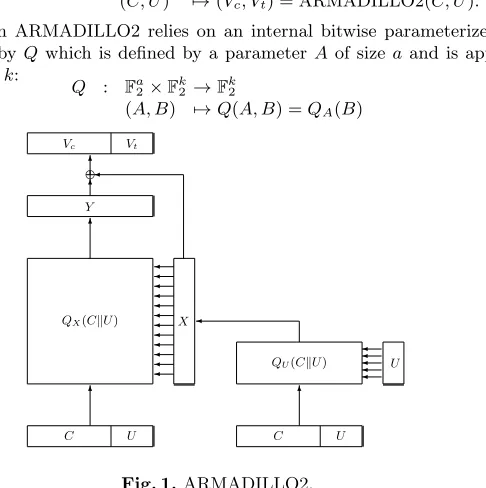
(C, U) into (Vc, Vt) as described in Figure 1: ARMADILLO2 : Fc2×F
m 2 →F
c 2×F
m 2
(C, U) 7→(Vc, Vt) = ARMADILLO2(C, U).
The function ARMADILLO2 relies on an internal bitwise parameterized permu-tation denoted byQwhich is defined by a parameter A of sizeaand is applied to a vectorBof sizek:
Q : Fa2×F
k 2 →F
k 2
(A, B) 7→Q(A, B) =QA(B)
C U
QX(CkU) X
QU(CkU)
C U
6
U
6 6
Y
6 e 6 Vc Vt
Fig. 1.ARMADILLO2.
Letσ0andσ1 be two fixed bitwise permutations of sizek. In [1], the permutations are not defined but some criteria they should fulfil are given. As the attacks presented in this paper are valid for any bitwise permutations, we do not describe these properties. We just stress that in the following, when computing the complexities we assume that these permutations behave like random ones. We denote by γ a constant of size k
defined by alternating 0’s and 1’s:γ= 1010· · ·10.
Using these notations, we can define Q which is used twice in the ARMADILLO2 function. LetAbe a parameter andBbe the internal state, the parameterized permu-tationQ(that we denote byQA when indicating the parameter is necessary) consists ina=|A|simple steps. Thei-th step ofQ(readingAfrom its least significant bit to its most significant one) is defined by:
– an elementary bitwise permutation:B←σAi(B), that is: • if thei-th bit ofAequals 0 we applyσ0 to the current state,
• otherwise (if thei-th bit ofAequals 1) we applyσ1 to the current state, – a constant addition (bitwisexor) ofγ:B←B⊕γ.
Using the definition of the permutationQ, we can describe the function ARMADILLO2. Let (C, U) be the input, then ARMADILLO2(C, U) is defined by:
– first computeX←QU(CkU) – then computeY ←QX(CkU)
– finally compute (VckVt)←Y ⊕X, the output is (Vc, Vt).
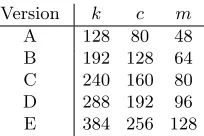
Version k c m
A 128 80 48 B 192 128 64 C 240 160 80 D 288 192 96 E 384 256 128
Table 1.Sets of parameters for the different versions of ARMADILLO2.
2.2 A Multi-Purpose Cryptographic Primitive
The general-purpose cryptographic function ARMADILLO2 can be used for three types of applications: FIL-MAC, hashing, and PRNG/PRF.
ARMADILLO2 in FIL-MAC mode. The secret key isC and the challenge, consid-ered known by the attacker, isU. The response isVt.
ARMADILLO2 in hashing mode. It uses a strengthened Merkle-Damg˚ard construc-tion, whereVc is the chaining value or the hash digest, andU is the message block.
ARMADILLO2 in PRNG/PRF mode. The output sequence is obtained by taking the firsttbits of (Vc, Vt) after at least riterations. For ARMADILLO2 the proposed values arer= 1 andt=k(see [1, Sec. 6]). When used as a stream cipher, the secret key isC. The keystream is composed ofk-bit frames indexed byU which is a public value.
3
Inverting the ARMADILLO2 Function
In [1] a sketch of a meet-in-the-middle (MITM) attack on ARMADILLO1, the first variant of the primitive, is given by the authors to provelower bounds for the com-plexity and justify the choice of parameters. However, they do not develop further their analysis.
In this section we describe how to invert the ARMADILLO2 function when a part of the output (Vc, Vt) is known andU is chosen in the input (CkU). Inverting means that we recoverC. The method we present can be performed for any arbitrary bitwise permutations σ0 and σ1. To conduct our analysis we suppose that they behave like random ones. Indeed, if the permutations σ0 and σ1 were not behaving like random ones, one could exploit their distributions to reduce the complexities of the attacks presented in this paper. Therefore, we are considering the worst case scenario for an attacker.
First, we describe the meet-in-the-middle technique we use. It provides two lists of partial states in the middle of the main permutation QX. To determine a list of possible values forC, we need to select a subset of the cartesian product of these two lists containing consistent couples of partial states. To build such a subset efficiently, we explain how to use an adaptation of theparallel matching algorithmpresented in [2, 5]. Then we present and apply the adapted algorithm and compute its time and memory complexities.
3.1 The Meet-in-the-Middle Technique
Whatever mode ARMADILLO2 is embedded in, we use the following facts:
– We can choose them-bit vectorU, in the input vector (CkU).
– We know part of the output vector (VckVt): them-bit vectorVtin the FIL-MAC, the (c+m)-bit vector (VckVt) in the PRNG/PRF and thec-bit vectorVc in the hash function.
We deal with two permutations: the pre-processingQU which is known as U is known and the main permutation QX which is unknown, and we exploit the three following equations:
– The permutationQU used in the pre-processing X = QU(CkU) is known. This implies that all the known bits in the input of the permutation can be traced to their corresponding positions inX. For instance, there are m coordinates of X
whose values are determined by choosingU.
– The output of the main permutationY = (VckVt)⊕X implies we know some bits ofY. The amount of known bits of Y is denoted by y and is depending on the mode we are focusing on through (VckVt).
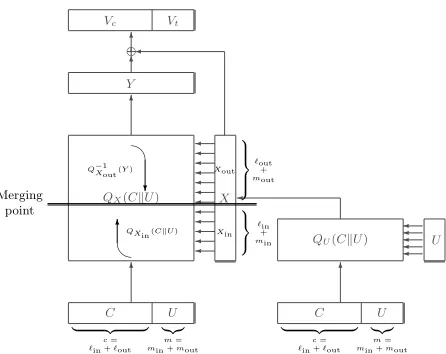
– In the sequel, we divide X in two parts: X = (XoutkXin). Then, the main per-mutationY =QX(CkU) can be divided in two parts:QXin andQXout separated
by a division line we call themiddle, hence we perform the meet-in-the-middle technique betweenQXin andQ
−1 Xout.
As (XoutkXin) =QU(CkU), we denote bymin (resp.mout) the number of bits of
U that are inXin(resp.Xout). We havemout+min=m. We denote by`in(resp.`out) the number of bits coming from C inXin (resp.Xout). We have`out+`in =c. The meet-in-the-middle attack is done by guessing the`inunknown bits ofXinand the`out unknown bits ofXout independently.
First, consider the forward direction. We can trace the`inunknown bits ofXinback to C withQ−U1. Next, for each possible guess of Xin, we can trace the corresponding
`in bits fromC plus thembits fromU to their positions in the middle by computing
QXin(CkU). Then consider the backward direction, we can trace theyknown bits ofY
back to the middle for each possible guess ofXout, that is computingQ−X1out(Y). This
way we can obtain two listsLinandLout, of size 2`inand 2`out respectively, of elements that represent partially known states in the middle ofQX.
To describe our meet-in-the-middle attack we represent the partial states in the middle ofQXas ternary vectors with coordinate values from{0,1,−}, where−denotes a coordinate (or cell) whose value is unknown. We say that a cell isactiveif it contains 0 or 1 and inactive otherwise. The weight of a vector V, denoted by wt(V), is the number of its active cells. Two partial states are a match if their colliding active cells have the same values.
The listLin contains elements QXin(CkU) whose weight is x=`in+m. The list
Lout contains elements Q−X1out(Y) whose weight is y. When taking one element from
each list, the probability of finding a match will then depend on the number of collisions of active cells between these two elements.
Consider a vectorAin{0,1,−}k
with weighta. We denote byP[k,a,b](i) the prob-ability over all the vectorsB∈ {0,1,−}k with weightbof havingiactive cells at the same positions inAandB. This event corresponds to the situation where there arei
C U
| {z } |{z}
c=
`in +`out
m=
min +mout QX(CkU) X
QU(CkU)
C U 6 U 6 6 Y 6 e 6
Vc Vt
| {z } |{z}
c=
`in +`out
m=
min +mout
Merging point
QXin(CkU)
Q−1
Xout(Y) ? 6 Xout Xin `out + mout `in + min
Fig. 2.Overview of the inversion of the ARMADILLO2 core function.
cells ofBlie in the (k−a) inactive positions inA. As the number of vectors of length
kand weightbis kb
, we have:
P[k,a,b](i) = a i
k−a b−i k b = b i
k−b a−i
k a
.
Taking into account the probability of having active cells at the same positions in a pair of elements from (Lin,Lout) and the probability that these active cells do have the same value, we can compute theexpected probability of finding a match for a pair of elements, that we will denote 2−Ncoll. We have:
2−Ncoll=
y X
i=0
2−iP[k,x,y](i).
This means that there will be a possible match with a probability of 2−Ncoll. In
total we will find 2`in+`out−Ncoll pairs of elements that pass this test. Each pair of
elements defines a wholeC value. Next, we just have to check which of these values is the correct one.
The big question now is that of the cost of checking which elements of the two lists
Lin and Lout pass the test. The ternary alphabet of the elements and the changing positions of the active cells make it impossible to apply the approach of traditional MITM attacks — having an ordered listLinand checking for each element in the list
Loutif a match exists with cost 1 per element. Even more, a priori, for each element in
Lin we would have to try if it matches each of the elements fromLoutindependently, which would yield the complexity of exhaustive search.
For solving this problem we adapt the algorithm described in [5, Sec. 2.3] asparallel
matchingto the case of ARMADILLO2. A generalized version of the algorithm is
ex-posed in Section 7 with detailed complexity calculations and the link to our application case.
3.2 ARMADILLO2 Matching Problem: Matching Non-Random Elements
Recently, new algorithms have been proposed in [5] to solve the problem ofmerging
of elements. These new algorithms take advantage of the special structures that can be exhibited by tto reduce the complexity of solving this problem. As stated in [5], the problem of merging several lists can be reduced to the problem of merging two lists. Hereafter, we recall the reducedProblem 1proposed in [5] that we are interested in.
Problem 1 ([5]). Let L1 and L2 be 2 lists of binary vectors of size2`1 and 2`2
re-spectively. We denote byxa vector ofL1 and byya vector ofL2.
We assume that vectors x and y can be decomposed intoz groups of s bits, i.e.
x,y∈({0,1}s
)z andx= (x1, . . . , xz)(resp.y= (y1, . . . , yz)). The vectors inL1 and
L2 are drawn uniformly and independently at random from{0,1}sz.
Lett be a Boolean function, t :{0,1}sz× {0,1}sz → {0,1} such that there exist
some functionstj:{0,1}s× {0,1}s→ {0,1}which verify:
t(x,y) = 1 ⇐⇒ ∀j, 1≤j≤z, tj(xj, yj) = 1.
Problem 1 consists in computing the set Lsol of all 2-tuples(x,y) of (L1×L2)
verifyingt(x,y) = 1. This operation is called mergingthe listsL1 andL2 with respect
tot.
One of the algorithms proposed in [5] to solve Problem 1 is the parallel matching
algorithm, which is the one that provides the best time complexity when the number of possible associated elements to one element is bigger than the size of the other list,
i.e., when we can associate bytmore than|L2|elements to an element fromL1as well as more than|L1|elements to an element fromL2.
In our case, the listsLinandLoutcorrespond to the listsL1andL2to merge but the application of this algorithm differs in two aspects. The first one is the alphabet, which is not binary anymore but ternary. The second aspect is the distribution of vectors in the lists. InProblem 1, the elements are drawn uniformly and independently at random while in our case the distribution is ruled by the MITM technique we use. For instance, all the elements ofLin have the same weightxand all the elements of Lout have the same weighty, which is far from the uniform case.
The functiontis theassociation rule we use to select suitable vectors fromLinand
Lout. We say that two elements are associated if their colliding active cells have the same values. We can now specify a newProblem 1adapted for ARMADILLO2:
ARMADILLO2 Problem 1. Let Lin and Lout be 2 lists of ternary vectors of size
2`in and 2`out respectively. We denote by xa vector of L
in and byy a vector of Lout,
withx,y∈ {0,1,−}k
The listsLin andLoutare obtained by the MITM technique described in Paragraph 3.1.
Lett:{0,1,−}k× {
0,1,−}k→ {
0,1}be the function defined byt=t1·t2· · ·tk−1·tk
and:
∀j, 1≤j≤k, tj:{0,1,−} × {0,1,−} → {0,1},
xj 0 0 0 1 1 1 − − −
yj 0 1 − 0 1 − 0 1 −
tj(xj, yj) 1 0 1 0 1 1 1 1 1
We say thatxandyare associated ift(x,y) = 1.
ARMADILLO2 Problem 1 consists in merging the lists Lin and Lout with respect
tot.
3.3 Applying the Parallel Matching Algorithm to ARMADILLO2
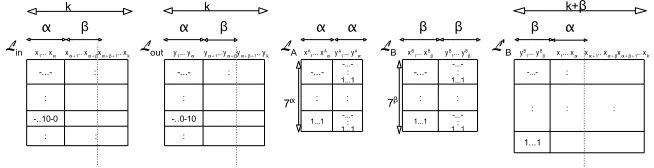
The principle of the parallel matching algorithm is to considerin parallel the possible matches for theαfirst cells and the nextβcells in the listsLinandLout. The underlying idea is to improve, when possible, the complexity to find all the elements that are a match for the (α+β) first cells. To have a match between a vector inLinand a vector inLout, the vectors should satisfy:
– the vector inLinhasuof itsxactive cells among the (α+β) first cells; – the vector inLouthasvof itsyactive cells among the (α+β) first cells;
– looking at the (α+β) first cells, both vectors should have the same value at the same active position.
Asxandyare the number of known bits from (CkU) and fromY resp. (see Fig. 2), the matching probability on the first (α+β) cells is:
2−Ncollα+β=
x X
u=0
P[k,α+β,x](u)· y X
v=0
P[k,α+β,y](v)· v X
w=0
2−wP[α+β,v,u](w).
This means that we will find 2c−Ncollα+β partial solutions. For each pair passing the
test we will have to check next if the remainingk−α−βcells are verified.
k k
: : : : :
1...1 1...1
: : : : : :
: : :
1...1 : 1...1 :
: : : 1...1 1...1
1...1
k+β
α β α β α α β β β α
Lin x Lout LA LB L'B
1... xα xα+1.. xα+βxα+β+1.. xk y1... yα yα+1.. yα+βyα+β+1.. yk xA1... xAαyA1... yAα xB1... xBβ yB1... yBβ yB1... yBβ x1... xαxα+1.. xα+βxα+β+1.. xk
-...- -...- -...- -...- -...- -...-
-...-7α 7β
-..10-0 -..0-10 -...-
-...-Fig. 3.Lists used in the parallel matching algorithm.
In a pre-processing phase, we first need to build three lists, namelyLA,LB,L0
B, which are represented in Fig. 3.
List LA contains all the elements of the form (xA1 . . . xAα, y1A. . . yαA) with (xA1 . . . xAα)∈
{0,1,−}α
and (yA1 . . . yAα) being associated to (xA1 . . . xAα). The size ofLA is:
|LA|=
α X
i=0
α i
! 2i3α−i2i
! = 7α.
List LB contains all the elements of the form (xB1 . . . xBβ, y B
1 . . . yBβ) with (x B
1. . .xBβ)∈
{0,1,−}β
and (y1B, . . . , yBβ) being associated to (x B
1, . . . , xBβ). The size ofLB is:
|LB|=
β X
i=0
β i
! 2i3β−i2i
! = 7β.
List L0B contains for each element (xB1, . . . , xBβ, yB1, . . . , yβB) inLB all the elementsx fromLin such that (xα+1. . . , xα+β) = (xB1, . . . , xBβ). Elements inL
0
B are of the form (yB
1, . . . , yBβ, x1, . . . , xk) indexed7 by (yB1 . . . , yBβ, x1, . . . , xα). The probability 7
for an element inLin to haveiactive cells in its nextβcells isP[k,β,x](i). The size ofL0
B is:
|L0B|=
β X i=0 β i !
2i3β−i2i2`inP[k,β,x](i)
2i β i
=
β X
i=0
3β−i2i2`inP
[k,β,x](i).
The cost of buildingL0
B is upper bounded by (|L
0
B|+ 3 β
), where 3β captures the cases where no element in Lin corresponds to elements in LB and is normally negligible.
Next, we do the parallel matching. The probability for an element in Lout to have
i active cells in its α first cells being P[k,α,y](i), for each element (xA1. . .xAα,y1A. . .yAα) inLA we consider the 2`out
P[k,α,y](i) 2i(α
i)
elements y from Lout such that (y1, . . . , yα) = (y1A, . . . , y
A
α). Then we check inL
0
Bif elements indexed by (yα+1. . .yα+β, xA1. . .x A α) exist. If this is the case, we check if each found pair of the form (x, y) verifies the remaining (k−α−β) cells. As we already noticed, we will find about 2c−Ncollα+β partial solutions
for which we will have to check whether or not they meet the remaining conditions. The time complexity of this algorithm is:
O 2c−Ncollα+β+ 7α+ 7β+
β X
i=0
3β−i2i2`inP
[k,β,x](i) + α X
i=0
3α−i2i2`outP
[k,α,y](i) !
.
The memory complexity is determined by 7α+ 7β+|L0B|. We can notice that if β
X
i=0
3β−i2i2`inP
[k,β,x](i)> α X
i=0
3α−i2i2`outP
[k,α,y](i),
we can exchange the roles ofLinandLout, so that the time complexity remains the same but the memory complexity will be reduced. The memory complexity is then:
O 7α+ 7β+ min ( β
X
i=0
3β−i2i2`inP
[k,β,x](i), α X
i=0
3α−i2i2`outP
[k,α,y](i) )!
.
4
Meet in the Middle Key Recovery attacks
4.1 Key Recovery Attack in the FIL-MAC Setting
In the FIL-MAC usage scenario, C is the secret key and U is the challenge. The response is them-bit size vectorVt. In order to minimize the complexity of our attack, we want the number of known bitsyfromY to be maximal. AsY = (VckVt)⊕X and
X=QU(CkU) it means that we are interested in having the maximum number of bits fromU among themless significant bits ofX.
As we havembits of freedom inU for choosing the permutationQU, we need the probability of havingiknown bits (fromU) among themfirst ones (ofX),P[k,m,m](i), to be bigger than 2−m. Then to maximize the number of known bits inY, we choose
yas follows:
y= max 0≤i≤m
i:P[k,m,m](i)>2
−m
. (1)
For instance for ARMADILLO2-A, we havey= 38 with a probability of 2−45.19>2−48. Then, from now on, we assume that we knowyamong thembits of the lower part ofX andybits at the same positions ofY.
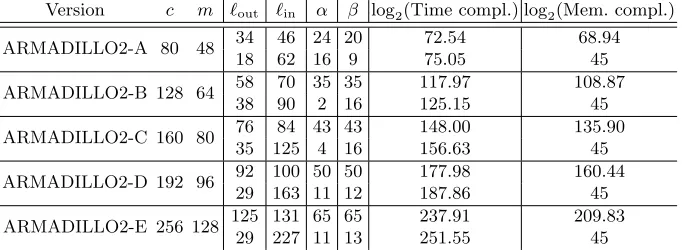
ARMADILLO2, with different trade-offs — the generic attack has a complexity of 2c. The results appear in Table 2.
For each version of ARMADILLO2 presented in Table 2, the first line corresponds to the (log2 of the) size of the listsLinandLoutwith the smallest time complexity. The second line corresponds to the best parameters when limiting the memory complexity to 245. In all cases, the complexity is determined by the parallel matching part of the attack. The data complexity of all the attacks is 1, that is, we only need one pair of plaintext/ciphertext to succeed.
Version c m `out `in α β log2(Time compl.) log2(Mem. compl.)
ARMADILLO2-A 80 48 34 46 24 20 72.54 68.94
18 62 16 9 75.05 45
ARMADILLO2-B 128 64 58 70 35 35 117.97 108.87
38 90 2 16 125.15 45
ARMADILLO2-C 160 80 76 84 43 43 148.00 135.90
35 125 4 16 156.63 45
ARMADILLO2-D 192 96 92 100 50 50 177.98 160.44 29 163 11 12 187.86 45
ARMADILLO2-E 256 128 125 131 65 65 237.91 209.83 29 227 11 13 251.55 45
Table 2.Complexities of the meet-in-the-middle key recovery attack on the FIL-MAC application
4.2 Key Recovery Attack in the Stream Cipher Setting
As presented in [1], ARMADILLO2 can be used as a PRNG by taking thetfirst bits of (Vc, Vt) after at leastr iterations. For ARMADILLO2, the authors state in [1, Sc. 6] thatr= 1 andt=kis a suitable parameter choice. If we want to use it as a stream cipher, the secret key isC. The keystream is composed ofk-bit frames indexed byU
which is a public value.
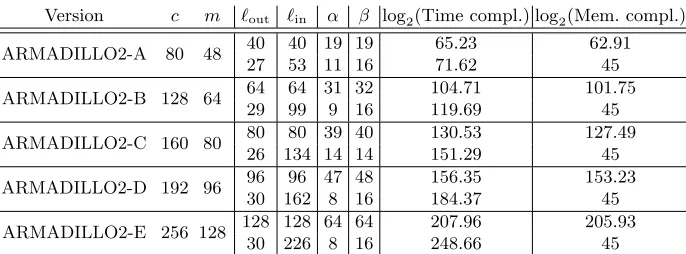
In this setting, we can perform an attack which is similar to the one on the FIL-MAC, but with different parameters. As we know more bits of the output of QX,
y=m+`out, complexities of the key recovery attack are lower.
In general, the best time complexity is obtained when`in =`out, as the number of known bits at each side is now x = m+`in in the input and y = m+`out in the output. In this context it also appears that the best time complexity occurs when
α=β. There might be a small difference between αandβwhen the leading term of the time complexity is 2c−Ncollα+β.
We present the best complexities we have computed for this attack in Table 3 — the generic attack has a complexity of 2c. Other time-memory trade-offs would be possible. As in the previous section, we give as an example the best parameters when limiting the memory complexity to 245.
5
(Second) Preimage Attack on the Hashing Applications
Version c m `out `in α β log2(Time compl.) log2(Mem. compl.)
ARMADILLO2-A 80 48 40 40 19 19 65.23 62.91
27 53 11 16 71.62 45
ARMADILLO2-B 128 64 64 64 31 32 104.71 101.75
29 99 9 16 119.69 45
ARMADILLO2-C 160 80 80 80 39 40 130.53 127.49 26 134 14 14 151.29 45
ARMADILLO2-D 192 96 96 96 47 48 156.35 153.23
30 162 8 16 184.37 45
ARMADILLO2-E 256 128 128 128 64 64 207.96 205.93
30 226 8 16 248.66 45
Table 3.Complexities of the meet-in-the-middle key recovery attack for the stream cipher with various trade-offs.
andVc the generated new chaining value and the hash digest. In [1] the authors state that (second) preimages are expected with a complexity of 2c, the one of the generic attack. We show, in this section, how to build (second) preimage attacks with a smaller complexity.
5.1 Meet-in-the-Middle (Second) Preimage Attack
The principle of the attack is represented in Fig. 5.1. We first consider that the ARMADILLO2 function is invertible with a complexity of 2q, given an output V
c and a message block. In the preimage attack, we choose and fix`, the number of blocks of the preimage. In the second preimage attack, we can consider the length of the given message. Then, given a hash valueh:
In the backward direction:
– We invert the insertion of the last blockMpad(padding). This step costs 2qin a preimage scenario and 1 in a second preimage one. We get
ARMADILLO2−1(h, Mpad) =S0.
– From state S0, we can invert the compression function for 2b different mes-sage blocksMb with a cost 2b+q, obtaining 2b different intermediate states: ARMADILLO2−1(S0
, Mb) =S00.
In the forward direction: From the initial chaining value, we insert 2amessages of length (`−2) blocks,M=M1kM2k. . .kM`−2, obtaining 2a intermediate states
S. This can be done with a complexity ofO((`−2)2a).
If we find a collision between one of the 2astatesSand one of the 2bstatesS00
, we have obtained a (second) preimage that isMkMbkMpad.
A collision occurs if a+b ≥ c. The complexity of this attack is 2a+ 2q+ 2b+q in time, where the middle term appears only in the case of a preimage attack and is negligible. The memory complexity is about 2b(plus the memory needed for inverting the compression function). So if 2q<2c, we can findaandbso that 2a+ 2b+q<2c.
5.2 Inverting the Compression Function
@ @
@ ARMADILLO2 @
@ @
ARMADILLO2 @
@ @
ARMADILLO2 @
@ @ ARMADILLO2 @
@ @ ARMADILLO2
IV0
M1 M2 M`−2 Mb Mpad
S S00 S0
c c
m m
c h
Collision with
probability2
a2b
2c
@ @I @I
1 second preimage 2q preimage
2b+q
2a
Fig. 4.Representation of the meet-in-the-middle (second) preimage attack.
can be seen as a key recovery similar to the one done in Section 4. In this case we know
U (the message block) andVc, and we want to findC. When inverting the function with the blocksMb, we choose message blocks (U) that define permutationsQUwhich put most of thembits fromU among thecmost significant bits ofX. This will result in better attacks, as the bits inY known fromU do not cost anything and this gives us more freedom when choosing the parameters`in and`out.
As before, we have 2m possibilities forQU. We denote bynthe number of bits of
U in thecmost significant bits ofX. The number of message blocks (U) verifying this condition is: Nblock(n) = 2m
P[k,c,m](n).
In fact we are interested in the values ofnwhich are the greatest possible (to lower the complexity) that still leaves enough message blocks to invert in order to obtainS00. It means that these values belong to a set{ni}such that:
X
{ni}
Nblock(ni)≥2b.
As the output isVc, the`outbits guessed fromX are also known bits from the output ofQX. The number of known bits of the output ofQX is then defined by:
y= min(c, `out+n)
Compared to the key recovery attack, the number of known bits at the end of the permutation QX is significantly bigger, as we may know up to c bits, while in the previous case the maximal number for y was y = maxi
i:P[k,m,m](i)>2
−m . To simplify the explanations, we concentrate on the case of ARMADILLO2-A, that can be directly adapted to any of the other versions. For n = 48 we have a probability
P[128,80,48] = 2−44.171. This leaves 248−44.171 = 23.829 message blocks to invert which allow us to know y= min(80, `out+ 48) bits from the output ofQX. As we need to invert 2bmessage blocks, ifbis bigger than 3.829, we have to consider next the message blocks withn= 47,that allow us to knowy= min(80, `out+ 47) bits, and so on. For eachnconsidered, the best time complexity (2qn) for inverting ARMADILLO2 might
be different, but in practice, with at most two consecutive values ofnwe have enough message blocks for building the attack, and the complexity of inverting the compression function for these two different types of messages is very similar.
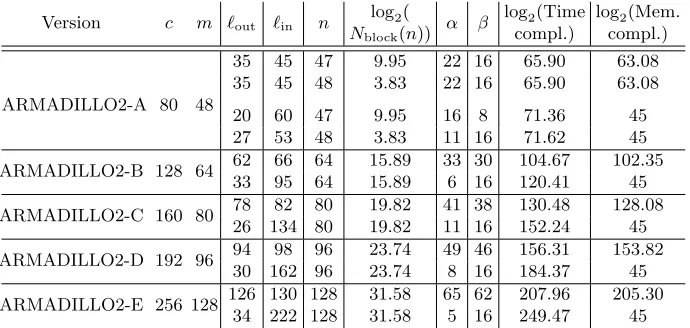
For instance, in ARMADILLO2-A, we considern= 48,47,associated each to 23.829 and 29.96possible message blocks respectively. The best time complexity for inverting the compression function in both cases is 2q48 = 2q47 = 265.9, as we can see from Table 4. If we want to find the best parameters foraandbin the preimage attack, we can consider thata+b=cand 2b= 2b48+2b47, and we want that 2a= 2b48265.9+2b47265.9= 265.9(2b48+ 2b47), as the complexity of the attack isO(2a+ 265.9(2b48+ 2b47)). So if we
Version c m `out `in n
log2(
Nblock(n))
α β log2(Time compl.)
log2(Mem. compl.)
ARMADILLO2-A 80 48
35 45 47 9.95 22 16 65.90 63.08 35 45 48 3.83 22 16 65.90 63.08
20 60 47 9.95 16 8 71.36 45 27 53 48 3.83 11 16 71.62 45
ARMADILLO2-B 128 64 62 66 64 15.89 33 30 104.67 102.35 33 95 64 15.89 6 16 120.41 45
ARMADILLO2-C 160 80 78 82 80 19.82 41 38 130.48 128.08 26 134 80 19.82 11 16 152.24 45
ARMADILLO2-D 192 96 94 98 96 23.74 49 46 156.31 153.82 30 162 96 23.74 8 16 184.37 45
ARMADILLO2-E 256 128 126 130 128 31.58 65 62 207.96 205.30 34 222 128 31.58 5 16 249.47 45
Table 4.Complexities for inverting the compression function.
In this particular case the time complexity forn= 48 and forn= 47 is the same, so finding the best band a can be simplified by b= c−2q and a =c−b. We obtain
b= 7.275,a = 72.95. We see that we do not have enough elements with n= 48 for inverting 2b blocks, but we have enough with n = 47 alone. As the complexities are the same in both cases, we can just considerb=b47. The best time complexity for the preimage attack that we can obtain is then 273.95, with a memory complexity of 263.08. Other trade-offs are possible by using other parameters for inverting the function, as shown in Table 5.
For the other versions of ARMADILLO2, the number of message blocks associated toy=mis big enough for performing the 2binversions, so we do not consider other
n’s for computing the (second) preimage complexity. Then, b=bm =
c−q{n=m}
2 and
a=c−bm.
Complexities for preimage attacks on the different versions of ARMADILLO2 are given in Table 5, where we can see two different complexities with different trade-offs for each version.
Best time Time-memory trade-off
Version c m log2(Time
compl.)
log2(Mem.
compl.)
log2(Time
compl.)
log2(Mem.
compl.)
ARMADILLO2-A 80 48 73.95 63.08 76.81 45
ARMADILLO2-B 128 64 117.34 102.35 125.21 45
ARMADILLO2-C 160 80 146.24 128.08 157.12 45
ARMADILLO2-D 192 96 175.16 153.82 191.19 45
ARMADILLO2-E 256 128 232.98 205.30 253.74 45
6
Experimental Verifications
To verify the above theoretical results, we implemented the proposed key recovery attacks in the FIL-MAC and stream cipher settings against a scaled version of AR-MADILLO2 that uses a 30-bit key and processes 18-bit messages, i.e. c = 30 and
m = 18. We performed the attack 10 times for both the FIL-MAC and the PRNG settings where at each time we chose random permutations for both σ0 and σ1 and random messagesU (in the FIL-MAC caseU was chosen so that we gotybits fromU
among themleast significant bits ofX).
As for each application the key is a 30-bit key, the generic attack requires a time complexity of 230. Using the parallel matching algorithm we decrease this complexity. Table 6 shows that the implementation results are very close to the theoretical esti-mates, confirming our analysis. We can also mention that we exchanged the role ofLin andLoutin our implementation of the attacks to minimize the memory needs.
c m `out `in α β y log2(|L
0
B|)
log2(c−
Ncollα+β)
log2(Time compl.)
log2(Mem. compl.)
FIL-MAC Impl. 30 18 12 18 8 6 14 23.477 27.537 27.874 24.066 Theory 30 18 12 18 8 6 14 23.475 27.538 27.874 24.064
PRNG Impl. 30 18 14 16 7 6 32 22.530 24.728 25.396 22.738 Theory 30 18 14 16 7 6 32 22.530 24.735 25.401 22.738
Table 6.Key recovery attacks against a scaled version of ARMADILLO2 in the FIL-MAC and PRNG modes.
7
Generalization of the Parallel Matching Algorithm
In Section 3, we managed to apply the parallel matching algorithm to invert the ARMADILLO2 function by modifying the mergingProblem 1of [5].
When the number of possible associated elements to one element is bigger than the other list as it is the case for ARMADILLO2, we cannot apply a basic algorithm like
theinstant matching algorithm proposed in [5]. Instead, we can use either thegradual
matching or the parallel matching algorithms also proposed in [5]. We are going to
concentrate on the parallel matching algorithm which allows a significant reduction of the time complexity of solvingProblem 1, while allowing several time-memory trade-offs.
We can state the generalized problem that also covers our attack on ARMADILLO2 and give the corresponding parallel matching algorithm. We believe that this more general problem will be useful for recognizing situations where the parallel matching can be applied, and solving them in an automatized way.
7.1 The Generalized Problem 1
As stated in [5],Problem 1 forN lists can be reduced to 2 lists, therefore we will only consider the problem of merging 2 lists in the sequel.
Generalized Problem 1. We are given 2 lists,L1 andL2of size2`1 and2`2
respec-tively. We denote by xa vector ofL1 and byy a vector ofL2. Coordinates of xand
y belong to a general alphabetA.
We assume that vectorsxandycan be decomposed intoz groups ofscoordinates,
i.e.x,y∈(As
We want to keep pairs of vectors verifying a given relation t: t(x,y) = 1. The
relation t is group-wise,and is defined byt : (As
)z×(As
)z → {0,1} such that there
exist some functions tj:As× As→ {0,1},verifying:
t(x,y) = 1 ⇐⇒ ∀j, 1≤j≤z, tj(xj, yj) = 1.
Generalized Problem 1consists inmergingthese2lists to obtain the setLsol of
all2-tuples of(L1×L2)verifying t(x,y) = 1. We say thatxand yare associated in
this case.
In order to analyze the time and memory complexities of the attack we need to compute the size ofLsol. This quantity depends on the probability that t(x,y) = 1. More precisely the complexities of the generalized parallel matching algorithm depends on the conditional probabilities: Pryj[tj(xj, yj) = 1|xj =a],a∈ As. We will denote these probabilities bypj,a,a∈ As
.
In [5] the elements of the listsL1andL2were binary (i.e.A={0,1}) and random, and the probability of each tjof being verified did not depend on the elements xj or
yj. Let us consider as an example the case wheres= 1 andtjtests the equality ofxj andyj. We have:
∀j, 1≤j≤z, pj,0=pj,1=
1 2.
In the case of the ARMADILLO2 cryptanalysis that we present in this paper, the alphabet is ternary (i.e. A={0,1,−}) and the association rule (see. ARMADILLO2
Problem 1) gives:
∀j, 1≤j≤z, pj,0=
2 3, pj,1=
2
3 andpj,−= 1
7.2 Generalized Parallel Matching Algorithm
First we need to build the three following lists:
List LA, of all the elements of the form (xA1, . . . , xAα, yA1, . . . , yAα) with (xA
1, . . . , xAα)∈(As) α
and (yA
1, . . . , yAα) being associated bytto (xA1, . . . , xAα). The size ofLA is:
|LA|=
X
a∈(As)α
α Y
j=1
|A|s
pj,aj, (2)
whereaj is thej-th coordinate ofa∈(As )α. List LB, of all the elements of the form (xB1, . . . , xBβ, y
B
1, . . . , yBβ) with (xB1, . . . , xBβ)∈(As)
β
and (yB1, . . . , yβB) being associated bytto (xB1, . . . , xBβ). The size ofLB is
|LB|=
X
b∈(As)β
β Y
j=1
|A|spj,bj,
wherebj is thej-th coordinate ofb∈(As)β .
List L0B, containing for each element (xB1, . . . , xβB, yB1, . . . , yβB) inLB all the elements
x from L1 such that (xα+1. . . , xα+β) = (xB1, . . . , xBβ). Elements in L
0
B are of the form (yB
1, . . . , yBβ, x1, . . . , xz) indexed8 by (yB1 . . . , yBβ, x1, . . . , xα). If we de-note by Pb,[α+1,α+β],L1 the probability of having an elementxfromL1such that
(xα+1, . . . , xα+β) =b, the size ofL0B is:
|L0B|=
X
b∈(As)β
β Y
j=1
|A|s
pj,bj
! 2`1P
b,[α+1,α+β],L1.
8
The cost of building this list is upper-bounded by (|L0B|+(|A|)β), where the second term captures the cases where no element inL1corresponds to elements inLB and should be negligible.
In the case where
X
a∈(As)α
α Y
j=1
|A|spj,aj
! 2`2P
a,[β+1,α+β],L2 <
X
b∈(As)β
β Y
j=1
|A|spj,bj
! 2`1P
b,[α+1,α+β],L1
we can swapL1andL2, to reduce the memory complexity of the attack. Next, we do the parallel matching. For each element (xA
1, . . . , xAα, y1A, . . . , yαA) in
LA we consider the 2`2P(yA
1,...,yAα),[1,α],L2 elements y from L2 such that (y1. . .yα) =
(y1A, . . . , yαA) and we check inL0B if elements indexed by (yα+1. . .yα+β, xA1. . .xAα) exist. If this is the case, we check if each found pair of the form (x, y) verifies the remaining (k−α−β) cells. We denote byΩ the number of partial solutions for which we will have to check whether or not they meet the remaining conditions:
Ω= 2`1+`2 X
b∈(As)α+β
α+β Y
j=1
pj,bj
!
Pb,[1,α+β],L1
The time complexity of this algorithm is:
O
Ω+|LA|+|LB|+|L0B|+ X
a∈(As)α
α Y
j=1
|A|spj,aj
! 2`2P
a,[β+1,α+β],L2
The memory complexity is determined by the size of the listsLA,LBandL0B. Therefore the memory complexity is:
X
a∈(As)α
α Y
j=1
|A|s
pj,aj+
X
b∈(As)β
β Y
j=1
|A|s
pj,bj+
X
b∈(As)β
β Y
j=1
|A|s
pj,bj
! 2`1P
b,[α+1,α+β],L1
7.3 Link with Formulas in the Case of ARMADILLO
Using the previous formulas for the time and memory complexities, we can rediscover formulas of the time and memory complexities we have computed for ARMADILLO2 (see. Section 3.3). As these formulas depend essentially on the size of the different lists, we simply expose how to find the size of the list|LA|using equation (2).
For ARMADILLO2, the probabilities pj,a are independent of the positionj and
pj,a= 2/3 if and only ifais an active cell. Moreover, in this case, each cell is composed of one letter of the alphabet which means thats= 1. And we have:
|LA|=
X
a∈(As)α
α Y
j=1
|A|spj,aj =
X
a∈{0,1,−}α
α Y j=1 3 2 3 wt(a) = α X i=0
#{a: wt(a) =i}3α 2 3 i = α X i=0 α i ! 2i 2 3 i 3α
The same method can be applied to find the size of the listLB andL0B. Here we have
8
Conclusion
In this paper, we have presented the first cryptanalysis of ARMADILLO2, the recom-mended variant of the ARMADILLO family. We propose a key recovery attack on all its versions for the FIL-MAC and the stream cipher mode, which works for any bitwise permutations σ0 and σ1. We give several time-memory trade-offs for its complexity. We also show how to build (second) preimage attacks when using the hashing mode.
Besides the results on ARMADILLO2, we have generalized the parallel matching algorithm presented in [5] for solving a wider Problem 1 which includes the cases where the lists to merge do not have random elements. We believe that new types of meet-in-the-middle attacks might appear now given this algorithm that is cheaper than exhaustive search.
References
1. Badel, S., Dagtekin, N., Nakahara, J., Ouafi, K., Reff´e, N., Sepehrdad, P., Susil, P., Vaudenay, S.: ARMADILLO: A Multi-purpose Cryptographic Primitive Dedicated to Hardware. In: Workshop on Cryptographic Hardware and Embedded Systems, CHES 2010. Lecture Notes in Computer Science, vol. 6225, pp. 398–412 (2010) 2. Khovratovich, D., Naya-Plasencia, M., R¨ock, A., Schl¨affer, M.: Cryptanalysis of
Luffa v2 components. In: Selected Areas in Cryptography 17th International Work-shop, SAC 2010. Lecture Notes in Computer Science, vol. 6544, pp. 388–409 (2010) 3. Moldovyan, A.A., Moldovyan, N.A.: A Cipher Based on Data-Dependent
Permuta-tions. Journal of Cryptology 15(1), 61–72 (2002)
4. Naya-Plasencia, M.: How to Improve Rebound Attacks. Tech. Rep. Re-port 2010/607, Cryptology ePrint Archive (2010), (extended version). http://eprint.iacr.org/2010/607.pdf