Succinct Non-Interactive Arguments via Linear Interactive Proofs
Nir Bitansky∗ Tel Aviv University
Alessandro Chiesa MIT
Yuval Ishai† Technion Rafail Ostrovsky‡
UCLA
Omer Paneth§ Boston University September 15, 2013
∗
This research was done while visiting Boston University and IBM T. J. Watson Research Center. Supported by the Check Point Institute for Information Security, an ISF grant 20006317, and the Fulbright program.
†
Supported by the European Research Council as part of the ERC project CaC (grant 259426), ISF grant 1361/10, and BSF grant 2008411. Research done in part while visiting UCLA and IBM T. J. Watson Research Center.
‡
Department of Computer Science and Department of Mathematics, UCLA. Email: [email protected]. Research supported in part by NSF grants CNS-0830803; CCF-0916574; IIS-1065276; CCF-1016540; CNS-1118126; CNS-1136174; US-Israel BSF grant 2008411, OKAWA Foundation Research Award, IBM Faculty Research Award, Xerox Faculty Research Award, B. John Garrick Foundation Award, Teradata Research Award, and Lockheed-Martin Corporation Research Award. This material is also based upon work supported by the Defense Advanced Research Projects Agency through the U.S. Office of Naval Research under Contract N00014-11-1-0392. The views expressed are those of the author and do not reflect the official policy or position of the Department of Defense or the U.S. Government.
§
Abstract
Succinct non-interactive arguments(SNARGs) enable verifying NP statements with lower complex-ity than required for classical NP verification. Traditionally, the focus has been on minimizing the length of such arguments; nowadays researchers have focused also on minimizing verification time, by drawing motivation from the problem of delegating computation.
A common relaxation is apreprocessingSNARG, which allows the verifier to conduct an expensive offline phase that is independent of the statement to be proven later. Recent constructions of preprocess-ing SNARGs have achieved attractive features: they are publicly-verifiable, proofs consist of onlyO(1)
encrypted (or encoded) field elements, and verification is via arithmetic circuits of size linear in the NP statement. Additionally, these constructions seem to have “escaped the hegemony” of probabilistically-checkable proofs (PCPs) as a basic building block of succinct arguments.
We present a general methodology for the construction of preprocessing SNARGs, as well as resulting concrete efficiency improvements. Our contribution is three-fold:
(1)We introduce and study a natural extension of the interactive proof model that considers algebraically-boundedprovers; this new setting is analogous to the common study of algebraically-bounded “adver-saries” in other fields, such as pseudorandomness and randomness extraction. More concretely, in this work we focus on linear (or affine) provers, and provide several constructions of (succinct two-message)
linear-interactive proofs(LIPs) for NP. Our constructions are based on general transformations applied to bothlinearPCPs (LPCPs) and traditional “unstructured” PCPs.
(2)We give conceptually simple cryptographic transformations from LIPs to preprocessing SNARGs, whose security can be based on different forms of linear targeted malleability(implied by previous knowledge assumptions). Our transformations convert arbitrary (two-message) LIPs into designated-verifier SNARGs, and LIPs with degree-bounded designated-verifiers into publicly-verifiable SNARGs. We also extend our methodology to obtainzero-knowledgeLIPs and SNARGs. Our techniques yield SNARGs
of knowledgeand thus can benefit from known recursive composition and bootstrapping techniques.
(3)Following this methodology, we exhibit several constructions achieving new efficiency features, such as “single-ciphertext preprocessing SNARGs” and improved succinctness-soundness tradeoffs. We also offer a new perspective on existing constructions of preprocessing SNARGs, revealing a direct connec-tion of these to LPCPs and LIPs.
Contents
1 Introduction 4
1.1 Background . . . 4
1.2 Motivation . . . 5
1.3 Our Results . . . 6
1.4 Structured PCPs In Other Works . . . 12
1.5 Organization . . . 14
2 Definitions of LIPs and LPCPs 14 2.1 Polynomials, Degrees, and Schwartz–Zippel . . . 14
2.2 Linear PCPs . . . 14
2.3 Linear Interactive Proofs . . . 16
3 Constructions of LIPs 17 3.1 LIPs From LPCPs . . . 17
3.2 LIPs From (Traditional) PCPs . . . 19
4 Definitions of SNARKs and Preprocessing SNARKs 21 4.1 Preprocessing SNARKs for Boolean Circuit Satisfaction Problems . . . 24
5 Linear-Only Encryption and Encodings 26 5.1 Linear-Only Encryption . . . 26
5.2 Linear-Only One-Way Encoding . . . 30
5.3 Instantiations . . . 33
6 Preprocessing SNARKs from LIPs 35 6.1 Designated-Verifier Preprocessing SNARKs from Arbitrary LIPs . . . 35
6.2 Publicly-Verifiable Preprocessing SNARKs from Algebraic LIPs . . . 37
6.3 Resulting Preprocessing SNARKs . . . 38
Acknowledgements 39 A Two LPCPs For Boolean Circuit Satisfaction Problems 40 A.1 An LPCP From The Hadamard Code . . . 40
A.2 An LPCP From Quadratic Span Programs . . . 42
B HVZK For LPCPs With Low-Degree Decision Algorithm 44
C Multi-Theorem Designated-Verifier SNARKs via Strong Knowledge 51
1
Introduction
Interactive proofs [GMR89] are central to modern cryptography and complexity theory. One extensively studied aspect of interactive proofs is their expressibility, culminating with the resultIP=PSPACE[Sha92]. Another aspect, which is the focus of this work, is that proofs forNPstatements can potentially be much shorterthan anNPwitness and beverified much fasterthan the time required for checking theNPwitness.
1.1 Background
Succinct interactive arguments.In interactive proofs forNPwith statistical soundness, significant savings in communication (let alone verification time) are unlikely [BHZ87, GH98, GVW02, Wee05]. If we settle for proof systems with computationalsoundness, known as argument systems [BCC88], then significant savings can be made. Using collision-resistant hashes (CRHs) and probabilistically-checkable proofs (PCPs) [BFLS91], Kilian [Kil92] showed a four-message interactive argument forNPwhere, to prove membership of an instancexin a givenNPlanguageLwithNPmachineML, communication and verification time are bounded bypoly(λ+|ML|+|x|+ logt), and the prover’s running time ispoly(λ+|ML|+|x|+t). Here,
tis the classical NPverification time of ML for the instancex, λis a security parameter, and polyis a universalpolynomial (independent ofλ,ML,x, andt). We call such argument systemssuccinct.
Proof of knowledge.A natural strengthening of computational soundness is (computational)proof of knowl-edge: it requires that, whenever the verifier is convinced by an efficient prover, not only can we conclude that a valid witness for the theoremexists, but also that such a witness can beextracted efficientlyfrom the prover. This property is satisfied by most proof system constructions, including the aforementioned one of Kilian [BG08], and is useful in many applications of succinct arguments.
Removing interaction. Kilian’s protocol requires four messages. A challenge, which is of both theoretical and practical interest, is the construction of non-interactivesuccinct arguments. As a first step in this di-rection, Micali [Mic00] showed how to construct publicly-verifiableone-messagesuccinct non-interactive arguments for NP, in the random oracle model, by applying the Fiat-Shamir heuristic [FS87] to Kilian’s protocol. In the plain model, one-message solutions are impossible for hard-enough languages (against non-uniform provers), so one usually considers the weaker goal of two-message succinct arguments where the verifier message is generatedindependentlyof the statement to be proven. Following [GW11], we call such argumentsSNARGs. More precisely, a SNARG for a languageLis a triple of algorithms (G, P, V) where: the generatorG, given the security parameter λ, samples areference stringσ and a corresponding verification stateτ (Gcan be thought to be run during an offline phase, by the verifier, or by someone the verifier trusts); the (honest) proverP(σ, x, w)produces a proofπfor the statement “x∈L” given a witness
w; then,V(τ, x, π)verifies the validity ofπ. Soundness should hold even ifxis chosen depending onσ. Gentry and Wichs [GW11] showed that no SNARG can be proven secure via a black-box reduction to a falsifiable assumption [Nao03]; this may justify using non-standard assumptions to construct SNARGs. (Note that [GW11] rule out SNARGs only for (hard-enough)NPlanguages. For the weaker goal of verifying deterministic polynomial-time computations in various models, there are beautiful constructions relying on standard assumptions, such as [GKR08, KR09, AIK10, CKV10, GGP10, BGV11, CRR11, CTY11, CMT12, FG12]. We focus on verifyingnondeterministicpolynomial-time computations.)
The preprocessing model.A notion that is weaker than a SNARK is that of apreprocessingSNARK: here, the verifier is allowed to conduct anexpensive offline phase. More precisely, the generatorGtakes as an additional input a time boundT, may run in timepoly(λ+T)(rather thanpoly(λ+ logT)), and generates
σandτ that can be used, respectively, to prove and verify correctness of computations of length at mostT. Bitansky et al. [BCCT13] showed that SNARKs can always be “algorithmically improved”; in particular, preprocessing SNARKs imply oneswithoutpreprocessing. (The result of [BCCT13] crucially relies on the fast verification time and the adaptive proof-of-knowledge property of the SNARK.) Thus, “preprocessing can always be removed” at the expense of only apoly(λ)-loss in verification efficiency.
1.2 Motivation
The typical approach to construct succinct arguments (or, more generally, other forms of proof systems with nontrivial efficiency properties) conforms with the following methodology: first, give an information-theoretic construction, using some form of probabilistic checking to verify computations, in a model that en-forces certain restrictions on provers (e.g., the PCP model [Kil92, Mic00, BG08, DCL08, BCCT12, DFH12, GLR11] or other models of probabilistic checking [IKO07, KR08, SBW11, SMBW12, SVP+12, BC12, SBV+12]); next, use cryptographic tools to compile the information-theoretic construction into an argu-ment system (where there are no restrictions on the prover other than it being an efficient algorithm).
Existing constructions of preprocessing SNARKs seem to diverge from this methodology, while at the same time offering several attractive features: such as public verification, proofs consisting of onlyO(1) encrypted (or encoded) field elements, and verification via arithmetic circuits that are linear in the statement. Groth [Gro10] and Lipmaa [Lip12] (who builds on Groth’s approach) introduced clever techniques for constructing preprocessing SNARKs by leveraging knowledge-of-exponent assumptions [Dam92, HT98, BP04a] in bilinear groups. At high level, Groth considered a simple reduction from circuit satisfaction problems to an algebraic satisfaction problem of quadratic equations, and then constructed a set of specific cryptographic tools to succinctly check satisfiability of this problem. Gennaro et al. [GGPR13] made a first step to better separate the “information-theoretic ingredient” from the “cryptographic ingredient” in preprocessing SNARKs. They formulated a new type of algebraic satisfaction problems, calledQuadratic Span Programs(QSPs), which are expressive enough to allow for much simpler, and more efficient, cryp-tographic checking, essentially under the same assumptions used by Groth. In particular, they invested significant effort in obtaining an efficient reduction from circuit satisfiability to QSPs.
Comparing the latter to the probabilistic-checking-based approach described above, we note that a re-duction to an algebraic satisfaction problem is a typical first step, because such satisfaction problems tend to be more amenable to probabilistic checking. As explained above, cryptographic tools are then usually invoked to enforce the relevant probabilistic-checking model (e.g., the PCP one). The aforementioned works [Gro10, Lip12, GGPR13], on the other hand, seem to somehow skip the probabilistic-checking step, and di-rectly construct specific cryptographic tools for checking satisfiability of the algebraic problem itself. While this discrepancy may not be a problem per se, we believe that understanding it and formulating a clear methodology for the construction of preprocessing SNARKs are problems of great interest. Furthermore, a clear methodology may lead not only to a deeper conceptual understanding, but also to concrete im-provements to different features of SNARKs (e.g., communication complexity, verifier complexity, prover complexity, and so on). Thus, we ask:
1.3 Our Results
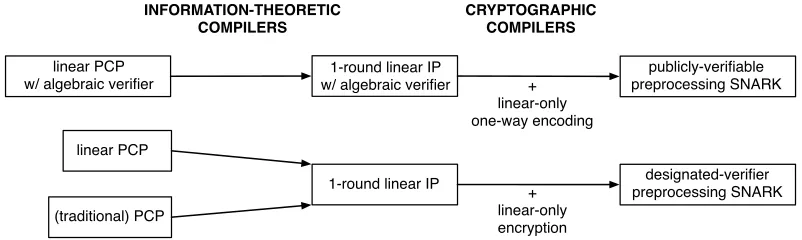
We present a general methodology for the construction of preprocessing SNARKs, as well as resulting concrete improvements. Our contribution is three-fold:
• We introduce a natural extension of the interactive proof model that considersalgebraically-bounded provers. Concretely, we focus onlinear interactive proofs(LIPs), where both honest and malicious provers are restricted to computing linear (or affine) functions of messages they receive over some finite field or ring. We then provide several (unconditional) constructions of succinct two-message LIPs forNP, obtained by applying simple and general transformations to two variants of PCPs.
• We give cryptographic transformations from (succinct two-message) LIPs to preprocessing SNARKs, based on different forms oflinear targeted malleability, which can be instantiated based on existing knowledge assumptions. Our transformation is very intuitive: to force a prover to “act linearly” on the verifier message, simply encrypt (or encode) each field or ring element in the verifier message with an encryption scheme that only allows linear homomorphism.
• Following this methodology, we obtain several constructions that exhibit new efficiency features. These include “single-ciphertext preprocessing SNARKs” and improved succinctness-soundness trade-offs. We also offer a new perspective on existing constructions of preprocessing SNARKs: namely, although existing constructions do not explicitly invoke PCPs, they can be reinterpreted as usinglinear PCPs, i.e., PCPs in which proof oracles (even malicious ones) are restricted to be a linear functions.1
We now discuss our results further, starting in Section 1.3.1 with the information-theoretic constructions of LIPs, followed in Section 1.3.2 by the cryptographic transformations to preprocessing SNARKs, and concluding in Section 1.3.3 with the new features we are able to obtain.
1-round linear IP 1-round linear IP w/ algebraic verifier
publicly-verifiable preprocessing SNARK
+ linear-only encryption
+ linear-only one-way encoding
CRYPTOGRAPHIC COMPILERS
linear PCP linear PCP w/ algebraic verifier
INFORMATION-THEORETIC COMPILERS
designated-verifier preprocessing SNARK (traditional) PCP
Figure 1: High-level summary of our transformations.
1.3.1 Linear interactive proofs.
The LIP model modifies the traditional interactive proofs model in a way analogous to the way the common study of algebraically-bounded “adversaries” modifies other settings, such as pseudorandomness [NN90, BV07] and randomness extraction [GR05, DGW09]. In the LIP model both honest and malicious provers are restricted to apply linear (or affine) functions over a finite field F to messages they receive from the
1
verifier. (The notion can be naturally generalized to apply over rings.) The choice of these linear functions can depend on auxiliary input to the prover (e.g., a witness), but not on the verifier’s messages.
With the goal of non-interactive succinct verification in mind, we restrict our attention to (input-oblivious) two-messageLIPs for boolean circuit satisfiability problems with the following template. To verify the re-lation RC = {(x, w) :C(x, w) = 1} whereC is a boolean circuit, the LIP verifierVLIP sends to the LIP
proverPLIPa messageqthat is a vector of field elements, depending onCbut not onx;VLIPmay also output
a verification stateu. The LIP proverPLIP(x, w)applies toqan affine transformationΠ = (Π0,b), resulting
inonly a constant number of field elements. The prover’s message a = Π0 ·q+bcan then be quickly
verified (e.g., withO(|x|)field operations) byVLIP, and the soundness error is at mostO(1/|F|). From here
on, we shall use the term LIP to refer to LIPs that adhere to the above template.
LIP complexity measures. Our constructions provide different tradeoffs among several complexity mea-sures of an LIP, which ultimately affect the features of the resulting preprocessing SNARKs. The two most basic complexity measures are the number of field elements sent by the verifier and the number of those sent by the prover. An additional measure that we consider in this work is thealgebraic complexityof the verifier (when viewed as anF-arithmetic circuit). Specifically, splitting the verifier into a query algorithmQLIPand
a decision algorithmDLIP, we say that it hasdegree(dQ, dD)ifQLIPcan be computed by a vector of
multi-variate polynomials of total degreedQeach in the verifier’s randomness, andDLIPby a vector of multivariate
polynomials of total degreedDeach in the LIP answersaand the verification stateu. Finally, of course, the running times of the query algorithm, decision algorithm, and prover algorithm are all complexity measures of interest. See Section 2.3 for a definition of LIPs and their complexity measures.
As mentioned above, our LIP constructions are obtained by applying general transformations to two types of PCPs. We now describe each of these transformations and the features they achieve. Some of the parameters of the resulting constructions are summarized in Table 1.
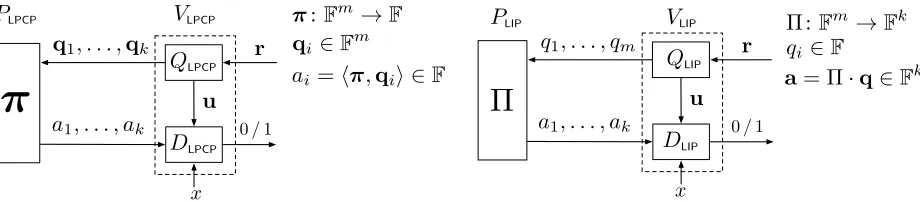
LIPs from linear PCPs. A linear PCP (LPCP) of length m is an oracle computing a linear function
π:Fm→ F; namely, the answer to each oracle queryq
i ∈Fmisai =hπ,qii. Note that, unlike in an LIP where different affine functions, given by a matrixΠand shiftb, are applied to a messageq, in an LPCP there is one linear functionπ, which is applied to different queries. (An LPCP with asinglequery can be viewed as a special case of an LIP.) This difference prevents a direct use of an LPCP as an LIP.
Our first transformation converts any (multi-query) LPCP into an LIP with closely related parame-ters. Concretely, we transform anyk-query LPCP of length m overFinto an LIP with verifier message inF(k+1)m, prover message inFk+1, and the same soundness error up to an additive term of1/|F|. The transformation preserves the key properties of the LPCP, including the algebraic complexity of the verifier. Our transformation is quite natural: the verifier sendsq = (q1, . . . ,qk+1)whereq1, . . . ,qk are the LPCP queries and qk+1 = α1q1 +. . .+αkqk is a random linear combination of these. The (honest) prover responds withai = hπ,qii, fori = 1, . . . , k+ 1. To prevent a malicious prover from using inconsistent choices forπ, the verifier checks thatak+1 =α1a1+. . .+αkak.
By relying on two different LPCP instantiations, we obtain two corresponding LIP constructions:
• A variant of the Hadamard-based PCP of Arora et al. [ALM+98a] (ALMSS), extended to work over an arbitrary finite fieldF, yields a very simple LPCP with three queries. After applying our transfor-mation, for a circuitCof sizesand input lengthn, the resulting LIP forRC has verifier message in FO(s2), prover message inF4, and soundness errorO(1/|F|). When viewed asF-arithmetic circuits, the proverPLIPand query algorithmQLIPare both of sizeO(s2), and the decision algorithm is of size
O(n). Furthermore, the degree of(QLIP, DLIP)is(2,2).
corresponding LPCP with three queries. For a circuitCof sizesand input lengthn, the resulting LIP forRC has verifier message inFO(s), prover message in F4, and soundness errorO(s/|F|). When viewed asF-arithmetic circuits, the prover PLIP is of size Oe(s), the query algorithmQLIP is of size
O(s), and the decision algorithm is of sizeO(n). The degree of(QLIP, DLIP)is(O(s),2).
A notable feature of the LIPs obtained above is the very low “online complexity” of verification: in both cases, the decision algorithm is an arithmetic circuit of sizeO(n). Moreover, all the efficiency features men-tioned above apply not only to satisfiability of boolean circuitsC, but also to satisfiability ofF-arithmetic circuits.
In both the above constructions, the circuit to be verified is first represented as an appropriate algebraic satisfaction problem, and then probabilistic checking machinery is invoked. In the first case, the problem is a system of quadratic equations overF, and, in the second case, it is a (strong) quadratic span program (QSP) overF. These algebraic problems are the very same problems underlying [Gro10, Lip12] and [GGPR13].
As explained earlier, [GGPR13] invested much effort to show an efficient reduction from circuit satis-fiability problems to QSPs. Our work doesnotsubsume nor simplify the reduction to QSPs of [GGPR13], but instead reveals a simple LPCP to check a QSP, and this LPCP can be plugged into our general trans-formations. Reducing circuit satisfiability to a system of quadratic equations overFis much simpler, but generating proofs for the resulting problem is quadratically more expensive. (Concretely, both [Gro10] and [Lip12] requireO(s2)computation already in the preprocessing phase). See Section 3.1 for more details. LIPs from traditional PCPs. Our second transformation relies on traditional “unstructured” PCPs. These PCPs are typically more difficult to construct than LPCPs; however, our second transformation has the advantage of requiring the prover to send only asinglefield element. Concretely, our transformation converts a traditional k-query PCP into a 1-query LPCP, over a sufficiently large field. Here the PCP oracle is represented via its truth table, which is assumed to be a binary string of polynomial size (unlike the LPCPs mentioned above, whose truth tables have size that is exponential in the circuit size). The transformation converts anyk-query PCP of proof lengthmand soundness errorεinto an LIP, with soundness errorO(ε) over a field of size2O(k)/ε, in which the verifier sendsm field elements and receives only a single field element in return. The high-level idea is to use a sparse linear combination of the PCP entries to pack thek
answer bits into a single field element. The choice of this linear combination uses additional random noise to ensure that the prover’s coefficients are restricted to binary values, and uses easy instances of subset-sum to enable an efficient decoding of thekanswer bits.
Taking time complexity to an extreme, we can apply this transformation to the PCPs of Ben-Sasson et al. [BSCGT13b] and get LIPs where the prover and verifier complexity are both optimal up topolylog(s) factors, but where the prover sends a single element in a field of size|F| = 2λ·polylog(s). Taking succinct-ness to an extreme, we can apply our transformation to PCPs with soundsuccinct-ness error2−λandO(λ)queries, obtaining an LIP with similar soundness error in which the prover sends a single element in a field of size |F|= 2λ·O(1). For instance, using the query-efficient PCPs of H˚astad and Khot [HK05], the field size is only |F|= 2λ·(3+o(1)).2 (Jumping ahead, this means that a field element can be encrypted using asingle,
normal-sizeciphertext of homomorphic encryption schemes such as Paillier or Elgamal even whenλ= 100.) On the down side, the degrees of the LIP verifiers obtained via this transformation are high; we give evidence that this is inherent when starting from “unstructured” PCPs. See Section 3.2 for more details.
Honest-verifier zero-knowledge LIPs.We also show how to make the above LIPs zero-knowledge against honest verifiers (HVZK). Looking ahead, using HVZK LIPs in our cryptographic transformations results in
2
preprocessing SNARKs that are zero-knowledge (against malicious verifiers in the CRS model).
For the Hadamard-based LIP, an HVZK variant can be obtained directly with essentially no additional cost. More generally, we show how to transformanyLPCP where the decision algorithm is of low degree to an HVZK LPCP with the same parameters up to constant factors (see Appendix B); this HVZK LPCP can then be plugged into our first transformation to obtain an HVZK LIP. Both of the LPCP constructions mentioned earlier satisfy the requisite degree constraints.
For the second transformation, which applies to traditional PCPs (whose verifiers, as discussed above, must have high degree and thus cannot benefit from our general HVZK transformation), we show that if the PCP is HVZK (see [DFK+92] for efficient constructions), then so is the resulting LIP; in particular, the HVZK LIP answer still consists of asinglefield element.
Proof of knowledge. In each of the above transformations, we ensure not only soundness for the LIP, but also a proof of knowledge property. Namely, it is possible to efficiently extract from a convincing affine functionΠa witness for the underlying statement. The proof of knowledge property is then preserved in the subsequent cryptographic compilations, ultimately allowing to establish the proof of knowledge property for the preprocessing SNARK. As discussed in Section 1.1, proof of knowledge is a very desirable property for preprocessing SNARKs; for instance, it enables to remove the preprocessing phase, as well as to improve the complexity of the prover and verifier, via the result of [BCCT13].
Thm. starting point of # field elements in # field elements in algebraic properties field size for2−λ number LIP construction verifier message prover message of verifier knowledge error
3.3 Hadamard PCP O(s2) 4 (d
Q, dD) = (2,2) 2λ·O(1) 3.4 QSPs of [GGPR13] O(s) 4 (dQ, dD) = (O(s),2) 2λ·O(s)
3.9 PCPs of [BSCGT13b] Oe(s) 1 none 2λ·polylog(s)
3.10 PCPs of [HK05] poly(s) 1 none 2λ·(3+o(1))
Table 1: Summary of our LIP constructions. See each theorem for more details, in-cluding the running times of the prover, query, and decision algorithms.
1.3.2 Preprocessing SNARKs from LIPs.
We explain how to use cryptographic tools to transform an LIP into a corresponding preprocessing SNARK. At high level, the challenge is to ensure that an arbitrary (yet computationally-bounded) prover behaves as if it was a linear (or affine) function. The idea, which also implicitly appears in previous constructions, is to use an encryption scheme with targeted malleability [BSW12] for the class of affine functions: namely, an encryption scheme that “only allows affine homomorphic operations” on an encrypted plaintext (and these operations are independent of the underlying plaintexts). Intuitively, the verifier would simply encrypt each field element in the LIP messageq, send the resulting ciphertexts to the prover, and have the prover homomorphically evaluate the LIP affine function on the ciphertexts; targeted malleability ensures that malicious provers can only invoke (malicious) affine strategies.
cryptographic assumptions seems to be justified.)
Designated-verifier preprocessing SNARKs from arbitrary LIPs. First, we show that anyLIP can be compiled into a corresponding designated-verifier preprocessing SNARK with similar parameters. (Re-call that “designated verifier” means that the verifier needs to maintain a secret verification state.) To do so, we rely on what we calllinear-only encryption: an additively homomorphic encryption that is (a) semantically-secure, and (b) linear-only. The linear-only property essentially says that, given a public key
pkand ciphertextsEncpk(a1), . . . ,Encpk(am), it is infeasible to compute a new ciphertextc0in the image of
Encpk, except by “knowing”β, α1, . . . , αmsuch thatc0 ∈Encpk(β+Pmi=1αiai). Formally, the property is captured by guaranteeing that, wheneverA(pk,Encpk(a1), . . . ,Encpk(am))produces valid ciphertexts(c01,
. . . , c0
k), an efficient extractorE(non-uniformly depending onA) can extract a corresponding affine func-tionΠ“explaining” the ciphertexts. As a candidate for such an encryption scheme, we propose variants of Paillier encryption [Pai99] (as also considered in [GGPR13]) and of Elgamal encryption [EG85] (in those cases where the plaintext is guaranteed to belong to a polynomial-size set, so that decryption can be done efficiently). These variants are “sparsified” versions of their standard counterparts; concretely, a ciphertext does not only includeEncpk(a), but alsoEncpk(α·a), for a secret field elementα. (This “sparsification” fol-lows a pattern found in many constructions conjectured to satisfy “knowledge-of-exponent” assumptions.) As for Paillier encryption, we have to consider LIPs over the ringZpq(instead of a finite fieldF); essentially,
the same results also hold in this setting (except that soundness isO(1/min{p,q})instead ofO(1/|F|)). We also consider a notion of targeted malleability, weaker than linear-only encryption, that is closer to the definition template of Boneh et al. [BSW12]. In such a notion, the extractor is replaced by a simula-tor. Relying on this weaker variant, we are only able to prove the security of our preprocessing SNARKs against non-adaptivechoices of statements (and still prove soundness, though not proof of knowledge, if the simulator is allowed to be inefficient). Nonetheless, for natural instantiations, even adaptive security seems likely to hold for our construction, but we do not know how to prove it. One advantage of working with this weaker variant is that it seems to allow for more efficient candidates constructions. Concretely, the linear-only property rules out any encryption scheme where ciphertexts can be sampled obliviously; instead, the weaker notion does not, and thus allows for shorter ciphertexts. For example, we can consider a standard (“non-sparsified”) version of Paillier encryption. We will get back to this point in Section 1.3.3.
For further details on the above transformations, see Section 6.1.
Publicly-verifiable preprocessing SNARKs from LIPs with low-degree verifiers.Next, we identify prop-erties of LIPs that are sufficient for a transformation topublicly-verifiable preprocessing SNARKs. Note that, if we aim for public verifiability, we cannot use semantically-secure encryption to encode the message of the LIP verifier, because we need to “publicly test” (without decryption) certain properties of the plaintext underlying the prover’s response. The idea, implicit in previous publicly-verifiable preprocessing SNARK constructions, is to use linear-only encodings (rather than encryption) that do allow such public tests, while still providing certain one-wayness properties. When using such encodings with an LIP, however, it must be the case that the public tests support evaluating the decision algorithm of the LIP and, moreover, the LIP remains secure despite some “leakage” on the queries. We show that LIPs withlow-degree verifiers(which we callalgebraicLIPs), combined with appropriate one-way encodings, suffice for this purpose.
More concretely, like [Gro10, Lip12, GGPR13], we consider candidate encodings in bilinear groups under similar knowledge-of-exponent and computational Diffie-Hellman assumptions; for such encoding instantiations, we must start with an LIP where the degree dD of the decision algorithm DLIP is at most
Both of the LIP constructions from LPCPs described in Section 1.3.1 satisfy these requirements. When combined with the above transformation, these LIP constructions imply new constructions of publicly-verifiable preprocessing SNARKs, one of which can be seen as a simplification of the construction of [Gro10] and the other as a reinterpretation (and slight simplification) of the construction of [GGPR13].
For more details, see Section 6.2.
Zero-knowledge. In all aforementioned transformations to preprocessing SNARKs, if we start with an HVZK LIP (such as those mentioned in Section 1.3.1) and additionally require a rerandomization property for the linear-only encryption/encoding (which is available in all of the candidate instantiations we consider), we obtain preprocessing SNARKs that are (perfect) zero-knowledge in the CRS model. In addition, for the case ofpublicly-verifiable(perfect) zero-knowledge preprocessing SNARKs, the CRS can be tested, so that (similarly to previous works [Gro10, Lip12, GGPR13]) we also obtain succinct ZAPs. See Section 6.3.
1.3.3 New efficiency features for SNARKs.
We obtain the following concrete improvements in communication complexity for preprocessing SNARKs.
“Single-ciphertext preprocessing SNARKs”. If we combine the LIPs that we obtained from traditional PCPs (where the prover returns only a single field element) with “non-sparsified” Paillier encryption, we obtain (non-adaptive) preprocessing SNARKs that consist ofa single Paillier cipherext. Moreover, when using the query-efficient PCP from [HK05] as the underlying PCP, even a standard-size Paillier ciphertext (with plaintext groupZpq wherep,qare 512-bit primes) suffices for achieving soundness error 2−λ with
λ= 100. (For the case of [HK05], due to the queries’ dependence on the input, the reference string of the SNARK also depends on the input.) Alternatively, using the sparsified version of Paillier encryption, we can also get security against adaptively-chosen statements with onlytwo Paillier ciphertexts.
Towards optimal succinctness. A fundamental question about succinct arguments is how low can we push communication complexity. More accurately: what is the optimal tradeoff between communication complexity and soundness? Ideally, we would want succinct arguments that are optimally succinct: to achieve2−Ω(λ)soundness against2O(λ)-bounded provers, the proof length isO(λ)bits long.
In existing constructions of succinct arguments, interactive or not, to provide2−Ω(λ)soundness against
2O(λ)-bounded provers, the prover has to communicate ω(λ) bits to the verifier. Concretely, PCP-based (and MIP-based) solutions requireΩ(λ3)bits of communication. This also holds for known preprocessing SNARKs, because previous work and the constructions discussed above are based on bilinear groups or Paillier encryption, both of which suffer from subexponential-time attacks.
If we had a candidate for (linear-only) homomorphic encryption that did not suffer from subexponential-time attacks, our approach could perhaps yield preprocessing SNARKs that are optimally succinct. The only known such candidate is Elgamal encryption (say, in appropriate elliptic curve groups) [PQ12]. However, the problem with using Elgamal decryption in our approach is that it requires, in general, to compute discrete logarithms.
One way to overcome this problem is to ensure that honest proofs are always decrypted to a known polynomial-size set. This can be done by taking the LIP to be over a field Fp of only polynomial size,
and ensuring that any honest proofπ has small`1-normkπk1, so that in particular, the prover’s answer is taken from a set of size at mostkπk1 ·p. For example, in the two LPCP-based constructions described in Section 1.3.1, this norm isO(s2)andO(s)respectively for a circuit of sizes. This approach, however, has two caveats: the soundness of the underlying LIP is only 1/poly(λ) and moreover, the verifier’s running time is proportional tos, and not independent of it, as we usually require.
is whether there exist LIPs where the decision algorithm has lineardegree. With such an LIP, we would be able to directly use Elgamal encryption because linear tests on the plaintexts can be carried out “in the exponent”, without having to take discrete logarithms.
Finally, a rather generic approach for obtaining “almost-optimal succintness” is to use (linear-only) El-gamal encryption in conjunction with any linear homomorphic encryption scheme (perhaps not having the linear-only property) that is sufficiently secure. Concretely, the verifier sends his LIP message encrypted under both encryption schemes, and then the prover homomorphically evaluates the affine function on both. The additional ciphertext can be efficiently decrypted, and can assist in the decryption of the Elgamal ci-phertext. For example, there are encryption schemes based on Ring-LWE [LPR10] that are conjectured to have quasiexponential security; by using these in the approach we just discussed, we can obtain 2−Ω(λ) soundness against2O(λ)-bounded provers with
e
O(λ)bits of communication.
Strong knowledge and reusability. Designated-verifier SNARKs typically suffer from a problem known as theverifier rejection problem: security is compromised if the prover can learn the verifier’s responses to multiple adaptively-chosen statements and proofs. For example, the PCP-based (or MIP-based) SNARKs of [BCCT12, GLR11, DFH12, BC12] suffer from the verifier rejection problem because a prover can adap-tively learn the encrypted PCP (or MIP) queries, by feeding different statements and proofs to the verifier and learning his responses, and since the secrecy of these queries is crucial, security is lost.
Of course, one way to avoid the verifier rejection problem is to generate a new reference string for each statement and proof. Indeed, this is an attractive solution for the aforementioned SNARKs because generat-ing a new reference strgenerat-ing is very cheap: it costspoly(λ). However, for a designated-verifierpreprocessing SNARK, generating a new reference string is not cheap at all, and being able toreusethe same reference string across an unbounded number of adaptively-chosen statements and proofs is a very desirable property. A property that is satisfied by all algebraic LIPs (including the LPCP-based LIPs discussed in Sec-tion 1.3.1), which we callstrong knowledge, is that such attacks are impossible. Specifically, for such LIPs, every prover either makes the verifier accept with probability1or with probability less thanO(poly(λ)/|F|). (In Appendix C, we also show that traditional “unstructured” PCPs cannot satisfy this property.) Given LIPs with strong knowledge, it seems that designated-verifier SNARKs that have a reusable reference string can be constructed. Formalizing the connection between strong knowledge and reusable reference string actually requires notions of linear-only encryption that are somewhat more delicate than those we have considered so far. See details in Appendix C for additional discussions.
1.4 Structured PCPs In Other Works
Ishai et al. [IKO07] proposed the idea of constructing argument systems with nontrivial efficiency properties by using “structured” PCPs and cryptographic primitives with homomorphic properties, rather than (as in previous approaches) “unstructured” polynomial-size PCPs and collision-resistant hashing. We have shown how to apply this basic approach in order to obtain succinct non-interactive arguments with preprocessing. We now compare our work to other works that have also followed the basic approach of [IKO07].
Strong vs. weak linear PCPs. Both in our work and in [IKO07], the notion of a “structured” PCP is taken to be alinear PCP. However, the notion of a linear PCP used in our work does not coincide with the one used in [IKO07]. Indeed there are two ways in which one can formalize the intuitive notion of a linear PCP. Specifically:
• Aweaklinear PCP is a PCP in which the honest proof oracle is guaranteed to be a linear function, and soundness is required to holdonlyfor linear proof oracles.
In particular, a weak linear PCP assumes an algebraically-bounded prover, while a strong linear PCP does not. While Ishai et al. [IKO07] considered strong linear PCPs, in our work we are interested in studying algebraically-bounded provers, and thus consider weak linear PCPs.
Arguments from strong linear PCPs. Ishai et al. [IKO07] constructed a four-message argument system for NP in which the prover-to-verifier communication is short (i.e., an argument with a laconic prover [GVW02]) by combining a strong linear PCP and (standard) linear homomorphic encryption; they also showed how to extend their approach to “balance” the communication between the prover and verifier and obtain aO(1/ε)-message argument system forNPwithO(nε)communication complexity. Let us briefly compare their work with ours.
First, in this paper we focus on the non-interactive setting, while Ishai et al. focused on the interactive setting. In particular, in light of the negative result of Gentry and Wichs [GW11], this means that the use of non-standard assumptions in our setting (such as linear targeted malleability) may be justified; in contrast, Ishai et al. only relied on the standard semantic security of linear homomorphic encryption (and did not rely on linear targeted malleability properties). Second, we focus on constructing (non-interactive) succinct arguments, while Ishai et al. focus on constructing arguments with a laconic prover. Third, by relying on weak linear PCPs (instead of strong linear PCPs) we do not need to perform (explicitly or implicitly) linearity testing, while Ishai et al. do. Intuitively, this is because we rely on the assumption of linear targeted malleability, which ensures that a prover is algebraically bounded (in fact, in our case, linear); not having to perform proximity testing is crucial for preserving the algebraic properties of a linear PCP (and thus, e.g., obtain public verifiability) and obtainingO(poly(λ)/|F|) soundness with only a constant number of encrypted/encoded group elements. (Recall that linearity testing only guarantees constant soundness with a constant number of queries.)
Turning to computational efficiency, while their basic protocol does not provide the verifier with any saving in computation, Ishai et al. noted that their protocol actually yields abatching argument: namely, an argument in which, in order to simultaneously verify the correct evaluation of`circuits of sizeS, the verifier may run in timeS (i.e., in timeS/` per circuit evaluation). In fact, a set of works [SBW11, SMBW12, SVP+12, SBV+12] has improved upon, optimized, and implemented the batching argument of Ishai et al. [IKO07] for the purpose of verifiable delegation of computation.
Finally, [SBV+12] have also observed that QSPs can be used to construct weak linear PCPs; while we compile weak linear PCPs into LIPs, [SBV+12] (as in previous work) compile weak linear PCPs into strong ones. Indeed, note that a weak linear PCP can always be compiled into a corresponding strong one, by letting the verifier additionally perform linearity testing and self-correction; this compilation does not affect proof length, increases query complexity by only a constant multiplicative factor, and guarantees constant soundness.
Remark 1.1. The notions of (strong or linear) PCP discussed above should not be confused with the (unre-lated) notion of alinear PCP of Proximity(linear PCPP) [BSHLM09, Mei12], which we now recall for the purpose of comparison.
Given a fieldF, anF-linear circuit[Val77] is anF-arithmetic circuitC:Fh → F` in which every gate computes anF-linear combination of its inputs; itskernel, denotedker(C), is the set of allw∈Fhfor which
Thus, a linear PCPP is a proximity tester for the kernels of linear circuits (which are not universal), while a (strong or weak) linear PCP is a PCP in which the proof oracle is a linear function.
1.5 Organization
In Section 2, we introduce the notions of LPCPs and LIPs. In Section 3, we present our transformations for constructing LIPs from several notions of PCPs. In Section 4, we give the basic definitions for preprocessing SNARKs. In Section 5, we define the relevant notions of linear targeted malleability, as well as candidate constructions for these. In Section 6, we present our transformations from LIPs to preprocessing SNARKs. In Appendix A, we discuss two constructions of algebraic LPCPs. In Appendix B, we present our general transformation to obtain HVZK for LPCPs with low-degree decision algorithms. In Appendix C, we discuss the notion of strong knowledge and its connection to designated-verifier SNARKs with a reusable reference string.
2
Definitions of LIPs and LPCPs
We begin with the information-theoretic part of the paper, by introducing the basic definitions of LPCPs, LIPs, and relevant conventions.
2.1 Polynomials, Degrees, and Schwartz–Zippel
Vectors are denoted in bold, while their coordinates are not; for example, we may write ato denote the ordered tuple (a1, . . . , an) for some n. A field is denoted F; we always work with fields that are finite. We say that a multivariate polynomial f: Fm → F has degree dif the total degree of f is at most d. Amultivalued multivariate polynomialf:Fm → Fµ is a vector of polynomials (f
1, . . . , fµ) where each
fi:Fm→Fis a (single-valued) multivariate polynomial. A very useful fact about polynomials is the following:
Lemma 2.1(Schwartz–Zippel). LetFbe any field. For any nonzero polynomialf:Fm →Fof total degree
dand any finite subsetSofF,
Pr
s←Sm
h
f(s) = 0i≤ d |S| .
In particular, any two distinct polynomials f, g:Fm → Fof total degree dcan agree on at most ad/|S| fraction of the points inSm.
2.2 Linear PCPs
A linear probabilistically-checkable proof (LPCP) system for a relation R over a field F is one where the PCP oracle is restricted to compute a linear functionπ:Fm → Fof the verifier’s queries. Viewed as a traditional PCP,πhas length|F|m(and alphabetF). For simplicity, we ignore the computational complexity issues in the following definition, and refer to them later when they are needed.
Definition 2.2(Linear PCP (LPCP)). LetRbe a binary relation,Fa finite field,PLPCPa deterministic prover
algorithm, andVLPCPa probabilistic oracle verifier algorithm. We say that the pair(PLPCP, VLPCP)is a
• Syntax. On any inputxand oracleπ, the verifierVπ
LPCP(x)makeskinput-oblivious queries toπand
then decides whether to accept or reject. More precisely,VLPCPconsists of a probabilistic query
algo-rithmQLPCP and a deterministic decision algorithmDLPCP working as follows. Based on its internal
randomness, and independently of x, QLPCP generates k queries q1, . . . ,qk ∈ Fm to π and state informationu; then, givenx, u, and thekoracle answersa1 = hπ,q1i, . . . , ak = hπ,qki,DLPCP
accepts or rejects.
• Completeness. For every(x, w) ∈ R, the output ofPLPCP(x, w)is a description of a linear function
π: Fm→Fsuch thatVπ
LPCP(x)accepts with probability1.
• Knowledge. There exists a knowledge extractorELPCPsuch that for every linear functionπ∗:Fm→F
if the probability thatVπ∗
LPCP(x)accepts is greater thanεthenE π∗
LPCP(x)outputswsuch that(x, w)∈ R. 3
Furthermore, we say that(PLPCP, VLPCP)hasdegree(dQ, dD)if, additionally,
1. the query algorithmQLPCPis computed by a degreedQ arithmetic circuit (i.e., there arekpolynomials
p1, . . . ,pk:Fµ → Fm and state polynomial p: Fµ → Fm0, all of degreed
Q, such that the LPCP queries areq1 =p1(r), . . . ,qk=pk(r)and the state isu=p(r)for a randomr∈Fµ), and
2. the decision algorithmDLPCPis computed by a degreedDarithmetic circuit (i.e., for every inputxthere is a test polynomial tx: Fm
0+k
→ Fη of degreed
D such that tx(u, a1, . . . , ak) = 0η if and only if
DLPCP(x,u, a1, . . . , ak)accepts);
Finally, for a security parameterλ, we say that(PLPCP, VLPCP)is analgebraic LPCP(forλ) if it has degree
(poly(λ),poly(λ)).
Remark 2.3(infinite relationsR). WhenRis an infinite relation∪`∈NR`, bothVLPCP= (QLPCP, DLPCP)and
PLPCPalso get as input1`. In this case, all parametersk, m, µ, m0, ηmay also be a function of`.
Some of the aforementioned properties only relate to the LPCP verifierVLPCP, so we will also say things
like “VLPCP has degree...”, i.e., using the verifier as the subject (rather than the LPCP).
Honest-verifier zero-knowledge LPCPs.We also considerhonest-verifier zero-knowledge(HVZK) LPCPs. In an HVZK LPCP, soundness or knowledge is defined as in a usual LPCP, and HVZK is defined as in a usual HVZK PCP. For convenience, let us recall the definition of a HVZK PCP:
Definition 2.4(honest-verifier zero-knowledge PCP (HVZK PCP)). A PCP system(PPCP, VPCP)for a
rela-tionR, wherePPCP is also probabilistic, isδ-statistical HVZKif there exists a simulatorSPCP, running in
expected polynomial time, for which the following two ensembles are δ-close (δ can be a function of the field, input length, and so on):
SPCP(x) (x,w)∈Rand
View Vπx,w
PCP (x)
|πx,w ←PPCP(x, w) (x,w)∈R ,
whereViewrepresents the view of the verifier, including its coins and the induced answers according toπ. If the above two distributions are identically distributed then we say that(PPCP, VPCP)isperfectHVZK.
3
In particular,(PLPCP, VLPCP)has soundness errorε: for everyxsuch that(x, w)6∈ Rfor allw, and for every linear function
π∗:Fm→F, the probability thatVπ∗
x q1, . . . ,qk
a1, . . . , ak
u
r qi 2Fm
ai=h⇡,qii 2F
⇡:Fm!F
⇡
VLPCP
QLPCP
PLPCP
DLPCP
0/1
x u
r
0/1
⇧
q1, . . . , qm
a1, . . . , ak
VLIP
PLIP
QLIP
DLIP
⇧ :Fm !Fk
qi2F
a= ⇧·q2Fk
Figure 2: Diagram of an LPCP and an input-oblivious two-message LIP.
2.3 Linear Interactive Proofs
A linear interactive proof (LIP) is defined similarly to a standard interactive proof [GMR89], except that each message sent by a prover (either an honest or a malicious one) must be a linear function of the previous messages sent by the verifier. In fact, it will be convenient for our purposes to consider a slightly weaker notion that allows a malicious prover to compute an affine function of the messages. While we will only make use of two-message LIPs in which the verifier’s message is independent of its input, below we define the more general notion.
Definition 2.5(Linear Interactive Proof (LIP)). Alinear interactive proofover a finite field Fis defined similarly to a standard interactive proof [GMR89], with the following differences.
• Each message exchanged between the proverPLIPand the verifierVLIPis a vectorqi ∈FmoverF.
• The honest prover’s strategy is linear in the sense that each of the prover’s messages is computed by applying some linear functionΠi:Fm → Fk to the verifier’s previous messages(q1, . . . ,qi). This function is determined only by the inputx, the witnessw, and the round numberi.
• Knowledge should only hold with respect to affine prover strategiesΠ∗= (Π,b), whereΠis a linear function, andbis some affine shift.
Analogously to the case of LPCPs (Definition 2.2), we say that a two-message LIP is input-oblivious if the verifier’s messages do not depend on the inputx. In such a case the verifier can be split into a query algorithmQLIP that outputs the queryqand possibly a verification stateu, and a decision algorithmDLIP
that takes as inputu,x, and the LIP answerΠ·q. We also consider notions of degree and algebraic LIPs, also defined analogously to the LPCP case.
Remark 2.6(LPCPs and LIPs over rings). The notions of LPCP and an LIP can be easily extended to be over aringrather than over a field. One case of particular interest is LIPs overZN, whereN is the product of two primespandq. (LIPs overZN are needed, e.g., when used in conjunction with Paillier encryption; see Section 5.3.) All of our results generalize, rather directly, to the case ofZN, where instead of achieving soundness-errorO(1/|F|), we achieve soundnessO(1/min{p,q}). For simplicity, when presenting most results, we shall restrict attention to fields.
Remark 2.8(LIP vs. LPCP). Note that a one-query LPCP is an LIP where the prover returns a single field element; however, when the prover returns more than one field element, an LIP is not a one-query LPCP. In this paper we construct both LIPs where the prover returns more than a single field element (see Section 3.1) and LIPs where the prover returns a single field element (see Section 3.2).
3
Constructions of LIPs
We present two transformations for constructing LIPs, in Section 3.1, Section 3.2 respectively.
3.1 LIPs From LPCPs
We show how to transform any LPCP into a two-message LIP with similar parameters. Crucially, our transformation does not significantly affect strong knowledge or algebraic properties of the LPCP verifier. Note that a non-trivial transformation is indeed required in general because the LIP verifier cannot simply send to the LIP prover the queriesq1, . . . ,qk generated by the LPCP verifier. Unlike in the LPCP model, there is no guarantee that the LIP prover will apply thesamelinear function to each of these queries; instead, we only know that the LIP prover will apply some affine functionΠto the concatenation ofq1, . . . ,qk. Thus, we show how to transform any LPCP(PLPCP, VLPCP)with knowledge errorεinto a two-message LIP(PLIP,
VLIP) with knowledge error at mostε+ |F1|. If the LPCP has kqueries of length mand is over a field F,
then the LIP verifierVLIPwill send(k+ 1)mfield elements and receive(k+ 1)field elements from the LIP
proverPLIP. The idea of the transformation is forVLIPto runVLPCP and then also perform a consistency test
(consisting of also sending toPLIPa random linear combination of thekqueries ofVLPCPand then verifying
the obvious condition on the received answers).
More precisely, we construct a two-message LIP(PLIP, VLIP)from an LPCP(PLPCP, VLPCP)as follows:
Construction 3.1. Let(PLPCP, VLPCP)be ak-query LPCP overFwith query lengthm. Define a two-message
LIP(PLIP, VLIP)as follows.
• The LIP verifierVLIPruns the LPCP verifierVLPCPto obtainkqueriesq1, . . . ,qk∈Fm, drawsα1, . . . , αk in Funiformly at random, and sends to the LIP prover PLIP the(k+ 1)m field elements obtained by
concatenating thekqueriesq1, . . . ,qktogether with the additional queryqk+1:=Pk
i=1αiqi.
• The LIP proverPLIPruns the LPCP proverPLPCPto obtain a linear functionπ:Fm→F, parses the(k+
1)mreceived field elements ask+1queries ofmfield elements each, appliesπto each of these queries to obtaink+ 1corresponding field elementsa1, . . . , ak+1, and sends these answers to the LIP verifierVLIP.
• The LIP verifierVLIPchecks thatak+1=Pki=1αiai(if this is not the case, it rejects) and decides whether to accept or reject by feeding the LPCP verifierVLPCP with the answersa1, . . . , ak.
Lemma 3.2(from LPCP to LIP). Suppose(PLPCP, VLPCP) is ak-query LPCP for a relationRoverFwith
query lengthmand knowledge errorε. Then,(PLIP, VLIP)from Construction 3.1 is a two-message LIP forR
overFwith verifier message inF(k+1)m, prover message inFk+1, and knowledge errorε+|F1|. Moreover, • if(PLPCP, VLPCP)has strong knowledge, then(PLIP, VLIP)also does, and
• if(PLPCP, VLPCP)has an algebraic verifier of degree(dQ, dD), then(PLIP, VLIP)has one with degree(dQ,max{2, dD}).
Proof. Syntactic properties and completeness are easy to verify. Furthermore, since the construction ofVLIP
Let Π : F(k+1)m → Fk+1 be an affine strategy of a potentially malicious LIP proverP∗
LIP. We
spec-ify Π by (k+ 1)2 linear functions π
i,j:Fm → F for i, j ∈ {1, . . . , k+ 1} and a constant vectorγ = (γ1, . . . , γk+1)∈Fk+1such that thei-th answer ofPLIP∗ is given byai :=
Pk+1
j=1
πi,j,qj
+γi. It suffices to show that, for any choice of queriesq1, . . . ,qk, exactly one of the following conditions holds:
• ai=hπk+1,k+1,qiifor alli∈[k], or
• with probability greater than1− 1
|F|overα1, . . . , αk,P ∗
LIPdoes not pass the consistency check.
Indeed, the above tells us that ifΠmakesVLIPaccept with probability greater thanε+|1F|, then πk+1,k+1 makes VPCP accept with probability greater than ε. Knowledge (and strong knowledge) thus follow as
claimed.
To show the above, fix a tuple of queries, and assume that, for some i∗ ∈ [k],a
i∗ 6= hπk+1,k+1,qi∗i. For the consistency check to pass, it should hold that:
k X i=1 αi k+1 X j=1
πi,j,qj
+γi
= k+1 X j=1
πk+1,j,qj
+γk+1 .
Equivalently, k+1 X j=1 k X i=1 αi
πi,j,qj
+ k
X
i=1
αiγi = k+1
X
j=1
πk+1,j,qj
+γk+1 .
Breaking the first summation using the equalityqk+1 =Pk
j=1αjqj, we get:
k X j=1 k X i=1 αi
πi,j,qj
+ k X i=1 αi *
πi,k+1,
k
X
j=1
αjqj
+ + k X i=1
αiγi= k
X
j=1
πk+1,j,qj
+
*
πk+1,k+1, k
X
j=1
αjqj
+
+γk+1 .
Rearranging, we see that the consistency check reduces to verifying the following equation:
k
X
i,j=1
αiαj
πi,k+1,qj
+ k X i=1 αi k X j=1
πi,j,qj
− hπk+1,k+1,qii+γi
−
k
X
i=1
hπk+1,i,qii+γk+1
!
= 0 .
BecausePk+1
j=1
πi∗,j,qj+γi∗ =ai∗ =6 hπk+1,k+1,qi∗i, the coefficient ofαi∗in the above polynomial is non-zero. Hence, by the Schwartz–Zippel Lemma (see Lemma 2.1), the identity holds with probability at most |F1|.
In light of the two LPCP constructions described in Appendix A, we deduce the following two theorems.
Theorem 3.3. LetFbe a finite field andC:{0,1}n× {0,1}h → {0,1}a boolean circuit of sizes. There is an input-oblivious two-message LIP forRC with knowledge errorO(1/|F|), verifier message inFO(s2), prover message inF4, and degree(2,2). Furthermore:
• the LIP proverPLIPis an arithmetic circuit of sizeO(s2);
• the LIP query algorithmQLIPis an arithmetic circuit of sizeO(s2);
Theorem 3.4. LetFbe a finite field andC:{0,1}n× {0,1}h → {0,1}a boolean circuit of sizes. There is an input-oblivious two-message LIP forRC with knowledge errorO(s/|F|), verifier message inFO(s), prover message inF4, and degree(O(s),2). Furthermore:
• the LIP proverPLIPis an arithmetic circuit of sizeOe(s);
• the LIP query algorithmQLIPis an arithmetic circuit of sizeO(s);
• the LIP decision algorithmDLIPis an arithmetic circuit of sizeO(n).
3.1.1 Zero-knowledge.
The LIPs we obtain by via above transformation can all be made honest-verifier zero-knowledge (HVZK) by starting with an HVZK LPCP. For this purpose, we show in Appendix B ageneraltransformation from anyLPCP withdD =O(1)to a corresponding HVZK LPCP, with only small overhead in parameters.
3.2 LIPs From (Traditional) PCPs
We present a second general construction of LIPs. Instead of LPCPs, this time we rely on a traditional
k-query PCP in which the proofπis a binary string of lengthm= poly(|x|). While any PCP can be viewed as an LPCP (by mapping each query locationq ∈ [m]to the unit vectoreqequal to1 at theq-th position and0everywhere else), applying the transformation from Section 3.1 yields an LIP in which the prover’s message consists ofk+ 1 field elements. Here we rely on thesparsenessof the queries of an LPCP that is obtained from a PCP in order to reduce the number of field elements returned by the prover to1. (In particular, the transformation presented in this section does not apply to either of the LPCPs we construct in Appendix A, because they do not have sparse queries.) The construction relies on the easiness of solving instances of subset sum in which each integer is bigger than the sum of the previous integers (see [MH78]).
Fact 3.5. There is a quasilinear-time algorithm for the following problem:
• input:Non-negative integersw1, . . . , wk, asuch that eachwiis bigger than the sum of the previouswj. • output: A binary vector(a1, . . . , ak)∈ {0,1}ksuch thata=
Pk
i=1aiwi(if one exists). (All integers are given in binary representation.)
The following construction uses a parameter`that will affect the soundness error. We assume that the fieldFis of a prime orderpwherep>2k`and identify its elements with the integers0, . . . ,p−1.
Construction 3.6. Let(PPCP, VPCP)be ak-query PCP with proof lengthm. Define an LIP(PLIP, VLIP)over Fas follows.
• The LIP verifierVLIP runs the PCP verifierVPCP to obtainkdistinct query locationsq1, . . . , qk ∈ [m], picks a sequence ofkrandom field elements
w1←[0, `−1], w2 ←[`,2`−1], w3 ←[3`,4`−1], . . . , wk ←[(2k−1−1)`,2k−1`−1] ,
and sends to the LIP proverPLIPthe vectorq= Pk
i=1wieqi, whereejis thej-th unit vector inF
m.
• The LIP proverPLIP responds by applying toqthe linear functionπ:Fm → Fwhose coefficients are
specified by the m bits of the PCP generated by the PCP proverPPCP. Letadenote the field element
returned byPLIP.
• The LIP verifierVLIP applies the subset sum algorithm of Fact 3.5 to find(a1, . . . , ak) ∈ {0,1}k such thata=Pk
i=1aiwi(if none exists it rejects) and decides whether to accept by feeding the PCP verifier
Lemma 3.7(from PCP to LIP). Suppose(PPCP, VPCP)is ak-query PCP for a relationRwith proof lengthm
and knowledge errorε, andFis a field of prime orderpwithp>2k`. Then(P
LIP, VLIP)from Construction 3.6
is a two-message LIP forRoverFwith verifier message inFm, prover message inF, and knowledge errorε+ 2`k.
Proof. Because the prover message is inF(i.e., the prover returns a single field element) the prover strategy is an affine functionΠ∗: Fm → F(i.e., as in an LPCP, see Remark (2.8)). Letπ∗: Fm → Fbe a linear function andγ∗∈Fbe a constant such thatΠ∗(q) =hπ∗,qi+γ∗for allq∈Fm.
We say that query positions q1, . . . , qk ∈ [m] are invalid with respect to Π∗ if γ∗ 6= 0 or there is
i∈ {1, . . . , k}such thatΠ∗(eqi)6∈ {0,1}. It suffices to show that, for any strategyΠ
∗as above, conditioned
on any choice of invalid query positionsq1, . . . , qk byVLIP, the probability ofVLIPaccepting is bounded by
2k/`. Indeed, for queries for whichΠ∗ is valid, it holds thatΠ∗(q
i) = hπ∗, qii ∈ {0,1}corresponding a traditional PCP oracleπ∗, so that the knowledge guarantees of(PPCP, VPCP)would kick in.
The above follows from the sparseness of the answersathat correspond to valid strategies and the high entropy of the answer resulting from any invalid strategy. Concretely, fix any candidate solution(a1, . . . ,
ak) ∈ {0,1}k and pick w1, . . . , wk as in Construction 3.6. Since each wi is picked uniformly from an interval of size`,
Pr w1,...,wk
Π ∗
· k
X
i=1
wieqi
!>
= k
X
i=1
aiwi
= Pr
w1,...,wk
" *
π∗,
k
X
i=1
wieqi
+
+γ∗ = k
X
i=1
aiwi
#
= Pr w1,...,wk
" k X
i=1
(πq∗i−ai)wi+γ∗= 0
#
≤1` .
Indeed, noting thatPk i=1(π
∗
qi−ai)wi+γ
∗is a degree-1polynomial in the variablesw
1, . . . , wk,
• if there isi ∈ {1, . . . , k} such that Π∗(eqi) 6∈ {0,1}then the coefficient of wi is non-zero (since
ai ∈ {0,1}) and thus, by the Schwartz–Zippel Lemma (see Lemma 2.1), the probability that the polynomial vanishes is at most1/`; and
• if instead for alli∈ {1, . . . , k}it holds thatΠ∗(e
qi)∈ {0,1}then it must be thatγ
∗ 6= 0; if there is
i∈ {1, . . . , k}such thatπ∗qi 6=aithen the same argument as in the previous bullet holds; otherwise,
γ∗ = 0with probability0since we know thatγ∗6= 0.
By a union bound, the probability that thereexistssolution(a1, . . . , ak)∈ {0,1}ksuch thatΠ(Pki=1wieqi) =
Pk
i=1aiwiis at most2k/`. Hence, the subset sum algorithm will fail to find a solution andVLIP will reject
except with at most2k/`probability.
By setting`:= 2k/ε, we obtain the following corollary:
Corollary 3.8. Suppose(PPCP, VPCP)is ak-query PCP for a relationRwith proof lengthmand knowledge
error ε, and F is a field of prime order p with p > 22k/ε. Then (P
LIP, VLIP) from Construction 3.6 is a
two-message LIP forRoverFwith verifier message inFm, prover message inF, and knowledge error2ε.
Focusing on asysmptotic time complexity, perhaps the most relevant PCPs for our purposes here are those of Ben-Sasson et al. [BSCGT13b]. They constructed PCPs where, to prove and verify that a random-access machineM accepts(x, w)withintsteps for somewwith|w| ≤ t, the prover runs in time(|M|+ |x|+t)·polylog(t)and the verifier runs in time(|M|+|x|)·polylog(t)(while askingpolylog(t)queries, for constant soundness). Invoking Corollary 3.8 with these PCPs, one can deduce the following theorem.
Theorem 3.9. LetFbe a finite field andC:{0,1}n× {0,1}h → {0,1}a boolean circuit of sizes. There is an input-oblivious two-message LIP forRC with knowledge error2−λ, verifier message inFO˜(s), prover message inF, and|F|>2λ·polylog(s). Furthermore:
• the LIP proverPLIPruns in timeO˜(s);
• the LIP query algorithmQLIPruns in timeO˜(s) +λ·n·polylog(s);
• the LIP decision algorithmDLIPruns in timeλ·n·polylog(s).
(All the above running times are up topolylog(|F|)factors.)
Focusing on communication complexity instead, we can invoke Corollary 3.8 with the query-efficient PCPs of H˚astad and Khot [HK05], which haveλ+o(λ)queries for soundness2−λ. (Because their PCPs have a query algorithm that depends on the input, we only obtain an LIP where the verifier’s message depends on the input; it is plausible that [HK05] can be modified to be input oblivious, but we did not check this.)
Theorem 3.10. LetFbe a finite field andC:{0,1}n× {0,1}h → {0,1}a boolean circuit of sizes. There is a two-message LIP forRCwith knowledge error2−λ, verifier message inFpoly(s), prover message inF, and|F|>2λ·(3+o(1)). Furthermore:
• the LIP proverPLIPruns in timepoly(s);
• the LIP query algorithmQLIPruns in timepoly(s) +λ·n·polylog(s);
• the LIP decision algorithmDLIPruns in timeλ·n·polylog(s).
(All the above running times are up topolylog(|F|)factors.)
The verifiers of the PCPs of Ben-Sasson et al. [BSCGT13b] (used to derive Theorem 3.9) and of H˚astad and Khot [HK05] (used to derive Theorem 3.10) do not have low degree, and thus the LIPs they induce via our transformation are not algebraic. In Appendix C, we give evidence that this is inherent, because we prove thatnoPCP (for a hard enough language) can have low-degree verifiers (or even satisfy a weaker, but still useful, property that we call “strong knowledge”).
3.2.1 Zero-knowledge.
In Section 3.1.1 we discussed a generic transformation from any LPCP withdD =O(1)to a corresponding HVZK LPCP. A (traditional) PCP does not typically induce an LPCP withdD =O(1). Thus, if we want to obtain an HVZK LIP through Construction 3.6, we need a different approach.
We observe that if we plug into Construction 3.6 a PCP that is HVZK (see Definition 2.4), then the corresponding LIP is also HVZK.
Lemma 3.11. In Lemma 3.7, if(PPCP, VPCP)is a HVZK PCP then(PLIP, VLIP)is a HVZK LIP.