Feistel Network Structure
⋆Ruilin Li1, Bing Sun1, Chao Li1,2, and Longjiang Qu1,3
1
Department of Mathematics and System Science, Science College, National University of Defense Technology, Changsha, 410073, China
[email protected], happy [email protected]
2State Key Laboratory of Information Security, Institute of Software,
Chinese Academy of Sciences, Beijing, 100190, China
lichao [email protected] 3
National Mobile Communications Research Laboratory, Southeast University, Nanjing, 210096, China
ljqu [email protected]
Abstract. This paper reevaluates the security of GF-NLFSR, a new kind of generalized unbalanced Feistel network structure that was pro-posed at ACISP 2009. We show that GF-NLFSR itself reveals a very slow diffusion rate, which could lead to several distinguishing attacks. For GF-NLFSR containingnsub-blocks, we find ann2-round integral
distin-guisher by algebraic methods and further use this integral to construct an (n2+n−2)-round impossible differential distinguisher. Compared
with the original (3n−1)-round integral and (2n−1)-round impossible differential, ours are significantly better.
Another contribution of this paper is to introduce a kind of non-surjective attack by analyzing a variant structure of GF-NLFSR, whose provable security against differential and linear cryptanalysis can also be provided. The advantage of the proposed non-surjective attack is that traditional non-surjective attack is only applicable to Feistel ciphers with non-surjective (non-uniform) round functions, while ours could be ap-plied to block ciphers with bijective ones. Moreover, its data complexity isO(l) withlthe block length.
Keywords:block ciphers, generalized unbalanced Feistel network, inte-gral attack, impossible differential attack, non-surjective attack
1
Introduction
Differential cryptanalysis (DC) [6] and linear cryptanalysis (LC) [23] are the two most powerful known attacks on block ciphers since 1990s. For a new block
⋆
cipher algorithm, designers must guarantee that it can resist these two attacks. However, even the security against DC and LC can be proved, the algorithm may suffer other attacks, such as truncated differential attack [13], higher-order differential attack [13, 18], impossible differential attack [4, 14], boomerang at-tack [27], amplified boomerang atat-tack [16], rectangle atat-tack [5], integral atat-tack [15], interpolation attack [12], non-surjective attack [24], algebraic attack [8], related-key attack [3], slide attack [1] and so on. Among these methods, inte-gral attack and impossible differential attack are of special importance. Take the well-known 128-bit version block cipher Rijndael as an example, six rounds is sufficient for resisting DC and LC. However, by integral attack or impossible differential attack, one can break six, seven, even eight rounds [9, 11, 20, 29].
Integral cryptanalysis [15], which is especially well-suited for analyzing ci-phers with primarily bijective components, was proposed by Knudsenet al.. In fact, it is a more generalization of Square attack [9], Saturation attack [19] and Multiset attack [2] proposed by Daemen et al., Lucks, and Biryukov et al., re-spectively. These methods exploit the simultaneous relationship between many encryptions, in contrast to differential cryptanalysis, where only pairs of en-cryptions are considered. Consequently, integral cryptanalysis applies to a lot of ciphers which are not vulnerable to DC and LC. These features have made integral an increasingly popular tool in recent cryptanalysis work.
The concept of using impossible differentials (differentials with probability 0) to retrieve the secret key of block ciphers was firstly introduced by Knud-sen [14] against the DEAL cipher and further by Biham et al. [4] to attack Skipjack. Unlike differential cryptanalysis which recovers the right key through the obvious advantage of a high probability differential (differential character-istic), impossible differential cryptanalysis is a sieving attack that excludes all the wrong candidate keys using impossible differentials. Since its emergence, im-possible differential cryptanalysis has been applied to attack many well-known block ciphers [20, 21, 28, 29].
Non-surjective attack [24] was introduced by Rijmenet al.and it is applica-ble to Feistel ciphers with non-surjective, or more generally, non-uniform round functions such as CAST and LOKI 91. If the round function of Feistel ciphers is non-surjective (non-uniform), then by analyzing the statistical bias of some expression derived from the round function, one can apply a key recovery attack. However, if the round function is a surjective (uniform) one, it is impossible to apply this kind of non-surjective attack.
Main Contribution. (1) We demonstrate that GF-NLFSR itself reveals a very slow diffusion rate, which could lead to several distinguishing attacks. We especially apply algebraic methods to find integral distinguishers inn-cell GF-NLFSR. In this method, plaintexts of special forms as well as their indeterminate states are treated as polynomial functions over finite fields, and in many cases, more precise information among these states could be obtained, which would lead to a better distinguisher.
Our cryptanalytic results show that, forn-cell GF-NLFSR, there exists ann2 -round integral distinguisher, which could be extended to an (n2+n−2)-round higher-order integral distinguisher. Furthermore, by studying the relationship between integral and truncated differential, an (n2+n−2)-round impossible differential distinguisher could be constructed. These distinguishers are signifi-cantly better than the original ones.
(2) We introduce a kind of non-surjective attack by analyzing a variant structure of GF-NLFSR, whose provable security against DC and LC can also be provided. The advantage of the proposed attack is that traditional non-surjective attack is only applicable to Feistel ciphers with non-surjective (non-uniform) round functions, while ours could be applied to block ciphers with bijective ones. Moreover, its data complexity isO(l) withl the block length.
Outline. We begin with a brief description of n-cell GF-NLFSR in Section 2. Encryption properties of n-cell GF-NLFSR by every n rounds are studied in Section 3. The existence of n2-round integral distinguisher and (n2+n− 2)-round impossible differential distinguisher are shown in Section 4 and Section 5, respectively. Section 6 presents a kind of non-surjective attack by analyzing a variant structure of GF-NLFSR. Section 7 contains results of the experiment with the proposed non-surjective attack on a toy cipher, and finally Section 8 is the conclusion.
2
Description of
n-cell GF-NLFSR
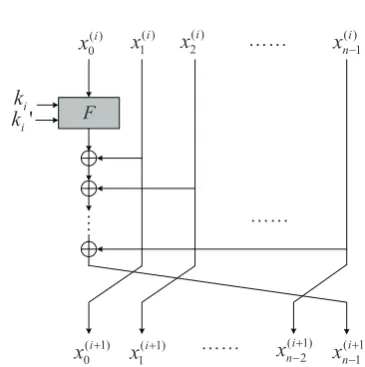
As shown in Fig. 1, assume the input, output and round key to thei-th round ofn-cell GF-NLFSR are (x(0i), x1(i), . . . , x(ni−)1)∈Fn
2b, (x
(i+1) 0 , x
(i+1) 1 , . . . , x
(i+1)
n−1 )∈
Fn
2b, andKi = (ki, ki′), then the round transformation can be described as follow:
(x(0i), x(1i), . . . , xn(i−)2, x(ni−)1)7→(x0(i+1), x(1i+1), . . . , x(ni−+1)2 , x(ni−+1)1 ),
where
{
x(li+1)=xl(+1i) , ifl= 0,1, . . . , n−2 x(ni−+1)1 =F(x(0i), Ki)⊕x
(i) 1 ⊕x
(i)
2 ⊕. . .⊕x (i)
n−1
andF(·, Ki),FKi(·) is a permutation onF2b.
F ) 0 (i
x
)1 (i
x
)2 (i
x
1 ( )i n
x
1 0 (i )
x
11 (i )
x
( 1)1
n i
x
!'
i
k
ik
n( 21)
i
x
!Fig. 1.Thei-th round transformation ofn-cell GF-NLFSR
Proposition 1. [7]Let the round function ofn-cell GF-NLFSRF :F2b×F2b×
Ω→F2b be of the formF(x, ki, ki′) =f(x⊕ki, ki′), where f :F2b×Ω→F2b is
bijective for all fixedk′i∈Ω. If the maximum differential (linear hull) probability
off satisfiesDP(LP)max(f)≤p(q), then the differential (linear hull) probability
of the (n+ 1)-round encryption is upper bounded by p2(q2).
3
Encryption Property of
n-cell GF-NLFSR
In this section, we study the encryption property ofn-cell GF-NLFSR by every nrounds. From now on, the round functionFKi(x) is treated as a permutation
polynomial overF2b.
Firstly, according to the definition ofn-cell GF-NLFSR, the following result could be obtained.
Proposition 2. Let (x0, x1, . . . , xn−1) be the input of the i-th round of n-cell
GF-NLFSR, and(y0, y1, . . . , yn−1)be the output of the(i+n−1)-th round, then {
y0=FKi(x0)⊕x1⊕x2⊕. . .⊕xn−1
ym=FKi+m−1(xm−1)⊕FKi+m(xm)⊕xm, if 1≤m≤n−1
and
n−1
⊕
j=0
yj =FKi+n−1(xn−1).
Proposition 3. Let the input of n-cell GF-NLFSR be(x, c1, . . . , cn−1), where
xis a variable and each ci is some constant with 1≤i≤n−1, let the output
of the r-th round be
(
y0(r)(x), y(1r)(x), . . . , yn(r−)1(x)
)
, and1≤m≤n−1, then
(1) y(im×n)(x)is a permutation polynomial over F2b if i=m,
(2) y(im×n)(x)is a constant if i > m.
Table 1 is the encryption results of every n rounds of n-cell GF-NLFSR when plaintexts are of the form (x, c1, . . . , cn−1) as described in Proposition 3. Note
that the first column denotes the round number, and each of the other columns represents the corresponding output sub-block. The letterC denotes some con-stant which could be different from each other.Pm(x) is some permutation
poly-nomial overF2b with 1≤m≤n−1, and those blank cells (elements under the
diagonal) indicate that their behaviors are unknown.
An immediate conclusion, from Proposition 3 and Table 1, is that the diffu-sion rate ofn-cell GF-NLFSR is very slow, since the input variable xneeds at least (n−1)×nrounds to influence the last (rightmost) sub-block of the output.
Table 1.Output of everynrounds ofn-cell GF-NLFSR
0 x C C . . . C . . . C C
n P1(x) C . . . C . . . C C
..
. . .. ... ... ...
(m−1)×n Pm−1(x) C . . . C C
m×n Pm(x). . . C C
..
. . .. ... ...
(n−2)×n Pn−2(x) C
(n−1)×n Pn−1(x)
4
Integral Distinguisher of GF-NLFSR
4.1 Preliminaries
To apply integral cryptanalysis, one should first find an integral distinguisher of the reduced-round cipher, then apply the key recovery attack. In this section, we show how to construct an n2-round integral distinguisher ofn-cell GF-NLFSR by using algebraic techniques.
Definition 1. A set {ai|ai ∈F2b,0≤i≤2b−1} is active, if for any0 ≤i <
j≤2b−1,a
i̸=aj. We use Ato denote the active set.
Definition 2. A set{ai|ai∈F2b,0≤i≤2b−1} ispassive orconstant, if for
any 0< i≤2b−1,a
i=a0. We useC to denote the passive set.
Definition 3. A set {ai|ai ∈F2b,0≤i≤2b−1} isbalanced, if the XOR-sum
of all element of the set is 0, that is ⊕2i=0b−1ai = 0. We use B to denote the
balanced set.
Moreover, three principles are widely used when applying empirical methods: (1) An active set remains active after passing a bijective transform. (2) The linear combination of several active/balanced sets is a balanced set. (3) The property of a balanced set after passing a nonlinear transformation is generally unknown. Obviously, the third one is the bottleneck of empirical methods, thus if one could determine the property of a balanced set after it passes a nonlinear trans-formation, integral distinguisher with more rounds can be constructed.
4.2 n2-Round Integral Distinguisher of n-cell GF-NLFSR
By using the empirical method, the designers presented the following (3n− 1)-round integral distinguisher:
(A, C, C, . . . , C)→(C,?,?, . . . ,?),
whereA is active inF2b,Cis constant inF2b, and ? is unknown.
Now we describe the newly constructed n2-round integral in the following theorem, the proof is based on algebraic methods. See Appendix B for a 16-round integral distinguisher of 4-cell GF-NLFSR as an example.
Theorem 1. There is an n2-round integral distinguisher of n-cell GF-NLFSR:
(A, C, . . . , C)→(S0, S1, . . . , Sn−1),
whereA is active, C is constant and(S0⊕S1⊕. . .⊕Sn−1)is active.
Proof. Let the input ofn-cell GF-NLFSR be (x, c1, . . . , cn−1) and the output of
the ((n−1)×n)-th round be
(
y0((n−1)×n)(x), y1((n−1)×n)(x), . . . , yn((−n−11)×n)(x)
)
,
theny((n−n1−1)×n)(x) is a permutation polynomial by Proposition 3. Assume the output of then2-round is
(
y(0n2)(x), y1(n2)(x), . . . , yn(n−21)(x)
)
,
according to Proposition 2,
y0(n2)(x)⊕y(1n2)(x)⊕. . .⊕yn(n−21)(x) =FKn2
(
yn((−n−11)×n)(x)
)
.
Since yn((−n1−1)×n)(x) is a permutation polynomial, so is FKn2
(
yn((−n1−1)×n)(x)
)
,
From the idea of higher-order integral [15], the above n2-round integral can be extended to an (n2+n−2)-round higher-order one.
Theorem 2. There is an(n2+n−2)-round higher-order integral distinguisher of n-cell GF-NLFSR:
(A0, A1, . . . , An−2, C)→(S0, S1, . . . , Sn−1),
where(A0, A1, . . . , An−2)is active in Fn2b−1,C is constant and (S0⊕S1⊕. . .⊕
Sn−1)is balanced.
Proof. First, according to bijective property of the encryption structure ofn-cell
NLFSR, if the input is (x0, x1, . . . , xn−2, c), where (x0, x1,· · · , xn−1) is active in
Fn−1
2b ,c∈F2b is constant, aftern−2 rounds encryption, the intermediate state
must be (y0, c, y2, . . . , yn−1), where (y0, y2, . . . , yn−1) is active inFn2b−1.
Next, let’s focus on the set containing these 2(n−1)bintermediate states after n−2 rounds encryption. Fix (y2, y3, . . . , yn−1)∈Fn2b−2, we thus get a structure
with 2b elements, which is the input of the n2-round integral distinguisher as shown in Theorem 1(From now on, we call this structure aΛset).
Now, these 2(n−1)b intermediate states can be divided into 2(n−2)b
indistin-guishable Λ sets. When each Λ set passes through the n2 rounds encryption, the XOR sum of the nsub-blocks of outputs is active (thus balanced) in F2b.
Consequently, the XOR sum of the n sub-blocks of outputs for these 2(n−2)b indistinguishableΛ sets is balanced. LetEj(i)(·) denote thej-th sub-block after i rounds encryption of the input, then we can explain the higher-order integral distinguisher as follows:
⊕
x0,x1,...,xn−2
n−1
⊕
j=0
E(jn2+n−2)(x0, x1, . . . , xn−2, c)
= ⊕
y0,y2,...,yn−1
n−1
⊕
j=0
Ej(n2)(y0, c, y2, . . . , yn−1)
= ⊕
y2,...,yn−1
⊕
y0
n−1
⊕
j=0
E(jn2)(y0, c, y2, . . . , yn−1)
= ⊕
y2,...,yn−1 0
= 0 ⊓⊔
5
Impossible Differential of GF-NLFSR
Theorem 3. The n2-round integral distinguisher of Theorem 1 corresponds to
the followingn2-round truncated differential with probability1:
(δ,0, . . . ,0)→(δ0, δ1, . . . , δn−1),
whereδ̸= 0andδ0⊕δ1⊕. . .⊕δn−1̸= 0.
Proof. Let the input of the n-cell GF-NLFSR be (x, c1, c2, . . . , cn−1), after n2
rounds, the output is (q0(x), q1(x), . . . , qn−1(x)), then according to Proposition 2,q0(x)⊕q1(x)⊕. . .⊕qn−1(x),q(x)∈F2b[x] is a permutation polynomial.
Assume two inputs are (x1, c1, c2, . . . , cn−1) and (x2, c1, c2, . . . , cn−1) with
x1 ̸=x2, thusq(x1)≠ q(x2). Now the input difference is (δ,0, . . . ,0) with δ= x1⊕x2̸= 0, and the output difference is (δ0, δ1, . . . , δn−1), satisfyingδ0⊕δ1⊕
. . .⊕δn−1=q(x1)⊕q(x2)̸= 0. ⊓⊔
Theorem 4. There exists an(n2+n−2)-round impossible differential in n-cell GF-NLFSR of the following form:
(δ,0, . . . ,0)9(ψ, ψ,0, . . . ,0),
whereδ̸= 0andψ̸= 0.
Proof. From encrypt direction, then2-round truncated differential (δ,0, . . . ,0)→
(δ0, δ1, . . . , δn−1) is with probability 1, whereδ̸= 0 andδ0⊕δ1⊕. . .⊕δn−1̸= 0. From decrypt direction, the (n−2)-round truncated differential (ψ, ψ,0, . . . ,0)→ (0, . . . ,0, ψ, ψ) is with probability 1. Sinceψ⊕ψ= 0, we find a contradiction. ⊓⊔
Remark. Wuet al.[30] independently found the same (n2+n−2)-round
impossi-ble differential through a more direct approach. By using the 18-round impossiimpossi-ble differential whenn= 4, they presented a key recovery attack on the full round block cipher Four-Cell. Due to these new distinguishers and the full round at-tack, the designers have modified Four-Cell to Four-Cell+ for better protection against the integral and impossible differential attacks.
6
A Kind of Non-surjective Attack
Our goal for introducing this kind of attack is that traditional non-surjective attack is only applicable to Feistel ciphers with non-surjective (non-uniform) round functions, while ours could be applied to block ciphers with bijective ones. Moreover, its data complexity isO(l) withl the block length.
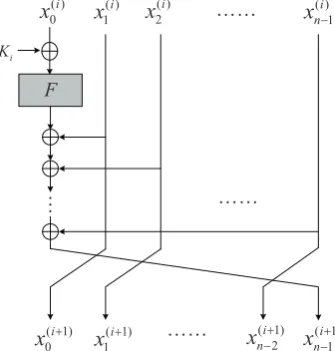
To this end, we describe a variant structure of n-cell GF-NLFSR, denoted as n-cell VGF-NLFSR. As shown in Fig. 2, the main difference between these two structures is the round function. Inn-cell VGF-NLFSR, the round function is F(x⊕Ki) with F bijective. One can easily demonstrate that the provable
security against DC and LC for n-cell VGF-NLFSR can be provided using the same technique in [7]. Furthermore, Proposition 2 and 3 also suit forn-cell VGF-NLFSR, thus there exist the same n2-round integral and (n2+n−2)-round impossible differential as in n-cell GF-NLFSR.
F ) 0 (i
x
)1 (i
x
)2 (i
x
1 ( )i n
x
1 0 (i )
x
11 (i )
x
( 1)1
n i
x
!"
"
"
x
(ni!21) iK
Fig. 2.Thei-th round transformation ofn-cell VGF-NLFSR
6.1 Description of the Non-surjective Distinguisher
Let the input ofn-cell VGF-NLFSR be (x, c1, . . . , cn−1), according to Proposition
2 and Proposition 3,yn((−n−12)×n)is a constant, sayC, and
n⊕−1
j=0
yj(n2−n)=F(C⊕Kn2−n),C′.
Thus
y0(n2−n)=C′⊕
n−1
⊕
j=1
yj(n2−n).
Assume the output of then2-th round is (q0(x), q1(x), . . . , qn−1(x)), from
Propo-sition 2, we have
q0(x) =F
(
y(0n2−n)⊕Kn2−n+1
)
⊕
n−1
⊕
j=1
y(jn2−n).
Lett=y0(n2−n)⊕Kn2−n+1, then
q0(x) =F(t)⊕t⊕Kn2+n−1⊕C′ =F(t)⊕t⊕C∗,
whereC∗=Kn2+n−1⊕C′ represents some unknown constant.
Letf(t) =F(t)⊕t, and defineDf ={y|y=f(t), t∈F2b}. From the above
Theorem 5. Let the input to n-cell VGF-NLFSRbe (x, c1, . . . , cn−1), whereci
is constant, and the output of then2-th round be(q
0(x), q1(x), . . . , qn−1(x)), then
there exists some constantC∗∈F2b, such that for anyx∈F2b,q0(x)⊕C∗∈ Df.
Consider the distinguisher in Theorem 5, in this situation, the input to the (n2+ 1)-th round functionF is q′(x) = q0(x)⊕K
n2+1, letc∗ =C∗⊕Kn2+1, thenq′(x)⊕c∗=q0(x)⊕C∗. In other words, for allx∈F2b, there exists some
constantc∗, such thatq′(x)⊕c∗∈ Df. Thus we could get the following theorem:
Theorem 6. Let the input of n-cell VGF-NLFSRbe(x, c1, . . . , cn−1), whereci
is constant, and the input of the(n2+ 1)-th round functionF beq′(x), then there
exists some constant c∗∈F2b, such that for anyx∈F2b,q′(x)⊕c∗∈ Df.
One should note that ifDf =F2b, then bothF(x) andF(x)⊕xare permutations
on F2b, which indicates thatF(x) is an orthormorphic permutation [22]. Since
the number of all orthormorphic permutations is small, in general, for a randomly chosen permutation F(x), f(x) = F(x)⊕xcan be seen as a random function (as the Davies-Meyer construction in hash function), thusDf ( F2b. From now
on, we will call the above distinguisher anon-surjective distinguisher, since the range of the functionf is only a subset ofF2b.
6.2 Description of the Non-surjective Attack
By using the non-surjective distinguisher, one can attack (n2+n′)-roundn-cell VGF-NLFSR by Algorithm 1, wheren′ >1.
Algorithm 1: Non-surjective attack on n-cell VGF-NLFSR
Step 1 Compute and store Df.
Step 2 Givent plaintexts (xi, c1, . . . , cn−1), obtain the corresponding (n2+n′)-round ciphertexts,i= 1, . . . , t.
Step 3 Guess the last (n′−1) round-keysrk= (rk1, rk2, . . . , rkn′−1), decrypt the ciphertext to get the input of the (n2+ 1)-round functionF, denoted by qrk′ (xi).
Step 4 For allxi in Step 2, test whether there exists some constantc∗
satisfyingqrk′ (xi)⊕c∗∈ Df. If not, the guessed round-keysrk must
be wrong.
Step 5 If necessary, repeat Step 2∼Step 5 to further filter the wrong round keys until only one left.
In order to estimate the complexity of the above attack, we need the following two lemmas and their proofs can be found in Appendix A.
Lemma 1. Given A⊆F2b,|A| denotes the number of different elements inA.
For a randomly chosen setX ⊆F2b(|X| ≤ |A|), letpbe the probability that there
exists some constant c∈F2b, such thatX⊕c={x⊕c|x∈X} ⊆A, then
p≤2b×|A| 2b ×
|A| −1
2b−1 ×. . .×
Lemma 2. Letf(x)be a random function fromFq toFq,Df ={f(x)|x∈Fq},
let ϵ = E(|Df|) and σ2 = V(|Df|) be the expectation and variance of |Df|,
respectively, then
(i) lim
q→∞
ϵ
q= 1− 1
e≈0.632,
(ii) lim
q→∞
σ2 q =
e−2
e2 ≈0.097.
From Lemma 1, for a randomly chosenX⊆F2b, if|X| ≪ |A|, the upper bound
ofpcan be well approximated by 2b×(|A|/2b)|X|.
From Lemma 2, whenqis large, theChebyshev Inequality [27] indicates
Pr(||Df| −ϵ| ≤lσ )≥1−
1 l2.
If we choose q= 2b andl= 10, then for a randomly chosenf,
Pr (
0.63×2b−3×2b/2≤ |Df| ≤0.63×2b+ 3×2b/2 )
≥0.99.
Thus we can estimate with high probability that |Df| is less than 0.63×2b+
3×2b/2. Moreover, whenb is large,|D
f|can be approximated by 0.63×2b.
Now, the data, time and space complexity of the proposed non-surjective attack can be analyzed as follows:
Data Complexity. Firstly, we note that when applying integral attack ton-cell VGF-NLFSR, one must choose at least a structure of all possible (x, c1, . . . , cn−1),
where c′is are constants. While for the non-surjective attack, only a fraction of them are needed.
Assume the number of chosen plaintexts as (x, c1, . . . , cn−1) ist, letT denote
the set of their corresponding ciphertexts,Trk denote the set of the input to the
(n2+ 1)-roundF function from decrypting the ciphertexts inT by guessing the lastn′−1 round keysrk.
The crucial step in Algorithm 1 is to check whether there exists a constant c∗∈F2b such thatTrk⊕c∗⊆ Df. Assume wrong key values can pass such test
with probabilityPerr, then from Lemma 1,
Perr≤(2(n ′−1)b
−1)×2b×
(
|Df|
t
)
/
(
2b t
) ,Pt,
thus in order to identify the right keys for the lastn′−1 rounds,Perr must be
small enough. Ifbis large, andt≪ |Df|,
Pt≈2n ′b
×(|Df|/2b )t
≈2n′b×0.63t.
LetPt= 2−λ, where the parameterλis related to the success probability, and
can be deduced by experiments, thenPerr≤Pt= 2−λ, which indicates that the
From 2n′b×0.63t= 2−λ, we gett≈ 3 2n′b+
3
2λ. Thus the data complexity of the above non-surjective attack isO(b).
To sum up, for attacking (n2+n′)-roundn-cell VGF-NLFSR, the data com-plexity is about 32n′b+32λ.
Time Complexity. As explained before, Step 4 of Algorithm 1 needs to verify whether there exists a constantc∗∈F2b, s.t.Trk⊕c∗⊆ Df for each possiblerk.
Assume for each possiblec∗, the time complexity for testing whetherTrk⊕c∗⊆
Df is equivalent to uencryptions, then the time complexity is about (
3 2n
′b+3 2λ
)
×(2(n′−1)b)×0.63×2b×u≈(n′b+λ)×2n′b×u,
thus a good algorithm for testing whether one set is included in another is required.
Space Complexity. Since one must storeDfto apply the non-surjective attack,
the space complexity is about 0.63×2b.
7
Experiments with the Proposed Non-surjective Attack
This section describes a 32-bit toy cipher based on 4-cell VGF-NLFSR, where the round function is defined byF(x, k) =S(x⊕k) withSas the S-box of AES. It is well known that the differential (linear hull) probability of the S-box of AES is upper bounded by 2−6, thus the differential (linear hull) probability for five rounds is upper bounded by (2−6)2= 2−12. Now we can see that the differential (linear) characteristic probability for 15 rounds is at most (2−12)3= 236≤2−32, that is to say such toy cipher with more than 15 rounds is practically secure against DC and LC.
As an example, we use the method in Section 6 to mount a non-surjective attack on the 18-round toy cipher. In this case,b= 8 and|Df|= 163≈0.63×28.
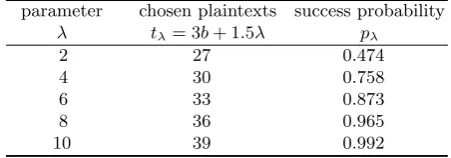
Table 2 lists our experimental results. For eachλ= 2,4,6,8,10,tλ denotes the
number of chosen plaintexts and pλ denotes the success probability, where the
“success” means the adversary can uniquely recover the right 18-th round key. For each chosen parameter λ, we do the non-surjective attack 1000 times, and in each time the plaintext as well as the encryption key are randomly generated. The success probabilities are 0.474,0.758,0.873,0.965,0.992.
One could also apply the integral attack to the 18-round toy cipher, however, to get a high success probability, its data complexity is about 2×28= 29.
Table 2.Experiments with the non-surjective attack on the 18-round toy cipher
parameter chosen plaintexts success probability
λ tλ= 3b+ 1.5λ pλ
2 27 0.474
4 30 0.758
6 33 0.873
8 36 0.965
8
Conclusion
This paper presents several security analysis on GF-NLFSR. Although such structure allows parallel computations for encryption and can even provide its provable security against DC and LC, the structure itself reveals a very slow diffusion rate, which could lead to several distinguishing attacks.
Forn-cell GF-NLFSR, our cryptanalytic results show that there exists ann2 -round integral distinguisher, which could be extended to an (n2+n−2)-round higher-order one. Based on thisn2-round integral distinguisher, an (n2+n− 2)-round impossible differential is constructed. These results are significantly better than the original ones and thus imply that the security ofn-cell GF-NLFSR must be carefully reevaluated.
Besides, a kind of non-surjective attack is proposed, which is different in essence with the one introduced by Rijmenet al., since traditional non-surjective attack is only applicable to Feistel ciphers with non-surjective (non-uniform) round functions while ours can be applied to block ciphers with round functions being bijective. To demonstrate this, we describe a variant structure ofn-cell GF-NLFSR, whose round function is defined by F(x⊕K). The provable security against DC and LC can also be provided for this variant structure, however, by using the proposed non-surjective attack, an efficient key recovery attack with very low data complexity could be mounted. Some experimental results are given for this non-surjective attack on a toy cipher based on the S-box of AES.
It is interesting that whether this kind of non-surjective attack can be applied to other block ciphers.
Acknowledgments
The authors wish to thank the anonymous reviewers of ACISP 2010 for their valuable suggestions and comments.
References
1. A. Biryukov and D. Wagner. Slide Attack. FSE 1999, LNCS 1636, pp. 245–259, Springer-Verlag, 1999.
2. A. Biryukov, and A. Shamir. Structural Cryptanalysis of SASAS. EUROCRYPT 2001, LNCS 2045, pp. 394–405, Springer–Verlag, 2001.
3. E. Biham. New Types of Cryptanalytic Attacks Using Related Keys. EURO-CRYPT 1993, LNCS 765, pp. 398–409, Springer-Verlag, 1994.
4. E. Biham, A. Biryukov, A. Shamir. Cryptanalysis of Skipjack Reduced to 31 Rounds Using Impossible Differentials. EUROCRYPT 1999, LNCS 1592, pp. 12– 23, Springer-Verlag, 1999.
5. E. Biham, O. Dunkelman, and N. Keller. The Rectangle Attack- Rectangling the Serpent. EUROCRYPT 2001, LNCS 2045, pp. 340–357, Springer-Verlag, 2001. 6. E. Biham and A. Shamir. Differential Cryptanalysis of DES-like Cryptosystems.
7. J. Choy, G. Chew, K. Khoo and H. Yap. Cryptographic Properties and Application of a Generalized Unbalanced Feistel Network Structure. ACISP 2009, LNCS 5594, pp. 73–89, Springer-Verlag, 2009.
8. N. Courtois and J. Pieprzyk. Cryptanalysis of Block Ciphers with Overdefined Systems of Equations. ASIACRYPT 2002, LNCS 2501, pp. 267–287, Springer-Verlag, 2002.
9. J. Daemen , L. Knudsen, V. Rijmen. The Block Cipher Square. FSE 1997, LNCS 1267, pp. 149–165, Springer-Verlag, 1997.
10. W. Feller. An Introduction to Probability Theory and Its Applications, 3rd Edition. Wiley, New York, 1968.
11. N. Ferguson, J. Kelsey, S. Lucks, B. Schneier, M. Stay, D. Wagner, and D. Whiting. Improved Cryptanalysis of Rijndael. FSE 2000, LNCS 1978, pp. 213–230, Springer-Verlag, 2001.
12. T. Jackobsen, L. Knudsen. The Interpolation Attack on Block Cipher. FSE 1997, LNCS 1008, pp. 28–40, Springer-Verlag, 1997.
13. L. Knudsen. Truncated and High Order Differentials. FSE 1995, LNCS 1008, pp. 196–211, Springer-Verlag 1995.
14. L. Knudsen. DEAL – A 128-bit Block Cipher. Technical Report 151, Department of Informatics, University of Bergen, Bergen, Norway, Feb. 1998.
15. L. Knudsen, D. Wagner. Integral Cryptanalysis. FSE 2002, LNCS 2365, pp. 112– 127, Springer-Verlag, 2002.
16. J. Kelsey, T. Kohno and B. Schneier. Amplified Boomerang Attacks against Reduced-round MARS and Serpent. FSE 2000, LNCS 1978, pp. 75–93, Springer-Verlag, 2001.
17. J. Kim, S. Hong, J. Sung, S. Lee, J. Lim, and S. Sung. Impossible Differential Cryptanalysis for Block Cipher Structures. Indocrypt 2003, LNCS 2904, pp. 82– 96, Springer-Verlag 2003.
18. X. Lai. High Order Derivatives and Differential Cryptanalysis. Communications and Cryptography, pp. 227–233, 1994.
19. S. Lucks. The Saturation Attack — A Bait for Twofish. FSE 2001, LNCS 2355, pp. 1–15, Springer–Verlag, 2002.
20. J. Lu, O. Dunkelman, N. Keller and J. Kim. New Impossible Differential Attacks on AES. Indocrypt 2008, LNCS 5365, pp. 279–293, Springer-Verlag 2008.
21. J. Lu, J. Kim, N. Keller and O. Dunkelman. Improving the Efficiency of Impossi-ble Differential Cryptanalysis of Reduced Camellia and MISTY1. CT-RSA 2008, LNCS 4904, pp. 370–386, Springer-Verlag 2008.
22. L. Mittenthal. Block Substitutions Using Orthomorphic Mappings. In Advances in Applied Mathematics, Vol 16(1), pp. 59–71, 1995.
23. M. Matsui. Linear Cryptanalysis Method for DES Cipher. EUROCRYPT 1993, LNCS 765, pp. 386–397, Springer-Verlag, 1993.
24. V. Rijmen, B. Preneel and E. De Win. On Weaknesses of Non-surjective Round Functions. Designs, Codes, and Cryptography, VOL 12, pp. 253–266, Springer-Verlag, 1997.
25. F. Roberts and B. Tesman. Applied Combinatorics, 2nd Edition. Pearson Educa-tion, 2005.
26. B. Schneier, J. Kelsey. Unbalanced Feistel Networks and Block Cipher Design. FSE 1996, LNCS 1039, pp.121–144, Springer-Verlag, 1996.
28. W. Wu, W. Zhang and D. Feng. Impossible differential cryptanalysis of Reduced-Round ARIA and Camellia. Journal of Compute Science and Technology 22(3), pp. 449–456, Springer-Verlag, 2007.
29. W. Zhang, W. Wu, and D. Feng. New Results on Impossible Differential Crypt-analysis of Reduced AES. ICISC 2007, LNCS 4817, pp.239–250, Springer-Verlag, 2007.
30. W. Wu, L. Zhang, L. Zhang and W. Zhang. Security Analysis of the GF-NLFSR Structure and Four-Cell Block Cipher. ICICS 2009, LNCS 5927, pp.17–31, Springer-Verlag, 2009.
A
Proofs of Lemma 1 and Lemma 2
1. Proof of Lemma 1
First note that the number of different sets chosen fromF2bwith|X|elements is (2b
|X| )
. Consider the subsetA⊆F2b, the number of different sets chosen from A
with |X| elements is(||XA||). Now for every fixedc∈F2b, the probability pc that
X⊕c⊆A is upper bound by(||XA||)/(|2Xb|). Thus we have
p= ∑
c∈F2b
pc≤2b× (
|A|
|X|
)
/
(
2b
|X|
)
.
⊓ ⊔
2. Proof of Lemma 2
Lemma 2 can be extended to a more general situation, whereFq can be replaced
by any set withnelements and we will prove this more general conclusion. Note that the result of (i) can also be found in [24], however, by using their technique, one could not get the result of (ii). So, we introduce a formal method and prove these two results in a unified approach.
Given a setS, |S| =n, let f be a random function fromS to S and Df =
{f(a)|a∈S} ⊆S.
(i) By the definition of expectation,
ϵ=∑
f
1
nn × |Df|=
1 nn ×
∑
f
|Df|. (1)
From the “Principle of Inclusive and Exclusive” [25], we have
∑
f
|Df|= n ∑
t=1 t·
(
n t
)
·
t−1
∑
i=0
(
t t−i
)
·(−1)i·(t−i)n
=
n ∑
t=1 t·
(
n t
)
·
t ∑
u=1
(
t u
)
=
n ∑
u=1 un·
n ∑
t=u
t· ( n t ) · ( t u )
·(−1)t−u
=
n ∑
u=1 un·
n∑−u
k=0
(k+u)·
(
n k+u
)
·
(
k+u u
)
·(−1)k (wherek=t−u)
=
n ∑
u=1 un·
n∑−u
k=0
(k+u)·
( n u ) · (
n−u k
)
·(−1)k
=
n ∑
u=1 un·
(
n u
)
·
n∑−u
k=0
(k+u)·
(
n−u k
)
·(−1)k
,A+B, (2)
where
A=
n ∑
u=1 un·
(
n u
)
·
n∑−u
k=0 k·
(
n−u k
)
·(−1)k
=
n∑−1
u=1 un·
(
n u
)
·
n∑−u
k=1 k·
(
n−u k
)
·(−1)k
=
n∑−1
u=1 un·
(
n u
)
·
n∑−u
k=1
(n−u)·
(
n−u−1 k−1
)
·(−1)k
=−
n∑−1
u=1 un·
(
n u
)
·
n−∑u−1
k′=0
(n−u)·
(
n−u−1 k′
)
·(−1)k′
=−n·(n−1)n,
and
B=
n ∑
u=1 un+1·
(
n u
)
·
n∑−u
k=0
(
n−u k
)
·(−1)k =nn+1.
From (1) and (2), we get
ϵ= A+B nn =
1 nn ×
(
nn+1−n·(n−1)n)=n−n·(1−1/n)n.
Thus
lim
n→∞
ϵ
n = limn→∞ (
1−
(
1− 1 n
)n)
= 1−1 e.
(ii) By the definition of variance,
σ2=∑
f
1
nn ×(|Df| −ϵ)
2= 1 nn ×
∑
f
From the result of (i),
∑
f
(|Df| −ϵ)2
=
n ∑
t=1
(
t−n
(
1−
(
1− 1 n
)n))2
· ( n t ) ·
t−1
∑
i=0
(
t t−i
)
·(−1)i·(t−i)n
=
n ∑
t=1
(
t2−2nt
(
1−
(
1− 1 n
)n)
+
(
1−
(
1−1 n
)n)2
·n2
) · ( n t ) ·
t−1
∑
i=0
(
t t−i
)
·(−1)i·(t−i)n
,A+B+C, (4)
where
A=
n ∑
t=1 t2·
(
n t
)
·
t−1
∑
i=0
(
t t−i
)
·(−1)i·(t−i)n,
B=−2n
(
1−
(
1−1 n
)n)
· n ∑ t=1 t· ( n t ) ·
t−1
∑
i=0
(
t t−i
)
·(−1)i·(t−i)n,
C=
(
1−
(
1− 1 n
)n)2
·n2·
n ∑ t=1 · ( n t ) ·
t−1
∑
i=0
(
t t−i
)
·(−1)i·(t−i)n.
Using the same technique as in the proof of (i), after careful calculation,
A=nn+2−2n(n−1)n+1+
(
2(n−2)n
(
n 2
)
−n(n−1)n
)
,
B=−2n
(
1−
(
1− 1 n
)n)
·(nn+1−n(n−1)n),
C=
(
1−
(
1−1 n
)n)2
·n2·nn.
From (3) and (4), we get
σ2= A+B+C nn .
Thus
lim
n→∞
σ2
n = limn→∞
A+B+C nn+1 =
e−2 e2 .