TABLE OF CONTENTS:
Vol, 37, No.~
November 1984
ARTICLES483
488
491
4%
501
503
507
509
514
517
521
523
529
534
538
542
549
554
Forage Response of a Mesquite-Buffalograss Community Following Range Reha- bilitation by Donald J. Bedunah and Ronald E. Sosebee
Low. Rates of Tebuthiuron for Control of Sand Shinnery Oak by V.E. Jones and R.D. Pettit
Short-term Vegetation Responses to Fire in the Upper Sonoran Desert by George H. Cave and Duncan T. Patten
Callie Bermudagrass Yield and Nutrient Uptake with Liquid and Soil N-P-K Fertilizers by Galen D. Mooso, Von D. Jolley, Sheldon D. Nelson, and Bruce L. Webb
Establishment of Diffuse and Spotted Knapweed from Seed on Disturbed Ground in British Columbia, Canada by L.D. Roze, B.D. Frazer, and A. McLean Phenological Development and Water Relations in Plains Silver Sagebrush by
Richard S. White and Pat 0. Currie
Germination ProtIles of Introduced Lovegrasses at Six Constant Temperatures by Martha H. Martin and Jerry R. Cox
’ Seed Pretreatments and Their Effects on Field Establishment of Spring-Seeded
Gardner Saltbush by R. James Ansley and Rollin H. Abernethy
Leaf Area, Nonstructural Carbohydrates, and Root Growth Characteristics of BlueGrama Seedlings by A.M. Wilson
Copper and Molybdenum Uptake by Forages Grown on Coal Mine Soils by Dennis R. Neuman and Frank F. Munshower
Natural Establishment of Aspen from Seed on a Phosphate Mine Dump by Bryan D. Williams and Robert s. Johnston
Variability of Infiltration within Large Runoff Plots on Rangelands Micheline Devaurs and Gerald F. Gifford
Evaluating Soil Water Models on Western Rangelands by Keith R. Cooley and David C. Robertson
Characteristics of Oak Mottes, Edwards Plateau, Texas by R.W. Knight, W.H. Blackburn, and L.B. Merrill
Soil, Vegetation, and Hydrologic Responses to Grazing Management at Fort Stanton, New Mexico by N. Dedjir Gamougoun, Roger P. Smith, M. Karl Wood, and Rex D. Pieper
Forage Preferences of Livestock in the Arid Lands of Northern Kenya by W.J. Lusigi, E.R. Nkurunziza, and S. Masheti
Cattle Distribution on Mountain Rangeland in Northeastern Oregon by R.L. Gillen, W.C. Krueger, and R.F. Miller
Dietary Selection and Nutrition of Spanish Goats as Influenced by Brush Man- agement by Expedito A. Lopes and Jerry W. Stuth
Published bimonthly-January, March, May, July, September, November
Copyright 1984 by the Society for Range Manage- ment
INDIVIDUAL SUBSCRIPTION is by membership in the Society for Range Management.
LIBRARY or other INSTITUTIONAL SUBSCRIP- TIONS on a calendar year basis are $56.00 for the United States postpaid and $66.00 for other coun- tries, postpaid. Payment from outside the United States should be remitted in US dollars by interna- tional money order or draft on a New York bank. BUSINESSCORRESPONDENCE, concerning sub- scriptions, advertising, reprints, back issues, and related matters, should be addressed to the Manag- ing Editor, 2760 West Fifth Avenue, Denver, Colo. 80204.
EDlTORIALCORRESPONDENCE,concerningmanu- scriptsorothereditorial matters, should beaddressed to the Editor, 2760 West Fifth Avenue, Denver, Colo. 80204.
INSTRUCTIONS FOR AUTHORS appear on the inside back cover of each issue. A Style Manual is also available from the Society for Range Manage- mentattheaboveaddress@$1.25forsinglecopies; $1 .OO each for 2 or more.
THE JOURNAL OF RANGE MANAGEMENT (ISSN 0022-409X) is published six times yearly for $56.00 per year by the Society for Range Management, 2760 West Fifth Avenue, Denver, Colo. 80204. SECOND CLASS POSTAGE paid at Denver, Colo. POSTMASTER: Return entire journal wlth address change-RETURN POSTAGE GUARANTEED-to Society for Range Management, 2760 West Fifth Avenue, Denver, Colo. 80204.
The Journal of Range Management serves as a forum for the presentahon and dtscus-
sion of facts, ideas, and philosophies pertain- ing to the study, management, and use of rangelandsand their several resources. Accord- rngly. all material published herein IS signed and reflects the indrvrdual views of the authors and is not necessarily an official position of the Society. Manuscripts from any source- nonmembers as well as members-are wel- come and will be grven every consideration by the editors Submissions need not be of a technical nature, but should be germane to the broad field of range management. Edrtor- ial comment by an indivrdual’is also welcome and subject to acceptance by the editor. WIII be pubkhed as a “Viewpornt.”
560 Estimating Seasonal Diet Quality of Pronghom Antelope from Fecal Analysis by B.H. Koerth, L.J. Krysl, B.F. Sowell, and F.C. Bryant
TECHNICAL NOTES
565 Technique to Separate Grazing Cattle into Groups for Feeding by J.F. Karn and R.L. Lorenz
BOOK REVIEWS
567 The Genesis and Classification of Cold Soils by Samuel Rieger; Domestication, Conservation and Use of Animal Resources Edited by L. Peel and D.E. Tribe. 568 Index
574 Table of Contents
Managlng Editor PETER V. JACKSON Ill
2760 West Fifth Avenue Denver, Cola. 80204
Editor
PATRICIA G. SMITH
Society for Range Management 2760 West Fifth Avenue Denver, CO 80204
Book Review Editor RICHARD E. FRANCIS
Rocky Mountain Forest and Range Experiment Station 2205 Columbia S.E.
Albuquerque, New Mexico 87106
ASSOCIATE EDITORS E. TOM BARTLETT
Dept. of Range Science Colorado State University Fort Collins, CO 80523
GARY FRASIER 780 West Cool Drive Tucson, AZ 85704
G. FRED GIFFORD
Dept. of Range Wildlife, and Forestry University of Nevada
Reno, Nev. 89506
W.K. LAUENROTH
Department of Range Science Colorado State University Fort Collins, CO 80523
LYMAN MCDONALD Statistics Department
College of Commerce and Industry University of Wyoming
Laramie, WY 82071
ROBERT MURRAY
US Sheep Experiment Station Dubois, ID 83423
KIETH SEVERSON Forest Hydrology
Laboratory
Arizona State University Tempe. AZ 85281
DARREL UECKERT
Texas Agricultural Experiment Station 7887 N. Highway 87
San Angelo, TX 76901
BRUCE WELCH Shrub Science Laboratory 735 N 500 E
Provo, UT 84701
LARRY M. WHITE USDA ARS
S. Plains Range Research Station 200 18th St.
Woodward, OK 73801
KARL WOOD Dept. of Animial and
Range Sciences Box 3-l
Las Cruces, NM 88001
JAMES YOUNG USDA ARS
Forage Response of a Mesquite-Buffalograss
Community Following Range Rehabilitation
DONALD J. BEDUNAH AND RONALD E. SOSEBEE
Abstract
The influence of different range rehabilitation methods on honey mesquite control, herbage production, and grazing capacity were evaluated on a depleted clay loam range site in west Texas. Mesquite control by foliar application of 2,4,5-T + picloram, shredding, mechanical grubbing, mechanical grubbing and seeding to kleingrass, and mechanical grubbing and vibratilling increased herbage production and grazing capacity. Shredding increased soil cover by adding plant litter, but significantly controlled mesquite competition for only 2 years. Seeding to kleingrass resulted in a productive stand with a high estimated grazing capacity. Foliar spraying doubled grass production compared to no treatment and resulted in 76% mesquite mortality 3 years after treatment. Defer- ment from grazing was important in increasing herbage produc- tion during the study period; however, for maximum grazing capacity both mesquite control and proper grazing would be necessary.
In much of west Texas, overgrazing by domestic livestock and increasing density of honey mesquite (Prosopis glandulosa Torr. var. glandulosa) have resulted in depleted ranges with low forage production. Smith and Rechenthin ( 1964) considered mesquite the most common and widespread noxious plant in Texas. Mesquite competes with valuable range plants for water; thereby, reducing forage production and increasing the aridity of the site. Without range improvements many of these areas will continue to decrease in productivity reducing the possibility of maintaining successful and long-term ranching operations.
Jacoby et al. (1982) reported that the most dramatic forage responses following brush control have occurred on arid to semi- arid ranges where there was critical competition between brush and forage plants for water. Studies on semiarid ranges in Arizona (Cable and Tschirley 1961) and Texas (Dahl et al. 1978, Jacoby et al. 1982) have reported that grass production significantly increased following mesquite control by aerial application of herbicides. However, few replicated experiments have been conducted on the influence of different mesquite control techniques on forage pro- duction of deteriorated semiarid west Texas range sites. Therefore, the purpose of this study was to evaluate changes in vegetation following several brush control techniques on a deterior- ated range site with high mesquite density.
Study Area
A mesquite-buffalograss (Buchloe dacryloides Nutt. Engelm.) dominated area on the Post-Montgomery Estate Ranch located 7 km north of Post, Texas, (Garza County) was chosen for the study. The area is a semiarid transition zone from the southern short grass plains of the Llano Estacado to the Red Rolling Plains of Texas. Average growing season is 216 days. High velocity winds are a critical factor in increasing evapotranspiration which averages 264.5 cm/yr (USDA 1965).
Authors are graduate research assistant and professor Department of Range and Wildlife Management Texas Tech University, Lubbock 79409. Dr. Bedunah’s current address is assistant professor, Range Resource Management, School of Forestry, University of Montana, Missoula 59812.
The authors would like to thank the Post-Monteomerv Estate Ranch and Mr. Tom - .
Copeland for their support during this study.
This article is Contribution No. T-9-353 of the College of Agricultural Sciences. Texas Tech University.
Manuscript accepted February 29, 1984.
JOURNAL OF RANGE MANAGEMENT 37(6), November 1964
The soil series of the study area was a Sagerton clay loam which is in the fine mixed thermic family of Typic Paleustolls. The Sagerton series consists of deep, welldrained, moderately slowly permeable soils that formed in calcareous clays, and loamy sedi- ments on nearly level to gently sloping uplands.
The study area was on a clay loam range site. Climax vegetation of this site is primarily a short grass community with a few mid- grasses intermingled (USDA 1965). Climax decreasers include blue grama (Bouteloua gracilis (H.B.K.) Griffiths), side-oats grama (B. curtipendufa (Michx.) Torr.), vine-mesquite (Panicum obtusum (H.B.K.)), and western wheatgrass (Agropyron smithii Rydb.). Important increasers of the climax vegetation include buffalograss, silver bluestem (Borhriochloa saccharoides (SW) Rydb.), tobosagrass (Hiliaria mutica (Buckl.) Nash), white tridens (Tridens muricus (Torr.) Nash), and Texas wintergrass (Stipa leu- corricha Trin. & Rupr.). Common invaders included perennial three-awns (Aristida L. sp.), sand dropseed (Sporobolus cryptan- drus (Torr.) Gray), hairy tridens (Erioneuron pilosum (Buckl.) Nash), Texas grama (Bouteloua rigidiseta (Steud.) Hitchc.), tum- ble grass (Schedonnarduspaniculatus (Nutt.) Trel.), prickley pear (Opuntia polyacantha Haw.), cholla (Opunria imbricata (Haw.) Engelm.), mesquite, and lotebush (Ziziphus obtusifolia (T. & G.) Gray) (USDA 1965).
At the initiation of the study, the site was in low fair range condition and was in a downward trend. Mesquite and buffalo- grass were the major overstory and understory dominants, respec- tively. Mesquite averaged 939 trees/ ha. The area historically had been grazed by cattle year long.
Methods
The study area was fenced in August, 1977, and protected from grazing by large herbivores for the duration of the study. Three rows of six 0.4-ha plots were located in a completely randomized design with 3 replications/ treatment. The treatments. or types of vegetation manipulation, were: (1) shredding mesquite, (2) foliar spraying mesquite, (3) mechanically grubbing mesquite, (4) mechan- ically grubbing between mesquite trees, (5) vibratilling, (6) seeding to kleingrass (Panicurn coloratum Walt.), and (7) a check or no treatment.
All treatments had been applied by June 1, 1978, except for the vibratilling and seeding, which were not completed until May,
1979, because of problems in employing a contractor. Treatments
Shredding
Mesquite was top removed on May 18, 1978, using a rotary shredder and farm-type tractor. Shredding was accomplished at a relatively slow travel rate and no attempt was made to reshred large debris. No other treatment was applied either simultaneously or subsequently to shredding.
Foliar Spray
Mesquite foliage was sprayed with a I:1 mixture of 2,4,5- Trichlorophenoxy-acetic acid (2,4,5-T) + 4amino-3,5,6-pico- linic acid (picloram)at 0.6 kg a.i./ ha. The herbicide was applied on May 31, 1978, using a John Bean sprayer equipped with a hand sprayer. Individual mesquite trees were sprayed until the foliage was completely wet. Spraying was delayed until soil temperatures
surpassed the minimum threshold soil temperature of 24OC (Dahl et al. 1971). Soil temperatures were measured with standard labor- atory thermometers and averaged 25.YC at a 45-cm depth.
Grubbing Trees
Mesquite was removed mechanically by grubbing on May 30 and 3 I,1978 using a rear-mounted grubber on a farm-type tractor. The trees were removed below the basal crown, leaving a pit where the tree was removed.
Grubbing between Trees
Grubbing between trees was used as a treatment to evaluate if the herbage response was a result of the method of removal (grub- bing and possibly impounding water) or from the removal of mesquite competition. Grubbing between trees was done on June 1, 1978, using the same equipment and procedures as used for grubbing the trees (including size of pit). An attempt was also made to simulate the number of pits per plot created by the grubbing tree treatment.
Vibratill
Mesquite was removed mechanically by grubbing and raking. A vibratiller (large chisel with an oscillating unit, driven by a power takeoff that causes the tynes to fracture subsurface soil simultane- ously with ripping) with the tynes set for a 76-cm row spacing and a 60-cm depth was pulled across the prevailing slope. The vibratill disturbed the soil surface and fractured the claypan, but left much of the vegetation intact.
Seeded
Mesquite was removed mechanically by grubbing. The plots were then plowed with a vibratiller, disked, and kleingrass was drilled-seeded at 1.4 kg/ha (PLS) on May 10, 1979. Kleingrass- seeded plots were never fertilized nor irrigated.
Mesquite Mortality
Mesquite mortality (%) was measured by counting living trees in each plot before treatment and 3-years post-treatment. Mesquite trees showing any resprouting 3 years post-treatment were consi- dered to be living. Mesquite mortality was considered to be impor- tant in assessing the potential longevity of the treatment.
Standing Crop and Soil Cover
Herbage data (standing crop) were collected after each growing season (approximately October 1). Herbage was determined by clipping 21 randomly located 0.45mr quadrats/treatment at I-cm stubble height. Herbage was separated by grass species, broom- weed species (Xanthocephalum dracunculoides (D.C.) Shinners and X. sarothrae (Pursh) Shinners), or by grouping all other forbs. Woody, herbaceous, and standing litter were also collected for each quadrat after removing the current year’s growth. The her- bage was oven dried at 50°C for at least 7 days and then weighed. Weights were converted to kilograms of oven-dried material per hectare.
Herbage was classified by 3 groups. The first group was total grass production, which was a sum of standing crop (kg/ha) of threeawns (Aristida fongiseta Steud. and A. purpurea Nutt.), buf- falograss, sand dropseed, blue grama, hairy tridens, windmill grasses (Chloris cucullata Bisch. and C. verticillata Nutt.), sand muhly (Muhlenbergia arenicola Buckl.), feather fingergrass (Chlo- ris virgata Swartz), silver bluestem, Arizona cottontop (Digitaria californica (Benth.) Henr.), vine-mesquite, plains bristlegrass (Setariamacrostachya H.B.K.), tobosagrass,and kleingrass. Total forb production or the sum production of broomweeds and other forbs constituted the second group. The third group was the sum of standing crop (total production) of grasses and forbs.
Ground cover was estimated ocularly for each quadrat by spe- cies (foliar cover) and for litter before clipping. Total ground cover was determined as the sum of litter and the canopy cover of living herbaceous vegetation.
Climatological Data
A climatological station for measurement of precipitation, air temperature, relative humidity, and evaporation was located on
the study site. Precipitation was measured with a tipping bucket rain gauge equipped with an event recorder capable of detecting changes in precipitation events every 5 min. Air temperature and relative humidity were measured and recorded with a Skyline hygrothermograph. Evaporation was measured from a standard Weather Bureau Class A free surface pan.
Grazing Capacity
Grazing capacity was estimated from herbage production data, similarly to methods used by McDaniel et al. (1982). Grazing capacity was determined from the proper use factor (PUF) and production according to the following equation:
PUF X Species dry weight/ha = ha/ AUY 4967 kg
Desirable plants, decreasers and the more palatable increasers, were assigned a 50% PUF (Table 1). Intermediate plants, increas- ers, and palatable invaders, were given a PUF between 30 and 40%.
Table 1. Palatability rating and proper use factor (PUP) of plants used for deteminging grazing capacity.
Proper use factor Palatability rating Plant species or grouping (%)
High Bouteloua gracilis 50
Bothriochloa saccharoides 50
Digitaria caltyornica 50
Panicum coloralum 50
Panicum obtusum 50
Setaria macrostachya 50
Perennial forbs 45
Moderate Buchloe dactyloides 40
Chloris sp. 30
L.eptoloma cognatum 30
Sporobolus cryptandrus 30
Low Aristida sp. 20
Hilaria mutica 20
Muhlenbergia arenicola 20
Panicum hallii 20
Erioneuron pilosum 20
Xanthocephalum sp. 0
Annual forbs 0
Annual grasses 0
Invader plants were assigned a PUF of 20 to 30%. Annual and perennial broomweed and annual grasses were not included in grazing capacity determinations. Intake for an animal unit (AU) was considered to be 13.6 kg/day (Bell 1973).
Statistical Analysis
The Statistical Analysis System (SAS) package programs were used (Helwig and Council 1979). Analysis of variance was used to test for differences in treatment means at the 0.05 level of probabil- ity. If the analysis of variance tests showed a significant treatment effect, means were separated using Duncan’s new multiple range test (Steel and Torrie 1960).
Results and Discussion
Mesquite Control
At the initiation of the study, mesquite canopy cover and density averaged 22% and 939 trees/ ha, respectively. All mesquite control techniques had the immediate effect of eliminating live mesquite canopy cover.
Foliar application with 2,4,5-T + picloram resulted in 78% root kill 3 years post-treatment. However, the reduction in mesquite canopy cover and transpiration surface was estimated to be 98%.
Mechanically grubbing mesquite resulted in top removal of all mesquite trees and 90% root-kill. Mesquite grubbing followed by
r
1978 1979 1980Fig. 1. Influence of range rehabiliration treatments on roraiforb, totalgrass and rotalproducrion (sum of the standing crop of totalforbs and totalgrass) for 1978, 1979 and 1980. Means within the same year with a similar superscript are not significantly different (P<O.OS).
vibratilling, or vibratilling and seeding kleingrass, resulted in 96% and 94% root kill 3 years post-treatment, respectively.
Shredding severely suppressed mesquite for the 1978 growing season. Mesquite regrowth was not evident until the middle of the second growing season. By the end of the second growing season mesquite regrowth was of low stature with few stems reaching 80 cm high. In 1980, there was rapid stem elongation with many plants attaining heights of 1.2 m. Mesquite regrowth appeared more robust in 1980 than in 1979. However, some mesquite control compared to the check was still evident in 1980 with mesquite canopy cover of 6%.
Therefore, all brush control techniques were effective in reduc- ing mesquite canopy cover 3 years post-treatment. However, mes- quite regrowth was a problem for the shredding treatment after only 2 years.
Herbage Production
Mesquite removal by all treatments resulted in increased her- bage production and vegetative ground cover for the 3-year period. We believe the increased herbage production was largely a function of reduced competition between mesquite and herbaceous plants. One growing season after brush removal total herbage produc- tion increased for the shred- and grub-tree treatments compared to the check (Fig. I). Mechanical grubbing impounded water and decreased runoff (Bedunah 1982). However, much of the increased water of the grub-between-tree treatment was apparently used by mesquite, which resulted in no change in herbage production when compared to the check.
Grass production for the shred treatment was higher than for the check (Fig. 1). On both the foliar spraying and shredding treat- ments there was a reduction in mesquite; however, foliar spraying caused a minor amount of grass mortality. Mesquite removal by shredding could increase grass production in a number of ways. Shredding would return nutrients to the soil and the litter would protect the soil surface from raindrop impact and reduce soil water evaporation.
Thus, any type of mesquite removal or soil disturbancecaused at least a trend of increased herbage production compared to the check on this depleted site. However, this range site in excellent condition should have produced more than three times the mea- sured (USDA 1965). The treatments causing the most favorable herbage response decreased mesquite competition and improved site conditions for infiltration (Bedunah 1982).
JOURNAL OF RANGE MANAGEMENT 37(6), November 1964
During the second season of the experiment the check produced less total herbage than the foliar spray, shredding, seeded or vibra- till treatments. Forb production was greatest for the vibratill treatment averaging 1,695 kg/ ha, which accounted for 7 1% of the total herbage (Fig. I). Much of the increase in forb production was annual broomweed, which averaged 1,147 kg/ ha or 67% of the total forb production. All other treatments, except seeded, had annual broomweed comprising greater than 75% of the total forb production.
In 1979 the check, foliar spray, shred and grub treatments had similar forb and annual broomweed production. The seeded treatment had no annual broomweed production because of the plowing and disking in early May. Since annual broomweed aver- aged 1,147 kg/ha for the vibratill treatment, the amount of actual forage was less than I ,24 1 kg/ ha. Also actual forage production for ail other treatments, except the seeded, averaged 24% less because of annual broomweed. Thus, in 1979 when environmental condi- tions were more favorable for plant growth, much of the increased growth was in an unusable herbaceous plant, annual broomweed. In 1980, herbage production was greater for the foliar spray, seeded, grub tree, and vibratill treatments compared to the check (Fig. 1). Mesquite regrowth was evident on the shredded areas in 1980; thus, herbage production for the shred treatment was begin- ning to respond similarly to the check. Scifres and Hoffman (1974) reported that shredding mesquite could result in prolific sprouting which would require retreating in 4 to 7 years. Our data support their conclusion. However, in areas where cropland makes aerial application of herbicides unfeasible, shredding could be used to reduce the stature ot mesqutte trees, increase soil protection by addition of the shredded mesquite and allow for foliar application of herbicides from ground equipment where herbicide drift could be reduced.
During 1980, the vibratill treatment had noticeably taller buffa- lograss that stayed green longer than that on other areas. Klett (1969) found an increase in soil moisture on vibratilled areas and Langley and Fisher (1939) reported that buffalograss remained green longer following contour listing. The grasses revegated the disturbed areas and responded favorably to the moderately severe vibratill treatment l-year post-treatment. Grass production for the foliar spray and seeded treatments was higher than the shred, check, or grub treatments in 1980. Therefore, we believe the small amount of mesquite regrowth on foliar spray plots had little influ- ence on grass growth during the study.
Grazing Capacity
The estimated grazing capacity was significantly increased by all range rehabilitation practices where mesquite was controlled (Table 2). Seeding to kleingrass resulted in the greatest estimated
Table 2. Influence of range rehabilitation treatments on grazing capacity (ha/AU/yr) during 1978,1979 and 1980’.
Year
Rehabilitation treatment 1978 I979 I980
Foliar spray 27.2b (x)2 10.9bc(y) 7.6bc(z)
Shred 20.3b (x) 10.3cd(y) 10.2ab(y)
Check 53.9a (x) 20.8a (y) 15.0a (z) Grub between trees 30.0ab(x) 15.2ab(y) I 1.9ab(z) Grub trees 19.4b (x) 13.4c (xy) 9.0bc(y)
Kleingrass -3 5.7d (x) 5.4c (x)
Vibratill 12.0bc(x) 8.3bc(y)
‘It was assumed that 9934 kg of total forage (dry weight) are required to support an animal unit (AU) per year.
‘Means followed by a similar letter within each column or in parenthesis wthm each row are not significantly different at the 0.05 level of probability.
‘No data were available in 1978 for the vibratill or kleingrass treatments.
grazing capacity for 1979. However, in 1980, grazing capacities for the foliar spray and vibratill treatments were similar to the seeded treatment. Mean estimated grazing capacity across treatments established in 1978 showed an increase in grazing capacity for each year. In 1978 mean grazing capacity was estimated at 28 ha/ AUY compared to 13 ha/AUY in 1979 and IO ha/AUY in 1980.
Grazing capacity is a function of the amount and kind of forage available. Most of the increase in grazing capacity was a result of an increase in grass production each year (Fig. 2). Grazing capacity
‘;;i
c \ul 1600
P
0
m
FORES 0 GRASS F-_l TOTALY
0
A_
a1978 1979
b
n
J
Fig. 2. Mean total forb, rota1 grass, and roral production (sum of the standing crop of toralforbs and [oral grass) for the foliar spray, shred, check. and grub treatments combinedfor 1978. 1979 and 1980. Means with a similar superscript are not significantly different (lYO.05).
was more related to total grass production than total herbage production because of the high production of annual broomweed during 1979. Buffalograss and sand dropseed were the most impor- tant species, averaging 38% and 19%, respectively, of the total herbage production for nonseeded treatments. Brock et al. (1978) and McDaniel et al. (1982) reported greater production of decreas- ers within the mesquite canopy zone. For this site, decreaser species comprised less than 2% of the total herbage production. Few decreasers were present even under mesquite trees. There was no
significant species composition change for nonseeded areas during the study, except for an increase in annual broomweed in 1979. The high production of annual broomweed in 1979, compared to 1978 and 1980, was probably caused by the higher amount of precipita- tion during June, July, and August (Fig. 3).
1978 1979 1980
Fig. 3. Precipilarion andfreepan evaporation for 1978, 1979 and 1980.
Much of the increase in grass production for this site was a result of mesquite control but grass showed an increase even for the check treatment. McDaniel et al. (1982) stated that a dormant season grazing regime following honey mesquite control should be carried out for one or more years, depending upon the range condition of treated pastures and the management goals. Therefore, we believe that some of the increased grass production was from an increase in vigor of the perennial plants associated with the rest from grazing and an increase in plant cover for protection of the soil surface. The range trend was up, but 3 years was not long enough to detect a change in range condition.
Summary and Conclusions
Mesquite removal by all range rehabilitation methods resulted in increased herbage production and grazing capacity. Each method influenced site conditions in a particular manner. The best range rehabilitation method for range sites in west Texas will depend on initial site conditions, management concerns and expected economic returns.
For very depleted sites, with few valuable forage plants, seeding improved grasses would result in a rapid increase in grazing capac- ity. Mechanical grubbing alone or followed by vibratilling, decreased surface runoff and would result in long term control of mesquite. Shredding mesquite resulted in only a short term (2 years) con- trol and increase in herbage production. Shredding influenced site
conditions by increasing plant litter, returning nutrients to the soil, and increasing grass production the year of the treatment. Shred- ding mesquite, in combination with another treatment, may offer a valuable range rehabilitation alternative for sites with poor her- baceous plant cover, but still having some valuable forage plants. Foliar spraying with 2,4,5-T + picloram was the most feasible control method for this site. The foliar spray resulted in satisfac- tory mesquite control, provided high grazing capacity and cost would be much lower than mechanical rehabilitation methods.
For deteriorated range sites a deferment from grazing would be important to improve the vigor of the forage plants. Nevertheless, for maintenance of maximum grazing capacity both mesquite control and proper grazing would be necessary.
Literature Cited
Bedunah, D.J. 1982. Influence of some vegetation manipulation practices on the biohydrological state of a depleted deep hardland range site. Ph.D. Diss., Texas Tech Univ., Lubbock.
Bell, H.M. 1973. Rangeland management for livestock production. Uni- versity of Oklahoma Press, Norman.
Brock, J.H., R.H. Haas, and J.C. Shaver. 1978. Zonation of herbaceous vegetation associated with honey mesquite in northcentral Texas. P.
187-189. In: Proc., 1st Internat. Range Cong., Denver, Colo. Cable, D.R., and F.H. Tschirley. 1961. Responses of native and introduced
grasses following aerial spraying of velvet mesquite in southern Arizona. J. Range Manage. 14: 155-l 59.
Dahl, B.E., R.E. Sosebee, J.P. Goen, and C.S. Brumley. 1978. Will mes- quite control with 2,4,5-T enhance grass production. J. Range Manage. 31:129-131.
Dahl, B.E., R.W. Wadley, M.R. George, and J.L. Talbot. 1971. Influence of site on mesquite mortality from 2,4,5-T. J. Range Manage. 24:210-215. Helwig, J.T., and K.A. Councils (eds.). 1978. SAS User’s Guide. SAS
Institute, Inc., Raleigh, N. C.
Jacoby, P.W., C.H. Meadors, M.A. Foster, and F.S. Hartmann. 1982. Honey mesquite control and forage response in Crane County, Texas. J. Range Manage. 35:424-426.
Klett, W.A. 1969. An evaluation of equipment used to treat depleted shortnrass ranges. M.S. Thesis. Texas Tech Univ I.ubbock.
Langley, B.C., aid C.E. Fisher. 1939. Some effects of contour listing on native grass pasture. J. Amer. Agron. 3 I: I I.
McDaniel, K.C., J.H. Brock, and R.H. Haas. 1982. Changes in vegetation
and grazing capacity following honey mesquite control. J. Range Man- age. 35:551-557.
Scifres, C.J., and G.O. Hoffman. 1974. Mesquite: growth and develop- ment, management, economics, control, uses-a brief. Texas Agr. Exp. Sta. Res. Monogr. I. Texas A&M Univ., College Station.
Smith, H.N., and C.A. Rechentbin. 1964. Grassland restoration: I. The Texas brush problem. USDA , Soil Conservation Service, Temple, Texas.
Steel, R.G.D., and J.H. Torrie. 1960. Principles and Procedures of Statis- tics. McGraw-Hill Book Co., New York.
U.S. Department of Agriculture. 1965. Texas Soil Survey, Garza County. U.S. Government Printing Office, Washington, D.C.
POSITION AVAILABLE
Position:
Research Associate, Texas Agricultural ExperimentStation.
Location: Texas Experimental Ranch, Throckmorton County.
Minimum Qualifications: MS. degree in Range Science or closely related field. Research experience in range nutrition preferred.
Salary: Competitive with other States and consistent with experience.
Closing Date for Applications: April 15 or until position is filled.
Duties and Responsibilities: Individual will supervise and coordinate routine ranching operations at the 2900 ha Texas Experimental Ranch. Other responsibilities will include the maintenance of detailed cow/calf performance records, coor- dination of all field research projects, and direct supervision of ranch foreman, ranch office secretary, and part-time workers. Significant opportunity for individual to maintain an active research program.
To Apply: Send resume, official transcripts and three letters of recommendation to: Dr. RodHeitschmidt, TexasA&M Research & Extension Center, P.O. Box 7658, Vernon, TX 76384.
An Equal Opportunity and Affirmative Action Employer
Director and Associate Dean
The director and associate dean is responsible for coordinat- ing the mission of the New Mexico Agricultural Experiment Station and acceptsother appropriately delegated responsibil- ities assigned by the dean of the College of Agriculture and
Home Economics. Applicants should have earned doctorate and administrative experience is desirable. Candidates should have substantial experience in research plus knowledge of the teaching, research and extension organization unique to land- grant universities. Application deadline is Januaryl,1985. Send resume plus names, addresses and phone numbers of five (5) references to (;.M. Southward, Experimental Statistics, BOX 3730, New Mexico State University, Las Cruces, NM 88003
(505-646-2936). New Mexico State University is an equal oppor- tunity/affirmative action employer.
!23
Low Rates of Tebuthiuron for Control of
Sand Shinnery Oak
V.E. JONES AND R.D. PETTIT
Abstract
Tebuthiuron [N-(5-(l,l-dimethylethyl)-l,3,4-thiadiazol-2-yl)N, N’-dimethylurea] pellets (20% ai) were broadcast at 0.2 kg incre- ments to 1.0 kg/ha onto a sand shinnery oak (Quercus havardii) community in west Texas (33” 23’52”N and 102°46’38”W). Treat- ments 50.4 kg/ha reduced oak canopy 98% and standing crop at least 90%. Grass yield was unaffected by herbicide treatments during the first year. Thereafter, yield on treated areas increased from 420 to 690 kg/ha as contrasted to 140 kg/ha on the control. Where oak was untreated, grasses became quiescent, due to drought, up to 6 weeks earlier than on treated areas.
Sand shinnery oak (Quercus havardii)grows on 1.2 million ha of rangeland in Texas, two-thirds having a canopy of 20% or more (Deering and Pettit 1971). This plant infests an additional 0.4 million ha in Oklahoma (Mcllvain 1956) and 1.1 million ha in New Mexico (Garrison and McDaniel 1982). Along the precipitation gradient across this species’ range, density and stature of oak increases with precipitation and locally with depth of surface sands.
This oak is toxic to livestock and competes with better forages. Presence of it increases livestock production costs because of (1) increased death loss, (2) reduced conception rates and weight gains caused by chronic poisoning, (3) required supplemental or alterna- tive feeds during the most toxic period, and (4) increased manage- rial costs.
Repeated applications of foliar herbicides or land conversion by deep-plowing have accounted for most control efforts. Risk asso- ciated with these techniques and increases in their cost have stimu- lated research to develop better controls. Use of root-absorbed herbicides has been suggested as a means of improving the reliabil- ity, efficiency, and safety of treatment. These herbicides, applied as pellets or granules, reduce the risk of off-target movement; and since they are root absorbed, plant condition at application is not believed as critical as for foliar applied compounds.
Pettit (1975) and Jones et al. (1978) reported that oak could be controlled with pelleted tebuthiuron [N-(5-( I,l-dimethylethyl)-l,3, 4-thiadiazol-2-yl)-N,N’-dimethylurea], a substituted urea. Tebu- thiuron at 1.0 kg/ ha or more killed all oak (Pettit 1979) while 2 years after treatment with 0.6-kg/ha stem density decreased over 80% (Jones et al. 1978). Other oaks are killed or suppressed by this herbicide (Meyer et al. 1978, Meyer and Bovey 1980, Scifres et al. 1981).
Oak-dominated rangelands in Oklahoma produce twice as much grass following single, foliar applications of phenoxy herbicides (Mcllvain and Armstrong 1959, 1963; Greer et al. 1968). Consecu- tive yearly treatments provide better oak control and result in a tripling of grass production. Production, however, soon declines and stabilizes at twice that of untreated areas (McIlvain and Arm- strong 1963). In Texas, grass production increases up to 6-fold the second year after a single foliar herbicide treatment; but since oak regrowth is not suppressed, retreatment is deemed necessary within
The authors, at the time of research, were graduate research assistant and associate professor, Department of Range and Wildlife Management, Texas Tech University, Lubbock 79409.
This article is Texas Tech University College of Agricultural Sciences Publication No T-Q-776 ._. . _ _._.
Manuscript accepted March 19, 1984.
488 JOURNAL OF RANGE MANAGEMENT 37(6), November 1984
3 to 5 years (Scifres 1972).
Forage increased up to 387% where pelleted herbicides were used to control oak in the Texas Rolling Plains (Jones et al. 1978). On the more arid Southern High Plains, grass yields tripled where oak yield was reduced 25% (Pettit 1979). Greater oak control gave a 4-to 9-fold increase in grass.
Data reported here reflect the effectiveness of low rates of tebu- thiuron for control of sand shinnery oak. The associated yield of grass is also addressed.
Materials and Methods
The study was on the Southern High Plains of Texas (33O 23’ 52” N and 102O 46’ 38” W), about 25 km S and 2.5 km E of Lehman, Texas. Soils of the study area were Brownfield, Circleback (tenta- tive series), Patricia and Tivoli fine sands. Excluding the Tivoli, these soils differ primarily in the depth of fine sand over a sandy clay loam subsoil. The first 3 soils are classed as Alfisols (Paleus- talfs) while the Tivoli is an Entisol (Ustipsamment).
A warm-temperate, semiarid climate typifies the area, though rapid temperature fluctuations, especially during the winter, are common. Precipitation averages 4 1 cm and is variable. About 80% of the precipitation is received from May through October. Fre- quent winds, high temperatures, and low relative humidity enhance evaporation. The growing season averages 200 days.
A motor-driven “Cyclone” seeder behind a tractor was used to broadcast tebuthiuron pellets (20% ai) onto 2-ha plots (100 by 200 m) at 0.2,0.4, 0.6, 0.8, and 1.0 kg/ha during May 1978. A func- tional swath of 16.7 m, offset slightly to the right, was used so that overlap between swaths would help equalize ,herbicide distribu- tion. Treatments plus a control were assigned in a completely randomized design with 3 replicates. Buffers of 20 m were left to prevent overlap during application.
Four transects, perpendicular to treatment swaths, were chosen at random across each plot. Along each, IO random points were permanently marked. Density and canopy cover by species were measured within square 0.25-m* quadrats at each reference point during the spring, summer, and fall from 1978 through 1980. Standing crop was estimated at 10 randomly selected reference points in each plot during the spring, summer, and fall from May 1978 through June 1981. Square 0.5-m2 quadrats were placed at preselected distance and direction from each point to prevent resampling the same area. Herbage was clipped at a 1 cm height and separated into current year’s growth by major species or group (i.e., forbs, shrubs, other grasses) before bagging. Samples were dried at 44 C to a constant water content and weighed.
Density and cover data were subjected to either square-root or arcsin transformation before being analyzed (Steel and Torrie
1960). Data were analyzed using standard analysis of variance or analysis of covariation techniques. Means separation (X0.05) utilized either Duncan’s multiple range test or the least significant difference (LSD) test (Steel and Torrie 1960).
Oak Control
Results and Discussion
associated with precipitation events. Little regrowth occurred after leaf drop unless either the soils were wet or an appreciable amount of precipitation was received. New leaves then developed rapidly, but before they were fully expanded, phytotoxic symptoms appeared. Maximum herbicidal effects on oak occurred when soils were wet and when climatic conditions favored high transpiration rates. Plant injury developed more slowly in swath overlap areas and in deeper sands.
Pretreatment canopy cover of oak, through only 17%, accounted for 60% of the total canopy cover. Oak frequency was 93% with a density of 12,000 old and 1,600 new (sprouts) shoots/ ha. Standing crop was likewise dominated by oak. On 6 June 1980 standing crop (1,309 kg/ ha) in untreated areas was 78% oak and 10,9, and 2% for other shrubs, grasses, and forbs, respectively.
By May 1979 density and canopy cover of old oak shoots were reduced in treated areas. In 1980 the mean density of old shoots in the 0.2-kg/ ha and LO.Ckg/ ha treatments was reduced 8 1 and 96% with a reduction in canopy of 84 and 98%, respectively.
As oak topgrowth died, rhizome buds broke dormancy; by fall 1978 the density of new shoots was greater than in the control. Herbicide induced mortality reversed this trend by mid 1979. There- after the density and canopy of new shoots continued to be lower in areas receiving at least 0.4 kg/ ha of herbicide.
Current year’s standing crop of oak was collected as an alterna- tive assessment of control. From July 1979 through June 1981 tebuthiuron treatments a.4 kg/ ha reduced oak standing crop 90% or more (Table 1). Oak yield was also reduced by the 0.2 kg/ ha treatment but due to unequal distribution of herbicide, control in individual plots ranged from negligible to near total in a pattern of alternating bands.
This oak produces primarily short shoots on which leaf expan- sion is rapid. When not damaged by frost or insects, leaves are fully expanded by late May. During the summer drought in 1980, untreated oak shed 36% of its leaves as compared to 24% in 1978. No effects of the drought were noted in 1979. Leafout in 1981 was normal and foliage was comparable to that of the previous years. Grass Response
After removing treatment effect by covariate analysis, grass yield was rarely influenced by the pretreatment canopy or density of grass. Thus all analyses of grass yields use data unadjusted for pretreatment population variables.
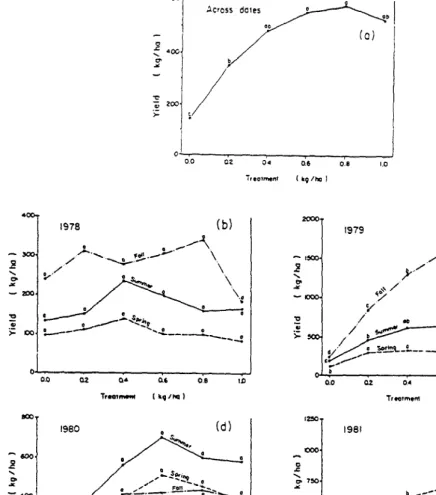
Mean grass yields throughout the total study period were greater in treated than untreated areas (Figure l-a). Maximum yield of 571 kg/ ha (nearly 4 times that of the control) occurred in the 0.8 kg/ ha treatment. Yield in the 0.2 kg/ha treatment was 2.5 times greater than in the control.
In 1978, grass yield (Figure I-b) did not differ among treatments. In more recent samples (Figures l-c, d, e), yields were consistently greater in treated areas. By late May 1979 grass yields on treated areas had already approached or exceeded the maximum yields recorded during the previous year. Fall 1978 and 1979 grass yields on control areas were comparable (239 vs. 23 1 kg/ ha) while on
treated areas yields were 600 to 1,500 kg/ ha greater in 1979. Early June 1980 grass yields in treated areas were almost 3.5 times (417 vs 120 kg/ha) greater than in the control and nearly 1.2 times greater than at the same period in 1979. Later grass growth was suppressed by the drought that prevailed throughout the summer of 1980. Fail rains came too late to stimulate additional growth.
Drought-induced quiescence of grasses during 1980 occurred up to 6 weeks earlier in control than in treated areas. From early June through July, grass yield in untreated areas increased only 5 kg/ ha as compared to increases of 34, 170, 193, 130, and 193 kg/ha in each successively higher herbicide rate. The reduction in competi- tive use of available soil water by oak diminished the effect of drought on herbage species in treated areas.
Management Concerns
We have observed oak ranges treated with tebuthiuron since 1974. Perennial brush species typically respond to treatment by undergoing cyclic defoliations. Up to 3 years may be required before control stabilizes. No reinfestation has been observed on areas where treatment provided total oak kill. However, a few sand sagebrush (Artemisia filifolia) have reestablished, and may be a management problem in the future. Soapweed (Yucca angustifo- lia) was not killed by tebuthiuron to 1.0 kg/ha and also may become a problem.
On the area studied, tebuthiuron did not kill all the oak. Grow- ing on Tivoli soils, it defoliated repeatedly, yet lived. Variability in sand depth, even on level topgraphy, caused a mottling effect of total oak kill. However, the patches of oak that remain may benefit wildlife habitat, especially for lesser prairie chickens (Tympanu- thus pallidicinctus).
We were able to convert a sand shinnery oak ecosystem to a mid-grass prairie; but this prairie has developed on easilyerodable soils. More than 90,000 ha of sand shinnery oak have been treated with tebuthiuron. The resulting prairie may require different man- agement strategies than the native oak-grass type.
Literature Cited
Deering, D., and R. Pettit. 1971. Sand shinnery oak acreage survey. Res. Highlights, Texas Tech Univ., Lubbock. 2: 14.
Garrison, G.I., and K.C. McDaniel. 1982. New Mexico brush inventory. New Mexico Dep. of Agr. Rep. No. I.
Greer, H.A.I., E.H. McIlvain, and C.G. Armstrong. 1968. Controlling shinnery oak in western Oklahoma. Oklahoma State Univ. Ext. Facts No. 2765.
Jones, V.E., C.H. Meadors, and P.W. Jacoby. 1978. Pelleted herbicides for control of sand shinnery oak (Quercus havardii). Thirty First Meeting Sot. Range Manage., Proc. 3 159. (Abstr.).
Mcllvain, E.H. 1956. Shinnery oak can be controlled. Southern Weed Sci. Sot., Proc. 9:95-98.
McIlvain, E.H.,and C.G. Armstrong. 1959. Shinnery oak control produces more grass. Southern Weed Sci. Sot., Proc. 12: I34- 137.
Mcllvain, E.H., and C.G. Armstrong. 1963. Progress in shinnery oak and sand sage control at Woodward. U.S. Southern Great Plains Field Sta. Prog. Rep. 630 I.
Table 1. Mean yield (kg/ha) of sand shinnery oak at study site in Co&ran County, Texas, during 1978,1979,1980 and 1981 after tebuthiuron treatment in May 1978.
Treatment 1978 1979
(kg/ha) Spring Summer Fall Spring Summer Fall
0.0 604 a 1 1041 a 906 a
0.2 323 b z2 458 _ 186b 166 b
0.4 462 ab 53 c 41 c
0.6 436 ab 25 c Ic
0.8 350 b - 2c oc
I.0 332 b oc oc
‘Means followed by a similar letter within the same column do not differ at the 0.05 level of probability. ‘Data not available.
Spring 1027 a
237 b 51 c 39 c l5c
2c
1980 Summer 781 a 293 b 78 c 24 c oc oc
Fall 655 a 136b
23 bc I8 bc
IC
oc
1981 Spring II49 a
346 b 46 c oc
oc
oc
4
1978
0.6 0.6 1.0 (k6hl
(b)
c2 04 06 06 I3
Trcotmem (kq/bo
i
0.0 QL 04 0.6 0.1 1.0 Tr rotm*fll I kg/ha)
00 a2 0’6 db o:a I.0 Treolment ( kg/ha 1
Fig. 1. Mean yield ofgrass both acrossdates (a)and bysamplingdote (b-e)ot study site in Cochron County, Tex., following treatment with tebuthiuron in May 1978. Means on the some sampling dote designed with the same letter are similar (X0.05).
Meyer, R.E., and R.W. Bovey. 1980. Control of live oak (Quercus virgini- Pettit, R.D. 1979. Effects of picloram and tebuthiuron pellets on sand ono) and understory vegetation with soil-applied herbicides. Weed Sci. shinnery oak communities. J. Range Manage. 32:196-200.
28:51-58. Scifres, C.J. 1972. Herbicide interactions in control of sand shinnery oak. J. Meyer, R.E., B.W. Bovey,end J.R. Bauer. 1978. Control of an oak (Quer- Range Manage. 25:386-389.
cus) complex with herbicide granules. Weed Sci. 26444-453. Scifres,C.J., J.W.Stuth,andR.W. Bovey. 1981.Controlofoaks(Qu~cus Pettit, R. 1975. Comparative effects of two pelleted herbicides on a shin oak spp.) and associated woody species on rangeland with tebuthiuron.
community. Res. Highlights, Texas Tech Univ., Lubbock. 6~43. Weed Sci. 29:270-215.
Steel, R.G.D., and J.H. Torrie. 1960. Principles and procedures of statis- tics. McGraw-Hill Book Co., Inc., New York.
Short-term Vegetation Responses to Fire in
the Upper Sonoran Desert
GEORGE H. CAVE AND DUNCAN T. PATTEN
Abstract
Annual and perennial plant vegetation was sampled following a controlled burn (1981) and a wildflre (1980) in the Upper Sonoran Desert near Phoenix, Ariz. Perennial plant composition 1 year after controlled burning included 32% shoot survivors, 30% sprouters, and 38% seeders, mostly brittle bush (Enceliafarinosd). Several invader species, stickweed (Stephanomeria exigua) and four o’clock (Mirabilis bigelovii) were important seeders, indicat- ing that there may be postfire successional communities in the Upper Sonoran Desert. Most cacti were fire killed or died eventu- ally from fire damage. Total annual plant density decreased (69%) while biomass increased significantly (131%) on burned areas. Red brome (Bromus rubens) was essentially eliminated 1 year after fire while schismus (Schismus arabicus) and Indian wheat (Plantago spp.) increased in both density and biomass. Fire appears to enhance rangeland productivity in the Upper Sonoran Desert.
Deserts of the southwestern United States have been increas- ingly impacted by man and as a result may be rapidly deteriorating. One such impact is an increase in fire occurrence on desert or semidesert recreation and rangeland areas. Desert fire ecology research, however, is lacking compared to available data from other ecosystems (Wells et al. 1979 and Lotan et al. 1981). This deficiency may be attributed to Shreve’s (1925 and 1951) state- ments characterizing the desert responses to fire disturbance as a direct and relatively rapid recovery back to the climax community. Muller (1940) and Whittaker (1975) have presented similar hypo- theses for general disturbances in the desert. In addition, Humph- rey (1963 and 1974) stated that fires have never been a factor of much importance and that their occurrence in the Upper Sonoran Desert is rare. All of these statements have undoubtedly discour- aged researchers from studying desert fires. Fire can, however, occur relatively frequently in the Upper Sonoran Desert during dry seasons that follow moist winters (USDA 1980).
Fires in southern Arizona desert grassland near Tucson, where fires can occur more frequently than in most desert areas, have been studied by Humphrey (1949), Humphrey and Everson (195 I), Reynolds and Bohning (1956), Humphrey (1963), Cable (1967), White (1969) and Martin (1983). These studies reported vegeta- tion responses to fire and investigated the use of fire as a tool for controlling undesirable species on grazing land.
Fire ecology in the Upper Sonoran Desert of central Arizona has only been recently studied (Whysong and Heisler 1978, Rogers and Steele 1980, McLaughlin and Bowers 1982, Patten and Cave 1984). This desert is floristically different from the southern Arizona desert grasslands, and fire recovery data are not comparable. Other recent studies have been conducted in southern Arizona semidesert Authorsaregraduateassistant, Department of Botany/ Microbiology,anddirector of The Center for Environmental Studies and professor of botany, Arizona State University, Tempe 85287.
The authors are indebted to the staff at Tonto National Forest, in particular to James Kimble and James Brown. In addition, W.D. Clark, M. Knox, S. Link, R. Maw. D. Robinson. G. Ruffner. T. Thomas. S. Workman. and esoeciallv Stan Smith de&e special recognition for their various contributionsand a&stan& We would also like to thank Jack Dieterich and Leonard DeBano from the U.S. Forest Service. Rocky Mountain Forest and Range Experiment Station, Arizona State University; Tempe.
Manuscript accepted March 7, 1984.
JOURNAL OF RANGE MANAGEMENT 37(6), November 1964
(Wright 1980), the western Colorado Desert (O’Leary and Minnich 1981), the Chihuahuan Desert (Ahlstrand 1982), and the Great Basin Desert (Rogers 1980). All these efforts reflect contemporary interests in re-evaluating and contributing to knowledge of fire ecology in North American deserts. To the extent that large por- tions of the Upper Sonoran Desert are used as rangeland, the present study is of particular interest because of the potential stimulatory effect ftre has on rangeland productivity.
This study was designed to examine short-term effects of fire on both annual and perennial plant communities in the Upper Sono- ran Desert through the use of controlled burning and study of an adjacent wildfire area. Specific objectives were: (1) to characterize
l- and 2-year postfire, herbaceous plant communities (annuals) with respect to changes in density and biomass in both open/shrub (small shrubs plus interspaces) and shaded (small trees) microhabi- tats; and (2) to examine the density and survival/ recovery strate- gies of l- and 2-year postfire tree, shrub, and cactus plant communities.
Methods
The study site was located in Bulldog Canyon, a desert canyon near Phoenix, Ariz., in the Tonto National Forest at 33O 15’N and I1 l”33’W with an elevation of 450 m. Three fire treatment sites were studied: (1) a wildfire area in which 84 ha burned on 26 May 1980; (2) I unburned hectare used for the controlled burn site and located adjacent to the wildfire site; and, (3) another adjacent, unburned hectare selected as a no fire control site. The controlled burn site was burned on I2 June 1981 by fire crews from Tonto National Forest.
Vegetation in the canyon was typical of the Upper Sonoran Desert in central Arizona and is characterized by the palo verde- cactus (mostly Opuntid and Carnegiea gigunreu)-shrub (mostly Ambrosia deltoideu) association (Shreve 1951). These perennial plants occupy about one-third of total ground cover. Perennial grasses are rare in this portion of the Upland Desert, but herbace- ous annual forbs and grasses are abundant after winter and heavy summer rains.
Precipitation data were from Stewart Mountain Weather Sta- tion operated by the National Oceanic and Atmospheric Adminis- tration and located approximately 5 km (33’34’N and 11 l”32’W) from the study site.
Herbaceous Plants
Herbaceous plant data were collected during 2-5 April 198 1 and 13-17 March 1982, during each year’s peak annual plant growth period. Plants were sampled on the no fire, controlled burn, and wildfire sites using randomly located 20 X 20 cm plots within both shaded and open/shrub areas. This segregation was designed to permit separate comparisons for annual plant species that grow primarily in shaded microhabitats (Tiedemann et al. 1971 and Patten 1978), and to distinguish fire recovery effects in shaded areas where annual plant growth can frequently be much greater than in partially shaded or unshaded areas created by low shrubs ‘Nomenclature follows Kearney and Peebles (1960) and Lchr (1978).
and open interspaces. Twenty plots were located in each area and above-ground biomass were calculated, the latter by harvest- except for open/ shrub areas on the no fire site which had 14 plots ing above-ground growth and drying for 48 hrs at 60°C before during 1981 sampling. For each species within the plots, density weighing.
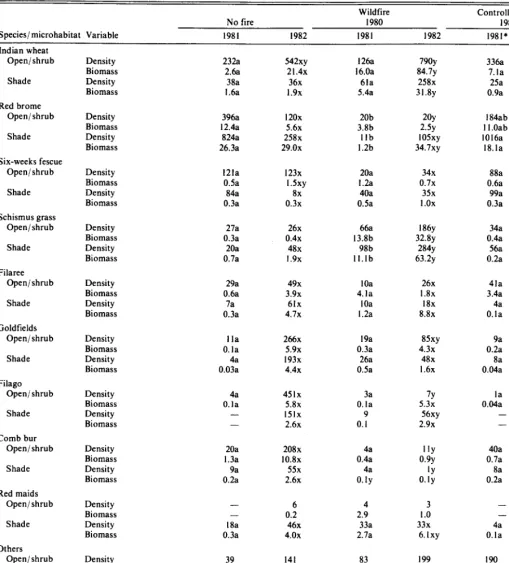
Table 1. Mean berbaceous (annual) plant density (no. plants/m’) and biomass (pm/m’) in 1981 and 1982 for two microhabitats (open/shrub and shade) within three fire treatment areas (no fire, wildfire 1980, and control burn 1981). Means followed by the same letter (a orb for 1981 comparisons among the three treatments and x or y for 1982 comparisons) are not significantly different (JYO.05) according to Dunn’s multiple comparison test. Where no significance is given, data were absent for comparison or were grouped (e.g., others).
Wildfire Controlled burn
No tire 1980 1981
Species/microhabitat Variable 1981 1982 1981 1982 1981’ 1982
Indian wheat Open/shrub
Shade
Red brome Open/ shrub
Shade
Six-weeks fescue Open/shrub
Shade
Schismus grass Open/shrub
Shade
Filaree Open/shrub
Shade
Goldfields Open/shrub
Shade
Filago Open/shrub
Shade
Comb bur Open/shrub
Shade
Red maids Open/ shrub
Shade
Others Open/ shrub
Shade
TOTALS Open/shrub
Shade
Density 232a 542xy l26a 79oY 336a 149x
Biomass 2.6a 21.4x 16.0a 84.7~ 7.la 19.4x
Density 38a 36x 61a 258x 25a 60x
Biomass l.6a 1.9x 5.4a 31.8~ 0.9a 18.Oxy
Density 396a 120x 20b 2OY I84ab l lY
Biomass l2.4a 5.6x 3.8b 2.5~ I I .Oab 2.4~
Density 824a 258x Ilb 105xy lOl6a 4Y
Biomass 26.3a 29.0x l.2b 34.7xy l8.la I.Oy
Density l2la 123x 2Oa 34x 88a 153x
Biomass 0.5a 1.5xy l.2a 0.7x 0.6a 9.7y
Density 84a 8x 40a 35x 99a 23x
Biomass 0.3a 0.3x 0.5a I .0x 0.3a 1.5x
Density 27a 26x 66a l86y 34a 99x
Biomass 0.3a 0.4x 13.8b 32.8~ 0.4a 10.6~
Density 20a 48x 98b 284~ 56a 125x
Biomass 0.7a I .9x Il.lb 63.2~ 0.2a 31.2~
Density 29a 49x IOa 26x 41a 33x
Biomass 0.6a 3.9x 4.la 1.8x 3.4a 5.5x
Density la 61x IOa 18x 4a IIX
Biomass 0.3a 4.7x l.2a 8.8x O.la 7.2x
Density Ila 266x l9a 85xy 9a 53Y
Biomass O.la 5.9x 0.3a 4.3x 0.2a 6.3x
Density 4a 193x 26a 48x 8a 51x
Biomass 0.03a 4.4x 0.5a 1.6x 0.04a 5.8x
Density 4a 451x 3a
Biomass O.la 5.8x O.la
Density - 151x 9
Biomass - 2.6x 0.1
Density 20a 208x 4a llY 40a 39xy
Biomass l.3a 10.8x 0.4a 0.9y 0.7a 2.9~~
Density 9a 55x 4a lY 8a llxy
Biomass 0.2a 2.6x O.ly O.ly 0.2a 0.9xy
Density Biomass Density Biomass
Density Biomass Density
Density Biomass Densitv
- - l8a 0.3a
39 I41 83 199 I90 230
2.4 8.7 10.8 2.1 3.2 66.3
41 252 66 I28 36 210
I.6 28.5 9.4 34.0 5.9 51.6
879a 20.3a l045a 31.3a
7Y la
5.3x O&la
56xy -
2.9x -
145xy IO.Ix
25~ 1.3x
6 4 3 - 4
0.2 2.9 I.0 - I.8
46x 33a 33x 4a 76x
4.0x 2.7a 6.1~~ O.la 31.4y
1914x 355b 1361~~ 923a 916~
64.2x 53.4b 136.1~ 26.6ab l38.Oy
1108x 358b 966x 1256a 596~
79.9x 32.2a 184.2~ 25.8a 155.94,
*Preburn measurements.