Concurrent composition in the
bounded quantum storage model
∗Dominique Unruh
University of Tartu, Estonia
May 15, 2011
Abstract
We define the BQS-UC model, a variant of the UC model, that deals with protocols in the bounded quantum storage model. We present a statistically secure commitment protocol in the BQS-UC model that composes concurrently with other protocols and an (a-priori) polynomially-bounded number of instances of itself. Our protocol has an efficient simulator which is important if one wishes to compose our protocol with protocols that are only computationally secure. Combining our result with prior results, we get a statistically BQS-UC secure protocol for general two-party computation without the need for any setup assumption. The round complexity of that protocol is linear in the circuit depth.
Contents
1 Introduction 2
1.1 Our contribution. . . 3
1.2 Preliminaries . . . 3
2 Bounded quantum storage UC 5 2.1 Review of quantum-UC . . . 5
2.2 The BQS-UC model . . . 6
2.3 On the memory bound of the environment . . . 8
2.4 Ideal functionalities . . . 9
2.5 Dummy-adversary . . . 10
2.6 Composition . . . 11
2.7 Quantum lifting . . . 14
3 Commitments 15 3.1 Extractable commitments . . 15
3.2 BQS-UC commitments . . . . 19
4 General 2-party computation 29
5 Conclusions 30
References 31
Index 33
∗
1
Introduction
Since the inception of quantum key distribution by Bennett and Brassard [BB84], it has been known that quantum communication permits to achieve protocol tasks that are impossible given only a classical channel. For example, a quantum key distribution scheme [BB84] permits to agree on a secret key that is statistically secret, using only an authenticated but not secret channel. (By statistical security we mean security against computationally unbounded adversaries, also known as information-theoretical security.) In contrast, when using only classical communication, it is easy to see that such a secret key can always be extracted by a computationally sufficiently powerful adversary. In light of this result, one might hope that quantum cryptography allows to circumvent other classical impossibility results, possibly even allowing for statistically secure multi-party computation protocols. Yet, Mayers [May97] showed that also in the quantum setting, even statistically secure commitment schemes are impossible, let alone general multi-party computation. This is unfortunate, because from commitments one can build OT (Bennett, Brassard, Cr´epeau, and Skubiszewska [BBCS91]), and from OT general multi-party computation (Kilian [Kil88]). A way to work around this impossibility was found by Damg˚ard, Fehr, Salvail, and Schaffner [DFSS05]. They showed that if we assume that the quantum memory available to the adversary is bounded (we speak of bounded quantum storage (BQS)), we can construct statistically secure commitment and OT schemes. Although such a result is not truly unconditional, it avoids hard-to-justify complexity-theoretic assumptions. Also, it achieves long-term security: even if the adversary can surpass the memory bound after the protocol execution, this will not allow him to retroactively break the protocol.
Yet, we still have not reached the goal of statistically secure multi-party computation. Although we have protocols for commitment and OT, we cannot simply plug them into the protocols by Bennett et al. [BBCS91] and by Kilian [Kil88]. The reason is that it is not clear under which circumstances protocols in the BQS model may be composed. For exam-ple, Dziembowski and Maurer [DM04] constructed a protocol that is secure in the classical bounded storage model, but that looses security when composed with a computationally secure protocol. To overcome this remaining difficulty, works by Wehner and Wullschleger [WW08] and by Fehr and Schaffner [FS09] give security definitions in the BQS model that enable secure sequential composition. Both works also present secure OT protocols in their respective settings. Based on these, we can construct secure multi-party computation proto-cols in the BQS model. There are, however, a few limitations. First, since only sequential composition is supported, all instances of the OT protocol used by the multi-party compu-tation need to be executed one after another, leading to a high round-complexity. Second, interactive functionalities such as a commitment are difficult to use: the restriction to se-quential composability requires that we have to commit and immediately open a commitment before being allowed to execute the next commitment. Third, the security proof of their OT protocols uses a computationally unlimited simulator. As discussed in [Unr10], a protocol with an unlimited simulator cannot be composed with a computationally secure protocol. Fourth, since we have no concurrent composability, it is not clear what happens if the proto-cols are executed in an environment where we do not have total control about which protoproto-cols are executed at what time.
and by Unruh [Unr04, Unr10]. In light of the success of the UC model, it seems natural to combine the ideas of the UC model with those of the BQS model in order to allow for concurrent composition.
1.1 Our contribution.
We define the notion of BQS-UC-security, which is an extension of quantum-UC-security [Unr10]. We have composability in the following sense: If π is a secure realization of a functionality F, and σF securely realizes G by using one instance of F, then σπ, the result of replacing F by π, still securely realizes G. In contrast to quantum-UC-security, however, BQS-UC-security does not allow for concurrent self-composition: ifπis secure, this does not automatically imply that two concurrent instances ofπ are secure.1
In order to get protocols that even self-compose concurrently, we design a commitment scheme πCOM such that n concurrent instances of πCOM securely realize n instances of the
commitment functionality in the presence of a-memory bounded adversaries. Here aand n
are arbitrary (polynomially-bounded), but the protocol depends onaand n.
The challenging part in the construction of πCOM is that BQS-UC-security requires the
following: There must be an efficient simulator (which is allowed to have more quantum memory than the adversary) that can extract the committed value (extractability) or change it after the commit phase (equivocality). Prior constructions of commitment schemes in the BQS model required computationally unbounded simulators. Also, the fact that we directly analyze the concurrent composition of several instances ofπCOM requires care: In the proof,
we have hybrid networks in which instances of both πCOM and of the simulator occur. Since
the simulator uses more quantum memory than πCOM tolerates, one needs to ensure that
the simulator cannot be (mis)used by the adversary to break the commitment.
Finally, using the composition theorem andπCOM, for any two-party functionalityG, we
get a statistically secure protocol π realizing G in the BQS model.2 The protocol is secure even when runningnconcurrent instances of the protocol. (Again, this holds for anyn and any memory bound, but the protocol depends on n and the memory-bound.) The round-complexity of the protocol is linear in the circuit depth. It does not use any quantum memory or quantum computation and thus is in the reach of today’s technology.
1.2 Preliminaries
General. A nonnegative function µ is called negligible if for all c > 0 and all sufficiently large k,µ(k)< k−c. µ is called exponentially-small if for somec >0 and sufficiently largek,
µ(k)< c−k. A nonnegative functionf is called overwhelming iff ≥1−µfor some negligible
µ. Keywords in typewriter font (e.g., environment) are assumed to be fixed but arbitrary distinct non-empty words in{0,1}∗. ε∈ {0,1}∗ denotes the empty word. We write kfor the concatenation of bitstrings. Given a bitstring x, we write xI for x restricted to the indices
in the setI. Given a set M, we writeM∁ for its complement. Ab-block (m, κ, d)-linear code is a code with alphabet{0,1}b (that is, each symbol of the code is ab-bit string), codewords
1The reader may wonder how it can be thatσandπmay compose in general whileπandπdo not. Might
notσ andπbe the same protocol? The reason lies in the exact conditions of the composition theorem: In order to compose,σ needs to be secure against adversaries with a higher quantum memory bound than π
tolerates. Thusσandπcannot be the same protocol.
2We are restricted to two-party functionalities because our construction uses a subprotocol by Wolf and
of length m (i.e., mb bits), size 2bκ, and detectingd−1 errors (i.e., any non-zero codeword contains at least d non-zero blocks). The Hamming distance between x and x∗ we denote
ω(x, x∗). (In the case of a block code, this is the number of blocks, not bits, that differ.) We say a family of (m, κ, d)-linear codes, parametrized by a security parameter k, has efficient error-correction if for any x, the codeword x∗ with ω(x, x∗) ≤ (d−1)/2 can be found in deterministic time polynomial in k(if such an x∗ exists).
Quantum systems. We can only give a terse overview over the formalism used in quantum computing. For a thorough introduction, we recommend the textbook by Nielsen and Chuang [NC00, Chap. 1–2]. A (pure) state in a quantum system is described by a vector |ψi in some Hilbert space H. In this work, we only use Hilbert spaces of the form H = C
N for
some countable set N, usually N = {0,1} for qubits or N = {0,1}∗ for bitstrings. We always assume a designated orthonormal basis {|xi :x ∈N} for each Hilbert space, called the computational basis. The basis states |xi represent classical states (i.e., states without superposition). Given several separate subsystems H1 = C
N1, . . . ,H
n =C
Nn, we describe
the joint system by the tensor productH1⊗· · ·⊗Hn=C
N1×···×Nn. We writehΨ|for the linear
transformation mapping|Φi to the scalar producthΨ|Φi. Consequently, |ΨihΨ|denotes the orthogonal projector on |Ψi. We set |0i+ := |0i, |1i+ := |1i, |0i× := √12(|0i+|1i), and
|1i×:= √1
2(|0i − |1i). Forx∈ {0,1}
nandθ∈ {+,×}n, we define|xi
θ :=|x1iθ1⊗ · · · ⊗ |xniθn.
Mixed states. If a system is not in a single pure state, but instead is in the pure state
|Ψii ∈ Hwith probabilitypi (i.e., it is in a mixed state), we describe the system by a density
operator ρ = P
ipi|ΨiihΨi| over H. This representation contains all physically observable
information about the distribution of states, but some distributions are not distinguishable by any measurement and thus are represented by the same mixed state. The set of all density operators is the set of all positive3operatorsHwith trace 1, and is denotedP(H). Composed
systems are descibed by operators in P(H1 ⊗ · · · ⊗ Hn). In the following, when speaking
about (quantum) states, we always mean mixed states in the density operator representa-tion. A mappingE :P(H1) → P(H2) represents a physically possible operation (realizable
by a sequence of unitary transformations, measurements, and initializations and removals of qubits) iff it is a completely positive trace preserving map.4 We call such mappings superop-erators. The superoperator Einitm on P(H) with H := C
{0,1}∗
and m ∈ {0,1}∗ is defined by
Em
init(ρ) :=|mihm|for all ρ.
Composed systems. Given a superoperatorE onP(H1), the superoperatorE ⊗id operates
on P(H1⊗ H2). Instead of saying “we apply E ⊗id”, we say “we apply E to H1”. If we say
“we initializeHwithm”, we mean “we applyEm
init toH”. Given a state ρ∈ P(H1⊗ H2), let
ρx := (|xihx| ⊗id)ρ(|xihx| ⊗id). Then the outcome of measuringH1 in the computational
basis isx with probability trρx, and after measuringx, the quantum state is trρxρx. Since we
will only perform measurements in the computational basis in this work, we will omit the qualification “in the computational basis”. The terminology in this paragraph generalizes to systems composed of more than two subsystems.
Classical states. Classical probability distributionsP :N → [0,1] over a countable set N
are represented by density operators ρ ∈ P(C
N) with ρ = P
x∈NP(x)|xihx| where {|xi}
is the computational basis. We call a state classical if it is of this form. We thus have a canonical isomorphism between the classical states overC
N and the probability distributions
3We call an operator positive if it is Hermitean and has only nonnegative Eigenvalues. 4A map E is completely positive iff for all Hilbert spaces H′, and all positive operators
ρon H1⊗ H′,
overN. We call a superoperatorE :P(C
N1)→ P(
C
N2) classical iff if there is a randomized
function F : N1 → N2 such that E(ρ) = Px∈N1 y∈N2
Pr[F(x) = y]· hx|ρ|xi · |yihy|. Classical
superoperators describe what can be realized with classical computations. An example of a classical superoperator on P(C
N) is E
class : ρ 7→ Pxhx|ρ|xi · |xihx|. Intuitively, Eclass
measures ρ in the computational basis and then discards the outcome, thus removing all superpositions fromρ.
2
Bounded quantum storage UC
2.1 Review of quantum-UC
Machine model. A machineM is described by an identityidM in{0,1}∗ and a sequence of
superoperatorsEM(k) (k∈N) onH
state⊗ Hclass⊗ Hquant withHstate,Hclass,Hquant := C{
0,1}∗
(the state transition operators). The index k in EM(k) denotes the security parameter. The Hilbert spaceHstate represents the state kept by the machine between invocations, andHclass
and Hquant are used both for incoming and outgoing messages. Any message consists of a
classical part stored in Hclass and a quantum part stored in Hquant. If a machine id sender
wishes to send a message with classical part m and quantum part |Ψi to a machine idrcpt,
the machine idsender initializes Hclass with (idsender,idrcpt, m) and Hquant with |Ψi. (See
the definition of the network execution below for details.) The separation of messages into a classical and a quantum part is for clarity only, all information could also be encoded directly in a single register. If a machine does not wish to send a message, it initializes Hclass and
Hquant with the empty word ε.
A networkNis a set of machines with pairwise distinct identities containing a machineZ
with idZ =environment. We writeidsN for the set of the identities of the machines inN. We call a machineM quantum-polynomial-time if there is a uniform5 sequence of
quan-tum circuits Ck such that for all k, the circuitCk implements the superoperator EM(k).
Network execution. The state space HN of a network N is defined as HN := Hclass ⊗
Hquant ⊗N
id∈idsNH state
id with Hstateid ,Hclass,Hquant := C{
0,1}∗
. Here Hstate
id represents the
local state of the machine with identityid and Hclass and Hquant represent the state spaces
used for communication. (Hclass andHquant are shared between all machines. Since only one
machine is active at a time, no conflicts occur.)
A step in the execution of N is defined by a superoperator E := EN(k) operating on HN. This superoperator performs the following steps: First, E measures Hclass in the
computa-tional basis and parses the outcome as (idsender,idrcpt, m). LetM be the machine inNwith
identity idrcpt. Then E applies EM(k) to Hstateidrcpt ⊗ H
class ⊗ Hquant. Then E measures Hclass
and parses the outcome as (id′sender,id′rcpt, m′). If the outcome could not be parsed, or if
id′sender 6=idrcpt, initializeHclass with (ε,environment, ε) and Hquant withε. (This ensures
that the environment is activated if a machine sends no or an ill-formed message.)
The output of the network N on input z and security parameter k is described by the following algorithm: Letρ∈ P(HN) be the state that is initialized to (ε,environment, z) in
Hclass, and to the empty wordεin all other registers. Then repeat the following indefinitely: ApplyEN(k)to ρ. MeasureHclass. If the outcome is of the form (environment, ε,out), return
5A sequence of circuitsC
kis uniform if a deterministic Turing machine can output the description ofCk
out and terminate. Otherwise, continue the loop. The probability distribution of the return value out is denoted by ExecN(k, z).
Corruptions. To model corruptions, we introducecorruption parties, special machines that follow the instructions given by the adversary. When invoked, the corruption partyPidC with identity id measures Hclass and parses the outcome as (id
sender,idrcpt, m). If idsender =
adversary,Hclass is initialized withm. (In this case, m specifies both the message and the
sender/recipient. Thus the adversary can instruct a corruption party to send to arbitrary recipients.) Otherwise, Hclass is initialized with (id,adversary,(id
sender,idrcpt, m)). (The
message is forwarded to the adversary.) Note that, sincePidC does not touch the Hquant, the
quantum part of the message is forwarded.
Given a network N, and a set of identities C, we write NC for the set resulting from
replacing each machine M ∈Nwith identity id ∈C by PidC.
Security model. A protocolπ is a set of machines with environment,adversary∈/ ids(π). We assume a set of identities partiesπ ⊆ ids(π) to be associated with π. partiesπ denotes which of the machines in the protocol are actually protocol parties (as opposed to incorrupt-ible entities such as ideal functionalities).
An environment is a machine with identityenvironment, an adversary or a simulator is a machine with identity adversary(there is no formal distinction between adversaries and simulators, the two terms refer to different intended roles of a machine).
In the following we call two networks ε-close if for all z ∈ {0,1}∗ and k ∈ N,
|Pr[ExecN(k, z) = 1]−Pr[ExecM(k, z) = 1]| ≤ε(k). We call two networks negligible-close if
they areε-close for negligible ε. We speak of perfect closeness if ε= 0.
Without assuming a memory bound, this leads to the following definition of quantum-UC-security:6
Definition 1 (Quantum-UC-security [Unr10]) Let protocols π andρ be given. We say π quantum-UC-emulates ρ iff for every setC ⊆partiesπ and for every adversary Adv there is a simulatorSimsuch that for every environmentZ, the networksπC∪{Adv,Z}(called the real model) and ρC∪ {Sim,Z} (called the ideal model) are negligible-close. We furthermore
require that if Adv is quantum-polynomial-time, so isSim.
2.2 The BQS-UC model
In order to define BQS-UC, we first need a definition of a memory-bounded machine. We call a machineM a-memory bounded if it keeps at mosta qubits of quantum memorybetween
activations. (An activation is the computation performed by a machine between receiving a message and sending the immediate response.) We do not impose any limitations on the computation-time or memory-use during a single activation of M: since we allow arbitrary state transition operators, this also includes state transition operators that need exponential time and a large number of auxiliary qubits during a single evaluation of that state transition operator.
We also stress that we do not impose any bound on the classical memory.
Definition 2 (Memory bounded machines) Let a be a function in the security param-eter k. We call a machine M a-memory bounded if for every k, we can decompose
Hstate as Hstate,q ⊗ Hstate,c with Hstate,q := C
{0,1}a(k)
and Hstate,c := C
{0,1}∗
such that
6In [Unr10], this notion is called statistical quantum-UC-security. Since we do not consider computational
EM(k) = (Eclass ⊗id)◦ EM(k). We write QM(M) for the smallest a such that M is a-memory bounded.
We can now formulate BQS-UC-security. Intuitively, a protocol is BQS-UC-secure if it is UC-secure for memory-bounded adversaries. To formulate this, we need to explicitly parametrize the definition over a memory bounda. Then we require that the total quantum memory used by environment and adversary is bounded by a. The reason why we include the environment’s memory is that the latter can be involved in the actual attack: If only the adversary’s memory was bounded, the adversary could use the environment as an external storage to perform the attack (see also our discussion in Section 2.3).7
It remains to decide whether the simulator should be memory bounded. If we allow the simulator to be unbounded, composition becomes difficult: In some cases, the simulator of one protocol plays the role of the adversary of a second protocol. Thus, if simulators where not memory bounded, the second protocol would have to be secure against unbounded adversaries. However, if we require the simulator to be a-memory bounded, we will not be able to construct nontrivial protocols: In order to perform a simulation, the simulator needs to have some advantage over an honest protocol participant (in the computational UC setting, e.g., this is usually the knowledge of some trapdoor). In our setting, the advantage of the simulator will be that he has more quantum memory than the adversary. Thus we introduce a second parameter s which specifies the amount of quantum memory the simulator may use for the simulation. More precisely, we allow the simulator to uses+ QM(Adv) qubits because the simulator will usually internally simulate the adversary Adv as a black-box and therefore have to additionally reserve sufficient quantum memory to store the adversary’s state.
Definition 3 (BQS-UC-security) Fix protocols π and ρ. Let a, s ∈ N0∪ {∞} (possibly
depending on the security parameter). We say π (a, s)-BQS-UC-emulates8 ρ iff for every set C ⊆ partiesπ and for every adversary Adv there is a simulator Sim with QM(Sim) ≤
s+ QM(Adv)such that for every environment Z withQM(Z) + QM(Adv)≤a, the networks πC∪{Adv,Z}(called the real model) andρC∪{Sim,Z}(called the ideal model) are negligible-close. We furthermore require that if Adv is quantum-polynomial-time, so is Sim.
We first state a few useful properties of BQS-UC.
Lemma 4 Let π, ρ, σ be protocols.
(i) Reflexivity: π (∞,0)-BQS-UC-emulates π.
(ii) Transitivity: Ifπ (a, s)-BQS-UC emulatesρandρ (a+s, s′)-BQS-UC emulatesσ, then π (a, s+s′)-BQS-UC-emulatesσ.
(iii) Monotonicity: If a′ ≤ a and s′ ≥ s and π (a, s)-BQS-UC emulates ρ, then π (a′, s′)
-BQS-UC emulates ρ.
(iv) Relation to quantum-UC: π quantum-UC emulates ρ iff there is a polynomial s such that π (∞, s)-BQS-UC emulates ρ.
Proof. Reflexivity and monotonicity follow directly from Definition 3.
To show transitivity, assume that π (a, s)-BQS-UC emulatesρ andρ (a+s, s′)-BQS-UC emulatesσ. Fix an adversary Adv and an environmentZ with QM(Z) + QM(Adv)≤a. To
7This is captured more formally by the completeness of the so-called dummy-adversary (see Section 2.5),
which shows that one can even shift the complete attack into the environment.
8Since we only consider statistical security in this work, we omit the qualifier “statistical”. Similarly, when
show that π (a, s+s′)-BQS-UC-emulates σ we need to show that there exists a simulator Sim that is independent of Z and that satisfies QM(Sim)≤s+s′+ QM(Adv).
Since π (a, s)-BQS-UC emulates ρ, there exists a simulator Sim′ (independent of Z) with QM(Sim′) ≤ s+ QM(Adv) ≤ a+s such that π ∪ {Adv,Z} and ρ ∪ {Sim′,Z} are negligible-close. Let Adv′ := Sim′. Since ρ (a+s, s′)-BQS-UC emulates σ, there exists a simulator Sim (independent ofZ) with QM(Sim)≤s′+ QM(Adv′) such thatρ∪ {Adv′,Z}
andσ∪{Sim,Z}are negligible-close. Thenπ∪{Adv,Z}andσ∪{Sim,Z}are negligible-close. And QM(Sim)≤s′+ QM(Adv′)≤s+s′+ QM(Adv). Thusπ(a, s+s′)-BQS-UC-emulatesσ. The proof of (iv) depends on the concept of the dummy-adversary introduced in the next section; we defer the proof until Section 2.5. (Note that the proofs in the next section do
not use (iv).)
2.3 On the memory bound of the environment
In Definition 3, we impose the memory bound on both the adversary and the environment. In this, we differ from the modeling by Wehner and Wullschleger [WW08]. In their definition, the environment (which is implicit in the definition of the indistinguishability≡εof quantum
channels) provides the input state to protocol and adversary, then gets the outputs of protocol and adversary, and finally the environment has to guess whether it interacted with the real or the ideal model. During the interaction of the protocol, the environment is not allowed to communicate with any other machine. Between its two activations, the environment is allowed to keep an arbitrarily large quantum state.9 The interesting point here is that, in
contrast to our Definition 3, Wehner and Wullschleger do not impose the memory bound on the environment, only on the adversary. They motivate unlimited environments by pointing out that it is more realistic to assume that a particular memory bound (say, 100 qubits) applies to a particular adversary (e.g., a smart card) than to the whole environment (i.e., all computers world-wide). We believe, however, that this reasoning has to be applied with care: Only when we have the guarantee that the adversary (e.g., the smart card) cannot communicate with any other machines can we assume a smart card is limited to 100 qubits. Otherwise, we have to assume that the smart card effectively has (in the worst case) access to all the quantum memory of the environment. Thus, except in very specific cases, the memory bound we assume needs to be large enough to encompass the environment’s memory as a whole. Thus, the bound we assume not to be surpassed by the adversary’s memory needs to be large enough that it makes sense to assume that the environment does not surpass this bound either. But in this case, we can safely assume in Definition 3 that the environment is restricted by that memory bound.
We stress that even if our environment is memory bounded, we do take into account the fact that an environment can have a quantum state that is entangled with that of the adversary; we just limit this quantum state to the memory bound.
We get, however, an interesting variant of our model if we follow the approach of Wehner and Wullschleger as follows. We call a machine a-⋄-memory-bounded10 if its state between
activations consists of two registers A and B. The register A contains at most a qubits,
9Note that strictly speaking, the formalism of [WW08, full version] does not model an environment with
quantum memory: For quantum channels Λ,Λ′
they define Λ ≡ε Λ′ iff for all quantum states ρ, the trace
distance between Λ(ρ) and Λ′(
ρ) is at most ε. To model environments with quantum memory, we should instead require that for all Hilbert spacesHand all quantum statesρ, the trace distance between (Λ⊗idH)(ρ)
and (Λ′⊗id
H)(ρ) is at mostε. We believe that the latter was the intended meaning of≡ε.
10We use the symbol⋄because⋄-memory-bounded environments essentially model indistinguishability with
and register B is unlimited but is only accessed in the first and the last activation of B. We denote by QM⋄(Z) the ⋄-memory bound of Z. We define (a, s)-⋄-BQS-UC-emulation like (a, s)-BQS-UC-emulation (Definition 3), except that we use QM⋄(Z) instead of QM(Z). (But we still use QM(Adv) and QM(Sim).)
Definition 5 (⋄-BQS-UC-security) Fix protocolsπandρ. Leta, s∈N0∪{∞}. We sayπ (a, s)-⋄-BQS-UC-emulatesρ iff for every setC ⊆partiesπ and for every adversary Advthere is a simulator Sim with QM(Sim)≤s+ QM(Adv) such that for every environment Z with
QM⋄(Z)+ QM(Adv)≤a, the networksπC∪ {Adv,Z}andρC∪ {Sim,Z}are negligible-close. We furthermore require that ifAdv is quantum-polynomial-time, so isSim.
We stress that our techniques also work for this definition. All results of this section still hold with essentially unmodified proofs (except that we always have to refer to the⋄-memory bound of the environment instead memory bound). The results from Section 3 (BQS-UC commitments) are based on the existence of certain commitment schemes that are hiding with respect to memory bounded adversaries. We use the commitment scheme from [KWW09] (see Theorem 20). To extend the results from Section 3 to Definition 5, we need schemes that are hiding with respect to⋄-memory bounded adversaries instead. Besides that, the proofs of the results in Section 3 stay essentially the same (except for using⋄-memory bounds instead of memory bounds).
2.4 Ideal functionalities
In most cases, the behavior of the ideal model is described by a single machine F, the so-called ideal functionality. We can think of this functionality as a trusted third party that perfectly implements the desired protocol behavior. For example, the functionality FOT
for oblivious transfer would take as input from Alice two bitstrings m0, m1, and from Bob
a bit c, and send to Bob the bitstring mc. Obviously, such a functionality constitutes a
secure oblivious transfer. We can thus define a protocol π to be a secure OT protocol ifπ
quantum-UC-emulatesFOT whereFOT denotes the protocol consisting only of one machine,
the functionality FOT itself. There is, however, one technical difficulty here. In the real
protocol π, the bitstringmc is sent to the environmentZ by Bob, while in the ideal model,
mcis sent by the functionality. Since every message is tagged with the sender of that message,
Z can distinguish between the real and the ideal model merely by looking at the sender of
mc. To solve this issue, we need to ensure that F sends the message mc in the name of Bob
(and for analogous reasons, thatF receives messages sent byZ to Alice or Bob). To achieve this, we use so-called dummy-parties [Can01] in the ideal model. These are parties with the identities of Alice and Bob that just forward messages between the functionality and the environment.
Definition 6 (Dummy-party) Let a machine P and a functionality F be given. The dummy-party P˜ for P and F is a machine that has the same identity as P and has the following state transition operator: Let idF be the identity of F. When activated, measure
Hclass. If the outcome of the measurement is of the form (environment,id
P, m), initialize
Hclass with (id
P,idF, m). If the outcome is of the form (idF,idP, m), initialize Hclass with
(idP,environment, m). In all cases, the quantum communication register is not modified
(i.e., the message in that register is forwarded).
Z Adv
π
(I)
Z Adv
π Advdummy
ZAdv
(II)
Z Adv
ρ Sim′
ZAdv
(III)
Z Adv
ρ Sim′ Sim
(IV)
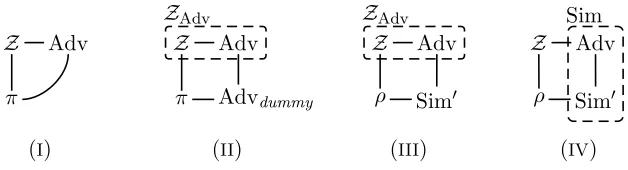
Figure 1: Completeness of the dummy-adversary: proof steps
Thus, if we writeπ quantum-UC-emulatesF, we mean thatπ quantum-UC-emulatesρF
whereρF consists of the functionalityF and the dummy-parties corresponding to the parties inπ. More precisely:
Definition 7 Let π be a protocol and F be a functionality. We say that π quantum-UC-emulatesF if π quantum-UC-emulates ρF where ρF :={P˜ :P ∈partiesπ} ∪ {F}.
2.5 Dummy-adversary
In the definition of UC-security, we have three entities interacting with the protocol: the adversary, the simulator, and the environment. Both the adversary and the environment are all-quantified, hence we would expect that they do, in some sense, work together. This intu-ition is backed by the following fact which was first noted by Canetti [Can01]: Without loss of generality, we can assume an adversary that is completely controlled by the environment. This so-called dummy-adversary only forwards messages between the environment and the protocol. The actual attack is then executed by the environment.
Definition 8 (Dummy-adversary Advdummy) When activated, the dummy-adversary
Advdummy measures Hclass; call the outcome m. If m is of the form (environment,
adversary, m′), initialize Hclass with m′. Otherwise initialize Hclass with (adversary,
environment, m). In all cases, the quantum communication register is not modified (i.e., the message in that register is forwarded).
Lemma 9 (Completeness of the dummy-adversary) Assume that π (a, s) -BQS-UC-emulates ρ with respect to the dummy-adversary (i.e., instead of quantifying over all ad-versaries Adv, we fix Adv := Advdummy). Then π (a, s)-UC-emulatesρ.
Proof of Lemma 9. In [Unr10], an analogous theorem has been shown for quantum-UC-security. Our proof is essentially the same, except that we additionally have to check that the machines we construct satisfy the required memory bounds.
Assume that π (a, s)-BQS-UC-emulates ρ with respect to the dummy-adversary. Fix an adversary Adv. We have to show that there exists a simulator Sim with QM(Sim) ≤
s+ QM(Adv) such that for all environments Z with QM(Z) + QM(Adv) ≤ a we have that π∪ {Adv,Z} and ρ∪ {Sim,Z} are negligible-close. Furthermore, if Adv is quantum-polynomial-time, Sim has to be quantum-quantum-polynomial-time, too.
For a given environment Z with QM(Z) + QM(Adv)≤a, we construct an environment
ZAdv that is supposed to interact with Advdummy and internally simulatesZ and Adv, and
that routes all messages sent by the simulated Adv to π through Advdummy and vice versa.
Then π∪ {Adv,Z}and π∪ {Advdummy,ZAdv}are perfectly close. (Cf. networks (I) and (II)
By definition of Advdummy, we have QM(Advdummy) = 0. And by construction of
ZAdv, we have QM(ZAdv) = QM(Z) + QM(Adv). Thus QM(Z) + QM(Advdummy) ≤
QM(Z) + QM(Adv) ≤ a. Since π (a, s)-BQS-UC-emulates ρ with respect to the dummy-adversary, we have that π∪ {Advdummy,ZAdv} and ρ∪ {Sim′,ZAdv} are negligible-close for
some Sim′ with QM(Sim′) ≤ s+ QM(Advdummy) and all Z. (Cf. networks (II) and (III).)
Since Advdummy is quantum-polynomial-time, so is Sim′. We construct a machine Sim that
internally simulates Sim′ and Adv (network (IV)). Then ρ∪ {Sim′,ZAdv} and ρ∪ {Sim,Z}
are perfectly close. Summarizing, π∪ {Adv,Z} and ρ∪ {Sim,Z} are negligible-close for all environments Z. Furthermore, since Sim′ is quantum-polynomial-time, we have that Sim is quantum-polynomial-time if Adv is. And QM(Sim′) = QM(Sim) + QM(Adv) ≤
s+ QM(Advdummy) + QM(Adv) =s+ QM(Adv). Thus π (a, s)-BQS-UC-emulates ρ.
Using Lemma 9, we can now prove the deferred Lemma 4 (iv).
Proof of Lemma 4(iv). If the π (∞, s)-BQS-UC-emulates ρ, then π trivially quantum-UC-emulatesρ (the condition QM(Z) + QM(Adv)≤ ∞is trivially fulfilled).
Assume thatπquantum-UC-emulatesρ. Then there is a simulator Sim such that for any environmentZ, π∪ {Advdummy,Z} and ρ∪ {Sim,Z} are negligible-close. Since Advdummy
is quantum-polynomial-time, so is Sim. Lets be a polynomial upper-bound on the running time of Sim. Then QM(Sim) ≤ s. Thusπ (∞, s)-BQS-UC-emulates ρ with respect to the dummy-adversary. By Lemma 9,π (∞, s)-BQS-UC-emulates ρ.
2.6 Composition
For some protocolσ, and some protocolπ, byσπ we denote the protocol whereσ invokes (up to polynomially many) instances of π. That is, in σπ the machines from σ and from π run together in one network, and the machines fromσ access the inputs and outputs ofπ. (That is,σplays the role of the environment from the point of view ofπ. In particular,Z then talks only to σ and not to the subprotocol π directly.) A typical situation would be that σF is some protocol that makes use of some ideal functionalityF, say a commitment functionality, and thenσπ would be the protocol resulting from implementing that functionality with some
protocolπ, say a commitment protocol. One would hope that such an implementation results in a secure protocol σπ. That is, we hope that if π BQS-UC-emulates F and σF BQS-UC-emulates G, then σπ BQS-UC-emulates G. Fortunately, this is the case, as long as we pick
the memory bounds in the right way:
Theorem 10 (Composition Theorem) Let π,ρ, andσ be quantum-polynomial-time pro-tocols. Assume thatσ invokes at most nsubprotocol instances (nmay depend on the security parameter). Assume thatπ (a, s)-BQS-UC-emulatesρ. Then σπ (a−QM(σ)−(n−1)b, ns)
-BQS-UC-emulates σρ where b:= max{QM(π),QM(ρ) +s}.
Proof of Theorem 10. In [Unr10], an analogous theorem has been shown for quantum-UC-security. Our proof is essentially the same, except that we additionally have to check that the machines we construct satisfy the required memory bounds.
Sinceσis quantum-polynomial-time,σinvokes at most a polynomial number of instances of its subprotocolπorρ. We can thus assume thatnis polynomially-bounded. Sinceπ(a, s )-BQS-UC-emulatesρ, there is a quantum-polynomial-time simulator Sim′ with QM(Sim′)≤s
such that for all environmentsZ with QM(Z) = QM(Z) + QM(Advdummy)≤awe have that
π∪ {Advdummy,Z} andρ∪ {Sim′,Z} are negligible-close. In the following, we call Sim′ the
(I)
Z
Adv
σ π..1
.
πn
(II)
Z
Adv
σ
Sim′1 ρ1
..
. ... Sim′n ρn
Sim
(III)
Z
Adv
σ
π1
.. .
πi−1
Advdummy πi
Sim′i+1 ρi+1
..
. ... Sim′n ρn
Zσ,i
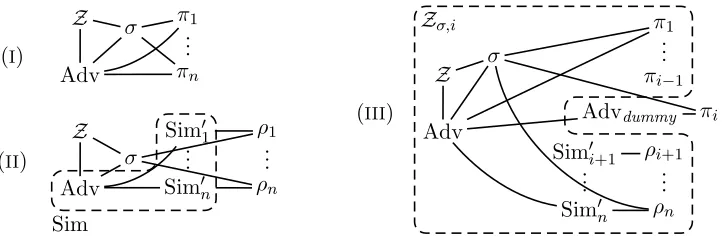
Figure 2: Networks occurring in the proof sketch of Theorem 10. Network (I) represents the real model, (II) the ideal model, and (III) the hybrid case. To avoid cluttering, in (III), the connections toπi−1, Sim′i+1, and ρi+1 have been omitted.
Let a quantum-polynomial-time adversary Adv be given (that is supposed to attack σπ). We construct a simulator Sim that internally simulates the adversary Adv and ninstances Sim′1, . . . ,Sim′nof the dummy-simulator Sim′. The simulated adversary Adv is connected to the environment and to the protocolσ, but all messages between Adv and thei-th instanceπi
of π are routed through the dummy-simulator-instance Sim′i (which is then supposed to transform these messages into a form suitable for instances of ρ). The simulator Sim is depicted by the dashed box in network (II) in Figure 2. We have QM(Sim)≤ns.
We have to show that for any environmentZ with QM(Z) + QM(Adv)≤a−QM(σ)−
(n−1)bwe have thatσπ∪ {Adv,Z}and σρ∪ {Sim,Z} are negligible-close (networks (I) and
(II) in Figure 2).
For this, we construct a hybrid environment Zσ,i. (Zσ,i is depicted as the dashed box in
network (III) in Figure 2.) This environment internally simulates the machines Z, Adv, the
protocol σ, instances π1, . . . , πi−1 of the real protocolπ, and instances Sim′i+1, . . . ,Sim′n and
ρi+1, . . . , ρn of the dummy-simulator Sim′ and the ideal protocol ρ, respectively. The
com-munication between Z, Adv, andσ is directly forwarded by Zσ,i. Communication between
Adv and the j-th protocol instance is forwarded as follows: If j < i, the communication is simply forwarded to πj. If j > i, the communication is routed through the corresponding
dummy-simulator Sim′j (which is then supposed to transform these messages into a form suit-able for ρj). And finally, if j =i, the communication is passed to the adversary/simulator
outside of Zσ,i. Communication betweenσ and the instances ofπ orρ is directly forwarded.
SinceZσ,iinternally simulates one copy ofZ, one copy of Adv, one copy ofσ,i−1 copies
ofπ, and n−icopies of Sim′ and ρ. Thus
QM(Zσ,i) = QM(Z) + QM(Adv) + QM(σ) + (i−1)QM(π) + (n−i)(QM(Sim′) + QM(ρ))
≤a−QM(σ)−(n−1)b+ QM(σ) + (i−1)QM(π) + (n−i)(QM(Sim′) + QM(ρ))
≤a−QM(σ)−(n−1)b+ QM(σ) + (i−1)b+ (n−i)b=a.
We will now show that there is a negligible function µ such that
|Pr[Execπ∪{Advdummy,Zσ,i}(k, z) = 1] − Pr[Execρ∪{Sim′,
Zσ,i}(k, z) = 1]| ≤ µ(k) for any
security parameterkand any i= 1, . . . , n. For this, we construct an environmentZσ which
expects as its initial input a pair (i, z), and then runsZσ,iwith inputz. Since QM(Zσ,i)≤a,
we have QM(Zσ) ≤a. Since π∪ {Advdummy,Z} and ρ∪ {Sim′,Z} are negligible-close for
all quantum-polynomial-time environments Z with QM(Z) ≤ a, π∪ {Advdummy,Zσ} and
difference of Pr[Execπ∪{Advdummy,Zσ,i}(k, z) = 1] = Pr[Execπ∪{Advdummy,Zσ}(k,(i, z)) = 1] and Pr[Execρ∪{Sim′,
Zσ,i}(k, z) = 1] = Pr[Execρ∪{Sim′,Zσ}(k,(i, z)) = 1] is bounded by µ(k) for
alli, k, z.
The game Execπ∪{Advdummy,Zσ,i}(k, z) is depicted as network (III) in Figure 2 (except that we wroteπiinstead ofπ). Observe that Execρ∪{Sim′
,Zσ,i+1}(k, z) (note the changed indexi+1)
contains the same machines as Execπ∪{Advdummy,Zσ,i}(k, z) (when unfolding the simulation
performed byZσ,iinto individual machines) except for the difference that the communication
with thei-th instance ofπ is routed through the dummy-adversary Advdummy. However, the
latter just forwards messages, so π∪ {Advdummy,Zσ,i} and ρ∪ {Sim′,Zσ,i+1} are perfectly
close.
Using the triangle inequality, it follows that |Pr[Execπ∪{Advdummy,Zσ,n}(k, z) = 1] −
Pr[Execρ∪{Sim′
,Zσ,1}(k, z) = 1]| is bounded by n · µ(k) which is negligible. Moreover,
Execπ∪{Advdummy,Zσ,n}(k, z) and Execσπ∪{Adv,Z}(k, z) describe the same game (up to
unfold-ing of simulated submachines and up to one instance of the dummy-adversary). Similarly, Execρ∪{Sim′
,Zσ,1}(k, z) and Execσρ∪{Sim,Z}(k, z) describe the same game (up to unfolding of
simulated submachines). Thus
Pr[Execσπ∪{Adv,Z}(k, z) = 1]−Pr[Execσρ∪{Sim,Z}(k, z) = 1]
is negligible and thus σπ ∪ {Adv,Z} and σρ∪ {Sim,Z} are negligible-close. Furthermore, since Sim′ is quantum-polynomial-time, we have that Sim is quantum-polynomial-time if Adv is. As mentioned above, QM(Sim)≤ns.
Since this holds for all Z with QM(Z) + QM(Adv) ≤ a−QM(σ)−(n−1)b, and the construction of Sim does not depend onZ, we have thatσπ (a−QM(σ)−(n−1)b, ns
)-BQS-UC-emulatesσρ.
Theorem 11 (Composition Theorem) Let π and σ be quantum-polynomial-time proto-cols and F and G be quantum-polynomial-time functionalities. Assume that σ invokes at most one subprotocol instance. Assume that π (a, s)-BQS-UC-emulates F and that σF (a−QM(σ) +s, s′)-BQS-UC-emulatesG. Then σπ (a−QM(σ), s+s′)-BQS-UC-emulatesG.
The proof of this theorem is very similar to that in [Unr10], except that we have to keep track of the quantum memory used by various machines constructed in the proof.
Proof. From Theorem 10, withn= 1, we get thatσπ (a−QM(σ), s)-BQS-UC-emulates σF. By assumption,σF (a−QM(σ) +s, s′)-BQS-UC-emulatesG. By transitivity (Lemma 4 (ii)), we get that σπ (a−QM(σ), s+s′)-BQS-UC-emulates G.
Notice that in the composition theorem (Theorem 11), the outer protocol σ is only al-lowed to invoke one instance of the subprotocol π. This stands in contrast to the univer-sal composition theorem for classical-UC [Can01] and for quantum-UC [Unr10] where any polynomially-bounded number of concurrent instances ofπis allowed. In fact, this is not just a limitation of our proof technique.11 For example, assume a protocolπA→B
COM that (a, s
)-BQS-UC-emulates the commitment functionality FA→B
COM with sender Aand recipient B. Assume
further that πCOMA→B does not use any functionalities as setup. As we will see later, such a protocol exists. Now let πCOMB→A be the protocol that results from exchanging the roles of A
and B. ThenπB→A
COM (a, s)-BQS-UC-emulates FCOMB→A. Consider the concurrent composition
of πACOM→B and πCOMB→A. In this protocol, a corrupted Bob may reroute all messages between the Alice in the first protocol and Alice in the second protocol. Thus, if Alice commits to a
11In the proof, the difficulty arises from a hybrid argument where the protocolπis executed together in one
random valuev in the first protocol, Bob commits to the same valuevin the second protocol without knowing it. It is easy to see that in a concurrent composition of FA→B
COM andFCOMB→A,
this is not possible. Thus the composition of πCOMA→B and πCOMB→A does not (a′, s′ )-BQS-UC-emulate the composition ofFCOMA→BandFCOMB→A(for any parametersa′, s′). To convert this into an example of a protocol that does not even compose with itself, just consider the protocol
πCOMA↔B in which Bob may choose whetherFCOMA→B or FCOMB→A should be executed. It might be possible to makeπACOM↔Bself-composable by adding suitable tags inside the messages, but the definition of BQS-UC-security does not enforce this.
Although BQS-UC-security does not guarantee for concurrent self-composability, individ-ual protocols may have this property. In order to formulate this, we introduce the concept of the multi-session variant of a protocol. Given a protocol π and a polynomially-bounded
n, we defineπn to be the protocol that executes ninstances of π concurrently. Then, from Theorem 11, we immediately get the following corollary:
Corollary 12 Let π and σ be quantum-polynomial-time protocols andF andG be quantum-polynomial-time functionalities. Letn, m≥0 be integers (depending on the security parame-ter). Assume that σ invokes at mostm subprotocol instances. Assume that πnm (a, s)
-BQS-UC-emulates Fnm and that (σF)n (a−nQM(σ) +s, s′)-BQS-UC-emulates Gn. Then (σπ)n (a−nQM(σ), s+s′)-BQS-UC-emulates Gn.
2.7 Quantum lifting
In [Unr10], it has been shown that for classical protocols, classical-UC-security implies quantum-UC-security (quantum lifting theorem). This theorem is very useful when reusing results from the classical-UC setting: For example, if a classical protocol σF classical-UC-emulates a functionality G, and a quantum protocol π quantum-UC-emulates F, then the quantum lifting theorem gives us thatσF quantum-UC-emulatesG, and then by the compo-sition theoremσπ quantum-UC-emulatesG.
A similar result also holds for BQS-UC:
Theorem 13 (Quantum lifting) If π and ρ are classical protocols and π classical-UC-emulatesρ, then π (∞,0)-BQS-UC emulates ρ.
Proof. In [Unr10], an analogous theorem has been shown for quantum-UC-security. Our proof is essentially the same, except that we additionally have to check that the simulator Sim we construct has QM(Sim) = 0. However, since Sim is a classical machine, this is trivial.
Given a machine M, let C(M) denote the machine which behaves like M, but measures incoming messages in the computational basis before processing them, and measures outgoing messages in the computational basis. More precisely, the superoperator EC(k)(M) first invokes
Eclass on Hclass ⊗ Hquant, then invokes EM(k) on Hstate ⊗ Hclass ⊗ Hquant, and then again
invokesEclass on Hclass⊗ Hquant. Since it is possible to simulate quantum Turing machines
on classical Turing machines (with an exponential overhead), for every machine M, there exists a classical machineM′ such thatC(M) andM′ are perfectly indistinguishable.12
We define the classical dummy-adversary Advclass
dummy to be the classical machine that is
defined like Advdummy (Definition 8), except that in each invocation, it first measuresHclass,
Hquant, andHstate in the computational basis (i.e., it appliesE
class toHstate⊗Hclass⊗Hquant)
and then proceeds as does Advdummy. Note that Advclassdummy is probabilistic-polynomial-time.
By Lemma 9, we only need to show that for any setC of corrupted parties, there exists a quantum-polynomial-time machine Sim with QM(Sim)≤0 + QM(Advdummy) = 0 such that
for every machineZ, the real model πC∪ {Z,Advdummy}and the ideal modelρC∪ {Z,Sim}
are negligible-close.
The protocol π is classical, thus πC is classical, too, and thus all messages forwarded
by Advdummy from πC to Z have been measured in the computational basis by πC, and
all messages forwarded by Advdummy from Z to πC will be measured by πC before being
used. Thus, if Adv would additionally measure all messages it forwards in the computa-tional basis, the view ofZ would not be modified. More formally, πC∪ {Z,Advdummy} and
πC∪ {Z,Advclassdummy}are perfectly close. Furthermore, since bothπC and Advclassdummy measure all messages upon sending and receiving,πC ∪ {Z,Advclass
dummy}and πC ∪ {C(Z),Advclassdummy}
are perfectly close. Since it is possible to simulate quantum machines on classical machines (with an exponential overhead), there exists a classical machineZ′ that is perfectly
indistin-guishable fromC(Z). ThenπC ∪ {C(Z),Advclassdummy}and πC ∪ {Z′,Advclassdummy}are perfectly close. Since Advclassdummy and Z′ are classical and Advclassdummy is polynomial-time, there exists a classical probabilistic-polynomial-time simulator Sim (whose construction is independent of
Z′) such thatπC∪ {Z′,Advdummyclass } and ρC ∪ {Z′,Sim} are negligible-close.
ThenρC∪ {Z′,Sim}andρC∪ {C(Z),Sim}are perfectly close by construction ofZ′. And since both ρC and Sim measure all messages they send and receive, ρC ∪ {C(Z),Sim} and
ρC∪ {Z,Sim} are perfectly close.
Summarizing, we have thatπC∪{Z,Advdummy}andρC∪{Z,Sim}are negligible-close for
all environments Z. Furthermore, Sim is classical probabilistic-polynomial-time and hence quantum-polynomial-time and its construction does not depend on the choice of Z. And since Sim is classical, QM(Sim) = 0. Thusπ (∞,0)-BQS-UC-emulates ρ.
3
Commitments
3.1 Extractable commitments
In this section, we present the notion of online-extractable commitments in the BQS model. These will be used as a building block for constructing BQS-UC commitments in the next section.
Definition 14 ((ε, a)-BQS-hiding) Given a commitment protocol π with sender Alice and recipient Bob, and an adversary B′ corrupting Bob, we denote withhA(m), B′iB′ the output
of B′ in an interaction between Alice and B′ where Alice commits to m.
We call π (ε, a)-BQS-hiding iff for all a-memory bounded B′ and all m1, m2 ∈ M, we
have that Pr[hA(m1), B′iB′ = 1]−Pr[hA(m2), B′iB′ = 1]
≤ε. HereM is the message space
of the commitment scheme.
Parameters: Integern(the length of the transmitted string). The parameters may depend on the security parameter k.
Parties: The sender Alice A and the recipient Bob B. Inputs: None.
Protocol:
1. Alice picks a randomx∈ {0,1}n and θ∈ {+,×}n. Then she encodes and sends each bit
xi in the basisθi, i.e., she sends|Ψi:=|xiθ to Bob.
2. Bob picks a random ˜θ∈ {0,1}n and measures the i-th qubit of |Ψi in basis θ
i. Call the
outcomes ˜xi.
3. Both parties wait until the quantum memory bound becomes effective.13 4. Alice sendsθ to Bob and outputsx.
5. Bob computesI :={i:θi = ˜θi} and outputs (I,x˜I).
Figure 3: Weak string erasure protocol πWSE from [KWW09].
Definition 15 ((ε, s)-online-extractable) Given a commitment protocolπwith sender Al-ice and recipient Bob, an extractor is a machine BS that, after the commit phase, gives an
outputV′ and then executes the (honest) code of Bob for the open phase and outputs a value
V (the accepted value). (In particular, BS needs to provide an initial state for the program
of the open phase of Bob that matches the interaction so far.) We write V =⊥ if the open phase fails.
For an adversary A′, we denote with hA′, BiA′ (hA′, BSiA′) the output of A′ in an
inter-action betweenA′ and Bob (BS) whereA′ is givenV after Bob (BS) terminates.
We call π (ε, s)-online-extractable iff there exists an s-memory bounded quantum-polynomial-time extractor BS such that for all adversaries A′, we have that
Pr[hA′, BiA′ = 1]−Pr[hA′, BSiA′ = 1] ≤εand in an interaction ofA′ andBS, we havePr[V /∈ {V′,⊥}]≤ε.
Constructing online-extractable commitments. K¨onig, Wehner, and Wullschleger [KWW09] present a commitment scheme in a generalization of the bounded quantum stor-age model. Although they only show that it is hiding and binding, their scheme turns out to be also online-extractable. Their construction proceeds in two steps. First, they give a protocol for what they call aweak string erasure (WSE). A WSE is a protocol between Alice and Bob after which Alice outputs a bitstring X and Bob outputs a set of indices I and the bitstringXI consisting of X restricted to the indices I. The properties guaranteed by a weak string erasure are – informally – that Bob does not learn too much aboutXI∁, and that Alice has no information about I. From a WSE, we can construct a commitment scheme as follows: If Alice wishes to commit to a string m, Alice and Bob perform a WSE. Then Alice sendsm⊕F(X) to Bob whereF is a universal hash function with suitable parameters. Furthermore, Alice sendsS(X), the syndrome ofX under a suitable linear code. Since Bob only learns XI, S(X), and little about XI∁, the string X has high min-entropy from Bob’s point of view. ThusF(X) looks random to Bob and the commitment is hiding. To open the commitment, Alice sendsX. Since she does not knowI, Alice will be detected if she sends an ˆX that is substantially different from X. If Alice sends an ˆX that differs fromX only at a few indices, the syndromesS(X) and S( ˆX) will not match. Thus Alice is forced to send
ˆ
X=X; the commitment is binding. The precise protocols are given in Figures 3 and 4.
13Formally, in our model this step does not exist because our model assumes that the quantum memory
Parameters: Integers ℓ(the length of the committed value),n < ℓ, andκ, d≤n. A binary (n, κ, d)-linear code whereS(ω)∈ {0,1}n−κ denotes the syndrome of a codewordω∈ {0,1}n. A familyFof universal hash functionsF :{0,1}n→ {0,1}ℓ. All parameters may depend on
the security parameterk.
Subprotocols: Then-bit WSE protocol from Figure 3. Parties: The sender Alice A and the recipient Bob B.
Inputs: In the commit phase, Alice getsv withv ∈ {0,1}ℓ. Bob gets no inputs. Commit phase:
C1. Alice and Bob execute the WSE protocol. Alice gets x, Bob gets I andxI.
C2. Alice picks a hash function F ← F, computes p := v⊕F(x), computes the syndrome
σ:=S(x), and sends (F, σ, p) to Bob. Open phase:
O1. Alice sends ˆx:=x to Bob.
O2. Bob checks whetherσ =S(ˆx) and ˆxI =xI. Otherwise, Bob aborts.
O3. Bob computes v:=p⊕F(ˆx) and outputs v. (I.e., Bob accepts the opened value v.)
Figure 4: Commitment schemeπKWW from [KWW09].
The hiding property of πKWW has already been proven in [KWW09], we only need to
specialize their result to the BQS model.
Lemma 16 Fix constants δ, ν > 0 with δ+ν < 12. Fix some integer a (the adversary’s memory bound; dependent on the security parameter k). Assume that a ≤ νn and n ≥ k. Assume that ℓ≤ 12n−δn−νn−(n−κ)−k. (n, κ, ℓ refer to the parameters in Figure 4.) Then there is an exponentially-small ε >0 such that πKWW is (ε, a)-BQS-hiding.
Proof. In [KWW09], the notion of an (n, λ, ε′)-WSE protocol is introduced. Here n is the length of the transmitted string, and λn lower bounds the knowledge that Bob has about the string (in terms of min-entropy, and up to an error probabilityε′). The precise definition is given in [KWW09]; for the present proof we will not need any details. Their definition is parametrized by an operator F that describes the evolution of the quantum state in Bob’s memory. To model the special case of the BQS model in which the adversary’s memory has a qubits, we have to choose F to be the identity on a-qubit states. Let PF
succ(n′) :=
max(Dx)x,(ρx)x
1 2n′
P
x∈{0,1}n′tr DxF(ρx)where (Dx)xgoes over all POVMs (measurements), and (ρx)xover all families ofa-qubit mixed states. Intuitively,PsuccF (n′) denotes the maximum
probability of correctly decoding a randomn′-bit string after it has been stored in anaqubit state. In [KW09, page 1] it is shown that PF
succ(n′) ≤2−n
′
(R−1) = 2−a+n′
for R := na′. By [KWW09, Theorem 3.2], for any constant δ ∈ (0,12), we have that πWSE is an (n, λ, ε′
)-WSE protocol where λ = −1nlogPsuccF (12 −δ)n
and ε′ = 2e− nδ2
512(4+log 1δ)2. We have that
λ ≥ −n1 log 2−a+(12−δ)n = (1
2 −δ)− na ≥ 12 −δ −ν. Let ε′′ := max{2−k/2, ε′}. Since
πWSE is an (n, λ, ε′)-WSE protocol it is also an (n, λ, ε′′)-WSE protocol. Furthermore, ℓ≤
λn−(n−κ)−2 log 1/ε′′. Then, by [KWW09, Lemma 4.3],14 if πWSE is an (n, λ, ε′′)-WSE
protocol, then πKWW is (ε, a)-BQS-hiding with ε:= 3ε′′.15 Since δ is constant and n ≥ k,
14Strictly speaking, [KWW09, Lemma 4.3] analyzes a protocol that commits to a random value (and in
particular does not send the valuepin the commit phase). It is, however, straightforward to see that their proof also applies toπKWW as presented in Figure 4.
15The definition of hiding is formulated slightly differently in [KWW09] but can easily be seen to imply our
we have thatε′ and hence also ε= 3 max{2−k/2, ε′} is exponentially-small.
We proceed to show that πKWW is online-extractable. Since K¨onig et. only showed the
binding property, we need to extend the proof of [KWW09]. The main ideas are, however, already present in [KWW09]. Intuitively, online-extractability ofπKWW is not surprising: If
Bob has an unbounded amount of quantum memory, he can delay the measurement of the qubits in πWSE and thus get all the bits xi. That is, πWSE is online-extractable. Then, in
πKWW, Bob will know x already in the commit phase and can thus compute v =p⊕F(x)
(after error-correcting x to match the syndrome σ). Since v is the committed value, this implies thatπKWW is online-extractable. To make this argument formal, we need to ensure
that even if Alice cheats, she is not able to send some ˆxin the open phase which differs from the valuex that Bob extracted. The proof of this fact is similar to the proof of the binding property in [KWW09].
We begin by making the fact formal that Bob (given sufficient quantum memory) can extract in πWSE.
Definition 17 (Online-extractable WSE) A n-bit WSE protocol π consisting of sender AWSE and recipient BWSE is s-online-extractable if there exists an s-memory bounded quantum-polynomial-time machine BWSE
S with the following properties:
• BWSE
S outputs an n-bit string x.
• For any adversary A′, let ρA′B denote the state of A′ after interacting with BWSE.
Here A′ gets the outputs x
I and I made by BWSE. Let σA′IXˆ
I denote the state of A ′
after interacting with BWSE
S . Here A′ gets xI and I where x is the output of BWSES
and I is a uniformly random subset of {1, . . . , n}.16 ThenρA′B =σ
A′ IXˆI.
Note that in this definition, we do not require the extractor BWSE
S to produce the set I.
Instead, in an execution of A′ and BWSE
S , we choose I randomly. Alternatively, we could
also letBWSE
S pick I and require thatI is uniformly random and independent ofx and the
state ofA′; this would lead to an equivalent definition.
The definition could be generalized by allowing an error ε; we would then require that the trace distance εbetweenρA′B and σ
A′IXˆ
I is bounded by ε. For our purposes, however, the present definition is sufficient.
Lemma 18 (Online-extractability of πWSE) πWSEisn-online-extractable. (Herenis as
in Figure 3.)
[KWW09, Theorem 3.5] states a weaker property (called “security for Bob”). The proof of that theorem, however, explicitly constructs a simulator and proves the properties required by Definition 17. Thus, their proof also constitutes a proof for our Lemma 18.
Given an online-extractable WSE protocol, we get an online-extractable commitment scheme:
Lemma 19 Assume that the code with syndrome S has efficient error-correction. If πWSE
is an s-online-extractable WSE protocol for some s, then πKWW is an (s,2−d/2)
-online-extractable commitment scheme. Hered,S are the parameters from Figure 4. Notice that we do not require that πWSE is the protocol from Figure 3.
Proof. To show that πKWW is online-extractable, we first construct the extractor BS. BS
follows the program of Bob (Figure 4), except that in Step C1, Bob runs the extractor
16The names of the statesρ
BWSE
S from Definition 17 (which yields an n-bit string x), chooses a random subset I of
{1, . . . , n}, and computesxI. In all other protocol steps, BS behaves like Bob in Figure 4.
After the commit phase, BS computes an x∗ with Hamming distance ω(x, x∗) ≤ (d−1)/2
and S(x∗) = σ. (This can be done in polynomial-time since the code with syndromeS has efficient error-correction.) ThenBS computesv′ :=p⊕F(x∗) and outputsv′. (If nox∗ with
ω(x, x∗)≤(d−1)/2 exists, thenBS sets v′:=⊥ instead.)
Since BWSE
S satisfies Definition 17, we have that Pr[hA′, BiA′ = 1] = Pr[hA′, BSiA′ = 1]. To show that πKWW is (s,2−d/2)-online-extractable, we thus are left to show that Pfail :=
Pr[v /∈ {v′,⊥}]≤2−d/2.
From the construction ofπKWW, we have thatPfail is upper bounded by the probability
that ˆx 6=x∗ and S(ˆx) =σ and ˆx
I =xI. Fix some ˆx, x∗ with ˆx 6=x∗ and S(ˆx) =σ. From S(ˆx) =σ =S(x∗) we haveS(ˆx−x∗) = 0. Hence ˆx−x∗has Hamming-weight at leastd. Thus
ω(ˆx, x∗)≥d. Sinceω(x, x∗)≤(d−1)/2, it follows that ω(x,xˆ)≥d−(d−1)/2≥d/2. (In the case wherev′ =⊥, we haveω(x, x∗)>(d−1)/2 for all x∗ and henceω(x,xˆ)>(d−1)/2 and hence ω(x,xˆ) ≥ d/2.) Since I is chosen independently of x,xˆ, and each iis in I with probability 12, it follows that xI = ˆxI with probability at most (12)ω(x,ˆx) ≤ 2−d/2. Thus
Pfail ≤2−d/2.
Combining our results on πWSEand πKWW, we get the following theorem:
Theorem 20 (Online-extractable commitments) For any polynomially-bounded inte-gers a and ℓ, there is a constant-round 0-memory bounded (ε, a)-BQS-hiding (ε, s) -online-extractable commitment scheme π for some exponentially-small ε and some polynomially-bounded s. The message space of π isM ={0,1}ℓ.
Proof. Reed-Solomon codes [RS60] are (2b −1,2b−d, d)-linear codes over GF(2b) (for any
b, d). By representing each symbol as a b-bit string, they can be converted into binary ((2b−1)b,(2b−d)b, d)-linear codes. Error-correction is efficiently possible using the
Berlekamp-Massey algorithm [Ber67, Ber84].
Let δ, ν > 0 be some constants with δ+ν < 12. (E.g., δ = ν = 16.) Let k denote the security parameter. All values introduced below will depend on k. Letd:=k. Letb be the smallest integer such thatn:= (2b−1)bsatisfies 12n−δn−νn−(d−1)b−k≥ℓand νn≥a
and n ≥k. Such a b exists and then n is polynomially-bounded. Let κ := (2b−d)b. Let S be the syndrome of the (n, κ, d)-Reed-Solomon code. LetF be a family of universal hash functions F :{0,1}n → {0,1}ℓ. Such functions exist for anyn, ℓ; for example, the set of all affine transformations from{0,1}n to {0,1}ℓ is easily seen to be strongly universal.
Since ℓ≤ 12n−δn−νn−(d−1)b−k= 12n−δn−νn−(n−κ)−d, by Lemma 16, we have thatπKWW is (ε1, a)-BQS-hiding for some exponentially-smallε1.
And with s:=n, by Lemmas 18 and 19, we get that πKWW is (s, ε2)-online-extractable
with ε:= 2d/2.
Since both ε1 and ε2 are exponentially-small, the theorem holds with ε:= max{ε1, ε2}.
3.2 BQS-UC commitments
In this section, we present a commitment schemeπCOM that is BQS-UC-secure for memory
boundaand for nconcurrent instances of πCOM. The parametersaand ncan be arbitrary,
but πCOM depends on them. To state our result, we first define the ideal functionality for