An efficient RFID mutual authentication scheme based on ECC
Jue-Sam Chou*1, Yalin Chen2, Cheng-Lun Wu3, Chi-Fong Lin4 1,3,4
Department of Information Management, Nanhua University, Taiwan *: corresponding author:[email protected]
[email protected],[email protected]
Tel: 886+ (0)5+272-1001 ext.56536 2
Institute of information systems and applications, National Tsing Hua University
Abstract
Recently, Radio Frequency Identification (RFID) technique has been widely deployed in many applications, such as medical drugs management in hospitals and missing children searching in amusement parks. The applications basically can be classified into two types: non-public key cryptosystem (PKC)-based and PKC-based. However, many of them have been found to be flawed in the aspect of privacy problem. Therefore, many researchers tried to resolve this problem. They mainly investigated on how low-cost RFID tags can be used in large-scale systems. However, after analyses, we found those studies have some problems, such as suffering physical attack or de-synch attack. Hence, in this paper, we try to design an efficient RFID scheme based on Elliptic Curve Cryptography (ECC) to avoid these problems. After analyses, we conclude that our scheme not only can resist various kinds of attacks but also outperforms the other ECC based RFID schemes in security requirements, with needing only little extra elliptic curve point multiplications.
Keywords:RFID, location privacy, forward secrecy, mutual authentication
1. Introduction
article is returned by customer. Some scholars [10] use RFID system to search for missing children in amusement park or some public place. Study [11] applies RFID tags in mobile environment. This solution is suitable for ubiquitous society in the future. Study [22] presents a multi-context RFID infrastructure which allows a RFID tag to play different roles in different contexts. For example, in a specific context a tag can be a health insurance card identified by the backend server through a hospital reader and provide personal medical information, but for another context, it can be a financial card used to authenticate an individual’s identity to a bank for acquiring financial services.
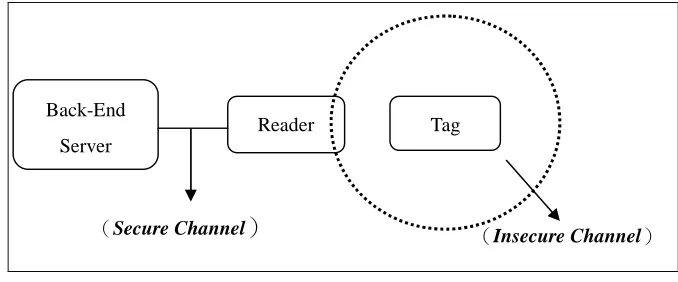
A typical RFID system has three parties: tag, reader, and back-end server, as shown in Fig. 1. When objects embedded with tags are to be identified, a reader emits an interrogation signal over the air. The tags in the range of the signal will answer the reader with authentication-related messages respectively. After receiving the responses, the reader passes it to the back-end server. The server, maintaining tags’ information, will confirm the legality of each tag. In addition, the communication channel between the tags and reader is a radio interface and is supposed to be insecure. Whereas the channel between the reader and back-end server is a fixed infrastructure and assumed to be secure in general. The insecure channel is vulnerable to various threats such as eavesdropping, business espionage, and tag masquerading.
Fig. 1. A typical RFID system
To counter these threats, many secure RFID authentication systems have been proposed. [2, 5, 8, 12, 13, 21, 28, 30]. In the following, we define seven important security issues about RFID systems according these works.
(1) Location privacy [5]:
An adversary can trace the location of a tag if the tag always outputs a fixed value.
(2) Forward secrecy [12, 21, 30]:
Even if an adversary can know all the resident data of a tag, the adversary should not be able to trace the tag through past conversions.
(Insecure Channel)
Tag
(Secure Channel) Back-End
Server
(3) Replay attack [5]:
An adversary resends data, which is ever transmitted from a tag (server), to a server (tag), whereas the server (tag) unconsciously accepts the data and believes the attacker is a valid tag (server).
(4) Impersonation attack [30]:
An adversary can successfully impersonate a server (tag) to authenticate himself to the tag (server) when he doesn’tknow the server’s (tag’s) secret data.
(5) Man-in-the middle attack [28]:
An adversary stands between a server and a tag and modifies both server-to-tag and tag-to-server messages to make them believe that they are talking to the intended party, respectively.
(6) Physical attack [5,8,13]:
An attacker can use physical means to undermine a tag to obtain the stored secrecy and further analyze them to deduce other tag’s privacy. Low-cost tag usually does not have a tamper-resistant device and thus cannot prevent this kind of attack. Hence, designing a secure RFID authentication protocol with physical-attack resistance becomes a desire task.
(7) Mutual authentication [2, 5]:
Mutual authentication means a tag should authenticate himself to a server, and vice versa.
We here classify the previous RFID authentication systems into non-public key cryptosystem (non-PKC)-based and PKC-based systems. Some non-PKC-based RFID systems use of simple bit-wise operations, like XOR, AND, OR, and rotation [7, 14-18], some support cyclic redundancy code (CRC) and pseudo random number generator, like the EPCglobal Class-1 Gen-2 RFID standard [9], some [2, 5, 11] adopt one-way hash functions, random number generating functions, or symmetric-key encryptions. However, the robustness of non-PKC-based RFID solutions using only simple bit operations, CRC, and PRNG are easily challenged. Moreover, they usually suffer from the scalability problem. The problem indicates that the back-end server always requires a linear search to identity a tag. In other words, the server must take
PKC-based RFID systems to be infeasible at present. Fortunately, many studies try to cheap PKC primitive implementations [22, 28, 31]; for example, [28, 31] implement an ECC scalar multiplication component using about 12.5K gates, [24] implements Rabin's encryption with cost about 17K gates, and [22]’s NTRU public encryption costs only about 3K gates. Besides, with the same security level, a RSA public-key encryption would require a key length of 1024 bits while ECC only needs 160 bits. Therefore, researchers believe that ECC could be a viable solution for low-cost RFID tags [26, 27, 28, 29].
Hence, in this paper, we will adopt ECC primitives [4] to design an efficient RFID mutual authentication protocol. Compared to previous related works, the proposed protocol is more efficient in both communicational and computational cost while achieving the same security level. The remaining of this paper is organized as follows. Section 2 reviews some recent RFID works and introduces the concept of ECC. We then present an efficient RFID mutual authentication scheme based on ECC in Section 3 and analyze its security in Section 4. The comparisons with other works and its discussion are presented in Section 5. Finally, a conclusion is given in Section 6.
2. Recent RFID studies
In this section, we briefly review recent RFID studies. We classify them into two types: non-PKC-based and PKC-based RFID systems, and discuss them in Section 2.1 and 2.2 respectively.
2.1 Non-PKC-based RFID systems
Ryu et al. [1] in 2009 proposed a hybrid solution for the privacy of RFID tags. In their design, the server stores the set of one-time values Δ={α1, ..., αm} in tag's memory, where αi= Epk{tagID||r}, r is a random number, and Epk(.) is a RSA encryption using public keypk. For each authentication, the tag sends a freshαito the server. The server can authenticate the tag in constant time O(1) by decrypting αi using its private key to obtain tagID. However, we consider that the size of αi might be too large and thus impractical for memory-limited low-cost tags. Because if the tag memory size is 2K bits and the security level of the RSA used in Ryu et al.’s system is 512-bit, then the number ofαia tag can store is only 4 (2048 / 512 = 4). This means the tag can be authenticated by the server at most 4 times.
token, and the other two for updating the old values,rtagandkatag. However, we found if an adversary maliciously queries a tag twice, the tag will update its key twice without the server’s updating its key simultaneously. This incurs the tag’s current key
katag cannot be recognized by the server and results in a de-synchronization error. Burnmester [17] in 2009 modified O-FRAP to O-RAP. Although O-RAP needs not to update the authentication keyktag; however, Duc et al. [7] in 2011 pointed that both O-FRAP and O-RAP are vulnerable to DOS (denial of service) attack. They also proposed a new solution. Unfortunately in their solution, we found that with only one physical attack on a tag, the common secret keyKS shared among the server and all tags will be known. The attacker then can masquerade as the server, authenticate himself to a tag by employing KS, and make the tag update its pseudonym with a wrong one. Of course, this wrong pseudonym cannot be recognized by the server anymore. .
Kang et al. [11] in 2008 proposed a secure RFID mutual authentication method for pervasive computing environments. Although they claimed their protocol is secure, we found it has a weakness. If an adversary eavesdrops on the reader-to-tag query,
G_keyir||G_keyiTS||H(r||TS) in the first session and replays the query to the tag in
the second. The tag will answer message, r metaID||H(r||metaID). This message is the same as the first session one. Because when the replay attack occurs,
r
will be the same as in the previous session (since r is computed byr-TS, andr
andTSare in the replayed query message) andmetaIDis a fixed value. Therefore, the adversary can easily track the location of the tag.
Liu et al. [2] in 2009 proposed a private authentication protocol for passive RFID tags in a retail store environment. However, we found their design makes the commodities traceable and leaks individual’s location privacy. More precisely, an adversary can do the following steps to track a person who carries a product embedded with a Liu et al.’s tag. The adversary first launches a physical attack on a tag to obtain the secret keykshared between the reader and tag. Then, the other tags in the same group (the same category of commodities) will be insecure. This is because tags in the same group employ the same secret key k. Consequently, the adversary can use this key to trace any tag in the group.
Cho et al. [5] in 2010 proposed a hash-based RFID mutual authentication protocol, trying to prevent a brute-force attack. However, we found there is a scalability problem existed in their scheme. Because in the authentication phase, the server must first extract tag’s ID (IDk) and secrecy sj stored in its database for generating βto compute Rt⊕β, then utilizesj and Rt to calculate RID, and generateα’by computing
h(IDk⊕Rt⊕Rr⊕RID) to check if equationα’=αholds, whereαis sent from the tag. It repeats this step for each tag stored in its database until a tag can satisfy the equation.
Song and Mitchell in 2011 [25] proposed a scalable RFID security protocol supporting tag ownership transfer. They claimed that their protocol requires only constant time to identify a tag. However, after a tag is maliciously queried more than
m times and then queried by the true server, the server requires performing a linear search to identify the tag. Moreover, in the tag secrecy update phase, after receivingr
and Ms(=gk(r||rT)(s||k’||m’)) from the server where, gk(.) is a hash function and
rT is tag’s one-time challenge, the tag computes gk(r||rT)Msto obtain S||K’||M’. It
then usesS to computeh (S) and examines whether the computedh(S) is equal to the old k. If it is, the tag updates k and c to K’and M’, respectively. However, if an adversary intercepts Ms and modifies the second l bits, obtaining Ms', then when the tag computes gk(r||rT)Ms', the second l bits of the computation result K’will be different from k' owned by the sever. This makes the tag and the server desynchronized.
2.2 PKC-based RFID systems
For this type of RFID systems, we further classify them into two kinds: (a) non-ECC based schemes, and (b) ECC based schemes. We describe them as follows.
(a) Non-ECC based schemes
Chen et al. in 2008 [19] proposed a private mutual authentication scheme based on quadratic residues (also referred as Rabin cryptosystem). In the scheme, the tag uses Rabin’s encryption to produce dynamic pseudonym and the server performs only one decryption to obtain the tag’s identify without requiring linear search. However, in 2008, Cao et al. [20] found Chen et al.’s scheme suffers from impersonation attack. In addition, in 2010, Yeh et al. [21] further pointed that Chen et al.’s scheme suffers the location privacy problem and replay attack. They further proposed an improvement. However, the improvement requires three Rabin’s encryptions and four hash operations on the tag side for each authentication. This computational overhead seems impractical for a power-limited low-cost tag.
For introducing ECC based RFID schemes, in this sections, we first briefly introduce the concepts of elliptic curve cryptography (ECC) and elliptic curve discreet logarithm problem (ECDLP), then discuss some ECC based schemes and their weaknesses.
(1) Elliptic curve cryptography and ECDLP
In 1985, Koblitz and Miller independently proposed the concept of ECC [32] which assumes that there exists an elliptic curve E: y2=x3+ax+b over a finite field, where
0 27
4a3 b2 and the finite field can be Z
P,F2, or others. All (x,y) points satisfying
this elliptic curve equation along with one infinite point O and an addition operation form a groupGwhich has the following properties.
A pointP which can generate all points in groupG is called a generator or base point. In addition, ifnP=O, thennis the order ofG.
For a pointP =(x,y) inG, its inverse is defined as–P =(x,-y). Addition rules:
- For allPG, P O O P P,P ( P) O.
- Let P,QG,P=(x1, y1), Q=(x2,y2) , and PQ. Then P+Q=(x3, y3), where x3 2 x1 x2,y3(x1 x3) y1, and
y
y
x
x
P
Q
x
a
y
P
Q
2 1 2 1 1 2 1
3
2
if
if
- Lets,tZn, for allPG, (s+t)P=sP+tP. Multiplication rules:
- LetkZn, for allPG,kP=P+P+…P, addingP ktimes. - Lets,tZn, for allPG,s(tP) =stP.
After introducing the concept of ECC, an ECDLP [32] can be defined as follows.
Definition 1. Let elliptic curve group G be defined as above, which has generator P
and ordern. GivenXGandYG, to find the integercZnsuch thatY=cX, is called Elliptic Curve Discrete Logarithm Problem (ECDLP) and is considered as hard.
(2) Some ECC based RFID schemes and their weaknesses
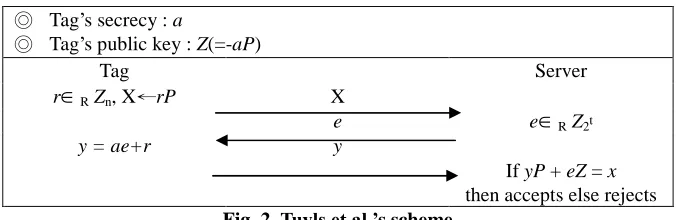
tag. Moreover, we found another privacy problem in their scheme. If an adversary first eavesdrops on the communication between a reader and a specific tag and obtains three values, X1 (= r1P), e, and y1 (= ae+r1), where a is the tag’s private key. Then, after receiving X2 (=r2P), he replays the challengee’(=e) to the unknown tag and obtains y2= ae+r2. As a result, he can identify the unknown tag as the specific tag if (y2- y1)Pequals toX2- X1. Besides, we think that Tuyls et al.’s protocol lacks forward secrecy. This is because when an adversary, performing above-mentioned steps, obtains the public keyZ(=-aP) of a tag, he can useZto track the past conversations of the tag. In addition, a scalability problem also exists in Tuyls et al.’s scheme. This is Because the server should fetch each tag’s public keyZ from its database to compute
yP + eZ for comparing with the received X1. This means the server requires linear search to identity each tag and thus increases considerable computational cost. Hence, their protocol lacks scalability.
◎ Tag’s secrecy :a
◎ Tag’s public key :Z(=-aP)
Tag Server
rRZn, X←rP X
e eRZ2t
y = ae+r y
IfyP+eZ=x then accepts else rejects
Fig. 2.Tuylsetal.’s scheme
Batina et al. in 2007 [27] proposed an ECC-based RFID identification protocol using Okamoto's identification, as shown in Fig. 3. Although they claimed their protocol can avoid active attacks, Lee et al. in 2008 [29] pointed their protocol exists a tracking problem. Because if an adversary obtains {X, e, y1,y2} and utilizes e-1 to obtainZ(=-y1P1- y2P2) by computing (X-y1P1-y2P2)e-1, whereZis tag’s public key, he can then use Z to track the tag. Moreover, we also found a forward-secrecy violation and a traceability problem existing in their scheme. This is BecauseX,e,y1 and y2 are publicly transferred and both P1 and P2 are system parameters. If an adversary first eavesdrops on the communication between the tag and reader, he can obtain the value e.Z by computing X - y1P1 - y2P2. Then, in another conversation, when the tag transfers X’to the reader, the adversary can impersonate the reader to communicate with the tag by sending a challenge e’=e+1 to the tag. If the tag answersy’1 andy’2, then the adversary can obtain the valuee’.Z by computingX’
◎ Tag’s secrecy :s1ands2
◎ Tag’s public key :Z(=-y1P1- y2P2)
Tag Server
r1,r2RZn
X←r1P1+ r2P2 X
e eRZ2t
y1= r1+es1 y2= r2+es2
y1,y2
Ify1P1+y2P2+eZ=x then accepts else rejects
Fig. 3.Batina etal.’s scheme
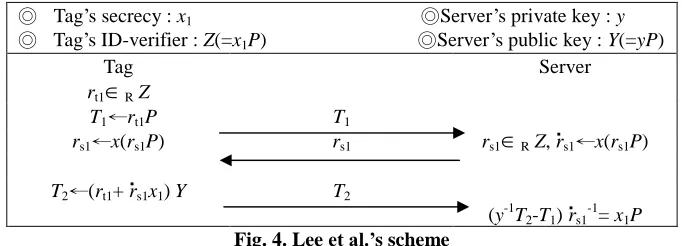
Lee et al. in 2010 [28] proposed an ECC-based RFID authentication protocol, as shown in Fig. 4, to address the tracking problems existing in [26, 27]. In the figure,rs1 =x(rs1P), indicating thex-coordinate ofrs1P, plays the key role to resist the possibility of linear operations on previous eavesdropped data to avoid privacy leakage like in [26, 27]. However, their protocol only considers tag-to-reader authentication, excluding reader-to-tag authentication. This makes tags easy to suffer malicious queries, because they are not capable of confirming whom they are talking to.
From the above mentioned, we know that there still lacks a secure RFID system to resist against possible attacks. Hence, in the following, we proposed a novel protocol possessing mutual authentication to resolve this problem.
◎ Tag’s secrecy :x1 ◎Server’s private key :y
◎ Tag’s ID-verifier :Z(=x1P) ◎Server’s public key :Y(=yP)
Tag Server
rt1RZ
T1←rt1P T1
rs1←x(rs1P) rs1 rs1RZ,rs1←x(rs1P) T2←(rt1+rs1x1)Y T2
(y-1T2-T1)rs1-1=x1P
Fig. 4. Leeetal.’s scheme
3. The proposed scheme
In this section, we present an ECC based RFID scheme in Section 3.1 and exemplify it in Section 3.2. There are two roles: server/reader and tag in our RFID system. As in traditional RFID systems, we use server to stand for server/reader and assume that the communication between the server and tag is insecure. Our protocol consists of two phases: (1) setup phase, and (2) authentication phase. Before describing these two phases, we first introduce some notations used.
G: a group of orderqon an elliptic curve,
xi: tagi's private key,
IDi= Xi(=xiP): tagi’s identify,
y: server’s private key,
Y(=yP): server's public key,
Cs, C: two counters,
r,k: two random numbers inZq, h: an one-way hash function
3.1 Our scheme
Our scheme consists of two phases. We demonstrate them as follows.
(a) Setup phase
In this phase, the server chooses a random number yZqas his private key and sets
Y(= yP) as its public key. It also choosesxiZqas the private key for tagiand setsXi (= xiP) as tagi’s identity IDi. In addition, the server stores each tagi’s identity and information in its database, where the information includes the name of the tag and production number, etc., as shown in Table 1.
Finally, the server initializes a counter valueCsto one and stores each tagi’s data [xiP, Y, P, C] in the memory, whereCis tagi’s counter initialized to zero.
Table 1. Server’s database containing tags’identity and information
identity information IDi=Xi(=xiP) name, production number
(b) Authentication phase
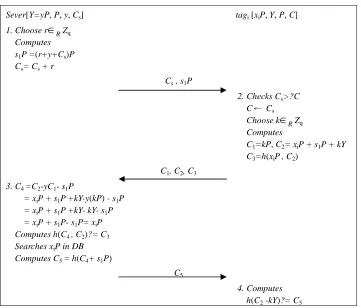
In this phase, the server chooses a random numberrZq and computess1P= (r +
y + Cs)P. It then sendsCs,s1Pto the tag and then incrementsCsbyr. After receiving the message, tagi checks whetherCs> C holds. If so, it replaces Cby Cs and picks a random numberkZq. Then, it computesC1=kP,C2=xiP+ s1P + kY, andC3=h(xiP,
C2), and sends these three values to the server. After receiving the values, the server utilizes its private keyy to computeC4=C2-yC1-s1P(= xiP+ s1P-s1P) = xiP. Then, it searches tagi’s identityIDi(=Xi=xiP) in the database. If found, the server computes
Sever[Y=yP,P,y,Cs] tagi[xiP,Y,P,C] 1. Choose rRZq
Computes s1P =(r+y+Cs)P Cs= Cs+ r
Cs, s1P
2. Checks Cs>?C C← Cs Choose kRZq Computes
C1=kP,C2= xiP + s1P + kY C3=h(xiP , C2)
C1, C2, C3
3. C4=C2-yC1- s1P
= xiP + s1P +kY-y(kP)- s1P = xiP + s1P +kY- kY- s1P = xiP + s1P- s1P= xiP Computes h(C4, C2)?= C3 Searches xiP in DB Computes C5= h(C4+ s1P)
C5
4. Computes h(C2-kY)?= C5
Fig. 5. Proposed RFID mutual authentication scheme
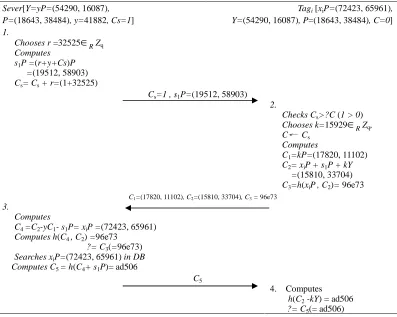
3.2 Example
In this section, we demonstrate the correctness of our scheme by running a program. Below, we first show the platform for running the program in part (a), then demonstrate the result in part (b).
(a) Platform
Our machine is equippedwith Intel(R) Pentium(R) CPU 2.00 GHz with 2 GB of RAM on windows XP. In the experiment, the Pairing-Based Cryptography (PBC) [23] library is used for implementing the proposed scheme. It is a C library that can perform EC point multiplications and pairing-based calculation. In addition, we also use an one-way hash function HashMyFiles [6] in our scheme.
(b) Exemplify
Sever[Y=yP=(54290, 16087), P=(18643, 38484), y=41882, Cs=1]
Tagi[xiP=(72423, 65961), Y=(54290, 16087), P=(18643, 38484), C=0] 1.
Chooses r=32525RZq Computes
s1P =(r+y+Cs)P =(19512, 58903) Cs= Cs+ r=(1+32525)
Cs=1 , s1P=(19512, 58903) 2.
Checks Cs>?C(1 > 0) Chooses k=15929RZq, C← Cs
Computes
C1=kP=(17820, 11102) C2= xiP + s1P + kY
=(15810, 33704) C3=h(xiP , C2)=96e73
C1=(17820, 11102), C2=(15810, 33704), C3=96e73 3.
Computes
C4=C2-yC1- s1P= xiP =(72423, 65961) Computes h(C4, C2)=96e73
?= C3(=96e73) Searches xiP=(72423, 65961)in DB Computes C5= h(C4+ s1P)= ad506
C5
4. Computes h(C2-kY) = ad506 ?= C5(= ad506)
Fig. 6. An example for the proposed RFID mutual authentication scheme
4. Security analysis
In the following, we will probe some attacks, which often occur in a RFID system, on our scheme. After analyzing, we found no attack on our protocol can work. The analyses are shown in the following.
(a) Location privacy:
An attacker E cannot know the location of the tag in our scheme, since the tag randomly chooses a valuekin each session, so that each response {C1,C2,C3} to the server is different. If E eavesdrops on the transmitted information and gets two responding messages, {C1, C2, C3} and {C1’, C2’, C3’} where C1(=kP),
C2(=xiP+s1P+kY),C3= h(xiP, C2),C1’(=k’P), C2’(=xiP+s1’P+k’Y), andC3’=h(xiP,
C2’). He tries to compute C2- s1P-C2’- s1’P (=kY- k’Y) to relate to a specific tag. But this affords no clue for him to attain this goal, sincekand k’are twp random numbers.
(b) Replay attack:
second message flow {C1=k’P,C2=xiP+ s1’P-k’P,C3= h(xiP, C2)} in a previous session. He then replays C1,C2, and C3 to the server. The server’s authentication cannot succeed as well. Because in the server side, the computation result of C4=
C2-yC1-s1P=xiP+ s1’P-s1Pyields no information aboutxiPin its database. (c) Man-in-the middle attack:
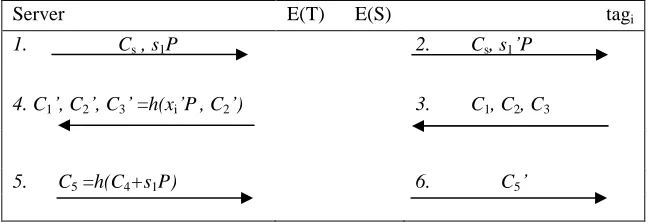
Suppose E launches a man-in-the middle attack (MIMA) between the server and the tag, we describe the details as follows and also illustrate it in Fig.7.
Step 1: The sever chooses a random number r, computes s1P=(r+y+Cs)P, and sends {Cs, s1P} to the tag.
Step 2: E intercepts the message {Cs, s1P}. It chooses another random number r’ and utilizes Y(=yP), and Cs to compute s1’P=(r’+Cs)P+Y and impersonates the server by sending {Cs, s1’P} to the tag.
Step 3: After receiving the message, the tag computes C1(=kP), C2(=xiP+ s1’P +
kY), andC3=h(xiP, C2), and then sends {C1, C2, C3} to the server.
Step 4: E intercepts the message {C1, C2, C3} sent by the tag to the server. However, E does not know tagi’s secret xiP. E chooses a new xi’and random number k’to compute C1’(=k’P), C2’(=xi’P+ s1’P + k’Y), and
C3’=h(xi’P, C2’), and masquerades as the tag by sending {C1’, C2’, C3’} to the server.
Step 5: After receiving the message, the server computes C4= C2’-yC1’- s1P (=xi’P+ s1’P- s1P≠xiP). Obviously, the server cannot use C4 to find out Tagi’s identity IDi(=xiP). It means the server’s authentication fails for Tagi. As a result, the server will not compute C5= h(C4+s1P) = h(xiP +s1P) to send it to the tag for authentication.
Step 6: Even receivingC5 from the server, if E wants to impersonate server to the tag, he must generate C5’= h(xiP+s1’P) for the tag’s authentication. However, not having tag’s secret xiP, E cannot compute and send C5’to the tag. It means E cannot pass tag’s authentication. Therefore, the MIMA fails.
Server E(T) E(S) tagi
1. Cs, s1P 2. Cs, s1’P
4. C1’, C2’, C3’=h(xi’P , C2’) 3. C1, C2, C3
5. C5=h(C4+s1P) 6. C5’
(d) Impersonation attack:
If E wants to impersonate the tag to the server, he will fail. This is because E must use the tagi’s secret xiPto compute validC2andC3for the server’s authentication. Conversely, if the attacker wants to impersonation the server to the tag, he must use xiP to compute C5. However, without the server’s computed value C4(=xiP), he cannot have valueC5(=h(C4+s1P)) to pass tagi’s authentication.
(e) Physical attack:
Even if E uses physical means to obtain the secretx1Pof tag1, he still cannot know the secret of the other tag, tag2. For example, if E eavesdrops on the communication between tag2 and the server. He can obtain {Cs’,s1’P}, and tag2’s transmitted values {C1’(= k’P), C2’(= x2P+s1’P+k’Y), C3’(= h(x2P, C2’))}. However, by using these values, E cannot obtain x2P. For example, if E tries to computeC2’- s1’P - x1P=x2P +s1’P+ k’Y- s1’P -x1P, he still cannot obtainx2P, the secret of tag2.
(f) Forward secrecy:
If E compromises tagi’s resident data xiP, he cannot identify the tagi by tracing though any previous communications. For example, if E eavesdrops on two successive rounds and obtains C2(=xiP+s1P+kY), s1P(=(r+y+Cs)P) and
C2’(=xiP+s1’P+k’Y), s1’P(=(r’+y+Cs’)P) respectively. He wants to utilize the secrecy xiP of tagi to determine whether the two messages {C1, C2, C3(= h(xiP,
C2))} and {C1’,C2’,C3’(=h(xiP,C2’))} come from the same tag by calculatingC2
-s1P - xiP=kY(=kyP)andC2’- s1’P - xiP= k’Y(=k’yP). E will fail. Sincekandk’are two random numbers without any relationship existing between them.
(g) Mutual authentication:
In our scheme, the server computes C4= C2-yC1-s1P = xiP to search xiP in the database, to check whether tagi is legal or not. Conversely, tagi also computes
h(C2- kY) and checks if it is equal to the receivedC5(sent from the server) to see whether the server is legal. We know that only legal tagi has valid xiP inC2 to let server deducexiP and search it in the database, and only legal server has the right
xiPstored in its database and sends backh(xiP+s1P) to pass the tag’s examination. Thus, our protocol can achieve mutual authentication.
5. Comparisons and discussions
(a) Comparisons
sides, as shown in Table 3.
Table 2. Comparisons of security properties
Tuyls et al. [26]
Batina et al. [27]
Lee et al.
[28] Ours
1.Location privacy No No Yes Yes
2.Replay attack Yes Yes Yes Yes
3.Man-in-the middle attack No No Yes Yes
4.Impersonation attack Yes No Yes Yes
5.Physical attack No No Yes Yes
6.Forward secrecy No No Yes Yes
7.Mutual authentication No No No Yes
Table 3. Comparisons of EC point multiplications
Tuyls et al. [26]
Batina et al. [27]
Lee et al.
[28] Ours
Server (2, 0) (4, 0) (3, 0) (2, 2)
(ECm, h)
Tag (1, 0) (2, 0) (3, 0) (2, 2)
ECm: EC point multiplication, h: hash operations
(b) Discussion
In our original design, the server sendsCs,ands1to the tag and the tag stores [xi, Y,
P, C] in its memory. This makes the tag needs four EC point multiplications. To reduce tag’s computational cost to two EC point multiplications, we modifys1tos1P and the tag’s private key xi to xiP in our final design. Besides, we demonstrate a practical example for showing the correctness of our scheme by running a program on windows XP with Intel(R) Pentium(R) CPU 2.00 GHz platform.
6. Conclusion
Appendix A
Experiment Result
A primitive element of G isP=
(1864324486434850227783519368629946432888504140613037180525899370798695911457178224 27675982310639640467155950411685064127611068763687818597296963230218232655312750197 73864099548629872027047963788692390250657550479197187400976748449789718327655970819 73526229813085333316652674955403157257518011227074949771532,
38484719811712723182957235852049806475511114895074053222385524382322335199704929343 53234514016493188548494141099161148579906118597615692595324507278248188701227429183 99163363371415810767694690477641028005923934761548429251228286173661574304409980803 400768807280860207024464468693129124308661985411675966211)
Tag’s identify isIDi= Xi(=xiP)=
(7242322798390552616928430065384098213668056329337129732939288955815330430944472012 56903693720629729347590016769573955056769666463922944052429462204338974955611316126 16195276953303204402426630587939077611154383010050124586763292534195069441002864392 76493127326325283149785692796402928355350394892711021839502,
65961993256936313361862378390051388559421088347199426209626749250228272117054182695 09042000350442246273989721196342784199676621666568366358795425724062413130186891352 35374645378394415172722578621912659681428828564395424337700945693661194210783286800 1227085322739023656766696908596084171368751625730392632043)
Server’s private key isy= 418820375757740693506812350424839701567646631122
Server's public key isY(=yP)=
(5429040498468109167447644585695603521714900614799008620617061198080169289363171158 04737439098288144341725949616255421186544551097055922496720554520259244303180352379 27634023652980187761607645080742244280945059824663324755375176338508211611350162738 09958948943768853982861813426010399739682626990591597078231,
16087420029241952725558420179856732463497884480380203053655447126407507641801653758 49906764021712588492195214241294235512393270620114372313281954028001692180231279417 80808604201890381509160698387868287119132549993643581791113213468504210509779771663 2755691584029114936503377377375511103262359518600705745470)
Server’sCs= 1
Server choose random numberr= 325255910598570747402344376650384037501906289352
Server computess1P =(r+y+Cs)P=
(1951238790360410153362708817191893424738880020392150369776842271017979117281163862 55218218320503094899707635363892082696724427538890550138251913244394868448506145088 84956403125229310653305389037784046903379351324916352058154508855766016428647546257 26204642257050079190813671244811431134506322925050479318525,
60886317331718984270961489113529354879181934987090046783596341790364590342472101530 61492796745128612664881772243599012522482360092703752740569035530004106679587344414 6206278047128301929657101425768256596687824898203663501600)
Tag'sC= 0
Tag choose random numberk= 159291522284677507776829529633828697130120254054
Tag computesC1= kP=
(1782015809338736716327926743507224929602093484974270113442902076353548749592686966 32899265118201622739657523839336549040304026221678633266461234237461786550666375585 02991457799222964851977693437929055937801479254541260523857359458431889425255576041 19711416757840961281965559322398740924041863697772967566700,
11102563590065534737602480302962423813962596981312733818669824699916935062706407430 46060799415273826327614932986029303793320589012466439857811164970469817626247033331 40448925742887664695140458598754285881982634764573231154852169469229530973941374510 0230904390461016035424094537272987277731801011503201918431)
Tag computesC2= x1P+s1P+kY=
(1581094412563122448153827726401533251920211158222231383792227146219531847555621683 20859204299749206725335829618884124641636374664049140415780454568099300207685133369 30548478442408877671652843480269025394770126776326973042829790351144390722373253069 80152288527926031224519625850328961832810355675177868942049,
33704258534231240037405407153077601584000067098203144509115203822799080583789709934 91566595983991914339760962994231799428328229693810144092223579166686898759526283328 71932807032185693258445848727677565893380461001438759971759087855699600472263727661 3058695125428824490534201461480166748954151110856361659818)
Tag computesC3=h(xiP, C2) =96e73d889070ad0196320be96cf9c538
Server computes C4=C2-yC1- s1P=tag’s ID=xiP=
(7242322798390552616928430065384098213668056329337129732939288955815330430944472012 56903693720629729347590016769573955056769666463922944052429462204338974955611316126 16195276953303204402426630587939077611154383010050124586763292534195069441002864392 76493127326325283149785692796402928355350394892711021839502,
65961993256936313361862378390051388559421088347199426209626749250228272117054182695 09042000350442246273989721196342784199676621666568366358795425724062413130186891352 35374645378394415172722578621912659681428828564395424337700945693661194210783286800 1227085322739023656766696908596084171368751625730392632043)
Server computesh(C4,C2)=96e73d889070ad0196320be96cf9c538
Server checksh(C4,C2)=C3
Server searchesxiPto find out the tag’s ID in DB. Tag’s ID=
56903693720629729347590016769573955056769666463922944052429462204338974955611316126 16195276953303204402426630587939077611154383010050124586763292534195069441002864392 76493127326325283149785692796402928355350394892711021839502,
65961993256936313361862378390051388559421088347199426209626749250228272117054182695 09042000350442246273989721196342784199676621666568366358795425724062413130186891352 35374645378394415172722578621912659681428828564395424337700945693661194210783286800 1227085322739023656766696908596084171368751625730392632043)
Server computesC5=h(C4+s1P) =ad506dfba13a3ccfb24fade2cd9210a9
Tag computesh(C2-kY)=ad506dfba13a3ccfb24fade2cd9210a9
Tag checksh(C2-kY) =C5
References
[1] E.-K. Ryu, and T. Takagi, “A hybrid approach for privacy-preserving RFID tags,”Computer Standards & Interfaces, Vol. 31, 2009, pp. 812-815.
[2] Alex X. Liu, and LeRoy A. Bailey, “A privacy and authentication protocolfor passive RFID tags,”Computer Communications, Vol. 32, 2009, pp. 1194-1199. [3] EasyCard,http://www.easycard.com.tw/.
[4] Wenbo Mao,Modern Cryptography - Theory And Practice, 2003, Prentice Hall, pp.196-203.
[5] J.S. Cho, S.S. Yeo, and S.K. Kim, “Securing against brute-force attack:A hash-based RFID mutual authentication protocol using a secret value,”Computer Communications, Vol. 34, 2011, pp. 391-397.
[6] NirSoft,http://www.nirsoft.net/.
[7] D. N. Duc, and K. Kim, “Defending RFID authentication protocolsagainstDoS attacks,”Computer Communications, 2010.
[8] S. Devadas, E. Suh, S. Paral, R. Sowell, T. Ziola, V. Khandelwal, “Design and implementation of PUF-based unclonable RFID ICs for anti-counterfeiting and security applications,”in: Proceedings of the IEEE International Conference on RFID, April 2008, pp. 58–64.
[9] EPCglobal, http://www.epcglobalinc.org.
[10] X. Lin, R. Lu, D. Kwan, and X. (Sherman) Shen, “An RFID-based privacy-preserving children tracking scheme for large amusement parks,”
Computer Networks, 2010.
[11] S.-Y. Kang, D.-G. Lee, and I.-Y. Lee, “A study on secure RFID mutual authentication scheme in pervasive,”Computer Communications, Vol. 31, 2008, pp. 4248-4254.
[12] M. Ohkubo, K. Suzuki and S. Kinoshita, “Cryptographic Approach to
“Privacy-Friendly”tags,” RFID Privacy Workshop 2003, MIT, November 2003. [13] S. Weis, S. Sarma, R. Rivest and D. Engels, “Security and Privacy Aspectsof
Low-Cost Radio Frequency Identification Systems,”Security in Pervasive Computing, March, 2003.
[14] B. Alomair, A. Clark, J. Cuellar, and R. Poovendran,“ScalableRFID Systems:a Privacy-Preserving Protocol with Constant-Time Identification,”Security in Pervasive Computing, March, 2003.
Identification Systems,”Computer Communications, 2010.
[16] T. V. Le, M. Burnmester, and B. de Medeiros, “Universally Composableand Forward-secure RFID Authentication and Authenticated Key Exchange,”The Proceedings of the Second ACM Symposium on Information, Computer and Communications Security, March 2007, pp. 242–252.
[17] M. Burnmester, “Universally Composable RFID Identification and Authentication Protocols,”ACM Transactions on Information and Systems Security, January 2009.
[18] T. Yeh, Y. Wanga, T. Kuo, and S. Wang,“Securing RFID systemsconforming to EPC Class 1 Generation 2 standard,”Expert Systems with Applications, Vol. 37, 2010, pp. 7678–7683.
[19] Y. Chen and J.S. Chou, and H.M. Sun, “A novelmutualauthentication scheme based on quadratic residues,”Computer Networks, Vol. 52, 2008, pp. 2373–2380. [20] T. Cao, and P. Shen, “CryptanalysisofsomeRFID authentication protocols,”
JOURNAL OF COMMUNICATIONS, VOL. 3, NO. 7, DECEMBER 2008.
[21] T.C. Yeh, C.H. Wua, Y.M. Tseng, “Improvement of the RFID authentication scheme based on quadratic residues,”Computer Communications, Vol. 34, 2011, pp. 337–341.
[22] S. V. Kaya, E. Savaş, A. Levi and Ö. Erçetin, “Publickey cryptography based privacy preserving multi-context RFID infrastructure,”Ad Hoc Networks, Vol. 7, 2009, pp. 136–152.
[23] PBC Library, http://crypto.stanford.edu/pbc/.
[24] G. Gaubatz, J. P. Kaps, E. Ozturk, and B. Sunar, State of the Art in Ultra-Low Power Public Key Cryptography for Wireless Sensor Networks, Proc. in the Third IEEE International Conference on Pervasive Computing and Communications Workshops (PERCOMW'05), 2005.
[25] B. Song, C. J. Mitchell, “Scalable RFID security protocols supporting tag ownership transfer,”Computer Communications, Vol. 34, 2011, pp. 556–566. [26] P. Tuyls, L. Batina,“RFID-tags for Anti-Counterfeiting,”Lecture Notes in
Computer Science, Volume 3860, 2006, Pages 115-131.
[27] L. Batina, J. Guajardo, T. Kerins, N. Mentens, P. Tuyls, I. Verbauwhede,
“Public-Key Cryptography for RFID-tags,”Fifth IEEE International Conference on Pervasive Computing and Communications Workshops, 2007, Pages 217-222
[28] Y. K. Lee, L. Batina, D. Singelee, B. Preneel, I. Verbauwhede,
“Anti-counterfeiting Untraceability and Other Security Challenges for RFID Systems- Public-Key-Based Protocols and Hardware,”Information Security and Cryptography, Part 5, 2010, Pages 237-257.
[29] Y. K. Lee, L. Batina, I. Verbauwhede,“EC-RAC (ECDLP Based Randomized Access Control): Provably Secure RFID authentication protocol,”IEEE International Conference on RFID, 2008, Pages 97-104.
[30] Y. K. Lee, L. Batina, I. Verbauwhede,“UntraceableRFID authentication
protocols: Revision of EC-RAC,”IEEE International Conference on RFID, 2009, Pages 178-185.