Available Online atwww.ijcsmc.com
International Journal of Computer Science and Mobile Computing
A Monthly Journal of Computer Science and Information Technology
ISSN 2320–088X
IMPACT FACTOR: 6.199
IJCSMC, Vol. 8, Issue. 6, June 2019, pg.147 – 152
A Comparative Study of Hash
Algorithms in Cryptography
Prashant P. Pittalia
Department of Computer Science, S. P. University, India
Abstract— In Network Security and Cryptography, hash functions play a very important role. To check the Integrity, Authenticity of information or data transmitting between the Seder and receiver party hash algorithms are used. Digital signature also uses the hash algorithm. Hash function used for key generation in Symmetric and Asymmetric Key Cryptosystems. Different algorithms provide different level of security depending on how difficult is to break them. The most well-known hash algorithms are 1, 2, SHA-3, MD4, MD5 and Whirlpool etc. This paper discusses importance of hash functions, description about various well known hash functions, and comparative analysis of various hash algorithms.
Keywords— SHA 1, MD5, Integrity, Hash Algorithm, Cryptography
I. INTRODUCTION
determining what the original message was by being given the digest. This property makes this hash functions a one-way function, it is not possible to deduce the input for a given output. Cryptographic hash functions have another property that it is very difficult to find two different messages that produce the same message digest. To provide the data integrity and data authentication, if a message digest of any information is changes, then the file itself has changed.
II. HASHING ALGORITHMS
In today's Internet environment, MD5 and SHA1 are two primarily cryptographic hash functions. MD5 stands for “Message Digest 5” because it is the fifth revision of a message digest algorithm devised by R.L. Rivest of RSA Laboratories (RSA Laboratories). The early revisions of this algorithm were published prior to 1989, and the most recent revision of the algorithm was published in 1991. SHA1 stands for “Secure Hash Algorithm 1”; it is the first revision of a hash algorithm developed by the National Security Agency. The algorithm was first published in 1995. SHA1 supports messages of any length less than 264 bits as input, and produces a 160-bit digest. If input data for the hash function larger than 264 bits in length the simplest solution would be to divide the large messages into smaller messages. There are other variations of SHA1 which produce longer digests, SHA-256, SHA-512. They produce digests of 256 bits and 512 bits, respectively. The SHA1 and MD5 algorithms are considered secure because there are no known techniques to find collisions, except via brute force. In a brute force attack random inputs are tried, storing the results until a collision is found. SHA1 is more secure than MD5, but it is more costly to compute a message digest using SHA1 than MD5. One-way Hash Function (OWHF) defined by Merkle [1] is a hash function H, that satisfies the following requirements:
1. H can be applied to Block of data of any length. (Any length means size of Block must be greater
Than size of Digest we conclude at the end).
2. H produces a fixed-length output i.e., Message Digest.
3. Given H and x (any given input), it is easy to computer Message Digest H(x). 4. Given H and H(x), it is computationally infeasible to find x.
5. Given H and H(x), it is computationally infeasible to find x and x’ such that H(x) = H (x’) for message authentication and digital signature the first three requirements are must for practical applications. The fourth states that it is easy to generate a message code of given message but very difficult to generate a message back from given digest. The fifth requirement guarantees that an alternative message hashing to the same code as a given message cannot be found.
A. MD5
modulo 264. The main MD5 algorithm operates on a 128-bit state, divided into four 32-bit words, denoted A, B, C, and D. These are initialized to certain fixed constants. The main algorithm then uses each 512-bit message block in turn to modify the state. The processing of a message block consists of four similar stages, termed rounds; each round is composed of 16 similar operations based on a non-linear function F, modular addition, and left rotation.
B. Whirlpool
It was designed by Vincent Rijmen (co-creator of the Advanced Encryption Standard) and Paulo S. L. M. Barreto, who first described it in 2000. The hash has been recommended by the NESSIE project. It has also been adopted by the International Organization for Standardization (ISO) and the International Electrotechnical Commission (IEC) as part of the joint ISO/IEC 10118-3 international standard. The Sub Bytes operation applies a non-linear permutation (the S-box) to each byte of the state independently. The 8-bit S-box is composed of 3 smaller 4-bit S-boxes. The Shift Columns operation cyclically shifts each byte in each column of the state. Column j has its bytes shifted downwards by j positions. The Mix Rows operation is a right-multiplication of each row by an 8×8 matrix over {\display style GF ({2^ {8}})} {\display style GF ({2^ {8}})}. The AddRoundKey operation uses bitwise xor to add a key calculated by the key schedule to the current state. The key schedule is identical to the encryption itself, except the AddRoundKey function is replaced by an AddRoundConstant function that adds a predetermined constant in each round. The block cipher W consists of an 8×8 state matrix {\displaystyle S} S of bytes, for a total of 512 bits. The encryption process consists of updating the state with four round functions over 10 rounds. The four round functions are SubBytes (SB), ShiftColumns (SC), MixRows (MR) and AddRoundKey (AK). During each round the new state is computed as {\displaystyle S=AK\circ MR\circ SC\circ SB(S)} S=AK\circ MR\circ SC\circ SB(S).
C. SHA- 1
In cryptography, SHA-1 (Secure Hash Algorithm 1) is a cryptographic hash function which takes an input and produces a 160-bit (20-byte) hash value known as a message digest. All major web browser vendors ceased acceptance of SHA-1 SSL certificates in 2017. [3][4][5] Several widely used security applications and protocols, TLS and SSL, PGP, SSH, S/MIME, and IPSec may use SHA-1. It is also used to identify that during transmission of information from sender to receiver is any changes occur or not.
One iteration within the SHA-1 compression function:
A, B, C, D and E are 32-bit words of the state; F is a nonlinear function that varies; left shiftn denotes a left bit rotation by n places; n varies for each operation; Wt is the expanded message word of round t; Kt is the round constant of round t; Addition denotes addition modulo 232.
D. SHA - 2
2 variants are 224, 256, 384, 512, 512/224, and SHA-512/256. SHA-2 includes
A significant number of changes from its predecessor, SHA-1. SHA-2 consists of a set of six hash functions with digests that are 224, 256, 384 or 512 bits. SHA-256 and SHA-512 are novel hash functions computed with 32-bit and 64-bit words, respectively. They use different shift amounts and additive constants, but their structures are otherwise virtually identical, differing only in the number of rounds. The SHA-2 functions were not easily adopted in compare to SHA-1. Reasons was that the lack of support for SHA-2 on systems running Windows XP SP2 or older and a lack of perceived urgency since SHA-1 collisions had not yet been found. From 2017, Microsoft announced that Internet Explorer and Edge would stop honouring public SHA-1-signed TLS certificates. From 2014-15 Google Chrome team announced a plan to make their web browser gradually stop honouring SHA-1-dependent TLS certificates. In January 2016, Mozilla disabled SHA-1 but had to re-enable it temporarily via a Firefox update, after problems with web-based user interfaces of some router models and security appliances.
Fig. 2 One SHA-2 Iteration [8]
E. SHA - 3
It is the latest standard released by NIST on August 5, 2015. SHA-3 is internally different from the MD5-like structure of SHA-1 and SHA-2. NIST does not currently plan to withdraw SHA-2 or remove it from the revised Secure Hash Standard. The purpose of SHA-3 is that it can be directly substituted for SHA-2 in current applications if necessary, and to significantly improve the robustness of NIST's overall hash algorithm toolkit. [6]
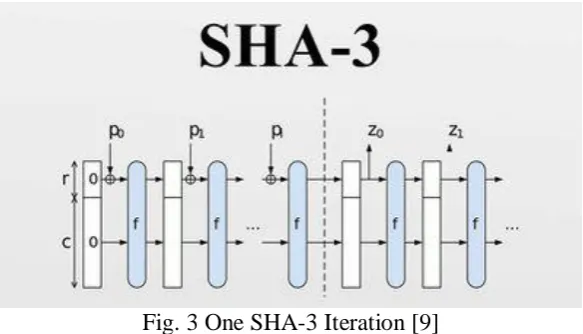
To ensure the message can be evenly divided into r-bit blocks, padding is required. SHA-3 uses the pattern 10*1 in its padding function: a 1 bit, followed by zero or more 0 bits (maximum r − 1) and a final 1 bit.
Fig. 3 One SHA-3 Iteration [9]
The sponge construction for hash functions. Pi are input, Zi are hashed output. The unused "capacity" c should be twice the desired resistance to collision or preimage attacks.
III.COMPARISON OF HASH ALGORITHMS WITH PARAMETERS
In following table the comparison between the various cryptographic hash algorithms like MD5, SHA-1, SHA-2, SHA-3 and Whirlpool shows with various parameters.
TABLE-I Hash Algorithms Comparisons
Parameters MD5 SHA-1 SHA-2 SHA-3 Whirlpool Block size
(bits)
512 512 512,1024 1600-2*bits 512
Digest size (bits)
128 160 160,224,256,384,512 160,224,256,384,512 512
Word size (bits)
32 32 32,64 64 8
Rounds 4 80 80 24 10
Collision found
Yes Theoretical attack
None None Yes
Operations and,or,xor,rot and,or,xor,rot and,or,xor,rot,shr and,or,xor,rot,shr and,or,xor,rot
CONCLUSIONS
Cryptographic integrity and security should be provided with the proper implementation of the proper hash algorithm. The detail design of each hash function is provided. We discuss the MD5, variants of SHA and Whirlpool algorithms by considering the various parameters. In current scenario in digitization it is very important that when the digital certificates are issued to the particular organization, people or device that certificate must use the proper has function to provide the integrity of the data as well as to authenticate the legitimate user.
R
EFERENCES
[1] R.C. Merkle, "One Way Hash Functions and DES", in CRYPTO, 1989, pp.428-446.
[2] Kleppmann, Martin (2 April 2017). Designing Data-Intensive Applications: The Big Ideas Behind Reliable, Scalable, and Maintainable Systems (1 ed.). O'Reilly Media. p. 203. ISBN 978-1449373320.
[4] "Google will drop SHA-1 encryption from Chrome by January 1, 2017". VentureBeat. 2015-12-18. Retrieved 2019-05-29.
[5] "The end of SHA-1 on the Public Web". Mozilla Security Blog. Retrieved 2019-05-29.
[6] "Announcing Request for Candidate Algorithm Nominations for a New Cryptographic Hash Algorithm (SHA-3) Family [U.S. Federal Register Vol. 72 No. 212)]" (PDF). November 2, 2007. Archived (PDF) from the original on March 31, 2011. Retrieved July 18, 2017.
![Fig. 1 One SHA-1 Iteration[7]](https://thumb-us.123doks.com/thumbv2/123dok_us/1892098.1247342/3.595.177.417.518.717/fig-one-sha-iteration.webp)
![Fig. 2 One SHA-2 Iteration [8]](https://thumb-us.123doks.com/thumbv2/123dok_us/1892098.1247342/4.595.183.415.371.539/fig-one-sha-iteration.webp)