O R I G I N A L R E S E A R C H
Circulating syndecan-1 as a novel biomarker
relates to lung function, systemic in
fl
ammation,
and exacerbation in COPD
This article was published in the following Dove Press journal:
International Journal of Chronic Obstructive Pulmonary Disease
Diandian Li,1,* Yanqiu Wu,1,* Shujin Guo,2,* Jiangyue Qin,1 Mei Feng,1Yunfei An,3 Junlong Zhang,3Yanping Li,4 Shuguang Xiong,5Hui Zhou,6 Qianglin Zeng,6Lei Chen,1 Fuqiang Wen1
1Department of Respiratory and Critical Care
Medicine, West China Hospital of Sichuan University and Division of Pulmonary Diseases, State Key Laboratory of Biotherapy of China, Chengdu 610041, People’s Republic of China;
2Department of Internal Medicine, Sichuan
Provincial People’s Hospital and Sichuan Academy of Medical Science, Chengdu 610072, People’s Republic of China;3Department of
Laboratorial Medicine, West China Hospital of Sichuan University, Chengdu 610041, People’s Republic of China;4Department of Respiratory
and Critical Care Medicine, The 3rd People’s Hospital of Chengdu, Chengdu 610031, People’s Republic of China;5Department of
Respiratory and Critical Care Medicine, 416 Hospital, Chengdu 610051, People’s Republic of China;6Department of Respiratory and Critical
Care Medicine, Affiliated Hospital of Chengdu University, Chengdu 610081, People’s Republic of China
*These authors contributed equally to this work
Introduction: Patients with COPD often show increased systemic inflammation which is
associated with lower functional status, greater exacerbation risk, and worse clinical out-comes. Syndecans (SDCs), a family of transmembrane heparan sulfate proteoglycans (HSPGs), have been found to involve in inflammatory processes in many chronic infl amma-tory diseases. The aim of this preliminary clinical study was to investigate the possible association between two SDCs, SDC-1 and SDC-4, with lung function, systemic infl amma-tion, and risk of exacerbations in COPD patients.
Method: Serum SDC-1 and SDC-4 levels were measured in 101 COPD patients and 57
health controls. Correlations between SDCs and other parameters were analyzed using Spearsman’s rho. Receiver operating curve (ROC) analysis was used to evaluate the thresh-old value in differentiating disease status.
Results: Although both serum SDC-1 and SDC-4 showed a downward trend in COPD
patients, only SDC-1 levels were correlated positively with the ratio of FEV1/FVC and parameters of small airway obstruction. Besides, SDC-1 but not SDC-4, was negatively correlated with C-reactive protein (CRP) in COPD patients and downregulated in frequent exacerbators (FEs) of COPD. Using a cutoff value of 2.08 ng/mL, the sensitivity and specificity of SDC-1 to differentiate FE were 44% and 93.4%, respectively.
Conclusion: In conclusion, circulating SDC-1 may be a novel inflammatory biomarker
associated with lung function and systemic inflammation in patients with COPD, which
could also be useful to identify the risk of COPD exacerbation. Further studies should be performed to clarify the influences of SDC-1 on the pathogenesis and outcomes of COPD.
Keywords: syndecan, chronic obstructive pulmonary disease, systemic inflammation,
exacerbation, biomarker
Introduction
COPD remains a common health and social problem with high morbidity and
mortality rates.1 The course of the disease will also be progressive, increasing
frequency and severity of acute exacerbations (AECOPD) that are associated with a substantial increase in all-cause mortality. Besides, patients with COPD often
show increased systemic inflammation apart from local inflammation in the lungs,
leading to lower functional status, greater exacerbation risk, and poorer clinical
outcomes.2–4Importantly, the inflammatory responses in COPD can be
self-perpe-tuating even in the absence of ongoing stimuli,5 which may be attributed to an
amplified, inflammatory cascade mechanism involving the activation and release of
Correspondence: Lei Chen; Fuqiang Wen Department of Respiratory and Critical Care Medicine, West China Hospital of Sichuan University and Division of Pulmonary Diseases, State Key Laboratory of Biotherapy of China, Chengdu 610041, People’s Republic of China
Tel +86 288 542 2350 Fax +86 288 558 2944 Email [email protected]; [email protected]
International Journal of Chronic Obstructive Pulmonary Disease
Dove
press
open access to scientific and medical research
Open Access Full Text Article
International Journal of Chronic Obstructive Pulmonary Disease downloaded from https://www.dovepress.com/ by 118.70.13.36 on 22-Aug-2020
several inflammatory cells and mediators. Increasing
stu-dies have shown that overexpression of proinflammatory
molecules found in both lung and peripheral blood has
been correlated with airway obstruction and its severity.6,7
Therefore, the identification of novel inflammatory
bio-markers can not only be clinically useful for COPD
stra-tification, but may also help to monitor the progression and
manage the patients of COPD.
In recent years, increasing evidence have indicated that syndecans (SDCs), a family of transmembrane heparan sulfate proteoglycans (HSPGs), played an important role during
inflammatory processes by interacting with a variety of
ligands, including cytokines, chemokines, growth factors,
and growth factor receptors, to maintain an inflammatory
microenvironment.8 Moreover, cleavage and shedding of
SDCs can mediate negative regulation of chemokine and
growth factor signaling pathways and ligand sequestration.9
There are four mammalian SDCs, SDC-1 thorough 4, among which SDC-1 is the major cell surface HSPG of epithelial cells, including the airway epithelium. Previous data indicate that shedding of SDC-1 negatively regulates both infectious
and noninfectious lung inflammation by modulating key
inflammatory mediators.10,11Meanwhile, circulating SDC-1
levels may mirror vascular endothelial damage and infl
amma-tion in acute systemic vasculitis.12SDC-2 is primarily found in cells of mesenchymal origin, and SDC-3 is mainly expressed by neuronal tissue. SDC-4, on the other hand, is expressed by most cell types and has been found to be involved in tumor
metastasis, angiogenesis, and inflammation. Systemic
admin-istration of SDC-4 caused a substantial increase in the number of bronchiolar progenitors with concomitant attenuation of
both airway and alveolar inflammation.13Thefindings above
suggest that SDCs may be potential biomarkers of airway
inflammation. However, nothing is known whether circulating
SDC-1 or SDC4 levels are associated with the inflammatory
response or airflow limitation in COPD. Therefore, we
per-formed a preliminary clinical study to test the hypothesis that a possible relationship exists between SDCs and lung function,
systemic inflammation, as well as risk of exacerbations in
COPD patients.
Methods
Subjects and study design
This prospective, observational study was conducted dur-ing the period of September 2015 to January 2017 among patients from the Outpatient Department of West China Hospital. The study protocol conforms to the principles of
the Declaration of Helsinki and was approved by the Institutional Review Board for Human Studies of West China Hospital of Sichuan University, China. All subjects provided written informed consent. Lung function tests were conducted in all control subjects by standardized methods according to the American Thoracic Society
guidelines. COPD was defined based on GOLD strategy
paper by the following criteria: a) postbronchodilator FEV1/FVC <70%; b) reversibility of FVC or FEV1
induced by β-agonist (200 mg salbutamol) <12% or 200
ml. Control subjects or patients were excluded if they had
pneumonia, active tuberculosis, pulmonaryfibrosis,
malig-nant tumor, end-stage renal or liver disease, and an exacer-bation within the last 12 weeks prior to recruitment.
Blood collection and analysis
Venous blood was collected from all subjects and immediately centrifuged at 3000 rpm for 10 mins at 4°C. The serum
samples were subsequently stored at −80°C until analysis.
Levels of SDC-1, SDC-4, and C-reactive protein (CRP) were analyzed using Human Magnetic Luminex Screening Assay (LXSAHM; R&D Systems China Co., Ltd. Shanghai, China) on Bio-Plex 200 detection platform (Bio-Rad, Hercules, CA, USA) by the Department of Laboratory Medicine of West China Hospital strictly according to the
manufacturer’s instructions. Technicians performing tests
were blinded to the clinical details of the subjects. Blood samples were detected by an SF-3000 blood counter system, and white blood cells were categorized.
Statistical analysis
Comparisons of characteristics between groups were per-formed by one-way ANOVA or Chi-square tests when appro-priate. Distributions of variables such as SDC-1, SDC-4, and CRP were skewed and could not be normalized after log-transformation, so correlations between SDCs and lung
func-tion parameters or other inflammatory markers were
analyzed using Spearsman’s rho. Multivariate linear
regres-sion analysis was conducted to identify the risk factors that determine serum levels of SDCs in the study subjects. Receiver operating curve (ROC) analysis was used to eval-uate the threshold value in differentiating disease status. For each ROC, a cutoff point was determined as the value of the
parameter that maximized the sum of specificity and
sensi-tivity. All continuous data were presented as mean ± SD, while categorical data were presented as frequency and
per-cent. A two-sidedP-value <0.05 was considered statistically
International Journal of Chronic Obstructive Pulmonary Disease downloaded from https://www.dovepress.com/ by 118.70.13.36 on 22-Aug-2020
significant. All statistical analyses were performed by SPSS 22.0 for Windows (IBM, Chicago, IL, USA).
Results
Subject characteristics
A total of 101 COPD patients and 57 healthy controls were enrolled in this study. All the demographic data and baseline characteristics of the study subjects are summarized inTable 1. Based on the GOLD criteria, 14 patients were categorized as GOLD 1, 37 patients as GOLD 2, 32 patients as GOLD 3, and
18 patients as GOLD 4. As expected, there were significant
reductions in FEV1/FVC ratio, FEV1% predicted, and para-meters of small airway obstruction (SAO) such as MEF50, MEF25, and MEF75/25 in COPD patients compared to healthy controls. Meanwhile, CRP was found to be increased in COPD patients compared to both control groups.
Circulating SDCs in COPD and controls
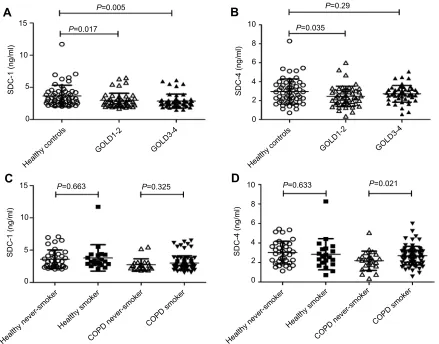
Both serum SDC-1 and SDC-4 levels showed a downward trend
in COPD patients compared to healthy controls (P=0.004 and
0.069, respectively). Particularly, SDC-1 was found to be
sig-nificantly lower in GOLD 3–4 COPD compared with healthy
subjects (3.665±1.665 vs 2.876±1.077), while SDC-4 was only
decreased significantly in GOLD 1–2 COPD patients (3.665
±1.665 vs 2.876±1.077) (Figure 1AandB). However, the effect
of smoking on the levels of SDCs was not observed in
non-COPD subjects (allP-values>0.05;Figure 1CandD). But for
COPD patients, increasing SDC-4 levels were observed in the
ever-smoking population (P=0.021;Figure 1D).
Correlations between SDCs and lung
function parameters
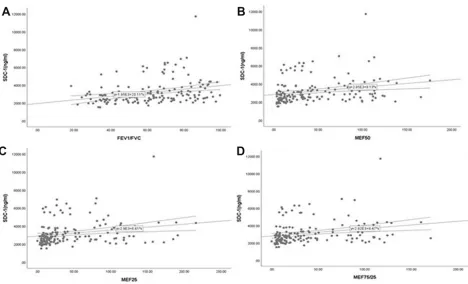
Serum SDC-1 levels in all subjects were correlated positively with the ratio of FEV1/FVC, FEV1% predicted (an index indicating the severity of airflow obstruction), as well as with
the parameters of SAO (Table 2andFigure S1), while no such
relationship was found between SDC-4 levels and lung function
parameters (allP-values>0.05). However, in COPD patients,
SDC-1 levels showed no positive correlation with FEV1%
predicted (rho=0.154,P=0.124).
Diagnostic value of SDC-1 for COPD
As SDC-1 levels were significantly different between
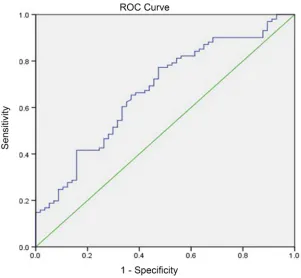
COPD patients and controls, and correlated positively with lung function parameters, we next explored the pos-sible value of SDC-1 in diagnosing COPD. ROC analyses showed that the area under curve (AUC) of SDC-1 to
differentiate COPD was 0.673 (95% CI, 0.587–0.76)
(Figure 2). With a cutoff value of 2.88 ng/mL, the
sensi-tivity and specificity were 63.3% and 65.3%, respectively.
Table 1Clinical character of included subjects
Variable Healthy controls (n=57) COPD (n=101) P-value
Never smoker (n=37)
Smoker (n=20)
Never smoker (n=23)
Smoker (n=78)
Age, years 59.59±13.96 59.25±12.37 64.17±9.59 63.08±8.78 0.187
Sex, male/female 13/24 20/0 8/15 75/3 <0.001a
BMI, kg/m2 25.87±3.78 24.02±3.17 23.84±3.36a 23.1±3.18b 0.001a
Smoking status 0.542
Ex-smoker (%) 13 (65) 52 (66.7)
Current smoker (%) 7 (35) 26 (33.3)
Pack-years for ever-smokers 44.36±32.13 38±26.27 0.36
Frequent exacerbator (≥2 exacerbations per year) (%)
9 (39.1) 16 (20.5) 0.07
FEV1/FVC, % 84±8.19 83.27±7.05 54.96±9.79b-c 48.29±14.54b-d <0.001a
FEV1% predicted 103.98±21.46 100.73±16.89 55.26±15.56b-c 52.69±25.08b-c <0.001a
MEF50 87.35±36.93 88.26±24.7 16.73±9.7b-c 18.76±14.06b-c <0.001a
MEF25 90.73±47.1 99.08±46.16 12.93±8.25b-c 18.44±12.64b-c <0.001a
MEF75/25 81.47±37.83 88.85±25.2 14.77±8.15b-c 17.54±12.27b-c <0.001a
WBC, 109/L 5.39±1.85 5.79±1.9 6.31±2.7 6.51±1.9b 0.041a
CRP, ug/ml 1.51±1.75 1.59±1.86 8.11±18.91b 6.56±13.89b 0.069
Notes: Data are presented as mean ± SD.a
Significant differences among all groups;b
significantly different compared to healthy never-smoker;c
significantly different compared to healthy smoker;dsignificantly different compared to never-smoking patients.
Abbreviations:BMI, body mass index; CRP, C-reactive protein; FEV1, forced expiratory volume in one second; FVC, forced vital capacity;MEF, maximum expiratoryflow; WBC, white blood cells.
International Journal of Chronic Obstructive Pulmonary Disease downloaded from https://www.dovepress.com/ by 118.70.13.36 on 22-Aug-2020
Correlations of SDCs with systemic
in
fl
ammation and risk of exacerbations
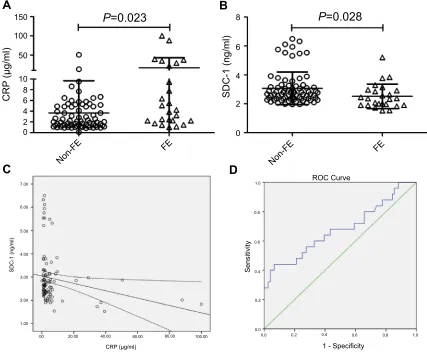
Elevated levels of CRP in individuals with COPD were asso-ciated with increased risk of having exacerbations. As expected, our results showed that COPD patients with frequent
exacerbations (≥2 exacerbations per year) had higher levels of
CRP (Figure 3A). Nevertheless, in frequent exacerbators (FE)
of COPD, serum levels of SDC-1 but not SDC-4 were down-regulated (P=0.028;Figure 3B). In addition, a negative corre-lation was observed between serum SDC-1 and CRP in COPD
patients (rho=−0.303, P=0.002; Figure 3C). No significant
association was found of SDC-4 with CRP in the patient
population (rho=−0.096,P=0.349).
Besides, ROC analyses were also performed to test the value of SDC-1 for identifying FEs of COPD. As a result, the AUC of SDC-1 to differentiate FE was 0.678
(95% CI, 0.543–0.813) (Figure 3D). The sensitivity and
specificity using a cutoff value of 2.08 ng/mL (determined by
the highest Youden index)14 were 44% and 93.4%,
respectively.
Multivariate linear analysis
As outlined in Table 3, multivariate linear analysis was
performed introducing common confounders such as age,
sex, BMI, smoking status, and inflammatory markers
WBC and CRP. The results demonstrated that CRP was
10
10 15
A
B
D
C
5
P=0.29
P=0.005
P=0.017
P=0.663 P=0.325
P=0.035
P=0.633 P=0.021
8
6
4
SDC-4 (ng/ml)
SDC-4 (ng/ml)
SDC-1 (ng/ml)
SDC-1 (ng/ml)
2
0 0
10 15
5
0
10
8
6
4
2
0
Healthy controls
GOLD1-2 GOLD3-4
Healthy controls
GOLD1-2 GOLD3-4
Healthy smoker
Healthy never-smoker COPD never-smoker
COPD smoker Healthy smoker
Healthy never-smoker COPD never-smoker
COPD smoker
Figure 1Levels of SDCs in subjects. Both SDC-1 and SDC-4 showed a downward trend in COPD patients (A-B), but the differences in the levels of SDCs between never smoking and ever-smoking controls were not observed (C-D).
Abbreviations:COPD, chronic obstructive pulmonary disease; SDC, syndecan.
Table 2Correlations of SDCs with lung function parameters in
all subjects
SDC-1 SDC-4
rho P-value rho P-value
FEV1/FVC ratio 0.36 <0.001 0.067 0.346
FEV1% predicted 0.248 0.002 0.034 0.674
MEF50 0.337 <0.001 0.072 0.371
MEF25 0.327 <0.001 0.088 0.272
MEF75/25 0.339 <0.001 0.024 0.768
Abbreviations:FEV1, forced expiratory volume in one second; FVC, forced vital capacity; MEF, maximum expiratoryflow; SDC, syndecan.
International Journal of Chronic Obstructive Pulmonary Disease downloaded from https://www.dovepress.com/ by 118.70.13.36 on 22-Aug-2020
the independent factor inversely associated with the serum levels of SDC-1.
Discussion
The main findings of the present study demonstrated that
decreased levels of circulating SDC-1, but not SDC-4,
have significant associations with lung function decline
and SAO. Besides, compared to patients with less frequent
exacerbations, SDC-1 was found to be significantly
down-regulated in FEs of COPD, also with a high specificity to
identify this subgroup. Furthermore, in the patient popula-tion, only SDC-1 levels showed negative correlations with
CRP, an important biomarker of systemic inflammation
and risk factor of having exacerbations. To the best of
our knowledge, this is thefirst retrospective cohort study
investigating the relationship between SDCs as infl
amma-tory biomarkers and COPD.
SDC-1 represents a cell surface proteoglycan that can
be modulated by many inflammatory mediators in vitro
and also by tissue injury and inflammatory conditions in
vivo.15,16 Relevant studies identified the activation of
SDC-1 expression and shedding to be generally a
protec-tive mechanism that may attenuate inflammatory
responses. It has been indicated that inducers of allergic
lung inflammation promoted SDC-1 shedding into the
air-way, while knockout of SDC-1 exaggerated the allergic
airway inflammation. In addition, administering purified
SDC-1 could suppress not only allergen-induced lung
inflammation, but also limit lung inflammation and injury
during influenza infection.17,18Nevertheless, a more recent
paper reported that in the smoke-induced inflamed
bron-chial environment, shed forms of SDC-1 in
bronchoalveo-lar lavage fluid would prolong stability and sustain
activities of inflammatory mediator proteins.19Thus, it is
still undetermined whether or to what extent can SDC-1
reflect the inflammatory process in COPD. In the present
study, circulating SDC-1 levels were significantly reduced
in COPD patients, independent of smoking status, and inversely correlated with the levels of CRP, an acute-phase protein synthesized in response to tissue damage
or inflammation. We also performed multivariable linear
analysis, which revealed that CRP was the independent factor negatively associated with SDC-1 levels, further validating their association. As circulating CRP levels are elevated in COPD patients and are related to the presence
of airflow obstruction, it has been regarded as a valid
biomarker of systemic inflammation in COPD. Therefore,
the negative correlation between SDC-1 and CRP in Figure 2Diagnostic accuracy of serum SDC-1 for COPD. Area under the curves (AUC) was calculated by the trapezoidal rule.
International Journal of Chronic Obstructive Pulmonary Disease downloaded from https://www.dovepress.com/ by 118.70.13.36 on 22-Aug-2020
COPD patients suggests that serum SDC-1 may function
as a biomarker of the level of systematic inflammation in
COPD.
The strongest predictor of a patient’s future
exacerba-tion frequency remains the number of exacerbaexacerba-tions they
have had in the prior year.1 Many studies have revealed
that excessive inflammation in response to increased
oxi-dative stress is closely related to COPD exacerbation.20
Moreover, a recent systematic review found CRP to be the only robust biomarker showing consistently elevated
levels in AECOPD compared with control groups,21 and
circulating CRP for AECOPD during the past year was a better risk factor for predicting readmission than sputum
inflammatory markers.4,22 Consistent with the previous
research, our results showed higher levels of serum CRP in FEs. Importantly, differential expression of SDC-1 was also observed between infrequent and FEs, implying that COPD exacerbation risk might be associated with lower SDC-1 levels. When a threshold value of 2.08 ng/mL was
used, SDC-1 had a satisfactory specificity differentiating
FEs. Thus, apart from reflecting systematic inflammation,
it may be of great potential for SDC-1 to predict COPD exacerbation.
In the present study, we observed that serum SDC-1
levels in COPD patients categorized GOLD 3–4 were
particularly downregulated, implying that serum SDC-1
150
100
50
8 10
CRP
(µg/ml)
SDC-1 (ng/ml)
SDC-1 (ng/ml)
8
B
A
C
D
P
=0.028
P
=0.023
6
6
4
4
2
2
0 0
7.00 1.0
1.0 0.8
0.8 0.6
0.6 0.4
0.4 0.2
0.2 0.0
0.0 6.00
5.00
4.00
3.00
2.00
1.00
.00 20.00 40.00 60.00
CRP (µg/ml)
80.00 100.00
ROC Curve
1 - Specificity
Sensitivity
Non-FE
FE
Non-FE
FE
Figure 3COPD patients with frequent exacerbations (FEs) had higher levels of CRP and lower levels of SDC-1 (A-B). Serum SDC-1 correlated negatively with CRP in COPD patients (C). Diagnostic accuracy of serum SDC-1 to differentiate FE was calculated (D).
Abbreviations:CRP, C-reactive protein; COPD, chronic obstructive pulmonary disease; SDC, syndecan.
Table 3 Multivariate linear analysis with circulating SDC-1 as
dependent variable
β P-value
Age 0.015 0.856
Sex −0.106 0.318
BMI 0.107 0.204
Smoking status −0.044 0.668
WBC, 109/L −0.09 0.285
CRP, ug/ml −0.175 0.031
Abbreviations:BMI, body mass index; CRP, C-reactive protein; WBC, white blood cells.
International Journal of Chronic Obstructive Pulmonary Disease downloaded from https://www.dovepress.com/ by 118.70.13.36 on 22-Aug-2020
levels may be negatively associated with the severity of disease. To further validate this hypothesis, correlation analyses between SDC-1 levels and lung function para-meters were performed, and positive associations of SDC-1 with FEVSDC-1/FVC and SAO parameters were found. However, circulating SDC-1 was neither satisfying as a diagnostic marker nor related to FEV1% predicted in COPD patients, indicating that SDC-1 may participate in
the development of airflow obstruction but play little role
in the disease severity of COPD. The underlying mechan-isms of SDC-1 participating in the pathogenesis of COPD require further validation, but the results of the present study would be explained by some indirect clues linking SDC-1 with this disease. It has been shown that the re-epithelialization in tumors might be associated with an increase in the expression (and shedding) of SDC-1,
whereas the markers of epithelial–mesenchymal transition
(EMT) like Twist were associated with the downregulation
of SDC-1.23,24While numerous studies have revealed that
the β-catenin-Snail1-Twist transcription factor cluster was
upregulated in COPD and their expression was closely
related to both EMT activity and airway obstruction,25
the reduced expression of SDC-1 in COPD may be asso-ciated with the enhanced EMT process.
Our study has several limitations. First, the present study was a retrospective analysis which would be affected by the common shortcomings of these types of studies. For example, causality between parameters studied could not
be defined, which requires more prospective or in vitro
studies to elucidate the potential mechanisms under the
findings. Second, due to the rigorous inclusion criteria,
only 158 subjects were enrolled, limiting our further inves-tigation on how SDC-1 correlates with lung function and
inflammation in different phenotypes of COPD. As for the
same reason, although statistically significant changes of
SDC-1 levels were observed among COPD groups, mag-nitude difference was not high (fold-change<2), so it
would be necessary to verify ourfindings in large cohorts
of patients. Besides, we selected a population without certain comorbidities, which could arguably result in selection bias. Third, only CRP was analyzed as the
indi-cator of systemic inflammation. It would be better to
further investigate the relationship between SDC-1 and
inflammatory responses in COPD with a panel of
biomar-kers. Last, future research should also comprehensively analyze the expression as well as shedding of SDC-1 in different sample types (eg, lung tissue, sputum,
bronchoal-veolar lavagefluid (BALF), peripheral blood).
In summary, the present study suggests the possibility
of circulating SDC-1 level as a novel inflammatory
bio-marker associated with lung function and systemic infl
am-mation in patients with COPD, which may be also useful to identify the risk of COPD exacerbation. However, further prospectively designed and experimental studies
should be performed to clarify the influences of SDC-1
on the pathogenesis and outcomes of COPD.
Acknowledgments
This work was supported by National Key Research
and Development Program (2016YFC0903600 and
2016YFC1304500), National Natural Science Foundation of China (81470236, 81670038 and 81830001), 1·3·5 Project for Disciplines of Excellence, West China Hospital, Sichuan University (2018HXFH017) and Health and Family Planning Commission of Sichuan Province (17PJ009). The funders had no role in study design, data collection or ana-lysis, decision to publish, and manuscript preparation. We also thank Dr Haiqiao Wu for providing assistance in data collection.
Author contributions
Diandian Li, Yanqiu Wu, Shujin Guo, Lei Chen, and Fuqiang Wen designed this research, and all authors con-tributed toward subjects recruit, data collection, statistical analysis, drafting, and critically revising the paper, gave
final approval of the version to be published, and agree to
be accountable for all aspects of the work.
Disclosure
The authors report no conflicts of interest in this work.
References
1. Vogelmeier CF, Criner GJ, Martinez FJ, et al. Global strategy for the diagnosis, management, and prevention of chronic obstructive lung disease 2017 report. GOLD Executive Summary.Am J Respir Crit Care Med.2017;195(5):557–582. doi:10.1164/rccm.201701-0218PP
2. Fabbri LM, Rabe KF. From COPD to chronic systemic inflammatory syndrome? Lancet. 2007;370(9589):797–799.
doi:10.1016/S0140-6736(07)61383-X
3. Ferrari R, Tanni SE, Caram LM, Correa C, Correa CR, Godoy I. Three-year follow-up of interleukin 6 and C-reactive protein in chronic obstructive pulmonary disease.Respir Res.2013;14:24. doi:10.1186/ 1465-9921-14-19
4. Jing Z, Chun C, Ning S, Hong Z, Bei H, Wan-Zhen Y. Systemic inflammatory marker CRP was better predictor of readmission for AECOPD than sputum inflammatory markers. Arch Bronconeumol.
2016;52(3):138–144. doi:10.1016/j.arbres.2015.01.011
5. Hogg JC. A pathologist’s view of airway obstruction in chronic obstructive pulmonary disease. Am J Respir Crit Care Med.
2012;186(5):v–vii. doi:10.1164/rccm.201206-1130ED
International Journal of Chronic Obstructive Pulmonary Disease downloaded from https://www.dovepress.com/ by 118.70.13.36 on 22-Aug-2020
6. Stanojkovic I, Kotur-Stevuljevic J, Milenkovic B, et al. Pulmonary function, oxidative stress and inflammatory markers in severe COPD exacerbation.Respir Med.2011;105(Suppl 1):S31–S37. doi:10.1016/ S0954-6111(11)70008-7
7. Conti V, Corbi G, Manzo V, et al. SIRT1 activity in peripheral blood mononuclear cells correlates with altered lung function in patients with chronic obstructive pulmonary disease.Oxid Med Cell Longev.
2018;2018:9391261. doi:10.1155/2018/9391261
8. Kufareva I. Chemokines and their receptors: insights from molecular modeling and crystallography. Curr Opin Pharmacol.2016;30:27– 37. doi:10.1016/j.coph.2016.07.006
9. Agere SA, Kim EY, Akhtar N, Ahmed S. Syndecans in chronic inflammatory and autoimmune diseases: pathological insights and therapeutic opportunities. J Cell Physiol. 2018;233(9):6346–6358. doi:10.1002/jcp.26388
10. Li Q, Park PW, Wilson CL, Parks WC. Matrilysin shedding of syndecan-1 regulates chemokine mobilization and transepithelial efflux of neutrophils in acute lung injury. Cell. 2002;111(5):635– 646. doi:10.1016/s0092-8674(02)01079-6
11. Park PW, Pier GB, Hinkes MT, Bernfield M. Exploitation of synde-can-1 shedding by pseudomonas aeruginosa enhances virulence. Nature.2001;411(6833):98–102. doi:10.1038/35075100
12. Luo L, Feng S, Wu Y, Su Y, Jing F, Yi Q. Serum levels of syndecan-1 in patients with kawasaki disease. Pediatr Infect Dis J. 2019;38 (1):89–94. doi:10.1097/INF.0000000000002047.
13. Santoso A, Kikuchi T, Tode N, et al. Syndecan 4 mediates Nrf2-depen-dent expansion of bronchiolar progenitors that protect against lung inflammation.Mol Ther.2016;24(1):41–52. doi:10.1038/mt.2015.153 14. Lee KS, Kim HR, Kwak S, et al. Association between elevated
pleural interleukin-33 levels and tuberculous pleurisy. Ann Lab Med.2013;33(1):45–51. doi:10.3343/alm.2013.33.1.45
15. Sanchez-Pedrosa G, Vara Ameigeiras E, Casanova Barea J, Rancan L, Simon Adiego CM, Garutti Martinez I. Role of surgical manipulation in lung inflammatory response in a model of lung resection surgery.Interact Cardiovasc Thorac Surg.2018;27:870–877. doi:10.1093/icvts/ivy198 16. Lu Z, Song N, Shen B, et al. Syndecan-1 shedding inhibition to
protect against ischemic acute kidney injury through HGF target signaling pathway. Transplantation. 2018;102(7):e331–e344. doi:10.1097/TP.0000000000002170
17. Xu J, Park PW, Kheradmand F, Corry DB. Endogenous attenuation of allergic lung inflammation by syndecan-1. J Immunol. 2005;174 (9):5758–5765. doi:10.4049/jimmunol.174.9.5758
18. Brauer R, Ge L, Schlesinger SY, et al. Syndecan-1 attenuates lung injury during influenza infection by potentiating c-Met signaling to suppress epithelial apoptosis.Am J Respir Crit Care Med.2016;194 (3):333–344. doi:10.1164/rccm.201509-1878OC
19. Lam DC, Chan SC, Mak JC, Freeman C, Ip MS, Shum DK. S-maltoheptaose targets syndecan-bound effectors to reduce smoking-related neutrophilic inflammation. Sci Rep. 2015;5:12945. doi:10.1038/srep12945
20. Celli BR, Barnes PJ. Exacerbations of chronic obstructive pulmonary disease. Eur Respir J. 2007;29(6):1224–1238. doi:10.1183/ 09031936.00109906
21. Chen YW, Leung JM, Sin DD. A systematic review of diagnostic biomarkers of COPD exacerbation.PLoS One.2016;11(7):e0158843. doi:10.1371/journal.pone.0158843
22. Crisafulli E, Torres A, Huerta A, et al. C-reactive protein at dis-charge, diabetes mellitus and >/=1 hospitalization during previous year predict early readmission in patients with acute exacerbation of chronic obstructive pulmonary disease.COPD.2015;12(3):306–314. doi:10.3109/15412555.2014.933954
23. Rautava J, Soukka T, Heikinheimo K, Miettinen PJ, Happonen RP, Jaakkola P. Different mechanisms of syndecan-1 activation through a fibroblast-growth-factor-inducible response element (FiRE) in muco-sal and cutaneous wounds. J Dent Res. 2003;82(5):382–387. doi:10.1177/154405910308200511
24. Vered M, Dayan D, Yahalom R, et al. Cancer-associatedfibroblasts and epithelial-mesenchymal transition in metastatic oral tongue squa-mous cell carcinoma. Int J Cancer. 2010;127(6):1356–1362. doi:10.1002/ijc.25358
25. Mahmood MQ, Walters EH, Shukla SD, et al. beta-catenin, twist and snail: transcriptional regulation of EMT in smokers and COPD, and relation to airflow obstruction. Sci Rep. 2017;7(1):10832. doi:10.1038/s41598-017-11375-x
International Journal of Chronic Obstructive Pulmonary Disease downloaded from https://www.dovepress.com/ by 118.70.13.36 on 22-Aug-2020
Supplementary material
International Journal of Chronic Obstructive Pulmonary Disease
Dove
press
Publish your work in this journal
The International Journal of COPD is an international, peer-reviewed journal of therapeutics and pharmacology focusing on concise rapid reporting of clinical studies and reviews in COPD. Special focus is given to the pathophysiological processes underlying the disease, inter-vention programs, patient focused education, and self management
protocols. This journal is indexed on PubMed Central, MedLine and CAS. The manuscript management system is completely online and includes a very quick and fair peer-review system, which is all easy to use. Visit http://www.dovepress.com/testimonials.php to read real quotes from published authors.
Submit your manuscript here:https://www.dovepress.com/international-journal-of-chronic-obstructive-pulmonary-disease-journal
Figure S1Serum SDC-1 correlated positively with the ratio of FEV1/FVC (A) and the parameters of small airway obstruction (SAO) (B-D) in all subjects.
Abbreviations:FEV1, forced expiratory volume in one second; FVC, forced vital capacity; SDC, syndecan.
International Journal of Chronic Obstructive Pulmonary Disease downloaded from https://www.dovepress.com/ by 118.70.13.36 on 22-Aug-2020