c
Owned by the authors, published by EDP Sciences, 2010
Meso-scale analysis of deformation wave heating in metalized
solid explosive
S. Chakravarthy1,a, K.A. Gonthier1,b, and C. Rumchik2,c
1 Mechanical Engineering Department, Louisiana State University, Baton Rouge, LA 70803, USA 2 U.S. Air Force Research Laboratory, AFRL-RWME, Eglin AFB, FL 32542, USA
Abstract. Deformation induced heating of reactive solids is a physically complex process. As such, the effects of meso-structure, component thermomechanical properties, component mass fractions, and porosity on their impact response is not well-understood. In this study, an explicit, 2-D, Lagrangian finite and discrete element technique is used to examine thermomechanical fields in metal-explosive (aluminum-HMX) particle mix-tures due to piston supported uniaxial deformation waves. The meso-scale description uses a plane strain, thermoelastic-viscoplastic and friction constitutive theory to describe the motion and deformation of individual particles, and an energy consistent, penalty based method to describe inter-particle contact. The deformation response of material having an initial solid volume fraction ofφ0
s =0.835 is characterized for different metal mass
fractions and wave strengths. Predictions indicate that the response can be classified into strength dominated and pressure dominated regions depending on wave strength. Average thermomechanical fields that define the macro-scale wave structure are found to differ both qualitatively and quantitatively between the two regions.
1 Introduction
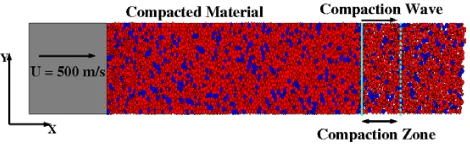
Reactive solids often consist of mixtures of high-explosive, metal, and oxidizer particles (size ≈ 10–200μm) embedded within a polymeric binder. It has been shown that inclusion of metal in ex-plosive mixtures can affect their impact sensitivity, detonation, and post-detonation behavior, though it remains fundamentally unclear how meso-structure, component (or phase) thermomechanical prop-erties, and metal mass fraction, affect the impact sensitivity of the mixture. The objectives of this study are two-fold: 1) to characterize the relative importance of phase-specific volumetric and surface dissipation and its dependence on meso-structure, metal mass fraction, and wave strength; and, 2) to investigate macro-scale manifestations of the particle-scale response by spatially averaging meso-scale fields over suitably chosen representative volumes (areas). The first objective is important for identifying physical mechanisms responsible for ignition, whereas the second objective is important for developing macro-scale, multiphase constitutive theories to accurately assess the performance of reactive solids in practice [1, 2]. Multiphase theories are routinely posed in terms of phase interaction terms that implicitly account for particle-scale phenomena that are difficult to experimentally resolve. The initial material configuration used in this study consists of circular, randomly packed alu-minum and HMX particles having an average diameter of ¯d ≈60μm, as illustrated in Fig. 1. Inter-particle voids are massless. This idealized geometry is chosen to mitigate singularities that would occur
ae-mail:[email protected]
be-mail:[email protected]. Corresponding author. ce-mail:[email protected]
Fig. 1. Illustration of an aluminized HMX mixture corresponding toλm = 0.2 and Up = 500 m/s. The blue
particles are metal and the red particles are HMX.
in the vicinity of sharp particle corners that are impossible to numerically resolve. Nonetheless, this simplified initial configuration still enables leading-order effects of viscoplastic deformation and inter-particle friction to be assessed. The average initial solid volume fraction of the material isφ0s =0.835.
For brevity, only predictions for piston speeds of Up=100 and 500 m/s are discussed as they enable
differences between the strength and pressure dominated deformation regions to be highlighted.
2 Model description
The model problem is posed as a multi-particle contact problem for the evolution of thermomechanical fields within particles and interactions between particles. Evolution equations for the momentum and energy of each particle are given in Lagrangian form by the following:
ρ¨u=∇·σ, (1)
ρcvT˙=−∇·q+ρr. (2)
Here,ρis the local density,σis the Cauchy stress tensor, r is the deformation induced heating, q is the heat flux, cvis the constant volume specific heat, and∇≡ ∂(∂•x)is the spatial gradient operator. Particles are assumed to be initially stationary and stress free. To satisfy the entropy inequality, a Clausius Duhem entropy constraint is used which is given by:
ρη˙−T−1(ρr−∇·q)+q·∇T−1≥0, (3)
whereηis the mass-specific entropy. Additionally, the following contact conditions are imposed on particle boundariesΓ:
σ·n=tconΓ∀t, (4)
−k∇T·n=qf +qconΓ∀t. (5)
Here, n is the local unit normal vector toΓ, tcis the local contact traction vector, qf is local frictional
heat flux, qcis the local heat flux needed to impose ideal thermal contact, and k is the thermal
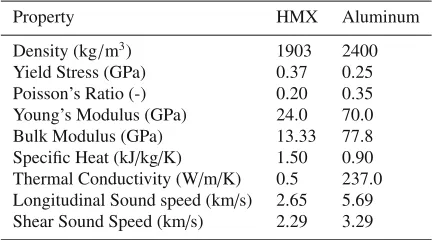
con-ductivity. The stress-strain behavior of the particles is modeled by a hyperelastic, multiplicative, finite strain constitutive model with a Von-Mises yield criterion and viscoplastic flow rule, and friction is modeled using an Amontons-Coulomb stick/slip theory. A detailed description of the model equations, contact conditions, and constitutive theory is given in Ref. [3]. Key thermomechanical properties for HMX and aluminum used in the simulations are given in Table 1.
2.1 Numerical technique
Table 1. Thermomechanical properties.
Property HMX Aluminum
Density (kg/m3) 1903 2400 Yield Stress (GPa) 0.37 0.25 Poisson’s Ratio (-) 0.20 0.35 Young’s Modulus (GPa) 24.0 70.0 Bulk Modulus (GPa) 13.33 77.8 Specific Heat (kJ/kg/K) 1.50 0.90 Thermal Conductivity (W/m/K) 0.5 237.0 Longitudinal Sound speed (km/s) 2.65 5.69 Shear Sound Speed (km/s) 2.29 3.29
deformation, whereas the discrete element method (DEM) is used to account for interactions between particles. The DEM utilizes a conservative potential based penalty method in which the normal con-tact traction between particles is estimated by penalizing their penetration, and frictional tractions are estimated using a penalty regularized Amontons-Coulomb law [3]. The initial particle configuration is generated using a pseudo-gravity drop method that consists of two steps. First, an initial packing arrangement is generated by randomly placing particles within the domain so that their centers lie outside the volume encompassed by other particles. Then, forces arising due to particle overlap drives rearrangement of particle positions in such a way as to eliminate overlap while continuously settling under the influence of a gravitational force [3]. Particles are discretized using constant strain triangu-lar elements, where each particle contains approximately 400–800 finite elements for all simulations performed in this study, depending on its size. The combined FEM/DEM algorithm has been verified, and is nominally second-order accurate in both space and time.
3 Predictions
Preliminary predictions are given in this section for piston supported uniaxial deformation waves in aluminized HMX havingφ0
s = 0.835. Macro-scale wave profiles are obtained by computing spatial
transverse averages over meso-scale fields using an averaging width of 200μm. Though computed average profiles do vary with averaging width, numerical experiments indicate that meaningful results are obtained provided that this width is smaller than approximately half the size of the macro-scale wave thickness.
Figure 2 gives predicted variations in the Hugoniot curves with metal mass fraction λm.
Figures 2(a) and (b) express these curves in the Up-Pmixand Up-D planes, respectively, where Pmix
is the average equilibrium mixture pressure behind the wave and D is the corresponding steady wave speed. To this end, the axial dimension of the computational domain was chosen sufficiently long to guarantee that steady waves evolved. Here, we consider piston speeds within the range 50 ≤ Up ≤
500 m/s and metal mass fractions within the range 0 ≤ λm ≤ 1, where piston speeds in excess of
approximately Up ≥ Upˆ = 250 m/s result in nearly complete material consolidation for all values
ofλm. This critical value of piston speed separates two well-defined impact regions. We refer to the
lower pressure region corresponding to Up <Upˆ as strength dominated because material strength is
important in preventing complete pore collapse. We refer to the higher pressure region corresponding to Up ≥Upˆ as pressure dominated because the resulting pressures are sufficient to completely
elim-inate porosity. Material strength plays a less significant role than pressure in the pressure domelim-inated region.
A few observations are noteworthy. First, Pmixmonotonically increases withλmdue to the high
acoustic impedance of aluminum which causes the reflection of acoustic energy at explosive-metal interfaces thereby enhancing the deformation and pressure of explosive particles. This observation is commensurate with data for neat granular HMX (λm = 0) and neat porous aluminum (λm = 1)
100 200 300 400 500 U
(a)
(b)
p[m/s]
0 0.5 1 1.5 2 2.5 3
Pmix
[Gpa]
λ m = 56 %
λ m = 20 %
Neat AL Neat HMX
100 200 300 400 500
Up [m/s]
1000 1500 2000 2500 3000
D [m/s]
λ m = 56 %
λ m = 20 %
Neat AL Neat HMX Incomplete Consolidation
(Strength Dominated)
Complete Consolidation (Pressure Dominated)
Fig. 2. Predicted Hugoniot curves for a material havingφ0
s =0.835 and metal mass fractionλm: (a) the P-Up plane; (b) the D-Upplane. Here, neat refers to a single phase granular material.
variations in D withλmqualitatively differ between the two impact regions. In the strength dominated region, D slightly decreases with increasingλmwhereas the opposite trend is predicted for the pressure dominated region. Though speculative at this juncture, this prediction is plausible because the lower aluminum strength enhances dissipation by plastic work during pore collapse, even for neat granular aluminum (λm = 1), resulting in slightly lower wave speeds than those associated with neat HMX in the strength dominated region. However, dissipation by plastic flow becomes more geometrically constrained within wave profiles in the pressure dominated region due to the elimination of porosity re-sulting in higher wave speeds, as anticipated. Though not shown here for brevity, the weak variation in
D with Upin the strength dominated region is largely due to inter-particle friction during pore collapse
which enhances the rigidity of the material; as such, we also refer to this region as being frictionally
rigid. Simulations performed for frictionless contact indicate a larger decrease in D as Up →0 in the
strength dominated region.
0 2 4 6 8 10
ξ [mm] 0
5 10 15 20
W
(a)
(b)
p
[GW/kg]
We
Wm
Neat HMX
We( σ)
Wm( σ)
Neat HMX( σ)
Up = 100 m/s
0 2 4 6 8 10
ξ [mm] 0
500 1000
W
p
[GW/kg]
We
Wm
Neat HMX
We( σ)
Wc( σ)
Neat HMX( σ)
Up = 500 m/s
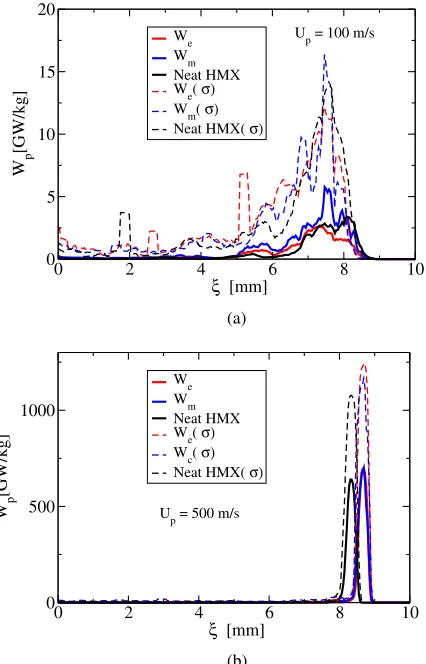
Fig. 3. Predicted average plastic heating rate ˙Wp profiles for a material havingφ0s = 0.835 and λm = 0.2: (a) Up=100 m/s; (b) Up=500 m/s. Corresponding standard deviations are given by dashed lines.
heating rates within wave profiles are important to analyze because they can be directly compared to predictions given by macro-scale multiphase theories and because they give a good indication of deformation wave thickness.
As seen in Fig. 3(a) for Up=100 m/s, the metal plastic heating rate exceeds that of the explosive within the wave profile for aluminized HMX. Further, the explosive plastic heating rate is marginally lower than that of the equivalent neat HMX configuration. This prediction is consistent with our previ-ous assertion for strength dominated waves for which the inclusion of aluminum reduces wave speed by enhancing plastic dissipation within aluminum particles during pore collapse, thereby reducing ex-plosive heating relative to neat HMX. Standard deviations about the average rates are large due to localized plastic deformation near inter-particle contacts. The predicted deformation wave thickness is approximately 4 mm.
Figure 3(b) gives predictions for Up=500 m/s. This case, which corresponds to a pressure domi-nated wave, results in a marginally higher explosive plastic heating rate than that of neat HMX, again possibly due to enhanced geometrical confinement associated with the elimination of porosity. The predicted deformation wave thickness is approximately 1 mm. The implications on impact sensitivity of these marginal differences in explosive heating relative to that of neat HMX remain an ongoing topic of our research.
0 2 4 6 8 10
ξ [mm] 0
50
(a)
(b) 100
150 200
W
f
[GW/kg]
We
Wm
Neat HMX
We( σ)
Wm( σ)
Neat HMX( σ)
Up = 100 m/s
0 2 4 6 8 10
ξ [mm] 0
1000 2000 3000
W
f
[GW/kg]
We
Wm
Neat HMX
We( σ)
Wm( σ)
Neat HMX( σ)
Up = 500 m/s
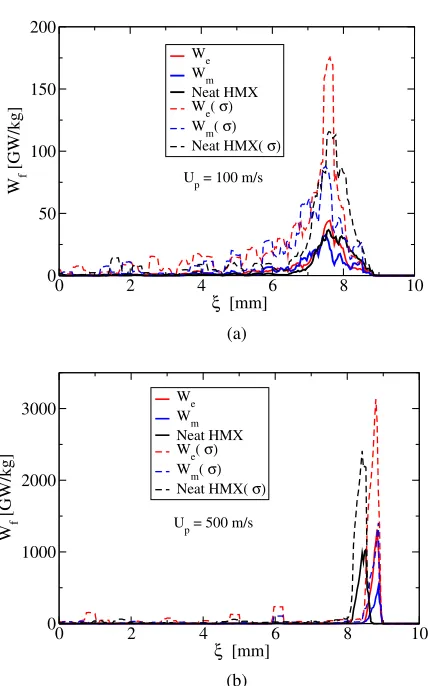
Fig. 4. Predicted average frictional heating rate ˙Wf profiles for a material havingφ0s = 0.835 andλm = 0.2: (a) Up=100 m/s; (b) Up=500 m/s. Corresponding standard deviations are given by dashed lines.
Here, the average phase-specific heating rate and its standard deviation are computed based on the local phase-specific mass affected by friction work, which is approximated by finite-element mass within the averaging area experiencing sliding contact. Based on this approximation, friction heating rates exceed plastic heating rates in all cases as friction work is a surface phenomenon. Though plastic work affects a larger mass of material, friction work remains a significant source of dissipation for pressure dominated waves. Importantly, friction work is believed to be a primary mechanism for the formation of hot-spots that are responsible for ignition of reactive solids.
4 Conclusion
dominated waves, and to increase explosive heating rate within pressure dominated waves. Fric-tion work is shown to be a potentially significant hot-spot formaFric-tion mechanism, even for pressure dominated waves. The average equilibrium pressure behind waves was found to increase with metal mass for both impact regions due to the high acoustic impedance of the metal. It is emphasized that careful interpretation of plastic and frictional heating rates, and meso-scale thermomechanical fields, is necessary to properly characterize the thermal response of reactive solids.
This work was supported by the U.S. Air Force Research Laboratory, Munitions Directorate, AFRL-RWME, Eglin AFB, Florida, USA. 96ABW-2009-0327.
References
1. Gonthier, K.A., Journal of Applied Physics 95(7), (2004) pp. 3482-3494.
2. Gonthier, K.A., and Rumchik, C.G., Technical Report ME-TSI-09, Mechanical Engineering Department, Louisiana State University, Baton Rouge, Louisiana, USA, 2009.
3. Panchadhar, R., and Gonthier, K.A., Computational Mechanics 44, (2009) pp. 717-744.