Media Access Control Protocol for Mobile
Sensor Network- Modelling
Using OMNeT++ -MiXiM Network
Simulator.
Mrs. Aditi .P. Khadilkar1 , Prof. Nitin G. Palan2 #
Department of Electronics and Telecommunication. Cummins College Of Engineering For Women, Pune.
Maharashtra, India
Abstract:- A Wireless Sensor Network (WSN) consist of battery operated sensing and computing devices deployed for monitoring applications. With the advent of new technologies WSNs are providing a new class of information to human beings. In most cases the networks were stationary but as a evolutionary step the WSNs have to consider mobility. This new class of sensor networks is Mobile Wireless Sensor Networks. Eg moving robots, surveillance aircrafts. Nodes share a communication channel for communication. To share communication channel the establishment of a MAC protocol is required in the sensor nodes. The objective of the MAC protocol is to regulate access to the shared wireless medium. So that the performance requirements of the underlying application are satisfied Energy efficiency and Mobility are big challenges for Medium Access Control protocol design to give a reliable communication. In this paper we have studied a Mobility aware MAC protocol, using OMNeT++ network simulator. OMNeT++ open source discrete event simulator. Mixim is ‘mixed simulator’ is developed for wireless and mobile simulations in OMNeT++.
Index terms:- Mobile nodes, OMNeT++, Mixim, constant
speed Mobility.
I. INTRODUCTION
A Wireless Sensor Network (WSN) special type of ad hocnetwork which consists of a large number of nodes equipped with different sensor devices. These nodes are deployed without careful planning. A Sensor node is a
communication, and processing are included it. These networks are widely used in the fields of environmental monitoring, military etc. WSN applications have strong Constraints regarding power resources and computational capacity. There are four basic components in a sensor network: 1) an assembly of distributed or localized sensors; 2) an interconnecting network (usually, but not always, wireless-based); 3) a central point of information clustering; and 4) a set of computing resources at the central point (or beyond) to handle data correlation, event trending, status querying, and data mining.
As the applications increased there was a need of new class of sensor networks. Which gave rise to Mobile wireless sensor networks (MSN)[1]. Sensor networks are used in air (aircrafts), ocean monitoring, automobiles, robotics, environmental monitoring and many other. All these applications need some mechanisms to enable their motion in space. Since these are sensor networks they have constraints for energy and processing limitations. There are many classes of MSN. 1)High mobility- in cars, airplanes devices move with high speed. 2) Mostly static- Here moving velocity of devices is comparatively slow, like moving supervising cameras, 3)Hybrid- It is the combination of both classes like aircraft which has sensors attached inside as well as outside.
intermediate data is processed by conducting a processing of ad hoc network.
The mobility of nodes has introduced unique challenges in aspects like resource management, coverage, routing protocols, security. The mobility should be efficiently handled in all the layers of sensor network protocol stack. The MSN has same stationary counter parts as that of WSNs. So they are having same constraints for energy and processing limitations. The major impacts the mobility makes in WSN are in the area of Topology management and Energy management. When nodes keep moving its position, topology management is responsible for the node connectivity and routing of nodes to the sink.
The conservation of energy and computation resources are the additional dimensions added to be included in protocol stack. The limited processing power, memory and battery life of the nodes introduces many challenges in design of MSN. The protocols needs to show the good performance and should be effective in stationary as well as mobile scenarios. The protocols is said to be working efficiently only when they are energy efficient in stationary scenario and it must provide performance in acceptable limits when the sensors are mobile. Energy management is very important key design issue in sensor networks. The MAC protocol design is mainly focused on energy efficiency.
Communication in wireless sensor nodes is on the unique channel. It is the characteristic of this channel that only a single node can transmit a message at any given time. To share communication channel the establishment of a MAC protocol is required in the sensor nodes. The objective of the MAC protocol is to regulate access to the shared wireless medium. So that the performance requirements of the underlying application are satisfied. The radio transceiver unit is most power consuming unit in node. Most protocols are designed with consideration that nodes are stationary. Therefore these protocols degrade in performance when they are applied in mobile environment.
PROBLEMS DUE TO MOBILITY :–
The MSN has same stationary counter parts as that of WSNs. So they are having same constraints for energy and processing limitations. The three components of system are event occurring, sensor nodes, administrator accessing information. Regarding these three components the mobility can be of 3 types, 1. Sensor level mobility- sensors are mounted on moving vehicle or aircraft. 2. Information level mobility– the event which is getting monitored is mobile. 3. User level mobility – the user accessing information is itself
moving. Eg. Policeman accessing information about traffic jam is moving in van.
As mobility is introduced in sensor networks it introduces certain issues[1] 1. Space and time has to be considered while collecting data.2. Data processing has to take into account user and phenomenon mobility.3.On demand reconfiguration has to consider sensor positioning.4. Effective and versatile positioning system is necessary. 5. Multimodal and multi querying capacity has to present in the sensor network.
In this paper we have described a mobility
aware MAC protocol for mobile sensor networks.
The paper is organized as follows in II] we present the related work. III] we describe the general OMNeT++ and MiXiM framework. III] Mobility aware MAC protocol. IV] Performance analysis of mobile sensor network.
II] RELATED WORK:-
The radio transmission unit is main source of power consumption the and the MAC directly controls its operation, MAC layer design is critical, it has to control transmission and reception operation. Energy conservation is the important consideration of scalable and stable MAC layer protocols for WSNs. A lot of energy is wasted in excessive overhead, idle listening, packet collisions, and overhearing. To share the communication media effectively requires the exchange of control and synchronization information among the competing nodes. This results in exchange of large number of control and synchronization messages. Due to this significant energy consumption is done. Long periods of idle listening may also increase energy consumption and decrease network throughput. Sometimes it is observed that energy is wasted by idle listening is around half of the total energy consumed by sensor during its lifetime. The retransmission of colliding packets also consumes energy. As the number of this collision increase it leads to severe performance degradation of the MAC layer protocol.
of mobility and, then whenever required, triggers the mobility handling mechanism. When this is done the new mobility-aware MAC protocol can work very energy efficiently when the network is stationary, it can maintain some level of network performance when there are mobile sensors [3].
The Traffic Adaptive Medium Access control Protocol, TRAMA is introduced for energy efficient collision-free channel access in wireless sensor networks. TRAMA protocol was developed by Venkatesh Rajendran Katia Obraczka J.J. Garcia-Luna-Aceves
.
TRAMA aims in reducing energy consumption by giving unicast, multicast, and broad cast transmissions which has no collisions. It also allows nodes to switch to a low-power, idle state when they are not transmitting or receiving.The trade off in the design is done between schedule based and contention based MAC protocol. MMAC[3] is an improvement of TRAMA protocol. MMAC is schedule based protocol so there is a collision
avoidance scheme. It grants the permission for
transmission to nodes depending upon mobility information and traffic conditions. The MMAC protocol has a mobility adaptive frame time which allows the protocol to adapt to changes in mobility patterns. Due to this the protocol becomes efficient in mobile as well as stationary sensor network environments. In the protocol the assumption is made, that the node knows their position. This information of position is used to predict the mobility pattern of the nodes .
This is a survey of MAC protocols for Mobile Sensor network. We have simulated a Mobile sensor network using OMNeT++ network simulator.
III] OMNeT++ and MiXiM framework[2]
OMNeT++ is a discrete event simulator for studying protocols for wired and wireless networks. OMNeT++ is designed to model the communication network and distributed systems. The important part of OMNeT++ is the Eclipse based simulation IDE. Simulation IDE is customized eclipse instance. From IDE one can design simulation models. It has simulation configuration editor, C++ build support a simulation launcher which is capable of running simulation in batches. Results can be plotted and analysed by a analyser tool. Simulation results can be observed on sequence chart.
In OMNeT++ simulations the nodes communicate with each other by means of messages. The entities in OMNeT+ are implemented by means of components and these components can have the hierarchical structure [8]. The system is modelled by a
Network Definition file NED file. NED file contains the description of network in terms of simple module and compound module. Simple module is the lowest level in hierarchy. The INI file is very important file where all the parameters of the network are defined. The OMNeT++ general hierarchy is as shown in the fig 1.
fig.1 Module Hierarchy
The gates are input and output interfaces of the modules. The messages are sent through output gates and arrived at input gates. The series of connections from source to sink is called as routes.
B The wireless scenarios are bit complex since it requires in depth knowledge of networks and it is tedious to make the sound analysis. Mixim is ‘mixed simulator’ is developed for wireless and mobile simulations in OMNeT++. MiXiM supports wireless and mobile simulations. It provides detailed models of the wireless channel (fading), wireless connectivity, mobility models like constant speed, rectangular, circular mobility. Also it provides models for obstacles and many communication protocols mainly at the Medium Access Control (MAC) level. Furthermore, it provides a user-friendly graphical representation of wireless and mobile networks, suppors debugging. MiXiM has a powerful and feature rich tool box because of which the user can simulate and study the performance analysis of wireless networks. The specialty of MiXiM is such that is tries to hide the complexity of such simulations and user gets a clean and easy user interface.
Most of the simulators provide single frequency and single antenna systems, MiXiM has rich library of protocols and modules also it has supporting infrastructure. MiXiM can support simulation of networks consisting up to 1000 nodes.
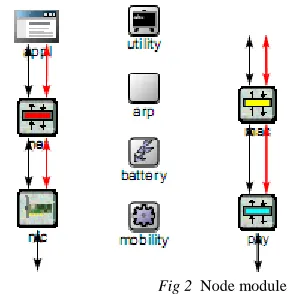
. Fig 2 Node module
Node is compound module consisting of application layer, network layer, physical layer and MAC layer.The layers are connected via gates. 1st pair of gates is for passing up and down data messages and control messages between the nodes and 2nd pair is used to exchange control messages between nodes.It is important to note that the MAC and physical layer are grouped into NIC [ network interface card module)card. We have taken a node with IEEE 802.11 NIC.
III] MOBILITY AWARE MAC PROTOCOL A MAC protocol design n is a key issue in
successful working of a Wireless network. The MAC
protocol design for wireless sensor networks has many challenges such as energy constraint resources, strict wireless bandwidth, channel utilization. Due to these issues the network topology and network scalability handling becomes a major problem In wireless sensor networks, mobile or stationary; the nodes can fail or new nodes can be added. Also in mobile networks the nodes move from their locations due to motion of the medium or by electro mechanical mechanisms designed for their motion[3]. When nodes move the topology of the network changes so the protocol has to accommodate the topology changes. In following session we have described some mobility issues.
A Mobility handling
MAC protocol for MSNs should take care of collisions, packet loss, resolution. Also it should give acceptable energy efficiency, throughput and robustness even when nodes are moving[8]. Some factors which are considered while designing MAC protocol[1]. 1. Moving nodes result in errors of synchronization and frame errors. MAC protocol needs to cope up these errors by adjusting frame time. The connections should be faster in the network. 2. MAC protocol should be able to adapt the schedule according to Mobility conditions in the network.
3. As mobility increases, probability of collisions increases which result in retransmission which in turn results in high energy consumption. MAC protocol should have means to use mobility information to avoid collisions. 4. Mobility information of node and its neighbours should be periodically circulated. This increases overhead in the network in the form of control messages. To reduce this mobility information in the form of common control messages should be made common to all layers. 5. Choice of mobility model should be such that it applies to real life.
B Mobility Model:-
Mobility model used is constant speed mobility[2]. In this nodes move with constant speed and random direction from one location to another location[10]. The mobility module is responsible for the movement of the node or object. Mobility and connectivity handling is main task of MiXiM framework. Each entity has a mobility sub-module which is responsible for movement of the node. And base mobility module is responsible for giving the graphical representation of an entity. Due to motion of nodes the links are created or failed. The Connection Manager module takes care of that.
IV] PERFORMANCE ANALYSIS:-
The MSN was modelled with the help of OMNeT++. The set of experiments include 5nodes. The experiment is simulated on playground size 250m*250m. traffic is generated by sensor nodes. The simulation is run for 50 secs. The simulation parameters are as follows
Table 1 – Simulation Parameters
No of nodes. 5
Node NIC 802.11
Connection manager Carrier frequency 2.142e9Hz
P Max 100mW
MAC header length 272bits
MAC queue length 14
MAC bit rate 2E+6bps
MAC tx power 100mW
Mobility type Constant speed
Node header length 32bits
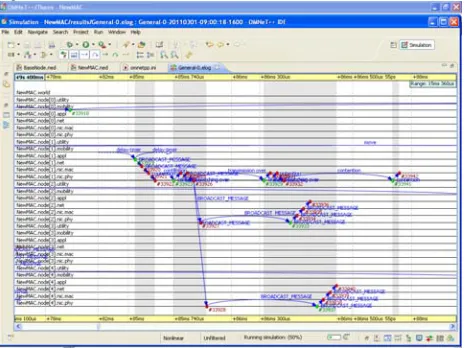
Fig 3 Transmission of packet
In the figure we can observe the layer wise transmission of packets. In the figure we can observe the node wise motion and messages transferred between the nodes .
The contention period for each node is different. We can observe it in fig 4.
Fig 4. Contention and channel access.
Fig 5 shows the MAC layer performance of the node. Where it shows the messages broadcasted and moved node along with the event number indicated by #.
Fig. 5 MAC layer of node 3
.
Fig 6 Movement of nodes with constant speed mobility
We can observe the mobility for each node. The nodes move with constant speed mobility which is similar to random waypoint mobility model [10]From the simulation results we can see the data transfer of the messages. It is observed as mobility of the nodes increases the average packet delay increases.
When the nodes are moving it affects the overall energy consumption but the added advantage is it dynamically covers all the area under observation.
IV] CONCLUSION:-
applications. Mobile sensor network was modelled using OMNeT++ network simulator and MiXiM framework. Energy consumption, efficient use of processing power were the considerations for MAC but now it has to consider the mobility. In this paper we have studied a few parameters of MSN.
And it has been observed that the average energy consumption increases as mobility increases.
REFERENCES:-
1] ] ‘An Adaptive mobility aware and energy efficient MAC protocol for wireless sensor network’. Bashir Yahya, Jalel Ben-Othman, University of Versailles Saint Quentin. IEEE international conference 2009.
2]http:- www.omnetpp.org
3]Muneeb Ali, Tashfeen Suleman, and Zartash Afzal Uzmi, "MMAC: A Mobility-Adaptive, Collision-Free MAC Protocol for Wireless Sensor Networks", Workshops Proc. of 24th IEEE Performance, Computing, and Communications Conf. (IPCCC'05), pp. 401-407, Phoenix, Arizona, USA, April 2005.
4] T. Dam and K. Langendoen, "An Adaptive Energy-Efficient MAC Protocol for Wireless Sensor Networks", Proc. ofACM SenSys, 2003. 5] Huan Pham and Sanjay Jha, "An adaptive mobility-aware MAC protocol for sensor networks (MS-MAC)", In the Proceedings of the 1st IEEE International Conference on Mobile Ad-hoc and Sensor Systems (MASS-2004), October 24-27,2004, Fort Lauderdale, Florida, USA. 6] Anjali Raja, Xiao, Su, "Mobility Handling in MAC for Wireless a Ad Hoc Networks", Wiley series on Wireless Communications and Mobile Computing? 2008.
7] Bashir Yahya, Jalel Ben-Othman, "Energy Efficient MAC Protocols in Wireless Sensor Networks", will appeare in Wiley series on Wireless Communications and Mobile Computing, 2009.
8 ]Wireless esh network simulation with OMNeT ++, by Tinku
Rasheed
9] T. Camp (ed),"A Survey of Mobility Models for Ad Hoc Network Research." , Wireless Communication and Mobile Computing, special issue on mobile ad hoc networking: research, trends and applications, Vol 2, No.5 (2002) 483-502.