Tense, Aspect and Relevance
By
Vladimir egarac
Thesis submitted in partial fulfilment of the requirements for the degree of PhD
University College London 1991
ABSTRACT
The main aim of this thesis is to consider some consequences of the relevance theory of Sperber and Wilson (1986) for explaining a number of phenomena relating to verbal aspect. Chapter one introduces some basic notions relating to aspect and illustrates the interaction of aspect and tense and gives an outline of the main tenets of relevance theory. Chapter two considers the aspectual categories (simple-progressive) of English and (perfective-imperfective) of Serbo-Croat in relation to each other, and also in relation to the the classification of verbs according to the situation types they denote. Problems of defining the aspectual categories of these two languages are examined, and the suggestion is put forward that relevance theory provides the framework which makes it possible to maintain a fairly austere semantics of aspectual categories as well as to explain aspectual choice. Chapter three examines the treatment of aspectual categories in terms of subjectivity. It is argued that speakers' intuitions about the aspectual categories being expressive of subjectivity can be explained pragmatically, in terms of the notions of loose use and interpretive use. In Chapter four, I argue that in addition to the feature of completion, the semantics of aspectual categories of both English and Serbo-Croat needs to be characterised in terms of reference to particular events instantiating the property denoted by the predicate. I show how this assumption makes it possible to explain a number of uses of the English progressive. I then proceed to argue that the progressive of English and the perfective of Serbo-Croat differ with regard to completion but that they both point indexically, as it were, to a particular event instantiating the property denoted by the predicate. This assumption is shown to be crucial in explaining aspectual choice in the two languages. Although the data discussed are drawn solely from English and Serbo-Croat, the central ideas presented should carry over to Slavonic languages in general.
ACKNOWLEDGMENTS
Whatever merit this thesis might have it would not have but for the help of a number of people. I owe the greatest debt of gratitute to Neil Smith, whose sustained support over the years has gone far beyond his role of supervisor. Working in close connection with such a personality as his has been a precious and unique experience. I thank him for everything, and especially for believing in me when I did not believe in myself:
Over the years during which this thesis was written I have shared my views and doubtø about many matters in life with Robyn Carston. On the pragmatics front, she was always ready for endless discussions. She has read many rough drafts of my papers, talks and chapters, and has also had the good will and the patience to proofread the fin1 version of this work. I thank her for all that, but most of all for the support and the encouragement that she gave me in my early days in London and the first days of my interest in pragmatics. I am not sure that this thesis could have been completed without her help, but I am sure it could never have been started without it.
It was a privilege for me to be introduced to relevance theory at its source and to attend a number of talks and seminars given by its authors, Dan Sperber and Deirdre Wilson. I feel particularly grateful to Deirdre Wilson for her lectures, and for her many discussions and comments, which have helped me gain a better grasp of relevance theory than would otherwise have been possible.
A number of other people have given me support and encouragement. I cannot mention them alL Many thanks to Ruth Kempson, Dick Hudson, and Diane Blakemore. I thank Dugan Puvaié, a friend and a colleague, who was always a patient informant for Serbo-Croat. A number of friends, fellow students who were, or still are, doing their PhDs at UCL, have created together an enjoyable and supportive working environment. In this regard I would especially like to thrnk Billy Clark, Maijolein Groefsema, Reiko Itani, Adrian Pilkington, and Vffly Rouchota.
In the past two years I have worked at the Survey of English Usage at UCL My thanks go to Baa Aarts, Sidney Greenbauin, And Rosta, and Laura Tollfree. Special thnk to me Mortelmans for her lively companionship at the Survey, for her persistence in urging me to be more efficient in my work, and for helping me to produce a much nicer looking copy of the present thesis than I could possibly have managed, if left to my own devices.
I thrnk Valerie Hazan whose last minute computational help saved me from a nervous breakdown.
TABLE OF CONTENTS
ABSTRACT 1
ACKNOWLEDGMENTS 2
Chapter One 7
INTRODUCTION 7
1.1. ASPECFUAL CATEGORIES 8
1.2 ASPECT AND AXTIONSART 14
1.3. TENSE AND ASPECT 18
1.3.1 Jespersen's analysis of tense 19 1.3.2 Reichenbach's analysis of tense 21
1.4 THE UNDERDETERMINACY THESIS - T) KINDS OF
SEMANTICS 27
Chapter Two 41
TWO APPROACHES TO ASPECT 41
2.1 PERFECTIVITY AND IMPEEFECTIVFI'Y 41
2.2 SITUATION TYPES 44
2.2.1 States and state verbs 45
2.2.2 Processes and process verbs 45 2.2.3 Accomplishments and accompilishinent
VPs 47
2.2.4 Achievements and achievement verbs 48 2.3 THE PERFECTIVE-IMPERFECTWE DISTINCTION AND
SITUATION TYPES 49
2.3.1 Valeur 51
2.3.2 The aspectual categories of English and
Serbo-Croat compared 66
2.3.3 Viewpoint aspect 70
2.4 CONCLUDING REMARKS 75
Chapter Three
78SUBJECTiVITY, ASPECT AND RELEVANCE
783.1 EVIDENCE FOR SUBJECflVITY 80
3.1.1. Overview of Banfield's analysis 80
3.1.1.1 Syntactic evidence for
subjectivity 80
3.1.1.2 Embeddable subjective
expressions 81
3.1.1.3 The progressive: simultaneity and
subjectivity 84
3.1.2 Lyons' account of subjectivity 86
3.1.2.1 Non-paraphrasabiity as
evidence for subjectivity 87
3.1.2.2 The quotative of French
and subjectivity 88
3.1.2.3 Aspectuol choice, modes of
discourse and subjectivity 90
3.2 THE USES OF TENSE-ASPECT FORMS 92
3.3 SUBJECrIVrFY AND RELEVANCE 104
3.3.1 Absence of SPEAKER 105
3.3.2 'The descriptive fallacy' 107 3.3.3 Descriptive and interpretive use 110
3.3.3.1 Free indirect style 111
3.3.3.2 Exciarnative interfections and higher level
explicatures 113
3.3.3.3 Subjectivity, evidential ity
and literalness 118
3.3.3.4 Loose Use 124
3.3.3.5 The progressive loose use and
iaterpretive use 126
Chapter Four 134
PRAGMATIC S ANT) VIEWPOINT ASPECT 134
134
4.1 THE PROGRESSIVE 135
4.1.1 The meaning of the progressive 136 4.1.2. Properties and instantiations of
properties 138
4.2 SOME CHARACFEBJSATIONS OF THE MEANING OF
THE PROGRESSWE 139
4.3 RELEVANCE THEORY AND THE OVERTONES OF
MILD REPROOF, iNSINCERITY AND TEMPORARThIESS 144 4.3.1 The overtone of mild reproof 144
4.3.2 The overtone of insiiwerity 147 4.3.3 The overtone of temporariness 150
4.4 MARKEDNESS 152
4.5 THE PROGRESSIVE AND CONSTRAINTS ON
RELEVANCE 164
4.6 THE PROGRESSIVE AND THE PERFECTWE 177
4.7 THE IMPEEFECTIVE AND THE PROGRESSIVE - THE
MORPHEME -IVA- 183
4.8 THE PERFECTIVE AND THE SThPLE 187
Chapter Five 193
PRAGMATIC S AND SITUATION TYPE
ASPECT 193
5.1 VERBS OF STATE 194
5.2 PROCESS VERBS AND ELIMINATION RULES 197 5.3 RELEVANCE THEORY AND TESTS FOR STATE VERBS 199 5.4 EvENT VERBS AND DELIMITEDNESS 208
Chapter Six 221
CONCLUSION 221
NOTES 224
BIBLIOGRAPHY 228
Chapter One INTRODUCTION
Putting it in the most general terms, the main aim of this study is to examine some issues pertRining to the category of aspect in the light of the relevance theory of Sperber and Wilson (1986) (S&W hereafter). This chapter addresses some preliminary questions. Which linguistic phenomena does the term aspect (or verbal aspect) refer to? What distinguishes aspectual categories from the closely related category of tense?
The term aspect, or verbal aspect, was originally used rather narrowly in relation to the linguistic expression of semantic distinctions presumed peculiar to Slavonic languages (cf. Forsyth (1970)), or as a descriptive cover term for a number of language particular categories characterised by partial semantic overlap and defined in terms of the grammaticalisation or lexicalisation of certain features of rneining or the combinations of these features. Only more recently has aspect been considered from the point of view of general and theoretical linguistics, although it should be mentioned that a well established tradition which looks at aspectual distinctions as universal was, for a long time, associated with philosophy. It will be ex ynined in the next chapter. So, what could be the rationale behind the language particular and the language universal approaches to aspect?
This chapter looks at some of the arguably defining semantic features of aspectual categories, and considers the relation between aspect and Aktionsart. The interaction of aspect and tense in determining the temporal interpretation of the utterance is illustrated.
INTW000CTIOI4
The problem of characterising the meanings of aspect and tense and explaining their interaction is shown to be largely due to the view of verbal communication as an encoding - decoding process characterised by strict isomorphism between the linguistic mepnings of natural language expressions and the contents of the conceptual representation which these expressions purport to communicate. It is Bhown that (explicit or implicit) reliance on the code model of verbal communication poses insurmountable difficulties for a plausible analysis of this relation, and two basic tenets of the relevance theory of S&W (1986) are introduced in order to indicate a way in which the problem could be tackled. The first one is the claim that the linguistically encoded meaning of the utterance characteristically severely underdetermines the conceptual content of the mental representation which the utterance purports to represent. This idea is known as the underdeterminacy thesis. The second tenet is the distinction between two kinds of
semantics: linguistic semantics and real semantics (i.e. truth-conditional semantics or the semantics of mental representations).
1.1. ASPECTUAL CATEGORIES
Aspectual categories are characteristically defined in terms of the pairing of certain features of meaning with certain natural language entities (words, derivational or inflectional affixes, or syntactic constructions). Following is an incomplete list of these features. The presence or lack of each has been taken by one author or another as defining a pair of categories: (a) complete; (b) habitual; (c) durative;
(d) dynamic; (e) telic; (f) iterative; (g) ingressive; (h) resultative; (i)progressive; (j)perfect. Let me ifiustrate them in turn.1
1NThOOIJCT1CC
(a) complete
(1) a. The cat ate the rat.
b. The cat sat on the mat all morning (and, for all I know, she may still be sitting there).
Intuitively, (la) is most likely to be understood as describing a complete event, and (ib) as describing a state of affairs in the past which lasted for some time and was, probably, terminsted before speech time. This feature is taken to be definitional of the aspectual categories imperfective and perfective of Serbo-Croat (and Slavonic languages in general), to be examined more closely in Chapter two.
(b) habitual
(2) a. Thecatsitsonthearmchairwhenitwautstobe stroked.
b. The cat is sitting on the armchair now. c. John walks to schooL
d. John is wplking to school at the moment.
The utterances (2a) and (2c) describe characteristic (or habitual) behaviour of their subject referents and contrast with (2b) and (2d) which are about events ongoing at the time of communication. But, note the slight difference in the ways (2a) and (2c) depict habitual or characteristic behaviour. In fact, it is not dear that (2a) is habitual at all. On the assumption that habitual utterances are to be explained as generalisations based on individual instances of events, it seems obvious that (2c) should be considered habitual, whereas (2a) might stifi be a statement about the causal connection between individual
mmoijcrioi
occurrences of the cat's sitting on the armchair and its desire to be
stroked.2
(c) durative
(3) a. John swam across the river in ten minutes. b. John's swimming/swim across the river lasted ten
minutes.
c. John arrived home in ten minutes.
d. *flJohn's arriving/arrival home lasted ten minutes.
The important observation here is that (3a) can be paraphrased by (3b),
while (3d) is rather unusual at best. What these examples show is that events may be conceptually represented as taking time to take place, (3a), or as momentary, i.e. as not involving duration at all, (3c).
(d) dynamic
(4) a. Mary ran on the beach. b. The book lay on the table. c. The cage contained the bird. d. The box contained five chocolates.
The utterances in (4a) and (4c) describe processes, i.e. / states of affairs which involve continuous change (more precisely, activities, since the chpnge is caused by an agent); those in (4b) and (4d) describe states, i.e. states of affairs which do not involve cbinge (but may be brought about and altered by some chpnge which is external to them). The distinction between state verbs and process verbs is discussed in some detail in Chapter two and Chapter five.
(e) telic
(5) a. He fell down. b. He blinked once.
Telic predicates like fall down denote events with some clear consequence(s) or outcome. With atelic ones the idea of outcome is absent, although it could be argued that events with the feature [+complete] always involve an outcome, which is more salient in some cases (if one falls down on a surface, one ends up being on that surface as a consequence of the fall) and less in others (making a blink is not readily associated with the idea of outcome or consequence).
(f) iterative
(6) a. John was/kept blinking. b. John blinked once.
The event in (6a) is made up of a series of events of the same kind. The utterance (6a) is about one occasion on which John produced a series of blinks which are seen as sub-parts of a single more inclusive instance of blinking, in contrast to (6b) which is about one single blink.
(g) ingressive (inceptive inchoative)
(7) a. They were about to leave.
b. They were on the point of leaving.
The feature ingressive is probably best characterised by reference to the onset of an event or state and, possibly, the event or state itselL The
IN1OUTtOt4
example, this feature is associated with the prefix uz-. So, the verb
pisati means 'to write', while its ingressive Counterpart pisati conveys the idea of starting writing and getting fully engaged in this activity. With verbs which do not involve change, the prefix uz- indicates merely transition into the state. For example moéi means 'can', 'be able to', and ymoéi means something like 'change from the state of not being able to into the state of being able to'.
(ii) resultative
(8) a. John built a house. b. John ran a mile.
The difference between the features telic and resultative is not always easy to draw. If the distinction is to be useful at all, the feature [+resultative] should be reserved for those verbal predicates denoting events which bring about the existence of their object referents. By this criterion, (8a) would be resultative, while (8b) would be merely telic. The two categories would stand in a relation of indusion: all resultative predicates would also be telic, but not all telic predicates would be resultative.
(i) progressive
(9) a. The cat was sitting on the mat all morning.
b. The cat sat on the mat all morning.
One of the differences between the progressive and the simple is illustrated by the overtones of dynamism and vividness conveyed by (9a), in contrast to (9b), where these overtones are absent. Although progressiveness is sometimes assumed to be a single feature, it should
ODVCIIOI4
be clear from the examples given here that, at the semantic level, it could be seen as resulting from the combination of the 5eatures [-complete] and [+ dynamic].
(j) perfect
(10) a. I have seen that film. b. I saw that film.
c. I have written a letter. d. I wrote a letter.
Both pairs of utterances in (10) locate events in the past, but carry different overtones. The present perfect highlights the idea of current relevance of the event, the simple past tends to focus, as it were, on the circumstances in the past related to the occurrence of the event.
There are two important and related questions regarding the perfect which deserve to be mentioned here. First, what exactly is the feature encoded by this grammatical form (if only one feathre is at stake)? Second, does the perfect belong to the category of aspect, or to some other category, such as tense? Clearly, the answer to the second question will crucially depend on how the domains of aspect end tense are defined, and how the meaning of the perfect construction is characterised.
Ten seems a good number to stop at. To be sure, the list could be expanded to include more categories. One possible objection might be that this great number of allegedly aspectual distinctions is arrived at by failing to put emphasis on the notions of lexicalisation and gramniaticalisation, on the expression of aspectual contrasts by derivational affixes and syntactic constructions, and by conflating the
H4TRODUCT1ON
notions of aspect and Aktionsart. In so far as aspectual categories concern the linguistic expression of conceptual contrasts, one could dismiss the distinction between syntactic and morphological means of expressing these contrasts as irrelevant. But what would be the difference between aspect and Aktionsart? The distinction between these two terms is examined briefly in the following section.
1.2 ASPECT ANI) AKTIONSART
The term Aktionsart has been used very inconsistently, causing considerable confusion. It could be used to capture the distinction between grammaticaiisation and lexicalisation (as Lyons (1977:705-706) suggests). The term aspect could be reserved for the former, and Aktionsart for the latter. For example, the progressive grimmaticalises incompletion. Hence, it would be an aspect. A verb like play denotes continuous activity. As incompletion is part of the lexicalised meaning of the verb, the feature (- complete] would in this case pertain to Aktionsart, and not to aspect.
Another possibility is to use the term aspect to cover only inflectional markers of certain meAning contrasts, while reserving the term Aktionsart for the marking of aspectual distinctions by derivation. A fairly clear example of an a8pectual distinction by this criterion would be the contrast between the passé simple and the imparfait of French:
the former denotes an event as a whole, the latter, as an ongoing process in the past.
(11) a. II reigna trente ans. b. II reignait treute ans.
He reigned/was reigning for thirty years.
By these same criteria, the contrasts between pairs of verbs like camp -encamp of English, battre - abattre ('beat' - 'demolish') of French, and tél
-oti61 ('go' - 'go away') of Serbo-Croat, fall within the scope of Aktionsart
on formal grounds, and in the scope of aspect, on semantic grounds (because the first member of each pair indicates incompletion, while the second one indicates completion).
One possibly useful way of maintaining the distinction is to confine the term Aktionsart to the contribution that various markers of (in)completion and change (the typical example being the prefixes of Slavomc) make to the lexicalised mesning of the verb, as illustrated by the opposition between verbs of Serbo-Croat tél ('go'), t ('come'), Q.ftii
('go away'), pjéi ('go through'). Aspectually, the last three verbs would all be perfective (i.e. completive), but each would have a different Aktionsart. In contrast to these prefixes, the perfectivising suffix -nu, as in metnuti ('put'), as opposed to meatati (roughly, 'be putting'), is strictly aspectual, since it does not change the lexical meRning of the verb beyond indicating completion.
Aktionsart seems a somewhat confusing, and, therefore, not particularly useful term. On the one hand, it has been used in many different ways. On the other hand, if one decides, following Lyons' suggestion, to introduce the term in order to draw the distinction between lexicalisation and grammaticalisation, Aktionsart will be found to overlap with the well established, and fairly consistently used term
situation type aspect, to be xmined in Chapter two. Regardless of the way in which this terminological quibble is resolved, the question of what caused the massive proliferation of aspectual distinctions imposes itself. The answer is obvious, at least in part. When the meaning of aspectual categories is defined in terms of semantic features such as completion, the picture may be complicated in two main ways.
INThOOUCTot
First, given a particular feature, say [+1- complete], the following
situations may arise in a language: (a) both the positive value [+ complete] and the negative value [- complete] may be grammaticalised, as illustrated by the perfective - imperfective contrast of Slavonic languages; (b) only one value may be grammaticalised while the other one is unspecified, e.g. the -ing suffix of English with the value
[-complete], in contrast to the simple aspect, which is (so one could argue at least) unspecified with respect to the feature in question, and (c) it
is possible, in principle at least, that neither value of a particular feature is gramniaticalised or lexicalised in a language. Given the possibilities (a) and (b), the apparent differences across languages could be attributed (i) directly to differences in the values which are grammaticalised, and (ii) to the ways in which the aspectual choices available in the language system interact with the pragmatic principle(s).
Second, an objection to the language universal view of aspect, particularly widespread among Slavicists, is that the choice of an aspectual category in one language, e.g. the imperfective in Slavonic, does not (or does not systematically) convey the same idea as the arguably corresponding category in another non-Slavomc language, e.g. the English progressive. Hence, the following argument: (a) there is no strict correspondence between aspectual categories across (different groups of) languages, therefore (b) aspectual categories are language particular. Forsyth (1970) is a representative exponent of this view. Of course, once the argument is spelled out it becomes obvious that it doesn't hold. The conclusion from (a) to (b) is simply not warranted. When a semantic feature is seen as definitional of a binary pair of categories then, given the potential grammaticalisation of its values, the following contrasts illustrated above could arise: [+1-], [01-], [+10] and
04Th000C7K*I
example, assuming that the simple - progressive contrast of English is adequately characterised as [0/- complete] part of the difference is in the ideas and overtones conveyed by the choice of the progressive in English, and the choice of the imperfective in Slavomc would (in some way which needs to be pragmatically explained) follow from the differences in the aspectual choices available in the two languages, the choices which determine what I will call the functional identity of aspectual categories within the language system. For example, the interpretation of a form with the value I- complete] will predictably vary depending on whether the value [+ complete] is also grammaticalised or not. This question and other closely related issues are discussed in more detail in the chapters to follow. The main point here is to emphasise that the reasoning behind the language particular view of aspect is flawed. The Slavicist's possible response to these objections would be that they are misplaced and that aspect is not to be defined only in terms of semantic features which never appear in isolation from other less salient facets of verb mepning. Completion and incompletion are, arguably, merely the most salient elements of aspectual semantics but do not exhaustively define the aspectual categories of perfective and imperfective. This leaves a range of apparently closely related meanings as an unexplained residue of the more salient and systematically gr2mmaticalised contrast between completion and incompletion, a residue which, seemingly, happens to be peculiar to Slavonic languages. Of course, one way of dealing with problems is to eschew them, but it is not a particularly interesting one.
The discussion in the chapters to follow rests on the fairly uncontroversial assumption that the feature 1+/- complete] is indeed definitional of the aspectual categories perfective - ixnperfective of
Slavonic and simple-progressive of English. Moreover, this feature plays a part in the interpretation of sentences in which neither of the
INTROIXICTION
values can be said to be determined by the linguistic meaning of the predicate, such as John read the newspaper, for example. Depending on the context in which it is used this sentence can be taken to convey two thoughts with different truth conditions, roughly: John spent some
tune reading the newspaper and John read the whole
newspaper/finished reading the newspaper. This example shows that
aspectual distinctions are crucially related to the temporal interpretation of the utterance. Most strikingly, on one interpretation the past event of John's reading the newspaper could be construed as extending over the time of communication, whereas on the alternative interpretation the event would be completed in the past and, therefore, could not be extending over the present. So the interaction of aspect and tense seems worth looking at in some detaiL
1.3. TENSE AND ASPECT
It is traditionally assumed that tense is a deictic category whereas aspect is not Tense arguably determines the temporal location of a state of affairs or event relative to the time of communication, while aspect determines the temporal properties internal to the state of affairs or event. At the end of section 1.2 I hinted at the need for looking at aspectual distinctions at the level of the conceptual representations, whether they are grammaticalised in a gwen language or not. In this section I further illustrate this point and show that on a par with what could be tentatively called grammatical and semantic
aspect, there is a case for drawing a distinction between grammatical and semantic tense. This section considers two well known analyses of tense. My main aims are to highlight the relevance theoretic distinctions between pragmatics and semantics, on the e hand, and two kinds of semantjce (linguistic semantics and truth-conditional
IN11oOUC?lOtI
semantics), on the other, by looking at examples which ifiustrate the
contribution of tense and aspect to utterance interpretation.
1.3.1 Jespersen's analysis of tense
In terms of traditional grammar tense is a verbal form expressing time. We conceive of time as past, present and future, and tense forms tell us which of these three is being talked about. In Jespersen's own words:
It is important to keep the two concepts time and tense strictly apart. The former is common to all mankind and is independent of language; the latter varies from Language to Language and is the Linguistic expression of time-relations, so far as these are indicated in verb jbr,ns;
By the essence of time itself, or at any rate by a necessity of our thinking, we are obliged to figure to ourselves time as something having one dimension only, thus capable of being represented by one straight line.
(Jespersen (1961:1))
The relevant conceptual temporal distinctions on the time line are schematically represented in Figure 1:
Ai Ah A B ( eb ('
A: past C: future
Fig.1.
ffTOOUCTION
The subdivisions read as follows: - before past (e.g. John
had already left at five); - past (e.g. John left at five); - after past (e.g. John was to leave at five); B - present (e.g. John is at the party);
- before future (e.g. John will have left by five); Q - future (John
will leave at five) Q - after future (e.g. If John arrives, Mary will soon
be leaving). Jespersen also recognises that 'we have other time relations which do not fit into the series because they imply something else beside the pure idea of time' (p.360). He calls them prospective and
retrospective, and indicates them by means of arrows. For example, (4—B) is retrospective present (as in John has arrived), (B—p) is the prospective present, (as in John is about to leave). As Jespersen's own examples show, the temporal location of states of iffir8 or events described by the utterance is largely determined by the context, both extra-linguistic (e.g. in John left at five, when exactly did John leave?
At five on the day of the utterance, the day before, or the Tuesday before
the day of the utterance) and linguistic (e.g. in If John arrives, Mary
will soon be leaving, it is not clear whether Mary's leaving is to take place soon after the time of communication or soon after John's arrival).
The good side of Jespersen's system is that it can accommodate a wide range of temporal distinctions. It also turns out to be its nuin disadvantage. The system is efficient, but - and precisely because - it is ad hoc. Potential exceptions can always be handled by introducing new symbols, whose number is unconstrained, or at best not constrained enough to allow for theoretically interesting predictions and explanatory insights. However, traditional grammar at its best, as practised by Jespersen, had an important merit. It was explicit enough to provide the basis for accounts which would not suffer from (some of) its deficiencies. One such analysis of tense was proposed by Reichenbach.
OOUCTW
1.3.2 Reichenbach's analysis of tense
Reichenbach (1947) developed a system of tense according to which the temporal relations expressed by utterances can be represented exhaustively in terms of ordering relations between three universals: speech time (S), reference time (R), and event time (E). Let me illustrate just a few combinatorial possibilities.
(12) a. E_R__..$ John had already left at five. b. E,R_$ John left at five.
c. E_R,S John has left.
d. E,R,S John is eating pancakes. e. S_L..._.R John will have left by five.
The past perfect, in (12a), by virtue of its grimniaticalised me2ning, locates the event in the past relative to a reference time in the past, i.e. a reference time preceding the time of speech. In (12b), the adverbial
at five specifies the reference time in the past at which the event occurred. The present perfect in (12c) locates the event in the past, but speech time is the reference time. This is presumably determined by part of the grRmmaticalised me pning of the present perfect. Hence the incompatibility of the construction with past time adverbials (*John has left at five o'clock). On the most natural interpretation of (12d) the
three points coincide. The future perfect reading of(12e) is somewhat misrepresented. The reference time must be in the future relative to the time of speaking, but the event itself needn't be located in the future relative to S. The event time may precede S or be simultaneous with it Consider the following situation
(13) k Has John left?
B: Fm not sure, but he will have left by five.
tN7IOflUC11OH
Speaker B guarantees merely that John will leave before five, not that
John has not left before or that John might not be leaving at the time of speiking (cf. Comrie (1985:128)). This may be merely a notational problem. However, there are other temporal contrasts which Reichenbach's framework does not capture. Consider the fbllowing examples:
(14) a. John has done his homework.
b. John has lived in London (but now he lives in New York).
c. John has lived in London (for three years now).
There are some significant differences between (14b) and (14c). While (14a)normally conveys the idea that John's homework was due for the day of the utterance, or the like, (14b), especially with the continuation in brackets, does not carry the overtone of current relevance. In contrast to (14b), (14c) clearly relates the situation to the present, but, unlike (14a), the utterance (14c) describes a state of afflirs which actually obtains at the time of communication. However, in Jespersen's notation all three are instances of the retrospective present (t —B), and on Reichenbach's, they are E_R,S configurations. If Jespersen's and Reichenbach's systems are taken to represent the meanings encoded by the tense forms of natural languages, they are clearly inadequate. The main point here is that the two analyses of tense, even when they are successful in representing temporal relations, do not really capture the distinctions which can plausibly be regarded as encoded in the language, but those that natural language expressions receive in use. This is what I tried to illustrate by the contrast between (14b)and (14c). Given different contextual information, as explicitly stated in the brackets, one and the same sentence, may be used to convey two different thoughts. The same point is exemplified in (15):
(15) A: What did you do on Sunday morning?
B: (i) I read the Sunday Times.
(ii) I read Robyn's review of Gavagai.
Each of B's answers may be taken to mean two different things: (a) B spent some time reading the newspaperithe review, and (b) B read the whole newspaper/review. Also, lbr some reason which needs to be spelled out, (a) is probably, the preferred understanding of the answer in (1), and (b) for the one in (ii). The apparently easy way out is to say that these are not distinctions pertaining to tense, but to aspect, and that the feature of completion is crucially involved. But there is a clear sense in which this aspectual feature should be recognised as significant for the temporal interpretation of the utterance. Consider the examples in (14) again. (14b) is clearly about a state of affairs in the past, while (14c) is at least partly about a state of affairs which obtains at the time of the utterance. Thus, in a number of languages, such as French or Serbo-Croat, (14b) would be translated by a past tense sentence (Jean a vécu a Londres...; Jovan je weo u Londonu...),
and (14c) by a present tense one (Jean vU a Londres depuis tmis ans; Jovan Evi u Londonu veé fri godine). Now, the examples in (14) could be explained in terms of ambiguity. It may seem reasonably plausible to assume that the present perfect is simply three (or more) ways ambiguous. However, this would be a partial explanation. One would still have to explain how disanibiguation is carried out, how the hearer decides which of the meanings the speaker intends to convey by using a particular form. In addition to this, the multiple ambiguity solution presents a general methodological problem for anyone committed to a Gricean pragniatics. It has become something of a truism that, other things being equal, a simple theory is preferable to a more complex one. In a line with this position Grice put forward the requirement (his 'modified version of Ockham's rasor') that ambiguities should not be
lNTROUUCTK(
multiplied beyond necessity. In other words: other things being equal, the simpler the semantics, the better the analysis. I will show ]ater that relevance theory which provides a reasoned account of the relation between the meaning encoded by natural language expressions and the meanings that they are used to communicate, constrains the proliferation of ambiguities in a principled way, thereby making it possible to maintain a fairly simple semantics. Moreover, the same principle which provides the explanation of the relation between the linguistically encoded mepning of an expression and the conceptual content which that expression is used to communicate also provides an explanation for disambiguation. The examples in (14) and (15) were intended to show that the problem of expbiining the relation between the linguistic meaning of a natural language expression and the information communicated by that expression is a real one. Reichenbach'8 notion of reference time is also of interest in this connection.
The term reference time, which Reichenbach left undefined, is far from dear, as illustrated by the examples below.
(16) a. John arrived too.
b. Tolstoy wrote many novels.
(17) That will be John at the door. (i) John is at the door now.
(ii) If the hearer opens the door (or the like) be will find out that John is at the door.
In both (16a) and (16b) reference time is in the past, but it is im1icit. The speaker does not say when John arrived or when (Chakespear) wrote many play) However, the specific point of time is intuitively
UThOWCY1O4
more significant in (16a) than in (16b). In addition to information about where John arrived, and who else arrived at the gathering which is talked about, the hearer will want to know something about the time of John's arrival, or at least about the time at which the gathering took place. In (16b), very vague assumptions about the pastness of the state of affairs described would normally be quite sufficient. So, the questions are: How specific a representation of R must the hearer arrive at? What does that depend on? In (17) there really seem to be two reference times rather than one. The speaker is asserting his commitment to the truth of the present tense proposition in (i) (hence, the contradiction in That will be John at the door, but I am not quite
sure that he is here at this vely instant), as well as to the future tense proposition in (ii). Not only is reference time partly determined on the basis of contextual information, but more than one R may be conveyed by a sentence with one tense form. What the -ed suffix and the modal verb will indicate by virtue of their mepnings does not amount to a full temporal specification of the propositions expressed by the utterances in which they are used. In terms of truth conditional semantics tensedness is a requirement for propositionalisation. For a representation to be capable of being true or false, it must be temporally interpreted, i.e. tensed. It would then seem that Reichenbach's reference time is a way of thiking about this requirement. If temporal interpretation of the utterance to the level of a fully fledged proposition is a pragmatically driven process, like reference assignment in the case of pronouns, and is in some way guided by the meanings of natural language tense forms, the notion of reference time seems superfluous. What is really there are the meanings of the morphological tense markers, and tensedness as a property of propositions. A possible way of preserving the notion of reference time might go as follows. In (17), for example, the sentence has present tense (assunilng that modal verbs such as will have present
IN1HOOUCTIOt
tense), the tense of the proposition expressed by the utterance of (17) is present, as indicated in (1), while the reference time is future - it is an indication encoded by the present tense modal will that future tense assumptions should be brought to bear on the contextualisation of the proposition expressed by the utterance (in other words, the derivation of the consequences of integrating the proposition with other assumptions in the encyclopaedic knowledge of the hearer). On this view, it would be the reference time which somehow or other leads the hearer to interpret the proposition (i) against a context which includes (ii) and/or other future tense propositions. However, this leaves us with the problem of expbining those uses of will in which the proposition expressed by the utterance has future tense. On the assumption that every utterance expresses only one proposition, one should be able to test the tense by constructing examples like (17'):
(17) a. *That will be John at the door, but he may not be there now.
b. That will be John at the door, but he'll be gone if you don't open the door immediately.3
Clearly, the epistemic use of will in utterances like (17) communicates two reference times: present and future. Examples like (lTa) and (1Th)
show that (17) expresses a present tense proposition. If(17) had future tense, (lTa) would not be contradictory, but (lTb) would. I assume that tense, in the semantic sense, is, roughly, that part of a mental representation concerning the time at which the truth conditions for the state of affair which that mental representation purports to represent are guaranteed to be met. Obviously, the Reichenbachian notion of tense as a relation between reference time (R) and speech time (S) is not correct, because utterances like (17) have two reference times (present and future), but only one tense (present). The characterisation
of tense in terms of the relation between reference time and speech time is simply too vague to be useful.
My aim in this section was to make the following points. First, the meanings of morphological or other tense markers only partly determine the temporal specification of the propositions expressed by natural language utterances. Second, I hope to have shown with sufficient clarity that aspectual distinctions may interact with morphological tense markers and play a crucial part in constraining the temporal relations conveyed by the utterance, i.e. in determining tense as a semantic property of propositions. Third, the examples in (14) and (15) show that the semantic contrasts pertaining to aspect, may play a
crucial role in the temporal interpretation of the utterance without being grammaticalised. Fourth, Jespersen's and Reichenbach's analyses, as well as those in terms of formal semantics, and many other approaches for that matter, fail to do justice to the observation that the linguistically encoded meaning of an utterance characteristically severely underdetermines the content of the proposition expressed by the utterance. This last point, the view that the content of a natural language expression severely underdetermines the content of the mental representation which that expression communicates is known as the underdeterniinacy thesis. It is central to the relevance theory of S&W (1986), the framework for the analysis to be presented in the following chapters.
1.4 THE UNDERDETERMINACY THESIS - TWO KINDS OF SEMANTICS
The view of natural language as a code and of verbal communication as being primarily an encoding - decoding process is deeply rooted in common sense. It was taken for granted in traditional
INTRODUC
grammar and semiotic approaches to communication and still survives in more or less moderate or disguised forms.
On the common sense view of verbal communication words and utterances convey meaning. When a speaker produces an utterance the hearer knows what the speaker intended to communicate by virtue of his knowledge of the language. Proof: when someone addresses you in a foreign language which you don't know, you are imlikely to be able to work out what they meant because you don't know the language. The common sense view has permeated the study of language over centuries. Various definitions of the term sentence are ifiustrative in this connection. According to Fries (1959), the following definition of sentence was proposed (at around 500 A.D.):
A sentence is a group of words expressing a complete
thought.
(Fries (1959:9)) This definition survived for a very long time in traditional and pedagogical textbooks of grammar, and was originally challenged on the grounds that the term complete thought could not be adequately defined and should, therefore, be dispensed with. The question of how ideas are actually communicated by means of language was postponed for better times and sometimes not considered central to the linguistic enterprise. However, some definitions of the term sentence come quite close to what would appear to be a plausible characterisation of the notion complete thought. Thus, Ries (1894) defines the term sentence as follows:
A sentence is a grammatically constructed smallest unit of speech which expresses its content with respect to this content's relation to reality.
INThODUC1ON
Towards the middle of this century Sundén (1941) suggested the following definition:
A sentence is a portion of speech that is putting forward to the listener a state of things (a thing meant) as having validity, i.e., as being true.
(in Fries (1959:18))
With slightly different emphases, both definitions are near characterisations of complete thought as a propositional mental representation. However, what matters to me here is that sentence meaning is plausibly characterised in terms of conceptual content, and that the relation between the meaning content of a sentence and the conceptual content of the thought communicated by the utterance of that sentence is not one of identity. It is the observation that sentences communicate different thoughts when uttered on different occasions and its consequences which are of interest here. The examples considered in section 1.3 show that the temporal information at sentence level is less determinate than at the level of the proposition expressed by the utterance both with respect to tense and aspect. Other mples which illustrate the same point are considered in this section. It is shown that an inferential theory of communication can explain the gap between sentence merning and utterance meaning, which cannot be accounted for on the code model view of verbal communication.
S&W (1986) argue that pragmatics plays a crucial part in establishing the propositional content of the utterance, and that its role is by no means confined to reference assignment and disambiguation, but is, in fact, far more significant than that. On their view the decoding of the linguistic meaning of the utterance yields a mental representation which they call the logical form of the utterance. The logical form is characteristically a less than fully propositional
representation, a structured string of concepts which needs to be further enriched and completed to the level of a fully fledged proposition, a mental representation (i.e. thought) capable of being true or false. Carston (1988) gives a detailed discussion of this point.
(18) He went to the edge of the big rock and jumped.
(adapted from Carston (1988:165))
(1) He went to the edge of the big rock and jumped over the edge of the big rock.
(ii) He went to the edge of the big rock and jumped, but he didn't jump over the edge of the big rock.
What could the speaker have intended to communicate by the utterance in (18)? On the most natural interpretation, i.e. the interpretation of the utterance in the most readily conceivable immediately accessible contexts, (18) would be taken to convey a thought like (i), although, given the appropriate context, it could also be used to convey a thought like (ii). The point is that one and the same utterance is used to express two propositions which are not truth-conditionally equivalent: the state of affairs which makes (i) true makes (ii) false, and vice versa. Consider (19):
(19) A: Is John very badly injured?
B: The man went to the edge of the rock and jumped.
premise: If John went to the edge of the rock and jumped from the edge of the rock, he is
probably very badly injured.
conclusion: John is probably very badly injured.
The information that John jumped over the edge of the rock, as well as the premise and the conclusion in (19), could only be derived pragmatically (i.e. by inference), and not by decoding. But, the assumption that John jumped off the rock has a different status from the other two. it is construed as part of the explicit content of the proposition expressed by the utterance, what is said in Grice's terms, and plays a crucial role in the formation of both the premise and the conclusion in (19). In relevance theory terms this representation which is arrived at by the process of pragmatic enrichment and completion of the logical form of the utterance is called the propositional form of the utterance. The derivation of the premise and the conclusion in (19) crucially depends on whether one assumes that the information John jumped off the rock is part of the propositional form, the proposition expressed by the utterance, and that it is an explicature (i.e. a proposition which, in addition to being a development of the logical form, is one which the speaker intended to communicate by his utterance).
The premise and the conclusion in (19) are arrived at by inference, as implicatures, implicated assumptions which the hearer believes the speaker could rationally have intended to communicate by the explicature of his utterance when interpreted in context. It seems crucial to observe that implicatures have a different status from explicatures. Upon answering A's question B may continue: By miracle he's got only a few bruises, thereby canceffing the implicated information, but not the explicature (in Grice's terms 'what is said'), i.e. that John went to the edge of the rock and jumped over the edge. The
blocking of the implicature does not lead to a change in the hearer's construal of the content of the intended explicature. But, once A has assumed that John jumped over the edge of the rock, B's continuation:
He didn't jump over the edge, or He didn't jump over the edge of the
INTh000CTION
rock will cause a major revision of A's assumption about what B had actually said, the explicit content of his utterance. My point here is that one and the same sentence can be used in describing two different situations in the world, and that this difference cannot be explained plausibly in terms of the linguistic menning of the sentence. The knowledge that the verb jump, can only be followed by certain prepositional adverbs such as over, up, down, and that the sentence is possibly elliptical, does not undermine this point. The decision about
the manner in which John jumped, the dtrection in which he jumped,
and the like are not to be regarded as determined by the linguistic meaning of the utterance, but by inference: by the formation of hypotheses on the part of the hearer about what the speaker could rationally have intended to communicate by his utterance. These hypotheses are partly constrained by the linguistic meaning of the utterance and partly by the way in which humans go about interpreting verbal (and other ostensive) stimuli. Central to S&W's theory of communication are the following claims about cognition:
Humans pay attention to those phenomena which are relevant to them. In other words they pay attention to phenomena when doing so is likely to bring them some cognitive gain. The greater the gain, the greater the relevance. In constructing and processing representations in their cognitive environment, people aim at achieving the greatest possible gain while investing as little processing effort as possible. In a nutshell, relevance is a positive function of cognitive effects and a negative function of
processing effort.
Utterances are ostensive stimuli, they are deliberate alterations of the cognitive environment aimed at attracting the attention of other individuals. This grants them a special status amongst all other phenomena which may impinge on us. Like any other ostensive stimulus, an utterance comes with the speaker's guarantee that it is worth paying attention to. In other words, every utterance comes with
IN11OUCT1GW
a guarantee that the effort required for processing it will be offset by the cognitive effects achieved. This claim S&W call the principle of relevance. On a more technical formulation, it can be stated as follows:
The Principle of Relevance
Every utterance communicates the presumption of its own optimal relevance.
According to S&W the principle of relevance is a generalisation about the way humans go about processing utterances and other ostensive stimuli and the key to an inferential theory of (verbal) communication. S&W argue that ostensive communication including verbal com-munication is essentially inferential. By using a given utterance the speaker makes it mutually manifest to himself and to the hearer that he intends by using that utterance to make manifest or more manifest
to the hearer a set of assumptions (I). (According to S&W (1986:39) the manifestness of a fact to an individual is determined by that person's ability (a) to represent that fact mentally and (b) to accept the mental representation of that fact as true. The set of facts manifest to an individual make up that individual's cognitive environnient.) But how does the hearer identify the set (U?4 The hearer makes hypotheses about what the speaker conforming to the principle of relevance could rationally have intended to communicate by his utterance. The intended interpretation is the first one which is found to be consistent with the principle of relevance. The essentially inferential process of utterance interpretation is helped by the natural language code. The meaning encoded by the utterance provides evidence for the construction of hypotheses about the speaker's communicative intention. But, in principle, the code is not a necessary prerequisite for communication. Consider (20):
INTOOUC11OI
(20) A: Is John very badly injured?
B pretends to have collapsed
A realises that B is merely pretending and starts waking guesses about
why B is behaving in that particular fashion. He could be trying to communicate that John is sick, that John has lost cransciousness, that
John is in a coma, or that John is exaggerating as he zsually does when he is not feeling quite well, etc. All these hypotheses crucially depend on A's realisation that B is behaving ostensively. STappose A assumes that B is really feeling unwell and has actually collapsed. A will form some assumptions about B's condition: B is veiy ill.,, I should call an ambulance, B must have sunstroke, etc. But once A realises that B is actually trying to communicate by exhibiting these particular symptoms, A will be led to interpret B's behaviour as related to A's question, and will form hypotheses consistent with this assumption. The game of charades is illustrative in this connection. Ostensive stimuli based on imitation are very vague, so vague that it may be very difficult, sometimes impossible, to work out what is being communicated. This is why in the game of charades good players are usually those who have established some code-like conventions which make the task of guessing easier. For example, if th€re is a convention like: one finger means one word, it is easy to work out what the player intends to communicate by raising one finger. What is more, if the task is, say, guessing titles of films, the raised finger will be first decoded as meaning one word, and this information will be completed into some fully propositional representation like: The title of the film has one word. Natural language is a code, and although it does not fully encode the content of the communicated information, it pro7ides a lot of very useful dues about the speaker's communicative intention. Thus, in (19), B uses a simple utterance and informs the hearer about the cause of John's injuries, as well as about their seriousness. The natural
INTROO(JCI•IOW
language code only boosts the chances of successful communication but it does not guarantee success, and is not a prerequisite for communication. In principle, human communication is possible without coding, and, just as in the game of charades communication is helped by, but not dependent on, code-like conventions, verbal communication is eased by, but is not in principle dependent on, the natural language code.
In the previous section utterance interpretation was characterised as a process which has two stages. The first stage is the decoding of the utterance. The output of decoding is the logical form of the utterance, a less than fully propositional conceptual representation. The second stage involves two steps. First, the logical form of the utterance is further enriched and completed to the level of a fully fledged proposition. The second step involves the contextualisation of this proposition, its integration with the bearer's general or encyclopaedic knowledge, i.e. the derivation of contextual effects, such as the implicated premise and the implicated conclusion in (19). This is summarily represented in Figure 2.
phoneticiphonological form
linguistic semantics
j decoding
logical form
pragmatics
propositional form (explicature)
real semantics
state of iffsiir in the world
Fig.2.
inference
tf4NOOUCr1O4
Three relations are distinguished here: (a) the relation between an utterance and its linguistically encoded logical form; (b) the relation between the logical form and the fully propositional form; (c) the relation between the propositional form and the state of affairs described by that utterance. In relevance theory terms, the relation (a) is the domain of linguistic semantics, the relation (b) is the domain of pragmatics, and (c) the domtin of real semantics (cf. Wilson and Sperber (1988:134)). The distinction between two kinds of semantics has far reaching consequences. Let me ifiustrate briefly some of the consequences of S&W's account for an analysis of the expression of time in natural language and temporal interpretation in verbal communication.
The range of tense and aspect choices made by speakers of natural languages under quite normal circumstances of everyday usage has led some authors to take the view that the grammar imposes on language users the making of a range of temporal distinctions which are redundant, which are, strictly speaking, not part of the speakers intended meaning of his utterance. Thus, Whorf (1952) cbiims that English is unnecessarily more time-bound than Hopi, for example. Quine (1960) is also critical:
Our ordinary language shows a tiresome bias in its treatment of time. Relations of date are exalted
grammatically as relations of position, weight, and color are noL This bias is of itself an inelegance, or breach of theoretical simplicity. Moreover, the /bnn it takes - that of requiring that every verb form show a tense - is peculiarly productive of needless complications, since it demands lip service to time even when time is farthest from our thoughts.
(Quine (1960:170))
H41OOUC?1O
There are two interesting readings of the passage above. On the first one, Quine is claiming that, when it comes to temporal distinctions, human languages in general are encumbered with semantic redundancies. On the second understanding, the criticism is aimed only at some languages, and Quine is more or less reiterating Whorl's (1952) remark that English grammaticalises (unnecessarily) many temporal distinctions in comparison with languages like Hopi, for example. As far as I can see, Quine's intended interpretation is the first one. However, whichever reading one attributes to Quine, the view expressed in the passage above seems to be untenable. The temporal information encoded by tense and aspect markers is rather vague and less specific than the conceptual content of the proposition expressed by
the utterance. Some constructions like the present perfect progressive (e.g. Peter has been eating the jam) provide considerable evidence about the temporal interpretation of the utterance, but they actually fall short of being fully specific. Is the event described by the utterance still going on at the time of communication (as in Peter's been eating the jam all morning and obviously doesn't intend to stop, as opposed to Peter's been eating the jam again, the pot's empty)? Is the event of short or long duration? Did it take place in the relatively proximate or in the relatively distant past? The linguistic meaning of the present perfect progressive construction does not answer any of these questions. Hence, Quine's and Whorl's claims appear to be dead wrong. Let me consider just one more example which illustrates the temporal underspecification of the utterance at the level of linguistic meaning.
(21) She gave him her key and he opened the door.
(Carston (1988:161))
The utterance of the sentence (21) may be taken to express a thought like (22):
IHThOflUCTIOP
(22) She1 gave him2 [her1 key]3at I and he2 opened the door at
t + n using [the keyl3
The meaning expressed by the utterance (21), represented in (22), cannot plausibly be taken to be determined by its linguistic meaning. Who gave which key to whom is pragmatically (Le. inferentially) established. Depending on the context, the senteflce (21) may be used to convey the idea: Mary gave Peter the key ... or Jane gave John the key ... and so on, but not: Peter gave Marj the key ... or John gave Jane the key .... These latter interpretations are precluded by the meaning of the personal pronoun she, which requires that its referent be female. Carston (1988:161) considers briefly the similarity between the interpretation of personal pronouns and tense forms. Three observations seem particularly important in this connection.
First, just as the linguistic meming of pronoune does not fully determine their referents, the temporal information encoded by tense forms does not encode reference to fixed moments in time. Therefore, the t and the t+n in (22) are pragmatically established. The past tense forms gave and opened explicitly indicate that past tame eveis are talked about. At which times in the past the events occed, is determined inferentially.
Second, the linguistic me pning of the tense forms in (22) are best considered to be even less specific than the mesrnillgs of personal pronouns, as illustrated by examples like (23).
(23) I didn't turn off the stove.
(taken from Carston (1988:161))
IN11OiX1C?)Ot4
While the personal pronouns she and he refer to some particular individuals, the utterance (23) is not necessarily taken to mean that there is some specific moment of time in the past at which the speaker did not turn off the stove. In Chapter four I argue that the progressive aspect of English and the perfective aspect of Serbo-Croat encode specific reference to particular instances of events, and are in this respect similar to personal pronouns. Consider (24), for example:
(24) I wasn't turning off the stove.
Unlike (23), (24) would normally be understood as referring to some particular moment, at which the speaker claims not to have been engaged in the activity of turning off the stove. My characterisation of the meaning of the progressive makes it possible to give a reasoned explanation for the iniplicature normally associated with (24), roughly,
The speaker was doing something else at the particular time referred to by the utterance, as well as the absence or lesser salience of this implicature when the simple is used, as in (23).
Third, as Carston (1988:162) points out, it seems that the linguistic meaning of a tense form is very much like the meaning of indefinite pronouns. It is sometimes pragmatically narrowed down to refer to particular moments or intervals, and sometimes not. Thus the utterance Someone has eaten the cake may be taken either to mean that some specific individual has eaten the cake, or simply as indefinite. Rather than encoding very specific information about the temporal location of the event, tense and aspect forms provide fairly rough guidelines on the basis of which the hearer may derive the optimally relevant temporal interpretation of the utterance. While tense forms encode (some) information about temporal interpretation, aspectual categories provide evidence about the intended temporal interpretation
UThOflUCTIOW
without encoding reference to the temporal location of the state of
affairs described by the utterance.
Chapter Two
TWO APPROACHES TO ASPECT
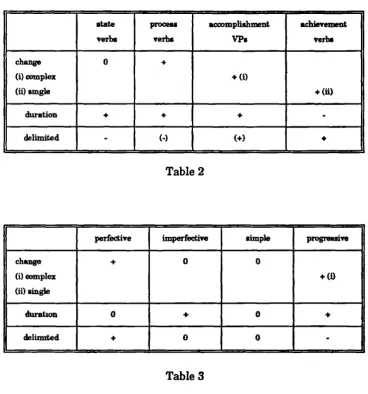
The following account is confined to a consideration of the main characteristics of two long-standing traditions in analysing verbal aspect The first is usually associated with the study of Slavonic languages and is normally called the perfective-imperfective distinction. The second is the classification of verbs according to the situation types they denote. It was originally developed within the realm of philosophy (by authors like Ryle (1949), Kenny (1963), Vendler (1967), Mourelatos (1981)), and was taken over by those specifically concerned with the study of language (Dowty (1979), Lyons (1977), C.S. Smith (1983; 1986), and others). My purpose here is to ex2mine some examples of aspectual phenomena in order to highlight and explain the common sense intuitions behind the two approaches, and to indicate some relevant problems.
2.1 PERFEcTIvrn AND IMPERFECTIVFrY
The perfective-imperfective distinction and the classification of verbs according to the situation types they denote have a crucial point in common. As a nile, both are characterised in terms of the notion of time. Perfectivity is defined either as involving absence of duration or (de)limited duration (in terms such as wholeness or completeness
(traditional grammarians), presence of temporal contour (Hockett (1958)), boundedness (Allen (1964)), discreteness (Morris (1984)). Definitions of imperfectivity fall into two groups. According to some
TWO APPROACHES TO ASPECT
authors, the imperfective is to be defined as the unmarked member of the distinction, it is to be characterised as unspecified with respect to the defining feature of the perfective. 5 Others find purely negative definitions of the imperfective aspect inadequate. Thus, Comrie (1976:24) proposes 'explicit reference to the internal temporal structure of a situation, viewing the situation from within' as the defining meaning of imperfectivity. Consider the Serbo-Croat and English examples below.
(1) a. Jovan ide u kolu. b. John is going to schooL c. John goes to school.
(2) Jovanjedjak. John is a pupil.
Process verbs in the so-called habitual use, exemplified by (la) as translated in (ic), and state verbs like be in (2) do not meet Comrie's definition, since they are not understood as iruiking reference to anything one would want to call internal temporal structure of the situation. Comrie's solution for this problem is to assume that imperfectivity is 'subdivided into a number of distinct categories, and yet others where there is some category that corresponds to part only of the meaning of imperfectivity'(pp. 24-5), while maintzaining the claim that 'these various subdivisions do in fact join together to form a single unified concept' (p. 26). Thus, the imperfective is said to be typically subdivided into habitual and continuous, and the latter is further subdivided into non-progressive and progressive (with the subdivisions varying across languages). But, unless this, arguably, unified concept in which such intuitively disparate notions cluster together is further specified and the nature of the connections that obtain between the