EXPLANATORY TEXT PLANNING IN LOGIC BASED SYSTEMS
CLARISSE SIECKENIUS DE SOUZA 1 PUC-Rio, Rio de Janeiro, Brazil MARIA DAS GRA(~AS VOLPE NUNES
ICMSC-USP, S~o Carlos, Brazil
Abstract
This paper discusses aspects of the planning of explanatory texts for logic based systems. It presents a method for deriving Natural Language text plans from Natural Deduction-based structures. This approach allows for the planning of explanatory texts in a general-purpose logic based system framework, ensuring a greater degree of portability across domains.
1. Introduction
Full exploration of resources o f f e r e d by k n o w l e d g e - b a s e d systems (KBS's) is only possible if their interface is able to convey a c o m p r e h e n s i b l e image of the system's reasoning. Given the abstract and complex nature of such reasoning, natural language (NL) text is an intuitive means interface designers choose to convey the system's responses. The same line of thought is applicable to the input side of the interface system -- NL seems to be intuitively desirable to convey KBS users' questions. Consequently, the particular framework we e n v i s a g e here for h u m a n - computer interaction is one in which a NL interpreter converts u s e r s ' u t t e r a n c e s into a representation language and a NL generator converts the system's reasoning represented in this language into NL text.
L o g i c - b a s e d k n o w l e d g e representation techniques have the advantage of being associated to a formal language, whose
syntax and semantics is precisely d e f i n e d and which e n s u r e s portability across domains. Unlike what often happens with other representation techniques, such as associative networks, in this case general methods can be conceived to translate any valid sentence of the formal language into one or more valid sentences in another language, including natural language.
Our choice of a ND inference system [8] is not arbitrary. Previous research [1] has shown that ND renders more u n d e r s t a n d a b l e proofs than the algorithmically more efficient resolution based systems, for instance. The output of a ND-based automatic prover is a recursively g e n e r a t e d tree, whose branches are qualified by possibly different inference rules. The limited number of rule types, together with explicit principles to combine them, allows for the identification of proof patterns. Therefore, the input to the text generator of the interface system p r e s e n t s a tow d e g r e e of variability, thus favoring the use of the schemata approach to text planning. For each pattern of proof there is a corresponding pattern of text.
Moreover, as we will see, given that ND p r o o f s a r e m o r e u n d e r s t a n d a b l e , only a few structural operations on the proof trees are needed to account for the content selection step during the NL text planning process.
2. Deriving Text Plans from N a t u r a l D e d u c t i o n P r o o f T r e e s
In order to achieve the generation of c o h e r e n t and c o h e s i v e multisentential NL texts, our processor performs two major steps: planning and realization. This separation is common to other approaches [4,5], and is meant to manage tasks involved in deciding what to say at a different step than those involved in deciding how to say it.
In terms of text planning paradigms, specifically, choices refer to either a rhetorical grammar based approach -- which consists
Our approach differs from those of McKeown and Paris's [7] or Moore and Swartout's [5], for example, because we use a theorem prover. It generates an idefinite number and variety of schemata (proof trees) instead of a limited set of schemata known to the designer. This feature forces us to conceive of transformational rules that will operate systematically on our schemata in order to turn them into acceptable NL text plans.
Additionally, although we generate text plans dynamically by means of structural rules, our approach is also different from other RST- based approaches such as those suggested by Scott and Souza [9],
I[A] A - - ~ B
B ~B
re
..L
-i b)
- A
A -'--I~ B ~B mt ~A
(a) (b)
Figure I: Deriving Modus Tollens
essentially of planning text in a dynamic manner by using overall rhetorical structure rules combined with perlocutionary goals and users' beliefs, as provided by Rhetorical Structure Theory (RST) [3] -- or a schemata based approach -- which amounts to selecting among alternative pre- existing text structuring schemata, which are elaborated from ideal or typical NL texts actually written for the purposes at 'hand [4,7]. We have chosen the schemata approach, although elements of rhetorical structure rules are present and accessible to the system's reasoning.
for example, b e c a u s e the elements i n c l u d e d in the specification of RST relations are not computed bv the system to constrain the application of transformational rules. They are used by the designer of the system to map certain patterns found in the proof trees to certain rhetorical structures. So, it is not the case that the system fully controls the selection of rhetorical relations, but it can, nevertheless, have access to the reasons why the designer has selected them -- it suffices to interpret the specification of the pre-selected relations appearing in the derived schemata for a given proof.
[image:2.432.126.325.214.321.2]2.1 M a n i p u l a t i n g t h e P r o o f T r e e
The content selection step in our approach consists of two operations performed on proof patterns: f ~ ¢ t o r i z 0 t i 0 n and derivation of rules. Both operations prune the proof tree. Factorization applies to a sequence of inference rules involving the introduction or elimination of identical logical connectives. The motivation for the factorization is only to avoid that derived text plans reflect in NL expositions of the system's reasoning a structure which is due to a syntactic idiosyncrasy of a logical language. So, for each logical connective (->, -, v, &), a
which cover the whole set of derived rules [6], including tautologies, De Morgan laws and syllogisms.
2.2. From Proof T r e e s to Text P l a n s
The rhetorical structuring step is carried out by means of mapping rules from ND subtrees to RST schemata. RST presents some kernel concepts we should emphasize here. First, it proposes that rhetorical relations bind two hierarchically different units: nuclei and satellites. Nuclei carry the most important portion of information to be conveyed in the text span, whereas satellites carry
~1 ~t2
A ~A
2-
consequence
J
" .opposition ..,L (absurdity)
nl n2
( A ) ( - A )
(a) (b)
Figure II: An Example of a Mapping Rule
factorization is proposed to reduce the impact of the language representation syntax on the final text.
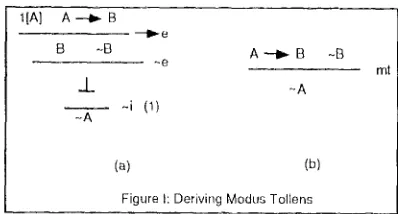
Derivation rules affect content selection by detecting logic argumentation patterns usually f o u n d in common sense r e a s o n i n g . Such patterns, however, do not belong to the set of inference rules of a ND system, but fit naturally in the reasoning path. An instance of such derivation rules is Modus Toflens.
In Figure I (a), we see the canonical ND derivation of ~A from A->B and -B. Rule (b) is derived from pattern (a) in a systematic way. In fact, we have formally defined abstract proof patterns
relatively secondary information. The attribution of importance to informational content is made by the writer. Second, rhetorical relations are specified in terms of writer's intentions and reader's expected reactions.
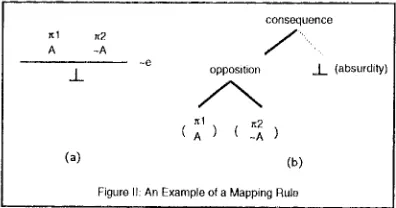
A ND subtree corresponding to an inference rule application is mapped onto RST subtrees. The example in Figure II shows the mapping rule for the absurdity rule, where x denotes a derivation path. Notice that, whereas ND subtrees have premises as leaves and a conclusion as the root, RST subtrees have information (ie. premises and conclusion) as leaves, and rhetorical relations as nodes. The mapping rules are
[image:3.432.125.323.220.324.2]guided by the type of the inference rule applied. In our approach, nuclei are always the information corresponding to premises of inference rules, and satellites, the conclusions. For the purpose of exposing the system's reasoning, the information about facts and axioms that have caused the conclusion is more central than the conclusion itself. It is worth saying that intermediary conclusions in the proof tree have, in each step, the role of premises, due to the recursiveness of the structure. Mapping inference rules onto RST structures results in a text plan which, if realized, is still far from acceptable. This is due to the
a special mode. In particular, this is the case of hypothesis a s s u m p t i o n s in N D - b a s e d systems, whose appropriate structuring in rhetorical terms is c o n t e x t - s e n s i t i v e . O n c e hypotheses are raised, ND proof proceeds according to the same set of rules as in any other case. Later on, when desired (partial) conclusions are achieved, those hypotheses are discarded. Of course, discarding only makes sense if raising is in topic. So, the text plan has to explicitly introduce the status of discardable premises as hypotheses, so that when discarding is mapped onto a rhetorical schema, the reader can refer it to the hypothesized
sequence
purpose (schema ~
( s c h e m a l~ ) c o n c l u d e ( ~ )
Figure II1: Antecipation of Reasoning Path
method of building text plans in a recursive fashion: in traversing the proof tree, inference rules are locally translated into rhetorical relation schemata. Also, if realization took place in an interleaved way [2], the resulting text plan could be sufficient for a c c e p t a b l e text r e n d i t i o n . However, since a sequential model is assumed, enhancements to this initial version of the text plan have to be made.
Since text planning is the result of r e c u r s i v e c o n t e x t - f r e e rule application, some important structures that improve the understandability of the final textual exposition of the system's reasoning have to be dealt with in
information in topic. This is done through the use of a C o n d i t i o n relation at the top of the rhetorical structured schema.
In fact, cases as the above- mentioned are related to discourse structuring not at the level of informational content (ie. proof+ bound) proper, but rather at the level of the writer's perlocutionary g o a l s , s u c h as c l a r i t y , understandability and the like. Clearly, proof-derived mapping rules account for informational content, but cannot fully ensure the achievement of perlocutionary goals in writing. This is why, in situations like assumption and ordering of hypotheses, for example, special mechanisms are
[image:4.432.61.382.42.330.2]introduced. Another similar case is that of repeating (ie. re-introducing a s t o p i c ) i n f o r m a t i o n corresponding to premises logically related to a conclusive information, but linearly far from the point where that information is presented. The necessity of this kind of rL.e_C_~ll may be derived heuristically from the height of the corresponding proof tree.
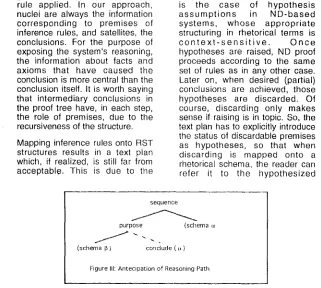
A relevant point that has to be considered in planning long and deductive texts is guiding the reader along the reasoning path. An interesting result of previous research [6] is that ND normal proof patterns offer the possibility
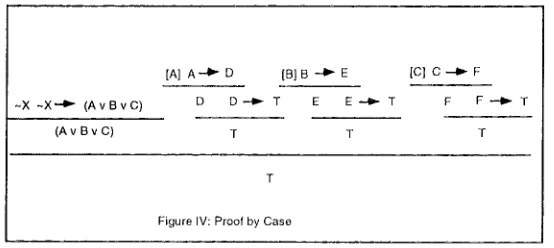
b_y__c_&~. Proof by case is used when the premise available to the prover is a disjunction, and the proof consists of deriving the conclusion from each of the elements of the disjunction, considered separately. We show, in Figure V, the equivalent RST structure corresponding to the text plan in Figure IV.
In the following, we propose a possible realization of the plan in English, where the formulae indexed by capital letters are instantiated as NL sentences. Once again, it is worth noting that at the present moment we are investigating realization rules and
- X -X " ~ ( A v B v C )
( A v B v C )
[A] A -J~ D [B]B ~ E
D D --),- T E E - - I ~
T T
[C] C ~ F
T F F --I~ T
T
T
Figure IV: Proof by Case
of identifying a special type of information ( m i n i m a l f o r m u l a e )
which is uniquely related to both premises and conclusions. This information is then used in text planning to anticipate reasoning steps. The rhetorical schema which applies to this information operates at some sort of meta- level if compared to other RST schemata. See the example in Figure III, where [5 has the role of guiding the deduction of o~. The result of the planning approach exposed here can be seen in the example below. First, the ND proof in Figure IV presents an instance of what is called rEr.g_~f
processes for B r a z i I i8 n P o r t u g u e s e . Therefore, all examples are tentative in English.
X: There are environment-protection policies available.
A: Ozone is being depleted from the atmosphere.
B: Land is undergoing a desertification process.
C: Waste is accumulating on earth.
D: Human immune system is depressed.
E: The area of productive land on earth is getting smaller.
F. Toxic substances are accumulating on earth.
[image:5.432.86.363.207.331.2]7~" Human life is threatened.
There aren't any environment protection policies available, and this implies that either ozone is being depleted from the atmosphere, land is undergoing a desertification process, or waste is accumulating on earth. Suppose that there is o z o n e depletion if+ the atmosphere; if so, the human immune system is depressed. Therefore, human life is threatened. Now, suppose that land undergoes desertification; ff so, the area of productive land on earth is getting smaller. Consequently, human life is also
have explored the benefits of rhetorical structuring as an intermediary representation of message content, in which the kinds of rhetorical relations, their specification in syntactic, semantic and pragmatic terms [9], and the reasons why they have been selected to appear in the text structure are a v a i l a b l e for the generator at the realization step. This feature, together with the
summary
/ . \
elaboration consequence
/',,,
/',,.,.
consequence list .+X T
/",.
/ \
I
list AvBvC conseq, conseq, conseq.
/ X
/ \
/ \ / x ,
-X -X->AvBvC list ] list T list T
,,,,',,,/,,,/%,
cond. D->T cond. L+>T cond. F->T/,,,, /,,,, / \
conseq. A conseq. B conseq. C
/'..,
/ \
/",,,
list D list E list F
/ N ,/% / x
A A->D B B->E C C->FFigureV: Equivalent RSI Structure
threatened. Finally, suppose that waste accumulates on earth; if so, toxic substances also accumulate. Thus, again, human life is threatened. In other words, since there are no environment protection policies available, human life is threatened.
3. C o n c l u s i o n
In the present paper, we have approached text planning for the generation of e x p l a n a t o r y NL answers in logic based question- answering systems. Assuming a two step generation paradigm, we
s o u n d n e s s a n d p o r t a b i l i t y p r o v i d e d by a logic b a s e d k n o w l e d g e r e p r e s e n t a t i o n technique, supports the generation of better NL explanations of the q u e s t i o n - a n s w e r i n g s y s t e m ' s reasoning. In terms of the planning activity, the rhetorical relations and the rhetorical s c h e m a t a d e r i v e d from proofs p r o v i d e elements for the explicit marking of the final text's coherence.
M o r e o v e r , w i t h a r i c h r e p r e s e n t a t i o n of p r o o f s , algorithms can be d e s i g n e d to m a n i p u l a t e t h e e x i s t i n g hierarchical structure, so that cohesion can be guaranteed by binding the pieces of information with discourse markers like "this", "also", "so", and others, which all refer to information previously mentioned in the text and avoid possible misunderstandings due to the repetition of m e n t i o n e d elements being interpreted as the introduction of new information. At the present moment, we are investigating general grammatical structures to realize the text plan and are not devoting much effort to customization of output to users needs, H o w e v e r , h i e r a r c h i c a l s t r u c t u r e s and b e l i e f / i n t e n t i o n oriented specifications of RST relations should allow for further stylistic elaboration of text. In this way, users should be provided with an exposition of reasoning more adapted to their personal knowledge. A specification of a text planner following suggestions presented in [6] is in progress. Future work in the short term should investigate aspects of the specification of the realization component.
4. R e f e r e n c e s
[1] Haeusler, E.H. Automatic Theorem Proving: An Attempt to Improve Readability of proofs Generated by Resolution. In C o n t e m p o r a r y Mathematics No. 69, pp. 179-188 1988.
[2] Hovy, E.H. Two types of Planning in Language Generation. In Proceedings of the 26th. Meeting of the Association for Computational Linguistics Buffalo, NY. 1988.
[3] Mann, W.C. and Thompson, SA. Rhetorical Structure Theory: Descnption and Construction of Text Structures. Technical Report ISI/RS-86- 174. Information Sciences Institute. University of Southern California. 1987.
[4] McKeown, K.R. Text Generation: Using Discourse Strategies and Focus Constraints to Generate Natural Language Text. Cambridge. Cambridge University Press. 1985.
[5] Moore, J.D. and Swartout, W.R. A Reactive Approach to Explanation: Taking the User's Feedback into Account. In Paris, C.L.; Swartout, W.R. and Mann, W.C. (eds) A r t i f i c i a l Intelligence and Computational L i n g u i s t i c s . Kluwer Academic Publishers. 1991.
[6] Nunes, M.G.V. A Gera~&o de Respostas Cooperativas em Sistemas Baseados em L6gica. PhD Dissertation. Departamento de Informfitica. PUC-Rio, Rio de Janeiro. 1991.
[7] Paris, C.L. and McKeown, K.R. Discourse Strategies for Describing Complex Physical Objects. In Kempen, G. (ed) Natural Language Generation. Dordrecht. Martinus Nijhoff Publishers. 1987.
[8] Prawitz, D. Natural Deduction. Stockholm. 1965.
[9] Scott, D.R. and Souza, C.S. Getting the Message Across in RST-based Text Generation. In Dale, Mellish and Zock (eds) Current Research in Natural Language Generation. London. Academic Press. 1990.
1This author is supported by the Brazilian Secretariat of Science and Technology (SCT) and by the Brazilian Council for the Development of Science and Technology (CNPq).