A Wikipedia-LDA Model for Entity Linking with Batch Size Changing
Instance Selection
Wei Zhang
†Jian Su
‡Chew Lim Tan
††
School of Computing
‡ Institute for Infocomm Research National University of Singapore [email protected] {z-wei,tancl}@comp.nus.edu.sgAbstract
Entity linking maps name mentions in context to entries in a knowledge base through resolv-ing the name variations and ambiguities. In this paper, we propose two advancements for entity linking. First, a Wikipedia-LDA method is proposed to model the contexts as the prob-ability distributions over Wikipedia categories, which allows the context similarity being measured in a semantic space instead of literal term space used by other studies for the dis-ambiguation. Furthermore, to automate the training instance annotation without compro-mising the accuracy, an instance selection strategy is proposed to select an informative, representative and diverse subset from an au-to-generated dataset. During the iterative se-lection process, the batch sizes at each itera-tion change according to the variance of clas-sifier’s confidence or accuracy between batches in sequence, which not only makes the selection insensitive to the initial batch size, but also leads to a better performance. The above two advancements give significant im-provements to entity linking individually. Col-lectively they lead the highest performance on
KBP-10 task. Being a generic approach, the batch size changing method can also benefit active learning for other tasks.
1
Introduction
Knowledge base population (KBP)1 involves ga-thering information scattered among the docu-ments of a large collection to populate a know-ledge base (KB) (e.g. Wikipedia). This requires either linking entity mentions in the documents with entries in the KB or highlighting these men-tions as new entries to current KB.
Entity linking (McNamee and Dang, 2009) in-volves both finding name variants (e.g. both
“George H. W. Bush” and “George Bush Se-nior” refer to the 41st U.S. president) and name disambiguation (e.g. given “George Bush” and
1
http://nlp.cs.qc.cuny.edu/kbp/2010/
its context, we should be able to disambiguate which president it is referring to).
Compared with Cross-Document Coreference (Bagga and Baldwin, 1998) which clusters the articles according to the entity mentioned, entity linking has a given entity list (i.e. the reference KB) to which we disambiguate the entity men-tions. Moreover, in the articles, there are new entities not present in KB.
For name disambiguation in entity linking, there has been much previous work which de-monstrates modeling context is an important part of measuring document similarity. However, the traditional approach for entity linking treats the context as a bag of words, n-grams, noun phrases or/and co-occurring named entities, and meas-ures context similarity by the comparison of the weighted literal term vectors (Varma et al., 2009; Li et al., 2009; McNamee et al., 2009; Zhang et al., 2010; Zheng et al., 2010; Dredze et al., 2010). Such literal matching suffers from sparse-ness issue. For example, consider the following four observations of Michael Jordan without term match:
1) Michael Jordan is a leading researcher in machine learning and artificial intelligence.
2) Michael Jordan is currently a full professor at the University of California, Berkeley.
3) Michael Jordan (born February, 1963) is a former American professional basketball player. 4) Michael Jordan wins NBA MVP of 91-92 season.
To measure the similarity of these contexts, the semantic knowledge underlying the words is needed.
Furthermore, current state-of-the-art entity linking systems (Dredze et al., 2010; Zheng et al., 2010) are based on supervised learning ap-proach requiring lots of annotated training in-stances to achieve good performance. However, entity linking annotation is highly dependent on the KB. When a new KB comes, the annotating process needs to be repeated. We have tried to automate this annotating process (Zhang et al.
2010). However, as discussed in that paper, the distribution of the auto-generated data is not
sistent with the real dataset, because only some types of instances can be generated.
In this paper, we propose two approaches: (1) a Wikipedia-LDA model to effectively mine the semantic knowledge from the contexts of the mentions. Such topic model allows us to measure the similarity between articles and KB entries in the semantic space of Wikipedia category. (2) An instance selection strategy to effectively utilize the auto-generated annotation through an itera-tive process of selecting a representaitera-tive, infor-mative and diverse batch of instances at each iteration. The batch sizes at each iteration change according to the variance of classifier’s confi-dence or accuracy between batches in sequence, which makes selection insensitive to the initial batch size and performs better than fixed size.
We conduct evaluation on KBP-10 data (Ji et al., 2010). Experiments show that the Wikipe-dia-LDA model is able to effectively capture the underlying semantic information and produce statistically significant improvement over literal matching alone. Correspondingly, instance selec-tion can make the dataset more balanced and it also produces a significant gain in entity linking performance. Collectively, the two advancements lead the highest performance on KBP-10 task. Being a generic approach, the batch size chang-ing method proposed in this paper can also bene-fit active learning for other tasks.
The remainder of this paper is organized as follows. Section 2 introduces the framework for entity linking. We present our Wikipedia-LDA model in Section 3, and the instance selection in Section 4. Section 5 shows the experiments and discussions. Section 6 concludes our work.
2
Entity Linking Framework
Entity linking is done through two steps: name variation resolution and name disambiguation. Name variation resolution finds variants for each entry in KB and then generates the possible KB candidates for the given name mention by string matching. Name disambiguation is to map a mention to the correct entry in the candidate set.
2.1 Name Variation Resolution
Wikipedia contains many name variants of enti-ties like confusable names, spelling variations, nick names, etc. We extract the name variants of an entry in KB by leveraging the knowledge sources in Wikipedia: “titles of entity pages”,
“disambiguation pages”2, “redirect pages”3
2.2 Name Disambiguation
and “anchor texts”. With the acquired name variants for entries in KB, the possible KB candidates for a given name mention can be retrieved by string matching. If the given mention is an acronym, we will expand it from the given article, and then use entity linking process.
First, using a learning to rank method, we rank all the retrieved KB candidates to identify the most likely candidate. In this learning to rank method, each name mention and the associated candidates are formed by a list of feature vectors. During linking, the score for each candidate en-try is given by the ranker. The learning algorithm we used is ranking SVM (Herbrich et al., 2000).
Next, the preferred KB candidate is presented to a binary classifier (Vapnik, 1995) to determine if it is believed as the target entry for a name mention. From here, we can decide whether the mention and top candidate are linked. If not, the mention has no corresponding entry in KB (NIL). The base features adopted for both learning to rank and classification include 15 feature groups divided to 3 categories. A summary of the fea-tures is listed in Table 1. Due to the space limit, we only show the feature name, leaving out the feature details which can be found in (Dredze et al., 2010; Zheng et al., 2010).
Categories Feature Names
Surface Exact Equal Surface, Start With String of Query, End With String of Query, Equal Word Num, Miss Word Num
Contextual TF-IDF Similarity, Similarity Rank, All Words in Text, NE Number Match, Country in Text Match, Country in Text Miss, Country in Title Match, Country in Title Miss, City in Title Match
Others NE Type
Table 1: Base Feature Set
3
Wikipedia-LDA Model
In the similar task cross-document coreference (Han and Zhao 2009) and other tasks (e.g. text classification) (Wang and Domeniconi, 2008), Wikipedia concepts are used to model the text. Wikipedia concept is a kind of entity-level topic. In our approach, we use the cross-entity topic Wikipedia Categories to represent the semantic knowledge.
2 http://en.wikipedia.org/wiki/Wikipedia:Disambiguation 3
Thus, we model the contexts as the distribu-tions over Wikipedia categories. Then, the simi-larity between the contexts can be measured in a semantically meaningful space. Finally, such semantic similarity, together with other base fea-tures, is incorporated in the trainable models to learn the ranker and classifier.
3.1 Modeling the Contexts as Distributions
over Wikipedia Categories
Wikipedia requires contributors to assign catego-ries to each article, which are defined as “major topics that are likely to be useful to someone reading the article”. Thus, Wikipedia can serve as a document collection with multiple topical labels, where we can learn the posterior distribu-tion over words for each topical label (i.e. Wiki-pedia category). Then, from the observed words in the mention’s context and KB entry, we can estimate the distribution of the contexts over the Wikipedia categories. To obtain this distribution, we use a supervised Latent Dirichlet Allocation (LDA) model – labeled LDA defined by Ramage
et al. (2009), which represents state-of-the-art method for multi-labeled text classification. It performs better on collections with more seman-tically diverse labels, which we need in order to leverage on the large semantically diverse cate-gories from Wikipedia as the topical labels.
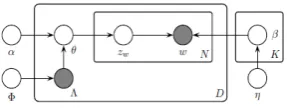
Figure 1 shows us a graphical representation of the labeled LDA for the multi-labeled docu-ment collection. Labeled LDA is a three level hierarchical Bayesian model. β is the multinomi-al distribution over words for a Wikipedia cate-gory, which has a Dirichlet prior with hyperpa-rameter η. Both the category set Λ as well as the topic prior α influence the topic mixture θ. These distributions can be used to generate doc-uments in the form of a collection of words (w).
D is the number of documents, N is the document length and K is the number of categories.
After the model is trained by Wikipedia data, the distributions of KB entry and the article over
[image:3.595.92.236.669.723.2]K categories are estimated by calculating the top-ic proportions θ. θ is given by an EM procedure that treats θ as a parameter with Z missing.
Figure 1: Graphical model of Labeled LDA
3.2 Context Similarity
We have mapped the contexts to a
K-dimensional semantic space. Thus, we can calcu-late the context similarity by their distance in this space. To measure the context similarity in the
K-dimensional topical space, we calculate the Cosine value as below:
𝑆𝑖𝑚𝑖𝑙𝑎𝑟𝑖𝑡𝑦𝑑,𝑒= ∑ 𝜃𝑑,𝑘×𝜃𝑒,𝑘
𝐾 𝑘=1
�∑𝐾𝑘=1(𝜃𝑑,𝑘)2×�∑𝐾𝑘=1(𝜃𝑒,𝑘)2
(1)
Where d means the document with the name mention and e means the KB entry.
Such semantic similarity can be further com-bined with other term matching features for SVM ranker and classifier of entity linking.
3.3 Wikipedia Category Selection
Each article in Wikipedia is assigned several cat-egories by the contributors as requested. Howev-er, from our observation some categories in Wi-kipedia may not be suitable to model the topics of a document. Thus, we shall consider selecting an appropriate subset from the Wikipedia catego-ries to effectively model the contexts. We ex-amined five possible category subsets: All, All-admin, isa_all, isa_class, and isa_instance.
Wikipedia contains 165,744 categories. This is the set All.
There are some meta-categories used for en-cyclopedia management in Wikipedia, e.g. “ Wi-kipedia editing guidelines”, which are unsuitable to describe the topics of a document. Thus, we remove the categories which contain any of the following strings: wikipedia, wikiprojects, lists, mediawiki, template, user, portal, categories, articles and pages. This leaves 127,325 catego-ries (All-admin).
However, some categories such as “people by status” and “Geography by place” in the
All-admin set cannot serve as the topics of a
docu-ment properly. Thus, we need to remove them from the category set. From our observation, the topical categories are usually in is-a relation. For example, the relation between the two topical categories “Olympic basketball players” and “Olympic competitors” is an is-a relation, while the categories to be removed “people by status” and “Geography by place” are not in any is-a
relation. We thus only select the categories con-nected by is-a relation to isa_all subset.
Since the categories are connected by unla-beled links in Wikipedia, we need to identify is-a
proposed by Ponzetto and Strube (2007) to dis-tinguish is-a and not-is-a relation links.
We first use a syntax-based method: assign is-a to the link between two categories if they share the same lexical head lemma (e.g. “British Com-puter Scientists” and “Computer Scientists”).
Then, we use structural information from the category network: (1) for a category c, look for a Wikipedia article P with the same name. Take all
P’s categories whose lexical heads are plural nouns CP ={cp1, cp2, …, cpn}. Take all superca-tegories of c, SC={sc1, sc2, …,sck }. If the head lemma of one of cpimatches the head lemma of
scj, label the relation between c and scj as is-a. (2) assign is-a label to the link between two ries if a Wikipedia article is redundantly catego-rized under both of them. For example, “Internet” is categorized under both “Computer networks” and “Computing” and there is a link between “Computer networks” and “Computing”. Then this link is assigned is-a.
Next, we use lexical-syntactic patterns in a corpus. This method uses two sets of patterns. One set is used to identify is-a relations (Cara-ballo, 1999; Hearst, 1992), for example “such NP1 as NP2”, NP1 and NP2 are the values of cat-egories and their subcatcat-egories respectively. The second set is used to identify not-is-a relations. For example “NP1 has NP2”, where the link be-tween NP1 and NP2 will be assigned not-is-a. These patterns are used with a corpus built from Wikipedia articles, and separately with the Tip-ster corpus (Harman and Liberman, 1993). The label is assigned by majority voting between the frequency counts for the two types of patterns.
Finally, we assign is-a labels to links based on transitive closures - all categories along an is-a
chain are connected to each other by is-a links. Another fact is that the categories defined by Wikipedia are not all classes. For example, “ Mi-crosoft” is an instance of the class “Computer and Video Game Companies”, and it appears both as an article page and as a category in Wi-kipedia. We would like to further examine the two different subsets: isa_class, and
isa_instance in isa_all set for entity linking. To distinguish instance and class in isa_all set, we use a structure-based method (Zirn et al., 2008). The categories which have other subcategories or Wikipedia articles connected to them by is-a re-lation are assigned class label. In our problem, the remaining categories are approximately re-garded as instances.
4
Instance Selection Strategy
In this section, we explore a method to effective-ly utilize a large-scale auto-generated data for entity linking.
In our pervious work (Zhang et al. 2010), we proposed automatically gathering large-scale training instances for entity linking. The basic idea is to take a document with an unambiguous mention referring to an entity e1 in KB and re-place it with its variation which may refer to e1,
e2 or others. For example, a mention “Abbott Laboratories” in a document only refers to one KB entry “Abbott Laboratories”. “Abbott Labor-atories” in the document is replaced with its am-biguous synonyms, including “Abbott” “ABT”,
etc. Following this approach, from the 1.7 mil-lion documents in KBP-10 text collection, we generate 45,000 instances.
However, the distribution of the auto-generated data is not consistent with the real da-taset, since the data generation process can only create some types of training instances. In the case of “Abbott Laboratories”, more than ten “Abbott” mentions are linked to “Abbott Labora-tories” entry in KB, but no “Abbott” example is linked to other entries like “Bud Abbott” “Abbott Texas”, etc. Thus, we need an instance selection approach to reduce the effect of this distribution problem. However, the traditional instance selec-tion approaches (Brighton and Mellish, 2002; Liu and Motoda, 2002) only can solve two prob-lems: 1) a large dataset causes response-time to become slow 2) the noisy instances affect accu-racy, which are different from our needs here. We thus propose an instance selection approach to select a more balanced subset from the auto-annotated instances. This instance selection strat-egy is similar to active learning (Shen et al., 2004; Brinker, 2003) for reducing the manual annotation effort on training instances through proposing only the useful candidates to annota-tors. As we already have a large set of auto-generated training instances, the selection here is a fully automatic process to get a useful and more balanced subset instead.
We use the SVM classifier mentioned in Sec-tion 2.2 to select the instances from the large da-taset. The initial classifier can be trained on a set of initial training instances, which can be a small part of the whole auto-generated data, or the li-mited manual annotated training instances avail-able, e.g. those provided by KBP-10.
and diverse batch of instances based on current hyperplane and add them to the current training instance set at each iteration to further adjust the hyperplane for more accurate classification.
We use the distance as the measure to select informative instances. The distance of an in-stance’s feature vector to the hyperplane is com-puted as follows:
𝐷𝑖𝑠𝑡(𝑤) =�∑𝑁𝑖=1𝛼𝑖𝑦𝑖𝑘(𝑠𝑖,𝑤) +𝑏� (2)
Where w is the feature vector of the instance,
𝛼𝑖,𝑦𝑖 and 𝑠𝑖 correspond to the weight, class and
feature vector of the ithsupport vector respective-ly. N is thenumber of the support vectors.
Next, we quantify the representativeness of an instance by its density. Such density is defined as the average similarity between this instance and all other instances in the dataset. If an instance has the largest density among all the instances in the dataset, it can be regarded as the centroid of this set and also the most representative instance.
𝐷𝑒𝑛𝑠𝑖𝑡𝑦(𝑤𝑖) =∑𝑗≠𝑖𝑆𝑖𝑚�𝑤𝑖,𝑤𝑗�
𝑁−1 (3)
Where w is the instance in the dataset and N is the size of dataset. Sim is cosine similarity.
We combine the informativeness and repre-sentativeness by the function 𝜆(1− 𝐷𝑖𝑠𝑡(𝑤) ) +
(1− 𝜆)𝐷𝑒𝑛𝑠𝑖𝑡𝑦(𝑤), in which Dist and Density
are normalized first. The individual importance of each part in this function is adjusted by a tra-deoff parameter 𝜆 (set to 0.5 in our experiment). The instance with the maximum value of this function will be selected first to the batch. This instance will be compared individually with the selected instances in current batch to make sure their similarity is less than a threshold 𝛽. This is to diversify the training instance in the batch to maximize the contribution of each instance. We set 𝛽 to the average similarity between the in-stances in the original dataset. When a batch of α instances is selected, we add them to the training instance set and retrain the classifier.
Such a batch learning process will stop at the peak confidence of the SVM classifier, since Vlachos (2008) shows that the confidence of the SVM classifier is consistent with its perfor-mance. The confidence can be estimated as the sum of the distances to hyperplane for the in-stances of an un-annotated development set. The development set guides the selection process to solve the distribution problem mentioned above. Alternatively, we can also leverage on some an-notated development data and use accuracy
in-stead to guide the selection process. We explore both approaches for different application scena-rios in our experiments.
We now need to decide how to set the batch
size α at each iteration. It is straightforward to set
a fixed batch size α (Fixed Number), which never changes during the process. However, there are some limitations as demonstrated in our experiment in this paper. First, the performance is sensitive to the batch size. Second, if we set the batch size too big, it will impede further im-provement allowed by small batch size. But if we set the batch size too small from the beginning, it will dramatically increase the number of itera-tions needed which will make the selection too slow. To resolve the above issues, we change the batch size according to the variance of classifi-er’s confidence on an un-annotated set. Thus, we assign an integer to 𝛼1 and 𝛼2 in the first two iterations, and 𝛼𝑖(𝑖> 2) in the ith iteration is computed as below (Flexible Number):
𝛼𝑖 =𝛼𝑖−1𝑐𝑜𝑛∗(𝑐𝑜𝑛𝑖−2𝑖−1−𝑐𝑜𝑛−𝑐𝑜𝑛𝑖−3𝑖−2) (4)
where 𝑐𝑜𝑛𝑖 is the confidence of the classifier on the un-annotated dataset at ith iteration.
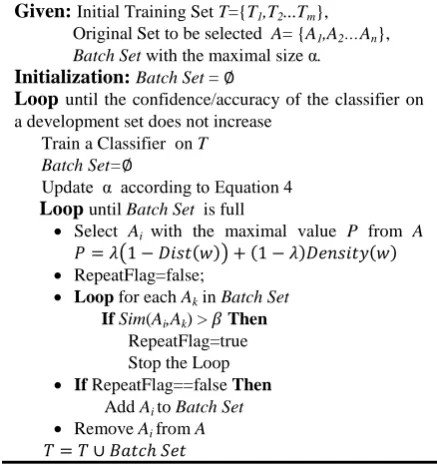
[image:5.595.310.529.421.655.2]Figure 2 summarizes the selection procedure.
Figure 2: Instance Selection Strategy
5
Experiments and Discussions
5.1 Experimental Setup
In our study, we use KBP-10 knowledge base and document collection to evaluate our ap-proach for entity linking. The KB is auto-generated from Wikipedia. The KB contains
Given: Initial Training Set T={T1,T2...Tm},
Original Setto be selected A= {A1,A2…An},
Batch Set with the maximal size α. Initialization: Batch Set =∅
Loopuntil the confidence/accuracy of the classifier on a development set does not increase
Train a Classifier on T
Batch Set=∅
Update α according to Equation 4
Loop until Batch Set is full
• Select Ai with the maximal value P from A
𝑃=𝜆�1− 𝐷𝑖𝑠𝑡(𝑤)�+ (1− 𝜆)𝐷𝑒𝑛𝑠𝑖𝑡𝑦(𝑤)
• RepeatFlag=false;
• Loop for each Ak in Batch Set
If Sim(Ai,Ak) > 𝛽Then
RepeatFlag=true Stop the Loop • If RepeatFlag==false Then Add Ai to Batch Set
• Remove Ai from A
Features ALL NIL Non-NIL ORG GPE PER Base Features 83.2 88.2 77.2 82.1 75.1 92.5 Base + All 84.0 88.6 78.5 84.0 76.0 92.1 Base + All - admin 84.9 88.9 80.0 84.9 76.9 92.8
Base + isa_all 85.9 89.1 82.0 85.2 78.6 93.8 Base + isa_class 85.5 88.8 81.3 84.9 78.0 93.2 Base+isa_instance 83.9 88.9 77.8 82.9 76.6 92.1
Table 2: Results of Entity Linking for Semantic Features
818,741 different entries and the document col-lection contains 1.7 million documents. Each KB entry consists of the Wikipedia Infobox4 and the corresponding Wikipedia page text. The test data has 2,250 mentions across three named entity types: Person (PER), Geo-Political Entity (GPE) and Organization (ORG). The documents con-taining these mentions are from newswire and blog text. The training set consists of 3,904 newswire mentions and 1,500 web mentions. In order to leverage name variant information tioned in Section 2.1 and category network men-tioned in Section 3.3, we further get Wikipedia data directly from Wikipedia website5
For pre-processing, we perform sentence boundary detection derived from Stanford pars-er (Klein and Manning, 2003), named entity rec-ognition using a SVM based system trained and tested on ACE 2005 with 92.5(P) 84.3(R) 88.2(F), and co-reference resolution using a SVM based resolver trained and tested on ACE 2005 with 79.5%(P), 66.7%(R) and 72.5%(F). In our implementation, we use the binary SVMLight developed by Joachims (1999) and SVMRank de-veloped by Joachims (2006). The classifier and ranker are trained with default parameters. The Stanford Topic Model Toolbox
. The ver-sion we use is released on Oct. 08, 2008.
6
We adopt micro-averaged accuracy used in
KBP-10 to evaluate our Entity Linker, i.e. the number of correct links divided by the total number of mentions.
is used for La-beled-LDA with default learning parameters.
5.2 System with Wikipedia-LDA
Table 2 lists the performance of entity linking with overall accuracy (ALL) as well as accuracy on subsets (Nil, Non-Nil, ORG,GPE and PER) of the data. In the first row, only base features de-scribed in Section 2.2 are used. This baseline system models the contexts with literal terms.
4
http://en.wikipedia.org/wiki/Template:Infobox 5 http://download.wikipedia.org
6
http://nlp.stanford.edu/software/tmt/tmt-0.3/
The second to sixth rows report the results com-bining base features with semantic knowledge (i.e. the context similarity is computed by the five different subsets of Wikipedia categories mentioned in Section 3.3).
American novels
American film actors
Members of the National Academy of Sciences
American basketball players
novel role prize nba
book actor researcher basketball story films professor points paperback appeared science rebounds
plot actress nobel games print television institute draft edition hollywood theory guard isbn california physics overall hardback roles received coach characters movie sciences professional published acting medal assists
man married chemistry play father death academy season
[image:6.595.306.533.279.479.2]love character award forward written starred ph. d ncaa
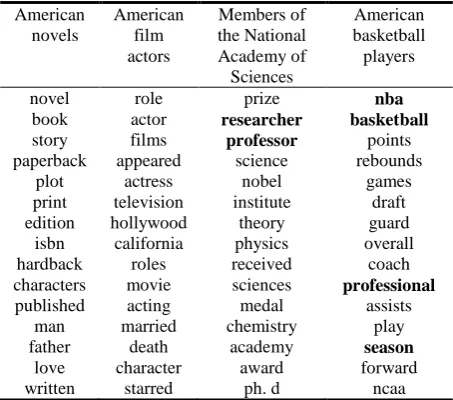
Table 3: Sample Wikipedia Categories and Cor-responding Top 15 Words
We see that all the five systems with semantic features perform better than the baseline system, which models the context similarity as literal term matching. Especially, the isa_all and
isa_class can achieve significantly better result
than the baseline (𝜌 < 0.05, 𝜒2 test). These re-sults prove that the semantic knowledge underly-ing the contexts has good disambiguation power for entity linking. Table 3 tells the reason of the improvements. Table 3 shows us four sample Wikipedia categories and top 15 highly probable words identified by the topic model for these cat-egories. The topic model successfully assigns a high probability to the words “researcher” and
“professor” in the category “Members of the National Academy of Sciences”, and assign a high probability to the words “nba” “basketball” “professional” and “season” in the category
Methods ALL NIL Non-NIL ORG GPE PER Auto_Gen 81.2 81.8 80.5 80.8 72.5 90.3 Auto_Gen+IS 85.2 87.5 82.5 84.4 78.5 92.8 KBP 83.2 88.2 77.2 82.1 75.1 92.5 KBP+Auto_Gen 82.2 83.8 80.4 81.7 75.6 89.5 KBP+Auto_Gen+IS 85.5 87.7 82.9 84.7 78.9 92.8
Table 4: Results of Entity Linking for Instance Selection
knowledge learned from Wikipedia data is help-ful in the example of “Michael Jordan” men-tioned in Section 1. This shows that entity link-ing can benefit from the semantic information underlying the words and overcome the short-comings of literal matching.
We further compare the performances of the five different category subsets. From the last five rows of Table 2, we can see that isa_all subset performs best among the five subsets for disam-biguation. This should be because isa_all in-cludes more categories than isa_class and
isa_instance, and thus can capture more
seman-tic information. However, although All and
All-admin include even more categories, they
intro-duce many categories which are unsuitable to model the topics of a news article or blog text, such as the two categories mentioned in Section 3.3, “people by status” which is not in an is-a relation and “Wikipedia editing guidelines” which is used for encyclopedia management.
5.3 System with Instance Selection
Table 4 shows the results for evaluating our in-stance selection strategy. These experiments use the base features (Section 2.2).
5.3.1 With and Without Manual Annotated Data
We want to find out the effectiveness of our in-stance selection strategy if no manually anno-tated data is available. In the first block of Table 4, we compare the performances of the systems with and without instance selection. “Auto_Gen” uses the auto-generated dataset described at the beginning of Section 4 as the training set direct-ly, and “Auto_Gen+IS” applies our instance se-lection to the auto-generated data for training. In the instance selection process, we use the KB entries with more than 15 linked documents in the auto-generated data as our Initial Training Set (1,800 instances) to train a classifier, and then use this classifier to select instance from the auto-generated dataset. The first block of Table 4 shows that our instance selection gives signifi-cant improvements (𝜌< 0.05, 𝜒2 test ). These
improvements show our selection strategy makes the training set more balanced and it can effec-tively reduce the effect of distribution problem in the large scale dataset.
We further evaluate our instance selection strategy when a large manually annotated data is available in the second block of Table 4. “KBP”
is trained on the manually annotated KBP-10
training set. “KBP+Auto_Gen” is trained on
KBP-10 set and the auto-generated set.
“KBP+Auto_Gen+IS” uses KBP-10 training set as the Initial Training Set, and applies instance selection process to the auto-generated data. Comparing “KBP+ Auto_Gen” with “KBP”, we can see that the unbalanced distribution caused serious problem which even pull down the per-formance achieved by the large manual annota-tion alone. The experiment results of “KBP” and “KBP+Auto_Gen+IS” show that our instance selection strategy appears very necessary to bring further improvements over the large manually annotated dataset (5,404 instances). These signif-icant ( 𝜌< 0.05, 𝜒2 test) improvements are achieved by incorporating more training in-stances in a reasonable way.
Comparing the performance of “ Au-to_Gen+IS” with “KBP” in Table 4, we can find that our method performs better without hard intensive work on annotating 5,404 articles. This proves that using our instance selection can save labor without compromise of entity linking accu-racy. The pretty much same performance of “ Au-to_Gen+IS” with “KBP +Auto_Gen+IS” also confirms the above conclusion.
5.3.2 Fixed Size Vs. Changing Size
We are also interested in the effectiveness of the two schemes (i.e. Fixed Number and Flexible Number) of setting the batch size α mentioned in Section 4. In Figure 3, we set the batch size α in
Fixed Number scheme and α1 α2 in Flexible
improvement at α=50, 60 and 70 is significant (𝜌< 0.05, 𝜒2 test). This proves that batch size should be in line with the variance of the clas-sifier’s confidence at each iteration of instance selection. Furthermore, in this Figure, the per-formance of flexible batch size is more stable than the Fixed Number scheme. This shows that Flexible Number scheme makes the entity link-ing system insensitive to the initial batch size during instance selection process. Thus the ini-tial batch size of the experiments in Table 4 is set to 80, which we believe that very similar perfor-mance can be achieved even with a different ini-tial size. Another fact is that the selection process is similar to active learning, which needs to ma-nually annotate the selected instances in each batch. Thus, being a generic approach, the batch size changing method proposed in this paper can also benefit active learning for other tasks.
Figure 3: Performance Curves for Two Batch Size Schemes
5.3.3 (Un-)Annotated Development Set
[image:8.595.91.264.324.397.2]In the above study, we directly use the test set without annotations as the development set for instance selection to optimize our solution to the application data. Such an approach will be useful when the application set is available in advance as in the case with KBP benchmarks.
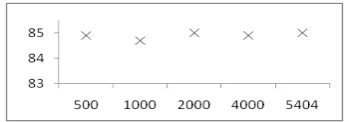
Figure 4: Annotated Development data
When the application set is unavailable befo-rehand, in other words, the articles to be linked only arrive one after the other in linking stage, we leverage on the accuracy on annotated devel-opment set for the instance selection. Figure 4 shows the performances on different sizes of an-notated development set. The results show that the different sizes contribute more or less same performances. We only need to use a small amount of annotated development data, 500 ar-ticles in our study to guide the instance selection
to achieve similar performance as with un-annotated test set being development data.
5.4 Overall Result Combining Two
Ap-proaches
We also evaluate our model which combines the Wikipedia- LDA and Instance Selection together on KBP-10 data, and compare our method with the top 7 systems in KBP-10 shared task (Ji et al., 2010). As shown in Figure 5, the first column is the performance of our system for entity linking, which outperforms the best solution7 in KBP-10
[image:8.595.99.274.541.602.2]shared task.
Figure 5: A Comparison with KBP-10 Systems
6
Conclusion
In our paper, we explored using two innovative approaches for entity linking. We proposed a Wikipedia-LDA to entity linking, which can dis-cover the semantic knowledge underlying the contexts. We also investigated the effectiveness of five subsets of Wikipedia categories to model the contexts. Furthermore, we proposed a batch size changing instance selection strategy to re-duce the effect of distribution problem in the au-to-generated data. It makes entity linking system achieve state-of-the-art performance without hard labor. Meanwhile, the flexible batch size not only makes the selection insensitive to the initial batch size, but also leads to a better per-formance than the fixed batch size. The above two advancements significantly improve entity linking system individually, and collectively they lead the highest performance on KBP-10 task.
Acknowledgment
This work is partially supported by Microsoft Re-search Asia eHealth Theme Program.
7 Another system submission shows 86.8%. However, it
References
A. Bagga and B. Baldwin. 1998. Entity-Based Cross-Document Coreferencing Using the Vector Space Model. 36th Annual Meeting of the Association of Computational Linguistics. 1998.
H. Brighton and C. Mellish. 2002. Advances in In-stance Selection for InIn-stance-Based Learning Algo-rithms. Data Mining and Knowledge Discovery.
K. Brinker. 2003. Incorporating Diversity in Active Learning with Support Vector Machines. In Pro-ceeding of ICML. 2003.
S. A. Caraballo. 1999. Automatic construction of a hypernym-labeled noun hierarchy from text. In
Proceedings of the 37th Annual Meeting of the As-sociation for Computational Linguistics, College Park, Md., 20-26 June. 1999.
M. Dredze, P. McNamee, D. Rao, A. Gerber and T. Finin. 2010. Entity Disambiguation for Knowledge Base Population. 23rd International Conference on Computational Linguistics (COLING 2010), Au-gust 23-27, 2010, Bejing, China
X. Han and J. Zhao. 2009. Named Entity Disambigu-ation by Leveraging Wikipedia Semantic Know-ledge. Proceeding of the 18th ACM conference on Information and knowledge man-agement (2009).
D. Harman and M. Liberman. 1993. TIPSTER Com-plete. LDC93T3A, Philadelphia, Penn. Linguistic Data Consortium , 1993.
M. A. Hearst. 1992. Automatic acquisition of hypo-nyms from large text corpora. In Proceedings of the 15th International Conference on Computa-tional Linguistics, Nantes, France, 23-28 August 1992.
R. Herbrich, T. Graepel and K. Obermayer. 2000. Obermayer. Large Margin Rank Boundaries for Ordinal Regression. Advances in Large Margin Classifiers (pp. 115-132). 2000.
H. Ji, R. Grishman, H. Dang, K. Griffitt, and J. Ellis.
2010. Overview of the TAC 2010 Knowledge Base Population Track. In Proceedingsof Text Analysis Conference 2010.
T. Joachims. 1999. Making large-Scale SVM Learn-ing Practical. Advances in Kernel Methods - Sup-port Vector Learning, MIT Press, 1999.
T. Joachims. 2006. Training Linear SVMs in Linear Time, The ACM Conference on Knowledge Dis-covery and Data Mining (KDD), 2006.
D. Klein and C. D. Manning. 2003. Fast Exact Infe-rence with a Factored Model for Natural Language Parsing. In Advances in Neural Information Processing Systems 15 (NIPS 2002), Cambridge,
MA: MIT Press, pp. 3-10.
F. Li, Z Zheng, F Bu, Y Tang, X Zhu, and M Huang. 2009. THU QUANTA at TAC 2009 KBP and RTE Track. Text Analysis Conference 2009 (TAC 09).
H. Liu and H. Motoda. 2002. On Issues of Instance Selection. 2002. Data Mining and Knowledge Dis-covery, 6, 115-130. 2002.
P. McNamee and H. T. Dang. 2009. Overview of the TAC 2009 Knowledge Base Population Track. In
Proceeding of Text Analysis Conference 2009
P. McNamee et al. 2009. HLTCOE Approaches to Knowledge Base Population at TAC 2009. In Pro-ceedings of Text Analysis Conference 2009 (TAC 09).2009.
S. P. Ponzetto and M. Strube. 2007. Deriving a Large Scale Taxonomy from Wikipedia. In Proceedings of the 22nd National Conference on Artificial Intelligence, Vancouver, B.C., 22-26 July, 2007, pp. 1440-1447.
D. Ramage, D. Hall, R. Nallapati and C. D. Manning. 2009. Labeled LDA: A supervised topic model for credit attribution in multi-labeled corpora. In Pro-ceedings of the 2009 Conference on Empirical Me-thods in Natural Language Processing, 2009. D. Shen, J. Zhang, J. Su, G. D. Zhou and C. L. Tan.
2004. Multi-Criteria-based Active Learning for Named Entity Recognition. In Proceedings of the ACL 2004.
V. Vapnik. 1995. The Nature of Statistical Leaning Theory. Springer-Verlag, New York. 1995
V. Varma et al. 2009. IIIT Hyderabad at TAC 2009. In Proceedings of Text Analysis Conference 2009 (TAC 09).
A. Vlachos. 2008. A Stopping Criterion for Active Learning. Computer Speech and Language. 22(3):295-312. 2008.
P. Wang and C. Domeniconi. 2008. Building Seman-tic Kernels for Text Classification Using Wikipe-dia. 14th ACM SIGKDD International Conference on Knowledge Discovery and Data Mining. 2008 W. Zhang, J. Su, C. L. Tan and W. T. Wang. 2010.
Entity Linking Leveraging Automatically Generat-ed Annotation. 23rd International Conference on Computational Linguistics, August 23-27, 2010. Z Zheng, F Li, X Zhu and M Huang. 2010. Learning
to Link Entities with Knowledge Base. In Proceed-ings of the 11th Annual Conference of the North American Chapter of the Association for Computa-tional Linguistics (NAACL). 2010. Los Angeles, CA