Safety Information Mining — What can NLP do in a disaster —
Graham NeubigKyoto University
Yoshida Honmachi, Sakyo-ku, Kyoto, Japan
Yuichiroh Matsubayashi
National Institute of Informatics Chiyoda-ku, Tokyo
Masato Hagiwara, Koji Murakami
Rakuten Institute of Technology New York
Abstract
This paper describes efforts of NLP re-searchers to create a system to aid the relief efforts during the 2011 East Japan Earthquake. Specifically, we created a system to mine information regarding the safety of people in the disaster-stricken area from Twitter, a massive yet highly unorganized information source. We de-scribe the large scale collaborative effort to rapidly create robust and effective sys-tems for word segmentation, named entity recognition, and tweet classification. As a result of our efforts, we were able to effec-tively deliver new information about the safety of over 100 people in the disaster-stricken area to a central repository for safety information.
1 Introduction
On March 11, 2011 at 14:461, a massive earth-quake of Magnitude 9.0 struck off the coast of Japan. The earthquake and the ensuing Tsunami caused damage across the entire eastern coast of the country, with homes destroyed, roads impassi-ble, and large swaths of the disaster-stricken area losing electricity and the ability to communicate.
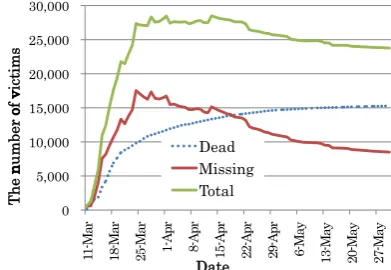
Figure 1 shows the death toll and the number of missing people from tsunami and earthquake, presented by the Japanese National Police Agency. The number of missing people reached its peak on March 25th, indicating that the government took 2 weeks to fully grasp the total number of victims, although they began gathering information about the whereabouts of victims and survivors as soon as the earthquake hit. One of the main reasons for this delay was that prefectures could not effec-tively collect the information from municipal gov-ernments or police stations because many of them
1All the dates and times in this paper are in JST.
0
Figure 1: Change of overall death toll and missing people
were extensively damaged or destroyed by the dis-aster (Anonymous, 2011)2. Furthermore, damage to communication equipment, power outages, and inundation of the air waves prevented the use of mobile phones, which are generally the most im-portant tool for communication during a disaster.
As a result, Twitter or social network services (SNS) such as mixi3 played an important role for propagating safety information among peo-ple. However, with SNSs flooded with informa-tion about the disaster, it was difficult to ensure that people would be properly connected with the information they were seeking. Soon after the disaster struck, many NLP researchers, engineers, and students from all over Japan (including the authors), spontaneously created a working group called ”ANPI NLP”4to try to organize this infor-mation into a form that would be useful. In partic-ular, we focused on mining and organizing infor-mation on Twitter regarding safety of individuals in the disaster-stricken area, as people are initially more concerned about the safety of their family or
2http://www.asahi.com/special/10005/
TKY201103120549.html
3http://mixi.jp/
4The word “ANPI” means “safety” in Japanese.
friends than anything else.
There were three major elements to this process: • Separating the tweets that contained safety information from the huge number of irrel-evant tweets.
• Extracting important information, such as person names and locations from highly domain-specific text included in the tweets.
• Verifying and delivering this information to the people that need it.
The working group tackled these issues in safety information extraction from Twitter, prepar-ing resources, buildprepar-ing tools, and connectprepar-ing the extracted information with Google Person Finder (GPF)5, a central location for safety information that was widely publicized through the Japanese news media. Our priorities were not only the ac-curacy, but also the speed with which we could provide the information.
In this paper, we report the process of build-ing an information extraction system in a disaster-response situation within a matter of days. The challenges involved included organizing volun-teers (§2), building resources for out-of-domain, noisy internet data (§3), and applying these vol-unteers and resources to the construction of NLP tools (§4 and§5). We also describe the final results of the project, the provision of new information about missing persons to GPF (§6), and summa-rize related work (§7). Finally in §8 we discuss what went right and what went wrong with the project, and provide some insight into what can be done to prepare for similar situations in the future. 2 Organization and Communication The project began with a single Twitter post soon after the earthquake hit, imploring NLP re-searchers and engineers to think about what they could do to help in the time of need. In particular, the creation of resources and tools that could be used to process information about the earthquake was cited as one example. In under an hour, the first responders to this call had started creating the language resources described in§3.
Given the public nature of Twitter, word of the efforts spread, and the number of partici-pants quickly increased. With the large num-ber of weakly connected participants, there was
5http://japan.person-finder.appspot.
com/
no clear power structure in place to delegate au-thority. Instead, several leaders spontaneously emerged, centered around people who joined the project early, had large Twitter followings, or were experts in a specific area (such as the creation of data or domain adaptation of tools). In addition to the discourse on Twitter, a publicly available Wiki page was created to gather information about the project in a single place6. Overall, we believe that the existing online communication framework proved quite effective in rallying and organizing members for the project.
On the other hand, the largest challenge in the project organization was the initial underestima-tion of the outpouring of support that the project would see. In the end, over 65 volunteers joined the project, and it was often difficult for the few main organizers to rapidly design and delegate tasks to such a large number of volunteers. This resulted in an over-concentration of effort in some areas, and lack of effort in others. We hope that this paper will help provide a road-map for the type of tasks that may be necessary in rapid-response NLP situations, and prompt discussion on what other tasks may be taken on in a disaster.
3 Language Resources and Tweet Corpus
The earliest stage of the project focused on sharing linguistic resources. These included dictionaries, which were used to improve various text analyzers and classifiers. At the same time, we also made efforts towards building a labeled corpus of tweets containing safety information, with the final goal of extracting information from unlabeled tweets.
3.1 Text Analysis Resources
Among the earliest contributions to the project were dictionaries, especially those containing per-son and place names specific to the Tohoku re-gion. These were generally contributed by people directly familiar with the resources, the creators or maintainers of the dictionaries themselves.
As time was critical, the linguistic analysis tools actually used in the project were based on widely available general domain resources, as well as domain-specific resources gathered within the very early stages of the project. The general domain language resources consisted of the Bal-anced Corpus of Contemporary Written Japanese
(BCCWJ) (Maekawa, 2008) and the UniDic dic-tionary (Den et al., 2008), which are high quality and annotated with a variety of tags.
The domain-specific resources gathered specif-ically for the project and used in the analysis tools described in§4 included:
• The dictionary used in the open source Mozc Japanese Input method, which contained 50,848 first names and 26,519 last names and was provided by the maintainer of the project.
• A name list that contains last names specific to northeast Japan7. These resources were publicly available on the web.
• A location name list of Iwate, Miyagi, Fukushima, and Ibaraki prefectures created by downloading a database of postal code in-formation and manually checking the data.
A number of other resources were created by volunteers, including a list of all the station names in Japan, station location information, land-mark names in Kanto and Tohoku extracted from Wikipedia, a list of geopolitical entities, and a list of abbreviated school names and places. While these resources were certainly significant, it was the resources that were prepared early on in the process that provided the most aid to the project as a whole. This indicates that for similar situa-tions in the future, it is essential to have as many resources as possible immediately available, and preferably familiar to the people in the project to facilitate rapid processing and dispersal.
3.2 Tweet Corpus Construction
As Twitter contained a wide variety of earthquake-related posts including information about the safety of people in the disaster-affected area, we decided to create a corpus of disaster-related tweets to aid our information extraction efforts. The first tweet corpus shared was the collection of 469,504 tweets containing the word “ ” (earthquake) from March 11th 16:09 to March 13th 8:59. We also collected tweets with the hash tags “#anpi” (safety information) such as “#hi-nan” (evacuation), “#j j helpme” (help request), and “#save ”+ location names. Tweets contain-ing RT (re-tweets) and QT (quote tweets) were removed to eliminate duplication. As a result,
7http://platinum22000.fc2web.com/
{miyagi,fukushima,iwate,tochigi}.htm
61,376 tweets were collected from March 13th 1:37am until March 14th 16:45pm.
A typical tweet containing safety information looked like the following8:
TANAKA Taro and Hanako who lived in Kesennuma City can’t be reached. Does anybody know where they are?
From the large corpus of tweets, we hope to dis-cover two pieces of information. First, we must recognize thetopicof the tweet, in this case that the tweet is asking for information about miss-ing people (tweet classification). Second, we need to recognize that the people in question are “TANAKA, Taro” and “Hanako,” both of whom live in “Kesennuma City” (NE recognition).
In order to create data to train tools to perform both tweet classification and NE recognition, vol-unteers began to perform tagging as soon as the tweet collection was finished. First, we defined nine kinds of tweet labels specifying the tweet top-ics, which are listed in Table 1. The distinction among S/O/U was sometimes unclear and went under extensive discussion among volunteers. In practice, the distinction of I/L/P/M from others (S/O/U) is of the highest importance.
One example is shown below:
<person type="M">TANAKA Taro</person> and <person type="M">Hanako</person> living in <location>Kesennuma city</location> can’t be reached.
Safety information is optionally added to every person tag, specifying the object of the safety in-formation, as shown in the above example. Also multiple tags are permitted when multiple types of safety information are contained in a single tweet. Utilizing Twitter, word was spread about the tagging task force, gathering a large number of volunteers, most of whom were NLP researchers, engineers, or students. In order to facilitate the task-force, several people with annotation experi-ence responded to questions in real-time, and var-ious tools were created and shared among the an-notators. Over 65 volunteers gathered to tag the corpus with class and NE tags over the course of two days, resulting in a total of 33,242 tweet an-notated.
Label Definition Example Count I Him/Herself is alive I’m XXX in YYY City. I’m all right. 405 L Alive Mr./Ms. XXX in YYY City is at ZZZ Shelter. He/She is alive. 1,154
P Passed away — 93
M Missing The safety of Mr./Ms. XXX living in YYY City is unknown. 4,438
H Help Request Mr./Ms. XXX is left in YYY and needs help! 280
S Information request My relatives/parents/... staying in South XXX City are missing.Refugees at XXX School are provided enough daily supplies? (Safety
information of unspecific individual, region, etc.) 1,903 O Not safety information You can post safety information on this site! 24,035
R External link Survivor list of XXX City: http://... 773
U Unknown (Non-Japanese or nonsense postings) 1,235
Table 1: Safety information tags on tweets
While the annotators were generally more skilled and motivated than those in previous at-tempts to create language resources using crowd-sourcing (Callison-Burch and Dredze, 2010; Finin et al., 2010), given the rapid nature by which the project developed, annotation started before tag-ging standards were put in place, leading to some inconsistency in the tagged corpus. In retrospect, despite the speed of the project, it would have been helpful to spend some more time thinking about what information was really necessary for the task, and have more experienced annotators do a quick test run before opening annotation to the broader volunteer base. In addition, as many of the annota-tors were less experienced, explicitly allowing the annotators to “pass” on difficult instances would have reduced the amount of time wasted on diffi-cult or ambiguous cases.
4 Text Analysis
Before mining the tweets for useful information, it was necessary to create text analysis tools that were capable of handling this very specialized data set. The main objective of text analysis was named entity recognition (NER), which would allow for the identification of names and locations.
4.1 Morphological Analysis and NER
The first step in Japanese text processing is morphological analysis (MA), which splits raw Japanese text into words and assigns POS tags to each word. While previous research in tagging for Twitter has profited by building a custom NLP pipelines over the course of several months (Gim-pel et al., 2011; Ritter et al., 2011) or by build-ing semi-supervised learnbuild-ing systems (Liu et al., 2011), it was necessary to create a morphological analyzer in the course of several hours. This is due to the fact that all other components of the system
depend on MA, and cannot be developed until MA is in place. Thus, we utilized existing general do-main resources, and added new resources as they were collected in a domain-adaptation framework. For this task we used KyTea9, an open source morphological analysis tool notable for being rela-tively robust to out-of-domain data, and being able to flexibly incorporate a variety of language re-sources (Neubig et al., 2011).
We trained a word segmentation (WS) and POS tagging model for KyTea using the BCCWJ and UniDic as a base. We trained the POS tagging model, but in order to facilitate NE recognition farther down the pipeline, we replaced all proper nouns with their subcategory tag (“first name,” “place name,” etc.). We also added a corpus of conversational and news text (CN Corpus) that was only annotated with word boundaries, and a large list of Japanese first and last names. We in-dicate the model trained with all of these resources asORIG.
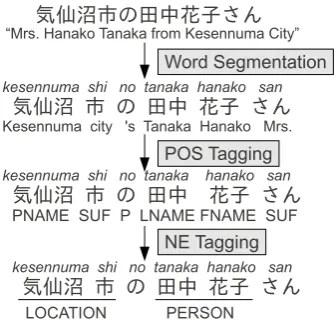
While the POS tagger works on a word-by-word basis, most named entities consist of multi-ple words. Previous work has developed linguistic resources for English NE tagging on Twitter (Finin et al., 2010), but again considering the short time frame, we developed a simple rule-based system to connect multiple words into single named en-tities. Rules scanned the corpus in order, finding the first of three POS tags: “first name (FNAME),”
“last name (LNAME),” or “place name (PNAME).”
These words are labeled with PERSON, PERSON,
orLOCATIONNE tags respectively. Continuing in
Figure 2: An example of the three steps of named entity recognition. Pronunciations and English translations are also provided for reference.
Name Words WS POS Group
BCCWJ 997k ORIG
CN Text 503k ORIG
UniDic 217k ORIG
Names 144k ORIG
Address 73.4k +DICT
+Names 29.4k +DICT
Active 10.2k +ACTIVE
Table 2: Resources used in building the model with names, word counts, whether each corpus is annotated with WS and POS information, and which group the resource was added in.
NE tagging process is shown in Figure 2.
4.2 Domain Adaptation
While this classifier worked well on general do-main data, it is known that accuracy greatly de-creases for text in different domains or styles than the training data (Finin et al., 2010; Neubig et al., 2011; Ritter et al., 2011). In the tweet data there were a large number of place and person names specific to the disaster-stricken region, as well as a large number of linguistic phenomena specific to tweets, and thus it was necessary to add a number of language resources (summarized in Table 2) to adapt the text processing tools to the new domain. To improve the accuracy on person and place names, we added the language resources previ-ously described in section 3. The combination of these dictionaries is indicated by “+Names” in Ta-ble 2, and a model trained adding these resources is indicated with +DICT.
Finally, to handle the the large number of Twitter-related linguistic phenomena such as
ORIG +DICT +ACTIVE
WS F 97.3% 97.3% 97.7%
Lab. NE PR 53.9%55.6% 69.6%71.7% 69.2%72.7% Unlab. NE PR 70.6%72.7% 80.4%82.8% 80.8%84.9%
Table 3: Word segmentation F-measure and NE precision (P) and recall (R) for both labeled and unlabeled evaluation.
the word “tweet” or hash tags, we annotated word boundaries using the active-learning/partial-annotation method described by Neubig et al. (2011). For each round of active learning, we chose the 100 words for which the morphologi-cal analyzer was least confident, and had a single human annotator correct the word boundaries for these words. This was repeated for 4 rounds (400 words), which took approximately 1.5 hours total. The model trained by adding this data to +DICTis
indicated as +ACTIVE.
4.3 Result Analysis
In order to demonstrate the necessity and effec-tiveness of domain adaptation, we present results of a quantitative and qualitative analysis of WS and NER forORIG, +DICT, and +ACTIVE.
Table 3 shows results for a quantitative analysis of WS and NE tagging results on a manually an-notated corpus of 50 tweets. Labeled NE accuracy indicates that the NE is only considered correct if both its span and its label (PERSON/LOCATION)
are correct, and unlabeled NE accuracy indicates that the NE is considered correct if the span is matched, regardless of the label. It can be seen that the addition of dictionaries for the target do-main greatly increased the NE accuracy, up to 16% for labeled tagging. The active-learning-based an-notation further improved the WS accuracy by 0.42%, resulting in gains of NE recall of 1-2%.
The main reason for the improvement between the ORIG and +DICT was the proper handling of
place names in the disaster-stricken area. ORIG
purify-ing plant). This, in turn, allowed for “ ” (Taira) to be properly recognized as a location name.
The largest remaining challenge for the fully adapted system was the distinction between last names and place names, which are highly ambigu-ous in Japanese. The use of the address infor-mation corpus greatly improved the NE tagging results, but also biased the classifier heavily to-wards place names. In a rapid-response situation it is necessary to use any and all of the resources available, even if they are known to be biased. This sample-bias problem can likely be amelio-rated by recent progress in machine learning tech-niques (Huang et al., 2007).
5 Safety Information Classifier
Next, we describe the classifier that we built to find tweets containing safety information out of all the tweets in the corpus.
5.1 Model 1
Our first classifier, which we will call Model 1, was developed in several hours by over-simplifying the classification problem and using a very limited feature set.
While, as explained in§3.2, a single tweet could be assigned multiple labels, for Model 1 we simply took the first label that each annotator assigned to be true, and trained a one-vs.-rest classifier on this data. We used two types of features for the clas-sification, bag-of-character-n-gram features, and NE features. The bag-of-character-n-gram fea-tures created a separate feature for each charac-ter n-gram from unigram to trigrams. As most Japanese words are relatively short, this is able to capture the most important words while not requir-ing word segmentation and thus berequir-ing relatively robust. Second, we used the counts of each type of named entity tag, which are generally larger in tweets that contained useful information.
We trained all models using the default SVM solver of LIBLINEAR (Fan et al., 2008). 10-fold cross validation on the test set showed that the classifier achieved a tag accuracy of 86.13%.
5.2 Model 2
After few days, we created Model 2 as an exten-sion of Model 1. Model 2 used a multi-class and multi-label classifier which output all the labels each of whose score exceeds a thresholdt.
We extended the feature set for Model 2. Model 2 includes the same features as Model 1, but for n-grams, Model 2 does not count dupli-cated sequences. As NE features, co-occurrence information ofPERSONandLOCATIONin a single
tweet was added as tweets for safety confirmation should generally include both of them. Combina-tion of character 3-grams and the appearance of a
PERSONwas also added to capture a tweet’s
inten-tion for that person. We also used existence of the hash tag “#anpi” and the total number of appear-ance of hash tags except for “#anpi” as clues for dividing tweets not related to safety confirmation (label O, U, S) from the others. Finally, we used the existence of the string ”http(s)” and combina-tion of existence of ”http(s)” and NE as clues for the label R (external lists).
5.3 Evaluation
We evaluated the Model 2 classifier in detail using the corpus from the 17th of March, which con-tained 9,812 tweets. We divided the corpus into three sets: 80% for training, 10% for develop-ment, and the other 10% for test. For comparison, we also developed Model10which is a multi-label
model using the same feature set as Model 1. Table 4 shows the results of the two models. The performance is not significantly different in terms of accuracy, but Model 2 obtained higher recall than Model 10. The thresholds here were
empirically determined to the one that maximize the F1-scores on the development set.
Dev Test
Model t P R F Acc. P R F Acc.
Model 10 0.55 87.8% 84.3% 86.0% 96.8% 87.9% 84.9% 86.4% 96.9%
Model 2 0.45 86.1% 85.7% 85.9% 96.7% 87.1% 86.4% 86.8% 97.0%
Table 4: Micro-averaged precision (P), recall (R), F-score (F), and accuracy (Acc.) achieved by Model10
and Model 2. For the evaluation, we transformed the gold and predicted data from multi-labeled instances to nine sets of binary-labeled instances.
Label #samples P R F
O 719 88.4% 98.3% 93.1%
M 134 91.2% 93.3% 92.3%
S 51 72.5% 56.9% 63.7%
L 45 50.0% 11.1% 18.2%
R 32 76.9% 31.3% 44.4%
U 22 0.0% 0.0% 0.0%
I 12 50.0% 58.3% 53.9%
H 6 100.0% 50.0% 66.7%
P 4 0.0% 0.0% 0.0%
Table 5: Precision (P), recall (R) and F-score (F) for each labels using Model 2 (t= 0.45).
Gold Predict #err. Gold Predict #err.
U O 22 LR OR 2
S O 17 R LR 2
L O 13 O LR 2
LR O 11 S OS 2
R O 9 MS S 2
O S 7 LPR O 2
L M 5 LM M 2
M IM 5 LM IM 2
M O 4 IM M 2
R OR 3
H O 3 Others 16
M S 3 Total 136
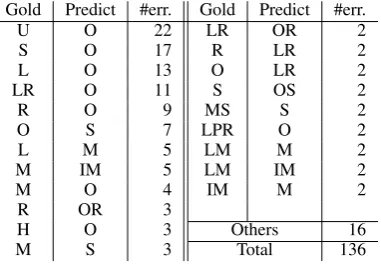
Table 6: Label sequences where the errors oc-curred with Model 2 (t= 0.45).
achieved by a fewer number of annotators, reduc-ing inconsistency issues.
6 Application of the System
The final step was verifying that the information was in fact reliable, and then matching PERSON
and LOCATION tokens from tweets, which were
classified as “L” (the person is alive) to the infor-mation of Google Person Finder (GPF). We chose to verify and match the information by hand to prevent the provision of misinformation on a sen-sitive topic such as safety of earthquake victims.
GPF contained several columns, such as the first name and last name of the person, home neighbor-hood, home city and home prefecture. The man-ually corrected NE information was matched with GPF data, and we were able to update the personal information of more than a hundred individuals
that were confirmed to be alive in tweets.
However, many tokens extracted from tweets had problems, including:
• Incomplete LOCATION information: The
tokens lacked a couple of information such as city, or neighborhood. “I was able to contact Taro Tanaka, who lives in Miyagi prefecture! [
]”. In this case, there may be many Taro Tanakas living in the prefecture, so a single individual cannot be identified.
• IncompletePERSON names: a) Last or first
names were be omitted when describing peo-ple of the same family. “I found Taro, Jiro, and Hanako Tanaka of Sendai at an evacua-tion shelter. [
]” or “The Tanaka family who live in Sendai has been reached! [
]” b) Many person names that are likely written in logographickanjiin normal text were instead written phonetically (using
katakanaorhiragana).
While we focused mainly on extracting infor-mation about missing people, it has also been noted that Twitter is a source of other information in disaster situations (Corvey et al., 2010; Vieweg et al., 2010). For example, “50 people in Kesen-numa city have evacuated to a hill behind the city
hall. [ 50
]” includes the number of people (50) and a concrete location (a hill behind the city hall), and could be a good indicator of where to concentrate rescue efforts. This could be an area of very practical application for recent research in verifying reliability of information on Twitter (Kawahara et al., 2008; Qazvinian et al., 2011). 7 Related Work
victims via NLP technologies as sub-projects of ANPI NLP. Prominent ones include:
• Association of tweets to evacuation shelter
locations:This includes geo-coding location names extracted from tweets and associating them with the evaluation shelter lists, which are also geo-coded.
• Visualization of tweets on a map: This in-cludes mapping geo-tagged tweets on a map so that they can be searched easily.
• Translation of information to foreign
lan-guages:This includes compilation and shar-ing of technical term multilshar-ingual dictionar-ies, automatic translation of earthquake formation, and provision of the translated in-formation in four major languages spoken by foreigners in Japan.
We are definitely not the first to focus on the disaster-related natural language processing. Lewis (2010) reports the development project of Haitian Creole translation system in rapid re-sponse to the Haiti earthquake in 2010. While their motivations have a lot in common with ours, such as the necessity to set up a deployable sys-tem in a very short time span. Corvey et al. (2010) describe the annotation of a corpus about the Ok-lahoma wildfires, aiming at provision of broad-scale information as opposed to safety information mining about individuals. There have also been a number of works on detecting general trends from twitter, including work by Sakaki et al. (2010), who detect earthquakes based on Twitter postings. There are many other systems designed for infor-mation sharing in emergency, including the one described in (Hasegawa et al., 2005).
8 Conclusion
In this paper we presented a description of the ef-forts of a group of volunteers to create a useful NLP system in a short time frame in response to a natural disaster.
On the whole, we believe the project was a suc-cess. In an extremely short time-frame, we were able to design, implement, and run a system for ex-tracting useful information from a highly unorga-nized and difficult-to-process information source. In the short term, this allowed us to provide in-formation about the safety of over 100 people. In addition, this allowed us to clarify the framework
required, and develop tools that can be used to al-low for provision of information on an even larger scale in future disaster situations. On a more ab-stract level, we were able to show that NLP has the potential to make a contribution in a disaster-response situation, which we hope will provide an impetus for similar future projects.
However, a number of challenges remain, and we conclude by summarizing the major lessons learned in the project.
• Speed is everything: Gathering data, mak-ing analysis tools, creatmak-ing a classifier, and providing information to the public all needed to be performed on a limited time frame. As each of these steps must be com-pleted in order, a delay in any part would re-sult in delays for the overall process. Thus, it was necessary to create working tools as fast as possible, even if this meant making sacri-fices in accuracy and refining later.
• A better annotation framework is needed: To resolve the challenges posed by annota-tion in such a short time frame, we must fo-cus on create of better standards considering only the necessary information, do test anno-tation runs to work out the kinks, and allow annotators to “pass” on difficult annotations.
• Human resources must be used effectively: The project summoned an outpouring of sup-port much larger than originally expected. To harness all of the people that are willing to help, it is important to have an overall project vision, and be able to quickly identify new projects for volunteers to work on.
Disasters such as earthquakes are tragic, over-whelming times, with too much information com-ing in for any individual to handle. We hope that our work has demonstrated that there is a need and a means for processing of this information, and will motivate similar projects in the future. Acknowledgments
References
Anonymous. 2011. Yakusho/keisatsu kinou daun, anpi kakunin susumazu, higashinihon daishinsai (In
Japanese). Inthe Asahi Shimbun, page 20. March
13.
Chris Callison-Burch and Mark Dredze. 2010. Cre-ating speech and language data with amazon’s
me-chanical turk. In NAACL HLT 2010 Workshop on
Creating Speech and Language Data with Amazon’s Mechanical Turk, pages 1–12.
William J. Corvey, Sarah Vieweg, Travis Rood, and Martha Palmer. 2010. Twitter in mass emergency:
What NLP can contribute. In NAACL HLT 2010
Workshop on Computational Linguistics in a World of Social Media, pages 23–24, Los Angeles, Cali-fornia, USA, June. Association for Computational Linguistics.
Yasuharu Den, Junpei Nakamura, Toshinobu Ogiso,
and Hideki Ogura. 2008. A proper approach
to Japanese morphological analysis: Dictionary,
model, and evaluation. In 6th International
Con-ference on Language Resources and Evaluation (LREC).
Rong-En Fan, Kai-Wei Chang, Cho-Jui Hsieh, Xiang-Rui Wang, and Chih-Jen Lin. 2008. LIBLINEAR: a
library for large linear classification. The Journal of
Machine Learning Research, 9:1871–1874.
Tim Finin, William Murnane, Anand Karandikar, Nicholas Keller, Justin Martineau, and Mark Dredze. 2010. Annotating named entities in
Twit-ter data with crowdsourcing. InNAACL HLT 2010
Workshop on Creating Speech and Language Data with Amazon’s Mechanical Turk, pages 80–88, Los Angeles, June. Association for Computational Lin-guistics.
Kevin Gimpel, Nathan Schneider, Brendan O’Connor, Dipanjan Das, Daniel Mills, Jacob Eisenstein, Michael Heilman, Dani Yogatama, Jeffrey Flanigan, and Noah A. Smith. 2011. Part-of-speech tagging for Twitter: Annotation, features, and experiments. In49th Annual Meeting of the Association for Com-putational Linguistics: Human Language
Technolo-gies, pages 42–47, Portland, Oregon, USA, June.
Association for Computational Linguistics.
Satoshi Hasegawa, Kumi Sato, Shohei Matsunuma, Masaru Miyao, and Kohei Okamoto. 2005. Multi-lingual disaster information system: information
de-livery using graphic text for mobile phones. AI &
Society, 19(3):265–278.
Jiayuan Huang, Alexander J. Smola, Arthur Gretton, Karsten M. Borgwardt, and Bernhard Scholkopf. 2007. Correcting sample selection bias by unlabeled
data. Advances in neural information processing
systems, 19:601.
Daisuke Kawahara, Sadao Kurohashi, and Kentaro Inui. 2008. Grasping major statements and their
contradictions toward information credibility
analy-sis of web contents. In2008 IEEE/WIC/ACM
Inter-national Conference on Web Intelligence and Intel-ligent Agent Technology, pages 393–397. IEEE.
William D. Lewis. 2010. Haitian Creole: how to build and ship an MT engine from scratch in 4 days, 17
hours, & 30 minutes. In14th Annual Conference of
the European Association for Machine Translation.
Xiaohua Liu, Shaodian Zhang, Furu Wei, and Ming Zhou. 2011. Recognizing named entities in tweets. In49th Annual Meeting of the Association for Com-putational Linguistics: Human Language
Technolo-gies, pages 359–367, Portland, Oregon, USA, June.
Kikuo Maekawa. 2008. Balanced corpus of
contem-porary written Japanese. In6th Workshop on Asian
Language Resources, pages 101–102.
Graham Neubig, Yosuke Nakata, and Shinsuke Mori. 2011. Pointwise prediction for robust, adaptable
japanese morphological analysis. In The 49th
An-nual Meeting of the Association for Computational Linguistics: Human Language Technologies (ACL-HLT) Short Paper Track, Portland, Oregon, USA, 6.
Vahed Qazvinian, Emily Rosengren, Dragomir R. Radev, and Qiaozhu Mei. 2011. Rumor has it:
Iden-tifying misinformation in microblogs. In2011
Con-ference on Empirical Methods in Natural Language Processing, pages 1589–1599, Edinburgh, Scotland, UK., July. Association for Computational Linguis-tics.
Alan Ritter, Sam Clark, Mausam, and Oren Etzioni. 2011. Named entity recognition in tweets: An
ex-perimental study. InConference on Empirical
Meth-ods in Natural Language Processing.
Takeshi Sakaki, Makoto Okazaki, and Yutaka Matsuo. 2010. Earthquake shakes Twitter users: real-time
event detection by social sensors. In 19th
interna-tional conference on World wide web, pages 851– 860. ACM.
Burr Settles. 2011. Closing the loop: Fast, interac-tive semi-supervised annotation with queries on
fea-tures and instances. In2011 Conference on
Empiri-cal Methods in Natural Language Processing, pages 1467–1478, Edinburgh, Scotland, UK., July. Asso-ciation for Computational Linguistics.
Simon Tong and Daphne Koller. 2002. Support vec-tor machine active learning with applications to text
classification. Journal of Machine Learning
Re-search, 2:45–66, March.
Sarah Vieweg, Amanda L. Hughes, Kate Starbird, and Leysia Palen. 2010. Microblogging during two nat-ural hazards events: what twitter may contribute to
situational awareness. In28th international