An Efficient Shift-Reduce Decoding Algorithm for Phrased-Based
Machine Translation
Yang Feng, Haitao Mi, Yang Liu and Qun Liu Key Laboratory of Intelligent Information Processing
Institute of Computing Technology Chinese Academy of Sciences
{fengyang,htmi,yliu,liuqun}@ict.ac.cn
Abstract
In statistical machine translation, decod-ing without any reorderdecod-ing constraint is an NP-hard problem. Inversion Transduc-tion Grammars (ITGs) exploit linguistic structure and can well balance the needed flexibility against complexity constraints. Currently, translation models with ITG constraints usually employs the cube-time CYK algorithm. In this paper, we present a shift-reduce decoding algorithm that can generate ITG-legal translation from left to right in linear time. This algorithm runs in a reduce-eager style and is suited to phrase-based models. Using the state-of-the-art decoder Moses as the baseline, ex-periment results show that the shift-reduce algorithm can significantly improve both the accuracy and the speed on different test sets.
1 Introduction
In statistical machine translation, for the diver-sity of natural languages, the word order of source and target language may differ and search-ing through all possible translations is NP-hard (Knight, 1999). So some measures have to be taken to reduce search space: either using a search algorithm with pruning technique or restricting possible reorderings.
Currently, beam search is widely used (Till-mann and Ney, 2003; Koehn, 2004) to reduce search space. However, the pruning technique adopted by this algorithm is not risk-free. As a result, the best partial translation may be ruled out
during pruning. The more aggressive the prun-ing is, the more likely the best translation escapes. There should be a tradeoff between the speed and the accuracy. If some heuristic knowledge is em-ployed to guide the search, the search algorithm can discard some implausible hypotheses in ad-vance and focus on more possible ones.
Inversion Transduction Grammars (ITGs) per-mit a minimal extra degree of ordering flexibility and are particularly well suited to modeling or-dering shifts between languages (Wu, 1996; Wu, 1997). They can well balance the needed flex-ibility against complexity constraints. Recently, ITG has been successfully applied to statistical machine translation (Zens and Ney, 2003; Zens et al., 2004; Xiong et al., 2006). However, ITG generally employs the expensive CYK parsing al-gorithm which runs in cube time. In addition, the CYK algorithm can not calculate language model exactly in the process of decoding, as it can not catch the full history context of the left words in a hypothesis.
In this paper, we introduce a shift-reduce de-coding algorithm with ITG constraints which runs in a left-to-right manner. This algorithm parses source words in the order of their corresponding translations on the target side. In the meantime, it gives all candidate ITG-legal reorderings. The shift-reduce algorithm is different from the CYK algorithm, in particular:
• It produces translation in a left-to-right man-ner. As a result, language model probability can be calculated more precisely in the light of full history context.
distor-target side target side target side (a) straight (b) inverted (c) discontinuous
Figure 1: Orientation of two blocks.
tion limit, shift-reduce decoding algorithm can run in linear time, while the CYK runs in cube time.
• It holds ITG structures generated during de-coding. That is to say, it can directly give ITG-legal spans, which leads to faster de-coding. Furthermore, it can be extended to syntax-based models.
We evaluated the performance of the shift-reduce decoding algorithm by adding ITG con-straints to the state-of-the-art decoder Moses. We did experiments on three data sets: NIST MT08 data set, NIST MT05 data set and China Work-shop on Machine Translation 2007 data set. Com-pared to Moses, the improvements of the accuracy are 1.59, 0.62, 0.8 BLEU score, respectively, and the speed improvements are 15%, 24%, 30%, re-spectively.
2 Decoding with ITG constraints
In this paper, we employ the shift-reduce algo-rithm to add ITG constraints to phrase-based ma-chine translation model. It is different from the traditional shift-reduce algorithm used in natural language parsing. On one hand, as natural lan-guage parsing has to cope with a high degree of ambiguity, it need take ambiguity into considera-tion. As a result, the traditional one often suffers reduce divergence. Nonetheless, the shift-reduce algorithm in this paper does not pay atten-tion to ambiguity and acts in a reduce-eager man-ner. On the other hand, the traditional algorithm can not ensure that all reorderings observe ITG constraints, so we have to modify the traditional algorithm to import ITG constraints.
We will introduce the shift-reduce decoding al-gorithm in the following two steps: First, we
1\1
The laptop with inquiry data on the event was stolen
(a)
Figure 2: A Chinese-to-English sentence pair and its corresponding ITG tree.
will deduce how to integrate the shift-reduce al-gorithm and ITG constraints and show its correct-ness (Section 2.1). Second, we will describe the shift-reduce decoding algorithm in details (Sec-tion 2.2).
2.1 Adding ITG constraints
In the process of decoding, a source phrase is re-garded as a block and a source sentence is seen as a sequence of blocks. The orientation of two blocks whose translations are adjacent on the tar-get side can be straight, inverted or discontinu-ous, as shown in Figure 1. According to ITG, two blocks which are straight or inverted can be merged into a single block. For parsing, differ-ent mergence order of a sequence of continuous blocks may yield different derivations. In con-trast, the phrase-based machine translation does not compute reordering probabilities hierarchi-cally, so the mergence order will not impact the computation of reordering probabilities. As a result, the shift-reduce decoding algorithm need not take into consideration the shift-reduce diver-gence. It merges two continuous blocks as soon as possible, acting in a reduce-eager style.
corre-S zairu1shijian2diaocha3ziliaode4diannao5zaoqie6
The laptop
S zairu1 shijian2diaocha3ziliaode4diannao5zaoqie6
The laptop with
S zairu1 shijian2diaocha3ziliaode4diannao5zaoqie6
The laptop with inquiry
(a) (b) (c)
S zairu1shijian2diaocha3ziliaode4diannao5zaoqie6
The laptop with inquiry data
S zairu1 shijian2diaocha3ziliaode4diannao5zaoqie6
The laptop with inquiry data
S zairu1 shijian2diaocha3ziliaode4diannao5zaoqie6
The laptop with inquiry data on the event
(d) (e) (f)
S zairu1shijian2diaocha3ziliaode4diannao5zaoqie6
The laptop with inquiry data on the event
S zairu1 shijian2diaocha3ziliaode4diannao5zaoqie6
The laptop with inquiry data on the event
S zairu1 shijian2diaocha3ziliaode4diannao5zaoqie6
The laptop with inquiry data on the event
(g) (h) (i)
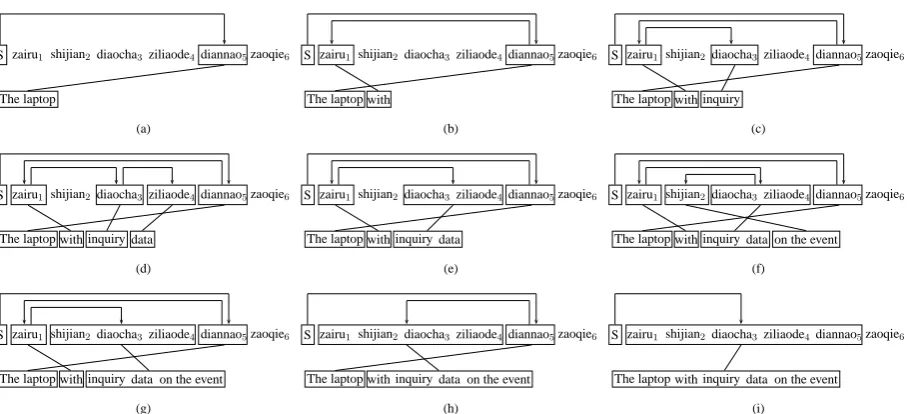
Figure 3: The partial translation procedure of the sentence in Figure 2.
sponding ITG tree, and source words covered by every node (eg. A1, ..., A11 in Figure 2(b))
in the ITG tree can be seen as a block. By watching the tree in Figure 2, we can find that a block must be adjacent to the block either on its left or on its right, then they can be merged into a larger block. For example, A2 matches
the block [zairu1] and A8 matches the block [shijian2 diaocha3ziliaode4].1 The two blocks
are adjacent and they are merged into a larger block [zairu1 shijian2 diaocha3 ziliaode4],
covered by A9. The procedure of translating
zairu1 shijian2 diaocha3 ziliaode4 diannao5
is illustrated in Figure 3.
For a hypothesis during decoding, we assign it three factors: the current block, the left neigh-boring uncovered span and the right neighbor-ing uncovered span. For example, in Figure 3(c), the current block is [diaocha3]and the left
neighboring uncovered span is[shijian2]and the
right neighboring uncovered span is [ziliaode4]. [zaoqie6]is not thought of as the right
neighbor-ing block, for it is not adjacent to[diaocha3]. The
next covered block is [ziliaode4] (as shown in
Figure 3(d)). For [diaocha3]and [ziliaode4]are
adjacent, they are merged. In Figure 3(e), the cur-rent block is[diaocha3 ziliaode4].
A sentence is translated with ITG constraints iff
1The words within a block are sorted by their order in the
source sentence.
its source side can be covered by an ITG tree. That is to say, for every hypothesis during decoding, the next block to cover must be selected from the left or right neighboring uncovered span.
First, we show that if the next block to cover is selected in this way, the translation must observe ITG constraints. For every hypothesis during de-coding, the immediate left and right words of the current block face the following three conditions:
(1) The immediately left word is not covered and the immediately right word is covered, then the next block to cover must be selected from the left neighboring uncovered span, eg. for the cur-rent block[diaocha3ziliaode4]in Figure 3(e). In
this condition, the ITG tree can be constructed in the following two ways: either all words in the left neighboring uncovered span are translated first, then this span is merged with the current span (taking three nodes as an example, this case is shown in Figure 4(a)), or the right part of the left neighboring uncovered span is merged with the current block first, then the new block is merged with the rest part of the left neighboring uncov-ered span (shown in Figure 4(b)). In a word, only after all words in the left neighboring uncovered span are covered, other words can be covered.
(a) (b)
Figure 4: The two ways that the current block is merged with its left neighboring uncovered span. The third node in the first row denotes the current block, the first and second nodes in the first row denote left and right parts of the left neighboring uncovered span, respectively.
covered.
(3) The immediately left and right words are neither covered. The next block can be selected from either the left or the right neighboring uncov-ered span until the immediate left or right word is covered.
The above operations can be performed recur-sively until the whole source sentence is merged into a single block, so the reordering observes ITG constraints.
Now, we show that translation which is not gen-erated in the above way must violate ITG con-straints.
If the next block is selected out of the neighbor-ing uncovered spans, the current block can be nei-ther adjacent to the last covered block nor adjacent to the selected next block, so the current block can not be merged with any block and the whole sen-tence can not be covered by an ITG tree. As in Figure 3(b), if the next block to cover is[zaoqie6],
then [zairu1] is neither adjacent to [diannao5]
nor adjacent to[zaoqie6].
We can conclude that if we select the next block from the left or right neighboring uncovered span of the current block, then the translation must ob-serve ITG constraints.
2.2 Shift-Reduce Decoding Algorithm
In order to generate the translation with ITG con-straints, the shift-reduce algorithm have to keep trace of covered blocks, left and right neighboring uncovered spans. Formally, the shift-reduce de-coding algorithm uses the following three stacks:
• St: the stack for covered blocks. The blocks are pushed in the order that they are covered, not the order that they are in the source sen-tence.
• Sl: the stack for the left uncovered spans of the current block. When a block is pushed into St, its corresponding left neighboring uncovered span is pushed intoSl.
• Sr:the stack for the right uncovered spans of the current block. When a block is pushed into St, its corresponding right neighboring uncovered span is pushed intoSr.
A translation configuration is a triple c =
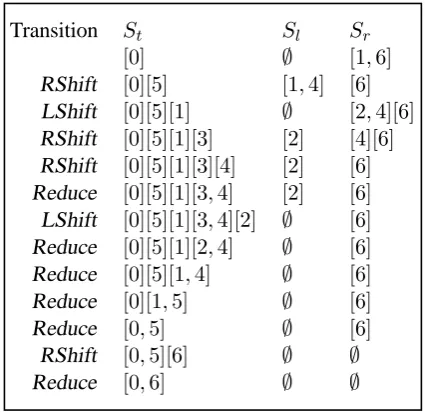
hSt, Sl, Sri. Given a source sentence f = f1, f2, ..., fm, we import a virtual start word and the whole translation procedure can be seen as a sequence of transitions from cs to ct, where cs = h[0], ∅, [1, m]i is the initial configura-tion, ct = h[0, m], ∅, ∅i is the terminal con-figuration. The configuration for Figure 3 (e) is
h[0][5][1][3,4], [2], [6]i.
We define three types of transitions from a configuration to another . Assume the cur-rent configurationc = h[ft11, ft12]...[ftk1, ftk2],
[fl11, fl12]...[flu1, flu2],[frv1, frv2]...[fr11, fr12]i,
then :
• Transitions LShift pop the top element
[flu1, flu2] from Sl and select a block [i, j] from [flu1, flu2] to translate. In addition,
they push[i, j]intoSt, and ifi 6=flu1, they
push [flu1, i−1] into Sl, and if j 6= flu2,
they push[j+ 1, flu2]intoSr. The precondi-tion to operate the transiprecondi-tion is thatSl is not null and the top span ofSlis adjacent to the top block ofSt. Formally, the precondition isflu2+ 1 =ftk1.
• Transitions RShift pop the top element
[frv1, frv2] of Sr and select a block [i, j]
from [frv1, frv2] to translate. In addition,
they push[i, j]intoSt, and ifi6=frv1, they
push[frv1, i−1]intoSl, and ifj6=frv2, they
adjacent to the top block ofSt. Formally, the precondition isftk2+ 1 =frv1.
• Transitions Reduce pop the top two blocks
[ftk−11, ftk−12],[ftk1, ftk2]fromStand push
the merged span [ftk−11, ftk2]into St. The precondition is that the top two blocks are ad-jacent. Formally, the precondition isftk−12+
1 =ftk1
The transition sequence of the example in Fig-ure 2 is listed in FigFig-ure 5. For the purpose of efficiency, transitions Reduce are integrated with transitions LShift and RShift in practical imple-mentation. Before transitions LShift and RShift push[i, j]intoSt, they check whether[i, j]is ad-jacent to the top block of St. If so, they change the top block into the merged block directly.
In practical implementation, in order to further restrict search space, distortion limit is applied be-sides ITG constraints: a source phrase can be cov-ered next only when it is ITG-legal and its tion does not exceed distortion limit. The distor-tiondis calculated byd=|starti−endi−1−1|,
where starti is the start position of the current phrase and endi−1 is the last position of the last
translated phrase.
3 Related Work
Galley and Manning (2008) present a hierarchi-cal phrase reordering model aimed at improving non-local reorderings. Via the hierarchical mer-gence of two blocks, the orientation of long dis-tance words can be computed. Their shift-reduce algorithm does not import ITG constraints and ad-mits the translation violating ITG constraints.
Zens et al. (2004) introduce a left-to-right decoding algorithm with ITG constraints on the alignment template system (Och et al., 1999). Their algorithm processes candidate source phrases one by one through the whole search space and checks if the candidate phrase complies with ITG constraints. Besides, their al-gorithm checks validity via cover vector and does not formalize ITG structure. The shift-reduce de-coding algorithm holds ITG structure via three stacks. As a result, it can offer ITG-legal spans directly and decode faster. Furthermore, with
Transition St Sl Sr
[0] ∅ [1,6]
RShift [0][5] [1,4] [6]
LShift [0][5][1] ∅ [2,4][6]
RShift [0][5][1][3] [2] [4][6]
RShift [0][5][1][3][4] [2] [6]
Reduce [0][5][1][3,4] [2] [6]
LShift [0][5][1][3,4][2] ∅ [6]
Reduce [0][5][1][2,4] ∅ [6]
Reduce [0][5][1,4] ∅ [6]
Reduce [0][1,5] ∅ [6]
Reduce [0,5] ∅ [6]
RShift [0,5][6] ∅ ∅
Reduce [0,6] ∅ ∅
Figure 5: Transition sequence for the example in Figure 2. The top nine transitions correspond to Figure 3 (a), ... , Figure 3 (i), respectively.
the help of ITG structure, it can be extended to syntax-based models easily.
Xiong et al. (2006) propose a BTG-based model, which uses the context to determine the orientation of two adjacent spans. It employs the cube-time CYK algorithm.
4 Experiments
We compare the shift-reduce decoder with the state-of-the-art decoder Moses (Koehn et al., 2007). The shift-reduce decoder was imple-mented by modifying the normal search algo-rithm of Moses to our shift-reduce algoalgo-rithm, without cube pruning (Huang and Chiang, 2005). We retained the features of Moses: four trans-lation features, three lexical reordering features (straight, inverted and discontinuous), linear dis-tortion, phrase penalty, word penalty and language model, without importing any new feature. The decoding configurations used by all the decoders, including beam size, phrase table limit and so on, were the same, so the performance was compared fairly.
training data set (Section 4.2). All experiments were done on Chinese-to-English translation tasks and all results are reported with case insensitive BLEU score. Statistical significance were com-puted using the sign-test described in Collins et al. (Collins et al., 2005).
4.1 Performance Evaluation
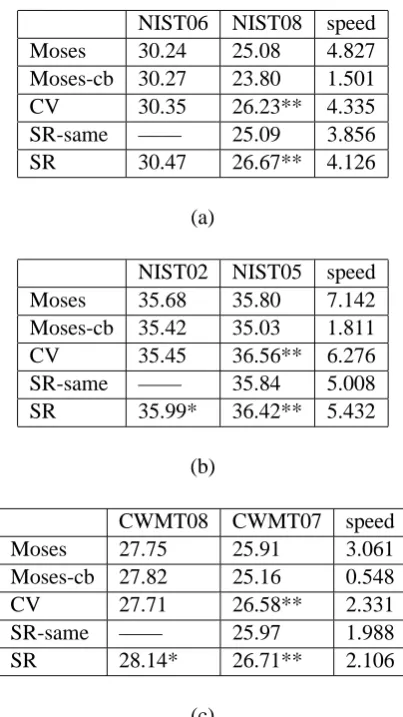
We did three experiments to compare the perfor-mance of the shift-reduce decoder, Moses and the decoder with ITG constraints using cover vector (denoted as CV). 2 The shift-reduce decoder de-coded with two sets of parameters: one was tuned by itself (denoted as SR) and the other was tuned by Moses (denoted as SR-same), using MERT (Och, 2003). Two searching algorithms of Moses are considered: one is the normal search algorithm without cubing pruning (denoted as Moses), the other is the search algorithm with cube pruning (denoted as Moses-cb). For all the decoders, the distortion limit was set to 6, the nbest size was set to 100 and the phrase table limit was 50.
In the first experiment, the development set is part of NIST MT06 data set including 862 sen-tences, the test set is NIST MT08 data set and the training data set contains 5 million sentence pairs. We used a 5-gram language model which were trained on the Xinhua and AFP portion of the Gigaword corpus. The results are shown in Table 1(a).
In the second experiment, the development data set is NIST MT02 data set and the test set is NIST MT05 data set. Language model and the training data set are the same to that of the first experiment. The result is shown in Table 1(b).
In the third experiment, the development set is China Workshop on Machine Translation 2008 data set (denoted as CWMT08) and the test set is China Workshop on Machine Translation 2007 data set (denoted as CWMT07). The training set contains 2 Million sentence pairs and the language model are a 6-gram language model trained on the Reuter corpus and English corpus. Table 1(c) gives the results.
In the above three experiments, SR decoder
2The decoder CV is implemented by adding the ITG
con-straints to Moses using the algorithm described in (Zens et al., 2004).
NIST06 NIST08 speed
Moses 30.24 25.08 4.827
Moses-cb 30.27 23.80 1.501
CV 30.35 26.23** 4.335
SR-same —— 25.09 3.856
SR 30.47 26.67** 4.126
(a)
NIST02 NIST05 speed
Moses 35.68 35.80 7.142
Moses-cb 35.42 35.03 1.811
CV 35.45 36.56** 6.276
SR-same —— 35.84 5.008
SR 35.99* 36.42** 5.432
(b)
CWMT08 CWMT07 speed
Moses 27.75 25.91 3.061
Moses-cb 27.82 25.16 0.548
CV 27.71 26.58** 2.331
SR-same —— 25.97 1.988
SR 28.14* 26.71** 2.106
(c)
Table 1: Performance comparison. Moses: Moses without cube pruning, Moses-cb: Moses with cube pruning, CV: the decoder using cover vector, SR-same: the shift-reduce decoder decoding with parameters tunes by Moses, SR: the shift-reduce decoder with parameters tuned by itself. The sec-ond column stands for develop set, the third col-umn stands for test set and speed colcol-umn shows the average time (seconds) of translating one sen-tence in the test set. **: significance at the .01 level.
accu-27.00
average decoding speed (s) d=-1
Figure 6: Performance comparison on NIST05. For a curve, the dots correspond to distortion limit
4,6,8,10,14 and no distortion from left to right. d=−1stands for no distortion limit.
racy. However, the speed of SR is faster than CV. Cube pruning can improve decoding speed dra-matically, but it is not risk-free pruning technol-ogy, so the BLEU score declines obviously.
4.2 Performance Analysis
We make performance analysis with the same ex-periment configuration as the second exex-periment in Section 4.1, except that the training set in the analysis experiment is FBIS corpus, includ-ing 289k sentence pairs. In the followinclud-ing exper-iments, Moses employs the normal search algo-rithm without cube pruning.
For the decoders employ the linear distortion feature, the distortion limit will influence the translation accuracy. Besides, with different dis-tortion limit, the proportion of ITG-legal transla-tion generated by Moses will differ. The smaller the distortion limit is, the greater the proportion is. So we first compare the performance with differ-ent distortion limit.
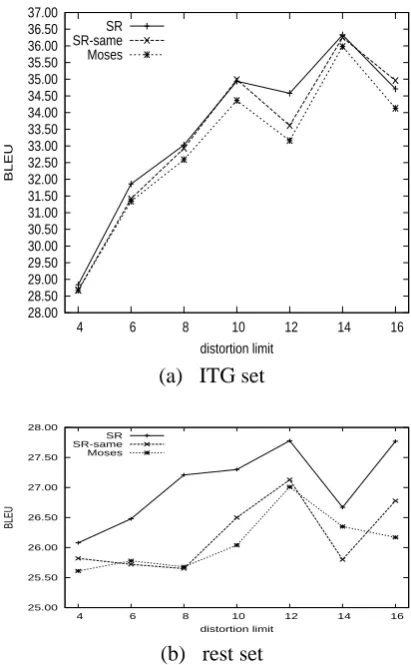
We compare the shift-reduce decoder with Moses using different distortion limit. The re-sults are shown in Figure 6. When distortion limit is set to 6, every decoder gets a peak value and SR has an improvement of 0.66 BLEU score over Moses. From the curves, we can see that the BLEU score of SR-same with distortion limit 8
28.00
Figure 7: Accuracy comparison on the ITG set and rest set of NIST05. The ITG set includes the sentences the translations of which generated by Moses are ITG-legal, and the rest set contains the rest sentences. distortion limit = 16denotes no distortion limit.
is lower than that of Mose with distortion limit 6. This is because the decoding speed of SR-same with distortion limit 8 is not faster than that of Moses with distortion limit 6. On the whole, compared to Moses, SR-same can improve the ac-curacy slightly with much faster decoding speed, and SR can obtain improvements on both the ac-curacy and the speed.
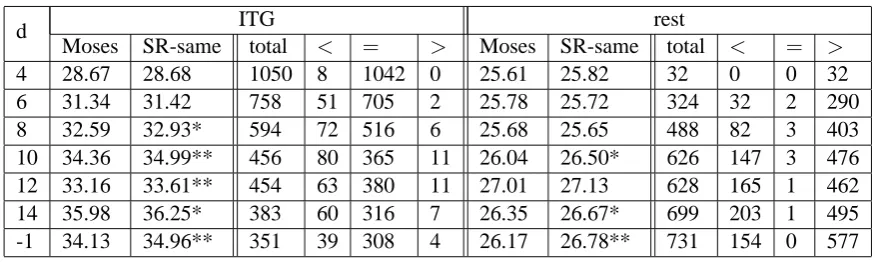
ITG rest d
Moses SR-same total < = > Moses SR-same total < = >
4 28.67 28.68 1050 8 1042 0 25.61 25.82 32 0 0 32
6 31.34 31.42 758 51 705 2 25.78 25.72 324 32 2 290
8 32.59 32.93* 594 72 516 6 25.68 25.65 488 82 3 403
10 34.36 34.99** 456 80 365 11 26.04 26.50* 626 147 3 476
12 33.16 33.61** 454 63 380 11 27.01 27.13 628 165 1 462
14 35.98 36.25* 383 60 316 7 26.35 26.67* 699 203 1 495
-1 34.13 34.96** 351 39 308 4 26.17 26.78** 731 154 0 577
Table 2: Search ability comparison. The ITG set and the rest set of NIST05 were tested, respectively. On the ITG set, the following six factors are reported from left to right: BLEU score of Moses, BLEU score of SR-same, the number of sentences in the ITG set, the number of sentences the translation probabilities of which computed by Moses, compared to that computed by SR, is lower, equal and greater. The rest set goes similarly. *: significance at the .05 level, **: significance at the .01 level.
limit. While SR-same decoder only gets better re-sults on the ITG set with all distortion limit. This may result from the use of the linear distortion feature. Moses may generate hypotheses the dis-tortion of which is forbidden in the shift-reduce decoder. This especially sharpens on the rest set. So SR-same may suffer from an improper linear distortion parameter.
The search ability of Moses and the shift-reduce decoder are evaluated, too. The translation must be produced with the same set of parameters. In our experiments, we employed the parameters tuned by Moses. The test was done on the ITG and the rest set, respectively. The results are shown in Table 2. As the distortion limit becomes greater, the number of the ITG-legal translation generated by Moses becomes smaller. On the ITG set, trans-lation probabilities from the shift-reduce decoder is either greater or equal to that from Moses on most sentences, and BLEU scores of shift-reduce decoder is greater than that of Moses with all distortion limit. Although the search space of shift-reduce decoder is smaller than that of Moses, shift-reduce decoder can give the translation that Moses can not reach. On the rest set, for most sen-tences, the translation probabilities from Moses is greater than that from shift-reduce decoder. But only when distortion limit is 6 and 8, the BLEU score of Moses is greater than that of the shift-reduce decoder. We may conclude that greater score does not certainly lead to greater BLEU score.
5 Conclusions and Future Work
In this paper, we present a shift-reduce decod-ing algorithm for phrase-based translation model that can generate the ITG-legal translation in lin-ear time. The algorithm need not consider shift-reduce divergence and performs shift-reduce operation as soon as possible. We compare the performance of the shift-reduce decoder with the state-of-the-art decoder Moses. Experiment results show that the shift-reduce algorithm can improve both the accuracy and the speed significantly on different test sets. We further analyze the performance and find that on the ITG set, the shift-reduce decoder is superior over Moses in terms of accuracy, speed and search ability, while on the rest set, it does not display advantage, suffering from improper parameters.
Next, we will extend the shift-reduce algorithm to syntax-based translation models, to see whether it works.
6 Acknowledgement
References
Collins, Michael, Philipp Koehn, and Ivona Kucerova. 2005. Clause restructuring for statistical machine translation. In Proc. of ACL, pages 531–540.
Galley, Michel and Christopher D. Manning. 2008. A simple and effective hierarchical phrase reordering model. In Proc. of EMNLP, pages 848–856.
Huang, Liang and David Chiang. 2005. Better k-best parsing. In Proceedings of the Ninth International Workshop on Parsing Technologies (IWPT), pages 53–64.
Knight, Kevin. 1999. Decoding complexity in word-replacement translation models. Computational Linguistics, 25:607–615.
Koehn, Philipp, Hieu Hoang, Alexandra Birch Mayne, Christopher Callison-Burch, Marcello Federico, Nicola Bertoldi, Brooke Cowan, Wade Shen, Chris-tine Moran, Richard Zens, Chris Dyer, Ondrej Bo-jar, Alexandra Constantin, and Evan Herbst. 2007. Moses: Open source toolkit for statistical machine translation. In Proc. of the 45th ACL, Demonstra-tion Session.
Koehn, Philipp. 2004. Pharaoh: A beam search de-coder for phrased-based statistical machine transla-tion. In Proc. of AMTA, pages 115–124.
Och, Frans J., Christoph Tillmann, and Hermann Ney. 1999. Improved alignment models for statistical machine translation. In Proc. of EMNLP, pages 20– 28.
Och, Frans J. 2003. Minimum error rate training in statistical machine translation. In Proc. of ACL, pages 160–167.
Tillmann, Chirstoph and Hermann Ney. 2003.
Word reordering and a dynamic programming beam search algorithm for statistical machine translation. Computational Linguistics, 29:97–133.
Wu, Dekai. 1996. A polynomial-time algorithm for statistical machine translation. In Proc. of ACL, pages 152–158.
Wu, Dekai. 1997. Stochastic inversion transduction grammars and bilingual parsing of parallel corpora. Computational Linguistics, 23:377–403.
Xiong, Deyi, Qun Liu, and Shouxun Lin. 2006. Maxi-mum entropy based phrase reordering model for sta-tistical machine translation. In Proc. of ACL, pages 521–528.
Zens, Richard and Hermann Ney. 2003. A compara-tive study on reordering constraints in statistical ma-chine translation. In Proc. of ACL, pages 144–151.