Streaming Cross Document Entity Coreference Resolution
Delip Rao and Paul McNamee and Mark Dredze
Human Language Technology Center of Excellence Center for Language and Speech Processing
Johns Hopkins University
delip,mcnamee,[email protected]
Abstract
Previous research in cross-document en-tity coreference has generally been re-stricted to the offline scenario where the set of documents is provided in advance. As a consequence, the dominant approach is based on greedy agglomerative cluster-ing techniques that utilize pairwise vec-tor comparisons and thus require O(n2)
space and time. In this paper we ex-plore identifying coreferent entity men-tions across documents in high-volume streaming text, including methods for uti-lizing orthographic and contextual infor-mation. We test our methods using several corpora to quantitatively measure both the efficacy and scalability of our streaming approach. We show that our approach scales to at least an order of magnitude larger data than previous reported meth-ods.
1 Introduction
A key capability for successful information ex-traction, topic detection and tracking, and ques-tion answering is the ability to identify equiva-lence classes of entity mentions. An entity is a real-world person, place, organization, or object, such as the person who serves as the 44th pres-ident of the United States. An entity mention is a string which refers to such an entity, such as “Barack Hussein Obama”, “Senator Obama” or “President Obama”. The goal of coreference res-olution is to identify and connect all textual entity mentions that refer to the same entity.
The first step towards this goal is to identify all references within the same document, or within document coreference resolution. A document of-ten has a leading canonical reference to the entity
(“Barack Obama”) followed by additional expres-sions for the same entity (“President Obama.”) An intra-document coreference system must first identify each reference, often relying on named entity recognition, and then decide if these refer-ences refer to a single individual or multiple enti-ties, creating acoreference chainfor each unique entity. Feature representations include surface form similarity, lexical context of mentions, po-sition in the document and distance between ref-erences. A variety of statistical learning meth-ods have been applied to this problem, including use of decision trees (Soon et al., 2001; Ng and Cardie, 2002), graph partitioning (Nicolae and Nicolae, 2006), maximum-entropy models (Luo et al., 2004), and conditional random fields (Choi and Cardie, 2007).
Given pre-processed documents, in which enti-ties have been identified and entity mentions have been linked into chains, we seek to identify across an entire document collection all chains that re-fer to the same entity. This task is called cross document coreference resolution (CDCR). Sev-eral of the challenges associated with CDCR dif-fer from the within document task. For example, it is unlikely that the same document will discuss John Phillips the American football player and John Phillips the musician, but it is quite proba-ble that documents discussing each will appear in the same collection. Therefore, while matching entities with the same mention string can work well for within document coreference, more so-phisticated approaches are necessary for the cross document scenario where a one-entity-per-name assumption is unreasonable.
Yarowsky, 2003; Gooi and Allan, 2004; Chen and Martin, 2007). These algorithms creates a O(n2) dependence in the number of mentions – for within document – anddocuments– for cross document. This is a reasonable limitation for within document, since the number of references will certainly be small; we are unlikely to en-counter a document with millions of references. In contrast to the small n encountered within a document, we fully expect to run a CDCR sys-tem on hundreds of thousands or millions of doc-uments. Most previous approaches cannot handle collections of this size.
In this work, we present a new method for cross document coreference resolution that scales to very large corpora. Our algorithm operates in astreamingsetting, in which documents are pro-cessed one at a time and only a single time. This creates a linear (O(n)) dependence on the
num-ber of documents in the collection, allowing us to scale to millions of documents and millions of unique entities. Our algorithm uses stream-ing clusterstream-ing with common coreference similar-ity computations to achieve large scale. Further-more, our method is designed to support both name disambiguation and name variation.
In the next section, we give a survey of related work. In Section 3 we detail our streaming setup, giving a description of the streaming algorithm and presenting efficient techniques for represent-ing clusters over streams and for computrepresent-ing simi-larity. Section 4 describes the data sets on which we evaluate our methods and presents results. We conclude with a discussion and description of on-going work.
2 Related Work
Traditional approaches to cross document coref-erence resolution have first constructed a vector space representation derived from local (or global) contexts of entity mentions in documents and then performed some form of clustering on these vec-tors. This is a simple extension of Firth’s distribu-tional hypothesis applied to entities (Firth, 1957). We describe some of the seminal work in this area. Some of the earliest work in CDCR was by Bagga and Baldwin (1998). Key contributions of their research include: promotion of a
set-theoretic evaluation measure, B-CUBED; intro-duction of a data set based on 197 New York Times articles which mention a person named John Smith; and, use of TF/IDF weighted vec-tors and cosine similarity in single-link greedy ag-glomerative clustering.
Mann and Yarowsky (2003) extended Bagga and Baldwin’s work and contributed several inno-vations, including: use of biographical attributes (e.g.,year of birth, occupation), and evaluation us-ingpseudonames. Pseudonames are sets of artifi-cially conflated names that are used as an efficient method for producing a set of gold-standard dis-ambiguations.1 Mann and Yarowsky used 4 pairs
of conflated names in their evaluation. Their sys-tem did not perform as well on named entities with little available biographic information.
Gooi and Allan (2004) expanded on the use of pseudonames by semi-automatically creating a much larger evaluation set, which they called the ’Person-X’ corpus. They relied on automated named-entity tagging and domain-focused text re-trieval. This data consisted of 34,404 documents where a single person mention in each document was rewritten as ’Person X’. Besides their novel construction of a large-scale resource, they in-vestigated several minor variations in clustering, namely (a) use of Kullback-Leibler divergence as a distance measure, (b) use of 55-word snippets around entity mentions (vs. entire documents or extracted sentences), and (c) scoring clusters us-ing average-link instead of sus-ingle- or complete-link.
Finally, in more recent work, Chen and Martin (2007) explore the CDCR task in both English and Chinese. Their work focuses on use of both lo-cal, and document-level noun-phrases as features in their vector-space representation.
There have been a number of open evaluations of CDCR systems. For example, the Web People Search (WePS) workshops (Artiles et al., 2008) have created a task for disambiguating personal names from HTML pages. A set of ambiguous names is chosen and each is submitted to a popular web search engine. The top 100 pages are then manually clustered.We discuss several other data
1See Sanderson (2000) for use of this technique in word
sets in Section 4.2
All of the papers mentioned above focus on dis-ambiguating personal names. In contrast, our sys-tem can also handle organizations and locations. Also, as was mentioned earlier, we are commit-ted to a scenario where documents are presencommit-ted in sequence and entities must be disambiguated instantly, without the benefit of observing the en-tire corpus. We believe that such a system is bet-ter suited to highly dynamic environments such as daily news feeds, blogs, and tweets. Additionally, a streaming system exposes a set of known entity clusters after each document is processed instead of waiting until the end of the stream.
3 Approach
Our cross document coreference resolution sys-tem relies on a streaming clustering algorithm and efficient calculation of similarity scores. We assume that we receive a stream of corefer-ence chains, along with entity types, as they are extracted from documents. We use SERIF (Ramshaw and Weischedel, 2005), a state of the art document analysis system which performs intra-document coreference resolution. BBN de-veloped SERIF to address information extraction tasks in the ACE program and it is further de-scribed in Pradhan et al. (2007).
Each unique entity is represented by an entity cluster c, comprised of entity chains from many
documents that refer to the same entity. Given an entity coreference chaine, we identify the best
known entity clusterc. If a suitable entity cluster
is not found, a new entity cluster is formed. An entity cluster is selected for a given corefer-ence chain using several similarity scores, includ-ing document context, predicted entity type, and orthographic similarity between the entity men-tion and previously discovered references in the entity cluster. An efficient implementation of the similarity score allows the system to identify the topkmost likely mentions without considering all m entity clusters. The final output of our
sys-tem is a collection of entity clusters, each con-taining a list of coreference chains and their doc-uments. Additionally, due to its streaming nature,
2We preferred other data sets to the WePS data in our
evaluation because it is not easily placed in temporal order.
the system can be examined at any time to produce this information based on only the documents that have been processed thus far.
In the next sections, we describe both the clus-tering algorithm and efficient computation of the entity similarity scores.
3.1 Clustering Algorithm
We use a streaming clustering algorithm to cre-ate entity clusters as follows. We observe a set of points from a potentially infinite setX, one at a time, and would like to maintain a fixed number of clusters while minimizing the maximumcluster radius, defined as the radius of the smallest ball containing all points of the cluster. This setup is well known in the theory and information retrieval community and is referred to as the dynamic clus-tering problem (Can and Ozkarahan, 1987).
Others have attempted to use an incremen-tal clustering approach, such as Gooi and Al-lan (2004) (who eventually prefer a hierarchi-cal clustering approach), and Luo et al. (2004), who use a Bell tree approach for incrementally clustering within document entity mentions. Our work closely follows theDoubling Algorithm of Charikar et al. (1997), which has better perfor-mance guarantees for streaming data. Streaming clustering means potentially linear performance in the number of observations since each document need only be examined a single time, as opposed to the quadratic cost of agglomerative clustering.3
The Doubling Algorithm consists of two stages: update and merge. Update adds points to existing clusters or creates new clusters while merge com-bines clusters to prevent the clusters from exceed-ing a fixed limit. New clusters are created accord-ing to a threshold set usaccord-ing development data. We selected a threshold of0.5since it worked well in
preliminary experiments. Since the number of en-tities grows with time, we have skipped the merge step in our initial experiments so as not to limit cluster growth.
We use a dynamic caching scheme which backs the actual clusters in a disk based index, but
re-3It is possible to implement hierarchical agglomerative
clustering in O(nlogm) time where n is the number of
points andmin the number of clusters. However this is still
superlinear and expensive in situations wheremcontinually
1 2 3 4 5 6
log(Rank)
0.5 0.0 0.5 1.0 1.5 2.0 2.5 3.0 3.5 4.0
log(Frequency)
PER LOC ORG
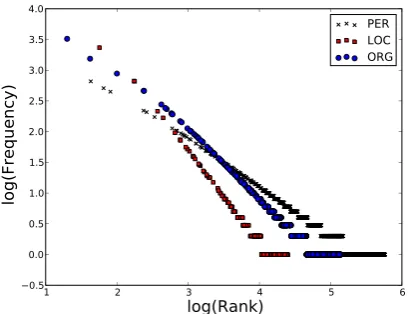
Figure 1: Frequency vs. rank for 567k people, 136k organizations, and 25k locations in the New York Times Annotated Corpus (Sandhaus, 2008).
tains basic cluster information in memory (see be-low). Doing so improves paging performance as observed in Omiecinski and Scheuermann (1984). Motivated by the Zipfian distribution of named en-tities in news sources (Figure 1), we organize our cluster store using an LRU policy, which facili-tates easy access to named entities that were ob-served in the recent past. We obtain additional performance gains by hashing the clusters based on the constituent mention string (details below). This allows us to quickly retrieve a small but re-lated number of clusters,k. It is always the case
thatk << m, the current number of clusters.
3.2 Candidate Cluster Selection
As part of any clustering algorithm, each new item must be compared against current clusters. As we see more documents, the number of unique clus-ters (entities) grows. Therefore, we need efficient methods to select candidate clusters.
To select the top candidate clusters, we obtain those that have high orthographic similarity with the head name mention in the coreference chaine.
We compute this similarity using the dice score on either word unigrams or character skip bigrams. For each entity mention string associated with a clusterc, we generate all possible n-grams using one of the above two policies. We then index the cluster by each of its n-grams in a hash maintained in memory. In addition, we keep the number of
n-grams generated for each cluster.
When given a new head mentionefor a
coref-erence chain, we generate all of the n-grams and look up clusters that contain these n-grams using the hash. We then compute the dice score:
dice(e, c) = |{ngram(e)} ∩ {ngram(c)}| |{ngram(e)} ∪ {ngram(c)}| ,
where{ngram(e)}are the set of n-grams in entity
mentioneand{ngram(c)}are the set of n-grams
for all entity mentions in clusterc. Note that we
can calculate the numerator (the intersection) by looking up the n-grams ofein the hash and
count-ing matches withc. The denominator is equivalent
to the number of n-grams unique toeand tocplus
the number that are shared. The number that are shared is the intersection. The number unique to
eis the total number of n-grams ineminus the
in-tersection. The final term, the number unique toc,
is computed by taking the total number of n-grams inc(a single integer stored in memory) minus the
intersection.
Through this strategy, we can select only those clusters that have the highest orthographic simi-larity toewithout requiring the cluster contents,
which may not be stored in memory. In our exper-iments, we evaluate settings where we select all candidates with non-zero score and a pruned set of the topkdice score candidates. We also include in the n-gram list known aliases to facilitate or-thographically dissimilar, but reasonable matches (e.g., IBM or ‘Big Blue’ for ‘International Busi-ness Machines, Inc.’).4
For further efficiency, we keep separate caches for each named entity type.5 We then select the
appropriate cache based on the automatically de-termined type of the named entity provided by the named entity tagger, which also prevents spurious matches of non-matching entity types.
3.3 Similarity Metric
After filtering by orthographic information to quickly obtain a small set of candidate clusters, a full similarity score is computed for the current
4We generated alias lists for entities from Freebase. 5Persons (PER), organizations (ORG), and locations
entity coreference chain and each retrieved can-didate cluster. These computations require infor-mation about each cluster, so the cluster’s suffi-cient statistics are loaded using the LRU cache de-scribed above.
We define several similarity metrics between coreference chains and clusters to deal with both name variation and disambiguation. For name variation, we define an orthographic similarity metric to match similar entity mention strings. As before, we use word unigrams and character skip bigrams. For each of these methods, we compute a similarity score as dice(e, c)and select the
high-est scoring cluster.
To address name disambiguation, we use two types of context from the document. First, we use lexical features represented as TF/IDF weighted vectors. Second, we consider topic features, in which each word in a document is replaced with the topic inferred from a topic model. This yields a distribution over topics for a given document. We use an LDA (Blei et al., 2003) model trained on the New York Times Annotated Corpus (Sand-haus, 2008). We note that LDA can be computed over streams (Yao et al., 2009).
To compare context vectors we use cosine sim-ilarity, where the cluster vector is the average of all document vectors assigned to the cluster. Note that the filtering step in Section 3.2 returns only those candidates with some orthographic similar-ity with the coreference chain, so a similarsimilar-ity met-ric that uses context only is still restmet-ricted to ortho-graphically similar entities.
Finally, we consider a combination of ortho-graphic and context similarity as a linear combi-nation of the two metrics as:
score(e, c) =αdice(e, c) + (1−α)cosine(e, c).
We setα= 0.8based on initial experiments.
4 Evaluation
We used several corpora to evaluate our meth-ods, including two data sets commonly used in the coreference community. We also created a new test set using artificially conflated names. And fi-nally to test scalability, we ran our algorithm over a large text collection that, while it did not have
Attribute smith nytac ace08 kbp09 Total Documents 197 1.85M 10k 1.2M Annotated Docs 197 19,360 415 ** Annotated Entities 35 200 3,943 **
Table 1: Data sets used in our experiments. For thekbp09data we did not have annotations.
ground truth entity clusters, was useful for com-puting other performance statistics. Properties for each data set are given in Table 1.
4.1 John Smith corpus
Bagga and Baldwin (1998) evaluated their disam-biguation system on a set of 197 articles from the New York Times that mention a person named ’John Smith’. This data exhibits no name variants and is strictly a disambiguation task. We include this data (smith) to allow comparison to previous work.
4.2 NYTAC Pseudo-name corpus
To study the effects of word sense ambiguity and disambiguation several researchers have ar-tificially conflated dissimilar words together and then attempted to disambiguate them (Sanderson, 2000). The obvious advantage is cheaply obtained ground truth for disambiguation.
The same trick has also been employed in per-son name disambiguation (Mann and Yarowsky, 2003; Gooi and Allan, 2004). We adopt the same method on a somewhat larger scale using annota-tions from the New York Times Annotated Corpus (NYTAC) (Sandhaus, 2008), which annotates doc-uments based on whether or not they mention an entity. The NYTAC data contains documents from 20 years of the New York Times and contains rich metadata and document-level annotations that in-dicate when an entity is mentioned in the docu-ment using a standard lexicon of entities. (Note that mention strings are not tagged.) Using these annotations we created a set of 100 pairs of con-flated person names.
smith nytac ace08
Approach P R F P R F P R F
Baseline 1.000 0.178 0.302 1.000 0.010 0.020 1.000 0.569 0.725 ExactMatch 0.233 1.000 0.377 0.563 0.897 0.692 0.977 0.697 0.814 Ortho 0.603 0.629 0.616 0.611 0.784 0.687 0.975 0.694 0.811 BoW 0.956 0.367 0.530 0.930 0.249 0.349 0.989 0.589 0.738 Topic 0.847 0.592 0.697 0.815 0.244 0.363 0.983 0.605 0.750 Ortho+BoW 0.603 0.634 0.618 0.801 0.601 0.686 0.976 0.691 0.809 Ortho+Topic 0.603 0.634 0.618 0.800 0.591 0.680 0.975 0.704 0.819
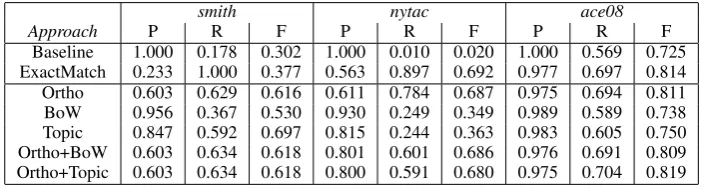
Table 2: BestB3performance on thesmith,nytac, andace08test sets.
US politicians). We imagined that this would be a more challenging subset because of presumed lexical overlap. The second set of 50 name pairs were arbitrarily conflated. We sub-selected the data to ensure that no two entities in our collec-tion co-occur in the same document and this left us with 19,360 documents for which ground-truth was known. In each document we rewrote the conflated name mentions using a single gender-neutral name; any middle initials or names were discarded.
4.3 ACE 2008 corpus
The NIST ACE 2008 (ace08) evaluation studied several related technologies for information ex-traction, including named-entity recognition, re-lation extraction, and cross-document coreference for person names in both English and Arabic. Ap-proximately 10,000 documents from several gen-res (predominantly newswire) were given to par-ticipants, who were expected to cluster person and organization entities across the entire collection. However, only a selected set of about 400 docu-ments were annotated and used to evaluate sys-tem performance. Baron and Freedman (2008) describe their work in this evaluation, which in-cluded a separate task for within-document coref-erence.
4.4 TAC-KBP 2009 corpus
The NIST TAC 2009 Knowledge Base Popula-tion track (kbp09) (McNamee and Dang, 2009) conducted an evaluation of a system’s ability to link entity mentions to corresponding Wikipedia-derived knowledge base nodes. The TAC-KBP task focused on ambiguous person, organization, and geo-political entities mentioned in newswire, and required systems to cope with name variation
(e.g., “Osama Bin Laden” / “Usama Bin Laden” or “Mark Twain” / “Samuel Clemens”) as well as name disambiguation. Furthermore, the task re-quired detection of when no appropriate KB entry exists, which is a departure from the conventional disambiguation problem. The collection contains over 1.2 million documents, primarily newswire. Wikipedia was used as a surrogate knowledge base, and it has been used in several previous stud-ies (e.g.,Cucerzan (2007)). This task is closely re-lated to CDCR, as mentions that are aligned to the same knowledge base entry create a coreference cluster. However, there are no actual CDCR anno-tations for this corpus, though we used it nonethe-les as a benchmark corpus to evaluate speed and to demonstrate scalability.
5 Discussion
5.1 Accuracy
In Table 2 we report cross document coreference resolution performance for a variety of experi-mental conditions using the B3 method, which includes precision, recall, and calculated Fβ=1 values. For each of the three evaluation corpora (smith,nytac, andace08) we report values for two baseline methods and for similarity metrics us-ing different types of features. The first baseline, calledBaseline, places each coreference chain in its own cluster while the second baseline, called ExactMatch, merges all mentions that match ex-actly orthographically into the same cluster.
Use of name similarity scores as features (in ad-dition to their use for candidate cluster selection) is indicated by rows labeledOrtho. Use of lexi-cal features is indicated byBoW and use of topic model features byTopic.
#coref chains Baseline ExactMatch Ortho BOW Topics Ortho+BOW Ortho+Topics
1000 702 699 925 857 699 697
10000 4563 4530 7964 7956 4514 4518
20000 8234 8202 15691 15073 8159 8163
30000 11745 11682 23138 21878 11608 11611
40000 15041 14964 30900 28500 14869 14863
50000 18110 18016 38248 34758 17910 17903
60000 20450 20377 44735 40081 20241 20228
70000 22845 22780 51190 45722 22615 22603
80000 25062 25026 57440 51104 24832 24818
90000 27389 27358 64140 56581 27145 27126
100000 29797 29782 71034 62228 29546 29511
110000 32147 32139 77705 67853 31882 31840
120000 34567 34589 84309 73397 34284 34235
130000 36817 36874 90465 78676 36543 36486
140000 38826 38901 96225 83525 38539 38482
0 37500 75000 112500 150000
1K 20K 40K 60K 80K 100K 120K 140K
# of clusters pr
oduced
# of entity chains seen
Baseline ExactMatch
Ortho BOW
Topics Ortho+BOW
Ortho+Topics
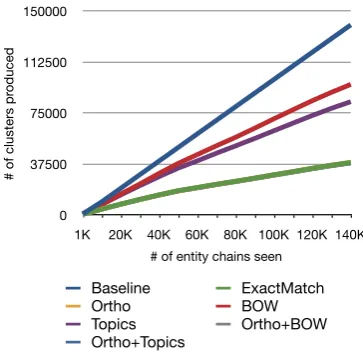
Figure 2: Number of clusters produced vs. num-ber of entity chains observed in the stream. Num-ber of entity chains is proportional to the numNum-ber of documents.
When used alone topic beats BoW, but in com-bination with the ortho features performance is equivalent. For both nytac andace08 heavy re-liance on orthographic similarity proved hard to beat. On the ace08corpus Baron and Freedman (2008) reportB3F-scores of 83.2 for persons and
67.8 for organizations, and our streaming results appear to be comparable to their offline method.
The cluster growth induced by the various mea-sures can be seen in Figure 2. The two base-line methods, Baseline andExactMatch, provide bounds on the cluster growth with all other meth-ods falling in between.
5.2 Hashing Strategies for Candidate Selection
Table 3 containsB3F-scores when different
hash-ing strategies are employed for candidate selec-tion. The trend appears to be that stricter match-ing outperforms fuzzier matchmatch-ing; full mentions tended to beat words, which beat use of the char-acter bigrams. This agrees with the results de-scribed in the previous section, which show heavy reliance on orthographic similarity.
5.3 Timing Results
Figure 3 shows how processing time increases with the number of entities observed in theace08
#chains 1 5 10 20
100000 20 49 67 127
101000 21 50 68 129
102000 21 51 69 131
103000 22 52 70 133
104000 23 53 71 136
105000 24 54 72 138
106000 25 55 73 140
107000 25 56 74 142
108000 26 57 75 144
109000 27 58 76 146
110000 28 59 77 148
111000 28 60 78 150
112000 29 61 79 153
113000 30 62 80 156
114000 31 63 81 158
115000 32 64 83 161
116000 33 66 84 163
117000 34 67 85 165
118000 35 68 86 167
119000 36 69 87 169
120000 37 70 88 171
121000 38 71 90 174
122000 39 72 92 177
123000 40 73 93 179
124000 41 74 94 181
125000 42 75 95 183
126000 43 76 96 186
127000 44 77 99 188
128000 45 78 100 191
129000 46 79 101 196
130000 47 80 102 198
131000 48 81 103 201
132000 49 82 104 204
133000 50 83 105 207
134000 51 84 106 210
135000 52 85 107 214
136000 53 86 109 217
137000 54 87 110 219
138000 55 89 112 222
1 10 100 1000
1000 25000 49000 73000 97000 121000
Time (secs)
# of chains processed
1 5 10 20
Figure 3: Elapsed processing time as a function of bounding the number of candidate clusters consid-ered for an entity. When fewer candidates are con-sidered, clustering decisions can be made much faster.
document stream. We experimented with using an upper bound on the number of candidate clusters to consider for an entity.
Figure 4 compares the efficiency of using three different methods for candidate cluster identifica-tion. The most restrictive hashing strategy, using exact mention strings, is the most efficient, fol-lowed by the use of words, then the use of charac-ter skip bigrams. This makes intuitive sense – the strictest matching reduces the number of candi-date clusters that have to be considered when pro-cessing an entity.6
The ace08 corpus contained over 10,000 doc-uments and is one of the largest CDCR test sets. In Figure 5 we show how processing time grows when processing thekbp09corpus. Doubling the number of entities processed increases the runtime by about a factor of 5. The curve is not linear due to the increasing number of entity cluster’s that must be considered. Future work will exam-ine how to keep the number of clusters considered constant over time, such as ignoring older entities.
6 Conclusion
We have presented a new streaming cross doc-ument coreference resolution system. Our ap-proach is substantially faster than previous
sys-6In the limit, if names were unique, hashing on strings
would completely solve the CDCR problem and processing an entity would be O(1)
smith nytac ace08
Approach bigrams words mention bigrams words mention bigrams words mention Ortho 0.382 0.553 0.616 0.120 0.695 0.687 0.540 0.797 0.811
BoW 0.480 0.530 0.467 0.344 0.339 0.349 0.551 0.700 0.738 Topic 0.697 0.661 0.579 0.071 0.620 0.363 0.544 0.685 0.750 Ortho+BoW 0.389 0.554 0.618 0.340 0.691 0.686 0.519 0.783 0.809 Ortho+Topic 0.398 0.555 0.618 0.120 0.477 0.680 0.520 0.776 0.819
Table 3:B3F-scores using different hashing strategies for candidate selection. Name/cluster similarity
could be based on character skip bigrams, words appear in names, or exact matching of mention.
#chains mention string word bigram
1000 2 1 1
36000 26 51 100
37000 26 53 104
38000 27 55 108
39000 27 57 112
40000 28 59 117
41000 29 63 121
42000 30 66 125
43000 31 70 129
44000 33 73 133
45000 34 77 137
46000 35 80 142
47000 36 84 146
48000 36 87 150
49000 38 90 154
50000 39 94 158
51000 40 98 162
52000 41 101 167
53000 42 104 171
54000 44 107 175
55000 45 111 179
56000 46 115 183
57000 48 119 187
58000 49 122 192
59000 49 126 196
60000 50 130 200
61000 51 134 204
62000 52 139 208
63000 53 143 212
64000 56 146 217
65000 57 150 222
66000 59 155 227
67000 60 158 232
68000 62 163 237
69000 62 167 242
70000 63 170 247
71000 65 173 252
72000 66 178 257
73000 67 183 262
74000 67 186 267
75000 68 191 273
76000 69 194 277
77000 70 198 282
78000 70 202 287
79000 71 207 292
80000 72 211 297
81000 73 215 302
82000 73 219 307
83000 74 224 312
84000 74 229 317
85000 75 233 322
86000 76 238 328
87000 77 243 333
88000 77 246 338
89000 78 250 343
90000 78 254 348
91000 79 258 353
92000 80 262 358
93000 80 268 363
94000 81 273 368
95000 82 277 373
96000 82 281 378
97000 83 284 384
98000 84 288 389
99000 84 293 394
100000 85 297 400
101000 85 300 406
102000 85 303 413
103000 85 307 419
104000 85 310 425
105000 86 314 431
106000 87 319 438
107000 89 325 444
108000 90 330 450
109000 91 334 456
110000 91 339 463
111000 92 343 469
112000 92 348 476
113000 93 352 482
114000 94 357 489
115000 95 362 495
116000 95 366 501
117000 96 369 507
118000 96 373 513
119000 96 377 520
120000 97 382 526
121000 97 387 532
122000 100 392 539
123000 100 395 546
124000 101 399 552
125000 101 403 558
126000 102 408 564
127000 102 412 571
128000 103 417 577
129000 104 421 583
130000 104 425 589
131000 105 430 596
132000 106 435 602
133000 108 441 609
134000 109 446 615
135000 111 452 622
136000 112 457 628
137000 113 461 634
138000 113 467 640
1 10 100 1000
1000 25000 49000 73000 97000 121000
Time (secs)
# of coref chains processed
mention string word bigram
Figure 4: Comparison of three hashing strategies for identifying candidate clusters for a given en-tity. The more restrictive strategies lead to faster processing as fewer candidates are considered.
tems, and our experiments have demonstrated scalability to an order of magnitude larger data than previously published evaluations. Despite its speed and simplicity, we still obtain competitive results on a variety of data sets as compared with batch systems. In future work, we plan to investi-gate additional similarity metrics that can be com-puted efficiently, as well as experiments on web scale corpora.
References
Artiles, Javier, Satoshi Sekine, and Julio Gonzalo. 2008. Web people search: results of the first evalua-tion and the plan for the second. InWorld Wide Web (WWW).
Bagga, Amit and Breck Baldwin. 1998. Entity-based cross-document coreferencing using the
vec-tor space model. InConference on Computational
Linguistics (COLING).
Baron, Alex and Marjorie Freedman. 2008. Who
#coref chains processed Time (secs)
1K 1.5
1K 100K 200K 400K 600K 900K 1.1M
Time (secs)
# of coref chains processed
Figure 5: The number of coreference chains pro-cessed over time in thekbp09 corpus. The pro-cessing of over 1 million coreference chains is at least an order of magnitude larger than previous systems reported.
is Who and What is What: Experiments in
cross-document co-reference. In Empirical Methods in
Natural Language Processing (EMNLP).
Blei, D.M., A.Y. Ng, and M.I. Jordan. 2003. Latent
dirichlet allocation. Journal of Machine Learning
Research (JMLR), 3:993–1022.
Can, F. and E. Ozkarahan. 1987. A dynamic clus-ter maintenance system for information retrieval. In
Conference on Research and Development in Infor-mation Retrieval (SIGIR).
Charikar, Moses, Chandra Chekuri, Tom´as Feder, and Rajeev Motwani. 1997. Incremental clustering and
dynamic information retrieval. InACM Symposium
on Theory of Computing (STOC).
Chen, Ying and James Martin. 2007. Towards ro-bust unsupervised personal name disambiguation. In Empirical Methods in Natural Language Pro-cessing (EMNLP).
Choi, Y. and C. Cardie. 2007. Structured local training and biased potential functions for conditional ran-dom fields with application to coreference
resolu-tion. InNorth American Chapter of the Association
for Computational Linguistics (NAACL), pages 65– 72.
Cucerzan, Silviu. 2007. Large-scale named entity
disambiguation based on wikipedia data. In
Em-pirical Methods in Natural Language Processing (EMNLP), pages 708–716.
Firth, J.R. 1957. A synopsis of linguistic theory 1930-1955. InStudies in Linguistic Analysis, pages 1–32. Oxford: Philological Society.
Gooi, Chung Heong and James Allan. 2004. Cross-document coreference on a large scale corpus. In
North American Chapter of the Association for Computational Linguistics (NAACL).
Luo, X., A. Ittycheriah, H. Jing, N. Kambhatla, and S. Roukos. 2004. A mention-synchronous corefer-ence resolution algorithm based on the bell tree. In
Association for Computational Linguistics (ACL).
Mann, Gideon S. and David Yarowsky. 2003.
Unsu-pervised personal name disambiguation. In
Confer-ence on Natural Language Learning (CONLL).
McNamee, Paul and Hoa Dang. 2009. Overview of the TAC 2009 knowledge base population track. In
Text Analysis Conference (TAC).
Ng, V. and C. Cardie. 2002. Improving machine
learn-ing approaches to coreference resolution. In
Asso-ciation for Computational Linguistics (ACL), pages 104–111.
Nicolae, C. and G. Nicolae. 2006. Bestcut: A
graph algorithm for coreference resolution. In
Em-pirical Methods in Natural Language Processing (EMNLP), pages 275–283. Association for Compu-tational Linguistics.
Omiecinski, Edward and Peter Scheuermann. 1984. A global approach to record clustering and file
reorga-nization. InConference on Research and
Develop-ment in Information Retrieval (SIGIR).
Pradhan, S.S., L. Ramshaw, R. Weischedel,
J. MacBride, and L. Micciulla. 2007.
Unre-stricted coreference: Identifying entities and events
in ontonotes. In International Conference on
Semantic Computing (ICSC).
Ramshaw, L. and R. Weischedel. 2005. Information extraction. InIEEE ICASSP.
Sanderson, Mark. 2000. Retrieving with good sense.
Information Retrieval, 2(1):45–65.
Sandhaus, Evan. 2008. The new york times annotated corpus. Linguistic Data Consortium, Philadelphia.
Soon, Wee Meng, Hwee Tou Ng, and Daniel Chung Yong Lim. 2001. A machine learning ap-proach to coreference resolution of noun phrases.
Computational Linguistics.
Yao, L., D. Mimno, and A. McCallum. 2009. Effi-cient methods for topic model inference on
stream-ing document collections. InKnowledge discovery