Looking for Trouble
Stijn De Saeger Kentaro Torisawa Language Infrastructure Group National Institute of Information and Communications Technology {stijn,torisawa}@nict.go.jp
Jun’ichi Kazama School of Information Science
Japan Advanced Institute of Science and Technology
Abstract
This paper presents a method for mining potential troubles or obstacles related to the use of a given object. Some exam-ple instances of this relation arehmedicine,
side effecti and hamusement park, height restrictioni. Our acquisition method con-sists of three steps. First, we use an un-supervised method to collect training sam-ples from Web documents. Second, a set of expressions generally referring to trou-bles is acquired by a supervised learning method. Finally, the acquired troubles are associated with objects so that each of the resulting pairs consists of an ob-ject and a trouble or obstacle inusingthat object. To show the effectiveness of our method we conducted experiments using a large collection of Japanese Web doc-uments for acquisition. Experimental re-sults show an 85.5% precision for the top 10,000 acquired troubles, and a 74% pre-cision for the top 10% of over 60,000 ac-quired object-trouble pairs.
1 Introduction
The Stanford Encyclopedia of Philosophy defines an artifact as “. . . an object that has been inten-tionally made or produced for a certain purpose”. Because of this purpose-orientedness, most human actions relating to an object or artifact fall into two broad categories — actions relating to its in-tended use (e.g. reading a book), and the prepa-rations necessary therefore (likebuying the book). Information concerning potential obstacles, harm-ful effects or troubles that interfere with this in-tended use is therefore highly relevant to the user.
c
2008. Licensed under the Creative Commons Attribution-Noncommercial-Share Alike 3.0 Unported li-cense (http://creativecommons.org/licenses/by-nc-sa/3.0/). Some rights reserved.
While some such troubles are self-evident, others represent a genuine obstacle whose existence was thusfar unknown to the user. For example, in early 2008 a food poisoning case caused a big media stir in Japan when dozens of people fell ill after eating Chinese-imported frozen food products containing residual traces of toxic pesticides. While suppos-edly the presence of toxic chemicals in imported frozen foods had already been established on sev-eral occasions before, until the recent incidents public awareness of these facts remained low. In retrospect, a publicly available system suggesting “residual agrichemicals” as a potential danger with the consumption of “frozen foods” based on in-formation mined from a large collection of Web documents might have led to earlier detection of this crisis. From the viewpoint of manufacturers as well, regularly monitoring the Internet for prod-uct names and associated troubles may allow them to find out about perceived flaws in their products sooner and avoid large scale recalls and damage to their brand.
For a less dramatic example, searching for
“Tokyo Disneyland” on the Internet typically
yields many commercial sites offering travel deals, but little or no information about potential ob-stacles such as “height restrictions” (constraints on who can enjoy a given attraction1) and “traf-fic jams” (a necessary preparation for enjoying a theme park is actually getting there in time). Ofter users have no way of finding out about this until they actually go there.
These examples demonstrate the importance of a highly accurate automatic method for acquir-ing what we will call “object-trouble” relations — pairsheo, eti in which the thing referred to byet constitutes an (actual or potential) trouble, obsta-cle or risk in the context of use of an object eo.
1For example, one has to be over 3 ft. tall to get on the
Splash Mountain.
Large scale acquisition of this type of contextual knowledge has not been thoroughly studied so far. In this paper, we propose a method for automati-cally acquiring Japanese noun phrases referring to troubles, (henceforth referred to astrouble expres-sions), and associating them with expressions de-noting artifacts, objects or facilities.
Our acquisition method consists of three steps. As a first step, we use an unsupervised method for efficiently collecting training data from a Web cor-pus. Then, a set of expressions denoting troubles is acquired by a supervised learning method — Sup-port Vector Machines (Vapnik, 1998) — trained on this data. Finally, the acquired trouble expressions are paired with noun phrases referring to objects, using a combination of pairwise mutual informa-tion and a verb-noun dependency filter based on statistics in a Web corpus.
A broad focus on noun-verb dependencies — and in particular the distinction between depen-dency relations with negated versusnon-negated
verbs – is the main characteristic of our method. While this distinction did not prove useful for im-proving the supervised classifier’s performance in step 2, it forms the basis underlying the unsuper-vised method for training sample selection in the first step, and the final filtering mechanism in the third step.
The rest of this paper is organized as follows. Section 2 points out related work. Section 3 ex-amines the notion of trouble expressions and their evidences. Section 4 describes our method, whose experimental results are discussed in Section 5.
2 Related Work
Our goal of automatically acquiring object-trouble pairs from Web documents is perhaps best viewed as a problem of semantic relation extraction. Re-cently the Automatic Content Extraction (ACE) program (Doddington et al., 2004) is a well-known benchmark task concerned with the au-tomatic recognition of semantic relations from unstructured text. Typical target relations in-clude “Reaction” and “Production” (Pantel and Pennacchiootti, 2006), “person-affiliation” and “organization-location” (Zelenko et al., 2002), “part-whole” (Berland and Charniak, 1999; Girju et al., 2006) and temporal precedence relations be-tween events (Chklovski and Pantel, 2004; Tori-sawa, 2006). Our current task of acquiring “object-trouble” relations is new and object-trouble
rela-tions are inherently more abstract and indirect than relations like “person-affiliation” — they crucially depend on additional knowledge about whether
andhow a given object’s use might be hampered by a specific trouble.
Another line of research closely related to our work is the recognition of semantic orientation and sentiment analysis (Turney, 2002; Takamura et al., 2006; Kaji and Kitsuregawa, 2006). Clearly trou-bles should be associated with a negative orien-tation of an expression, but studies on the acqui-sition of semantic orientation traditionally do not bother with the context of evaluation. While re-cent work on sentiment analysis has started to as-sociate sentiment-related attribute-evaluation pairs to objects (Kobayashi et al., 2007), these attributes usually concernintrinsicproperties of the objects, such as a digital camera’s colors — they do not extend to sentiment-related factorsexternal to the object like “traffic jams” for theme parks. The ac-quisition method proposed in this work addresses both these matters.
Finally, our task of acquiring trouble expres-sions can be regarded as hyponymy acquisition, where target expressions are hyponyms of the word “trouble”. Although we used the classical lexico-syntactic patterns for hyponymy acquisition (Hearst, 1992; Imasumi, 2001; Ando et al., 2003) to reflect this intuition, our experiments show we were unable to attain satisfactory performance us-ing lexico-syntactic patterns alone. Thus, we also use verb-noun dependencies as evidence in learn-ing (Pantel and Ravichandran, 2004; Shinzato and Torisawa, 2004). We treat the evidences uniformly as elements in a feature vector given to a super-vised learning method, which allowed us to tract a considerably larger number of trouble ex-pressions than could be acquired by sparse lexico-syntactic patterns alone, while still keeping decent precision. What kind of hyponymy relations can be acquired by noun-verb dependencies is still an open question in NLP. In this work we show that at least trouble expressions can successfully be ac-quired based on noun-verb dependency informa-tion alone.
3 Trouble Expressions and Features for Their Acquisition
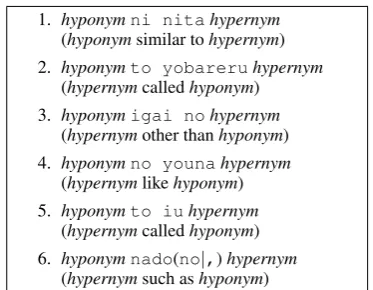
1. hyponymni nitahypernym (hyponymsimilar tohypernym) 2. hyponymto yobareruhypernym
(hypernymcalledhyponym) 3. hyponymigai nohypernym
(hypernymother thanhyponym) 4. hyponymno younahypernym
(hypernymlikehyponym) 5. hyponymto iuhypernym
(hypernymcalledhyponym) 6. hyponymnado(no|,)hypernym
[image:3.595.88.275.69.214.2](hypernymsuch ashyponym)
Table 1: Japanese lexico-syntactic patterns for hy-ponymy relations
as hyponyms of “trouble”. Hence one source of ev-idence for acquisition are hyponymy relations with “trouble” or its synonyms. Another characteriza-tion of trouble expressions is to think of them as obstacles in a broad sense: things that prevent cer-tain actions from being undertaken properly. In this sense traffic jams and sickness are troubles since they prevent people from going places and doing things. This assumption underlies a second important class of evidences for learning.
More precisely, the evidence used for learning is classified into three categories:(i)lexico-syntactic patterns for hyponymy relations,(ii) dependency relations between expressions and negated verbs, and (iii) dependency relations between expres-sions and non-negated verbs. The first two cat-egories are assumed to contain positive evidence of trouble expressions, while we assumed the third to function mostly as negative evidence. Our ex-periments show that(i)turns out to be less useful than expected, while the combination of(ii) and (iii)alone already gave quite reasonable precision in acquiring trouble expressions. Each category of evidence is described further below.
3.1 Lexico-syntactic patterns for hyponymy
Since trouble expressions are hyponyms of “trou-ble”, one obvious way of acquiring trouble expres-sions is to use classical lexico-syntactic patterns for hyponymy acquisition (Hearst, 1992). Table 1 lists some of the patterns proposed in studies on hyponymy acquisition for Japanese (Ando et al., 2003; Imasumi, 2001) that are utilized in this work.
In actual acquisition, we instantiated the
hy-pernym positions in the patterns by Japanese
translations of “trouble” and its synonyms, namely toraburu (troubles), sainan (acci-dents),saigai(disasters) andshougai (obsta-cles or handicaps), and used the instantiated terns as evidence. Hereafter, we call these pat-terns LSPHs (Lexico-Syntactic Patterns for Hy-ponymy).
3.2 Dependency relations with Verbs
We expect expressions that frequently refer to troubles to have a distinctdependency profile, by which we mean a specific set of dependency rela-tions with verbs (i.e. occurrences in specific argu-ment positions). IfT is a trouble expression, then given a sufficiently large corpus one would expect to find a reasonable number of instantiations of patterns like the following:
• TkeptXfrom doingY. • Xdidn’t enjoyY because ofT.
Similarly, “X enjoyed T” would present neg-ative evidence for T being a trouble expression. Rather than single out a set of particular depen-dency relations suspected to be indicative of trou-ble expressions, we let a supervised classifier learn an appropriate weight for each feature in a large vector of dependency relations. Two classes of de-pendency relations proved to be especially benefi-cial in determining trouble candidates in an unsu-pervised manner, so we discuss them in more detail below.
Dependency relations with negated verbs Fol-lowing our characterization of troubles as things thatpreventspecific actions from taking place, we expect a good deal of trouble expressions to appear in patterns like the following.
• Xcannot go toY because ofT. • Xdid not enjoyY because ofT.
The important points in the above are (i) the negated verbs and(ii)the mention ofT as the rea-son for notverb-ing. The following are Japanese translations of the above patterns. Here P denotes postpositions (Japanese case markers), V stands for verbs and the phrase “because of” is translated as the postpositionde.
• T deP Y niP ikenaiV (cannot go).
We refer to the following dependency relations between expressions marked with the postposition
de and negated verbs in these patterns as DNVs
(Dependencies to Negated Verbs).
T de→negated verb (1) We allow any verb to be the negated verb, expect-ing that inappropriate verbs will be less weighted by machine learning techniques. For instance, the dependency relations to negated verbs with an originally negative orientation such as “suffer” and “die” will not work as positive examples for trou-ble expressions.
Unfortunately, these patterns still present only
weak evidence for trouble expressions. The pre-cision of the trouble expressions collected using DNV patterns is extremely low — around 6.5%. This is due to the postpositionde’s ambiguity — besides “because of” relations it also functions as a marker for location, time and instrument relations, among others. As a result, non-trouble expressions such as “by car” (instrument) and “in Tokyo” (lo-cation) are marked by the postpositiondeas well. We consider a second class of dependency rela-tions, acting mostly as a counter to the noisy ex-pressions introduced by the ambiguity of the post-positionde.
Dependency relations with non-negated verbs
The final type of evidence is formulated as the fol-lowing dependency relation.
T de→non-negated verb
We call this type of relationDAVs (Dependen-cies to Affirmative Verbs). The use of these pat-terns is motivated by the intuition that noisy ex-pressions found with DNVs, such as exex-pressions about locations or instruments, will also frequently appear with non-negated verbs. That is, if you ob-serve “cannot go toY (by / because of)X” andX is not a trouble expression, then you can expect to find “can go toY (by / because of)X” as well.
Our initial expectation was that the DNV and DAV evidences observed with the postpositionde
alone would contain sufficient information to ob-tain an accurate classifier, but this expectation was not borne out by our early experiments. As it turns out, using dependency relations to verbs in
allargument positions as features to the SVM re-sulted roughly in a 10∼15% increase in precision. Therefore in our final experiments we let the DNV
and DAV evidence consist of dependencies with four additional postpositions (ha,ga,woandni), which are used to indicate topicalization, subject, object and indirect object. We found that the SVM was quite successful in learning a dependency pro-file for trouble expressions based on this informa-tion.
Nonetheless, the DNV/DAV patterns proved to be useful besides as evidence for supervised learn-ing, for instance in gathering sufficient trouble can-didates and sample selection when preparing train-ing data2.
4 Method
As mentioned, our method for finding troubles in using some objects consists of three steps, de-scribed in more detail below.
Step 1 Gather training data with a sufficient amount of positive samples using an unsuper-vised method to reduce the workload of man-ual annotation.
Step 2 Collect expressions commonly perceived as troubles by using the evidences described in the previous section.
Step 3 Identify pairs of trouble expressions and objects such that the trouble expressions rep-resent an obstacle in using the objects.
4.1 Step 1: Gathering Training Data
We considered noun phrases observed with the LSPH and DNV evidences as candidate trouble ex-pressions. However, we still found only 7% of the samples observed with these evidences to be real troubles. Because of the diversity of our ev-idences (dependencies with verbs) we need a rea-sonable amount of positive samples in order to ob-tain an accurate classifier. Without some sample selection scheme, we would have to manually an-notate about 8000 samples in order to obtain only 560 positive samples in the training data. For this reason we used the following scoring function as an unsupervised method for sample selection.
Score(e) = f fLSPH(e) +fDNV(e)
LSPH(e) +fDNV(e) +fDAV(e) (2)
Here,fLSPH(e),fDNV(e) andfDAV(e)are the
fre-quencies that expression e appears with the re-spective evidences. Intuitively, this function gives
2We will discuss yet another use of the DNV evidence in
a large score to expressions that occur frequently with the positive evidences for trouble expressions (LSPHs and DNVs), or those that appear rarely with the negative evidences (DAVs). In prepar-ing trainprepar-ing data we ranked all candidates accord-ing to the above score, and annotatedN elements from the top and bottom of the ranking as traing data. In our experiments, the top elements in-cluded a reasonable number of positive samples (25.8%) while there were almost none in the worst elements.
4.2 Step 2: Finding Trouble Expressions
In this step our aim is to acquire expressions of-ten associated with troubles. We use a super-vised classifier, namely Support Vector Machines (SVMs) (Vapnik, 1998) for distinguishing trou-bles from non-troutrou-bles, based on the evidences de-scribed above. Each dimension of the feature vec-tor presented to the SVM corresponds to the obser-vation of a particular evidence (i.e., these are bi-nary features). We tried using frequencies instead of binary feature values but could not find any sig-nificant improvement in performance. After learn-ing we sort the candidate trouble expressions ac-cording to their distance to the hyperplane learned by the SVM, and consider the topN expressions in the sorted list as true trouble expressions.
4.3 Step 2: Identifying Object-Trouble Pairs
In this third stage we rank possible combinations of objects and trouble expressions acquired in the previous step according to their degree of associ-ation and apply a filter using negated verbs to the top pairs in the ranking. The final output of our method is the topN pairs that survived the filter-ing. We describe each step below.
Generating Object-Trouble Pairs To generate and rank object-trouble pairs we use a variant of pairwise mutual information that scores an object-trouble pair heo, eti based on the observed fre-quency of the following pattern.
eo no et
P (3)
The postpositionnois a genitive case marker, and the whole pattern can be translated as “et of / in eo”. We assume that appearance of expressionet in this pattern refers to a trouble in using the object eo.
More precisely, we generate all possible combi-nations of trouble expression and objects and rank them according to the following score.
I(eo, et) = f(“ef(“eonoet”)
o”)f(“et”) (4) where f(e) denotes an expression e’s frequency. This score is large when the pattern “eo no et” is observed more frequently than can be expected fromeoandet’s individual frequencies. Frequency data for all noun phrases was precomputed for the whole Web corpus.
Filtering Object-Trouble Pairs The filtering in the second step is based on the following assump-tion.
Assumption If a trouble expressionetrefers to a trouble in using an objecteo, there is a verbv such thatv frequently co-occurs witheo and vhas the following dependency relation with et.
et de→negatedv
The intuition behind this assumption can be ex-plained as follows. First, ifeodenotes an object or artifact then its frequently co-occurring verbs are likely to be related to a use ofeo. Second, ifetis a trouble in usingeo, there is some action associated witheothatetprevents or hinders, implying thatet should be observed with its negation. For instance, if “traffic jam” is a trouble in using an amusement park, then we can expect the following pattern to appear also in a corpus.
• juutaitraffic jam deP yuuenchitheme park niP V (cannot go)ikenai. cannot go to a theme park because of a traffic jam The verb “to go” co-occurs often with the noun “theme park” and the above pattern contains the dependency relation “traffic jamde→cannot go”. Substitutingvin the hypothesis for “to go”, the as-sumption becomes valid. Because of data sparse-ness the above pattern may not actually appear in the corpus, but even so the dependency relation “traffic jam de → cannot go” may be observed with other facilities, and thus making the assump-tion hold anyway.
negated form and the postpositionde. If none of theKverbs has such a dependency with the trou-ble expression, the pair is discarded. Otherwise, it is produced as the final output of our method.
5 Experimental Results
5.1 Finding Trouble Expressions
We extracted noun phrases observed in LSPH, DNV and DAV patterns from6×109sentences in
about 108 crawled Japanese Web documents, and
used the LSPH and DNV data3as candidate trou-ble expressions. After restricting the noun phrases to those observed more than 10 times in the evi-dences, we had 136,212 noun phrases. We denote this set asD. Extracting 200 random samples from D we found the ratio of troubles to non-troubles was around 7% and thus expected to find about 10,000real trouble expressions inD. 4
Using the sample selection method described in Section 4.2 we prepared 6,500 annotated samples taken fromDas training data. The top 3,500 sam-ples included 912 positive samsam-ples and the worst 3,000 had just 9 positives, thereby confirming the effectiveness of the scoring function for selecting a reasonable amount of positive samples. Our final training data thus contained 14% positives.
For the feature vectors we included dependen-cies with all verbs occurring more than 30 times in our Web corpus. Besides the LSPH, DNV and DAV evidences discussed previously, we also in-cluded 10 additional binary features indicating for each of the five postpositions whether the expres-sion was observed with DNV or DAV evidenceat all, and found that including this information im-proved performance.
We trained a classifier with a polynomial kernel of degree 1 on these evidences using the software TinySVM5, and evaluated the results obtained by the supervised acquisition method by asking three human raters whether a randomly selected sample expression denotes a kind of “trouble” in general situations. More specifically, we asked whether the expression is a kind of toraburu (trou-ble), sainan (accident), saigai (disaster) or
shougai (obstacle or handicap).6 For various
3We restricted noun phrases from the DNV data to those
found with the postpositionde, as these are most likely to refer to troubles.
4 Thus, in the experiments we evaluated the top 10,000
samples output by our method.
5http://chasen.org/∼taku/software/TinySVM/
6Actually one of the raters is a co-author of this paper, but
0 20 40 60 80 100
0 20 40 60 80 100
Precision (%)
Number of Samples (%) random
[image:6.595.311.520.73.225.2]LSPH Score full w/o LSPH w/o DAV w/o DNV w/o sum DAV/DNV
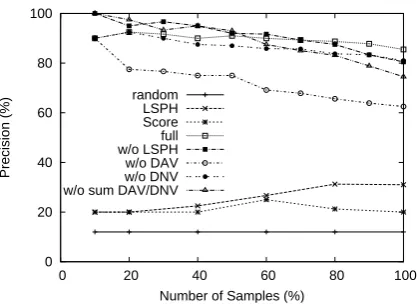
Figure 1: Performance of trouble expression ac-quisition (all 3 raters)
combinations of evidences (described below), we presented 200 randomly sampled expressions from the top 10,000 expressions ranked according to the distance to the hyperplane learned by the SVM. Samples of all the compared methods are merged and shuffled before evaluation. The kappa statistic for assessing the inter-rater agreement was 0.78, indicating substantial agreement according to Lan-dis and Koch, 1977.7 We made no effort to remove samples used in training from the experiment, and found that the samples scored by the raters (1281 in total, after removal of duplicates) contained 67 training samples. The 200 samples from the “full” classifier contained 12 of these.
Fig. 1 shows the precision of the acquired trou-ble expressions compared to the samples labeled as troubles by all three raters. We sorted the sam-ples according to their distance to the SVM hyper-plane and plotted the precision of the topN sam-ples. The best overall precision (85.5%) was ob-tained by a classifier trained on the full combina-tion of evidences (labeled “full” in Fig. 1), main-taining over 90% precision for the top 70% of the 200 samples.
The remaining results show the relative con-tributions of the evidences. They were obtained by retraining the “full” classifier with a particu-lar set of evidences removed, respectively LSPH evidences (labeled “w/o LSPH”), DNV evidences (“w/o DNV”), DAV evidences (“w/o DAV”) and the 10 features indicating the observation of
he had no knowledge of the experimental setting nor had seen the acquired data prior to the experiment.
7 This kappa value was calculated over the sum total of
20 30 40 50 60 70 80 90 100
0 20 40 60 80 100
Precision (%)
Number of Samples (%) random
[image:7.595.324.508.70.185.2]top 10% MI top 50% MI top 10% proposed top 50% proposed
Figure 2: Performance of object-trouble pair ac-quisition (3 raters)
DAV/DNV evidence per postposition (“w/o sum DAV/DNV”).
As Fig. 1 shows, leaving out DNV and even LSPH evidences did not affect performance as much as we expected, while leaving out the DAV dependencies gave more than 20% worse results. Of further interest is the importance of the binary features for DAV/DNV presence per postposition (“w/o sum DAV/DNV”). The absence of these 10 binary features accounts for a 10% precision loss compared to the full feature set (75%).
We also compared it with a baseline method us-ing only lexico-syntactic patterns. We extracted 100 random noun phrases from the LSPH evidence inDfor evaluation (“LSPH” in Fig. 1). The pre-cision for this method was 31%, confirming that lexico-syntactic patterns for hyponymy constitute fairly weak evidence for predicting trouble expres-sions when used alone. “Score” shows the preci-sion of the top 100 samples output by ourScore function from section 4. Finally, “random” (drawn as a straight line) denotes 100 random samples from D and roughly corresponds to our estimate of 7% true positives.
5.2 Identifying Object-Trouble Pairs
For the second step, we assumed the top 10,000 ex-pressions obtained by our best-scoring supervised learning method (“full” in the previous experi-ments) to be trouble expressions, and proceeded to combine them with terms denoting artifacts or facilities.
We randomly picked 2,500 words that ap-peared as direct objects of the verbs kau (“to buy”),tsukau(“to use”),tsukuru(“to make”),
taberu(“to eat”) andtanoshimu(“to enjoy”)
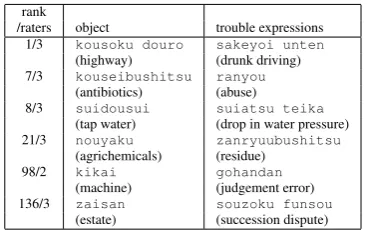
rank
/raters object trouble expressions
1/3 kousoku douro sakeyoi unten
(highway) (drunk driving)
7/3 kouseibushitsu ranyou
(antibiotics) (abuse)
8/3 suidousui suiatsu teika
(tap water) (drop in water pressure)
21/3 nouyaku zanryuubushitsu
(agrichemicals) (residue)
98/2 kikai gohandan
(machine) (judgement error)
136/3 zaisan souzoku funsou
(estate) (succession dispute)
Figure 3: Examples of acquired object-trouble pairs
more than 500 times in our Web corpus, assuming that this would yield a representative set of noun phrases denoting objects or artifacts.8 Combining this set of objects with the acquired trouble expres-sions gave a list of 61,873 object-trouble pairs (all pairs heo, eti with at least one occurrence of the pattern “eo noet”). Of this list, 58,570 pairs sur-vived the DNV filtering step and form the final out-put of our method. For the DNV filtering, we used the top 30 verbs most frequently co-occurring with the object.
We again evaluated the resulting object-trouble pairs by asking three human raters whether the pre-sented pairs consist of an object and an expression referring to an actual or potential troublein using
the object. The kappa statistic was 0.60, indicating
moderateinter-rater agreement.
Fig. 2 shows the precision of the acquired pairs when comparing with what are considered true object-trouble relations by all three raters. Some examples of the pairs obtained by our method are listed in table 3 along with their ranking and the number of raters who judged the pair to be correct. The precision for our proposed method when considering the top 10% of pairs ranked by theI score and filtered by the method described in sec-tion 4.3 is 71.5% (“top 10% proposed” in Fig. 2), which is actually worse than the results obtained
without the final DNV filtering (“top 10% MI”, 74%). For the first half of all samples however, we do observe some performance increase by the fil-tering, though both methods appear to converge in the second half of the graph. This tendency is mir-rored closely when considering the results for the top 50% of all pairs (respectively “top 50% pro-posed” and “top 50% MI” in Fig. 2). The 15% decrease in precision compared to top 10% results
[image:7.595.75.287.75.224.2]indicates that performance drops gradually when moving to the lower ranked pairs.
6 Concluding Remarks and Future Work We have presented an automatic method for find-ing potential troubles in usfind-ing objects, mainly ar-tifacts and facilities. Our method acquired 10,000 trouble expressions with 85.5% precision, and over 6000 pairs of objects and trouble expressions with 74% precision.
Currently, we are developing an Internet search engine frontend that issues warnings about poten-tial troubles related to search keywords. Although we were able to acquire object-trouble pairs with reasonable precision, we plan to make a large-scale highly precise list of troubles by manually check-ing the output of our method. We expect such a list to lead to even more acurate object-trouble pair ac-quisition.
References
Ando, M., S. Sekine, and S. Ishizaki. 2003. Automatic extraction of hyponyms from newspaper using lexi-cosyntactic patterns. In IPSJ SIG Technical Report 2003-NL-157, pages 77–82. in Japanese.
Berland, M. and E. Charniak. 1999. Finding parts in very large corpora. InProc. of ACL-1999, pages 57– 64.
Chklovski, T. and P. Pantel. 2004. Verbocean: Mining the web for fine-grained semantic verb relations. In Proc. of EMNLP-04.
Doddington, G., A. Mitchell, M. Przybocki, L. Ramshaw, S. Strassel, and R. Weischedel. 2004. The Automatic Content Extraction (ACE) Program–Tasks, Data, and Evaluation. Proceedings of LREC 2004, pages 837–840.
Girju, R., A. Badulescu, and D. Moldvan. 2006. Au-tomatic discovery of part-whole relations. Computa-tional Linguistics, 32(1):83–135.
Hearst, M. 1992. Automatic acquisition of hyponyms from large text corpora. In Proc. of COLING’92, pages 539–545.
Imasumi, K. 2001. Automatic acqusition of hyponymy relations from coordinated noun phrases and apposi-tions. Master’s thesis, Kyushu Institute of Technol-ogy.
Kaji, N. and M. Kitsuregawa. 2006. Automatic con-struction of polarity-tagged corpus from html docu-ments. InProc. of COLING/ACL 2006, pages 452– 459. (poster session).
Kobayashi, N., K. Inui, and Y. Matsumoto. 2007. Ex-tracting aspect-evaluation and aspect-of relations in opinion mining. InProc. of EMNLP-CoNLL 2007, pages 1065–1074.
Pantel, P. and M. Pennacchiootti. 2006. Espresso: Leveranging generic patterns for automatically harvesting semantic relations. In Proc. of COLING/ACL-06, pages 113–120.
Pantel, P. and D. Ravichandran. 2004. Automatically labelling semantic classes. InProc. of HLT/NAACL-04, pages 321–328.
Shinzato, K. and K. Torisawa. 2004. Acquir-ing hyponymy relations from web documents. In HLT/NAACL-04, pages 73–80.
Takamura, H., T. Inui, and M. Okumura. 2006. Latent variable models for semantic orientation of phrases. InProc. of EACL 2006, pages 201–208.
Torisawa, K. 2006. Acquiring inference rules with temporal constraints by using japanese coordinated sentences and noun-verb co-occurrences. In Moore, R.C., J.A. Bilmes, J. Chu-Carroll, and M. Sanderson, editors,HLT-NAACL. The Association for Computa-tional Linguistics.
Turney, P. 2002. Thumbs up or thumbs down? seman-tic orientation applied to unsupervised classification of reviews. InProc. of ACL’02, pages 417–424. Vapnik, Vladimir N. 1998. Statistical Learning
The-ory. Wiley-Interscience.