Unsupervised Part of Speech Tagging Using Unambiguous Substitutes
from a Statistical Language Model
Mehmet Ali Yatbaz
Dept. of Computer Engineering Koc¸ University
˙
[email protected] [email protected]
Deniz Yuret
Dept. of Computer Engineering Koc¸ University
˙
Abstract
We show that unsupervised part of speech tagging performance can be significantly improved using likely substitutes for tar-get words given by a statistical language model. We choose unambiguous substi-tutes for each occurrence of an ambiguous target word based on its context. The part of speech tags for the unambiguous sub-stitutes are then used to filter the entry for the target word in the word–tag dictionary. A standard HMM model trained using the filtered dictionary achieves 92.25% accu-racy on a standard 24,000 word corpus. 1 Introduction
We define the unsupervised part-of-speech (POS) tagging problem as predicting the correct part-of-speech tag of a word in a given context using an unlabeled corpus and a dictionary with possi-ble word–tag pairs0 The performance of an
un-supervised POS tagging system depends highly on the quality of the word–tag dictionary (Banko and Moore, 2004). We propose a dictionary fil-tering procedure based on likely substitutes sug-gested by a statistical language model. The pro-cedure reduces the word–tag dictionary size and leads to significant improvement in the accuracy of the POS models.
Probabilistic models such as the hidden Markov model (HMM) trained by expectation maximiza-tion (EM), maximum a posteriori (MAP) esti-mation, and Bayesian methods have been used
0In the POS literature the term “unsupervised” is typi-cally used to describe systems that do not directly use the tagged data. However, many of the unsupervised systems, including ours, uses the tag–word dictionary.
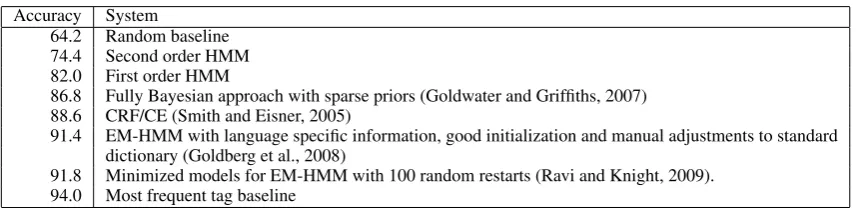
to solve the unsupervised POS tagging problem (Merialdo, 1994; Goldwater and Griffiths, 2007). All of these approaches first learn the parameters connecting the hidden structure to the observed sequence of variables and then identify the most probable values of the hidden structure for a given observed sequence. They differ in the way they estimate the model parameters. HMM-EM esti-mates model parameters by using the maximum likelihood estimation (MLE), MAP defines a prior distribution over parameters and finds the param-eter values that maximize the posterior distribu-tion given data, and Bayesian methods integrate over the posterior of the parameters to incorporate all possible parameter settings into the estimation process. Some baseline results and performance reports from the literature are presented in Table 1.
Accuracy System
64.2 Random baseline 74.4 Second order HMM 82.0 First order HMM
86.8 Fully Bayesian approach with sparse priors (Goldwater and Griffiths, 2007) 88.6 CRF/CE (Smith and Eisner, 2005)
91.4 EM-HMM with language specific information, good initialization and manual adjustments to standard dictionary (Goldberg et al., 2008)
[image:2.595.83.515.68.174.2]91.8 Minimized models for EM-HMM with 100 random restarts (Ravi and Knight, 2009). 94.0 Most frequent tag baseline
Table 1: Tagging accuracy on a 24K-word corpus. All the systems – except (Goldwater and Griffiths, 2007) – use the same 45 tag dictionary that is constructed from the Penn Treebank.
Bayesian methods by achieving 88.6% accuracy on the same 24K corpus.
Despite the fact that HMM-EM has a poor repu-tation in POS literature (Goldberg et al., 2008) has shown that with good initialization together with some language specific features and language de-pendent constraints HMM-EM achieves 91.4% accuracy. Aside from the language specific infor-mation and the good initialization, they also man-ually reduce the noise in the word–tag dictionary. (Ravi and Knight, 2009) focus on the POS tag collection to find the smallest POS model that ex-plain the data. They apply integer programming to construct a minimal bi-gram POS tag set and use this set to constrain the training phase of the EM algorithm. The model trained by EM is used to reduce the dictionary and these steps are iter-atively repeated until no further improvement is observed. Their model achieves 91.6% accuracy on the 24K word corpus (with 100 random starts this goes up to 91.8%). The main advantage of this model is the restriction of the tag set so that rare POS tags or the noise in the corpus do not get incorporated into the estimation process.
Language models for disambiguation: Recent work has shown that statistical language models trained on large amounts of unlabeled text can be used to improve the performance on various disambiguation problems. The language model is used to generate likely substitutes for the tar-get word in the given context and these benefit the disambiguation process to the extent that the likely substitutes are unambiguous or have dif-ferent ambiguities compared to the target word. Using statistical language models based on large corpora for unsupervised word sense
disambigua-tion and lexical substitudisambigua-tion has been explored in (Yuret, 2007; Hawker, 2007; Yuret and Yatbaz, 2010). Unsupervised morphological disambigua-tion in agglutinative languages using likely sub-stitutes has been shown to improve on standard methods in (Yatbaz and Yuret, 2009).
In this paper we use the statistical language model to reduce the possible number of tags per word to help the disambiguation process. Specif-ically we assume that the same hidden tag se-quence that has generated a particular test sen-tence can also generate artificial sensen-tences where one of the words has been replaced with a likely substitute. POS tags of the likely substitutes can then be used to reduce the tag set of the target word. Thus, the substitutes are implicitly incorpo-rated into the disambiguation process for reducing the noise and the rare tags in the dictionary.
Currency gyrations canwhipsaw(VB/NN)the funds . Currency gyrations canwithdraw(VB)the funds . Currency gyrations canrestore(VB)the funds . Currency gyrations canmodify(VB)the funds . Currency gyrations canjustify(VB)the funds . Currency gyrations canregulate(VB)the funds . Table 2: Sample artificial sentences generated for a test sentence from the Penn Treebank.
that have not been observed from the dictionary. Assuming that the first sentence in Table 2 is the only sentence in which we observe “whipsaw”, the “NN” tag of “whipsaw” will be removed.
The next section describes the details of our dictionary reduction method. Section 3 explains the details of statistical language model. We ex-perimentally demonstrate that the word–tag dic-tionary reduced by the substitutes improve the performance by constraining the unsupervised model in Section 4. Finally, Section 5 comments on the results and discusses the possible exten-sions of our method.
2 Dictionary Reduction
Our main assumption is that likely replacements of a target word should have the same POS tag as the target word in a given context. Motivated by this idea we propose a new procedure that au-tomatically reduces the dictionary size by using the unambiguous replacements of the target word. For all occurrences of the target word the pro-cedure counts the POS tags of the replacement words and removes the unobserved POS tags of the target word from the dictionary.
Our approach is based on the idea that similar words in a given context should have the same tag sequence. To reduce the dictionary with the help of the replacement words similar to a target word w, we follow three rules:
1. Choose the replacement word from unam-biguous substitutes that are likely to appear in the target word context.
2. Substitutes must be observed in the training corpus.
3. Count the tags of the replacement for all oc-currences of the target word.
4. Remove the tags that are not observed as the tag of replacements in any occurrences of the target word.
The first rule is used to increase the likelihood of getting a replacement word with the same POS tag. The second rule makes sure that the size of the vocabulary does not change. The third rule
determines the unused POS tags in all occurrences ofwand finally, last rule removes the unobserved tags ofwfrom the dictionary.
We use the standard first order HMM to test the performance of our method. In a standardnth
or-der HMM each hidden state is conditioned by its npreceding hidden states and each observation is conditioned by its corresponding hidden state. In POS tagging, the observed variable sequence is a sentence s and the hidden variablesti are the
POS tags of the wordswi in s. The HMM
pa-rametersθcan be estimated by using Baum-Welch EM algorithm on an unlabeled training corpusD (Baum, 1972). The tag sequence that maximizes
Pr(t|s,θˆ) can be identified by the Viterbi search algorithm.
3 Statistical Language Modeling
In order to estimate highly probable replacement words for a given wordwin the contextcw, we use
an n-gram language model. The context is defined as the2n−1word windoww−n+1. . . w0. . . wn−1
and it is centered at the target word position. The probability of a word in a given context can be estimated as:
P(w0=w|cw) ∝ P(w−n+1. . . w0. . . wn−1) (1)
= P(w−n+1)P(w−n+2|w−n+1)
. . . P(wn−1|wn−−n+12 ) (2)
∝ P(w0|w−−n1+1)P(w1|w−0n+2)
. . . P(wn−1|wn0−2) (3)
where wij represents the sequence of words wiwi+1. . . wj. In Equation 1, Pr(w|cw) is
pro-portional toPr(w−n+1. . . w0. . . wn+1) since the
context of the target word replacements is fixed. Terms withoutw0are common for every
replace-ment in Equation 2 therefore they have been dropped in Equation 3. Finally, because of the Markov property of n-gram language model, only n−1words are used as a conditional context.
The probabilities in Equation 3 are estimated using a 4 gram language model for all the words in the vocabulary ofDthat are unambiguous and have a common tag with the target wordw. The words with the highestPr(r|cw)wherer ∈Dare
To get accurate domain independent proba-bility estimates we used the Web 1T data-set (Brants and Franz, 2006), which contains the counts of word sequences up to length five in a
1012 word corpus derived from publicly
accessi-ble Web pages. The SRILM toolkit is used to train 5-gram language model (Stolcke, 2002). The lan-guage model parameters are optimized by using a randomly selected 24K words corpus from Penn Treebank. In order to efficiently apply the lan-guage model to a given test corpus, the vocabulary size is limited to the words seen in the test corpus.
4 Experiments
In this section we present a number of experi-ments measuring the performance of several vari-ants of our algorithm. The models in this sec-tion are trained1and tested on the same unlabeled
data therefore there aren’t any out-of-vocabulary words. The experiments in this section focus on: (1) the analysis of the dictionary reduction (2) the number of the substitutes used for each ambigu-ous word and (3) the size of the word–tag dictio-nary.
4.1 Dataset
We trained HMM-EM models on a corpus that consists of the first 24K words of the Penn Tree-bank corpus. To be consistent with the POS tag-ging literature, the tag dictionary is constructed by listing all observed tags for each word in the entire Penn Treebank. Nearly 55% of the words in Penn Treebank corpus are ambiguous and the average number of tags is 2.3.
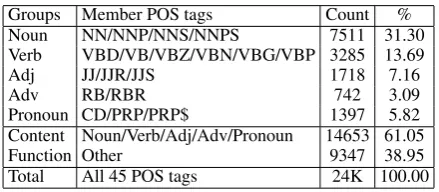
Groups Member POS tags Count %
Noun NN/NNP/NNS/NNPS 7511 31.30
Verb VBD/VB/VBZ/VBN/VBG/VBP 3285 13.69
Adj JJ/JJR/JJS 1718 7.16
Adv RB/RBR 742 3.09
Pronoun CD/PRP/PRP$ 1397 5.82
Content Noun/Verb/Adj/Adv/Pronoun 14653 61.05
Function Other 9347 38.95
Total All 45 POS tags 24K 100.00
Table 3: Group names, members, number and per-centage of the words according to their gold POS tags.
1The GMTK tool is used to train HMM-EM model on an unlabeled corpus (Bilmes and Zweig, 2002).
Table 3 shows the POS speech groups and their distributions in the 24K word corpus. We report the model accuracy on several POS groups. Our motivation is to determine HMM-EM model ac-curacies on the subgroups before and after imple-menting the dictionary reduction procedure.
4.2 Baseline
Table 4 presents some standard baselines for com-parison. We define a random and a most frequent tag (MFT) baseline on the 24K corpus. The ran-dom baseline is calculated by ranran-domly picking one of the tags of each word and it also represents the amount of ambiguity in the corpus. The MFT baseline simply selects the most frequent POS tag of each word from the 1M word Penn Treebank corpus (counts of the first 24K words is not in-cluded in the 1M word corpus). If the target word does not exist in the training set, the MFT base-line randomly picks one of the possible tags of the missing word.
The first and second order HMMs can be treated as the unsupervised baselines. These unsu-pervised baselines are calculated by training uni-formly initialized first and second order HMMs on the target corpus without any smoothing. All the initial parameters of HMM-EM are uniformly ini-tialized to observe only the effects of the artificial sentences on the performance of HMM-EM.
The success of the MFT baseline on theN oun, Adj, P ronoun and function word groups shows that tag distributions of the words in these groups are more skewed towards to one of the available tags. The MFT baseline performs poorly, com-pared to the above groups, on V erb, and Adv which is due to the less skewed POS tag behav-ior of these tags.
[image:4.595.71.291.548.644.2]Noun Verb Adj Adv Pronoun Content Function Total(%) Random Baseline 76.98 53.87 68.46 72.98 87.64 71.59 52.64 64.21 3-gram HMM 77.43 68.16 78.06 73.32 94.85 76.88 70.45 74.38 2-gram HMM 92.22 83.84 85.22 83.96 95.56 89.42 70.49 82.05 MFT Baseline 96.11 80.30 88.56 83.15 98.75 91.28 98.25 93.99
Table 4: Percentages of words tagged correctly by different models using standard dictionary.
not capture the highly skewed behavior of func-tion words. Moreover the amount of skewness af-fects the accuracy of the EM such that the perfmance gain of the MFT baseline over the first or-der HMM on function words is around 28%-30% while the performance gain on N oun, Adj and P ronounis around 3%-4%.
4.3 Reduced Dictionary
EM can not capture the sparse structure of the word distributions therefore it tends to assign equal number of words to each POS tag. Together with the noisy word–tag dictionary great portion of the function words are tagged with very rare POS tags. The abuse of the rare tags is presented in Table 5 in a similar fashion with (Ravi and Knight, 2009). The count of replacement word POS tags and the removed rare POS tags of 2 er-roneous function words are also shown in Table 5.
Word Tag Gold EM Replacement
dictionary tagging tagging POS counts of {RB,RP,IN} IN(632) IN(0) IN(2377)
RP(0) RP(632) RP(0) RB(0) RB(0) RB(850) a {LS,SYM,NNP, DT(458) DT(0) DT(513) FW,JJ,IN,DT} IN(1) IN(0) IN(317)
[image:5.595.72.291.452.555.2]JJ(2) JJ(0) JJ(1329) SYM(1) SYM(258) SYM(0) LS(0) LS(230) LS(0)
Table 5: Removed POS tags of the given words are shown in bold.
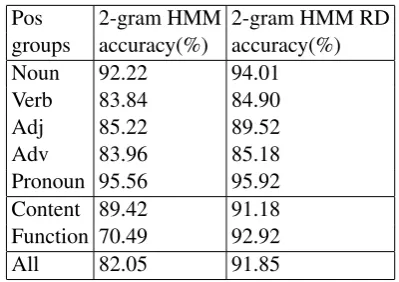
The results obtained with the dictionary that is reduced by using 5 replacements are presented in Table 6. Note that with reduced dictionary the uniformly initialized first order HMM-EM achieves 91.85% accuracy. Dictionary reduction also removes some of the useful tags therefore the upper–bound (oracle score) of the 24K dataset becomes 98.15% after the dictionary reduction. We execute 100 random restarts of the EM
algo-rithm and select the model with the highest corpus likelihood, our model achieves 92.25% accuracy which is the highest accuracy reported for the 24K corpus so far.
As Table 6 shows, the effect of the dictionary reduction on the function words is higher than the effect on the content words. The main reason for this situation is, function words are frequently tagged with one of its tags which is also the reason for the high accuracy of the majority voting based baseline on the function words.
The reduced dictionary (RD) removes the rare problematic POS tags of the words as a result the accuracy on the content and function words shows a drastic improvement compared to HMM models trained with the original dictionary.
Pos 2-gram HMM 2-gram HMM RD groups accuracy(%) accuracy(%)
Noun 92.22 94.01
Verb 83.84 84.90
Adj 85.22 89.52
Adv 83.96 85.18
Pronoun 95.56 95.92 Content 89.42 91.18 Function 70.49 92.92
All 82.05 91.85
Table 6: Percentages of the correctly tagged words by different models with modified dictio-nary. The dictionary size is reduced by using the top 5 replacements of each target word.
4.4 More Data
proce-dure. Using the 5 replacements of each ambigu-ous word we reduce the dictionary and train a new HMM-EM model using this dictionary. The ad-ditional data together with 100 random starts in-creases the model accuracy to 92.47% on the 48K corpus.
Pos 3-gram HMM RD 2-gram HMM RD groups accuracy(%) accuracy(%)
Noun 89.45 93.47
Verb 85.56 88.99
Adj 86.02 87.53
Adv 94.44 95.92
Pronoun 94.08 94.04 Content 88.91 91.97 Function 92.44 92.26
All 90.31 92.09
Table 7: Percentages of the correctly tagged words by the first and second order HMM-EM model trained on the 48K corpus with reduced dictionary. The dictionary size is reduced by using the top 5 replacements of each target word.
As we mentioned before, when the model is trained using the original dictionary, the perfor-mance gap between the first order HMM the sec-ond order HMM is around 8% as presented in Ta-ble 4. On the other hand, when we use the re-duced dictionary together with more data the ac-curacy gap between the second order and the first order HMM-EM becomes less than 2% as shown in Table 7. This confirms the hypothesis that the low performance of the second order HMM is due to data sparsity in the 24K-word dataset, and bet-ter results may be achieved with the second order HMM in larger datasets.
4.5 Number of Replacements
In this set of experiments we vary the number of artificial replacement words per each ambiguous word ins. We run our method on the 24K corpus with 1, 5, 10, 25 and 50 replacement words per ambiguous word and we present the results in Ta-ble 8. The performance of our method affected by the the number of replacements and highest score is achieved when 5 replacements are used. Incor-porating the probability of the substitutes into the model rather than using a hard cutoff may be a better solution.
Number of 2-gram HMM RD replacements accuracy(%)
none 82.05
1 89.65
5 91.85
10 90.09
25 89.97
50 89.83
Table 8: Percentages of the correctly tagged words by the models trained on the 24K corpus with different reduced dictionaries. The dictio-nary size is reduced by using different number re-placements.
4.6 17-Tagset
To observe the effect our method on a model with coarse grained dictionary, we collapsed the 45– tagset treebank dictionary to a 17–tagset coarse dictionary (Smith and Eisner, 2005). The POS literature after the work of Smith and Eisner fol-lows this tradition and also tests the models on this 17–tagset. Table 9 summarizes the previously re-ported results on coarse grained POS tagging. Our system achieves 92.9% accuracy where the ora-cle accuracy of 24K dataset with the reduced 17– tagset dictionary is 98.3% and the state-of-the-art system IP+EM scores 96.8%.
Model Accuracy Data Size
BHMM 87.3 24K
CE+spl 88.7 24K
RD 92.9 24K
LDA+AC 93.4 1M
InitEM-HMM 93.8 1M
[image:6.595.351.475.71.152.2]IP+EM 96.8 24K
Table 9: Performance of different systems using the coarse grained dictionary.
[image:6.595.91.272.166.269.2] [image:6.595.343.481.439.514.2]by contrastive estimation method and achieves 88.7% accuracy (Smith and Eisner, 2005). Fi-nally, BHMM is a fully Bayesian approach that uses sparse POS priors and scores 87.3% (Gold-water and Griffiths, 2007).
5 Contributions
In this paper we proposed a dictionary reduction method that can be applied to unsupervised tag-ging problems. With the help of a statistical lan-guage model, our system creates artificial replace-ments that are assumed to have the same POS tag as the target word and use them to reduce the size of the word–tag dictionary. To test our method we used HMM-EM as the unsupervised model. Our method significantly improves the prediction accuracy of the unsupervised first order HMM-EM system in all of the POS groups and achieves 92.25% and 92.47% word tagging accuracy on the 24K and 48K word corpora respectively. We also tested our model on a coarse grained dictionary with 17 tags and achieved an accuracy of 92.8%.
In this work, we show that unambiguous re-placements of an ambiguous word can reduce the amount of the ambiguity thus replacement words might also be incorporated into the other unsuper-vised disambiguation problems.
Acknowledgments
This work was supported in part by the Scien-tific and Technical Research Council of Turkey (T ¨UB˙ITAK Project 108E228).
References
Banko, Michele and Robert C. Moore. 2004. Part of
speech tagging in context. In COLING ’04:
Pro-ceedings of the 20th international conference on Computational Linguistics, page 556, Morristown, NJ, USA. Association for Computational Linguis-tics.
Baum, L.E. 1972. An inequality and associated maxi-mization technique in statistical estimation for
prob-abilistic functions of Markov processes.
Inequali-ties, 3(1):1–8.
Bilmes, J. and G. Zweig. 2002. The Graphical Models Toolkit: An open source software system for speech
and time-series processing. In IEEE International
Conference On Acoustics Speech and Signal Pro-cessing, volume 4, pages 3916–3919.
Brants, T. and A. Franz. 2006. Web 1T 5-gram Ver-sion 1.Linguistic Data Consortium, Philadelphia.
Goldberg, Y., M. Adler, and M. Elhadad. 2008. Em can find pretty good hmm pos-taggers (when given
a good start). Proceedings of ACL-08. Columbus,
OH, pages 746–754.
Goldwater, S. and T. Griffiths. 2007. A fully Bayesian approach to unsupervised part-of-speech tagging. In Annual Meeting-Assosiation for Computational Linguistics, volume 45, page 744.
Hawker, Tobias. 2007. Usyd: Wsd and lexical substi-tution using the web1t corpus. InProceedings of the Fourth International Workshop on Semantic Eval-uations (SemEval-2007), pages 446–453, Prague, Czech Republic, June. Association for Computa-tional Linguistics.
Johnson, M. 2007. Why doesnt EM find good HMM
POS-taggers. InProceedings of the 2007 Joint
Con-ference on Empirical Methods in Natural Language Processing and Computational Natural Language Learning (EMNLP-CoNLL), pages 296–305.
Marcus, M.P., B. Santorini, and M.A. Marcinkiewicz. 1994. Building a large annotated corpus of
En-glish: The Penn Treebank. Computational
linguis-tics, 19(2):313–330.
Merialdo, B. 1994. Tagging english text with
a probabilistic model. Computational linguistics,
20(2):155–171.
Mitzenmacher, M. 2004. A brief history of generative models for power law and lognormal distributions.
Internet mathematics, 1(2):226–251.
Ravi, Sujith and Kevin Knight. 2009. Minimized models for unsupervised part-of-speech tagging. In
ACL-IJCNLP ’09: Proceedings of the Joint Confer-ence of the 47th Annual Meeting of the ACL and the 4th International Joint Conference on Natural Lan-guage Processing of the AFNLP: Volume 1, pages 504–512, Morristown, NJ, USA. Association for Computational Linguistics.
Smith, Noah A. and Jason Eisner. 2005. Contrastive estimation: training log-linear models on unlabeled
data. InACL ’05: Proceedings of the 43rd Annual
Meeting on Association for Computational
Linguis-tics, pages 354–362, Morristown, NJ, USA.
Associ-ation for ComputAssoci-ational Linguistics.
Stolcke, A. 2002. SRILM-an extensible language
modeling toolkit. InSeventh International
Toutanova, K. and M. Johnson. 2007. A Bayesian LDA-based model for semi-supervised part-of-speech tagging. InProceedings of NIPS, volume 20.
Yatbaz, Mehmet Ali and Deniz Yuret. 2009. Unsuper-vised morphological disambiguation using
statisti-cal language models. In NIPS 2009 Workshop on
Grammar Induction, Representation of Language and Language Learning.
Yuret, Deniz and Mehmet Ali Yatbaz. 2010. The noisy channel model for unsupervised word sense
disambiguation. Computational Linguistics, 36(1),
March.
Yuret, Deniz. 2007. KU: Word sense
disambigua-tion by substitudisambigua-tion. In Proceedings of the Fourth