79
Effect of LPS Endotoxin on the Improvement of Rice
Dust Levels C-Reactive Protein C-RP and Physiology
Decrease
Frida Hendrarinata
1*, I KetutSudiana
2,Soedjajadi Keman
3Magister Program Studi, Environment Health Department , Public Health Faculty, Airlangga University , Surabaya, Indonesia1*
Immunology Department, Medical Faculty, Airlangga University, Surabaya, Indonesia2
Environment Health Department , Public Health Faculty, Airlangga University , Surabaya, Indonesia3
Email: [email protected]
Abstract- One of the agents which are contained in rice dust and become a trigger of inflammation the
respiratory is LPS endotoxin. The purpose of this study was analyzing the effect of the increase of LPS endotoxin toward the increase of C-RP and the decrease of lungs function. This study was an analytical observational with design of longitudinal prospective study. The samples were 11 respondent in Palur Kebonsari village. The data collection were interviewing, measuring the personal dust and LPS endotoxin, lungs function and the content of C-RP cross shift. The dependent variables were the content of C-RP and lungs function. The independent variable was the content of LPS endotoxin. This study showed the average of the worker’s age was 35,64 years old, work time was 5 years, the 63,6% of them were medium smokers. After working in 8 hours, the personal dust was 1,47 mg/m3 and the average LPS endotoxin was 91,1 EU/ m3. The increase of C-RP was 0,94 mg/L.The decrease of FVC (63,6%) and FEV1 (45,5). The personal LPS endotoxin affected the increase of C-RP and the decrease of lungs function.The conclusion was increase of LPS endotoxin in grain rice affect the increase of C-RP and lungs function.
Keywords: - grain rice, LPS endotoxin, pulmonary function, C-Reactive Protein (C-RP), the rice mill operator.
1. INTRODUCTION
Agriculture is one of the industries aspect that have the potential adverse health effects. Chronic exposure of various activities in agriculture can lead to diseases such as rhinitis, sinusitis, asthma, chronic bronchitis, chronic obstructive pulmonary disease (COPD) and hypersensitivity pneumonitis (Eduard et al., 2009; Kirkhorn) But health problems that often arise in the industry agriculture is the respiratory tract due to exposure to organic dust especially dust grains (Prakash et al., 2010; Dhillon et al., 2011).
There are many agents that are present in organic dust. One of the agent contained in the rice dust and lead to inflammation of the airways is endotoxin LPS (Ghosh et al., 2014). Endotoxin is a molecule that is contained in the membrane that surrounds the cell wall of negative types of bacteria in the air when the bacteria die (Schwartz et al., 2010).
As research conducted by Lusno, (2013) exposure to dust containing endotoxin LPS rice may cause a decrease in lung function. In the study conducted by Thorn (2001) that pajajan endotoxin LPS given to healthy people through inhalation with different doses will involve inflammatory cells, respiratory epithelial cells and the release of certain cytokines. With the results of exposure to <0.5 mg does not cause acute response, 0.5ug cause changes in blood polymorphonuclear (PMN), 5 g will be an increase in
C-RP, 50 g causes a fever and changes in lung function.
C - reactive protein (C-RP) is an acute phase serum protein formed in the liver (hepatocyte cells). This protein is formed in response to cytokines produced by macrophages including IL-1 and IL-6. This protein increases for various circumstances in response to inflammation, trauma, or infection. This protein has a role in protection against infection, tissue cleansing useless, autoimmunization prevention and regulation of the inflammatory response. C-RP regarded as prototypic acute phase reactant in humans due to its concentration in the blood increases to several hundred micrograms per milliliter in the first 6-48 hours of the acute phase response (Baratawidjaya, 2012 and Du Clos, 2000).
80 generated during work. If the condition is left is
possible occupational diseases is increasing so it can reduce labor productivity affecting their income.
2. RESEARCH METHODS
This type of research is analytic observational prospective longitudinal study design. The population in this study is a rice mill operator in the village Palur Kebonsari Madison County. Rice mill operators who made respondents in this study is the workers who work in the rice milling industry ranging from rice milling to packing. Observations were made on 25 rice mill operator. Where sampling is done randomly and met the inclusion criteria that had been worked> of 2 years and does not have a work history that can cause respiratory disorders. The sample size was 11 people by using the formula:
Information :
Zα : adjusted standard deviation for α 1 Way test (1,65).
Zβ : adjusted standard deviation for β (β=0,20 z = 0,84).
ρ : Correlation Coefisien between expected variable. Aminatus (2013) research explained that ρ = 0,712 Ln : function logaritma “ln”
Data obtained by conducting interviews using a questionnaire so that respondents get the characteristic data such as age, years of service and smoking habits. Smoking habits were measured using Brikman index is the result obtained from the multiplication between smoking duration in years multiplied by the number of cigarettes smoked per day, smoking habits following criteria: light smokers = 0-200 pack years, Medium: 200-600 pack years, Weight :> 600 pack years.
Personal dust concentration measurement using the Personal Dust Sampler tool. LPS endotoxin measurement by sandwich ELISA techniques with methods Amebocite lysat Limulus (LAL). Measurement of pulmonary function by using a spirometer. Measured levels of C-RP conducted using florescence examination immunology I-Chroma TM Reader. To analyze the effect of LPS endotoxin exposure to elevated levels of C-RP serum and a decrease in pulmonary function using multiple linear regression test
3. RESULTS AND DISCUSSION
Rice mill is a place that is vulnerable to exposure to dust containing endotoxin LPS, rice dust produced from some processes starting from the rice drying,
[image:2.595.306.525.161.432.2]storage prior to milling, grinding, repackaging and storage of rice. Respondents in this study were included in the criteria for inclusion work> 2 years and never work in a place that can cause respiratory problems.
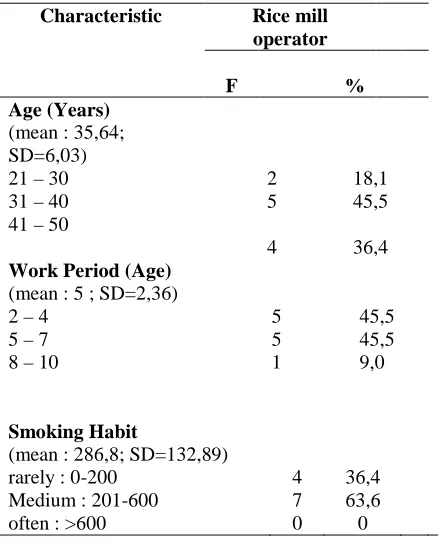
Table 1. Respondent Characteristic
Characteristic Rice mill
operator
F % Age (Years)
(mean : 35,64; SD=6,03)
21 – 30 2 18,1
31 – 40 5 45,5
41 – 50
4 36,4
Work Period (Age)
(mean : 5 ; SD=2,36)
2 – 4 5 45,5
5 – 7 5 45,5
8 – 10 1 9,0
Smoking Habit
(mean : 286,8; SD=132,89)
rarely : 0-200 4 36,4 Medium : 201-600 7 63,6 often : >600 0 0
Table 1 shows that the average age of 35.64 rice mill operator. With a minimum age of 25 years and maximum age of 43 years. Age is one epidemiological variable according to the (person) who always note where the mortality and morbidity virtually all circumstances show the relationship with age (Notoatmodjo, 2003). According to Noor (2008) Age is the main characteristic of respondents as age is closely linked to the risk of certain diseases and exposure, where the older age groups will be more susceptible to certain diseases this is because the level of exposure as well as the course of the disease process in the body (pathogenesis ) which may take a long time. In this study showed the average tenure of 5 years tenure in which the highest rice mill operator is 10 years old. And the lowest working period of 2 years. For a long time when working continuously breathe air polluted by allowing workers to respiratory infections. According Suyono et al., (2001) stated that exposure to relationships effect depend on long exposure.
81 = 0-200 pack years, Medium: 200-600 pack years,
Weight :> 600 pack years.
According Suyono et al., (2001) Cigarette smoke can cause irritation of the lungs and into the bloodstream. A decrease in vital capacity of the lung is more affected by smoking compared to some occupational health hazards. Smoking can cause changes in the structure and function of the respiratory tract and lung tissue. Smoking habits will accelerate the decline in pulmonary function. According Dhaise et al (2000) dusty environment with a workforce who smoke tend to result in respiratory disorders compared to workers who are in the same environment but do not smoke.
Research Gold et al (2005) in the United States shows the results of the dose-response relationship between smoking and low levels of FEV1 / FVC, and FEF 25-75%. Total cigarette consumption as much as 10 cigarettes per day was found associated with a decrease in FEF 25 to 75% compared to people who do not smoke.
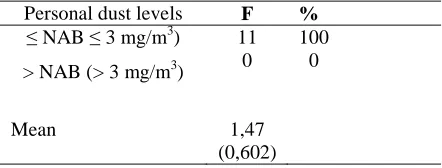
[image:3.595.305.520.161.259.2]Measurement of personal dust levels were measured using the Personal Dust sampler which is expected to portray the dust content of each respondent. Personal dust concentration measurement results show the following:
Table 2 Personal dust levels of rice mill operator
Personal dust levels F %
≤ NAB ≤ 3 mg/m3) 11 100
> NAB (> 3 mg/m3) 0 0
Mean
1,47 (0,602) Source: Primary Data
According Lestari (2010) Dust is one form of solid aerosols resulting from the destruction process, sanding, fast collisions, explosions and decrepitating (breakdown due to heat) from organic and inorganic materials, such as stone, rock ore, metals, coal, wood and plant seeds. Factors that can affect the movement of the particles.
Dust levels were measured by the personal respondents using a Personal Dust Sampler (PDS), based on material of Regulation of Manpower and Transmigration No. Per.13 / Men / X / 2011 on the Threshold Value Factor Physical and Chemical Factors in the workplace is 3 mg / m3.
In this study found average levels of personal dust rice mill operator at 1.47 mg / m3 (under NAB). This study is different from that performed Lusno (2013) that the workers working on the rice mill operator showed above NAB is equal to 5.68 mg / m3.
Measurement of endotoxin levels of personal by using Sandwich ELISA techniques with methods Amebocite lysat Limulus (LAL) The results of the
measurement of endotoxin personal rice mill operators are shown in Table 3 below.
Table 3 LPS Endotoxin Level of personal rice mill operators
Endotoksin levels of mill dust
(EU/m3)
F %
60-79 4 54,4
80 – 99 4 54,4
100-119 2 18,2
120 – 129 1 9,0
Mean 91,1(±21,87)
Based on Table 3, threshold values endotoxin levels according to The Dutch Expert Committee On Occupational Safety (decos) by 90 EU / m3 or 9 ng / m3 (1 ng equivalent of 10 EU) .In this study the mean levels of LPS personal endotosin 91.1 EU / m3 (above NAV) in line with studies that have been conducted by Lusno (2013) found the average exposure to endotoxin in the rice mill at 232,22EU / m3 (above NAB).
LPS endotoxin derived from the cell wall of integral components (lipopolysaccharide) gram-negative bacteria (such as meningococcal). LPS endotoxin is often issued at the time of lysis circumstances and resistant to heat and is stable at a temperature of 1000C (Sears et al, 2011; Brooks et al, 2008)
A lipopolysaccharide endotoxin from the bacterium that can be responded to by the cells inflamator and resulting inflammation by releasing inflammatory mediators compounds such as eosinophils, neutrophils, monocytes, macrophages, proinflammatory cytokines. Inflammatory cells and structural cells are activated as a result of inflammation in asthma will generate reactive oxidants and nitrogen (ROS and RNS) in response to some stimuli (Caramori Pusparini 2004 in 2012)
Do et al, 2008 states the LPS endotoxin contained in the rice dust with chronic exposure will lead to an increase in the acidity of the airway, which at the time of acute conditions LPS endotoxin exposure on rice dust causes oxidative stress (oxidative stress). Oxidative stress is an increase in reactive oxygen intermediates (ROI) that toxins exceed endogenous antioxidant defenses. This cause occur excess free radicals that will react with fat, protein, cellular nucleic acids, resulting in damage to local and specific organ dysfunction.
[image:3.595.72.293.415.499.2]82 Table 4 ∆ FVC dan ∆ FEV1 levels of rice mill
operator.
∆ FVC ∆ FEV1
N % N %
Increase 4 36,4 5 54,5 Decrease 7 63,6 6 45,5 Totaly 11 100,0 11 100,0
Mean (SD)
0,134(±0,361) 0.156(±0,420)
Source: Primary Data
Table 4 shows that after working for 8 hours in a rice mill based on measurements using the spirometer, rice mill operator ∆ mean FVC was 0.134 (± 0.361) and the mean ∆ FEV1 was 0.156 (± 0.420). Where workers decreased by 63.6% FVC and FEV1 were decreased by 45.5%. Examination of lung function that is often done to portray the respiratory function is as the strength of the vital capacity (FVC = Forced Vital Capacity) is the total volume of air that is expelled with the maximum and quickly, after doing an inspiration to the fullest. To determine the presence of pulmonary function disorders is necessary to check lung function. Which takes at least two parameters: 1 second forced expiratory volume (FEV1) and forced capacity (FVC) (Ikawati, 2011).
According to the American Thorac Society, that the accuracy of the measurement results are affected by the respondent spirometer difficulties and tightness at the time of measurement, the respondents are less able to understand the instructions given, there are air holes during the measuring process takes place (Leader 2014).
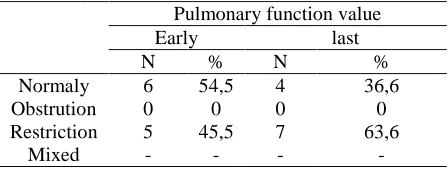
Strength expiratory volume in time (Forced expiratory volume = FEV) is the volume of air that is expelled at the time of maximal expiratory quickly after doing the maximum inspiration is calculated within 1 second (FEV1), 2 seconds (FEV2) or 3 seconds (FEV3 ). The percentage ratio of FEV1 to FVC is 80% of normal people (Levizky, 2007). Table 5 pulmonary function values distribution of rice mill operator
Pulmonary function value
Early last
N % N %
Normaly 6 54,5 4 36,6 Obstrution 0 0 0 0 Restriction 5 45,5 7 63,6
Mixed - - - -
From the above table 5 it can be concluded that most of the rice mill operator since the beginning of the study had experienced a restriction 45.5%., And
which is still normal 54.5% .And after working 8 hours a distribution of pulmonary function values decreased pulmonary function with the results of respondents ritriksik experiencing 63.6% and normal and 36.6% of respondents.
[image:4.595.67.295.161.254.2]Levels of C-RP in the serum of respondents were analyzed using ELISA method. Results Levels of C-RP measurements in serum rice mill operators are as follows:
Table 6 C-RP serum levels of rice mill operator
∆ C-RP N %
Increase 5 45,5 Decrease
Fixed
4 2
36,4 18,1 Mean 0,94(±1,24)
Source: Primary Data
From Table 6 above is known that most of the rice mill operator 45.5%) have elevated levels of C-RP serum, decreased 36.4%, and 18.1% remained after working for 8 hours.
In the normal state of the C-RP contained in small amounts in the body. When there is an infection or tissue damage, acute levels of C-RP will increase and detected in 6-10 hours and peaked within 24-72 hours. C-RP has a half-life of 24 hours and levels of C-RP will decrease within 3-4 days. Severity of reaction acute inflammation and tissue damage can affect the height and duration of elevated levels of C-RP. A level of C-RP is not affected directly by the administration of anti-inflammatory drugs or immunosuppressant, or in patients with drug sitostatika leukemia (Widodo, 2004).
Levels of C-RP in healthy people is below or equal to 1 mg / L. and levels of C-RP can increase when there is an acute phase stimulus within 4-6 hours and peaks within 24-48 hours up to a thousand times (Retnowati, 2005). Approximately there are 40 plasma proteins that are defined as acute phase proteins. This definition is based on the change in the levels of these proteins in circulation after the inflammatory stimulus.
Table 7 Multiple Regression Analysis Test between Personal Endotoxin levels. Age, Period Work and against Smoking habits ∆ C-RP Serum on Rice Milling Operator
Variable
β ∆
C-RP p Endotoksin
Personal Levels
0,543
0,013
Age -0,347
[image:4.595.300.525.219.288.2] [image:4.595.67.291.637.722.2]83 Period 0,607 0,033
Smooking Habits
0,407
0,203
Table 7 shows that the levels of endotoxin personal ∆ smoke effect on serum levels of C-RP rice mill operator with p = 0.013 and β = 0.543. The results of the above it can be concluded that the higher levels of endotoxin in the blood will increase the levels of C-RP serum respondent. There is increasing evidence that the disease is caused by organic dust is primarily inflammatory. Among many agents present in organic dust, bacterial endotoxins are prime candidates for inflammatory reactions. According Heederik et al., (2000) In vitro studies on endotoxin-related particles noted that animal waste and plant material contaminated with bacteria contributes most in touch with endotoxins. C-Reaction Protein is an alpha -globulin that appears in the serum in case of inflammation. Because it reacts with the C-polysaccharide found in pneumokokkus that this protein called C-Reaction Protein (Sukis, 2012). In the normal state of the C-RP contained in small amounts in the body. When there is an infection or tissue damage, acute levels of C-RP will increase and detected in 6-10 hours and peaked within 24-72 hours. C-RP has a half-life of 24 hours and levels of C-RP will decrease within 3-4 days. Severity of reaction acute inflammation and tissue damage can affect the height and duration of elevated levels of C-RP. A level of C-RP is not affected directly by the administration of anti-inflammatory drugs or immunosuppressant, or in patients with drug sitostatika leukemia (Widodo, 2004).
Multiple Regression Analysis between Personal Endotoxin levels. Age, Period Work and against Smoking Habit FVC ∆ Serum on Rice Milling Operator Palur village Kebonsari Madiun district in 2015.
Table 8 Test Multiple Regression Analysis between Personal Endotoxin levels. Age, Period Work and against Smoking habits ∆ FEV1 Serum on Rice Milling Operator Palur village Kebonsari Madison County 2015
Variable ∆ FVC P Endotoksin
Levels -0.745
0,014* Age -1,613
0,017* Work
Period 0.818
0,037 * Smoking
Habits 1,606
0,007**
*p< 0,05 (significant)
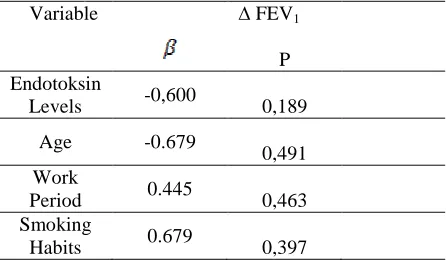
Table 9 Test Multiple Regression Analysis between Personal Endotoxin levels. Age, Period Work and against Smoking habits ∆ FEV1 Serum on Rice
Milling Operator Palur village Kebonsari Madison County 2015
Variable ∆ FEV1
P
Endotoksin
Levels -0,600
0,189
Age -0.679 0,491 Work
Period 0.445
0,463 Smoking
Habits 0.679
0,397
From Tables 8 and 9 show that the personal endotoxin levels, age, years of service and smoking habits and the effect on FVC ∆ ∆ FEV1 no effect on the rice mill operator (FVC ∆ β = -0.745 p = 0.014) and (∆FEV1 β = -0.600: p = 0.189)
Based on epidemiological studies in populations of farmers and workers in the cotton textile mill suggests a link between exposure to endotoxin response to acute changes in lung function, which will be accelerated decline in lung function and asthma Chronic nonalergi (Smit, et al., 2008; Eduard. Et al., 2004; Thorn, et al., 2001).
On examination pulmonary function involves at least two parameters, namely when 1 second forced expiratory volume (FEV1) and forced capacity (FVC). If FVC ≥ 80% and FEV1 / FVC ≥ 70% then said lung function within normal limits. If FVC <80% FVE1 / FVC ≥70% ritriksi said. If). If FVC ≥ 80% and FEV1 / FVC <70% then said lung function in a state of obstruction, if FVC <80% and FEV1 / FVC <70% then said lung function in a state of obstruction and ritriksik. It said if the obstruction of air pollutants that enter the respiratory tract mucus that causes narrowing will occur in the respiratory tract. While ritriksi describing lung development disorders due to the elasticity of the lung barrier. This dkarenakan incoming air pollutants accumulate into a fiber network in the alveolar wall so it cannot inflate the alveolar wall perfectly (Alsagaff, 2010)
[image:5.595.300.523.116.247.2]84 exposed to cement dust showed that age is a risk
factor for the occurrence of pulmonary function impairment. Also, in normal circumstances frequency age also affect breathing and lung capacity. Frequency of adults between 16-18 times per minute, at about 24 times per minute the child was breathing in infants 30 times per minute. Although the adult respiratory rate is smaller than the children and babies, but KVP in adults greater than children and infants.
In this study there is a relationship between the tenure of the pulmonary function with the direction of the relationship positive by value β (β = 0818 p = 0.37) it is not in accordance with the theory that long working period determines a person's exposure to the risk factors of lung function decline, According to Naini 2009 that the respirable dust also take a long time to cause respiratory problems, as well as the sensitiveness of workers to pollutants. At the time the study was not more specific categorized working lives and does not categorize the workplace exposure more specifically which categories of exposure to light, medium and high so this is a limitation of the study.
In this study there is a relationship between smokings to lung physiology in a positive direction β relationship. With value (β = 1.606 p = 0.007) this is not in accordance with the theory according Mengkidi 2006 workforce smoking and dusty environments are prone to respiratory disorders compared to workers who are in the same environment do not smoke. It is also according to Gold et al, 2005 which states that smoking in workers exposed to dust increase the possibility of occurrence of pulmonary function impairment.
This can happen due to the limitations of the study were not examined physical exercise habits that can affect the results of the study in accordance with the theory put forward by Sumosardjuno, 1992 which states that smoking or working in a place where the air is polluted, will occur emphysema on lungs. But if exercising in the lungs will become stronger and protected from emphysema.
Based on this limited number of researchers also did not examine superoxide dismutase, catalase ROI scavenger (phenolic glycolipid sulfatides, liporabinomanna), a key concept in theory antibacterial effector mechanisms activated macrophages include: producing NO, ROI, murder intrafagosom, acidification of the phagosome, the phagosome- lysosome fusion and reducing supply Fe, while efforts avoidance of microorganisms on the immune response, among others: producing molecules that damage ROI, among others: superoxide dismutase, catalase ROI scavenger (phenolic glycolipid sulfatides, liporabinomanna)
4. CONCLUSION
The results showed that the mean age of 35.64 years old workers, the average working period of 5 years, 63.6% are moderate smokers. After working 8 L. Analysis using multiple regression test showing
that There is the influence of LPS endotoxin exposure to the increase in C-RP serum respondents where β = 0.543 and p = 0.013. so that it can be concluded increased levels of endotoxin LPS will increase serum levels of C-RP respondents while working lives affect the increase in serum levels of C-RP respondents like β = 0, 607: p = 0.033. The longer the tenure effect on the increase in serum levels of C-RP. While age, smoking does not affect the increase in serum levels of C-RP.
Based on the results of this study indicate that personal endotoxin levels, age, years of service and smoking habits and the effect on FVC ∆ FEV1 no effect on the rice mill operator (FVC ∆ β = -0.745 p = 0.014) and (∆FEV1 β = - 0,600: p = 0.189)
To reduce the occurrence of health problems, especially respiratory disorders of the rice mill workers caused by exposure to endotoxin should bear in rice miller seeks to provide protective equipment types No power Air Purifying Respirator or (NAPR) N Series (Not resistant to oil) to protect workers against exposure to endotoxin PS seta repairing ventilation systems, lighting and cleanliness of the work space. And it would need to conduct periodic checks of the respiratory symptoms and pulmonary function primarily (∆ FEV1 and ∆FVC) in order to know at an early workers who are at risk for health problems, especially respiratory disorder.
REFERENCES
[1] Alsagaff H., MuktyH.A ., 2010 Dasar-Dasar Ilmu Penyakit Paru, Surabaya:Airlangga University Press.
[2] Agusnar. (2012) .Debu dan Penurunan Faal paru. USU Press.
[3] Aminatus S, 2013. Peningkatan C-Reactive Protein Serum Pada Pekerja Terpapar Debu Kapuk Yang Mengandung Endotoksin Lipopolisakarida ( Studi Longitudinal di Industri Kapuk Desa Mojotengah dan Puskesmas pembantu Desa Mojotengah kecamatan Sukorejo Kabupaten Pasuruan)
Skripsi.Surabaya. UNAIR Postgraduate.
[4] Baratawidjaja GK. dan Rengganis I., 2012.
Imunologi Dasar. Ed 10, Jakarta: Penerbit
FK-UI, hal. 28-283.
[5] Brooks, G F., Butel., J S dan Morse, S A., 2008.
Mikrobiologi Kedokteran Jawetz, Melnik,&
Adelberg. Jakarta :ECG
[6] Dhillon SK., Roopam B and Harkirat, 2011 A Study of Lung Function Abnormalities in Workers of Rice: Indian Journal of Fundamental and
Applied Life Sciences ISSN: 2231-6345 2011 Vol.
1 (3), pp. 217-220 Mills.
[7] Du Clos TW., 2000. Function of C-reaction protein: Ann Med. hal 174 – 8.
[8] Eduard W, Pearce N, Douwes J, 2009 Chronic bronchitis, COPD, and lung function in farmers the role of biological agents. Jurnal PubMed;
85 [9] Gold, Diane., Xiaobin Wang., Wypij, David; et al.,
2005 Effect of cigarette smoking on lung function
in adolescent boys and girls. NEJM. Vol. 335 No.
13 . 2005 : 1 – 4
[10] Gosh T., Somnath G., Banibrata, 2014 Prevalence of Respiratory Sumptoms and Disorders Among Rice Mill Workers in India :
Environ Health Prev Med 2014 May
8;19(3):226-33.
[11] Heederik, D., Douwes, J., Wouters, I., Doekes, G. 2000. Organic dusts: beyond endotoxin. Inhalation Toxicol. 12(suppl. 3): 27-33. [12] Ikawati Z. 2011. Penyakit sistem pernafasan dan tatalaksana terapinya. ed 1, Yogyakarta : penerbit Bursa Ilmu. Hal: 17-28
[13] Khumaidah 2009 Analisis Faktor-Faktor Yang Berhubungan Dengan Gangguan Fungsi Paru Pada Pekerja Mebel PT Kota Jati Furnindo Desa Suwawal Kecamatan Mlonggo Kabupaten Jepara. tesis, Undip, Program Studi Kesehatan Lingkungan.
[14] Kirkhorn, S. R., and V. F. Garry. 2000. Agricultural lung disease. Envomental . Health Perspective. 108(4):705
[15] Leader D 2014., Factors That May Influence You Spirometry Results. Spirometry Results Highly Dependent Upon Patient and Technician Updated October 26.
[16] Lusno MF., 2013 Peningkatan Kadar Endotoksin LPS Dalam Debu Penggilingan Padi Dan Pengaruhnya Terhadap Penurunan Faal Paru dan peningkatan Kadar IL-8 serum darah Operator ,Thesis,Surabaya. UNAIR Postgraduate.
[[17] Lestari., F., 2010 Bahaya Kimia: Sampling &
Pengukuran Kontaminan Kimia di Udara ,
Jakarta:ECG.
[18] Levitzky M.G., 2007 Pulmonary Physiology, 7th Edition. McGraw-Hill Companies inc, USA.p 54-57.
[19] Mengkidi D., 2006 Gangguan fungsi paru dan faktor-faktor yang Mempengaruhi pada Karyawan PT. Semen Tonasa Pangkep Sulawesi Selatan. Semarang, Tesis, Universitas Diponegoro. [20] Naini, I., 2009. Pajanan Debu Kapuk (PM10) dengan kejadian ISPA pada pekerja Industri Kapuk Di Kecmatan Bukit Kecil Kota Palembang Tahun 2009. Skripsi. Depok;Universitas Indonesia. [21] Notoatmodjo, Soekidjo 2003. Ilmu Perilaku
Kesehatan. Rineka Cipta.Jakarta.
[22] Pudjiastuti, W, 2002. Debu Sebagai Bahan Pencemar yang Membahayakan Kesehatan Kerja. Jakarta : Pusat Kesehatan Kerja Depertemen Kesehatan RI.
[23] Pusparini D.C., Oktavianie Ayu A.D., 2012 .Kadar Malondialdehida (MDA) dan Gambaran Histopatologi Organ Paru pada Hewan Model Tikus (Rattus norvegicus) Asma dengan Induksi Lipopolisakarida. Thesis.Semarang: Universitas Diponegoro Postgranduate.
[24] PrakashS., Manjunatha S and Shashikala C. 2010. Morbidity patterns among rice mill workers: A cross sectional study. Indian Journal of
Occupational and Environmental Medicine ;
14(3): 91–93.
[25] Retnowati E., 2005. Aplikasi Klinis Pemeriksaan High Sensitivity C-Reactive Protein (HS-CRP). Buuletin PS PATKLIN. Surabaya. [26] Schwartz DA., 2010. Endotoxin Exposure
and Asthma.epa goverment Children.
[27] Sears,B W., Spear,L., dan Saenz, R., 2011. Intisari mikrobiologi dan Imunologi. Jakarta:ECG. [28] Smit L., AM., Heederik G., Doekes, E,J.M., Krop, G.T., Rijker, and I.,M. Wouter., 2009. Exvivocytokine release reflects sensitivity to occupational endotoksin expose, Env Respir
J;34:795-802.
[29] Sukis, 2012. Perbedaan Kadar Seng, Kadar C-RP dan Tingkat Konsumsi Protein pada Balita Anemia dan Tidak Anemia Usia 24-40 bulan di kota Surabaya. Tesis Suarabaya, Universitas airlangga;26.
[30] Sumosardjuno S, (1992) Pengetahuan Praktis Kesehatan Dalam Berolahraga Jakarta: Gramedia. [31] Suyono, Joko. 2001. Deteksi Dini Penyakit
Akibat Kerja.Jakarta: EGC.
[32] Todar, Kenneth. 2012. Bacterial Endotoxin. [33] Thorn J., 2001 The Inflammatory Response
In Humans After Inhalation Of Bacterial Endotoxin: A Review. Journal Inflamm Res. 50 (5): 254-61.