A N E W A P P R O A C H
T O E X P E R T S Y S T E M
E X P L A N A T I O N S
R e g i n a B a r z i l a y t, D a r y l McCullough*, O w e n R a m b o w * J o n a t h a n DeCristofaro$, T a n y a Korelsky*, Benoit Lavoie*
* C o G e n T e x . I n c .
t D e p a r t m e n t • o f C o m p u t e r Science, • C o l u m b i a University D e p a r t m e n t of C o m p u t e r Science , University of D e l a w a r e
C o n t a c t : o w e n © c o g e n t e x , com
1 Expert System Explanation
Expert systems were one of the first applications to emerge from initial research in artificial intel- ligence, and the explanation of expert system reasoning was one of the first applications of natural language generation3 This is because the need for explanations is obvious, a n d generation from a knowledge-based application such as reasoning should be relatively straightforward. However, while explanation has been universally acknowledged as a desirable functionality in expert systems, natural language generation has not taken a central place in contemporary expert system devel- opment. For example, a popular.text book about expert systems such as (Giarratano and Riley, 1994) stresses twice i n the introduction the importance of explanation, but provides n o further mention of explanation in the remaining 600 pages. (The book is based on the popular CLIPS framework.) In this paper, we present a n e w approach to enhancing an expert system with an explanation facility. The approach comprises both software components and a methodology for assembling the components. T h e methodology is minimally intrusive into existing expert system development practice.
This paper is structured as follows. In Section• 2, we discuss previous work and identify shortcom- ings. We present our analysis of knowledge • types in Section 3. Section 4 presents the •Security Assistant and its explanation facility. Finally, we sketch a general methodology for explainable expert system engineering in Section 5 .
2
P r e v i o u s W o r k
A very important early result (based on experiences with explanation 2 in systems such as MYCIN (Shortliffe, 1976)) was the finding that "reasoning strategies employed by programs do not form a good basis for understandable explanations" (Moore, 1994, p.31). Specifically, simply paraphrasing the chain of reasoning of the expertsystem d o e s n o t let a human user easily understand that reasoning.
Two separate approaches have been proposed to address this problem:
• In the E x p l a i n a b l e E x p e r t S y s t e m (EES) approach (Swartout et al., 1991; Swartout a n d Moore, 1993), the knowledge representation used by the expert system is enriched to include explicit "strategic" knowledge, i.e., knowledge about how to reason, and domain-specific knowledge. From this knowledge, the rules used by the expert system are compiled, and this knowledge is also used to provide more abstract explanations of the system's reasoning.
• In the R e c o n s t r u c t i v e E x p l a i n e r (Rex) approach (Wick, 1993), the expert system is un- changed, but after it has performed its reasoning, a causal chain for explanation is constructed from the input data to the conclusion reached previously by the expert system as a separate process. The work of (Tanner et al., 1993) can also be seen as falling in this paradigm, since a separate representation of knowledge (the "functional representation") is used only for explanation, and the explanation must be specially derived from this.
These approaches have in common a preoccupation with a categorization of knowledge used in the system into different types. E E S concentrates on an abstract representation of strategic knowledge (how does a particular action of the system relate to the overall goal?) and on the representation of design rationale (why are actions reasonable in view of domain goals?). In addition, there is terminological domain knowledge (definitions of terms). Rex and related approaches have a representation of domain knowledge, along with domain rule knowledge (mainly causality), which is completely separate from that used by the expert system itself. This knowledge is used to derive an "explanation path" through the domain knowledge representation.
There are problems with both approaches. EES has not proven to be a fully satisfactory solution to the problem of expert system explanation. The problem is that the writers of expert systems have not been too quick or too eager to adopt frameworks such as EES. The requirement for a more abstract representation of knowledge (from which the actual expert system rules are compiled) that EES imposes may be considered onerous by the expert system developer, appearing unmotivated from the point of view of the core functionality of the system, namely reasoning (as opposed to explanation). Presumably, it is difficult for one and the same person to be a domain expert and a expert on communication in the domain.
In the Rex approach, the obvious problem is that in order to generate an explanation, additional reasoning must be performed which in some sense is very similar to that done by the expert
system itself (e.g., finding causal chains). This is redundant, and does not result in a clear sep- aration between reasoning and explanation. While Wick (1993) argues against such a separation on philosophical grounds, practical constraints suggest, as indicated above, that the domain expert responsible for implementing the reasoning system shouldnot also be responsibl e for implementing
the explanation capability, and that the communication engineer (responsible for implementing the explanation facility) should not need to replicate domain reasoning.
In this paper, we present a new approach (architecture and methodology) to expert system ex- planation which does not require the expert system writer to take into account the needs of the explanation while writing the rules. At the same time, we avoid the necessity of having a separate domain reasoning component for the explanation generation. Instead, the expert system is largely considered a stand-alone application, onto which explanation is added. However, this is done b y having a communication enginee r design a second knowledge representation (separate from the expert System's domain • knowledge representation) specifically for the purpose of communicating explanation s. This representation is instantiated by the expert system as it reasons, not by a separate module after reasoning has occurred. Thus, no separat e reasoning facility is needed.
3
Types of Knowledge in Explanation•
We follow previous work in distinguishing different types of knowledge. However, use operational criteria: we classify knowledge by what it is used for and who is responsible for its engineering, not by its structure or contents. We briefly present our classification here and illustrate it on a n :example in the following section.
• R e a s o n i n g d o m a i n k n o w l e d g e (RDK). This is knowledge about the domain needed to perform the reasoning. Typically, it includes rules, terminological knowledge, and •instance knowledge.: It is encoded by the domain expert in the expert system proper.
• C o m m u n i c a t i o n d o m a i n k n o w l e d g e (CDK). This is knowledge about the domain which is needed for communication about t h e domain. It typically is a different "view" on the • domain knowledge than RDK, and may include additional information not needed for the
reasoning itself. It is encoded by the communication engineer in the explanation facility.
• D o m a i n c o m m u n i c a t i o n k n o w l e d g e (DCK). This is knowledge about how to communi- cate in the domain. D C K typically includes strategies for explanation in the given domain, and knowledge how to describe the entities of the domain. It is encoded by the communication engineer in the explanation facility.
The distinctions may at first seem overly fine-grained. However, each type of knowledge is dis- tinguished from the other types. CDK is domain knowledge, but it is'domain knowledge that is needed only for communication, not for reasoning (as is RDK). RDK and CDK of course overlap, but they are not identical. T h i s is in fact the lesson from much previous work in expert system explanation, for example the work of Paris et al. (1988)contrasting "the line of reasoning" and "the line of explanation", a n d the claim of Swartout et al. (1991) that the domain representation must be augmented with additional knowledge about the domain and about reasoning in the do- main. Many researchers have identified the need for packaging domain knowledge differently for
I
communication. For example, the "views" of Lester and Porter •(1997) can be seen as a form of CDK, though they are not a declarative representation. What is new in our work, however, is the proposal that CDK should be represented explicitly in a distinct representation from the domain knowledge. 3
CDK is different from DCK in that CDK is knowledge a b o u t the domain as it is needed for communication, but DCK is knowledge about how to communicate in that domain (and in a specific communicative setting characterized by factors as diverse as communication type or genre,• hearer needs, communication medium, or cultural context). Therefore, for expert system explanation applications, CDK is conceptual knowledge (what conceptual content must be conveyed to the user to explain system reasoning effectively?), while DCK is knowledge about language use (how do we use linguistic acts to explain system reasoning effectively?). 4 DCK may b e expressed in communicative plan operators which achieve goals related to the hearer's cognitive state, while CDK would never include plan operators related to the hearer's cognitive state because the hearer is not part of the domain of the expert system.
4
The Security Assistant
The Security Assistant or SA (Webber et al:, 1998) is part of the DesignExpert tool (Ehrhart et al., 1998), which helps software engineers analyze system-wide(or "non-functional") requirements such as security, fault-tolerance, and human-computer interaction. The SA aids a software engineer in • Choosing security measures to protect valuable system assets (e.g. important data) against likely threats (e.g. disclosure or corruption). In the following three subsections~ we discuss how the three types of knowledge discussed in the previous section - RDK, CDK, and DCK, are represented and used in the SA.
4.1 T h e E x p e r t S y s t e m : R e a s o n i n g D o m a i n K n o w l e d g e
The SA first queries the user for information about entities of the system to be analyzed, such as system assets, system components, and system sites, and the damage types that are of concern for these entities. Additional damage types are inferred for each important asset •of a system (e.g. data can suffer from disclosure or corruption). Th e system then reasons about possible defenses that
SWhile CDK is closely related to
content selection,
it should not be equated with content selection, which is often seen a s the first t a s k in text planning (followed by content ordering). Content selection is entirely oriented towards the anticipated act of communication, and hence defined by its parameters: w h a t the communicative goal is, What the m e d i u m is, who the hearer is, and other constraints (length of communication, and so on). CDK is knowledge needed for content selection, but excludes all choices t h a t d e p e n d on knowledge of the intended act of communication. For example, CDK might •include relative salience between domain objects, b u t does not include information a b o u t how salient an object needs to be in order to interest the hearer. However, we a d m i t t h a t t h e distinction may be blurred, especially in implementations.directly prevent these damage types. If no single complete defenses can be found, the SA determines all attack methods which can cause t h e damage, and then deduces all enabling conditions for such attacks. It subsequently determines defenses that prevent such enabling situations. This reasoning can then be iterated. The result of the SA's reasoning is a list undefended assets and, for each such asset, a a list of recommended defenses.
Fo r example, suppose direct modification by a malicious user has been identified as a possible • damage to a system asset (say, a database), and t h a t the SA can determine no immediate defense against direct modification (for example, it is impossible to disable all editors). Modification is 0n!y: possible after the malicious user has gained illegal access to t h e system. In this case, we would say that illegal access enables modification. A defense against illegal access is therefore also a defense
• against modification. .. .... " •
The knowledge needed fo r reasoning is expressed in the usual manner as production •rules which, if the conditions are met, assert the existence of new •damages, defenses, enabling conditions, and so
O n .
• f..
I ' = - " i < I id .. / <
I L I < >~--"- --
:
~t . ~' (
"prevent~
,L:.,o,.'" I I
r
L
I $ l°h'"¢t*'i~i I I I'
.,i, 1
, - -
" ~ .'t .
I,;:.'::,""'°°:"i °"
I I " I ¢ ' - - ~ I " i " "
csblse8
enaDles
s4
[Vp,prevet)t l
Defense I /
I_J
agent
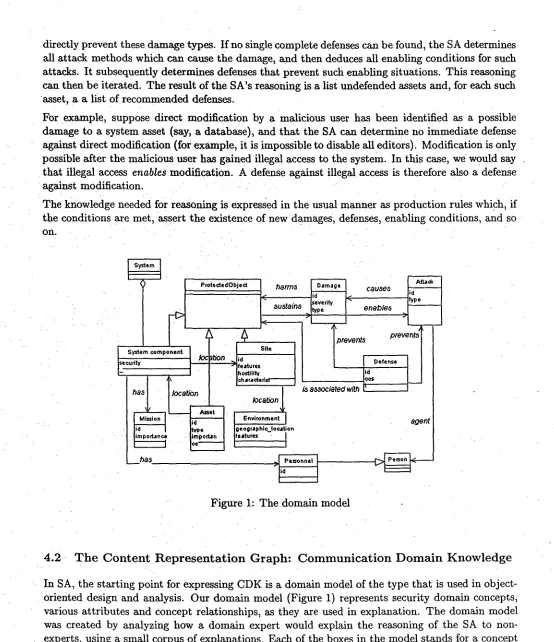
Figure h The •domain model
4 . 2 ' T h e • C o n t e n t R e p r e s e n t a t i o n G r a p h : C o m m u n i c a t i o n D o m a i n K n o w l e d g e
In SA, the starting point for expressing CDK is a domain model of the type that is used in object- oriented design and analysis. Our domain model (Figure 1) represents security domain concepts, various attributes and Concept relationships, as they are used in explanation. The domain model was created by analyzing how a domain expert would explain the reasoning of the SA to non- experts, using a small corpus of explanations. Each of the boxes i n the model stands for a concept in th e security domain, a n d inside these •boxes are attributes associated with the concept. Arrow-
[image:5.612.27.581.65.707.2]tipped edges represent relations between concepts in the domain model Database, triangle-tipped edges represent is-a relations and diamond-tipped edges are has-a relations. Some: examples:
• Defense objects have id (name) and cost attributes;
• Damage objects have id, severity and type attributes;
• prevent is a relation that holds between a Defense instance and a Damage instance;
• Site, Asset and System component are different sub-classes of ProtectedObject; • A System consists of one or more system components. : . . .
The CDK expressed in this domain model has no role in the expert syste m reasoning. In •fact, during the reasoning process, the expert system models the relations as primary objects, and the concepts of our domain model are merely slots of the relations in the expert system. As a result, the relations typically are n o t binary, but n-ary. In contrast, the domain model contains only binary relations. This reflects, we claim, the difference between the optimal way of representing knowledge for machine reasoning, a n d the way in which humans model the world (which is what the CDK domain model captures). As an example of the difference • in relations, the relation that corresponds to the CDK domain model's prevent relation between Defense and Damage corresponds to, in the reasoning component, a.quintary relation between the defense, the location of the defense, the damage it prevents, the locations at which it prevents the damage, and the damages that negate the defense. Another example i s the likely_attack_method relation used in RDK (and its structural. clone, the possible_attack_method relation) of the reasoning component, which is a ternary relation between an asset, a location, and an attack method. As can be seen from the domain model diagram, this relation is not modeled in CDK at all.
Knowledge about d o m a i n Concepts and relationships is not sufficient for generating an expressive explanation. Additional C D K is required in order to select and organize content according to ex- Planation type and length limitation. The domain model is therefore augmented with the following information.
Importance level, which is defined for every relation and attribute. This information about relative importance of attributes a n d •relations enables us to produce explanations of different length. For example, the relation prevent between Defense and Damage has higher impor- tance level than the relation have between SystemComponent and Mission. • In o u r domain model, we use a two-valued scale.
A key attribute for each concept which is required in instances of the concept and which identifies an instance of the concept. For example, id is a key attributes for Site but Hostili- tyCharacteristi¢ is not a key attribute.
Mutual dependencies among concept relations and attributes. T h i s information covers cases in which a particular relation or attribute can be presented only if some other relations or attributes are presented. For example, the relation prevent between Defense and Attack
• Order among relations and order among attributes of the same concept, namely in what order should relations of the concept be presented, e.g. for concept damage arc goal is ordered before
arc enable.
• Meta-relations between relations of the same concept. For example, there is a meta-relation purpose between (Defense prevent damage) and (Defense is associated with ProtectedObject).
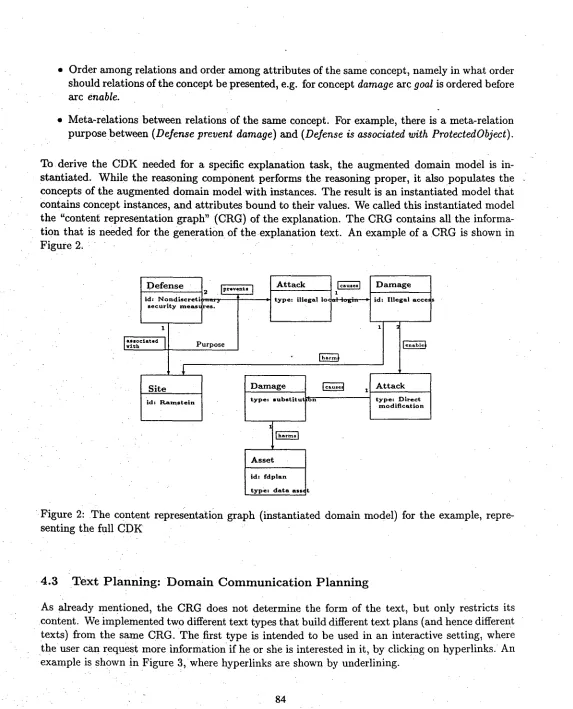
T o derive the CDK needed for a specific explanation task, the augmented domain model is in- stantiated. While the reasoning component performs the reasoning proper, it also populates the concepts of the augmented domain model•with instances. The result is an instantiated model that contains concept instances, and attributes bound to their values. We called this instantiated model the "conten~ representation graph" (CRG) of the explanation. The CRG contains all the informa- tion that is needed for the generation of the explanation text. An example of a CRG is shown in Figure 2,
Oe ense" =
" .•
|2 .V "-'~--- ]IAtta i
IOamage t
id; s e c u r i t y m e a s u r e s . N o n d l s c r e t i y [ ~ . . . j ~ . t y p e : illegal Io ~ ; ~ ; ~ ~I - id: Illegal a e c e s
vi~h Purpose
II
',l Attack
Site
.Damage
"id: P ~ a m s t e i n | t y p . . . . b s t i t u t ~ n t y p e : D i r e c t
• m o d i f i c a t i o n
Asset
• 1
id: f d p l a n
t y p e : d a t a ass t
F i g u r e 2: T h e content representation graph (instantiated domain model) for the example, repre- senting the full C D K
4 . 3 T e x t P l a n n i n g : D o m a i n C o m m u n i c a t i o n P l a n n i n g
As already mentioned , the CRG does not determine the form of the text, but only restricts its • content. We implemented two different text types that build different text plans (and hence different texts) from the same CRG. T h e first type is intended to be used in an interactive setting, where t h e user can request more information if he or she is interested in it, by clicking on hyperlinks. An
e x a m p l e i s shown in Figure 3, where hyperlinks are shown by underlining.
84
I
i!
!
[image:7.612.25.598.45.754.2]Nondiscretionary security measures are required on the Ramstein site.
• Which d~.mage do nondiscretionary security measures prevent?
• Which assets do nondiscretionary security measures protect?
Figure 3: The interactive hypertext
Nondiscretionary security measures are required on the Ramstein site in order to prevent substitution of data asset "ftdplan'. T h e s e measures prevent substitution because they prevent illegal local login to the Ramstein system, which may enable illegal access. Illegal access may enable direct modification of data asset "ftdplan", a n d direct modification may cause substitution.
I
I
I
I
I
I
I
I
I
I
I
Figure 4: The fluent, hyperlink-free text
However, for the DesignExpert application it is also necessary to generate explanations that are free of hypertext for inclusion in printed documents. • These texts must include the entire explanation at a level of detail appropriate for t h e kind of expected reader. An example is shown in Figure 4. In order to create hyperlink-free explanation text, the CRG must be traversed according to constraints at •every nodes: which attributes to use to describe the object, which relations of this object with other •object must be presented in explanation, in what order to present t h e relations and what are -meta-relationship between them. The planner processes every graph edg e according to specified
order, and structures resulting phrases with resPect to meta-relations.
For both text types, we used a text planner with a declarative formalism for text plan specification ' which directly expresses the DCK (Lavoie •and Rambow, i998). Other representations of domain- specific text planning knowledge could also have been used, and we omit details of the formalism here.
5 Methodology
We propose the following methodology for developing an explainable expertsystem. We assume three roles, that of the domain expert (where "domain" refers to the domain of the expert system, such as computer security or infectious diseases), knowledge engineer (a specialist in eliciting and representing domain models, specifically in the form of expert systems), and a communication engi- neer (a specialist in analyzing and representing the knowledge needed for efficient communication).
1. The knowledge engineer creates the expert system in consultation with the domain expert, Using any sort of tool or shell and any sort of methodology that are convenient.
[image:8.612.38.579.51.781.2]2.
.
The domain expert writes several instances of (textual) explanations of the type needed for • the application in question, based on scenarios that the expert system can handle.
The communication engineer analyzes the corpus of hand-written explanations along • two
lines:
• The domain concepts that are reported in the text are analyzed and •recorded using an object-oriented modeling technique, perhaps augmented by more expressive• constructs, such as meta-relations (relations between relations). This Structure is the content rep- resentation graph, represents the CDK (both• the augmented domain model and its " instances).
• . The structure of the text is recorded using some notation for discourse structure suitable for the text planner being used in the text generator (say, RST (Mann and Thompson, 1987)).
4. Using the CDK representation, the communication engineer consults With the domain expert and the knowledge• engineer to define a mapping from the domain representation used by the.expert system to the CDK domain model devised by the communication engineer. The communication domain•knowledge representation may be modified as a result.
5: The knowledge engineer adds rules to t h e expert System that instantiate the communication domain knowledge representation with instances generated during the reasoning process.
6. The communication engineer designs a text planner that draws on the knowledge in the CDK representation and produces text. This task involves the creation of an explicit representation
of DCK for the domain and task (and genre)at hand.
• The resulting system is modular in terms of software modules. The expert system is preserved as a Stand-alone module (though its rule base has been somewhat extended to identify communication domain knowledge), as is the text planner. Both modules can be off-the-shelf components. Only the CDK representation is designed in a task-specific manner, but of course standard •knowledge representation tools, object-oriented data bases, or the like can be used.
In addition, the methodology is modular in terms of tasks and expertise. The domain expert and • knowledge engineer do not need to learn about communication , and the communication engineer
does not: need to understand the workings of the expert system (though she does need to understand the domain well enough in order to design communication strategies for it, of course).
:6 • C o n c l u s i o n
i We have presented an approach to expert system explanation which is based on a classification of types of knowledge into reasoning domain knowledge, communication domain knowledge, and domain communication knowledge. We have argued that this distinction, in addition to being theoretically appealing, allows us to better manage the software engineering asPeCt of explainable
expert system development.
I
I
I
I
I
I
I,
I
I
l
I
I
l
l
l
I
l
l
l
While we think that our approach is well suited to explaining the reasoning of expert systems to users after t h e fact, the approach does not, at first glance, appear to lend itself very well to answers to "Why are you asking?" type questions from the user (as opposed to "Why are you recommending this?", which is what the SA answers). This is because the CDK is-not intended to: mimic the system's reasoning. However, it may be possible that the same kind of CDK can be used to answer questions before the reasoning is complete. We hope to investigate this in future work.
Bibliography
Ehrhart, L. S., Korelsky, T., McCu!lough , D., McEnerney , J., Overmyer, S., Rainbow, O., Webber, F., Flo, R., and White, D. (1998). DesignExpert: A knowledge-based tool for developing system-wide properties. Submitted. •
Giarratano, J. and Riley (1994). Expert Systems: Principles and Programming. PWS Publishing Company, Boston.
Kittredge, R., Korelsky, T., and Rambow, O. (1991). On the need for domain communication knowledge.
Computational Intelligence, 7(4).
Lavoie, B. and Rainbow, O. (1998). A framework for customizable generation of multi-modal presentations.
In 36th Meeting of the Association for Computational Linguistics (A CL '98), Montr6al, Canada. ACL. Lester, J. C. and Porter, B. W. (1997). Developing and empirically evaluating robust explanation generators:
The KNIGHT experiments. Computational Linguistics, 23(1):65-102. "
Mann, W. C. and Thompson, S. A. (1987). Rhetorical Structure Theory: A theory of text organization. Technical Report ISI/RS-87-190, ISI.
McKeown, K. (1985). Text Generation. Cambridge University Press, Cambridge. Moore, J. (1994). Participating in Explanatory Dialogues. MIT Press.
Paris, C., Wick, M., and Thompson, W. (1988). The line of reasoning versus the line of explanation. In
• Proceedings of the 1988 A A A I Workshop on Explanation, pages 4-7.
Paris, C. L. (1988). Tailoring object descriptions to a user's level of expertise. Computational Linguistics,
14(3):64-78.
Shortliffe, E. H. (1976). Computer-Based Medical Consultations: Mycin. American Elsevier, New York. Swartout, W. and Moore, J. (1993). Explanation in second generation expert systems. In David, J.-M.,
Krivine, J.-P., and Simmons, R., editors, Second Generation Expert Systems, pages 543-585. Springer Verlag.
Swartout, W., Paris, C., and Moore, J. (1991). Design for explainable expert systems. IEEE Expert,
6(3):59-64.
Tanner, M. C., Keunecke, A. M., and Chandrasekaran, B. (1993). Explanation using task structure and domain functional models. In David, J.-M., Krivine, J.-P., and Simmons, R., editors, Second Generation Expert Systems, pages 586-613. Springer Verlag.
Webber, F., McEnerney, J-i and Kwiat, K. (1998). The DesignExpert approach to developing fault-tolerant and secure systems. I n 4th Int'l Conf. on Reliability and Quality in Design.
Wick, M. R. (1993). Second generation expert system explanation. In David, J.-M., Krivine, J.-P., and Simmons, R., editors, Second Generation Expert Systems, pages 614-640. Springer Verlag.