Two-Stage Bootstrapping for Anaphora Resolution
Balaji J, T V Geetha, Ranjani Parthasarathi, Madhan Karky
Dept. of CS E & IS T,
Anna University, Chennai- 600 025
Abstract:
In this paper, we propose a two-stage bootstrapping approach to resolve various anaphora representing persons, places, plura ls and events in Ta mil te xt. The e xisting approaches dealt with only single pronoun type and not all anaphora using common approach. Moreover, most of the approaches concentrate on syntax- based algorith ms and semantics to some e xtent. Instead in our approach, we tackle various types of pronouns using a semi-supervised bootstrapping approach with uniform pattern representation and by e xploring the semantic features in resolving anaphors. In order to aid the se mantics, we use Un iversal Networking Language (UNL ), a deep se mantic representation for resolving various types of pronouns. The two stages of our bootstrapping approach consists of identification of anaphora and its set of referring e xpressions in stage 1 and identification of correct antecedent of a pro noun in stage 2. In our approach two patterns are defined – one for anaphora and other for set of refe rring e xp ressions. In addition, we introduce triggering tuples, which can be word based semantics or context based semantics, represented in the pattern of both anaphora and referring e xp ressions so as to resolve the ambiguit ies during the identification of correct antecedent. The performance of our bootstrapping approach gives better results and proved.
1.
Introduction
Anaphora Resolution commonly ca lled Pronoun resolution is a problem of finding references in the previous utterances of a p ronoun. The refe rences can be noun, noun phrase, verb phrase and/or clause. The main aim o f anaphora resolution is to find the correct antecedent of a pronoun fro m the set of re ferring e xp ressions. The antecedent of a pronoun is identified by the set of features such as number gender agreement features, grammatica l relat ions for person pronouns and verb predicates for plural and event pronouns .
Popular syntax-based approaches include Centering theory (Brennan et al, 1987) and Hobb’s algorith m (Hobbs, 1978) in wh ich the both the algorithms a re used to resolve person pronouns using agreement features and gra mmat ical ordering of re lations . The verb predicate feature has been used to identify event pronouns using a composite kernel method (Bin et al, 2010) . In addition, rule -based has been attempted to resolve personal pronouns. The rules do not fit to resolve entire pronoun resolution task. In contrast, machine learn ing approaches have also been attempted to resolve person pronouns automatically. In particula r, most of these techniques dealt with resolving only person pronouns and in some cases plurals and event pronouns (Chen et al, 2009).
In this paper, we propose a two-stage bootstrapping approach to resolve anaphora representing person, place, plura l and events automatica lly fro m Ta mil te xt. We define a uniform pattern to detect all types of pronouns while for re ferring e xpressions we define two types of patterns, one to tackle person and place pronouns and other to tackle plura l and event pronouns. To our knowledge, this is the first attempt to tackle all types of pronouns using a single bootstrapping fra me work. We introduce the concept of triggering tuples in both the patterns of anaphora and its corresponding referring expressions to identify the correct antecedent. In order to aid the semantic co mpatibility information in anaphora resolution, we use Un iversal Net working Language (UNL) (UNDL, 2012), a deep se mantic representation, to represent the referring e xpressions in the form of directed acyclic graphs. In this paper, the word level semantics and context leve l se mantics informat ion are utilized to resolve all the pronoun types. In addition, in order to generate new patterns, the semantic similarity of the antecedents is measured using the taxono my of semantic constraints called UNL Ontology (UNDL 2012). While in our previous rule-based approach, we use three UNL relat ion based rules to tackle plural and event pronouns, however in this work, we have generalized the semantic re lations to tackle more nu mber of instances.
The paper is organized as follows. Section 2 d iscusses the related works on pronoun resolution. Section 3 describes the semi-supervised learning – bootstrapping of pronoun resolution which includes features, pattern representation and different stages of bootstrapping in finding the antecedent of a pronoun and generation of new patterns. In section 4, we d iscuss the performance of our approach and compared with another bootstrapping system. Finally, we conclude our approach with future enhancements.
2.
Related Work
(Ba la ji2 et al, 2011). A robust rule based system has been applied to resolve personal pronouns, subject and dative pronouns in French in which the rules are based on agreement featu res and syntactic structure (Trouilleu x, 2002). A syntactic rule based Hobb’s algorithm has been used to resolve possessive and refle xive pronouns of Hindi language (Ka mlesh et al, 2008). In contrast to the rule based approaches, machine learning approaches such as conditional random fie ld (CRF) statistical model for chinese(Li & Shi, 2008), Ta mil (Murthi et al, 2007) have been attempted. A twin candidate based learning model has been proposed to resolve event pronouns in English in which the verb predicates are considered as antecedents (Bin et al, 2010).
In the e xisting approach (Bala ji2 et a l, 2011), various pronoun types have been resolved using a set of rules. However, rules have limited knowledge and do not provide accurate results for large set of sentences. In contrast, machine learn ing techniques focused on using syntactic features. to resolve person pronouns and co-reference chains in which the patterns defined are based on syntactic paths and word associations . Moreover, gender/number informat ion and semantic compatibility have been determined using a p robabilistic behavior (Bergsma et al, 2006). Another bootstrapping procedure for co-reference resolution us es word association information and are labeled using a self-trained approach (Kobdani et al, 2011).
However, the use of syntactic features and paths are difficu lt in re lative ly free -word o rder languages like Ta mil and the approaches described above consider only limited types of anaphora. In order to overcome these difficult ies , we propose a semi-supervised, two-stage bootstrapping procedure to resolve person, place, plural and event pronouns. The input to our bootstrapping fra me work is a set of UNL semantic graphs. The word level and context leve l informat ion obtained from UNL graphs is utilized to define the e xa mple patterns. We introduce various scoring schemes during the filtering of non -referring e xpressions, choosing the correct antecedent and, the confidence of tuples and dependency relations in resolving pronouns. In addition to the scoring, we measure the semantic similarity between the se mantic tuples of the referring e xpressions and propose a generalized procedure to learn new set coordinating and subordinating UNL relat ions to find the correct antecedent of a p ronoun along with the e xisting relations proposed in the existing work (Balaji2 et al, 2011).
3.
Bootstrapping for Anaphora Resolution
Bootstrapping is a task of iterative ly learning new patterns fro m un labeled data, starting with a sma ll labeled data fro m which the seed patterns are obtained. In this paper, we describe a two stage bootstrapping approach to resolve various types of anaphora. Our bootstrapping approach consists of two stages.
Stage 1: Extraction of anaphora and an associated set of referrin g expressions
Stage 2: Identification of the correct antecedent of the anaphora fro m the referring e xpressions obtained from Stage 1.
3.1
Features used for pattern representation in Anaphora Resolution
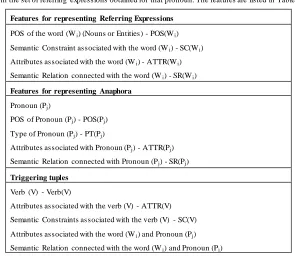
The triggering tuple helps the bootstrapping process to select the correct antecedent of a pronoun from the set of referring expressions obtained for that pronoun. The features are listed in Table-1.
Features for representing Referring Expressions
POS of the word (Wi) (Nouns or Entities) - POS(Wi) Semantic Constraint associated with the word (Wi) - SC(Wi) Attributes associated with the word (Wi) - ATTR(Wi) Semantic Relation connected with the word (Wi) - SR(Wi)
Features for representing Anaphora
Pronoun (Pj)
POS of Pronoun (Pj) - POS(Pj)
Type of Pronoun (Pj) - PT(Pj)
Attributes associated with Pronoun (Pj) - ATTR(Pj) Semantic Relation connected with Pronoun (Pj) - SR(Pj)
Triggering tuples
Verb (V) - Verb(V)
Attributes associated with the verb (V) - ATTR(V) Semantic Constraints associated with the verb (V) - SC(V)
Attributes associated with the word (Wi) and Pronoun (Pj) Semantic Relation connected with the word (Wi) and Pronoun (Pj)
TABLE 1 Features for resolving various types of anaphora
Fro m Tab le-1, we introduce a new concept called triggering tuples which are used to signal the correct antecedent of a pronoun from the detected set of referring e xp ressions. The triggering tuples are represented in the patterns of both referring e xp ressions and pronouns. The triggering tuples can be a set of word based features and context based features
3.2
Pattern representation
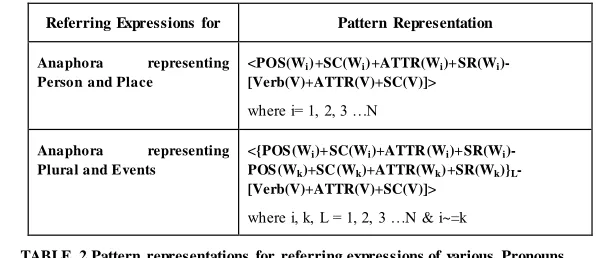
In our approach, patterns are defined with use the graph based features (including both word -based and context--based features. The pattern representation for the set of referring e xpressions corresponding to anaphora representing persons and places is different fro m the re ferring e xpressions corresponding to anaphora representing plurals and e vents and thus can be shown in table 2. However, it is to be noted that the pattern representation for anaphora is common to all anaphora types. The pattern representations are described in detail in the following sections .
3.2.1 Pattern representation for Anaphora
The pattern representation is generic to all types of anaphora. Based on the features mentioned in Table-1, the pattern of anaphora is defined as
where j = 1,2 ….N
3.2.2 Pattern representation for a set of Referring Expressions
As described earlier, the pattern representation for the set of referring e xpressions corresponding to anaphora representing persons and places is different fro m the refe rring e xpressions of plural and event anaphora which are shown in table 2.
Referring Expressions for Pattern Representation
Anaphora representing Person and Place
<POS(Wi)+SC(Wi)+ATTR(Wi)+SR(Wi )-[Verb(V)+ATTR(V)+SC(V)]>
where i= 1, 2, 3 …N
Anaphora representing Plural and Events
<{POS (Wi)+SC(Wi)+ATTR (Wi)+SR(Wi )-POS (Wk)+SC (Wk)+ATTR(Wk)+SR(Wk)}L -[Verb(V)+ATTR(V)+SC(V)]>
where i, k, L = 1, 2, 3 …N & i~=k
TABLE 2 Pattern representations for referring expressions of various Pronouns
3.3
Stage 1: Extraction of Anaphora and associated referring expressions
During this stage, anaphora and the associated possible set of re ferring e xpressions are identified and extracted. The refe rring e xpressions are e xtracted based on the triggering tuple represented in the pattern of anaphora. Moreover, in order to reduce the redundant expressions such as non -referring e xp ressions, a scoring function is introduced. This s coring is used to filter out non-referring expressions from the set.
3.3.1 Filtering of non-referring expressions
One of the important tas ks of anaphora resolution is to filter out non-referring e xp ressions that do not take part in resolving the anaphora type. The referring e xpressions of a pronoun can be nouns and entities. The non-referring e xpressions are usually filtered out using g rammatica l re lations (Brennan et a l, 1987). Instead of using the gra mmatica l o rdering for filtering out non -referring e xpressions, we use a scoring function for filtering. The scoring of referring e xpressions is based on the number of entit ies and/or nouns identified as re ferring e xp ressions for t he corresponding pronoun among the total number of re ferring e xp ressions along with the type of anaphora to be resolved.
Where REAs - set of refe rring e xpressions for a specific anaphora, An– all types of anaphora, REI - referring expressions where I = 1, 2, 3 …N, As - specific anaphora to be resolved
3.4
Stage 2: Identification of correct antecedent of a pronoun
During this stage, the correct antecedent of a pronoun is identified fro m the set of referring e xpressions obtained fro m stage 1 through the selection of co mplete patterns and partial patterns . The defined patterns represent the anaphora and the set of referring expressions. In order to choose the correct antecedent of a pronoun, the triggering tuples defined in the pattern are exploited using word based features and context based features .
3.4.1 Triggering Tuples
One of the important aspects of our bootstrapping approach is the use of triggering tuples to identify the correct antecedent of a pronoun. The idea behind the use of triggering tuples is to filter out the non-referring e xpressions among the set of re ferring e xpressions of a pronoun. In some cases, most approaches as discussed earlier failed to identify the correct antecedent of a pronoun. This is because the most popular algorith ms such as Centering theory (Brennan et al, 1987), Hobb’s algorithm (Hobbs, 1978) etc used in the e xisting approaches for resolving pronouns are syntax-based algorithms and not focused on the semantics of the word and /or context of a pronoun. However, Bin et al (2010) mod ified the centering theory by incorporating the semantic ro les to resolve the pronouns. This approach solves the problem to an e xtent but only for person pronouns and the problem re ma ins unsolvable in amb iguous cases (i.e. choosing an antecedent is amb iguous). Instead in our approach, this proble m can be resolved by e xa mining word based semantics and context based semantics. The fo llowing section describes the selection of correct antecedent of a pronoun.
3.4.2 Selection of comple te patter ns in i de ntifying the antece de nts of a c orrespondi ng pronoun
Identifying the correct antecedent of a pronoun is achieved by the selection of co mp lete patterns. The triggering tuples of the patterns of anaphora and its referring exp ressions play a vital role in identifying the correct antecedent of a pronoun. A probabilistic scoring of triggering tuples in the pattern of anaphora and its corresponding referrin g e xpressions set is determined. Based on the scoring, confidence of the instances are e xa mined and identified as an antecedent of a corresponding anaphora. The scoring of tuples is given below.
where ANAs – Antecedent of a specific anaphora, As - specific anaphora to be resolved, An– all types of anaphora, T – Triggering tuples , REI - referring expressions where I = 1, 2, 3 …
3.4.3 Selection of partial patterns to generate new patterns
The detailed analysis of semantic simila rity of constraints and, coordinating and subordinating relations are described below.
3.4.3a Semantic Similarity of Constraints
The semantic simila rity between constraints is useful in identify ing the anaphora representing places. As discussed above, adverbs such as ―ingu‖ and ―angu‖ along with its morphologica l variations can act as pronouns which represent places. Se mantic constraints such as city, town, sta te, country etc all rep resent places. However it is difficult to list all these semantic variat ions in a pattern. Instead a semantic abstraction of constraints is needed to tackle these variations. This is achieved by using the se mantic abstraction of the semantic constraints which is available through the semantic UNL ontology (UNDL, 2012). Se mantic similarity is measured by the distance between the parent semantic constraints in UNL Ontology and is given below.
Where Ci – Se mantic Constraint of refe rring e xpression obtained for an instance, Cj– Se mantic constraint of referring e xpression in an exa mp le pattern , Cparent– Parent semantic constraint in UNL Ontology, DIST – Distance measure
Ne xt, we will discuss the handling of coordinating and subordinating relations necessary to obtain the correct antecedent of a pronoun.
3.4.3b Coordinating and Subordinating UNL Relations
UNL relat ions obtained for refe rring e xp ressions that exact ly matches with the UNL re lation obtained for anaphors are coordinating UNL re lations and UNL re lations obtained for anaphors that infer the UNL re lations obtained for re ferring e xp ressions are subordinating UNL re lations (Ba la ji et al, 2011). In addit ion, we e xplo red more nu mber of coordinating and subordinating relations to resolve various pronouns. The specific rules on UNL relat ions are a lso generalized and thus the antecedent of a pronoun can be decided by
1. Partic ipant relations connected with pronoun that exact ly matches with Part icipant re lations connected with the referring e xpressions in the previous utteranc es. Here, the triggering tuple is a verb and its associated UNL attribute as unaccusative (NACC). Exa mp le shown below comes under this category and is resolved using the triggering tuples mentioned above. For example,
Ra m ba luva i a diththa an. Ava n a zhutha a n. Ra m hit Ba lu. He cried.
hit (agt>thing, obj>thing)
[agt] Ram (iof>person)
[obj] Balu (iof>person)
cry (obj>thing), NACC
FIGURE 2 UNL Graphs for the sentences “Ram hit Balu. He cried”.
The semantic constraints are shown in the braces and the relations connected with the corresponding concepts are shown in square brackets. The attribute ―NACC‖ represents the verb is unaccusative.
The participant re lation ―obj‖ connected with pronoun that exactly matches with the partic ipant relation ―obj‖ connected with the concept ―balu (iof>person)‖ in the previous sentence. Here , the triggering tuple is ―NACC‖.And thus the antecedent of a pronoun ―he‖ is identified as ―balu‖. Similarly the other conditions are applied to obtain the correct antecedent of a pronoun.
2. Partic ipant re lations connected with pronoun that infers the Partic ipant re lations connected with the referring e xpressions in the previous utterances. Here, the triggering tuples are transitive verbs and its associated information.
3. Modifier relat ions connected with pronoun that infers the Participant relations connected with the referring e xpressions in the previous utterances. Here, the triggering tuples are transitive verbs.
4. Location relations connected with pronoun along with the ―be‖ verb infers the Attribute relations connected with referring expressions in the previous utterances.
Using the conditions described above, the coordinating and subordinating relations are identif ied. In addition, new combination of re lations is learned fro m the above conditions and thus the correct antecedent of a pronoun is obtained.
5.
Evaluation
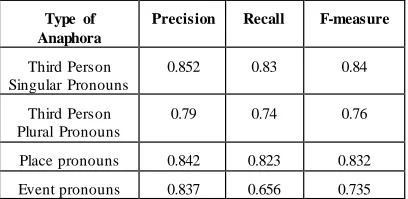
The performance of our bootstrapping approach is investigated using Tourism and News do ma in. We have considered 10000 sentences fro m each do ma in and tagged with the appropriate features such as POS, UNL attributes, UNL se mantic constraints and UNL relat ion. We have taken 1000 tagged sentences for tra ining data and e xtracted the most frequently occurred e xa mple patterns of each pronoun type. During this process we have identified 3025 person pronouns (singular), 2857 p lace p ronouns, 156 plu ral pronouns and 323 event pronouns. Out of these obtained pronouns, we have achieved the overall result of 84% accuracy. The precision, reca ll and F -measure for resolving pronouns are shown in the table below. Table -3 shows the precision of various types of pronouns resolved.
Type of Anaphora
Precision Recall F-measure
Third Person Singular Pronouns
0.852 0.83 0.84
Third Person Plural Pronouns
0.79 0.74 0.76
Place pronouns 0.842 0.823 0.832
Event pronouns 0.837 0.656 0.735
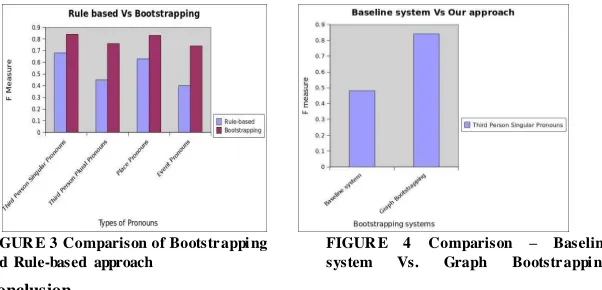
We have also compared our bootstrapping approach with the previous rule based approach (Ba la ji et a l, 2011). The co mparison is shown in Fig 3. Fro m the results, it is to be noted that our bootstrapping approach performs better than the previous rule based approach. Since the ru les are limited in our prev ious approach, the F-measure is low and this d ifficulty could be resolved in our bootstrapping approach. We have also compared our bootstrapping approach with the path coreference of (Bergsama et a l, 2006) which is a bootstrapping approach. The comparison of baseline system with our approach is shown in Fig 4. The parse tree for Ta mil sentences is constructed using the existing Ta mil parser (Sa ravanan et al, 2003). Fro m the results, it can be seen that the performance of our approach gives better results than the e xisting system and the f-measure of our approach is 84% when compared to the baseline system as 48%.
FIGUR E 3 Comparison of Bootstr appi ng and Rule-based approach
FIGUR E 4 Comparison – Baseline system Vs. Graph Bootstr appi ng
Conclusion
In this paper, a semi-supervised, two-stage bootstrapping approach has been described to resolve all types of anaphora. In stage 1, the anaphora and its referring e xpressions are identified and in stage 2, the correct antecedent of a pronoun is selected among the set of referring e xpressions of a corresponding pronoun. This two-stage bootstrapping approach uses two patterns – for anaphora and referring e xp ressions. Both the patterns consist of word based semantics and context based semantics. Moreover, a new concept called triggering tuples has been introduced in our bootstrapping approach so as to identify correct antecedent of a pronoun in case of amb iguities. The performance of our bootstrapping approach produces better results when compared to the baseline bootstrapping system. Further, we enhance this bootstrapping approach for identifying coreference entities by identifying more number of coordinating and subordinating relations.
References
Abney Steven, (2004), Understanding the yarowsky algorith m, Computa tiona l Intelligence, pages: 365-395
Ba laji J1, T V Geetha, Ran jani and Madhan Karky, (2011), MorphoSe mantic Features for Rule -based Ta mil Enconversion, Interna tional Journa l of Computer Applica tions 26(6):11-18, July 2011. Published by Foundation of Computer Science, New York, USA
Bergsma , Shane and Lin, Dekang, (2006), Bootstrapping path-based pronoun resolution, Proceedings of the 21st Interna tiona l Conference on Computa tiona l Linguistics a nd the 44th a nnua l meeting of the Associa tion for Computationa l Linguistics , ACL-44, Sydney, Australia, pages: 33--40
Bin, Chen and Jian, Su and Lim, Tan Chew, (2010), A twin-candidate based approach for event pronoun resolution using composite kerne l, Proceedings of the 23rd Interna tional Conference on Computa tiona l Linguistics, COLING '10, Beijing, China, pages: 188—196
Brennan Susan E, Marilyn W. Fried man , Carl J. Pollard, (1987), A centering approach to pronouns, Proceedings of the 25th a nnual meeting on Associa tion for Computa tiona l Linguistics , p.155-162, July 06-09, 1987, Stanford, California
Chen, Zheng and Ji, Heng and Hara lic k, Robert , (2009), A pairwise event coreference model, feature impact and evaluation for event coreference resolution , Proceedings of the Workshop on Events in Emerging Text Types, eETTs '09, pages: 17—22
Chen, Zheng and Ji, Heng, (2009), Graph-based event coreference resolution, Proceedings of the 2009 Workshop on Gra ph -ba sed Methods for Natura l La ngua ge Processing, TextGra phs -4, pages: 54—57
Duan Manjuan and Jiang Ping, (2010), An Empirical study of Centering in Chinese Anaphoric Resolution, Interna tional Conference on Artificia l Intelligence a nd Computa tional Intelligence, IEEE, pages: 373-377
Hobbs, J. R. (1978), Resolving Pronoun references, Lingua 44:311-338
Ka mlesh Dutta, Nupur Prakash, and Saro j Kaushik, (2008), Resolving Prono mina l Anaphora in Hindi using Hobbs’ Algorithm, Web Journa l of Forma l Computa tion a nd Cognitive Linguistics , Vol. 1, No. 10
Kobdani, Ha midre za and Schütze, Hinrich and Schiehlen, Michael and Ka mp, Hans , (2011), Bootstrapping coreference resolution using word associations , The Associa tion for Computa tiona l Linguistics, ACL, pages: 783-792
Li Fei and Shi Shuicai, (2008), Ch inese Pronomina l Anaphora Resolution based on Conditional Random Fields, Interna tiona l Conference on Computer Science a nd Softwa re Engineering, IEEE, pages: 732-734
Narayana Murthi, K.N, Sobha, L, Muthukuma ri, B. (2007), Pronominal Resolution in Ta mil Using Machine Lea rning Approach, The First Workshop on Ana phora Resolution (WAR I), Ed Christer Johansson, Ca mb ridge Scholars Publishing, 15 Angerton Ga rdens, Newcastle, NE5 2JA , UK pp.39-50
Saravanan K, Ranjani Pa rthasarathi and T V Geetha, (2003), Syntactic Parser for Ta mil, In INFITT-2003
Shalo m Lappin , Herbert J. Leass, (1994), An a lgorithm fo r prono mina l anaphora resolution, Computa tiona l Linguistics, v.20 n.4, p.535-561, December 1994