Abstract-Economic Load Dispatch (ELD) is one of the important subjects of concern in power system operation and planning. The main objective of the ELD problems is to present the optimised combination of power outputs of all generating units so as to meet the objective function while taking care of constraints. In conventional computation, the cost function for each unit inELD problems is solved using mathematical or analytical methods. Generally, these mathematical methods require some marginal cost information to find the global optimal solution. But the fact is that, the real-world inputoutput characteristics of generating units are highly nonlinear and non-smooth because of prohibited operating zones, valve point loadings, and multi-fuel effects, etc. Thus, the actualELD problem is represented as a non linear(non smooth) optimization problem having both equality and inequality constraints, cannot be directly solved by conventional analytical techniques. After the evolution of diversified application of soft computing techniques in order to solve these non-smooth ELD problems, many salient methods have been successfully implemented such as hierarchical numerical method, genetic algorithm, evolutionary programming, neural network approaches, differential evolution, particle swarm optimization, and other hybrid method.Genetic algorithm is proved to be efficient optimization techniques over the past few years. In this paper we has presented the solution of an economic load dispatch problem of thermal generator using Genetic Algorithm (GA) method. The proposed method has been implemented on 3 generator system and 6 generator systems. The system considered here is the lossless system. The results obtained show significant improvement in generator fuel cost as compared to conventional techniques while satisfying various equality and inequality constraints.
Index Terms-Economic Load Dispatch, Genetic Algorithm, conventional techniques
.
1. INTRODUCTION
Economic Load Dispatch (ELD) is a tool to schedule the generating unit outputs with respect to the specifiedload demands, so as to operate the power system most economically, or in other words, the main objective of economic load dispatch is optimal allocation of various generating units at the lowest operating cost possible while meeting all system constraints.In recent decade, many efforts have beenmade to solve the ELD problem, incorporating different kinds of constraints or multiple objectives through variousmathematical programming and optimization techniques. The conventional methods include Newton- Raphson method, Lambda Iteration method, Base Point and Participation Factor method, Gradient method, etc [1]. However, these classical dispatch algorithms require the incremental cost curves to be monotonically increasing or piece-wise linear [2]. The input/output characteristics of modern units are inherently highly nonlinear (with valve-point effect, rate limits etc) and having multiple local minimum points in the cost function. Their characteristics are approximated to meet the\ requirements of classical dispatch algorithms leading to suboptimal solutions and therefore, resulting in huge revenue loss over the time. Consideration of highly nonlinear characteristics
of the units requires highly robust algorithms to avoid getting stuck at local optima [3]. The classical calculus
based techniques fail in solving these types of problems as the problem is non linear. In this respect, stochastic search algorithms like genetic algorithm (GA) [4]-[9], evolutionary strategy (ES) [10]-[12], evolutionary programming (EP) [13], particle swarm optimization (PSO) [14] and simulated annealing (SA) may prove to be very efficient in solving highly nonlinear ELD problem without any restrictions on the shape of the cost curves.
Figure 1. Model of Operation of Fossil Power Plant
Performance Analysis of Economic load Dispatch using
Genetic Algorithm
Uttam Kumar Gupta
1, GauravGangil
2, Mrs. ShilpaAgarwal
3Figure 2.Standard Operating Cost Curve
In figure 1. We have shown the model of a fossil plant showing the fuel input to boiler. The cost of operation is generally approximated by one or more quadratic segments, figure 2.Illustrates the standard operating cost curve of a power plant.
2. METHODOLOGY
The applied methodology involves two important - 1. Synthesis of ELD Problem.
2. Application of Genetic Algorithm for optimization.
3. Implementation of Genetic Algorithm in ELD Problem
2.1 SYNTHESIS OF ELD PROBLEM
2.1.1 ObjectiveFunction(Minimum Cost Function) The goal of the economic dispatch problem is to minimize the total fuel cost of generating units while satisfying theequality and inequality constraints of given generating system. The simplified cost function of each generator can be presentedby a quadratic function shown in given
expression
……….(i)
……… (ii)
In this expression ai , bi , ci are cost coefficients for i th unit, Fi (Pgi ) is the total cost of generation, Pgi is the generation of i th plant.In order to balance the power, an equality constraint should be satisfied. The total generated power should be equal to the sum of total loaddemand and total transmission line loss.
ΣPgi= PD + Ploss………..(iii)
Such that Pd is the total demand and Ploss is total loss. 2.1.2. Constraints-
Power output of each generating unit (generator) should have value of generation in between maximum
and minimum limits of their generating capacity. The corresponding inequalityconstraints for each generator lie between these two values.[6]
2.2 Application of Genetic Algorithm for optimization
Genetic Algorithm (GA) is a soft computing technique used in to find exact or approximate solutions to optimizationand search problems. Genetic algorithms are categorized as global search heuristics. Genetic algorithms come underclass of Evolutionary Algorithms (EA) that use techniques inspired by evolutionary biology such as inheritance, mutation,selection, and crossover.
[image:2.595.79.287.71.237.2]Genetic algorithms are processedas a simulation tool in which a population of abstract termed as chromosomes or the genotype of the genome of candidate solutions termed as individuals, creatures, or phenotypes to anoptimization problem evolves toward better solutions.[5]
Figure 3.Flowchart of operation of GA
Figure 3 shows the flow chart of operation of GA whose constituents block and their operations are explained as follows.
2.2.1 Representation
In genetic algorithm all solution of a problem corresponds to chromosome whereas the set of solutions or set of chromosomes forms a population or search space.
2.2.2 Encoding
[image:2.595.321.524.309.527.2]2.2.3 Decoding
Decoding is the process of conversion of the encoded value of chromosomes into decimal equivalents of the featurevalues. Thedecoded feature values are meant to calculate theimportant problem performance parameters like the objective function, fitness values,constraint violation and system statistical characteristics like variance, standard deviation and rate of convergence.
2.2.4 Initialization
Initially many individual solutions are randomly generated to form an initial population. The population size depends onthe nature of the problem, but typically contains several hundreds or thousands of possible solutions. Traditionally, thepopulation is generated randomly, covering the entire range of possible solutions (the search space).
2.2.5 Evaluation
Efficiency and effectiveness of the solutions is calculated from the initial set of solution of the problem. For this effectiveness calculation, we use a function called fitness function. This function is derived from the objective function and used in successivegenetic operation. The evaluation function is a procedure for establishing the fitness of each chromosome in the population and is very much application orientated.[10]
2.2.6 Fitness Function (Objective Function)
The function calculating the output or objective is called fitness function and the measure of effectiveness is given by fitness value of particular solution. This principal is used to find fitness value of the process for
solving maximization problems.
Minimizationproblems are usually transferred into maximization problems using some suitable transformations.
2.2.7 Selection
During each successive generation, a proportion of the existing population is selected to breed a new generation.Individual solutions are selected through a
fitness-based process, where fitter solutions (as
measured by a fitness function)are typically more likely to be selected.
2.2.8 Crossover-
Two best chromosomes from a given population are reproduced to form new offspring; this process is defined as crossover. There are several types of crossover, in our problem we have used one point crossover with given crossover probability Pc of
2.2.9 Mutation
Mutation is done inside new offspring to enhance the fitness value and make the solution more efficient. In our problem the probability of mutation Pm is taken as
This generational process is repeated until a termination condition has been reached. Common terminating conditions
are:[11]
1.Minimum criteria solution is achieved. 2.Set number of generations has been reached 3. Computation time/money reached
4. The highest ranking solution's fitness is reaching or has reached a plateau such that successive iterations nolonger produce better results
5. Manual inspection
6. Combinations of the above.
2.3. Implementation of Genetic Algorithm in ELD Problem
The given 3 generator problem has been taken from Haddisaddat Power system book example 7.8. Case-1. 3 Generator Systems
Given data-The cost function is given as
Cost= [200 7.0 0.008; 180 6.3 0.009; 140 6.8 0.007]; The generating limit is given as
MW limits= [10 85; 10 80; 10 70];
The demand in Mega Watt is given as (variable)
Pdt = 150;
The loss matrix is given as
B= [0.0218 0.0093 0.0028;0.0093 0.0228 0.0017 ;0.0028 0.0017 0.0179];
B0= [0.0003 0.0031 0.0015]; B00=0.00030523;
The base value of mva is taken as
Basemva=100;
Case-2. 6 Generator Systems
The data matrix should have 5 columns of fuel cost coefficients and plant limits.
1. ($/MW^2) 2. $/MW 3.($) 4. Lower limit(MW) 5.Upper limit(MW)
data=[0.007 7 240 100 500 0.0095 10 200 50 200 0.009 8.5 220 80 300 0.009 11 200 50 150 0.008 10.5 220 50 200 0.0075 12 120 50 120];
Here number of rows denote the number of plants (n).
The loss matrix is given as
B=1e-4*[0.14 0.17 0.15 0.19 0.26 0.22 0.17 0.6 0.13 0.16 0.15 0.2
The demand in Mega Watt is given as (variable)
Pd=700;
The step-wise procedure is outlined below:
1. Get data, cost coefficients, a i , bi , ci , no. of iterations, length of string, population size, probability of crossover and mutations, power demand, Pminand Pmax ..
2. Create the initial population randomly using binary encoding.
3. Decode the string, or obtain the decimal integer from the binary string using given
equation-…(iv) 4. The Power output from the decoded population is
calculated using following equation
…… (v) 5. Check Pij ifPij is greater than P max then set Pijequal to Pmax and if Pij is smaller than Pmax then set Pij equal to P min.
6. Find fitness if ( Fj> F max ) then set F max= Fj and if ( Fj<F max ) then set F min= Fj.
7. Find population with maximum fitness and average fitness of the population.
8. Select the parents for crossover using stochastic remainder roulette wheel selection method. 9. Perform single point crossover for the selected
parents.
10. Perform mutation.
11. If the number of iterations reaches the maximum, then go to step 12. Otherwise, go to step 2. 12. The fitness that generates the minimum total
generation cost is the solution of the problem.
4. RESULTS
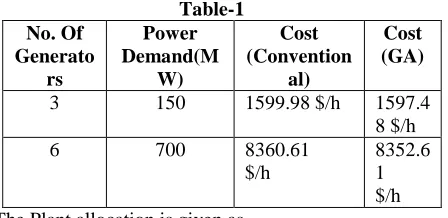
The result of ELD after the implementation of proposed GA method is discussed. The Simulation of given data were done in Matlab R2013a. The results of plant allocation and cost of generation was compared with that of conventional analytical method.The coefficients of fuel cost and maximum and minimum power limits are needed to be given. The power demand is considered to be 150 (MW) and700 (MW) respectively for 3 generator system and 6 generator system.. The length of string in the population has beentaken as 48 and 96 respectively and the population size has been assumed as 10 and 20 respectively. The single stringrepresents three substrings, each of 16 bits. Therefore, population we have taken is10 x 48 and 20 x 96 respectively inbinary. The mutation probability is taken as 0.1. and crossover probability as 0.9.
The Comparative analysis between conventional and soft computing approach (GA) is shown below-
Table-1 No. Of Generato rs Power Demand(M W) Cost (Convention al) Cost (GA)
3 150 1599.98 $/h 1597.4
8 $/h
6 700 8360.61
$/h
8352.6 1 $/h The Plant allocation is given as –
Case-1. For 3 generator system
Table-2 Peak Deman d P1(MW ) P2(MW ) P3(MW ) Gen. Cost($/h) 150
MW 32.8101
64.5950 54.9369 1597.480 0 200M W
54.1854 80.00 70.00 1994.686 6 185M
W 44.3779 74.9467 69.2098
1873.274 4
Case-2. For 6 generator system
Table-3
Peak Dem and
P1 P2 P3 P4 P5 P6 Gen. Cost( $/h) 700 323
.63 76. 685 158. 43 50. 00 51. 97 50. 00 8352. 6109 750 339
.77 88. 02 170. 06 50. 00 64. 59 50. 00 8949. 2093 800 355
.99 99. 38 181. 7274 50. 00 77. 22 50. 00 9558. 5647
The results are shown witrh the help of tabular representation Table 1 shows the comparative analysis of conventional method and GA based approach showing the utility and advantage of using GA in ELD problem.
Table 2 and Table 3 shows the appliation of GA in plant allocation for optimum generation in various power demand scenario.
5. COCNLUSIONS
[image:4.595.308.532.131.240.2]dispatch.The results were improved and more efficient as comapred to analytical and conventional algorithm.This method is useful for any n number of generators and variable power demand as well.Further the result can be enhanced by using hybrid optimization techniques and more real world constraints so as to get optimum and accurate solution.
REFERENCES
[1] Hetzer J., Yu C., and Bhattarai K., An economic dispatch modelincorporating wind power, IEEE
Trans. Energy Convers, 23(2),603–611 (2008).
[2] NidulSinha, Chakrabarthi R. and P. K. Chattopadhyay, “Evolutionary programming techniques for economic loaddispatch”, IEEE Transactions on evolutionary computation, Vol. 7, pp.83- 94, 2003.
[3] NidulSinha, Chakrabarti, P. K. Chatopadhyay, “Improved fast evolutionary program for economic load dispatch with non-smooth cost curves”, IE (I) Journal. EL Vol. 85, 2004. [4] L.S.Coelho, A.D.V. Almeida and V.C. Mariani.
2008.Cultural differential evolution approach to optimizethe economic dispatch of electrical energy usingthermal generators. In: Proceeding of 13th IEEEInternational Conference on Emerging Technologiesand Factory Automation (ETFA), Hamburg, Germany.pp. 1378-1383..
[5] C. L. Chiang, “Genetic – based algorithm for power economic load dispatch,” IET Gener. Transm.Distrib, 1, (2), pp. 261-269, 2007. [6] S. H. Ling, H. K. Lam, H. F. Leung and Y. S. Lee,
“Improved genetic algorithm for economic load dispatch with valve- point loadings”, IEEE Transactions on power systems, Vol. 1, pp. 442 – 447, 2003.
[7] R. Ouiddir, M. Rahli and L. Abdelhakem – Korid, “Economic dispatch using genetic algorithm: application to westernalgeria’s electrical power network”, Journal of Information Science and Engineering 21, pp. 659 – 668, 2005.
[8] MimounYounes, MostafaRahli, “Economic power dispatch using the combination of two genetic algorithms”, Journal of Electrical and Electronics Engineering, Vol. 6, pp. 175-181, 2006.
[9] ChiraAchayuthakan, S.C.Srivastava, “A genetic algorithm based economic load dispatch solution for eastern region ofegat system having combined cycle and cogeneration plants”, IEEE Transactions on power systems, Vol. 1, pp. 165-170, 1998.
[10] MimounYounes, MostefaRahli, LahouriAbdelhakemKoridak, “Economic power dispatch using Evolutionary Algorithm”, Journal of Electrical Engineering Vol. 57, No. 4, pp. 211-217, 2006.
[11] June Ho Park, Sung Oh Yang, HwaSeok Lee, Young Moon Park, “Economic load dispatch using evolutionary algorithms”, IEEE
Transactions on power systems, Vol. 2, pp. 441-445, 1996.
[12] GiridharKumaran, V. S. R. K. Mouly, “Using evolutionary computation to solve the economic load dispatch problem”, IEEE Transactions on power systems, Vol. 3, pp. 296-301, 2001. [13] J. H. Park, S. O. Yang, K. J. Mun, H. S. Lee and J.
W. Jung, “An application of evolutionary computations to economic load dispatch with piecewise quadratic cost functions”, IEEE Transactions on power systems, Vol. 69, pp. 289-294, 1998.
[14] Ah King R. T. F. and Rughooputh H. C. S., “Elitist Multiobjective Evolutionary Algorithm for Environmental/Economic Dispatch”, IEEE Congress on Evolutionary Computation, Canberra, Australia, vol. 2, pp. 1108-1114, 2003. [15] Dhillon J. S., Parti S. C. and Kothari D. P., “Multi