A Minimum Message Length Approach for Argument Interpretation
Ingrid Zukerman and Sarah George
School of Computer Science and Software Engineering Monash University
Clayton, VICTORIA 3800, AUSTRALIA email: ingrid,sarahg @csse.monash.edu.au
Abstract
We describe a mechanism which receives as input a segmented argument composed of NL sentences, and generates an inter-pretation. Our mechanism relies on the Minimum Message Length Principle for the selection of an interpretation among candidate options. This enables our mech-anism to cope with noisy input in terms of wording, beliefs and argument struc-ture; and reduces its reliance on a partic-ular knowledge representation. The per-formance of our system was evaluated by distorting automatically generated argu-ments, and passing them to the system for interpretation. In 75% of the cases, the interpretations produced by the system matched precisely or almost-precisely the representation of the original arguments.
1 Introduction
Discourse interpretation is at the cornerstone of human-computer communication, and an essential component of any dialogue system. In order to pro-duce an interpretation from a user’s NL utterances, the concepts referenced by the user’s words must be identified, the propositions built using these con-cepts must be understood, and the relations between these propositions must be determined. Each of these tasks is fraught with uncertainty.
In this paper, we focus on the interpretation of ar-gumentative discourse, which is composed of impli-cations. We present a mechanism for the interpre-tation of NL arguments which is based on the ap-plication of the Minimum Message Length (MML) Principle for the evaluation of candidate
interpreta-tions (Wallace and Boulton, 1968). The MML prin-ciple provides a uniform and incremental framework for combining the uncertainty arising from differ-ent stages of the interpretation process. This enables our mechanism to cope with noisy input in terms of wording, beliefs and argument structure, and to fac-tor out the elements of an interpretation which rely on a particular knowledge representation.
Our interpretation mechanism is embedded in a web-based argumentation system called BIAS (Bayesian Interactive Argumentation Sys-tem). BIAS uses Bayesian Networks (BNs) (Pearl, 1988) as its knowledge representation and reasoning formalism. It is designed to be a comprehensive ar-gumentation system which will eventually engage in an unrestricted interaction with users. However, the current version of BIAS performs two activities: it generates its own arguments (from a BN) and inter-prets users’ arguments (generating a Bayesian sub-net as an interpretation of these arguments). In this paper we focus on the interpretation task.
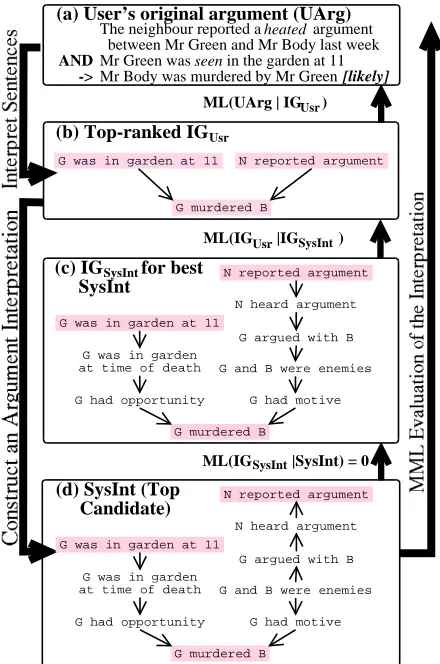
Figure 1(a) shows a simple argument given by a user, and Figure 1(d) shows a subset of a BN which contains the preferred interpretation of the user’s ar-gument; the nodes corresponding to the user’s in-put are shaded. The user’s argument is obtained through a web interface (the uncertainty value of the consequent is entered using a drop-down menu). In this example, the user’s input differs structurally from the system’s interpretation, the belief value for the consequent differs from that in the domain BN, and the wording of the statements differs from the canonical wording of the BN nodes. Still, the sys-tem found a reasonable interpretation in the context of its domain model.
The results obtained in this informal trial are val-idated by our automated evaluation. This
ML(IG |IG )Usr SysInt ML(UArg | IG )Usr
ML(IG |SysInt) = 0SysInt
(d) SysInt (Top Candidate)
N reported argument
N heard argument
G argued with B
G and B were enemies G was in garden at 11
G was in garden at time of death
G had motive G had opportunity
G murdered B
N reported argument
N heard argument
G argued with B
G and B were enemies G was in garden at 11
G was in garden at time of death
G had motive G had opportunity
G murdered B
(c) IG for best SysIntSysInt
(b) Top-ranked IG
N reported argument G was in garden at 11
G murdered B
(a) User’s original argument (UArg)
Usr
The neighbour reported a argument between Mr Green and Mr Body last week Mr Green was in the garden at 11 Mr Body was murdered by Mr Green
AND
-> [likely]
heated
seen
Figure 1: Interpretation and MML evaluation
tion, which assesses baseline performance, consists of passing distorted versions of the system’s argu-ments back to the system for interpretation. In 75% of the cases, the interpretations produced by the sys-tem matched the original arguments (in BN form) precisely or almost-precisely.
In the next section, we review related research. We then describe the application of the MML crite-rion to the evaluation of interpretations. In Section 4, we outline the argument interpretation process. The results of our evaluation are reported in Section 5, followed by concluding remarks.
2 Related Research
Our research integrates plan recognition for dis-course understanding with the application of the MML principle (Wallace and Boulton, 1968).
The system described in (Carberry and Lambert, 1999) recognized a user’s intentions during expert-consultation dialogues. This system considered sev-eral knowledge sources for discourse understanding. It used plan libraries as its main knowledge
rep-resentation formalism, and handled short conversa-tional turns. In contrast, our system relies on BNs and handles unrestricted arguments.
BNs have been used in several systems that per-form plan recognition for discourse understanding, e.g., (Charniak and Goldman, 1993; Horvitz and Paek, 1999; Zukerman, 2001). Charniak and Gold-man’s system handled complex narratives, using a BN and marker passing for plan recognition. It au-tomatically built and incrementally extended a BN from propositions read in a story, so that the BN represented hypotheses that became plausible as the story unfolded. Marker passing was used to restrict the nodes included in the BN. In contrast, we use do-main knowledge to constrain our understanding of the propositions in a user’s argument, and apply the MML principle to select a plausible interpretation.
Like Carberry and Lambert’s system, both Horvitz and Paek’s system and Zukerman’s handled short dialogue contributions. Horvitz and Paek used BNs at different levels of an abstraction hierarchy to infer a user’s goal in information-seeking inter-actions with a Bayesian Receptionist. In addition, they used decision-theoretic strategies to guide the progress of the dialogue. We expect to use such strategies when our system engages in a full dia-logue with the user. In previous work, Zukerman used a domain model and user model represented as a BN, together with linguistic and attentional infor-mation, to infer a user’s goal from a short-form re-joinder. However, the combination of these knowl-edge sources was based on heuristics.
The approach presented in this paper extends our previous work in that (1) it handles input of unre-stricted length, (2) it offers a principled technique for selecting between alternative interpretations of a user’s discourse, and (3) it handles discrepancies be-tween the user’s input and the system’s expectations at all levels (wording, beliefs and inferences). Fur-ther, this approach makes no assumptions regarding the synchronization between the user’s beliefs and the system’s beliefs (but it assumes that the system is a domain expert). Finally, this approach may be extended to incorporate various aspects of discourse and dialogue, such as information pertaining to the dialogue history and user modeling information.
complex-ity (a glossary of model-selection techniques appears in http://www-white.media.mit.edu/
tpminka/statlearn/glossary). MML has been
used in a variety of applications, e.g., in NL it was used for lexical selection in speech understanding (Thomas et al., 1997). In this paper, we demonstrate its applicability to a higher-level NL task.
3 Argument Interpretation Using MML
The MML criterion implements Occam’s Razor, which may be stated as follows: “If you have two theories which both explain the observed facts, then you should use the simplest until more evidence comes along”. According to the MML criterion, we imagine sending to a receiver a message that de-scribes a user’s NL argument, and we want to send the shortest possible message.1 This message corre-sponds to the simplest interpretation of a user’s argu-ment. We postulate that this interpretation is likely to be a reasonable interpretation (although not nec-essarily the intended one).
A message that encodes an NL argument in terms of an interpretation is composed of two parts: (1) structions for building the interpretation, and (2) in-structions for rebuilding the original argument from this interpretation. These two parts balance the need for a concise interpretation (Part 1) with the need for an interpretation that matches closely the user’s ut-terances (Part 2). For instance, the message for a concise interpretation that does not match well the original argument will have a short first part but a long second part. In contrast, a more complex in-terpretation which better matches the original argu-ment may yield a message that is shorter overall, with a longer first portion, but a shorter second por-tion. Thus, the message describing the interpretation (BN) which best matches the user’s intent will be among the messages with a short length (hopefully the shortest). Further, a message which encodes an NL argument in terms of a reasonable interpretation will be shorter than the message which transmits the words of the argument directly. This is because an interpretation which comprises the nodes and links in a Bayesian subnet (Part 1 of the message) is much
1
It is worth noting that the sender and the receiver are theo-retical constructs of the MML theory, which are internal to the system and are not to be confused with the system and the user. The concept of a receiver which is different from the sender en-sures that the message constructed by the sender to represent a user’s argument does not make unwarranted assumptions.
more compact than a sequence of words which iden-tifies these nodes and links. If this interpretation is reasonable (i.e., the user’s argument is close to this interpretation), then the encoding of the discrepan-cies between the user’s argument and the interpre-tation (Part 2 of the message) will not significantly increase the length of the message.
In order to find the interpretation with the shortest message length, we compare the message lengths of candidate interpretations. These candidates are ob-tained as described in Section 4.
3.1 MML Encoding
The MML criterion is derived from Bayes Theorem:
Pr Pr Pr
, where
is the data and
is a hypothesis which explains the data. An optimal code for an event with probability
Pr
has message length ML
(measured in bits). Hence, the message length for the data and a hypothesis is:
ML
The hypothesis for which ML is minimal is considered the best hypothesis.
Now, in our context, UArg contains the user’s ar-gument, and SysInt an interpretation generated by our system. Thus, we are looking for the SysInt which yields the shortest message length for ML
The first part of the message describes the in-terpretation, and the second part describes how to reconstruct the argument from the interpreta-tion. To calculate the second part, we rely on an intermediate representation called Implication
Graph (IG). An Implication Graph is a
graphi-cal representation of an argument, which repre-sents a basic “understanding” of the argument. It is composed of simple implications of the form Antecedent! Antecedent
""
Antecedent#%$
Consequent (where$ indicates that the antecedents
imply the consequent, without distinguishing be-tween causal and evidential implications). &(' Usr
represents an understanding of the user’s argument. It contains propositions from the underlying repre-sentation, but retains the structure of the user’s ar-gument. &(' SysInt represents an understanding of a
candidate interpretation. It is directly obtained from
SysInt, but it differs from SysInt in that all its arcs
evi-dence nodes are represented as antecedents of an im-plication, while SysInt is a general Bayesian subnet. Since both &(' Usr and &' SysInt use domain
proposi-tions and have the same type of representation, they can be compared with relative ease.
Figure 1 illustrates the interpretation of a short ar-gument presented by a user, and the calculation of the message length of the interpretation. The inter-pretation process obtains &(' Usr from the user’s
in-put, and SysInt from &' Usr (left-hand side of
Fig-ure 1). If a sentence in UArg matches more than one domain proposition, the system generates more than one&' Usrfrom UArg (Section 4.1). Each&' Usr
may in turn yield more than one SysInt. This hap-pens when the underlying representation has sev-eral ways of connecting between the nodes in&(' Usr
(Section 4.2). The message length calculation goes from SysInt to UArg through the intermediate rep-resentations &(' SysInt and &(' Usr (right-hand side of
Figure 1). This calculation takes advantage of the fact that there can be only one&(' Usrfor each UArg–
SysInt combination. Hence,
Pr
UArg &' Usr SysInt
&(' Usr SysInt
Thus, the length of the message required to trans-mit the user’s argument and an interpretation is
ML
That is, for each candidate interpretation, we cal-culate the length of the message which conveys:
SysInt – the interpretation,
&(' Usr
SysInt – how to obtain the belief and
struc-ture of&(' Usrfrom SysInt,
2and
UArg
&' Usr– how to obtain the sentences in UArg
from the corresponding propositions in&' Usr.
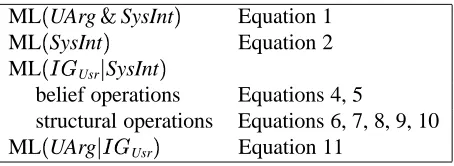
The interpretation which yields the shortest message is selected (the message-length equations for each component are summarized in Table 1).
2
We use
SysInt for this calculation, rather than SysInt.
This does not affect the message length because the receiver can obtain
SysIntdirectly from SysInt.
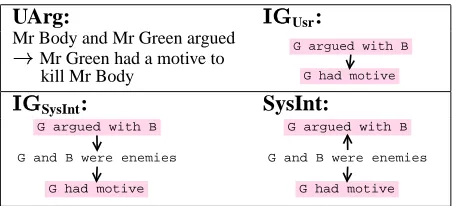
Throughout the remainder of this section, we de-scribe the calculation of the components of Equa-tion 1, and illustrate this calculaEqua-tion using the simple example in Figure 2 (the message length calculation for our example is summarized in Table 2).
UArg: Usr:
Mr Body and Mr Green argued
Mr Green had a motive to kill Mr Body
G argued with B
G had motive
SysInt: SysInt:
G argued with B
G had motive G and B were enemies
G argued with B
G had motive G and B were enemies
Figure 2: Simple Argument and Interpretation
3.2 Calculating ML
SysInt
In order to transmit SysInt, we simply send its propo-sitions and the relations between them. A standard MML assumption is that the sender and receiver share domain knowledge (recall that the receiver is not the user, but is a construct of the MML theory). Hence, one way to send SysInt consists of transmit-ting how SysInt is extracted from the domain rep-resentation. This involves selecting its propositions from those in the domain, and then choosing which of the possible relations between these propositions are included in the interpretation. In the case of a BN, the propositions are represented as nodes, and the relations between propositions as arcs. Thus the message length for SysInt in the context of a BN is
C
# nodes(domainBN)# nodes(SysInt)
C
# incident arcs(SysInt)# arcs(SysInt)(2) For the example in Figure 2, in order to transmit
SysInt we must choose 3 nodes from the 82 nodes
in the BN which represents our murder scenario (the Bayesian subnet in Figure 1(d) is a fragment of this BN). We must then select 2 arcs from the 3 arcs that connect these nodes. This yields a message of length
3.3 Calculating ML
IGUsr
SysInt
The message which describes &' Usr in terms of
SysInt (or rather in terms of &' SysInt) conveys how
&(' Usrdiffers from the system’s interpretation in two
3.3.1 Belief differences
For each proposition in both&' SysIntand&(' Usr,
we transmit any discrepancy between the belief stated by the user and the system’s belief in this proposition (propositions that appear in only one IG are handled by the message component which de-scribes structural differences). The length of the message required to convey this information is
is the belief in proposition in &(' . Assuming an optimal message encoding,
we obtain which expresses discrepancies in belief as a proba-bility that the user will hold a particular belief in a proposition, given the belief held by the system in this proposition.
Since our system interacts with people, we use linguistic categories of probability that people find acceptable (similar to those used in Elsaesser, 1987) instead of precise probabilities. Our 7 categories are:
VeryUnlikely, Unlikely, ALittleUnlikely, EvenChance, ALit-tleLikely, Likely, VeryLikely . This yields the following
approximation of Equation 3:
is the category for the belief in node in&(' .
In the absence of statistical information about dis-crepancies between user beliefs and system beliefs, we have devised a probability function as follows: Pr
is a normalizing constant, and NumCt is the number of belief categories (=7). This function yields a maximum probability when the user’s be-lief in node agrees with the system’s belief. This probability gets halved (adding 1 bit to the length of the message) for each increment or decrement in be-lief category. For instance, if both the user and the system believe that node isLikely, Equation 5 will yield a probability of
10 trast, if the user believed that this node has only an
EvenChance, then the probability of this belief given
the system’s belief would be
3.3.2 Structural differences
The message which transmits the structural dis-crepancies between&' SysIntand &(' Usrdescribes the
structural operations required to transform &(' SysInt
into &(' Usr. These operations are: node insertions
and deletions, and arc insertions and deletions. A node is inserted in &(' SysInt when the system
can-not reconcile a proposition in the user’s argument with any proposition in its domain representation. In this case, the system proposes a special Escape (wild card) node. Note that the system does not pre-sume to understand this proposition, but still hopes to achieve some understanding of the argument as a whole. Similarly, an arc is inserted when the user mentions a relationship which does not appear in
&(' SysInt. An arc (node) is deleted when the
corre-sponding relation (proposition) appears in &' SysInt,
but is omitted from&(' Usr. When a node is deleted,
all the arcs incident upon it are rerouted to connect its antecedents directly to its consequent. This op-eration, which models a small inferential leap, pre-serves the structure of the implication around the deleted node. If the arcs so rerouted are inconsis-tent with&(' Usrthey will be deleted separately.
For each of these operations, the message an-nounces how many times the operation was per-formed (e.g., how many nodes were deleted) and then provides sufficient information to enable the message receiver to identify the targets of the op-eration (e.g., which nodes were deleted). Thus, the length of the message which describes the structural operations required to transform &' SysInt into &(' Usr
comprises the following components: ML
Node insertions = number of inserted nodes plus the penalty for each insertion. Since a node is inserted when no proposition in the domain matches a user’s statement, we use an insertion penalty equal to465 – the probability-like score
of the worst acceptable word-match between the user’s statement and a proposition (Section 4.1). Thus the message length for node insertions is
Node deletions = number of deleted nodes plus their designations. To designate the nodes to be deleted, we select them from the nodes in SysInt (or&(' SysInt):
Arc insertions = number of inserted arcs plus their designations plus the direction of each arc. (This component also describes the arcs incident upon newly inserted nodes.) To designate an arc, we need a pair of nodes (head and tail). However, some nodes in &(' SysIntare already connected by
arcs, which must be subtracted from the total number of arcs that can be inserted, yielding
# poss arc ins
C
# nodes(
SysInt)+# nodes ins
# arcs(&(' SysInt)
We also need to send 1 extra bit per inserted arc to convey its direction. Hence, the length of the message that conveys arc insertions is:
Arc deletions = number of deleted arcs plus their designations.
For the example in Figure 2, &(' SysInt and &(' Usr
differ in the node [B and G were enemies] and
the arcs incident upon it. In order to transmit that this node should be deleted from &' SysInt, we must
select it from the 3 nodes comprising &' SysInt. The
length of the message that conveys this information is:
bits (the automatic rerout-ing of the arcs incident upon the deleted node yields
&(' Usrat no additional cost).
3.4 Calculating ML(UArg
IGUsr)
The user’s argument is structurally equivalent to
&(' Usr. Hence, in order to transmit UArg in terms of &(' Usrwe only need to transmit how each statement
in UArg differs from the canonical statement gener-ated for the matching node in &(' Usr (Section 4.1).
The length of the message which conveys this infor-mation is
Table 1: Summary of Message Length Calculation
ML
belief operations Equations 4, 5
structural operations Equations 6, 7, 8, 9, 10 ML
Table 2: Summary of Message Length Calculation for the Simple Argument
ML
belief operations (no beliefs stated) 0.0 bits
structural operations 1.6 bits
ML
where Sentence
in UArg is the user’s sentence which matches the proposition for node in&(' Usr.
Assuming an optimal message encoding, we obtain
We approximate Pr
Sentence
in UArg
using the score returned by the comparison function de-scribed in Section 4.1. For the example in Fig-ure 2, the discrepancy between the canonical sen-tences “Mr Body argued with Mr Green” and “Mr Green had a motive to murder Mr Body” and the corresponding user sentences yields a message of length 33.6 bits + 32 bits respectively (=65.6 bits).
4 Interpreting Arguments
Our system generates candidate interpretations for a user’s argument by first postulating propositions that match the user’s sentences, and then finding differ-ent ways to connect these propositions – each variant is a candidate interpretation.
4.1 Postulating propositions
We currently use a naive approach for postulating propositions. For each user sentence Usr we gen-erate candidate propositions as follows. For each node in the domain, the system proposes one or more canonical sentences
have found a candidate interpretation for Usr.3 For example, the proposition [G was in garden at 11] in Figure 1(b) is a plausible interpretation of the input sentence “Mr Green was seen in the garden at 11” in Figure 1(a). Some sentences may have no proposi-tions with match-scores above 4 5 . This does not
automatically invalidate the user’s argument, as it may still be possible to interpret the argument as a whole, even if a few sentences are not understood (Section 3.3).
The match-score for a user sentence Usr and a proposition – a number in the [0,1] range – is scaled from a weighted sum of individual word-match scores that relate words in Usr with words in
. Inserted or deleted words are given a fixed penalty.
The goodness of a word-match depends on the following factors: (1) level of synonymy – the per-centage of synonyms the words have in common (ac-cording to WordNet, Miller et al., 1990); (2) posi-tion in sentence (expressed as a fracposi-tion, e.g., “1/3 of the way through the sentence”); and (3) relation tags –SUBJ/OBJtags as well as parts-of-speech such as NOUN, VERB, etc (obtained using the MINIPAR parser, Lin 1998). That is, the th word in sentence
,
-
, matches perfectly the th word in the
user’s sentence, -
Usr, if both words are exactly the same, they are in the same sentence position, and they have the same relation tag. The match-score between
-
and -
Usris reduced if their level of synonymy is less than 100%, or if there are discrepancies in their relation tags or their sentence positions. For instance, consider the canonical sen-tence “Mr Green murdered Mr Body” and the user sentences “Mr Body was murdered by Mr Green” and “Mr Green murdered Ms Scarlet”. The first user sentence has a higher score than the second one. This is because the mismatch between the canoni-cal sentence and the first user sentence is merely due to non-content words and word positions, while the mismatch between the canonical sentence and the second user sentence is due to the discrepancy be-tween the objects of the sentences.
3This step of the matching process is concerned only with
identifying the nodes that best match a user’s sentences. Words indicating negation provide further (heuristic-based) informa-tion about whether the user intended the positive version of a node (e.g., “Mr Green murdered Mr Body”) or the negative ver-sion (e.g., “Mr Green didn’t murder Mr Body”). This informa-tion is used when calculating the user’s belief in a node.
Upon completion of this process, the match-scores between a user sentence and its candidate propositions are normalized, and the result used to approximate Pr
Usr
, which is required for the MML evaluation (Section 3.4).4
At first glance, this process may appear unwieldy, as it compares each of the user’s sentences with each proposition in the knowledge base. However, since the complexity of this process is linear for each input sentence, and our informal trials indicate that most user arguments have less than 10 propositions, re-sponse time will not be compromised even for large BNs. Specifically, the response time on our 82-node BN is perceived as instantaneous.
4.2 Connecting the propositions
The above process may match more than one node to each of the user’s sentences. Hence, we first gen-erate the&(' Usrs which are consistent with the user’s
argument. For instance, the sentence “Mr Green was seen in the garden at 11” in Figure 1(a) matches both
[G was in garden at 11]and [N saw G in garden](but
the former has a higher probability). If each of the other input sentences in Figure 1(a) matches only one proposition, two IGs which match the user’s in-put will be generated – one for each of the above alternatives.
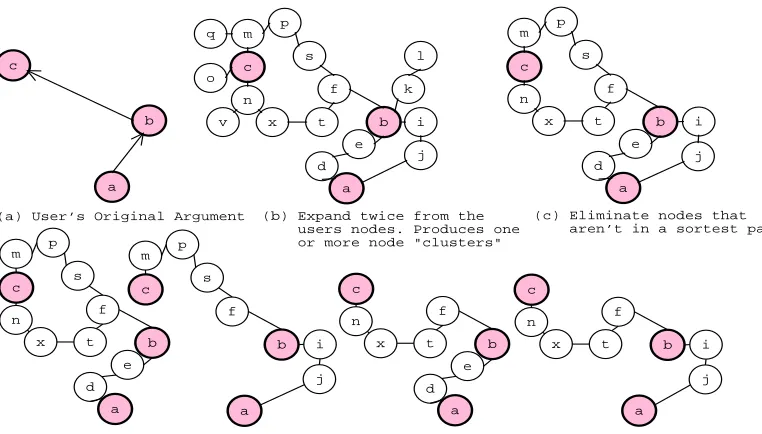
Figure 3 illustrates the remainder of the interpretation-generation process with respect to one &(' Usr. This process consists of finding
con-nections within the BN between the nodes in&(' Usr;
eliminating superfluous BN nodes; and generating sub-graphs of the resulting graph, such that all the nodes in &' Usr are connected (Figures 3(b), 3(c)
and 3(d), respectively). The connections between the nodes in &(' Usr are found by applying a small
number of inferences from these nodes (spreading outward in the BN). Currently, we apply two rounds of inferences, as they enable the system to produce “sensible” interpretations for arguments with small inferential leaps. These are arguments whose nodes are separated by at most four nodes in the system’s BN, e.g., nodes b and c in Figure 3(d).5 If upon completion of this process, some nodes are still
4
We are currently implementing a more principled model for sentence comparison which yields more accurate probabilities.
5
(a) User’s Original Argument (b) Expand twice from the users nodes. Produces one or more node "clusters"
(c) Eliminate nodes that aren’t in a sortest path
(d) Candidates are all the subgraphs of (c) that connect the user’s nodes. (Only some of the 9 candidates illustrated)
a
Figure 3: Argument interpretation process
unconnected, the system rejects the current &' Usr.
This process is currently implemented in the context of a BN. However, any representation that supports the generation of a connected argument involving a given set of propositions would be appropriate.
5 Evaluation
Our evaluation consisted of an automated experi-ment where the system interpreted noisy versions of its own arguments. These arguments were generated from different sub-nets of its domain BN, and they were distorted at the BN level and at the NL level. At the BN level, we changed the beliefs in the nodes, and we inserted and deleted nodes and arcs. At the NL level, we distorted the wording of the proposi-tions in the resultant arguments. All these distor-tions were performed for BNs of different sizes (3, 5, 7 and 9 arcs). Our measure of performance is the edit-distance between the original BN used to gener-ate an argument, and the BN produced as the inter-pretation of this argument. That is, we counted the number of differences between the source BN and the interpretation. For instance, two BNs that differ by one arc have an edit-distance of 2 (one addition and one deletion), while a perfect match has an edit-distance of 0.
Overall, our results were as follows. Our system produced an interpretation in 86% of the 5400 tri-als. In 75% of the 5400 cases, the generated
inter-pretations had an edit-distance of 3 or less from the original BN, and in 50% of the cases, the interpre-tations matched perfectly the original BN. Figure 4 depicts the frequency of edit distances for the differ-ent BN sizes under all noise conditions. We plotted edit-distances of 0,
""
, 9 and
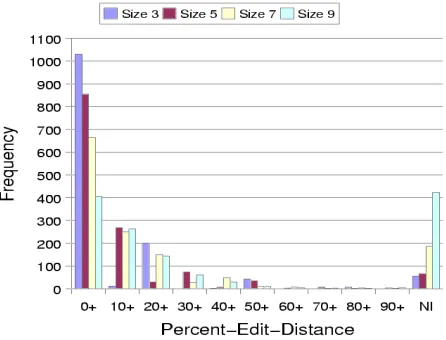
, plus the category NI, which stands for “No Interpretation”. As shown in Figure 4, the 0 edit-distance has the highest fre-quency, and performance deteriorates as BN size in-creases. Nonetheless, for BNs of 7 arcs or less, the vast majority of the interpretations have an edit dis-tance of 3 or less. Only for BNs of 9 arcs the num-ber of NIs exceeds the numnum-ber of perfect matches. Figure 5 provides a different view of these results. It displays edit-distance as a percentage of the pos-sible changes for a BN of a particular size (the x-axis is divided into buckets of 10%). For example, if a selected interpretation differs from its source-BN by the insertion of one arc, the percent-edit-distance will be
in the source-BN.6The results shown in Figure 5 are consistent with the previous results, with the vast majority of the edits being in the [0,10)% bucket. That is, most of the interpretations are within 10% of their source-BNs.
We also tested each kind of noise separately,
6A BN of
Figure 4: Frequency of edit-distances for all noise conditions (5400 trials)
Figure 5: Frequency of edit-distances as percent of maximum edits for all noise conditions (5400 trials)
maintaining the other kinds of noise at 0%. All the distortions were between 0 and 40%. We performed 1560 trials for word noise, arc noise and node in-sertions, and 2040 trials for belief noise, which war-ranted additional observations. Figures 6, 7 and 8 show the recognition accuracy of our system (in terms of average edit distance) as a function of arc noise, belief noise and word noise percentages, re-spectively. The performance for the different BN sizes (in arcs) is also shown. Our system’s perfor-mance for node insertions is similar to that obtained for belief noise (the graph was not included owing to space limitations). Our results show that the two main factors that affect recognition performance are BN size and word noise, while the average edit dis-tance remains stable for belief and arc noise, as well as for node insertions (the only exception occurs for 40% arc noise and size 9 BNs). Specifically, for arc
Figure 6: Effect of arc noise on performance (1560 trials)
Figure 7: Effect of belief noise on performance (2040 trials)
noise, belief noise and node insertions, the average edit distance was 3 or less for all noise percentages, while for word noise, the average edit distance was higher for several word-noise and BN-size combina-tions. Further, performance deteriorated as the per-centage of word noise increased.
The impact of word noise on performance rein-forces our intention to implement a more principled sentence comparison procedure (Section 4.1), with the expectation that it will improve this aspect of our system’s performance.
6 Conclusion
Figure 8: Effect of word noise on performance (1560 trials)
the effect of the underlying knowledge representa-tion on the interpretarepresenta-tion process. The results of our automated evaluation were encouraging, with inter-pretations that match perfectly or almost-perfectly the source-BN being generated in 75% of the cases under all noise conditions.
Our system has the following limitations:
The interpretations generated by our system are in terms of the propositions and relations known by the system. However, the MML Principle it-self addresses this limitation (at least partially), as the length of a message is a quantitative mea-sure for determining whether an interpretation is likely to reflect the user’s intentions.
Our mechanism does not infer an implicit goal proposition, nor does it infer discourse relations from free-form discourse. At present, this limita-tion is circumvented by forcing the user to state the goal proposition of the argument, and to in-dicate clearly the antecedents and consequents of the implications in his/her argument (this is done by means of a web-based interface).
Our argument-interpretation mechanism has been tested on one knowledge representation only – BNs.
It is unclear whether arguments produced by au-tomatically distorting our system’s arguments are representative of arguments generated by people. Further trials with real users will be conducted to ascertain this fact.
The system’s performance deteriorates for large BNs (9 nodes). However, it is unclear whether
this will affect the use of the system in practice.
Despite these limitations, we are hopeful about the potential of this approach to address the dis-course interpretation challenge.
Acknowledgments
This research was supported in part by Australian Research Council grant A49927212.
References
Sandra Carberry and Lynn Lambert. 1999. A process model for recognizing communicative acts and model-ing negotiation subdialogues. Computational Lmodel-inguis-
Linguis-tics, 25(1):1–53.
Eugene Charniak and Robert P. Goldman. 1993. A Bayesian model of plan recognition. Artificial
Intel-ligence, 64(1):50–56.
Christopher Elsaesser. 1987. Explanation of probabilis-tic inference for decision support systems. In
Proceed-ings of the AAAI-87 Workshop on Uncertainty in Artifi-cial Intelligence, pages 394–403, Seattle, Washington.
Eric Horvitz and Tim Paek. 1999. A computational ar-chitecture for conversation. In UM99 – Proceedings of
the Seventh International Conference on User Model-ing, pages 201–210, Banff, Canada.
Dekang Lin. 1998. Dependency-based evaluation of MINIPAR. In Workshop on the Evaluation of Parsing
Systems, Granada, Spain.
George Miller, Richard Beckwith, Christiane Fellbaum, Derek Gross, and Katherine Miller. 1990. Introduc-tion to WordNet: An on-line lexical database. Journal
of Lexicography, 3(4):235–244.
Judea Pearl. 1988. Probabilistic Reasoning in Intelligent
Systems. Morgan Kaufmann Publishers, San Mateo,
California.
Ian Thomas, Ingrid Zukerman, Jonathan Oliver, David W. Albrecht, and Bhavani Raskutti. 1997. Lexical ac-cess for speech understanding using Minimum Mes-sage Length encoding. In UAI97 – Proceedings of the
Thirteenth Conference on Uncertainty in Artificial In-telligence, pages 464–471. Morgan Kaufmann.
C.S. Wallace and D.M. Boulton. 1968. An informa-tion measure for classificainforma-tion. The Computer
Jour-nal, 11:185–194.
Ingrid Zukerman. 2001. An integrated approach for gen-erating arguments and rebuttals and understanding re-joinders. In UM01 – Proceedings of the Eighth
Inter-national Conference on User Modeling, pages 84–94,