Answering Clarification Questions
Matthew Purver1, Patrick G.T. Healey2, James King2, Jonathan Ginzburg1 and Greg J. Mills2
1Department of Computer Science King’s College, London London WC2R 2LS, UK
2Department of Computer Science Queen Mary, University of London
London E1 4NS, UK
Abstract
This paper describes the results of cor-pus and experimental investigation into the factors that affect the way clarifica-tion quesclarifica-tions in dialogue are interpreted, and the way they are responded to. We present some results from an investigation using the BNC which show some general correlations between clarification request type, likelihood of answering, answer type and distance between question and an-swer. We then describe a new experi-mental technique for integrating manip-ulations into text-based synchronous dia-logue, and give more specific results con-cerning the effect of word category and level of grounding on interpretation and response type.
1 Introduction
Requesting clarification is a vital part of the com-municative process and has received attention from both the formal semantic (Ginzburg and Cooper, 2001; Ginzburg and Cooper, forthcoming) and con-versation analytic traditions (Schegloff, 1987), but little in the computational dialogue system commu-nity. In theory, a perfect dialogue system should be able to interpret and deal with clarification requests (CRs) made by the user in order to elicit clarifica-tion of some part of a system utterance, and be able to request clarification itelf of some part of a user ut-terance. This is no easy task – CRs may take many
different forms (often highly elliptical), and can be intended to be interpreted with many different read-ings which query different aspects of the original ut-terance. As a result, dialogue system design has tra-ditionally attempted to avoid the necessity for CR interpretation by making system utterances as clear and precise as possible, and avoid having to generate all but the most simple CRs by using robust shallow methods of interpretation or by relying on highly domain-dependent lexicons and grammars. How-ever, as systems become more human-like, it seems likely that we will have to cope with user CRs at some stage; and the ability to generate system CRs can be useful in order to repair misunderstanding, disambiguate other utterances, and learn new words – see (Knight, 1996; Dusan and Flanagan, 2002; Purver, 2002).
The investigations presented here had two main aims: to examine (a) how CRs are interpreted, and (b) how they are responded to. The two are clearly dependent – the response must depend on the inter-pretation – but there are many other influencing fac-tors such as CR form, context and level of ground-ing. Answers to (a) should help us with the follow-ing questions:
• What factors can help us disambiguate and cor-rectly interpret user CRs?
• What factors should govern generation of sys-tem CRs such that they are correctly interpreted by the user?
• How (and when) should we answer user CRs?
• How (and when) should we expect users to re-spond to system CRs?
The paper is organised as follows. The next sec-tion gives a brief overview of CRs in general and some previous corpus work. Section 3 describes fur-ther corpus work which gives some general results concerning response type. Section 4 then describes a text-based dialogue experiment examining the de-tailed effects on interpretation and response of part-of-speech (PoS) type and level of grounding for one particular CR form, and section 5 then draws some general conclusions.
2 Clarification Requests
Purver et al. (2001; 2002) presented a taxonomy of CR forms and readings derived from a corpus study using the British National Corpus (BNC) – see (Burnard, 2000). This showed that some forms showed a high correlation with certain readings, but that some were highly ambiguous.
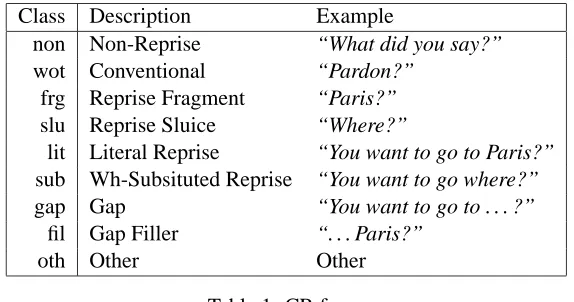
Purver et al. (2002)’s taxonomy of CR forms is given in table 1 and CR readings in table 21. Some CRs (the non-reprise class) explicitly identify the clarification required, e.g. “What did you say?” or “What do you mean?”, and some forms (e.g. literal reprises) appear to favour a particular reading almost exclusively, but most are more ambiguous. Indeed, they found that the two most common forms (the conventional and reprise fragment form) could take any reading.
Although this corpus study provided informa-tion about the distribuinforma-tion of different CR forms and readings, it did not provide any information about the specific conditions which prompt partic-ular readings and affect how the CR is answered. In this paper we concentrate mostly on the reprise fragment (RF) form, where only a single part of the problem utterance, possibly a single word, is reprised2 as in example (1). This form is not only
1
They also give a correction reading, which we have ex-cluded here: such CRs are almost exclusively self-corrections and as such do not fit well with our discussion here. They are also very rare compared with the other classes, making up only about 2% of CRs.
2
Such reprises need not be verbatim repeats: users may use anaphoric terms or use a clearer expression in order to clarify the fragment in question.
common (approximately 30% of CRs in the previ-ous study) and can appear with many readings (al-though biased towards a clausal reading – 87% of occurrences), but specifies the problematic element that it clarifies quite precisely, and therefore should give us scope for examining the effect of features of that element.
(1)3
Gary: Aye, but <pause> you know <pause> like you se- she mentioned one in particular, like
Jake: What?
Gary: the word skeilth Jake: Skeilth? Lilias: Mm. Gary: Aha.
Jake: Aye, yeah, yeah, take skeilth.
Intuitively, at least two such features would be expected to affect the type of reading assigned to a RF: PoS category and level of grounding.4 The PoS category of the reprised word should influence expectations about what is being clarified. For ex-ample, reprise of a content word (e.g. noun or verb) should be more likely to signal a constituent problem than a reprise of a function word (e.g. preposition or determiner). Dialogue participants would normally assume that the meaning of function words is well known in a particular linguistic community and that, as a result, a reprise of a function word is more likely to signal clausal or lexical problems. RF interpreta-tion should also depend on whether a reprised frag-ment is already considered to have been grounded by the participants in a conversation. For example, a reprise of a proper noun would be more likely to be read as signalling a constituent problem if it oc-curs on the first mention than on second mention. All things being equal, the content of a constituent is already considered to have been established by the time a second mention occurs.
3 Corpus Investigation
Accordingly we have re-examined the corpus from the above study in order to add information about
3
BNC file KPD, sentences 578–584
4
Class Description Example
non Non-Reprise “What did you say?” wot Conventional “Pardon?”
frg Reprise Fragment “Paris?” slu Reprise Sluice “Where?”
lit Literal Reprise “You want to go to Paris?” sub Wh-Subsituted Reprise “You want to go where?”
gap Gap “You want to go to . . . ?”
fil Gap Filler “. . . Paris?”
oth Other Other
Table 1: CR forms
Class Description Paraphrase
cla Clausal “Are you asking/telling me that . . . X . . . ?” con Constituent “What/who do you mean by ‘X’?”
lex Lexical “Did you utter ‘X’?” oth Other Other
Table 2: CR readings
category, grounding and method of answering.
3.1 Method
The same corpus was re-marked for four attributes: response type and CR-answer distance, and the PoS and last mention of the original source element.
The markup scheme used for response type evolved during the study and is shown in table 3: it includes classification of apparently unanswered CRs into those that may have been answered, but the sentence possibly containing an answer was tran-scribed in the BNC as<unclear>; those that ap-pear to have remained unanswered because the CR initiator continued their turn without pause; and those that are not answered at all (or at least where we have no indication of an answer – eye contact, head movement etc. are not recorded in the BNC but could function as answers). In cases where the ini-tial response was followed by further information, both were recorded, but the results here are pre-sented only for the initial response. Further work later may take both into account, along the lines of (Hockey et al., 1997) who showed this to be impor-tant for questions in general.
CR-answer distance was marked in terms of the sentence numbering scheme in the BNC – in these
cases it corresponds very closely to distance in speaker turns, although the correspondence is not exact.
PoS category and time of last mention of the source element were marked, but have not currently been used due to lack of useful data (see below).
Reliability of the markup has not yet been exam-ined. However, the method is close to that of (Purver et al., 2002) (and the corpus is identical), where re-liability was examined and found to be acceptable. We then examined the correlation between CR type and response type, between reading and response type, and the spread of CR-answer distance.
3.2 Results
3.2.1 Response Type
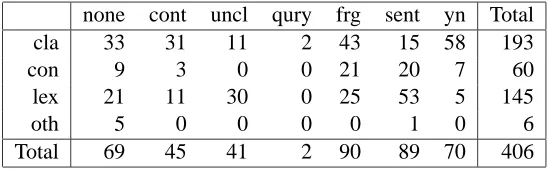
Results for response type are shown in table 4 as raw numbers, and also in table 5 as percentages for each CR type, with the none, cont, uncl and qury classes conflated as one “unanswered” class, and only the most common 4 CR forms shown.
none No answer
cont CR initiator continues immediately
uncl Possible answer but transcribed as<unclear> qury CR explicitly queried
frg Answered with parallel fragment sent Answered with full sentence
yn Answered with polar particle
Table 3: CR response types
as<unclear>) and cont (the CR-raiser continues without waiting). The most common forms (conven-tional and RF) appear to be answered least – around 45% go unanswered for both. The form which ap-pears to be most likely to be answered overall is the explicit non-conventional form.
Some forms appear to have high correlations with particular response types. As might be ex-pected, sluices (which are wh-questions) are gen-erally answered with fragments, and never with a polar yes/no answer. Yes/no answers also seem to be unsuitable for the conventional CR form, which is generally answered with a full sentence. RFs, conversely, are not often answered with full sen-tences, but can be responded to either by fragments or yes/no answers.
Similarly, from tables 6 and 7 (again, percentages given for each CR reading, with “unanswered” re-sponse types conflated and only the most common 3 readings shown) we can see that there is a correla-tion between reading and response type, but that this correlation is also not as simple as a direct reading-answer correspondence. Clausal CRs are unlikely to be answered with full sentences, but can get either fragment or yes/no responses. Constituent CRs are less likely to get yes/no responses but could get ei-ther oei-ther type. Interestingly, constituent CRs seem to be roughly twice as likely to get a response as clausal or lexical CRs (even though there are fewer examples of constituent CRs than the others, this difference is statistically significant, with aχ2
(1)test
showing<0.5% probability of independence).
3.2.2 Answer Distance
Results for CR-answer distance are shown in ta-ble 8. It is clear that the vast majority (94%) of CRs that are answered are answered in the immediately
unans frg sent yn
wot 45.6 8.7 44.8 0.8 (100) frg 43.2 21.1 3.4 32.2 (100) slu 37.0 50.0 12.9 0 (100) non 13.4 26.9 26.9 32.6 (100)
Table 5: BNC results: Response type as percentages for each CR form
unans frg sent yn
cla 39.8 22.2 7.8 30.0 (100) con 20.0 35.0 33.3 11.6 (100) lex 42.7 17.2 36.5 3.4 (100)
Table 7: BNC results: Response type as percentages for each CR reading
1 2 3 >3 Total Distance 273 14 2 0 289
Table 8: CR-answer distance (sentences)
following sentence, and that none are left longer than 3 sentences. While we do not yet have concrete equivalent figures for non-clarificational questions, a study is in progress and initial indications are that in general, answers are less immediate: only about 70% have distance 1, with some up to distance 6.5
We therefore expect that (a) answering user CRs must be done immediately, and that any dialogue management scheme must take this into account, and (b) we should expect answers to any system CRs to come immediately – interpretation routines (we are thinking especially of any ellipsis resolution routines here) should not assume that later turns are
5
none cont uncl qury frg sent yn Total
wot 21 13 24 0 11 57 1 127
frg 23 22 6 0 25 4 38 118
slu 8 6 5 1 27 7 0 54
non 4 2 1 0 14 14 17 52
lit 5 2 1 0 1 1 10 20
fil 3 0 1 0 7 1 4 16
sub 4 0 3 0 4 4 0 15
gap 1 0 0 0 1 0 0 2
oth 0 0 0 1 0 1 0 2
Total 69 45 41 2 90 89 70 406
Table 4: BNC results: Response type vs. CR form
none cont uncl qury frg sent yn Total
cla 33 31 11 2 43 15 58 193
con 9 3 0 0 21 20 7 60
lex 21 11 30 0 25 53 5 145
oth 5 0 0 0 0 1 0 6
Total 69 45 41 2 90 89 70 406
Table 6: BNC results: Response type vs. CR reading
relevant to the CR.
3.2.3 Further Details
While interesting, we would like to know more detail than the general trends described above: in particular we would like to know the effect of the factors we have mentioned (word category and grounding) for particular forms. As stated above, we concentrate here on the reprise fragment form.
Examination of original CR source fragment PoS category, in order to test the effect of the con-tent/function distinction, showed that almost all RFs were of content words or whole phrases: only 6 of 118 RFs were of function words, all of which were determiners (mostly numbers). This is interesting in itself: perhaps RFs are unlikely to be used to clarify uses of e.g. prepositions. However, the effect may be due to lack of data, and does not provide us with any way of testing the distinction between clausal and constituent reading that we expect.
Markup of last mention of the original source fragment has also not given results in which we can be confident. For RFs, we have seen that all con-stituent readings occur on the first mention of the
fragment (as expected) – but there are too few of these examples to draw any firm conclusions. It is also impossible to know whether first mention in the transcription is really the first mention between the participants: we do not know what happened before the tape was turned on, what their shared history is, or what is said during the frequent portions marked as<unclear>.
So we need more information than our current corpus can provide. In order to examine these ef-fects properly we have therefore designed an exper-imental technique to allow dialogues to be manipu-lated directly, with reprises with the desired proper-ties automatically introduced into the conversation. The next section describes this technique and the ex-periment performed.
4 Experimental Work
1986), (Garrod and Doherty, 1994). These stud-ies have been used to to motivate a variety of pro-posals about turn-level mechanisms and procedures that sustain dialogue co-ordination. Further devel-opment and testing of these proposals has, how-ever, been limited by the indirect nature of the avail-able evidence. Corpus studies provide, retrospec-tive, correlational data which is susceptible to chal-lenge and re-interpretation. Current psycholinguis-tic techniques do not provide ways of integrating ex-perimental manipulations into interactions in a man-ner that is sensitive to the linguistic and conversa-tional context. This section introduces a technique for carrying out experiments in which text-based in-teractions can be directly manipulated at the turn level, and gives the results of an experiment which uses this approach to investigate the effects of the factors mentioned above on interpretation and re-ponse to RFs. We also briefly discuss the range of potential applications and some of the practical lim-itations of the approach in the context of the experi-mental results.
4.1 Manipulating ‘Chat’ Interactions
The experimental technique presented here draws on two general developments. Firstly, the increasing use of text-based forms of synchronous conversa-tional interaction, for example: chat rooms (MUD’s, MOO’s etc.), instant messaging, and some online conferencing tools. Secondly, advances in natural language processing technology which make some forms of text processing and transformation fast enough to be performed on a time scale consistent with exchanges of turns in synchronous text chat.
The basic paradigm involves pairs of subjects, seated in different rooms, communicating using a synchronous text chat tool (see figure 1 for an ex-ample). However, instead of passing each completed turn directly to the appropriate chat clients, each turn is routed via a server. Depending on the specific goals of the experiment, the server can be used to systematically modify turns in a variety of ways. For example, some simple forms of mis-communication can be introduced into an interaction by transform-ing the order of characters in some of the input words or by substituting words with plausible non-words. Importantly, the server controls which mod-ifications are broadcast to which participant. So, if
participant A types the word “table” the sever can echo backA: tableto participant A and a trans-formed version, say, “blate” to participant B who sees A: blate. The ability to set up controlled asymmetries of this kind between the participants in a interaction creates a powerful range of experimen-tal possibilities. Here, we describe an application of this technique to the investigation of reprise clarifi-cation requests (CR’s).
A chat-tool experiment was designed to test the following hypotheses:
1. RFs for function words will normally receive clausal readings, whereas both clausal and con-stituent readings will be available for content words.
2. RFs for content words will receive more con-stituent readings on first mention than on sec-ond mention.
3. No difference is predicted for RFs for function words on first vs. second mention.
4.2 Method
Two tasks were used to elicit dialogue, a balloon debate and a story-telling task. In the balloon de-bate subjects are presented with a fictional scenario in which a balloon is losing altitude and about to crash. The only way for any of three passengers to survive is for one of them to jump to a certain death. The three passengers are; Dr. Nick Riviera, a can-cer scientist, Mrs. Susie Derkins, a pregnant primary school teacher, and Mr. Tom Derkins, the balloon pilot and Susie’s husband. Subjects are asked to de-cide who should jump. The advantages of this task are that it is effective at generating debates between subjects and involves repeated references to particu-lar individuals.
4.2.1 Subjects
Twenty-eight subjects were recruited, 20 male and 8 female, average age 19 years, from computer science and IT undergraduate students. They were recruited in pairs to ensure that the members of a pair were familiar with one another and only sub-jects who had experience with some form of text chat such as chat rooms, IRC, ICQ or other mes-saging systems were used. Each subject was paid at a rate of £7.50 per hour for participating in the experiment.
4.2.2 Materials
A custom experimental chat tool, written in Java and Perl, was used for the experiment. The user in-terface is similar to instant messaging applications: a lower window is used to enter text, and the con-versation is displayed in the main upper window as it emerges (see figure 1). The chat clients were run on two Fujitsu LCD tablet computers with text in-put via standard external keyboards, with the server running on a standard PC in a separate room.
User Interface The Chattool client user interface is written in Java and is designed to be familiar to subjects experienced with instant messaging/chat applications. The application window is split into two panes: a lower pane for text entry and an up-per pane in which the conversation is displayed (see figure 1). A status display between the two panes shows whether the other participant is active (typ-ing) at any time. This can be artificially controlled during the generation of artificial turns to make it appear as if they are generated by the other partici-pant. The client also has the ability to display an er-ror message and prevent text entry: this can be used to delay one participant while the other is engaged in an artificially-generated turn sequence.
Server Each turn is submitted to a server (also written in Java) on a separate machine when a ‘Send’ button or the ‘Return’ key is pressed. This server passes the text to a NLP component for processing and possible transformation, and then displays the original version to the originator client, and the pro-cessed (or artificially generated) version to the other client. The server records all turns, together with each key press from both clients, for later analysis. This data is also used on the fly to control the speed
and capitalisation of artificially generated turns, to be as realistic a simulation of the relevant subject as possible.
NLP Component The NLP component consists of a Perl text-processing module which commu-nicates with various external NLP modules as re-quired: PoS tagging can be performed using LT-POS (Mikheev, 1997), word rarity/frequency tag-ging using a custom tagger based on the BNC (Kil-garriff, 1997), and synonym generation using Word-Net (Fellbaum, 1998).
Experimental parameters are specified as a set of rules which are applied to each word in turn. Pre-conditions for the application of the rule can be spec-ified in terms of PoS, word frequency and the word itself, together with contextual factors such as the time since the last artificial turn was generated, and a probability threshold to prevent behaviour appear-ing too regular. The effect of the rule can be to transform the word in question (by substitution with another word, a synonym or a randomly generated non-word, or by letter order scrambling) or to trigger an artificially generated turn sequence (currently a reprise fragment, followed by an acknowledgement, although other turn types are possible).
The current experimental setup consists of rules which generate pairs of RFs and subsequent acknowledgements6, for proper nouns, common nouns, verbs, determiners and prepositions, with probabilities determined during a pilot experiment to give reasonable numbers of RFs per subject. No use is made of word rarity or synonyms.
The turn sequences are carried out by (a) present-ing the artificially-generated RF to the relevant client only; (b) waiting for a response from that client, pre-venting the other client from getting too far ahead by locking the interface if necessary; (c) presenting an acknowledgement to that response; and (d) pre-senting any text typed by the other client during the sequence.
4.2.3 Procedure
Prior to taking part subjects were informed that the experimenters were carrying out a study of the effects of a network-based chat tool on the way
peo-6
ple interact with one another. They were told that their interaction would be logged, anonymously, and kept for subsequent analysis. Subjects were advised that they could also request the log to be deleted af-ter completion of the inaf-teraction. They were not in-formed of the artificial interventions until afterwards (see below).
At the start of the experiment subjects were given a brief demonstration of the operation of the chat tool.
To prevent concurrent verbal or gestural interac-tion subjects were seated in separate rooms. Each pair performed both dialogue tasks and were given written instructions in each case. The balloon task was carried out once and the story-telling task twice; one story for each participant. To control for or-der effects the oror-der of presentation of the two tasks was counterbalanced across pairs. A 10-minute time limit was imposed on both tasks. At the end of the experiment subjects were fully debriefed and the intervention using ‘artificial’ clarifications was ex-plained to them.
This resulted in a within-subjects design with two factors; category of reprise fragment and level of grounding (first vs. second mention).
After the experiment, the logs were manually cor-rected for the PoS category of the RF and for the first/second mention clarification. PoS required cor-rection as the tagger produced incorrect word cate-gories in approximately 30% of cases. In some in-stances this was due to typing errors or text-specific conventions, such as “k” for “okay”, that were not recognised. Detection and classification of proper nouns was also sensitive to capitalisation. Subjects were not consistent or conventional in their capitali-sation of words and this caused some misclassifica-tions. In addition a small proportion of erroneous tags were found. Each system-generated CR was checked and, where appropriate, corrected. Because pairs completed both tasks together CRs classified as ‘first mentions’ were checked to ensure that they hadn’t already occured in a previous dialogue.
4.3 Results
The readings attributed to each RF were classified in the same way as the original BNC-based cor-pus, with the addition of one further category: non-clarificational, referring to situations in which the
fragment is treated as something other than a CR (this did not apply when building the original cor-pus, as only utterances treated as CRs were con-sidered). In the experimental results, gap, lexical and non-clarificational readings were low frequency events (4, 1 and 8 instances respectively) and no in-stances of correction readings were noted. These fig-ures are comparable with (Purver et al., 2002)’s ob-servations for the BNC. For statistical analysis these three categories of reading were grouped together as ‘Other’.
Across the corpus as a whole a total of 215 system-generated RFs were produced. In 50% of cases the system-generated clarification received no response from the target participant. This may be due in part to the medium: unlike verbal exchanges, participants in text-chat can produce their turns si-multaneously. This can result in turns getting out of sequence since users may still be responding to a prior turn when a new turn arrives. Users must then trade off the cost of undoing their turn in progress to respond to the new one, against going ahead any-way and responding to the new turn later if it seems necessary. Thus in some cases we observed that the response to a clarification was displaced to the end of the turn in progress or to a subsequent turn. How-ever, comparison with the BNC results from sec-tion 3 above show similar figures: only 56% of the frg class received a clear answer. Although the true figure will be higher (of the 56%, 5% may have been answered, but the next turn was transcribed as <unclear>, and we cannot know in how many cases the reprise may have been answered using non-verbal signals), it seems likely that a significant proportion may simply be ignored.
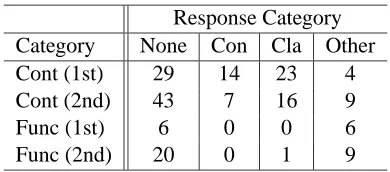
Response Category Category None Con Cla Other Cont (1st) 29 14 23 4 Cont (2nd) 43 7 16 9
Func (1st) 6 0 0 6
Func (2nd) 20 0 1 9
Table 9: Frequency of Reading Types By RF Cate-gory and Mention
frequency of Clausal, Constituent, and Other read-ings for content words and function words. This proved to be reliably different (χ2(2) = 35.3, p = 0.00).7 As table 9 shows, RFs of Function words were almost exclusively interpreted as Other, i.e. ei-ther Gap, Lexical or Non-clarificational. By contrast Content word reprises were interpreted as Clausal CRs 53% of the time, as Constituent CRs 29% of the time and as Other 18% of the time.
Content word and Function word clarifications were also compared for the the frequency with which they received a response. This showed no reliable difference (χ2(1) = 1.95, p = 0.16) indicat-ing that although the pattern of interpretation for Content and Function reprises is different they are equally likely to receive some kind of response.
The influence of grounding on reading type was assessed firstly by comparing the relative frequency of Constituent, Clausal and Other readings on first and second mention. This was reliably different (χ2(2) = 6.28, p = 0.04) indicating that level of grounding affects the reading assigned. A focussed comparison of Constituent and Clausal readings on first and second mention shows no reliable differ-ence (χ2
(1) = 0.0, p = 0.92). Together these findings
indicate that, across all word categories, Constituent and Clausal readings are more likely for RF’s of a first mention than a second mention and, conversely, Other readings are less likely for RF’s to a first men-tion than a second menmen-tion.
The effect of grounding on the relative frequency with which a clarification received a response was also tested. This indicated a strong effect of mention (χ2(1)= 12.01, p = 0.00); 58% of reprise clarifications of first mentions recieved a response whereas only 33% of second mention clarifications did.
4.4 Discussion
The experimental results support two basic conclu-sions. Firstly, people’s interpretation of the type of CR a reprise fragment is intended to make is influ-enced both by the category of the reprise fragment and its level of grounding. Secondly, reprise frag-ment CRs to first frag-mentions are much more likely to be responded to than reprise fragment CRs for
sec-7
A criterion level of p<0.05 was adopted for all statistical tests.
ond mentions.
Text-based and verbal interaction have different properties as communicative media. Amongst other things, in text-chat turns take longer to produce, are normally produced in overlap, and they persist for longer. However, even given these differences, the general pattern of clarifications observed in the experimental task is similar to that noted in ver-bal dialogue. In particular, Lexical, Gap and Non-clarificational readings are infrequent and reprise fragment clarifications are ignored with surprising frequency. In the present data, the clearest contrast between text-based and verbal interaction is in the relative frequency of Constituent and Clausal read-ings. In the BNC reprise fragments receive Clausal readings in 87% of cases, and constituent readings in 6% of cases. In the experimental corpus they receive Clausal readings in 48% of cases and Constituent readings in 34% of cases.
These findings demonstrate the viability, and some limitations, of investigating dialogue co-ordination through the manipulation of chat-tool based interactions. The chat tool was successful in producing plausible clarification sequences. Al-though in some cases participants had difficulty making sense of the artificial clarifications this did not make them distinguishable from other, real, but equally problematic turns from other participants. The clarifications were mostly successful in creat-ing realistic exchanges such as those illustrated in figures 2 and 3. When questioned during debriefing, no participants reported any suspicions about the ex-perimental manipulation.
The main practical difficulty encountered in the present study related to text-chat conventions such as novel spellings, abbreviations, and use of ‘smi-leys’. This created specific problems for the PoS tagger which assumes a more standard form of En-glish. These problems were also compounded by the noise introduced by typing errors and inconsistency in spelling and capitalisation.
it carries, particularly in comparison with corpus-based techniques, is in the investigation of dialogue phenomena which for various reasons are infrequent in existing corpora.
5 Conclusions
The main conclusions we draw from the results pre-sented here are as follows:
• Reprise CRs appear to go without response far more often than might be expected, both in the BNC and in our experimental corpus. Both may be effects of the media (transcription in one case, turn sequencing overlap in the other), but the figures are large enough and similar enough to warrant further investigation.
• Corpus investigation shows some strong corre-lations between CR form and expected answer type. It also shows that responses to CRs, when they come, come immediately.
• Both word PoS category and first/second men-tion appear to be reliable indicators of RF read-ing. This can help us in disambiguating user CRs, and in choosing forms when generating system CRs.
• RFs generated on the first mention of a word have a higher likelihood of receiving a response than on second mention.
• We have presented a new experimental tech-nique for manipulating dialogue, which we be-lieve has many potential uses in dialogue re-search.
6 Acknowledgments
This work was supported by the EPSRC under the project “ROSSINI: Role of Surface Structural Infor-mation in Dialogue” (GR/R04942/01).
References
J.B. Bavelas, N. Chovil, D. Lawrie, and L. Wade. 1992.
Interactive gestures. Discourse Processes, 15:469–
489.
Lou Burnard. 2000. Reference Guide for the British National Corpus (World Edition). Oxford University Computing Services.
Herbert H. Clark and Deanna Wilkes-Gibbs. 1986. Re-ferring as a collaborative process. Cognition, 22:1–39.
Sorin Dusan and James Flanagan. 2002. Adaptive dialog based upon multimodal language acquisition. In Pro-ceedings of the Fourth IEEE International Conference on Multimodal Interfaces, Pittsburgh, October.
Christiane Fellbaum, editor. 1998. WordNet: An Elec-tronic Lexical Database. MIT Press.
Simon Garrod and Gwyneth Doherty. 1994. Conversa-tion, co-ordination and convention: an empirical in-vestigation of how groups establish linguistic conven-tions. Cognition, 53:181–215.
Jonathan Ginzburg and Robin Cooper. 2001. Resolv-ing ellipsis in clarification. In ProceedResolv-ings of the 39th Meeting of the ACL, pages 236–243. Association for Computational Linguistics, July.
Jonathan Ginzburg and Robin Cooper. forthcoming.
Clarification, ellipsis, and the nature of contextual up-dates. Linguistics and Philosophy.
Beth Ann Hockey, Deborah Rossen-Knill, Beverly Spe-jewski, Matthew Stone, and Stephen Isard. 1997. Can you predict answers to Yes/No questions? Yes, No and Stuff. In Proceedings of Eurospeech ’97.
Adam Kilgarriff. 1997. Putting frequencies in the
dictionary. International Journal of Lexicography,
10(2):135–155.
Kevin Knight. 1996. Learning word meanings by in-struction. In Proceedings of the Thirteenth National Conference on Artifical Intelligence, pages 447–454. AAAI/IAAI.
A. Mikheev. 1997. Automatic rule induction for
un-known word guessing. Computational Linguistics,
23(3):405–423.
Matthew Purver, Jonathan Ginzburg, and Patrick Healey. 2001. On the means for clarification in dialogue. In Proceedings of the 2nd ACL SIGdial Workshop on Dis-course and Dialogue, pages 116–125. Association for Computational Linguistics, September.
Matthew Purver, Jonathan Ginzburg, and Patrick Healey.
2002. On the means for clarification in dialogue.
In R. Smith and J. van Kuppevelt, editors, Current and New Directions in Discourse & Dialogue. Kluwer Academic Publishers.
Matthew Purver. 2002. Processing unknown words in a dialogue system. In Proceedings of the 3rd ACL SIG-dial Workshop on Discourse and Dialogue, pages 174– 183. Association for Computational Linguistics, July.
Figure 1: Chattool Client Interface
Subject A’s View Subject B’s View
A: Obviously the relatives were coming around like they do to see me
B: Obviously the relatives were coming around like they do to see me
Probe → A: relatives?
Block B: Yeah just unts and uncles Ack → A: ah
A: yeah B: yeah
Figure 2: Story Telling Task Excerpt, Noun Clarification, Subjects 1 & 2
Subject A’s View Subject B’s View
A: so we agree B: so we agree
B: agree? ← Probe
A: yeah to chuck out Susie derkins
Block
B: uh huh ← Ack
A: yes B: yes