Ontology-based linguistic annotation
Philipp Cimiano, Siegfried Handschuh Institute AIFB
University of Karlsruhe
cimiano,handschuh @aifb.uni-karlsruhe.de
Abstract
We propose an ontology-based framework for linguistic annotation of written texts. We argue that linguistic annotation can be actually considered a special case of se-mantic annotation with regard to an on-tology such as pursued within the con-text of the Semantic Web. Furthermore, we present CREAM, a semantic annota-tion framework, as well as its concrete im-plementation OntoMat and show how they can be used for the purpose of linguistic annotation. We demonstrate the value of our framework by applying it to the an-notation of anaphoric relations in written texts.
1 Introduction
Linguistic annotation is crucial for the develop-ment and evaluation of natural language processing (NLP) tools. In particular machine-learning based approaches to part-of-speech tagging, word sense disambiguation, information extraction or anaphora resolution - just to name a few - rely on corpora an-notated with the corresponding phenomenon to be trained and tested on. In this paper, we argue that linguistic annotation can to some extent be consid-ered a special case of semantic annotation with re-gard to an ontology. Part-of-Speech (POS) annota-tion for example can be seen as the task of choos-ing the appropriate tag for a word from an ontol-ogy of word categories (compare for example the
Penn Treebank POS tagset as described in (Marcus et al., 1993)). The annotation of word senses such as used by machine-learning based word sense dis-ambiguation (WSD) tools corresponds to the task of selecting the correct semantic class or concept for a word from an underlying ontology such as WordNet (Resnik, 1997). Annotation by template filling such as used to train machine-learning based information extraction (IE) systems as (Ciravegna, 2001) can be seen as the task of finding and marking all the at-tributes of a given ontological concept in a text. An ontological concept in this sense can be a launching event, a management succession event or a person together with attributes such as name, affiliation, po-sition, etc. The annotation of anaphoric or bridging relations is actually the task of identifying the se-mantic relation between two linguistic expressions representing a certain ontological concept.
as its concrete implementation OntoMat. Finally, section 5 discusses related work, and section 6 con-cludes the paper.
2 The Ontology-based linguistic annotation framework
An ontology is a formal specification of a conceptu-alization (Gruber, 1993). A conceptuconceptu-alization can be understood as an abstract representation of the world or domain we want to model for a certain purpose. The ontological model underlying this work is basi-cally the one in (Bozsak et al., 2002). According to this model, an ontology is defined as follows:
Definition 1 (Ontology)
An ontology is a structure
consisting of (i) two disjoint sets and called
concept identifiers and relation identifiers
respec-tively, (ii) a partial order on called concept
hierarchy or taxonomy, (iii) a function
1called signature and (iv) a partial order
on called relation hierarchy.
In addition, the underlying ontological model also allows to define axioms:
Definition 2 ( -Axiom System)
Let be a logical language. An -axiom system for an ontology as defined above is a pair (AI, ) where (i) AI is a set whose elements are called axiom
identifiers and (ii) : AI is a mapping. The
elements of A:= (AI) are called axioms.
In our ontological framework, a relation! can for ex-ample be defined as symmetric, i.e. SYM(! ). Now if F-logic (Kifer et al., 1995) is used as the underly-ing logical language such as in (Staab and M¨adche, 2000), the translation of the SYM axiom identifier is as follows:
"
$#%&'&)(+*,#.-0/213&54'67 (1) 8:9<;
#=(
+*,&7-In addition, we will also distinguish special type of relations which we will call attributes. These are re-lations with a plain datatype as range, i.e. rere-lations
8%>?
with signatures of the type@
?
ABDC ,
1
Here we actually restrict the model to binary relations.
whereC is a plain datatype such as a string, an inte-ger, etc.
Our framework basically offers three ways of anno-tating a text with regard to an ontology:
E
a linguistic expression appearing in a text can be annotated as an instance of a certain onto-logical conceptF
>
E
a linguistic expression in a text can be anno-tated as an attribute instance of some other linguistic expression previously annotated as a certain conceptF
>
E
the semantic relation between two linguistic ex-pressions respectively annotated as instances of two conceptsFHGFJI
>
can be annotated as an instance of relation!
>
ifKL!M36FNGOFJIO
The advantages of an ontology-based linguistic an-notation framework as described above are the fol-lowing:
E
The formalization of the annotation scheme as an ontology as well as the use of standard formalisms such as RDF (Lassila and Swick, 1999) or OWL2to encode it, allow to reuse the scheme across different annotation tools. This meets the interoperability requirement men-tioned in (Ide, 2002).
E
The specification of the annotation task, i.e. the annotation scheme, can be performed in an ar-bitrary ontology development environment and thus becomes completely independent of the annotation tool actually used.
E
The ontology-based linguistic annotation model offers the kind of flexibility mentioned in (Ide, 2002) in the sense that it is general enough to be applied to a broad variety of annotation tasks.
E
The fact that annotation is performed with re-spect to an ontological hierarchy offers anno-tators the possibility to choose the appropri-ate level of annotation detail such that they are never forced to overspecify, i.e. to annotate more specifically than they actually feel com-fortable with.
2
In addition, a hierarchical annotation offers further possibilities regarding the computation of the agree-ment between different annotators as well as the evaluation of a system against a certain annota-tion. In this sense, instead of measuring only the categorial agreement between annotators with the kappa statistic (Carletta, 1996) or the performance of a system in terms of precision/recall, we could take into account the hierarchical organization of the categories or concepts by making use of measures considering the ’hierarchical distance’ between two concepts such as proposed by (Hahn and Schnat-tinger, 1998) or (M¨adche et al., 2002).
Furthermore, the use of an ontology-based and thus more semantic framework for linguistic annotation has two further, very interesting properties. On the one hand, the use of an ontology helps to constrain the possible relations between two concepts, thus re-ducing the amount of errors in the annotation pro-cess. For example when annotating Coreference-relations in a text, it seems obvious that an event and an entity will never be coreferring and in fact such an erroneous annotation can be avoided if the underlying ontological model actually forbids such an annotation (see below). Furthermore, by using axioms such as described above for example stating that Coreference is reflexive, symmetric and transitive thus representing an equivalence relation -the evaluation of systems becomes much easier and more straightforward when using an inference ma-chine such as (Decker et al., 1999). If an annotator for example annotates the following coreferences: Coreference(A,B) and Coreference(B,C) a system’s answer such as Coreference(A,C) will actually be counted as correct due to the fact that Coreference is defined as a transitive relation within the ontology.
3 Annotating anaphoric relations
Before showing how our framework can be applied to the annotation of anaphoric relations in written texts, the assumptions underlying our model have to be explained. First, we aim at a more semantic annotation of anaphoric relations than for example described in (M¨uller and Strube, 2001) because we think that such a model can to some extent be sub-sumed by the one we propose. In fact, we will un-derstand the term anaphoric in a much wider sense
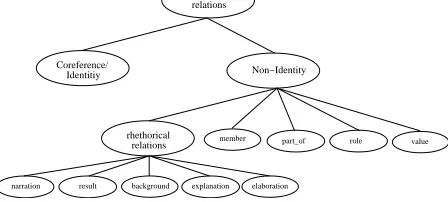
in line with (Krahmer and Piwek, 2000) and (van Deemter and Kibble, 2000). They argue for exam-ple that coreference is not a necessary property of anaphora such as proposed in (M¨uller and Strube, 2001). So annotating the relation between two ex-pressions as anaphoric will correspond to the most general relation in our hierarchy. In particular, in our model Identity or Coreference will only be a special type of anaphoric relation (compare figure 2). On the other hand, bridging will be defined in our framework in line with (Asher and Lascarides, 1999) as “the inference that two objects or events that are introduced in a text are related in a particular way that isn’t explicitly stated”. Thus Coreference or Identity can represent an anaphoric relation or more specifically a bridging reference depending on whether the identity relation is explicit or not. Con-sider the following minimal pair:
(2) John bought a car yesterday. The car was in a good state.
(3) John bought a car yesterday. The vehicle was in a good state.
In example (2), the anaphoric relation is explicit due to the matching heads of the NPs a car and
The car. In (3) the anaphoric or bridging
rela-tion is not explicit as world knowledge such as that cars are vehicles is needed to resolve the reference. In the semantics-based model for the annotation of anaphoric relations we propose in this paper, both examples will in fact be annotated as instances of the Coreference or Identity relation. Consequently, we will completely omit the concept bridging
refer-ence in the ontology underlying the annotation. In
grammatical information modeled as attributes of a concept will then yield a classification as envisioned by (M¨uller and Strube, 2001). For example, if two expressions are annotated as coreferring, this se-mantic relation can be further classified as nominal
anaphora if the referring expression is a pronoun,
as direct anaphora if the heads of the expression match or as a bridging reference otherwise. On the other hand, all the Non-Identity relations modeled in the ontology underlying the annotation task will lead to a classification as a bridging reference (com-pare figure 2). However, it should be mentioned that we do not aim at such a ’grammatical’ classifica-tion of anaphoric relaclassifica-tions. We envision a task as in (Asher and Lascarides, 1999), where bridging ref-erence resolution corresponds to the task of finding the discourse referent serving as antecedent as well as the semantic relation between this discourse ref-erent and the one of the referring expression. In our model, an expression can be antecedent for more than one referring expression, an assumption which seems to be commonly shared by many anno-tation schema. However, in our model a certain ex-pression can also refer to more than one antecedent. (Poesio and Reyle, 2001) for instance show that the antecedent of a referring expression can in fact be ambiguous in a way that the overall interpretation of the expression or sentence is not affected. Fur-thermore, (Poesio and Reyle, 2001) argue that it is not clear whether the addressees of an utterance ac-tually are aware of all the possible antecedents for a certain referring expression, if they underspecify the antecedent of a referring expression in case the over-all interpretation is not affected or if they just choose one of the possible antecedents without being aware of the other ones. In any case, a model for the anno-tation of anaphoric or bridging relations should not
a priori exclude that referring expressions can have
more than one antecedent. Consequently, the anno-tation of the semantic relation between a referring expression and an antecedent can neither take place at the antecedent nor the referring expression such as in (M¨uller and Strube, 2001), but in a functional way, i.e. at a virtual edge between them.
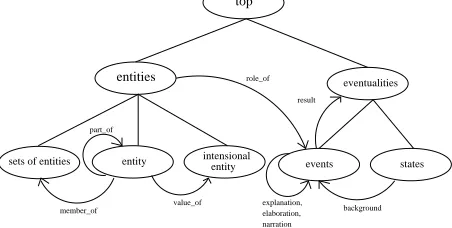
The ontology underlying our annotation scheme is depicted schematically in figure 1 We distinguish two types of eventualities: events and states, and model the discourse relations described in
(Las-entities
top
part_of
events states
eventualities
entity intensionalentity sets of entities
member_of
value_of
role_of
explanation, elaboration, narration
background result
Figure 1: The ontology underlying the annotation scheme
carides and Asher, 1991) as semantic relations be-tween them. In addition, we distinguish bebe-tween three types of (meta-) entities: sets of entities, inten-sional entities (van Deemter and Kibble, 2000) and (real-world) entities together with the potential rela-tions such as member of, part of, etc. between them as well as to other types: An entity for example can play a certain thematic role in some event (compare figure 1).
With such a concept hierarchy as well as seman-tic relations with a precisely defined signature, we can for example overcome annotation problems of intensionality and predication as discussed in (van Deemter and Kibble, 2000). In order to profit from the benefits of a hierarchical annotation, we also de-fine a hierarchy on the semantic relations (see figure 2). Thus if annotators for example feel that there is an anaphoric relation between two linguistic ex-pressions, but can not specify the type of relation, they can choose the most general relation in the hi-erarchy, i.e. anaphoric relation. As mentioned in section 2, the idea is that annotators are never forced to overspecify and can annotate at the hierarchical level they feel comfortable with.
4 CREAM and OntoMat
syn-relations rhethorical Coreference/
Identitiy
anaphoric relations
Non−Identity
value
result
narration background explanation elaboration
member part_of role
Figure 2: The hierarchical organization of the se-mantic relations.
tactic resources (viz. textual documents) into inter-linked knowledge structures that represent relevant underlying information (Handschuh et al., 2001). However, with an apropriate ontology one can also take advantage of the framework and use it for lin-guistic annotation. In the subsequent section we will explain only the features that are relevant to this pur-pose.
4.1 CREAM Features 4.1.1 User Interface
OntoMat’s document viewer visualizes the docu-ment contents. The user may easily provide annota-tions by selecting pieces of text and aligning it with parts of the ontology. The document viewer supports various formats3 (HTML, PDF, XML, etc.). The
Ontology and Fact Browser is the visual interface
to the ontology and the annotated facts. The anno-tation framework needs guidance from the ontology. In order to allow for sharing of knowledge, newly created annotations must be consistent with a given ontology. Otherwise, if annotators instantiate arbi-trary classes and properties the semantics of these properties remains void and the annotation thus use-les.
Both the Ontology and Fact Browser and the
docu-ment editor/viewer are intuitive to use: Drag’n’drop
helps to avoid syntax errors and typos and a good visualization of the ontology helps the annotators to correctly choose the most appropriate class for an
3
The current OntoMat implementation is restricted to HTML/XHTML and plain text. A support for PDF is in de-velopment.
instance (compare figure 3).
4.1.2 Annotation
An annotation in our context is a set of instantia-tions of classes, relainstantia-tionships and attributes. This in-stances are not directly embedded into the text, but are pointing to appropriate fragments of the docu-ment. The link between the annotation and the doc-ument is done by using XPointer (DeRose et al., 2001) as a adressing mechanism. This has some ad-vantages with regards to the flexibility of annotation as it allows (i) multiple annotation (ii) nested anno-tation and (iii) overlapping annoanno-tation of text seg-ments.
4.1.3 Annotation Inference Server
The annotation inference server reasons on the in-stances and on the ontology. Thereby, it also takes into account the axioms modeled within the ontol-ogy and can thus be used in the evaluation of a certain system such as described in section 2. We use Ontobroker’s F-Logic-based inference engine (Decker et al., 1999) as annotation inference server. The F-Logic inference engine combines ordering-independent reasoning in a high-level logical lan-guage with a well-founded semantics.
4.1.4 Storage
CREAM supports different ways of storing the annotation. This flexiblity is given by the XPointer technique which allows to separate the annotation from the document. Hence, the annotations can be stored together with the document. Alternatively or simultaneously it is also possible to store them remote, either in a separate file or in the annotation inference server.
4.2 Annotaing anaphoric relations
The ontology described in section 3 is available in the form of DAML+OIL4 classes and properties, in OWL, as pure RDF-Schema and in F-Logic. In the following, we shortly explain how OntoMat can be used for the creation of instances consistent with the ontology described in section 3.
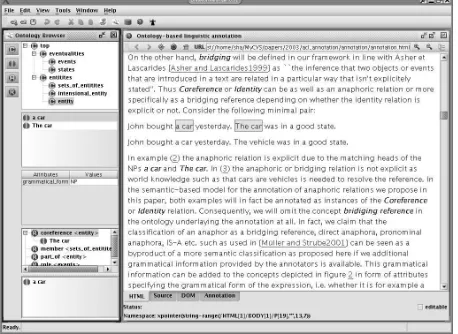
Figure 3 shows the screen for navigating the ontol-ogy and creating annotations in Ontomat. The right
Figure 3: Annotation Tool Screenshot.
pane displays the document and the left panes shows the ontological structures contained in the ontology, namely classes, attributes and relations. In addition, the left pane shows the current semantic annotation knowledge base, i.e. existing class instances, at-tribute instances and relationship instances created during the semantic annotation. First of all, the user browses a document by entering the URL of the web document that he would like to annotate. Then he loads the corresponding ontology into the ontology browser. He selects a text fragment by highlighting it. There are two possibilities for the text fragment to be annotated: as an instance or as a relation. In the case of an instance, the user selects in the on-tology the class where the text fragment fits in, e.g. for the expression ”a car” in example 2, he would select the class entity. By clicking on the class, the annotation gets created and thus the text fragment will be displayed as an instance of the selected class in the ontology browser. The relationships between the created instances can be specified, e.g. the en-tity The car can be annotated as coreferring with the preceding entity a car as described in section 2. For this purpose, when selecting a certain class instance as well as a corresponding semantic relation from the ontology, OntoMat already presents the possible target class instances according to the range restric-tions of the chosen relation. Hereby erroneous an-notations of relations are avoided (compare section
2). Futhermore, literal attributes can be assigned to every created instance by typing them into the re-lated attribute field. The choice of the predefined attributes depends on the class the instance belongs to. Thereby, instances of a certain concept can be annotated with grammatical information about how they are linguistically expressed, i.e. through an NP, a noun, a pronoun, a verb, etc. (compare section 3).
5 Discussion of Related Work
There is a vast amount of frameworks and tools developed for the purpose of linguistic annotation. However, in this paper we will focus on the discus-sion of frameworks for the annotation of anaphoric or discourse relations in written texts. In the an-notation scheme proposed by (M¨uller and Strube, 2001) in the context of their annotation tool MMAX and in contrast to the one proposed in this paper, anaphoric relations are restricted to coreferring ex-pressions, while bridging relations are restricted to non-coreferring ones. In line with (Krahmer and Pi-wek, 2000) and (van Deemter and Kibble, 2000) this is in our view a too strict definition of anaphora so that we propose a more relation-based classification of anaphoric and bridging relations. Furthermore, in (M¨uller and Strube, 2001), anaphoric relations are further differentiated according to the lexical items taking part in the relation. We have shown that un-der the assumption that the corresponding grammat-ical information is provided by the annotators, such a classification can be seen as a byproduct of a more semantic one such as outlined in this paper. In ad-dition, (M¨uller and Strube, 2001) propose to spec-ify antecedence with regard to equivalence classes rather than with regard to particular antecedents. However, this has the disadvantage that the infor-mation about the actual antecedent an annotator has selected is actually lost. Thus in our annotation pro-posal the fact that the Coreference relation forms equivalence classes is modeled by an underlying ax-iom system which can be exploited in the evaluation of a system against the annotation standard.
et al.’s annotation scheme definite descriptions are also explicitly annotated as discourse new.
The MUC coreference scheme (Hirschman and Chinchor, 1997) is restricted to the annotation of coreference relations, where coreference is also de-fined as an equivalence relation. Though this anno-tation scheme may seem quite simple, we agree with (Hirschman and Chinchor, 1997) that it is complex enough when taking into account the agreement of the annotators on a task. In fact, it has been shown that the agreement of subjects annotating bridging (Poesio and Vieira, 1998) or discourse (Cimiano, 2003) relations can be too low for tentative conclu-sion to be drawn (Carletta, 1996). The motivation of the MUC coreference scheme was thus to develop an annotation scheme leading to a good agreement. On the other hand, our motivation is to show how our ontology-based framework can be applied to the annotation of anaphoric relations in written texts and from this perspective the MUC coreference annota-tion scheme would have been in fact too restricted to actually show all the advantages of our approach. The UCREL (Fligelstone, 1992) and DRAMA (Pas-soneau, 1996) annotation schemes are more related to ours than the schemes above in the sense that they also provide a rich set of particular bridging rela-tions that can be annotated. However, in contrast to the ontology-based framework presented in this pa-per, these bridging relations are not constrained with regard to the conceptual types of their arguments, so that erroneous annotations can not be avoided. The coreference annotation scheme proposed within the MATE Workbench project consists of a core as well as an extended scheme (Davies et al., 1998). The core scheme is in principle identical with the MUC coreference scheme and is restricted to the an-notation of coreference in the sense of (van Deemter and Kibble, 2000). The extended scheme also al-lows the annotation of bound anaphors, of the rela-tionship between a function and its values, of differ-ent set, part and possession relations, of instantiation relations as well as of event relations. The MATE scheme is related to our ontology-based annotation scheme in the sense that relations are also annotated as triples via the link-tag (Davies et al., 1998). As in our framework, the MATE scheme also allows to mark up ambiguities of reference. However, in contrast to the MATE scheme our framework has no
means to specify a preference order on these am-biguous antecedents. On the other hand, the MATE scheme also includes a reasonable and complete tax-onomy of markables as well as some features rele-vant for the annotation of coreference in dialogues such as the treatment of hesitations, disfluencies and misunderstandings.
6 Conclusion
References
N. Asher and A. Lascarides. 1999. Bridging. Journal of Semantics, 15:83–113.
E. Bozsak, M. Ehrig, S. Handschuh, A. Hotho, A. M¨adche, B. Motik, D. Oberle, C. Schmitz, S. Staab, L. Stojanovic, N. Stojanovic, R. Studer, G. Stumme, Y. Sure, J. Tane, R. Volz, and V. Zacharias. 2002. Kaon - towards a large scale semantic web. In Pro-ceedings of the Third International Conference on E-Commerce and Web Technologies (EC-Web 2002). Springer Lecture Notes in Computer Science.
J. Carletta. 1996. Asessing agreement on classification tasks: The kappa statistic. Computational Linguistics, 22(2):249–254.
P. Cimiano. 2003. Ontology-driven discourse analysis in GenIE. In Proceedings of the 8th International Con-ference on Applications of Natural Language to Infor-mation Systems.
F. Ciravegna. 2001. Adaptive information extraction
from text by rule induction and generalization. In Pro-ceedings of tht 17th International Joint Conference on Artificial Intelligence (IJCAI 2001).
S. Davies, M. Poesio, F. Bruneseaux, and L.
Ro-mary, 1998. Annotating Coreference in
Di-alogues: Proposal for a scheme for MATE. http://www.cogsci.ed.ac.uk/˜poesio/anno manual.html.
S. Decker, M. Erdmann, D. Fensel, and R. Studer. 1999. Ontobroker: Ontology Based Access to Distributed and Semi-Structured Information. In R. Meersman et al., editors, Database Semantics: Semantic Issues in Multimedia Systems, pages 351–369. Kluwer.
S. DeRose, E. Maler, and R. Daniel. 2001. XML Pointer Language (XPointer). Technical report, W3C. Work-ing Draft 16 August 2002.
S. Fligelstone. 1992. Developing a scheme for annotat-ing text to show anaphoric relations. In G. Leitner, ed-itor, New Directions in Corpus Linguistics, pages 153– 170. Mouton de Gruyter.
T.R. Gruber. 1993. Toward principles for the design of ontologies used for knowledge sharing. In Formal Analysis in Conceptual Analysis and Knowledge Rep-resentation. Kluwer.
U. Hahn and K. Schnattinger. 1998. Ontology engineer-ing via text understandengineer-ing. In Proceedengineer-ings of the 15th World Computer Congress ’The Global Information Society on the Way to the Next Millenium’ (IFIP’98).
S. Handschuh, S. Staab, and A. M¨adche. 2001. CREAM — Creating relational metadata with a component-based, ontology-driven annotation framework. In Pro-ceedings of K-Cap 2001, pages 76–83. ACM Press.
L. Hirschman and N. Chinchor. 1997. MUC-7 corefer-ence task definition. In Proceedings of the 7th Mes-sage Understanding Conference (MUC-7).
Nancy Ide. 2002. Linguistic annotation framework.
Technical Report ISO TC37/SC4/WG1 N11, ISO TC37 SC4 Language Resource Management, 08.
M. Kifer, G. Lausen, and J. Wu. 1995. Logical foun-dations of object-oriented and frame-based languages. Journal of the ACM, 42:741–843.
E. Krahmer and P. Piwek. 2000. Varieties of anaphora: Introduction. In ESSLLI 2000 Reader.
A. Lascarides and N. Asher. 1991. Discourse relations and defeasible knowledge. In Meeting of the Associa-tion for ComputaAssocia-tional Linguistics, pages 55–62.
O. Lassila and R. Swick. 1999. Resource
descrip-tion framework (RDF) model and syntax specifica-tion. Technical report, W3C. W3C Recommendaspecifica-tion. http://www.w3.org/TR/REC-rdf-syntax.
A. M¨adche, V. Pekar, and S. Staab. 2002. Ontology learning part one - on discovering taxonomic relations from the web. In Web Intelligence. Springer.
M. Marcus, B. Santorini, and M.A. Marcinkiewicz.
1993. Building a large annotated corpus of
en-glish: The penn treebank. Computational Linguistics, 19(2):313–330.
C. M¨uller and M. Strube. 2001. Annotating anaphoric and bridging relations with MMAX. In Proceedings of the 2nd SIGdial Workshop on Discourse and Dialogue, pages 90–95.
R. Passoneau, 1996. DRAMA: Instructions for Applying Reference Annotation for Multiple Applications.
M. Poesio and U. Reyle. 2001. Underspecification in anaphoric reference. In Proceedings of the IWCS-4.
M. Poesio and R. Vieira. 1998. A corpus-based investi-gation of definite description use. Computational Lin-guistics, 24(2):183–216.
Philip Resnik. 1997. Selectional preference and sense disambiguation. In Proceedings of the ACL SIGLEX Workshop on Tagging Text with Lexical Semantics: Why, What, and How?
S. Staab and A. M¨adche. 2000. Ontology engineering beyond the modeling of concepts and relations. In R. V. Benjamins, A. Gomez-Perez, N. Guarino, and M. Uschold, editors, Proceedings of the 14th Confer-ence on Artificial IntelligConfer-ence, Workshop on Applica-tions and Problem-Solving Methods.