Multilingual Mention Detection for Coreference Resolution
Olga Uryupina
DISI, University of Trento, Italy
Alessandro Moschitti
QCRI, Qatar Foundation, Doha, Qatar
Abstract
This paper proposes a novel algorithm for multilingual mention detection: we ex-tract mentions from parse trees via kernel-based SVM learning. Our approach al-lows for straightforward mention detection for any language where (not necessary per-fect) parsing resources are available, with-out any complex language-specific rule engineering. We also investigate possi-bilities for incorporating automatically ac-quired mentions into an end-to-end coref-erence resolution system. We evaluate our approach on the Arabic and Chinese por-tions of the CoNLL-2012 dataset, showing a significant improvement over the system with the baseline mention detection.
1 Introduction
Accurate mention detection (MD) is a vital prereq-uisite for a variety of Natural Language Processing tasks, in particular, for Relation Extraction (RE) and Coreference Resolution (CR). If a toolkit can-not extract mentions reliably, it will obviously be unable to assign them to relations or entities.
Many studies on RE and CR report evaluation figures ongoldmentions: in such a setting, a sys-tem is supplied with correct mention boundaries and/or semantic classes or other relevant prop-erties. It can, in theory, be argued that such a methodology provides better insights on perfor-mance of RE and CR algorithms per se. It has been demonstrated, however, that evaluation results on gold mentions are misleading: for example, Ng (2008) shows that unsupervised CR algorithms ex-hibit promising results on gold mentions, that are not mirrored in a more realistic evaluation on au-tomatically detected mentions.
The exact scope of the mention detection task varies considerably depending on the annotation
guidelines. Thus, some corpora consider all the (non-embedding) NPs to be mentions, some cor-pora do not allow for non-referential mentions and some do not mark singleton referential mentions, that do not participate in coreference relations. In addition, some guidelines may restrict the annota-tion to specific semantic types.
A number of linguistic studies focus on various syntactic, semantic and discourse clues that might help identify nominal constructions that cannot participate in coreference relations. Possible fea-tures include, among others, specific syntactic constructions for expletive pronouns, negation, modality and quantification (Karttunen, 1976). Several algorithms have been proposed recently, trying to tackle some of the addressed phenom-ena within a computational approach. Thus, a number of algorithms have been developed re-cently to identify expletive usages of “it” (Evans, 2001; Boyd et al., 2005; Bergsma and Yarowsky, 2011). While these approaches are potentially beneficial for mention detection in English, for other languages, neither theoretical nor compu-tational studies are available at the moment. In this paper, we use tree kernels to extract relevant syntactic patterns automatically, without assuming any prior knowledge of the input language.
In this paper, we propose a learning-based so-lution to the mention detection task. We use SVMs (Joachims, 1999) with syntactic tree ker-nels (Collins and Duffy, 2001; Moschitti, 2008; Moschitti, 2006) to classify parse tree nodes as
±mentions. Our approach does not require any language- or corpus-specific engineering and thus can be easily adapted to cover new languages or mention annotation schemes.
The rest of paper is organized as follows. In the next section, we define the task and discuss our tree and vector representations. Section 4 presents MD evaluation figures. Finally, in Section 5 we incorporate our MD module into an end-to-end
coreference resolution system.
2 Related Work
Until recently, most RE and CR toolkits have been evaluated on the ACE datasets (Doddington et al., 2004). The ACE guidelines restrict possi-ble mentions to be considered to specific semantic types (PERSON, LOCATION and so on). More-over, mentions are annotated with their minimal and maximal span, allowing for relaxed matching between gold and automatically extracted bound-aries. In such a setting, the mention detection task can be cast as a tagging problem, similar to the named entity recognition and classification task. A number of systems have followed this scenario, demonstrating reliable performance (Florian et al., 2004; Ittycheriah et al., 2003; Zitouni and Florian, 2008).
In the past years, however, several corpora have been created from a more linguistic perspective: for example, the OntoNotes dataset (Hovy et al., 2006; Pradhan et al., 2012) provides annotation for unrestricted coreference. The guidelines differ significantly from the ACE scheme: mentions cor-respond to parse nodes and can be of any semantic type, the systems are expected to recover mention boundaries exactly. The OntoNotes mentions— unlike ACE ones–correspond to large NP struc-tures (embedding NP nodes in gold parse trees), so a traditional approach (e.g., one of those men-tioned above), which aims at identifying basic NP chunks, would not be applicable here. There-fore, any MD method for OntoNotes would rely on parsing.
The OntoNotes corpus has been used for eval-uating end-to-end CR systems at two CoNLL shared tasks (2011 and 2012). At the 2011 shared task, the participants relied on rule-based mod-ules for extracting mention boundaries from parse trees. This was relatively straightforward, as the task was devoted to CR in English and most par-ticipants could use their in-house MD modules developed and refined in the past decade. At the 2012 shared task, however, the systems were expected to provide end-to-end coreference res-olution for Arabic and Chinese. As it turned out, most groups could not adapt their MD rules to cover these two languages and fell back to very simple baselines (e.g., “use all NP nodes as mentions”). Kummerfeld et al. (2011) investi-gated various post- and pre-filtering heuristics for
adapting their mention detection algorithm to the OntoNotes English data in a semi-automatic way, reporting mixed results.
3 Mention extraction from parse trees
We recast MD as anode filteringtask: each candi-date node is classified as either mention or not. In this study, we consider all “NP” nodes to be candi-dates for MD. As Table 1 shows, this is a reason-able assumption for the OntoNotes dataset, as al-most 90% of all the mentions for both Arabic and Chinese correspond to NP nodes. The remaining 11-14% of mentions can mostly be attributed to parsing errors: as we aim at end-to-end process-ing with no gold information available, we run our system on automatically extracted parse trees, it is therefore possible that a mention corresponds to a gold NP node that has not been labeled correctly in an automatic parse tree.
train development
NP-nodes % NP-nodes %
[image:2.595.308.526.335.392.2]ARB 24068 87.23 2916 87.91 CHN 88523 85.96 12572 88.52
Table 1: NP-nodes in OntoNotes for Arabic (ARB) and Chinese (CHN): total numbers and percentage of mentions that are NP-nodes.
Not all the NP nodes, however, correspond to a mention. Such non-mention NPs fall into several categories:
• Embedded NPs. When an NP is embedded into another one, only the outer NP is used to represent a mention:
(1) [M EN T ION−N P[N PThis type] of earthquake]has no precursors.1
A number of heuristics have been proposed for English to identify and discard embedded NPs, based on available head-finding algo-rithms, e.g., (Collins, 1999). For other lan-guages, however, the task of finding a head of a given NP in a constituency tree is not trivial.
• Non-referential NPs. Depending on the an-notation guidelines, non-referential NPs can
either be marked as mentions or not. In OntoNotes, non-referential NPs should not be annotated:
(2) This type of earthquake has [N Pno precursors].
• Singleton NPs. In some CR corpora (for ex-ample, ACE), mentions are annotated even if they do not participate in any corefer-ence relations. In other corpora (MUC and OntoNotes), suchsingletonsare not marked. When singletons are not marked, the MD tasks becomes considerably more difficult: the performance of an MD component cannot be measured and optimized directly, but only in conjunction with a coreference resolver.
• Erroneous NPs. When we evaluate an end-to-end system, we expect it to process raw in-put and thus rely on automatically extracted parse trees. Some NP-nodes might be incor-rect, not corresponding to any NP in the gold tree. Such nodes cannot be mentions:
(3) At the meeting, Huang Xiangning read [N Pthe earthquake prediction] that they had previously issued.
“The earthquake prediction” is considered to be an NP node by the parser. In the gold data, however, this node does not exist at all. And even if it existed, the mention should correspond to its embedding NP node, “the earthquake prediction that the had previously issued” (cf. example 1 above). While this problem is less crucial for English, parsing resources for other languages are still scarce and less reliable.
3.1 Tree Representation
We use kernel-based SVMs to classify nodes as
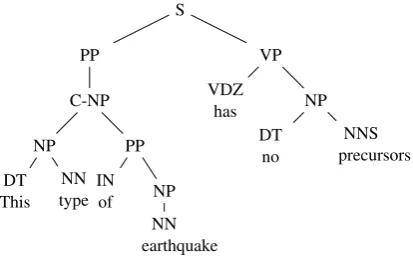
±mentions. This requires representing a relevant fragment of a tree with a specific node marked as “C-NP” (candidate). We start from a straightfor-ward representation: using automatically gener-ated parse trees provided within the CoNLL data distribution, we generate one example for each NP node: the example corresponds to the entire parse tree with just a single node re-labeled as “C-NP”. The assigned class label reflects the fact that this particular node corresponds to some gold mention or not. For example, the full parse tree for our sen-tence (1-2) will generate one positive (for “This
type of earthquake”, shown on Figure 1) and three negative examples (for “This type”, “earthquake” and “no precursors”).
While this representation might work for our toy example, for a longer sentence it would pro-vide irrelevant information. Consider again the tree on Figure 1. To generate a training example we append “C-” to one NP node, keeping all the remaining nodes as-is. The tree kernel operates on subtrees of the given structure, so, effectively, it will consider a lot of tree fragments that do not contain the marked node. These fragments will affect the treatment of different examples, possi-bly with conflicting class labels. It will not only make learning slow but also introduce spurious ev-idence, decreasing the system’s performance. We have therefore investigated two possibilities for pruning our trees.
Our first pruning algorithm (“up-down”) starts from the node of interest (C-NP) and goes up for
unodes. From each node on the path, it considers all its children up to the depthd. The first part of Figure 2 shows a pruned tree foru= 2, d= 1for the node “This type of earthquake.”
Our second pruning algorithm (“radial”) starts from the node of interest and considers all the nodes in the tree that are reachable from it via at mostnedges. The second part of Figure 2 shows a pruned tree forn= 2for the same node.
3.2 Vector Representation
S
PP
C-NP
NP DT This
NN type
PP IN
of NP
NN earthquake
VP VDZ
has NP
DT no
[image:4.595.210.417.64.195.2]NNS precursors
Figure 1: Parse tree for “This type of earthquake”, examples (1-2): before pruning.
S
PP
C-NP
NP PP
VP
S
PP
C-NP
NP DT This
NN type
PP IN
of NP
[image:4.595.93.460.235.371.2]NN earthquake
Figure 2: Up-down (left) vs. radial (right) pruning for “This type of earthquake,” examples (1-2)
language-specific manual engineering.
Table 2 lists the features for our vector repre-sentation. Nominal values are binarized, leading to 10 binary or continuous features.
feature possible values
Gender F,M,Unknown
Definiteness Yes, No
Number Sg,Pl,Du,Unknown MentionType Name,Nominal,Pronoun #same-surface NPs continuous (normalized)
[image:4.595.75.290.480.583.2]in the doc
Table 2: Features used for Mention Detection: each feature describes an individual NP
4 Evaluating MD
In this section we provide evaluation results on both Arabic and Chinese. We reserve a small por-tion of the CoNLL training data (around 20k in-stances for each language) for training an MD sys-tem. Another small subset (around 5k instances) is reserved for fitting the system parameters. The evaluation results are reported on the CoNLL de-velopment data. Note that we evaluate the
NP-node classifier, so the system receives no penalty for missing mentions that are not NPs. In Section 5 below, however, we will assess the impact of MD on the end-to-end CR system and thus penalize for missing non-NP mentions.
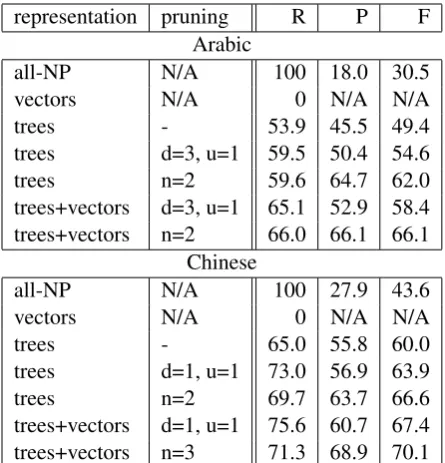
As a baseline (“all-NP”), we consider all the NP nodes to be mentions. Table 3 below compares this baseline against mentions extracted automatically from different representations. We use Syntactic Tree Kernels (TK) implemented within the SVM-TK toolkit2to induce the classification.
As our results suggest, vector representation does not provide enough information for robust mention detection.3 Indeed, without tree kernels, the system is only able to learn a major class label-ing. This highlights the importance of a model that is able to handle structured input, learning relevant patterns directly from parse trees.
As discussed in Section 3 above, full trees con-tain too much misleading evidence. A single parse tree might contain several dozens of NP nodes, so,
2http://disi.unitn.it/moschitti/ Tree-Kernel.htm
representation pruning R P F Arabic
all-NP N/A 100 18.0 30.5
vectors N/A 0 N/A N/A
trees - 53.9 45.5 49.4
trees d=3, u=1 59.5 50.4 54.6
trees n=2 59.6 64.7 62.0
trees+vectors d=3, u=1 65.1 52.9 58.4 trees+vectors n=2 66.0 66.1 66.1
Chinese
all-NP N/A 100 27.9 43.6
vectors N/A 0 N/A N/A
trees - 65.0 55.8 60.0
trees d=1, u=1 73.0 56.9 63.9
trees n=2 69.7 63.7 66.6
[image:5.595.71.294.62.294.2]trees+vectors d=1, u=1 75.6 60.7 67.4 trees+vectors n=3 71.3 68.9 70.1
Table 3: Performance of the MD classifier on the development set
using a full sentence tree to represent a particular candidate node provides confusing input for the classifier. This is reflected with a low classifier performance on full representations.
Both pruning strategies have resulted in a sub-stantial improvement in the performance level. The radial pruning has significantly outperformed the up-down strategy. Moreover, the radial prun-ing depends on just one parameter and can there-fore be optimized faster.
Finally, joint vector and tree representation fur-ther outperforms a plain tree-based model. It must be noted, however, that our MD features (Table 2) require at least some minimal amount of language-specific engineering.
5 Incorporating TK-based Mention Detection into an end-to-end coreference resolution system
For our experiments, we use BART – a modu-lar toolkit for coreference resolution that supports state-of-the-art statistical approaches to the task and enables efficient feature engineering (Vers-ley et al., 2008). BART has originally been cre-ated and tested for English, but its flexible modu-lar architecture ensures its portability to other lan-guages and domains.
In our evaluation experiments, we follow a very simple model of coreference, namely, the mention-pair approach advocated by Soon et al.
(2001) and adopted in many studies ever since. We believe, however, that more complex models of coreference will also benefit from our MD algo-rithm: most state-of-the-art CR systems treat men-tion detecmen-tion as a preprocessing step that is not af-fected by further processing and therefore we ex-pect them to yield better performance when such a preprocessing is achieved in a more robust way.
Creating a robust coreference resolver for a new language requires linguistic expertise and language-specific engineering. This cannot and, moreover, should not be avoided by fully language-agnostic methods. Our approach to end-to-end coreference resolution relies on a universal MD component that requires no linguistic engi-neering – it facilitates the development of coref-erence resolvers in the narrow sense, by provid-ing them with input mentions. We must stress that the resolvers themselves are not supposed to be universal: in fact, a number of linguistic studies on coreference address various language-specific challenging problems (e.g., zero pronouns, differ-ent marking of information status etc).
Below we describe the adjustments we made to BART to cover Arabic and Chinese and then report on our experiments for integrating kernel-based MD into BART to provide an end-to-end coreference resolution for these languages.
5.1 Adapting BART to Arabic and Chinese
The modularity of the BART toolkit enables its straightforward adaptation to different languages. This includes creating meaningful linguistic repre-sentations of mentions (“mention properties”) and, optionally, some experiments on feature selection and engineering.
We extracted some properties (sentence bound-aries, lemmata, speaker id) for Arabic and Chi-nese directly from the CoNLL/OntoNotes layers4. Mention types are inferred from PoS tags.
We compiled lists of pronouns for both Arabic and Chinese from the training and development data. For Arabic, we used gold PoS tags to clas-sify pronouns into subtypes, person, number and gender. For Chinese, no such information is avail-able, so we consulted several grammar sketches and lists of pronouns on the web. Finally, we ex-tracted a list of gender affixes for Arabic along
with a list of gender-classified lemmata from the training data.
We assessed the list of features, supported by BART, discarding those that require unavailable information (for example, thealiasingfeature relies on semantic types for named entities that are not available within the CoNLL/OntoNotes distri-bution for languages other than English). We also created two additional features:LemmataMatch
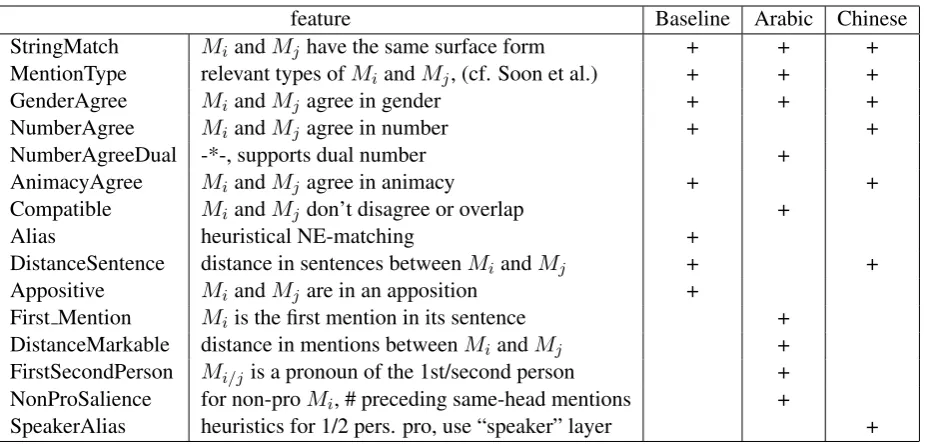
(similar to string match, but uses lemmata instead of tokens) andNumberAgreementDual (simi-lar to commonly used number agreement features, but supports dual number). Both features are ex-pected to provide important information for coref-erence in Arabic, a morphologically rich language. We ran a feature selection experiment to fur-ther remove irrelevant features (BART were only tested on European languages, thus several fea-tures reflected patterns more common for Ger-manic and Romance languages). This resulted in two feature sets, one for each language, listed in Table 4. For comparison, we also show the base-line features (cf. below).
5.2 Incorporating Kernel-based MD into a Coreference Resolver
Coreference resolution systems have different tol-erance for precision and recall MD errors. If a spu-rious mention is introduced, the CR system might still assign it to no coreference chain and thus dis-card from the output partition. If a correct men-tion is missed, however, the system has no chance of recovering it as it does not even start processing such a mention. This suggests that an MD module should be tuned to yield better recall.
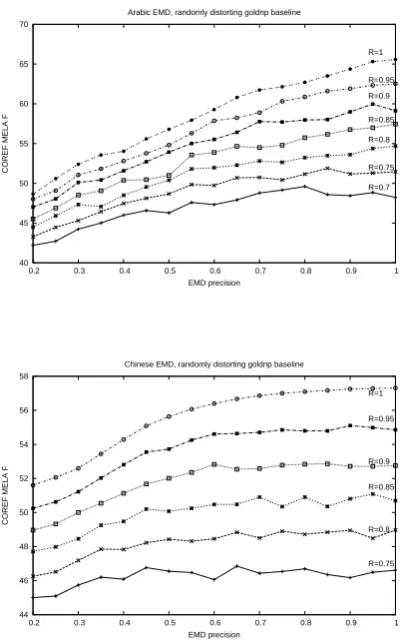
To assess the impact of MD precision and recall errors on the performance of our coreference re-solver, we run a simulation experiment. We start from the upper bound baseline: the MD module considers all the true (gold) NP mentions to be positive and all the spurious ones – to be neg-ative. We then randomly distort this baseline, adding spurious mentions and removing correct ones, to arrive at a predefined performance level. The resulting MD output is then sent to our coref-erence resolution system and its performance is measured. As a measure of the CR system per-formance, we use the MELA F-score – an aver-age of MUC, B3 and CEAFe metrics, the official performance measure at the CoNLL shared task (Pradhan et al., 2012).
Figure 3 shows the results of our simulation ex-periment on the development data. Each line on the figure corresponds to a single MD recall level (varying from 100% to 70%). On the horizon-tal axis, we plot the MD precision (from 10% to 100%) and on the vertical axis – the end-to-end system MELA F-score. The curves support our in-tuition that reliable MD recall is crucial for coref-erence: when the MD recall drops to around 70%, the MELA score remains at the baseline level even for very high MD precision. It must be noted that our simulation experiment relies on an unrealistic assumption: we assume all the errors to be inde-pendent. In a more practical setting, the MELA F-score for a given combination of MD precision and recall can be higher, because the coreference system might fail to resolve the same NPs that are problematic for the MD module. Nevertheless, the curves illustrate the fact that any MD module should be strongly biased towards recall in order to be useful for coreference resolution.
We therefore reran our optimization experi-ments to fit more parameters of the MD module. Recall from Section 4 that we already used a small amount of CoNLL training data to fit ourd,uand
nvalues. We expanded the set of parameters, us-ing the end-to-end performance (MELA F-score) to select optimal values on the same subset. Table 5 lists all the parameters of our MD module.
d, u up-down pruning thresholds n radial pruning threshold
j precision-recall trade-off (SVM-TK) c cost factor (SVM-TK)
s size of MD vs. CR data splits r tree vs. tree+vector representation
Table 5: Parameters optimized on a held-out data
Our experiments reveal that, indeed, a recall-oriented version of our MD classifier yields the most reliable end-to-end resolution. Table 6 shows the MD performance of the best classifier selected according to the MELA score. While the F-scores of these biased classifiers are, obviously, much lower than their unbiased counterparts, they still manage to filter out a substantial amount of noun phrases, at the same time maintaining a very high recall level.
feature Baseline Arabic Chinese StringMatch MiandMj have the same surface form + + + MentionType relevant types ofMiandMj, (cf. Soon et al.) + + +
GenderAgree MiandMj agree in gender + + +
NumberAgree MiandMj agree in number + +
NumberAgreeDual -*-, supports dual number +
AnimacyAgree MiandMj agree in animacy + +
Compatible MiandMj don’t disagree or overlap +
Alias heuristical NE-matching +
DistanceSentence distance in sentences betweenMiandMj + + Appositive MiandMj are in an apposition +
First Mention Miis the first mention in its sentence + DistanceMarkable distance in mentions betweenMi andMj + FirstSecondPerson Mi/j is a pronoun of the 1st/second person + NonProSalience for non-proMi, # preceding same-head mentions +
[image:7.595.73.536.61.283.2]SpeakerAlias heuristics for 1/2 pers. pro, use “speaker” layer +
Table 4: Features used for Coreference Resolution in Arabic and Chinese: each feature describes a pair of mentions{Mi, Mj}, i < j, whereMi is a candidate antecedent andMj is a candidate anaphor
kernel-based MD (TKMD), we compare its per-formance against two baselines. The lower bound, “all-NP”, considers all the NP-nodes in a parse tree to be candidate mentions. The upper bound, “gold-NP” only considers gold NP-nodes to be candidate mentions. Note that the upper bound does not include mentions that do not correspond to NP-nodes at all (around 12% of all the mentions in the development data, cf. Table 1 above).
Tables 7 and 8 also show the performance level of BART’s rule-based MD module that was de-veloped for English. Although this heuristic has proved reliable on the English data, for example, at the CoNLL 2011 and 2012 shared tasks, it is not robust enough to be ported as-is to other lan-guages: indeed, the performance of the heuristic MD on Arabic and Chinese is lower than the all-NP baseline. This highlights the importance of a learning-based approach: while rule-based MD shows good results for English, we cannot expect spending ten more years on designing similar sys-tems for other languages.
R P F
[image:7.595.101.261.655.699.2]Arabic 90.67 31.07 46.28 Chinese 98.37 38.27 55.1
Table 6: Performance of the recall-oriented MD classifier on the CoNLL development set.
For both languages, the performance goes up
Soon et al. (2001) Table 4 features features Arabic
all-NP 46.15 46.32
English MD 43.46 43.49
TK-MD 48.13† 50.02†
gold-NP 63.27† 64.55†
Chinese
all-NP 51.04 51.40
English MD 46.77 46.77
TK-MD 53.40† 53.86†
gold-NP 57.30† 57.98†
Table 7: Evaluating the impact of MD and lin-guistic knowledge: MELA F-score on the devel-opment set, significant improvement over the cor-responding all-NP baseline shown with†.
drastically when one shifts from a realistic eval-uation (the “all-NP” baseline) to gold NP men-tions. Kernel-based MD is able to recover part of this difference, providing significant improve-ments over the baseline (t-test on individual docu-ments,p <0.05).
40 45 50 55 60 65 70
0.2 0.3 0.4 0.5 0.6 0.7 0.8 0.9 1
COREF MELA F
EMD precision Arabic EMD, randomly distorting goldnp baseline
R=1
R=0.95 R=0.9 R=0.85 R=0.8
R=0.75 R=0.7
44 46 48 50 52 54 56 58
0.2 0.3 0.4 0.5 0.6 0.7 0.8 0.9 1
COREF MELA F
EMD precision Chinese EMD, randomly distorting goldnp baseline
R=1 R=0.95
R=0.9 R=0.85
R=0.8
[image:8.595.87.288.77.399.2]R=0.75
Figure 3: Performance of an end-to-end corefer-ence resolution system for different values of MD Recall and Precision in a simulation experiment: MELA F-score on the Arabic and Chinese devel-opment data.
related phenomena specific for Arabic and Chi-nese. However, the extra features help more when the MD improves. This suggests that a robust MD module is an essential prerequisite for further work on coreference in new languages: a more ac-curate set of mentions provides a better testbed for manually engineered language-specific features or constraints.
6 Conclusion and Future Work
In this paper we have investigated possibilities for language-independent mention detection based on syntactic tree kernels. We have shown that a kernel-based approach can provide a robust pre-processing system that is a vital prerequisite for fast and efficient development of end-to-end mul-tilingual coreference resolvers.
We have evaluated different tree and vector rep-resentations, showing that the best performance is
Soon et al. (2001) Table 4 features features Arabic
all-NP 46.79 47.36
English MD 43.77 43.65
TK-MD 48.38† 51.54†
gold-NP 63.07† 65.57†
Chinese
all-NP 53.26 53.24
English MD 48.99 48.99
TK-MD 58.11† 58.15†
gold-NP 59.97† 60.04†
Table 8: Evaluating the impact of MD and lin-guistic knowledge: MELA F-score on the official CoNLL-2012 test set, significant improvement over the corresponding all-NP baseline shown with†.
achieved by applying radial pruning to parse trees and augmenting the resulting representation with feature vectors, encoding very basic and shallow properties of candidate NPs.
We have investigated possibilities of incorporat-ing our MD module to an end-to-end coreference resolution system. Our evaluation results show significant improvement over the system relying on the “all-NP” baseline for both Arabic and Chi-nese. It should be stressed that no other baseline is available without using deep linguistic expertise.
In the future, we plan to follow two directions to further improve our algorithm. First, we want to consider more global models of MD, providing joint inference over sets of NP nodes, and, possi-bly, incorporating CR predictions as well. Several studies (Daume III and Marcu, 2005; Denis and Baldridge, 2009) followed this direction recently, showing promising results for joint MD and CR modeling.
Acknowledgments
The research described in this paper has been par-tially supported by the European Community’s Seventh Framework Programme (FP7/2007-2013) under the grant #288024: LIMOSINE – Linguis-tically Motivated Semantic aggregation engiNes.
References
Shane Bergsma and David Yarowsky. 2011. NADA: A robust system for non-referential pronoun detec-tion. InProc. DAARC, pages 12–23, Faro, Portugal, October.
Adriane Boyd, Whitney Gegg-Harrison, and Donna
Byron. 2005. Identifying nonreferential it: A
machine learning approach incorporating
linguisti-cally motivated patterns. In Proceedingd of the
ACL Workshop on Feature Engineering for Machine Learning in Natural Language Processing,, pages 40–47.
Michael Collins and Nigel Duffy. 2001. Convolution kernels for natural language. InAdvances in Neural Information Processing Systems 14, pages 625–632. MIT Press.
Michael Collins. 1999. Head-Driven Statistical
Mod-els for Natural Language Parsing. Ph.D. thesis, University of Pennsylvania.
Pascal Denis and Jason Baldridge. 2009. Global joint models for coreference resolution and named entity classification. InProcesamiento del Lenguaje Natu-ral 42, Barcelona: SEPLN.
George Doddington, Alexis Mitchell, Mark Przybocki, Lance Ramshaw, Stephanie Strassell, and Ralph Weischedel. 2004. The automatic content extrac-tion (ACE) program–tasks, data, and evaluaextrac-tion. In
Proceedings of the Language Resources and Evalu-ation Conference.
Richard Evans. 2001. Applying machine learning to-ward an automatic classification ofit. Literary and Linguistic Computing, 16(1):45–57.
Radu Florian, Hany Hassan, Abraham Ittycheriah, Hongyan Jing, Xiaoqiang Luo, Nicolas Nicolov, and Salim Roukos. 2004. A statistical model for multi-lingual entity detection and tracking. InProceedings of the Human Language Technology Conference of the North American Chapter of the Association for Computational Linguistics, pages 1–8.
Eduard Hovy, Mitchell Marcus, Martha Palmer,
Lance Ramshaw, and Ralph Weischedel. 2006.
OntoNotes: The 90% solution. In Proceedings of
HLT/NAACL.
Hal Daume III and Daniel Marcu. 2005. A large-scale exploration of effective global features for a joint en-tity detection and tracking model. InProceedings of
the 2005 Conference on Empirical Methods in Nat-ural Language Processing.
Abraham Ittycheriah, Lucian Vlad Lita, Nanda Kamb-hatla, Nicolas Nicolov, Salim Roukos, and Margo Stys. 2003. Identifying and tracking entity
men-tions in a maximum entropy framework. In
Pro-ceedings of the Conference of the North American Chapter of the Association for Computational Lin-guistics on Human Language Technology.
Thorsten Joachims. 1999. Making large-scale SVM learning practical. In B. Sch¨olkopf, C. Burges, and
A. Smola, editors, Advances in Kernel Methods
-Support Vector Learning. MIT-Press.
Lauri Karttunen. 1976. Discourse referents. In
J. McKawley, editor, Sytax and Semantics,
vol-ume 7, pages 361–385. Academic Press.
Jonathan K Kummerfeld, Mohit Bansal, David Burkett, and Dan Klein. 2011. Mention detection:
Heuris-tics for the OntoNotes annotations. InProceedings
of the Fifteenth Conference on Computational Nat-ural Language Learning: Shared Task, pages 102– 106, Portland, Oregon, USA, June. Association for Computational Linguistics.
Alessandro Moschitti. 2006. Efficient convolution ker-nels for dependency and constituent syntactic trees. InProceedings of European Conference on Machine Learning, pages 318–329.
Alessandro Moschitti. 2008. Kernel methods, syntax and semantics for relational text categorization. In
Proceeding of the International Conference on In-formation and Knowledge Management, NY, USA.
Vincent Ng. 2008. Unsupervised models for
corefer-ence resolution. In Proceedings of the 2008
Con-ference on Empirical Methods in Natural Language Processing, pages 640–649.
Sameer Pradhan, Alessandro Moschitti, Nianwen Xue, Olga Uryupina, and Yuchen Zhang. 2012.
CoNLL-2012 shared task: Modeling multilingual
unre-stricted coreference in OntoNotes. InProceedings
of the Sixteenth Conference on Computational Natu-ral Language Learning (CoNLL 2012), Jeju, Korea.
Wee Meng Soon, Hwee Tou Ng, and Daniel
Chung Yong Lim. 2001. A machine learning ap-proach to coreference resolution of noun phrases.
Computational Linguistic, 27(4):521–544.
Yannick Versley, Simone Paolo Ponzetto, Massimo Poesio, Vladimir Eidelman, Alan Jern, Jason Smith, Xiaofeng Yang, and Alessandro Moschitti. 2008. BART: a modular toolkit for coreference resolution. InProceedings of the 46th Annual Meeting of the As-sociation for Computational Linguistics on Human Language Technologies, pages 9–12.