Graph Based Sentiment Aggregation using ConceptNet Ontology
Srikanth G Tamilselvam and Seema Nagar and Abhijit Mishra and Kuntal Dey
IBM Research, Bangalore and New Delhi, India
{srikanth.tamilselvam, senagar3, abhijimi, kuntadey}@in.ibm.com
Abstract
The sentiment aggregation problem ac-counts for analyzing the sentiment of a user towards various aspects/features of a product, and meaningfully assimilating the pragmatic significance of these fea-tures/aspects from an opinionated text. The current paper addresses the senti-ment aggregation problem, by assigning weights to each aspect appearing in the user-generated content, that are propor-tionate to the strategic importance of the aspect in the pragmatic domain. The nov-elty of this paper is in computing the prag-matic significance (weight) of each aspect, using graph centrality measures (applied on domain specific ontology-graphs ex-tracted fromConceptNet), and deeply in-graining these weights while aggregating the sentiments from opinionated text. We experiment over multiple real-life product review data. Our system consistently out-performs the state of the art - by as much as a F-score of20.39%in one case.
1 Introduction
User-generated content accounts for a large frac-tion of the online content that is available today. The advent of web-platforms such as on online so-cial networks (e.g., Facebook,Twitter etc.), blogs, discussion forums and product portals (e.g., Ama-zon) has resulted in creation of a plethora of user-generated opinionated-content. The task of senti-ment analysis focuses on analyzing such text, and deciphering user sentiment towards given products or their features, often referred to asaspects.
The task of sentiment aggregation builds upon sentiment analysis processes in general. While sentiment analysis (SA) aims to classify an
opinion into positive or negative or neutral categories (in case of coarse-grained SA) or into more intricate categories (in case of fine-grained/dimensional SA), often enough, it con-siders the opinion in its entirety, and is agnos-tic of the aspect-specific sentiments expressed. However, in practical settings, opinions expressed by users (such as product reviews) often tend to focus on multiple aspects, not just one. The diversity of the aspects, does not allow the aspect-specific sentiment-polarity values to be just naively summed up for the purpose of obtaining an overall aggregated sentiment of a given user to-wards a given product.
As an example, let us consider the following text regarding a software application:This app has a beautiful interface. It is not bug free though.The first sentence here is a positive feel to it from the interface feature (aspect). The second sentence has a negative feel to it from the accuracy (bug) feature (aspect). Thus, a simple linear aggregation (sum of the individual polarities) of the features, will yield a overall neutral review polarity score. This is not necessarily accurate. While an inter-face is a necessary enabler for users to use a soft-ware, it is of imperative necessity that the software runs accurately, without posing problems of bugs. Perhaps, a reasonable interface with an error-free running platform, is more necessary for an appli-cation software, than to just have a beautiful inter-face and erroneous execution. So the overall po-larity of this review should be negative.
Let us flip the above example to the follow-ing: This app has a bad and unfriendly interface. The software is, however, stellar in terms of execu-tion.This time, the first sentence shows a negative intent, while the second shows positive. Again, clearly, the overall sentiment can be deemed posi-tive, although a simple-minded sum of the individ-ual aspects would yield a neutral value.
While in the previous examples the words such ashoweverandthoughcould potentially appear to act as discourse markers, such discourse markers will not appear in most of the cases. For instance, consider the following review example: I hated the little hints they gave us hardcore NDers on the Dare to Play message board. I had extremely high hopes for this game–I adored Last Train to Blue Moon Canyon and waited AGES for this game. Now, besides the absurd level of difficulty in this game [it was seemingly VERY hard in my eyes–I could not make it the first time through without the assistance of a walkthrough], I LOVED it.Clearly, while there are both positive and negative aspects in the review, the aggregate sentiment of the re-view is overall positive. And there is no discourse marker to simplify detecting the aggregated senti-ment.
Assigning an overall review polarity requires a deeper aggregation of the sentiment polarity of each aspect. This involves not only understand-ing the sentiment purely from a natural language processing (NLP) standpoint, but also needs to ac-count for the domain, and the pragmatic signifi-cance of the feature in the given domain.
Multiple works in the literature, such as ( Hatzi-vassiloglou and Wiebe, 2000), (Turney, 2002), (Wu et al.,2009) and (Chen and Yao,2010) have attempted to perform sentiment aggregation. One promising line of work explores usage ofdomain ontologies in order to factor for the pragmatic valueof each aspect of the product. A recent work by (Mukherjee and Joshi, 2013) attempted to use ConceptNet (Liu and Singh, 2004), to learn the product attribute-hierarchy over attributes, syn-onyms, essential components and functionalities, and create a domain-specific ontology tree, using ConceptNet relationships across concepts. They subsequently map the sentiments associated with each feature of each given product to this ontology tree, and determine the overall aggregated senti-ment as a weighted sum of these features, where the weights are computed as a function of proxim-ity of the concept to the root node of the ontology. Our work also uses domain ontologies for senti-ment aggregation; however, we do not use the con-cept of ontology trees that has been used in the lit-erature (Mukherjee and Joshi,2013). We propose a novel approach, that extracts ontology-graphs from ConceptNet, around given themes,e.g., soft-ware. The extracted concepts are assigned weights
using a measure of theircentralityto the theme un-der consiun-deration (e.g., the centrality ofbuggiven the themesoftware). Akin toMukherjee and Joshi (2013), these weights are combined with the asso-ciated feature sentiments, and a weighted aggre-gation is carried out to obtain the final sentiment aggregation scores for each user review.
For experiments, we use the same datasets as used by (Mukherjee and Joshi, 2013). Our sys-tem is more effective compared to the rest of the literature: it outperforms the state of the art for all the domains, including a large F-score mar-gin of 20.39% in one case. Amongst the four datasets we experiment with,closeness centrality often outperforms the other graph centrality mea-sures we use, namely betweenness centralityand PageRank; however, betweenness centrality out-performs the rest in a few cases. These centrality measures are explained in Section3.1.
Overall, we provide a novel graph-driven base-line over domain ontologies, for deeply ingraining pragmatic information of various aspects of prod-uct reviews. Experiments indicate that the perfor-mance of our system is consistent across datasets, and also it consistently outperforms the state of the art. The system is expected to provide in-sights to organizations in understanding overall user sentiments towards products, by analyzing user-generated natural language text content.
2 Related Work
embed-dings. A few representative works in this direc-tion for sentiment analysis are based on Convolu-tional Neural Networks (CNNs) (dos Santos and Gatti,2014;Kim,2014;Tang et al.,2014), Recur-rent Neural Networks (RNNs) (Dong et al.,2014; Liu et al.,2015) and combined architecture (Wang et al., 2016). A few works exist on using deep neural networks for sarcasm detection, such as by Ghosh and Veale (2016) that uses a combination of RNNs and CNNs.
Sentiment analysis for product reviews has been investigated since a long time, in the literature. An early work attempting to classify reviews into pos-itive vs. negative was conducted byTong(2001), generating sentiment timelines. This was followed by several works, that attempted to replace the bag-of-words based early models by more sophis-ticated feature driven models (such as lexical, syn-tactic and semantic features). Some noteworthy works in this space include Hatzivassiloglou and Wiebe(2000),Kamps et al.(2001),Turney(2002) andTurney and Littman(2003). However, neither did these works consider domain-specific informa-tion, nor did they account for users’ views on the different aspects (features) of a given product - all of which are central to comprehend the overall ag-gregate sentiment of a user towards a product.
Subsequent works attempted to incorporate user sentiments towards specific product aspects (prod-uct features); few of these incorporated deeper NLP techniques, such as dependency parsing (Wu et al.,2009;Chen and Yao,2010;Mukherjee and Bhattacharyya, 2012) and joint sentiment topic models using LDA (Lin and He, 2009). These works, however, do not provide methodical or ro-bust approaches to combine the feature-specific sentiments, to form the aggregate review polarity of a given user towards a given product.
Mukherjee and Joshi(2013), which happens to be the work closest to ours, attempt to overcome this shortcoming, extending over Wei and Gulla (2010) and Sureka et al. (2010). Wei and Gulla (2010) propose a hierarchical learning method for labeling product attributes and the associated sen-timents in product reviews, using a Sentiment On-tology Tree (HL SOT) with a supervised learning technique. However, the work requires feature-specific labeling, which is not practicable in real-life applications, as well as, falls short of propos-ing any elegant aggregation mechanism for inte-grating feature-specific sentiments. Sureka et al.
(2010) were among the first ones to use Concept-Net (Liu and Singh, 2004) in sentiment analysis. Mukherjee and Joshi(2013) borrow from the con-cept of sentiment ontology tree, extract feature-specific ontology using ConceptNet, and finally present an Expected Sentiment Weight based com-bination of the feature-specific polarities, relying upon (a) the feature-specific sentiment polarity and strength, and (b) the weight of the sentiment derived as a function of the distance of the concept phrase (feature) from the root of the ontology tree. Their system also accounts for noisy and one-to-many relations in ConceptNet, and topic drift.
We notice that, there is scope in research, to fully exploit the intricate inter-relationship of the non-independent concepts that are practically bound to arise in a real-life setting. For exam-ple, in a world ofcamera, the concepts oflensand flashcannot be completely independent. And yet, in the ontology-tree based approach, such inter-dependencies go uncaptured. Such examples are clearly seen in Figure 1 in Mukherjee and Joshi (2013). This motivates the need to better capture the intricate interdependencies of such concepts, in terms of interdependencies as well as the signif-icance of such dependencies. We hence propose a graph-based approach, where graph vertex proper-ties, including weights, derived from the connec-tivity structures, can accommodate for such fac-tors. Our approach is weakly supervised, unlike most of the recent SA systems mentioned above, including the conceptually similar but supervised approach ofSocher et al.(2013) who model RNN on sentiment treebank for sentiment aggregation. The system is easy to implement and deploy, and consistently outperforms the literature for all the sentiment aggregation benchmark datasets.
3 Why Graph based Solutions?
to concepts present in the ontology) to be hier-archical, thereby straight-away eliminating non-hierarchical relationships (likemetonymy). As dis-cussed earlier, concepts like “lens” and “flash” in camera domain do not share a parent-child rela-tionship; it is thus impossible to find a connec-tion between these two nodes in the ontology-tree. Moreover, as perMukherjee and Joshi(2013), the intensity of sentiment expressed are aggregated from the leaf node towards the root. This does not allow sharing of sentiment related informa-tion between nodes at same levels (like “lens” and “flash”). Our proposed systems overcomes this problem by using the ontology-graph structure as it is, without performing any lossy transforma-tion, unlikeMukherjee and Joshi(2013). We mea-sure the pragmatic importance of the nodes of the ontology-graph through various centrality mea-sures (discussed in Section3.1), which helps our system decide how much sentiment-information can be shared across nodes during sentiment ag-gregation. We believe, a graph-based sentiment aggregation technique like ours offers a more nat-ural way of sentiment aggregation that preserves all possible interrelationships amongst aspects. 3.1 Graph Centrality: Definitions
The centrality measures, the key constituents our approach, are explained below. The definitions are borrowed from the domain of graph theory.
Closeness Centrality:The closeness centrality (Bavelas,1950) of a vertex in a connected graph indicates how central the vertex is to the over-all graph structure. This is defined as the aver-age length of the shortest paths between the given vertex and all other vertices in the given graph. If a given connected graph G comprises n ver-tices, then, the closeness centralityC(v)of a ver-texv∈Gis computed as
whered(u, v)represents the shortest path distance between the verticesuandv.
Betweenness Centrality: For each pair of ver-tices in any connected graph, there exists at least one shortest path between the pair of vertices, such that, the number of edges constructing the path is minimized (in case of unweighted graphs), or, the total weight of the edges constructed is min-imized (weighted graphs). The betweenness
cen-trality (Freeman,1977) of a given vertex of a graph is defined as the number of such shortest paths passing through the vertex. For a given vertexv, this is computed as
g(v) = X
s6=v6=t
σst(v)
σst
where σst is the total number of shortest paths from vertexsto vertextandσst(v)of these pass through vertexv.
PageRank: The PageRank (Brin and Page, 1998) of a given vertex in a graph denotes the sta-tionary probability of a random walk with restarts to arrive on the given vertex. For a given vertexvi on a given graphGconstituting ofnvertices, the PageRank of the vertexP(vi)is computed as
P(vi) =α
i ujiis the number of neighbors of vertexj, andα, the damping factor, represents the probability of the random walk to continue. 4 Our Approach: Sentiment Aggregation
using Graph Centrality
Our approach consists of two steps for assigning an overall polarity to a review for a product, based on the polarities expressed for individual aspects.
• The first step computes the pragmatic sig-nificance score for each aspect of a prod-uct, based on the graph centrality metrics ob-tained from domain specific ontology-graphs constructed from ConceptNet.
• The second step aggregates the polarities of different aspects to get one overall polarity for a review text, based on the scores from the earlier step and the polarities expressed for each aspect.
We provide the details of our approach below. 4.1 Ontology Graph Construction
graph representation rightly captures all the de-pendencies among the aspects as well as the com-plicated relationships among them.
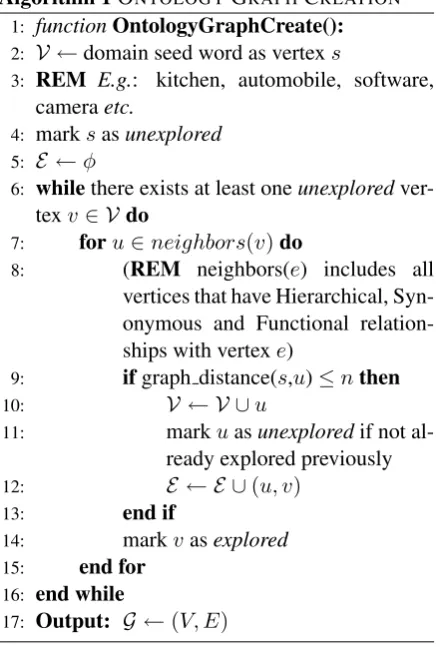
The graph is constructed as follows. The con-cept/domain is identified by aseed word such as, camera,automobile,etc.. A vertex is constructed for the seed word, and is marked asunexploredin the set of graph vertices. This is added toV, the set of vertices in the ontology graphG = (V,E). For each unexploredvertex v in the graph, each concept in ConceptNet that has at least one rela-tionship withv, a vertexuis added to the vertex setV and is marked asunexplored, as well as, an edge(u, v) is added toE. At this stage, the ver-texv is marked asexplored. The ontology graph creation algorithm completes, when all vertices in
V are marked as explored. We provide a maxi-mum graph distance cut-off of n (a given num-ber), wherenis number of edges on the minimum-length path to reach from the concept to the seed word in the graph. Algorithm1 provides the de-tails of the ontology graph creation algorithm.
Hierarchical LocatedNear, HasA, PartOf, MadeOf, IsA, InheritsFrom Synonymous Synonym,
ConceptuallyRe-latedTo
Functional UsedFor, CapableOf, De-finedAs, HasProperty
Table 1: Categorization of ConceptNet Relation-ship Types
Three types of ConceptNet relationships are used to form the edges, shown in Table 1. Hier-archicalrelationships represent parent-child rela-tionships of concepts. Synonymous relationships are used to identify related concepts. Functional relationships are used to identify the purpose or property of interest of the given concept.
4.2 Graph Centrality Computation
This step computes the centrality of each cept appearing in the domain ontology graph con-structed in the earlier step. For computing prag-matic significance score for each aspect, we em-ploy graph centrality measures. Specifically, we propose to use centrality metrics such as close-ness centrality, betweenclose-ness centrality and page rank, since these centrality measures captures sig-nificance of a node from different perspectives. In
Algorithm 1ONTOLOGYGRAPH CREATION 1: functionOntologyGraphCreate(): 2: V ←domain seed word as vertexs
3: REM E.g.: kitchen, automobile, software,
cameraetc.
4: marksasunexplored 5: E ←φ
6: whilethere exists at least oneunexplored
ver-texv∈ V do
7: foru∈neighbors(v)do
8: (REM neighbors(e) includes all
vertices that have Hierarchical, Syn-onymous and Functional relation-ships with vertexe)
9: ifgraph distance(s,u)≤nthen
10: V ← V ∪u
11: markuasunexploredif not
al-ready explored previously
12: E ← E ∪(u, v) 13: end if
14: markvasexplored 15: end for
16: end while
17: Output: G ←(V, E)
computation of the different centrality metrics we do not consider the type of relationship on an edge. An example of a closeness centrality graph, has been provided in Figure1, for the domaincamera.
4.3 Feature/Aspect-Specific Sentiment Computation
A user’s opinion (review) could constitute of mul-tiple aspects (features) of a given product, and dif-ferent sentiment (opinion) polarities with respect to each aspect. The process of overall user senti-ment analysis, mandates understanding the user’s sentiment towards each of these aspects. To de-termine the sentiment polarity expressed by a user towards each aspect (feature), we perform depen-dency parsingof each review, to associate a given aspect of the review, with the opinion of the user towards the given feature, expressed in the text.
LetR be a user review towards a product. Let
W be the words constituting the review R. Fol-lowing the approach of (Mukherjee and Bhat-tacharyya, 2012), we perform dependency pars-ing, and obtain D, the set of significant de-pendency relations in the corpus (e.g., nsubj, amod,dobj, etc). For each dependencyDlwhere
Figure 1: Depiction of closeness centrality measure for Camera Ontology
s.t. all (wi, wj) ∈ W are connected by edge
ek∈E.
A PoS tagger is used to extract the entities (nouns). These entities are used as the initial fea-ture (aspect) set fi ∈ F. For each feature fi, a clusterCi is initiated, wherefi acts as the cluster head ofCi. Each word w ∈ W occurring in re-view R, is assigned to the cluster having closest cluster head. The “closest” distance is measured, using the number of edges in the shortest path, that connects the word to the closest cluster head. Two clusters are merged, if the distance between the two cluster heads are less than a given threshold.
The set of wordsWi belonging to each cluster
Ci, are used to determine the user’s opinion about feature fi. This is attained by conducting a sim-plemajority votingof the sentiment values of the individual wordswi ∈ Wi, using sentiment lex-icons. A final aspect-specific sentiment score is produced, as−1for negative,0for neutral and+1
for positive.
Also note that, we use the simple negation handling framework that was also adopted by (Mukherjee and Joshi,2013). We reverse the sen-timent polarities of all the words appearing within a window of size 5 (Hu and Liu, 2004), starting from any of the negation operatorsnot, nor, nei-therandno.
4.4 Sentiment Polarity Aggregation
polar-ity values across different aspects, with adequate weightage that the aspect requires.
LetR be a review text, for a productP which hasM aspects. Letmi andmip representith as-pect, and it’s sentiment polarity as computed as described earlier. Letcmi represent the centrality score for an aspectmi computed using the ontol-ogy graph for the domain whichPbelongs to. The polarity valuep(sum)for a review textRis found by computing the polarity value, as the following:
p(sum) =XM
i=1
mip×cmi
Finally, the aggregated sentiment polarity S is assigned as:
S =P ositve ifp(sum)>0 S =Negative ifp(sum)<0 S =Neutral ifp(sum) = 0
To find the aggregate sentiment of all users for a given product, we again opt for amajority-voting strategy. The overall methodology is presented in Algorithm2.
5 Datasets and Ontologies
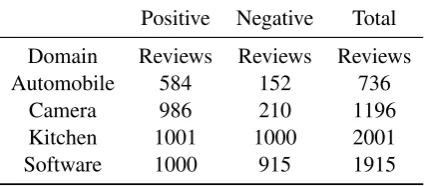
Dataset from four different domains correspond-ing to automobile, camera, kitchen and software are used for experiments. The camera reviews are collected from Mukherjee and Joshi (2013). The automobile, kitchen and software reviews are taken fromBlitzer et al.(2007). Table2shows the dataset statistics.
Positive Negative Total Domain Reviews Reviews Reviews Automobile 584 152 736
Camera 986 210 1196
Kitchen 1001 1000 2001 Software 1000 915 1915
Table 2: Dataset Statistics
Note that, akin toMukherjee and Joshi(2013), all the words have been lemmatized in the reviews, which ensures that all the terms such as camera and cameras are treated as the root word cam-era. Further, words such ashvnt, dnthave been replaced to their original forms.
In the ontology graph construction process, we keep addingunexploredvertices to the vertex set,
Corpus
Frequent Ontology Ontology Domain Features Nodes Edges Automobile 132 114 778
Camera 986 979 1280
Kitchen 767 670 10629
Software 150 135 842
Table 3: Ontology-graph Statistics
as long as, there is at least one edge between the corresponding concept to an existing vertex in the vertex-set, of one of the typesfunctional, hierar-chical or synonymous. However, we restrict to adding vertices such that the maximum distance between theseed wordand the newly added con-cept remains less than a given threshold n. We empirically fixn = 4, which practically provides a sufficiently large number of concepts that are re-alistically related to the concept of the seed word. Higher values of nlead to domain concept delu-sion and topic drift. Table3presents statistics of the ontology graphs extracted for four domains.
6 Experiments
6.1 Tools and Resources
We use several well-known tools and resources.
• For PoS tagging, we use Stanford NLP Toolkit1. PoS tagging is carried out to tag the
user reviews, which in turn is used to identify the entities (noun concepts) in the reviews.
• For ontology construction for the domains, we use ConceptNet 52.
• To compute centrality measures of the ontol-ogy graphs, we use the graph toolR3.
• For dependency parsing of the user reviews, we use Stanford Dependency Parser4.
• For sentiment lexicons, we experiment with SentiWordNet (Baccianella et al.,2010) and Bing Liu sentiment dictionary (Hu and Liu, 2004). Although we report our results only for the Bing Liu sentiment dictionary for the
1http://nlp.stanford.edu/software/tagger.shtml 2http://conceptnet5.media.mit.edu
3https://www.r-project.org
Algorithm 2THEOVERALLAPPROACH 1: G(V,E)←OntologyGraphCreate()
2: foreach vertexv∈ Gdo
3: centrality(v)←centrality measure value of vertexvin graphG 4: end for
5: total senti←0
6: foreach user reviewRdo
7: extract entitiesT fromR
8: perform dependency parsing ofR 9: user senti←0
10: foreach dependencyDwheref =headword(D)∈the full feature/aspect setF do 11: (REMEach headword represents an aspect of the review)
12: dep senti(f)←0
13: foreach word-conceptw∈ Ddo
14: dep senti(f)←dep senti(f) +Sentiment(w) 15: end for
16: iff ∈ V then
17: user senti←user senti+dep senti(f)×centrality(f) 18: end if
19: end for
20: user senti set←user senti set∪<R, user senti > 21: total senti←total senti+user senti
22: end for
23: Output: total senti,user senti set
24: functionSentiment(Word Conceptw):
25: return Sentiment Dictionary Lookup(w) (REMSentiWordNet, Bing Liuetc.)
sake of brevity, we observe similar perfor-mances using SentiWordNet also.
6.2 Results
We establish the first baseline of our work, us-ing the lexical classification based approach of (Taboada et al., 2011). In this approach, a senti-ment lexicon is used as a reference, that consists of words having positive and negative sentiment polarities. In a given review, if the total number of positive terms is higher compared to the total number of negative terms, the review is considered positive, and is considered negative if the oppo-site holds true. The baseline does not incorporate the feature (aspect) specific approach. We mod-ify the approach to associate the lexical terms with the aspects (features), and thus obtain a feature-specific lexical sentiment. We subsequently aggre-gate these sentiments, to obtain improved baseline results. For sentiment lexicon, we empirically
ex-plore with SentiWordNet and Bing Liu sentiment dictionary.
We further compare our work against the re-ported approach for the same task by ( Mukher-jee and Joshi,2013) which also uses ConceptNet, and has an approach similar to ours. However, as mentioned earlier, they consider ontology as a treewhile we construct agraph. Also, they assign pragmatic weights to each aspect present in the re-view, using the height (distance) of the aspect from the root (seed word) of the ontology tree they con-struct, while we use graph centrality measures.
Models Automobile Camera Kitchen Software
F1 Acc. F1 Acc. F1 Acc. F1 Acc.
Lexical Baseline (Bing Liu) 73.45 64.43 79.74 63.65 66.77 67.11 66.04 69.38 Hierarchical Aggr. (Mukherjee et al., 2013) 71.48 70.23 81.22 70.38 67.28 67.62 70.19 70.28 Aggr.Closeness(Our approach) 75.93 73.85 84.68 74.00 85.66 72.96 70.87 70.52
Aggr.Betweenness(Our approach) 76.47 72.91 82.68 73.16 87.67 71.61 68.79 69.10 Aggr.PageRank(Our approach) 75.96 73.68 82.99 71.56 85.2 71.31 68.87 69.60
McNemar Significance Test (p) <0.0001 <0.0001 <0.0001 <0.0001
Table 4: Overall F1 score and accuracy (in %) of all models across all domains. For all domains, the per-formance improvements obtained usingClosenesscentrality measure over that reported in the literature (Mukherjee et al., 2013) are statistically significant (withp <<0.05), as confirmed by McNemar test.
Joshi(2013), and our results, using the three dif-ferent graph centrality measures. As observed, all our proposed centrality based approaches outper-form the baseline. Theclosenesscentrality mea-sure performs the best, with statistically signifi-cant improvement (p <<0.05) observed over the system reported by Mukherjee and Joshi (2013). Other graph based approaches also show improve-ment, except for thesoftwaredomain.
7 Conclusion and Future Work
In this paper, we performed sentiment aggrega-tion as a combinaaggrega-tion of user sentiments, ana-lyzed towards multiple aspects/features of a prod-uct, from user-generated content. The novelty of this work was in deeply ingraining the sentiment weight of each entity derived from the user gen-erated content, and pragmatic significance of the entity in the domains that was obtained by using a graph-structured ontology. We observe a consis-tently high performance of our system across all the keywords that we experiment with. We out-perform the state of the art by a F-score of3.02%,
3.46%,20.39%and0.68%, forautomobile, cam-era, kitchen and software respectively. Further, the effectiveness of our system often increases by using closeness centrality over the other graph centrality measures such asbetweenness central-ityandPageRank, althoughbetweenness centrality does outperform the rest of the methods in some cases. In future, we would like to improve the cur-rent technique to include the intensity of sentiment bearing words appearing in the reviews. Integrat-ing lexico-semantic knowledge acquired through concept-embeddings learned from ontology struc-tures in the aggregation step is also a future work. Our system will have significant real-life impact in helping organizations understand overall user sentiment towards products, on e-commerce sites
(e.g., Amazon) as well as online social networks, discussion forums and blogs.
Acknowledgments
We gratefully acknowledge the encouragement and existing intellectual assets we received from Sachindra Joshi, IBM Research India, and Sub-habrata Mukherjee, Max Planck Institute Ger-many, towards our work, and sincerely thank them.
References
Apoorv Agarwal, Boyi Xie, Ilia Vovsha, Owen Ram-bow, and Rebecca Passonneau. 2011. Sentiment
analysis of twitter data. InProceedings of the
Work-shop on Languages in Social Media. Association for Computational Linguistics, pages 30–38.
Stefano Baccianella, Andrea Esuli, and Fabrizio Sebas-tiani. 2010. Sentiwordnet 3.0: An enhanced lexical resource for sentiment analysis and opinion mining.
InLREC. volume 10, pages 2200–2204.
Luciano Barbosa and Junlan Feng. 2010. Robust sen-timent detection on twitter from biased and noisy
data. InProceedings of the 23rd International
Con-ference on Computational Linguistics: Posters. As-sociation for Computational Linguistics, pages 36– 44.
Alex Bavelas. 1950. Communication patterns in
task-oriented groups. The Journal of the Acoustical
So-ciety of America22(6):725–730.
John Blitzer, Mark Dredze, Fernando Pereira, et al. 2007. Biographies, bollywood, boom-boxes and blenders: Domain adaptation for sentiment
classi-fication. InACL. volume 7, pages 440–447.
Sergey Brin and Lawrence Page. 1998. The anatomy of
a large-scale hypertextual web search engine.
Com-puter networks and ISDN systems30(1):107–117. Mosha Chen and Tianfang Yao. 2010. Combining
chinese opinion-element relation identification. In Universal Communication Symposium (IUCS), 2010 4th International. IEEE, pages 299–305.
Li Dong, Furu Wei, Chuanqi Tan, Duyu Tang, Ming Zhou, and Ke Xu. 2014. Adaptive recursive neural network for target-dependent twitter sentiment
clas-sification. InACL (2). pages 49–54.
C´ıcero Nogueira dos Santos and Maira Gatti. 2014. Deep convolutional neural networks for sentiment
analysis of short texts. InProceedings of COLING.
Linton C Freeman. 1977. A set of measures of
central-ity based on betweenness. Sociometrypages 35–41.
Aniruddha Ghosh and Tony Veale. 2016. Fracking
sarcasm using neural network. In Proceedings of
NAACL-HLT. pages 161–169.
Vasileios Hatzivassiloglou and Kathleen R McKeown. 1997. Predicting the semantic orientation of
ad-jectives. In Proceedings of the eighth conference
on European chapter of the Association for Compu-tational Linguistics. Association for Computational Linguistics, pages 174–181.
Vasileios Hatzivassiloglou and Janyce M Wiebe. 2000. Effects of adjective orientation and gradability on
sentence subjectivity. In Proceedings of the 18th
conference on Computational linguistics-Volume 1. Association for Computational Linguistics, pages 299–305.
Minqing Hu and Bing Liu. 2004. Mining and
summa-rizing customer reviews. InProceedings of the tenth
ACM SIGKDD international conference on Knowl-edge discovery and data mining. ACM, pages 168– 177.
Jaap Kamps, Maarten Marx, Robert J Mokken, and
Marten de Rijke. 2001. Words with attitude.
Cite-seer.
Aamera ZH Khan, Mohammad Atique, and
VM Thakare. 2015. Combining lexicon-based
and learning-based methods for twitter sentiment
analysis. International Journal of Electronics,
Communication and Soft Computing Science & Engineering (IJECSCSE)page 89.
Yoon Kim. 2014. Convolutional neural networks for
sentence classification. InProceedings of the 2014
Conference on Empirical Methods in Natural Lan-guage Processing (EMNLP). Association for Com-putational Linguistics, Doha, Qatar, pages 1746– 1751.
Olga Kolchyna, Th´arsis TP Souza, Philip Treleaven, and Tomaso Aste. 2015. Twitter sentiment analysis. arXiv preprint arXiv:1507.00955.
Efthymios Kouloumpis, Theresa Wilson, and Johanna Moore. 2011. Twitter sentiment analysis: The good
the bad and the omg! ICWSM11:538–541.
Bac Le and Huy Nguyen. 2015. Twitter sentiment
analysis using machine learning techniques. In
Ad-vanced Computational Methods for Knowledge En-gineering, Springer, pages 279–289.
Chenghua Lin and Yulan He. 2009. Joint
senti-ment/topic model for sentiment analysis. In
Pro-ceedings of the 18th ACM conference on Informa-tion and knowledge management. ACM, pages 375– 384.
Hugo Liu and Push Singh. 2004. Conceptneta
practi-cal commonsense reasoning tool-kit. BT technology
journal22(4):211–226.
Pengfei Liu, Shafiq R Joty, and Helen M Meng. 2015. Fine-grained opinion mining with recurrent neural
networks and word embeddings. InEMNLP. pages
1433–1443.
Subhabrata Mukherjee and Pushpak Bhattacharyya. 2012. Feature specific sentiment analysis for
prod-uct reviews. Computational Linguistics and
Intelli-gent Text Processingpages 475–487.
Subhabrata Mukherjee and Sachindra Joshi. 2013. Sentiment aggregation using conceptnet ontology. InIJCNLP. pages 570–578.
Aliaksei Severyn and Alessandro Moschitti. 2015. Twitter sentiment analysis with deep convolutional
neural networks. InProceedings of the 38th
Inter-national ACM SIGIR Conference on Research and Development in Information Retrieval. ACM, pages 959–962.
Richard Socher, Alex Perelygin, Jean Y Wu, Jason Chuang, Christopher D Manning, Andrew Y Ng, Christopher Potts, et al. 2013. Recursive deep models for semantic compositionality over a
senti-ment treebank. InProceedings of the conference on
empirical methods in natural language processing (EMNLP). volume 1631, page 1642.
Ashish Sureka, Vikram Goyal, Denzil Correa, and Anirban Mondal. 2010. Generating domain-specific ontology from common-sense semantic network for
target specific sentiment analysis. In Proceedings
of the fifth international conference of the Global WordNet Association. Mumbai, India. pages 1–8. Maite Taboada, Julian Brooke, Milan Tofiloski,
Kim-berly Voll, and Manfred Stede. 2011. Lexicon-based
methods for sentiment analysis. Computational
lin-guistics37(2):267–307.
Duyu Tang, Furu Wei, Bing Qin, Ting Liu, and Ming Zhou. 2014. Coooolll: A deep learning system for
twitter sentiment classification. In Proceedings of
the 8th International Workshop on Semantic Evalu-ation (SemEval 2014). pages 208–212.
Peter D Turney. 2002. Thumbs up or thumbs down?: semantic orientation applied to unsupervised
classi-fication of reviews. InProceedings of the 40th
an-nual meeting on association for computational lin-guistics. Association for Computational Linguistics, pages 417–424.
Peter D Turney and Michael L Littman. 2003. Mea-suring praise and criticism: Inference of semantic
orientation from association. ACM Transactions on
Information Systems (TOIS)21(4):315–346. Jin Wang, Liang-Chih Yu, K. Robert Lai, and Xuejie
Zhang. 2016. Dimensional sentiment analysis using
a regional cnn-lstm model. In Proceedings of the
54th Annual Meeting of the Association for Compu-tational Linguistics (Volume 2: Short Papers). Asso-ciation for Computational Linguistics, Berlin, Ger-many, pages 225–230.
Wei Wei and Jon Atle Gulla. 2010. Sentiment learning on product reviews via sentiment ontology tree. In Proceedings of the 48th Annual Meeting of the Asso-ciation for Computational Linguistics. Association for Computational Linguistics, pages 404–413. Theresa Wilson, Paul Hoffmann, Swapna
Somasun-daran, Jason Kessler, Janyce Wiebe, Yejin Choi, Claire Cardie, Ellen Riloff, and Siddharth Patward-han. 2005. Opinionfinder: A system for subjectivity
analysis. InProceedings of hlt/emnlp on interactive
demonstrations. Association for Computational Lin-guistics, pages 34–35.
Yuanbin Wu, Qi Zhang, Xuanjing Huang, and Lide Wu. 2009. Phrase dependency parsing for opinion
min-ing. InProceedings of the 2009 Conference on
Em-pirical Methods in Natural Language Processing: Volume 3-Volume 3. Association for Computational Linguistics, pages 1533–1541.
David Zimbra, M Ghiassi, and Sean Lee. 2016. Brand-related twitter sentiment analysis using feature en-gineering and the dynamic architecture for
artifi-cial neural networks. In 2016 49th Hawaii