Generating a Training Corpus for OCR Post-Correction Using
Encoder-Decoder Model
Eva D’hondt
LIMSI, CNRS, Univ. Paris-Saclay F-91405 Orsay
Cyril Grouin
LIMSI, CNRS, Univ. Paris-Saclay F-91405 Orsay
Brigitte Grau
LIMSI, CNRS, ENSIIE, Univ. Paris-Saclay F-91405 Orsay
Abstract
In this paper we present a novel ap-proach to the automatic correction of OCR-induced orthographic errors in a given text. While current systems depend heavily on large training corpora or exter-nal information, such as domain-specific lexicons or confidence scores from the OCR process, our system only requires a small amount of relatively clean train-ing data from a representative corpus to learn a character-based statistical language model using Bidirectional Long Short-Term Memory Networks (biLSTMs). We demonstrate the versatility and adaptabil-ity of our system on different text corpora with varying degrees of textual noise, in-cluding a real-life OCR corpus in the med-ical domain.
1 Introduction
Recently, Optical Character Recognition (OCR) technology has improved substantially, which has allowed for a large-scale digitization of textual resources such as books, old newspapers, an-cient hand-written documents, etc. (Romero et al., 2011). The quality of the subsequent digital cor-pora can vary substantially, depending on factors such as quality of the original paper, ink quality, differences in fonts, etc. The amount of noise in digital collections can have a severe negative im-pact on the accuracy of subsequent text mining processes (e.g., Named Entity Recognition, Infor-mation Extraction, etc.).
OCR post-correction techniques are used to improve the text quality of OCR output. Tra-ditionally, they rely on domain-specific lexi-cons (de Does and Depuydt,2013) and character-based errors statistics obtained from a corrected
training set (Kumar and Lehal, 2016). However, they have some drawbacks that limit their useful-ness for specific, low-resource domains. Such re-sources are expensive to create and for highly spe-cialized texts (e.g., medical domain) not always possible to obtain. The recent advances in neu-ral network models, based on textual context and needing no external resources, provide new oppor-tunities for OCR post-correction. Character-level sequence modeling architectures are especially suited for this task (Chrupała, 2014; Schmaltz et al., 2016), as they reduce the complexity at output time. Moreover, current systems are of-ten limited to processing texts with a limited de-gree of OCR corruption, i.e., so-called single-error word corrections (Kissos and Dershowitz, 2016) and correction of OCRed corpora that have been generated by older OCR engines can prove too challenging. The correct recognition of historical texts remains an open challenge (Kluzner et al., 2009). A general-purpose OCR post-correction tool should be adaptable to the ratio of error that is present in the OCR output in order to deal with both types of errors.
In this paper, we propose a novel approach to OCR post-correction using bidirectional re-current neural networks for learning a robust character-based language model that (i) captures the domain-specific vocabulary of a text and (ii) which is able to detect and correct noise in corrupted text in the same time. In order to over-come the problem of producing manually anno-tated data, our system requires zero pre-annoanno-tated training material. Rather than using a large cor-rected training corpus to learn an error model, we propose a method of generating our own training material from clean text. This has multiple advan-tages: it allows us complete control over the learn-ing process, and we can train on larger and more diverse corpora.
First, we demonstrate the flexibility of the pro-posed model by evaluating it on artificially cre-ated test sets with varying degrees of noise. We also show how variation inherent in the texts influ-ences training rates. Second, we explore a more realistic setting in which very little clean training data is available to learn a language model. We test our method on a real-life OCRed corpus of French medical reports. Our method outperforms the baseline by 14.3% on domain-specific noisy data, even when the latter is supplemented with a domain-specific lexicon.
2 Background
The problem of OCR post-correction has been studied since the seventies (Kukich,1992). While traditional OCR error detection systems focused on constructing ‘confusion matrices’ of likely character (pairs) to detect corruptions of existing words into non-words, recent systems improve ac-curacy using information on the language context in which the error appears (Evershed and Fitch, 2014), using bigrams (Kissos and Dershowitz, 2016), large-scale word grams and character n-grams from the web (Bassil and Alwani, 2012) or associating confusion scores into a Bayesian model (Tong and Evans,1996) or a HMM model (Borovikov et al.,2004) to select the optimal word candidate. These systems are explicitly or implic-itly limited to cases in which an erroneous word appears in an otherwise clean context. For serious degrees of corruption (e.g., historical texts), the common approach aims to optimally combine an ensemble of multiple OCR engines (Nakano et al., 2004;Lund and Ringger,2009).
‘Noisy channel paradigm’ aims to learn er-ror models describing the OCR output genera-tion from the reference text, and as such com-bine error and language models.Kolak and Resnik (2005) used finite state machines on a small set of training material while Llobet et al. (2010) combined all OCR process hypotheses for each recognized character. Such models need a large amount of training material which is costly and not always easily available. In response, the Text-Induced Corpus Clean-up (TICCL) system ( Rey-naert,2011) was developed to run with no anno-tated training data. It takes noisy texts and extracts the high-frequency word variants through statisti-cal analysis and clusters typographistatisti-cal word vari-ants within a user-defined Levenshtein distance.
Recently, Neural Network Language Models have proven to be extremely effective in complex NLP tasks. For spelling errors correction, sys-tems either include auto-encoders to detect near-est neighbor matches of spelling errors with cor-rect words (Raaijmakers,2013) or learn edit oper-ations from labeled data while incorporating fea-tures induced from unlabelled data via character-level neural text embeddings (Chrupała, 2014). Contrary to Azawi (2015) which makes use of LSTM based on character-aligned strings, our method does not require annotated training data (gold standard) to learn the character-based lan-guage model. Moreover, our method does not cap-italize on learning character transformation rules based on frequently occurring errors, as done in Azawi(2015), but learns a robust character-based language model.
3 Method
The model we proposed consists of a many-to-many character sequence learning network using long short term memory (LSTM) nodes.
3.1 Definition
LSTM are a special type of Recurrent Neural Net-work (RNN), a neural netNet-work hierarchy designed to model times series or other sequences. Stan-dard RNNs have trouble capturing long-distance sequential dependencies, as the error signal during back propagation tends to disperse or blow up over time, which is known as the problem of vanishing or exploding gradients (Hochreiter,1991;Bengio et al.,1994). This problem is typically addressed by replacing the standard RNN cell with a long short-term memory cell, which allows for a con-stant error flow along the input sequence ( Hochre-iter and Schmidhuber,1997).
Technically, the LSTM architecture is given by the following equations,
i(t) =σ(Wix.x(t))+Wih.h(t−1)+b i)
f(t)=σ(Wfx.x(t))+Wfh.h(t−1)+b f)
o(t)=σ(Wox.x(t)+Woh.h(t−1)+b o)
g(t)=tanh(Wgx.x(t)+Wgh.h(t−1)+b g)
c(t)=f(t)c(t−1)+i(t)g(t)
h(t)=tanh(c(t))o(t)
informa-tion contained inx); f stands for the forget gate, which select which parts of the information to for-get and which to retain;gcreates a vector of new candidate values that are used to update the cell state; o stands for the output gate which decides what parts of the cell state should be outputted.
A bidirectional LSTM (biLSTM) is a combina-tion of two unidireccombina-tional LSTM layers, the first of which encodes the input string from left-to-right, the second from right-to-left. This ensures that er-rors that occur at the beginning of the input string have enough context (on the right-hand side) to be corrected.
3.2 Encoder-Decoder Model: biLSTM model
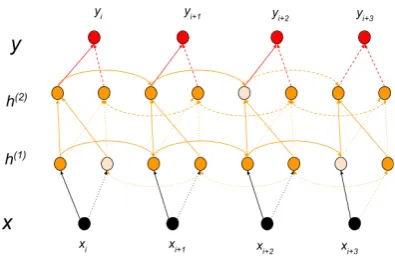
We stack two bidirectional LSTM layers on top of each other: the first hidden level is an encoder that reads the source character sequence and the other is a decoder that functions as a language model and generates the output. Figure1shows the lay-ers in their unrolled forms as they read in the input.
Figure 1: Hierarchy of bidirectional 2-layer many-to-many sequence learning network; lighter nodes in the hidden layers refer to disconnected nodes due to dropout
Architecture We first define a character vocabu-laryV =v1, v2, ..., v|V| which contains all the
characters that are present in the training corpus. Each input string of 20 characters is padded on the right-hand side to a maximum length of 23, which allows for differences in string length due to inser-tions in the training phase (see Section3.3). For an input string we define a 23-dimensional vectorx in which each element corresponds to the index of the corresponding character in vocabularyV, thus preserving the order. The inputx is then passed to an embedding layer that returns the sequence S =cj|j =x1, x2..., x23 wherecj is the
char-acter embedding (by a hyperparameterd= 64) for
the characters in the initial string. This sequence is then passed to the first biLSTM, which combines two unidirectional LSTM layers that process the input from the left-to-right and right-to-left hand side, respectively. Each LSTM layer H consists ofk LSTM memory units, and its output is a ma-trixH = htRk | t = 1,2, ...,23 . We set k
at 512. The output of the individual LSTM layers is concatenated and given as input for the second biLSTM layer. The last hidden layer then projects unto a|V|-dimensional output layer. Finally, we apply the softmax function to select the character with the highest probability for a given timestep and obtain a 23-dimensional vector y with the characters indices for the corrected string.
We also added two drop-out layers to the hidden layers, each set at 0.5, since this has been shown to improve performance (Srivastava et al.,2014). The model was implemented in Keras, a python library for deep learning.
3.3 Training strategy
During training, the neural network is fed cor-rupted input strings and provided the original non-corrupted string as output labels. In this way, the network learns the domain-specific character-based language model that underlies the text in the training documents, while at the same time it learns to detect and eliminate noise introduced by OCR errors. Following the observations that OCR-induced variation is generally much less sys-tematic than spelling errors (Reynaert, 2008), we generate corrupted strings by randomly deleting, inserting and substituting one or two characters for a given string (cf. algorithm3.1).
Algorithm 3.1: CORRUPTSTRING(str, noiseRatio)
len=len(str)
chars=set of characters in corpus
comment:Randomly delete a character
ifrand()<(noiseRatio∗len) :
then
pos=randInt(len)
str=str[:pos] +str[pos+ 1 :]
comment:Randomly insert a character
ifrand()<(noiseRatio∗len) :
comment:Randomly replace 1 or 2 characters
ifrand()<(noiseRatio∗len) :
numChars=randChoice([1,2])
pos=randInt(len)
+(randChoice(chars)) +str[pos+ 1 :]
pos+ +
Table1shows the generated input strings for a given string for the different noise ratios we used. In this table, the second row shows the percentage of strings with at least one OCR error in the real-life test set. We split the initial text into windows of 20 characters with an overlap per 3 characters. This length was empirically determined on train-ing experiments w.r.t. accuracy and traintrain-ing speed.
Table 1: Percentage and examples of corrupted strings w.r.t. the noise ratio on the clean corpus. Bold highlights generated errors
noise corrupted strings (20 characters length) ratio strings original: n oven for 15 minute 0.001 5%
In our experiments, we used a few corpora, both ‘clean’ (digital corpora that contain no OCR or orthographic errors) and ‘real-life’ corpora (that contain varying degrees of OCR errors). They were selected according to two criteria: (i) text genre, either ‘structured text’ or ‘free text’, and
(ii)domain, ‘general domain’ or ‘specialized do-main’, more particularly the medical domain.
Table2 gives an overview of the different cor-pora and their attributes. We give the sizes of the corpora in number of characters, rather than words since the varying degrees of OCR errors make the latter an unreliable metric.
Table 2: Overview of used corpora text style domain size & language train/test
CURD structuredEnglish general 150K44K
LM free textFrench general 2M100K
Handbook free textFrench foetopath 1M -medical structured other 1M reports French medical -foetopath structured foetopath 500K reports French 57K
We generate several artificial test sets for two clean corpora. Artificially corrupted strings are created using the same methodology as used for training. We generated two types of artificial test sets:
• test sets with a set noise ratio, which contain both corrupted and uncorrupted strings
• and test sets that contain only corrupted strings of a set Levenshtein Distance (LD)
4.1 Clean corpora
CURD corpus The Carnegie Mellon University Recipe Database corpus (Tasse and Smith,2008) contains 260 structured cooking recipes in En-glish: a list of ingredients followed by short de-scriptive sentences. This corpus closely resembles the real-life OCRed corpus of medical reports pre-sented in the next section. Unlike medical reports, we consider it to be ‘general domain’. We did not use the semantic annotations in the original CURD corpus but extracted only the plain text.
Handbook on foetopathology We used an elec-tronic copy of a comprehensive French handbook of foetopathology (Bouvier et al., 2008) to train a domain-specific language model of free text for the foetopathological domain.
Medical reports This set of in-house French medical reports were written in the same report-ing style as the real-life OCRed foetopathological reports presented in Section4.2. While medical, they do not treat the foetopathological domain but rather cancer and gastro-internal illnesses.
4.2 Real-life OCR corpora
The foetopathological reports corpus is a data set of French patient notes from the domain of foe-topathology, spanning 22 years. In total, the cor-pus contains the files from 2476 individual pa-tients. The files were processed with a custom-trained commercial OCR engine, and later de-identified with an in-house de-identification tool (Grouin and Zweigenbaum,2013).
Since the model of the OCR engine used to con-vert the entire corpus was trained on a subset of documents of more recent years (implying good paper quality, clear font, etc.), the OCR quality of the OCRed documents decreases substantially for the older documents (D’hondt et al.,2016).
All evaluations in this paper were carried out on an annotated set of 53 files, for which reference texts have been created manually by one annotator in two passes.1 We extracted two sets of training material from the corpus. One set has a reasonable OCR quality,2 the second set is taken randomly from the corpus and contains texts with varying degrees of OCR quality. Both training sets have the same size.
5 Evaluation
5.1 Evaluation metrics
For evaluation, we use the CER metric (for-mula1), as defined in OCR post-correction eval-uations:
CER= SS++DD++CI (1) where S refers to the number of substituted characters in the OCR text (w.r.t. the reference
1These reference texts were later verified by a second
an-notator. The role of the second annotator was to check that the existing annotations were correct and consistent. Ergo the annotations were not done independently.
2Based on the proportion of out-of-vocabulary words
present in a document for a given lexicon.
texts), D to the number of deleted characters, I to the number of inserted characters and C to the number of ‘correct’ characters. We use the CER metric when comparing to the baseline system (see Section6.4), using theocrevalUAtion3 pack-age (Carrasco,2014).
Since our models use overlapping4windows of 20 characters, a purely character-based metric is not ideal to evaluate. We want to measure the sys-tems performance per input, rather than per char-acter. We therefore introduce two complementary accuracy-based evaluation metrics, which evaluate on the level of the character window:
• detection accuracy (detAcc) shows the pro-portion of correctly detected errors and non-errors in the evaluated set of 20-character strings
• correction accuracy (corrAcc) reflects the ability of the language model to accurately correct corrupted strings without overgener-ating and editing non-corrupted strings
These metrics are calculated as follows:
detAcc=(T P+(T NT P++T NF P++F NincorrectEdit+incorrectEdit) )
corrAcc= (T P+T N+F P(T P++F NT N+)incorrectEdit)
Table3 illustrates the different elements of the formulae.
5.2 Baseline model
We compare our system against the only other ap-proach which requires zero annotated training ma-terial and no external resources, the TICCL sys-tem (Reynaert,2011). As explained in Section2, this system is word-based and uses anagram hash-ing to handle lexical variation in a large, noisy text collection. The system analyses a corpus to se-lect high-frequency word variants, and then aims to map near-neighbours (in terms of edit distance) to those forms in order to reduce global variation in the corpus.
3https://github.com/impactcentre/
ocrevalUAtion
4Allowing this overlap is a deliberate choice to maximize
Table 3: Example of evaluation categories for the detection accuracy (detAcc) and correction accu-racy (corrAcc) metrics, given the reference string ‘n oven for 15 minute’
input
string outputstring True Positive (TP) n o5en
for 15 minute
n oven for 15 minute
incorrectEdit n o5en for 15 minute
n oven for 15 mlnute
True Negative (TN) n oven for 15 minute
n oven for 15 minute
False Positive (FP) n oven for 15 minute
n oven for 15 mlnute
False Negative (FN) n o5en for 15 minute
n o5en for 15 minute
We used the system available for French with pretrained character confusion models with its de-fault settings.5 For the foetopathological reports test corpora, we provided TICCL with the full available corpora to extract word variants but cal-culated CER only on the test sets. TICCL per-forms specific preprocessing to limit the size of its character vocabulary (all numbers and digits are mapped unto the character ‘3’).
6 Experiments and Discussion
Since our system does not use annotated data, the language and error models learned from the train-ing data are approximations of what will be en-countered in the test set. In Sections6.1and6.2, we examine how the error model (the prior prob-ability of encountering an error in a given input string) learned during training corresponds to the (expected) noise ratio in the test set, and how the text genre and size of the training corpus influence performance. Section6.3presents how Language Models can be learned when no clean training ma-terial is available for a given test set. Section6.4 shows a comparison with the word-based baseline.
5Online TICCL interface for French with default settings:
http://ticclops.clarin.inl.nl/ticclops/
6.1 Adaptability to different degrees of noise
One of the advantages of our approach is its adapt-ability to different levels of expected noise. It suf-fices to train the model with a noise ratio that cor-responds to the noise found in the test set.
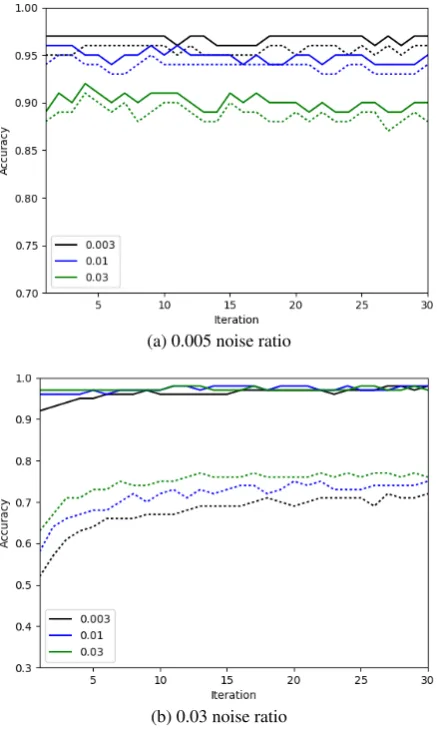
The upper subfigure in Figure 2shows the de-tection accuracy (full line) and correction accuracy (dotted line) on a test set with a 0.005 noise ratio for three different models which were trained in 30 iterations on the CURD training data with 0.003, 0.01 and 0.03 noise ratio, respectively.
(a) 0.005 noise ratio
(b) 0.03 noise ratio
Figure 2: Performance of models trained with dif-ferent noise ratios on the CURD corpus for the 0.005 noise ratio test (upper) and 0.03 noise ratio test (lower), in terms of detection accuracy (full line) and correction accuracy (dotted line)
however, the more aggressively trained model per-forms the best. The high detection accuracy scores in both figures (full lines) show that the models are correctly identifying errors (i.e., unlikely char-acter sequences) and have little tendency to ig-nore errors (FN) or incorrectly edit a correct string (FP). The difference between the detection accu-racy (full lines) and correction accuaccu-racy (dotted lines) in Figure2shows the increased difficulty for the language models to make correct edits when the input strings have multiple corruptions.
Figure3examines this more closely. Here, the training model has been fixed (trained with noise ratio 0.03) and we examine its performance on test sets were each corrupted string has the same Lev-enshtein distances to its reference string. Here as well, overall detection accuracy is quite high, but the increasingly lower correction accuracy scores show the increased difficulties of the language model to propose correct edits for a given cor-rupted string. Since the 0.03 model is trained to expect moderate corruption, it performs best on corrupted strings with a Levenshtein distance of 2.
Figure 3: Performance of best model (ratio 0.03) on test sets which contain only corrupted sub-strings, with a fixed Levenshtein Distance (LD), in terms of detection accuracy (full line) and cor-rection accuracy (dotted line)
6.2 Impact of text variability on training
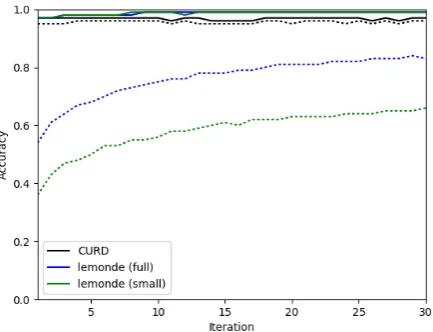
The previous experiments were carried out on the CURD corpus, a small corpus with relatively fixed vocabulary and structured text, which makes it easy to learn a comprehensive model. Figure 4 shows the performance of a corpus with more in-herent variation, the journalistic LM corpus.
Figure 4: Performance of best-performing models on the CURD and LM 0.005 test set, in terms of detection accuracy (full line) and correction accu-racy (dotted line)
As expected, the language model of a more vari-able corpus has a slower learning rate and needs more training data to achieve good performance. The green lines (lemonde (small)) refer to a subset of the LM corpus of exactly the same size as the CURD corpus (150K characters), which is clearly not enough training material to learn a language model on free text.
6.3 Adaptation to a real-life corpus
While the previous experiments only used artifi-cial test sets, a more realistic setting is that in which an OCRed test set needs to be corrected but no clean data is available to train the system on.
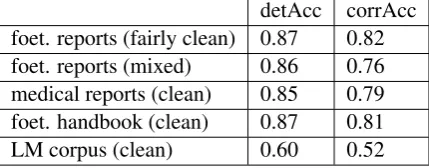
Table4presents the results we achieved on the real life test set while training our model on dif-ferent types of text that are either similar to the test set w.r.t. text genre or domain. We also com-pared these to the performance of models that were trained on noisy training data from the same corpus as the test set. For the foetopathological reports, we trained models on two test sets of sim-ilar size, one which contained data with relatively few OCR errors, and one whose text quality was mixed.
Table 4: Performance of different models trained on different training data (with 0.003 noise ratio) on real-life test set of foetopathological reports
detAcc corrAcc foet. reports (fairly clean) 0.87 0.82 foet. reports (mixed) 0.86 0.76 medical reports (clean) 0.85 0.79 foet. handbook (clean) 0.87 0.81 LM corpus (clean) 0.60 0.52
on similar corpora, both in text genre (medical re-ports) and domain (Handbook) leads to almost as good correction accuracy as training on the orig-inal corpus. The language model trained on the LM corpus, whilst having seen the most training data, has the worst performance since the text in this corpus is too far removed from foetopatholog-ical reports, both in domain and text genre.
6.4 Comparison with baseline
To compare against our baseline system, we trans-formed the output of the two best performing sys-tems from the experiments in Section6.3to a sin-gle final output string. Where two characters dif-fered in the overlapping output strings from our system, we used majority vote to construct the fi-nal output string.
Table 5 shows the results against the TICCL baseline system, using the CER metric. TICCL-lex refers to a setting in which it was provided with a French, domain-specific lexicon of frequent terms in the foetopathology domain. We find that our system significantly outperforms the baseline on the structured, domain-specific data, by 14.3%.
Table 5: Comparison of baseline system (TICCL) with best performing systems on the foetopatho-logical real-life test set
Character Error Rate (CER) original text 34.3
biLSTM 7.1
TICCL 34
TICCL-lex 21.4
7 Conclusion
In this paper we proposed a novel zero-annotated data approach to OCR post-correction. We used biLSTMs to build an encoder-decoder model.
Rather than learning from annotated data, we de-veloped a method to generate our own training ma-terial. Our model is trained on clean or moderately clean data in order to produce a robust character-based language model.
We have evaluated our method on different text genres and domains. We found that our method is especially suited to correct domain-specific, struc-tured text, even when no training text from the same corpus is available.
Acknowledgments
This work was partially supported by the French National Agency for Research under the grant Ac-cordys6ANR-12-CORD-0007.
References
Mayce Ibrahim Ali Al Azawi. 2015. Statistical Lan-guage Modeling for Historical Documents using Weighted Finite-State Transducers and Long Short-Term Memory. Ph.D. thesis, University of Kaiser-slautern.
Youssef Bassil and Mohammad Alwani. 2012. OCR context-sensitive error correction based on Google web 1t 5-gram data set. American Journal of Scien-tific Research.
Yoshua Bengio, Patrice Simard, and Paolo Frasconi. 1994. Learning long-term dependencies with gradi-ent descgradi-ent is difficult.IEEE transactions on neural networks, 5(2):157–166.
Eugene Borovikov, Ilya Zavorin, and Mark Turner. 2004. A filter based post-OCR accuracy boost sys-tem. InProc of ACM Work. on Hardcopy document processing, pages 23–28.
Raymonde Bouvier, Dominique Carles, Marie-Christine Dauge, Pierre D´echelotte, Anne-Lise Del´ezoide, Bernard Foliguet, Dominique Gaillard, Bernard Gasser, Marie Gonzal`es, and F´erecht´e Encha-Razavi. 2008. Pathologie fœtale et placen-taire pratique. Sauramps M´edical.
Rafael C Carrasco. 2014. An open-source OCR evalu-ation tool. InProc of Digital Access to Textual Cul-tural Heritage, pages 179–184.
Grzegorz Chrupała. 2014. Normalizing tweets with edit scripts and recurrent neural embeddings. In
Proc of ACL, volume 2, pages 680–686.
Eva D’hondt, Cyril Grouin, and Brigitte Grau. 2016. Low-resource OCR error detection and correction in French Clinical Texts. InProc of LOUHI, pages 61– 68, Lisbon, Portugal.
6Agr´egation de Contenus et de COnnaissances pour
Jesse de Does and Katrien Depuydt. 2013. Lexicon-supported OCR of eighteenth century Dutch books: a case study. InProc. of SPIE, volume 8658 of Doc-ument Recognition and Retrieval.
John Evershed and Kent Fitch. 2014. Correcting noisy OCR: Context beats confusion. InProc of ICDAR, pages 45–51.
Cyril Grouin and Pierre Zweigenbaum. 2013. Auto-matic de-identification of French clinical records: Comparison of rule-based and machine-learning ap-proches. In Stud Health Technol Inform, volume 192, pages 476–80, Copenhagen, Denmark.
Sepp Hochreiter. 1991. Untersuchungen zu dynamis-chen neuronalen Netzen. Ph.D. thesis, Technische Universit¨at M¨unchen.
Sepp Hochreiter and J¨urgen Schmidhuber. 1997. Long short-term memory. Neural computation, 9(8):1735–1780.
Ido Kissos and Nachum Dershowitz. 2016. OCR er-ror correction using character correction and feature-based word classification. In Proc of Document Analysis Systems Work, Santorini, Greece.
Vladimir Kluzner, Asaf Tzadok, Yuval Shimony, Eu-gene Walach, and Apostolos Antonacopoulos. 2009. Word-based adaptive OCR for historical books. In
Proc of ICDAR, pages 501–505.
Okan Kolak and Philip Resnik. 2005. OCR post-processing for low density languages. In Proc of EMNLP, pages 867–874.
Karen Kukich. 1992. Techniques for automatically correcting words in text. ACM Computing Surveys (CSUR), 24(4):377–439.
Atul Kumar and Gurpreet Singh Lehal. 2016. Auto-matic text correction for Devanagari OCR. Indian Journal of Science and Technology, 9(45).
Rafael Llobet, Jose-Ramon Cerdan-Navarro, Juan-Carlos Perez-Cortes, and Joaquim Arlandis. 2010. OCR post-processing using weighted finite-state transducers. InProc of ICPR, pages 2021–2024.
William B Lund and Eric K Ringger. 2009. Improving optical character recognition through efficient mul-tiple system alignment. InProc of Digital libraries, pages 231–240.
Yasuaki Nakano, Toshihiro Hananoi, Hidetoshi Miyao, Minoru Maruyama, and Kenichi Maruyama. 2004. A document analysis system based on text line matching of multiple OCR outputs. Lecture Notes in Computer Science, pages 463–471.
Stephan Raaijmakers. 2013. A deep graphical model for spelling correction. In Proc of Benelux Con-ference on Artificial Intelligence, Delft, The Nether-lands.
Martin Reynaert. 2008. Non-interactive OCR post-correction for giga-scale digitization projects. In
Proceedings of the 9th International Conference on Computational Linguistics and Intelligent Text Pro-cessing, CICLing’08, pages 617–630, Berlin, Hei-delberg. Springer-Verlag.
Martin WC Reynaert. 2011. Character confusion ver-sus focus word-based correction of spelling and OCR variants in corpora. International Journal on Document Analysis and Recognition, 14(2):173– 187.
Ver´onica Romero, Nicol´as Serrano, Alejandro H. Toselli, Joan Andreu S´anchez, and Enrique Vidal. 2011. Handwritten text recognition for historical documents. In Proceedings of the Language Tech-nologies for Digital Humanities and Cultural Her-itage Workshop, pages 90–96, Hissar, Bulgaria. Allen Schmaltz, Yoon Kim, Alexander M Rush, and
Stuart M Shieber. 2016. Sentence-level grammatical error identification as sequence-to-sequence correc-tion. arXiv preprint arXiv:1604.04677.
Nitish Srivastava, Geoffrey E Hinton, Alex Krizhevsky, Ilya Sutskever, and Ruslan Salakhutdinov. 2014. Dropout: a simple way to prevent neural networks from overfitting. Journal of Machine Learning Re-search, 15(1):1929–1958.
Dan Tasse and Noah A Smith. 2008. SOUR CREAM: Toward semantic processing of recipes. Carnegie Mellon University, Pittsburgh, Tech. Rep. CMU-LTI-08-005.