C o m p u t i n g
p r o s o d i c p r o p e r t i e s i n a d a t a - t o - s p e e c h
s y s t e m
M. Theune* and E. Klabbers* and J. Odijk and J.R. de P i j p e r
IPO, Center for Research on User-System Interaction
P.O. Box 513
5600 MB Eindhoven
The Netherlands
theune~ipo, tue. nlA b s t r a c t
We propose a set of rules for the computation of prosody which are implemented in an exist- ing generic Data-to-Speech system. The rules make crucial use of both sentence-internal and sentence-external semantic and syntactic in- formation provided by the system. In a Text- to-Speech system, this information would have to be obtained through text analysis, but in Data-to-Speech it is readily available, and its reliable and detailed character makes it pos- sible to compute the prosodic properties of generated sentences in a sophisticated way. This in turn allows for a close control of pros- odic realization, resulting in natural-sounding intonation.
1
I n t r o d u c t i o n
T h e central topic of this paper is the problem of com- puting the prosodic properties of sentences gener- ated ill Data-to-Speech systems (i.e., systems which present d a t a in the form of a spoken monologue - sometimes also called 'Concept-to-Speech' systems). We propose a set of rules for the assignment of prosodic properties which take an explicit discourse model into account. In contrast to Text-to-Speech systems (and more generally, systems which re- quire linguistic analysis of the input), explicit dis- course models can be reliably constructed in Data- to-Speech systems (and more generally, in systems which generate natural language from data), so that a more natural prosody can be achieved.
The rules for prosody assignment described in this paper are used in the language generation compon- *Authors Theune and Klabbers carried out this re- search within the framework of the Priority Programme Language and Speech Technology (TST). The TST- programme is sponsored by NWO (Dutch Organization for Scientific Research).
eat ofD2S, a generic system for the creation of Data- to-Speech systems. T h e m e t h o d for natural lan- guage generation implemented in D2S is hybrid in nature (Reiter, 1995); (Coch, 1996). It is a particu- lar mixture of (syntactic) template-based techniques and full natural language generation, described in more detail in Klabbers et al. (1997a). A variety of Data-to-Speech systems have been and are be- ing developed on the basis of D2S. Examples are the Dial Your Disc (DYD)-system, which presents information in English about Mozart compositions (Deemter et al., 1994); (Collier and Landsbergen, 1995), and the G o a l G e t t e r system, which presents spoken monologues in Dutch a b o u t the course and the result of a football game (Klabbers et al., 1997b). In this paper, we illustrate the prosodic rules used in D2S with examples from GoalGetter.
After a brief description and illustration of the general architecture of D2S, we describe in detail how the prosodic component of D2S computes the prosodic properties of the generated sentences. T h e n we discuss how the resulting prosodic annotations are used in the various speech o u t p u t techniques em- ployed in D2S. We end with some remarks a b o u t evaluation of the prosodic rules and a conclusion.
2
A r c h i t e c t u r e o f D 2 S
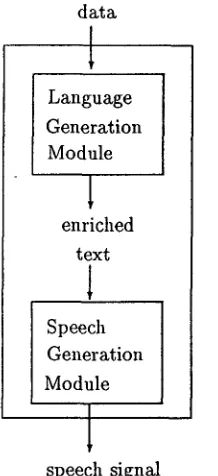
T h e general architecture of D2S is represented in Figure 1. It consists of two modules, the Language Generation Module (LGM), and the Speech Genera- tion Module (SGM).
T h e LGM takes d a t a as input and produces en- riched text, i.e., prosodically a n n o t a t e d text. For instance, it contains annotations to indicate accents and prosodic boundaries. This is input to the SGM, which turns it into a speech signal.
data
l
Language Generation ModuleL
enriched text
1
Speech Generation Module
L
speech signalFigure 1: Global architecture of D2S
formation on this match. An example of the in- put data is given in Figure 2, and one possible out- put text is given in Figure 3. In the enriched text, pitch accents are indicated by double quotes (") and phrase boundaries of varying strength are indicated by one to three slashes (/). The other symbols used in the text will be clarified in Section 4.
team 1: PSV goals 1: 1 team 2: Ajax goals 2: 3
goal 2: Kluivert (5) goal 2: Kluivert (18) goal 2: Blind (83/pen) goal 1: Nilis (90) referee: Van Dijk spectators: 25.000 yellow 1: Valckx
Figure 2: Example input of the LGM Since we lack the space for a full description of the LGM, presented schematically in Figure 4, we only point out some important aspects which are relevant for the prosodic rules given in Section 3. For a more detailed description, see Klabbers et al. (1997a).
data
[ domain data] I Knowledge State I
I 1
T T
[
[
J I Oo=o
I
enriched
text
Figure 4: The architecture of the Language Gener- ation Module (LGM)
The input for the LGM consists of data on spe- cific football matches (see Figure 2) and on the do- main, e.g., background information on the players and the teams. The information in the input can be expressed by means of templates in the form of a syntactic tree with variable slots. Choice and or- dering of the templates and the filling of their slots depend on conditions on (1) the Knowledge State, which keeps track of which information has been ex- pressed, and (2) the Context State, in which various aspects of the context are represented (Deemter and Odijk, 1995).
A central part of the Context State is the Dis- course Model, which contains information about which linguistic expressions have been used in the preceding text. Rules formulated in terms of this Discourse Model make it possible to use various ref- erential expressions (proper names, pronouns, defin- ite descriptions, etc.) appropriately. For instance, in the fourth sentence of the example text given in Figure 3, Dertien minuten later liet de aanvaller zijn tweede doelpunt aantekenen ('Thirteen minutes later the forward had his second goal noted'), it was pos- sible to use a definite description (de aanvaller, 'the forward') to refer to Kluivert, because the Discourse Model contained an appropriate unique antecedent (namely, the proper name Kluivert that was used in the third sentence). When a new sentence has been generated, the Discourse Model is updated accord- ingly, and then the sentence with its full parse tree and the updated Discourse Model are input to the Prosody module.
3 C o m p u t i n g p r o s o d y
[image:2.596.329.558.65.202.2] [image:2.596.148.257.71.309.2] [image:2.596.118.273.461.623.2]"De "wedstrijd tussen "PSV en "Ajax / eindigde in " @ e e n / / - " @ d r i e / / / " Vijfentwintig duizend "toeschouwers / bezochten het "Philipsstadion
///
"Ajax ham na "vijf "minuten de "leiding / door een "treff~r van " K l u i v e r t / / / " D e r t i e n minuten "later / tier de aanvaller zijn "tweede doelpunt aantekenen / / / De 7o "verdediger "Blind / verzil- verde in de "drieentachtigste minuut een "straf- schop voor A j a x / / / V l a k voor het "eindsignaal / bepaalde "Nilis van "PSV de "eindstand / op " @ e e n / / - " @ d r i e / / /
% "Scheidsrechter van "Dijk / "leidde het duel / / / " Valckx van "PSV kreeg een "gele " k a a r t / / /
Translation:
The match between PSV and Ajax ended in 1- 3. Twenty-five thousand spectators visited the Philips stadium.
After five minutes, Ajax took the lead tlirough a goal by Kluivert. Thirteen minutes later the forward had his second goal noted. The defender Blind kicked a penalty home for Ajax in the 83rd minute. Just before the end signal, Nilis of PSV brought the final score to 1-3.
Referee Van Dijk led the match. Valckx of PSV received a yellow card.
Figure 3: Example output of the LGM
and semantic information. First we will discuss the accentuation algorithm, which is based on a version of Focus-Accent Theory proposed in (Dirksen, 1992) and (Dirksen and Quen~, 1993). In Focus-Accent Theory, binary branching metrical trees are used to represent the relative prominence of nodes with re- spect to pitch accent.
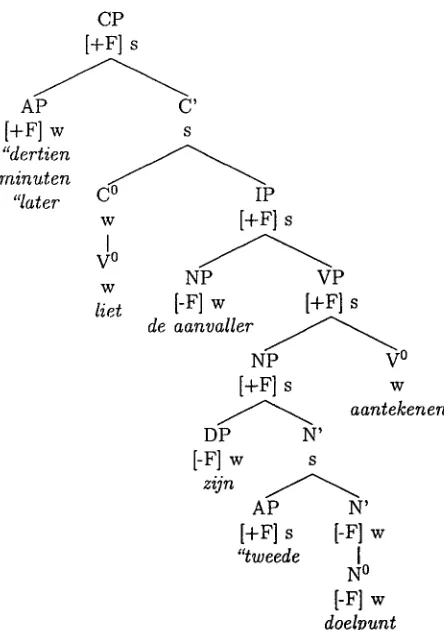
We will use our previous example sentence, Der- tien minuten later liet de aanvaller zijn tweede doelpunt aantekenen, as an illustration. First, the accentuation algorithm constructs the sentence's metrical tree, shown in Figure 5 (simplified). In our implementation, this tree corresponds to the sen- tence's syntactic tree, 1 except that its nodes have focus markers and are labeled weak or strong. The focus properties of the nodes in the metrical tree are determined as follows.
Initially, all maximal projections (NP, VP etc.) are assigned a positive focus value, indicated as [+F]. The other nodes are not specified for focus. These initial focus values can be changed by non-syntactic factors causing the focus value to become negative, indicated as I-F]. This happens in three cases: (1) a node dominates an unaccentable word; (2) a node represents given information? (3) a node domin- ates only nodes which are marked [-F]. Unaccentable
1 Unary branching of metrical trees is allowed. 2This is based on the observation by Halliday (1967), Chafe (Chafe, 1976), Brown (Brown, 1983) and others that phrases expressing 'new' information are normally accented, while phrases expressing ~given' or 'old' in- fbrmation are usually deaccented.
words, e.g., certain function words, are explicitly lis- ted. Our example sentence contains only one such word, the determiner de ('the'). The rules for de- termining givenness are based on the theory pro- posed by van Deemter (1994), who distinguishes two kinds of givenness: object-givenness and concept- givenness.
A phrase is regarded as object-given if it refers to a discourse entity that has been referred to earlier in its local discourse domain, which in the present implementation consists of all preceding sentences in the same paragraph. In the example, checking the Discourse Model reveals that the phrases de aanvaUer ('the forward') and zijn ('his') are object- given, because their referent (Kluivert) was referred to in the preceding sentence, which belongs to the same paragraph. This means that their dominat- ing nodes in the metrical tree must be marked I-F]. This example illustrates that object-givenness does not depend on the surface form of the referring ex- pression, but only on its referent. The expressions de aanvaller and zijn are object-given even though they were not used earlier in the text.
CP [+F] s
AP C'
[+F] w s
"dertien C ~ minuten
"later IP
w [+F] s
40
N P VP
W
liet [-F] w [ + F l s
de aanvaller
NP V °
[+F] s w
aantekenen
DP N'
I-F] w s zijn
AP N'
[ + F l s I-F] w "tweede [
N O
I-F] w
doelpunt
Figure 5: Metrical tree for the fourth sentence.
ing sentence of the synonymous words minuten and treffer respectively. T h e second case, subsumption, can be illustrated by the sequence Kluivert is een heel goede aanvaller; Hij is de beste speler van Ajax ('Kluivert is a very good forward; He is the best player of Ajax'). Since the concept s p e l e r ('player') subsumes the concept a a n v a l l e r ('forward'), the word speler in the second sentence will be defocused due to concept-givenness.
Note t h a t the first case of concept-givenness is the only kind of givenness distinguished in D2S which can also be determined in a relatively easy way in un- restricted Text-to-Speech systems, e.g., NewSpeak (Hirschberg, 1990); (Hirschberg, 1992). T h e second case of concept:givenness, subsumption, will be very difficult to detect in an unrestricted Text-to-Speech system because it requires the presence of a concept hierarchy, which is only feasible if the relevant con- cepts are known in advance. Finally, determining object-givenness will also be very difficult in Text- to-Speech, because it makes very high demands on text analysis.
Aider the metrical tree nodes have been assigned focus markings, their weak/strong labelling can be
determined. This labelling depends both on the structure of the tree and the focus properties of the nodes. In Dutch, the structural rule is t h a t the left node of two sisters is weak and the right node is strong, unless the right node is a zero projection, like the V ° node dominating aantekenen in figure 5.3 This structural labelling can be changed under the influence of focus. If the structurally strong node is marked I-F] while the structurally weak node is not, the so-called Default Accent Rule applies and the labelling is switched. In figure 5, this happened to the AP dominating tweede and the N' dominat- ing doelpunt. T h e N' is marked [-F] because all the nodes it dominates are marked I-F]. (See defocusing rule (3) given above.)
After the w e a k / s t r o n g labelling has been determ- ined, accents are assigned according to the following algorithm: each node t h a t is marked [+F] launches an accent, which trickles down the tree along a path of strong nodes until it lands on a terminal node (a word). In our example, the accents launched by CP, IP and VP all coincide with the accent launched by the N P node dominating zijn tweede doelpunt, finally landing on the word tweede. Note t h a t if the word doelpunt had not been concept-given, then the N O and the N' would not have been marked I-F] and the Default Accent Rule would not have applied. T h e accent would then have landed on doelpunt
Since the N P node dominating de aanvaller is weak, no accent trickles down to it, and because it is marked I-F] it does not launch an accent itself. T h e AP node dominating the phrase dertien minuten later (its internal structure is not shown due to lack of space) does launch an accent, which trickles down to the word later. T h e N P dertien minuten, which is contained in the AP, also launches an accent; since this cannot land on the word minuten (which is de- focused due to concept-givenness) it ends up on the word dertien.
Recently, an algorithm for the generation of con- trastive accent has been added to the G o a l G e t t e r system. This algorithm assigns a pitch accent to phrases which provide contrastive information, over- riding deaccentuation due to givenness. For more 3Evidence for this rule comes from constructions like the following:
(i) Kluivert liep [vP [v0 voorbij] [Np het doel]l (ii) Kluivert fiep [vP [top het doel] [v,, voorbij]]
[image:4.596.89.311.66.381.2]details on the algorithm, see T h e u n e (1997). After accentuation, phrase boundaries are as- signed. T h r e e phrase b o u n d a r y strengths are dis- tinguished. 4 T h e sentence-final boundary ( / / / ) is the strongest one. Words which are clause final (i.e., the last word in a CP or IP) or which precede a punc- tuation symbol other than a comma (e.g., ';') are fol- lowed by a m Q o r boundary (-//). Minor boundaries (/) are assigned to other words preceding a comma. Additionally, constituents to the left of an I', a C' or a maximal projection are followed by a weak bound- ary, provided t h a t both constituents are accessible for accent, and t h a t the left one has sufficient length (more than four syllables). This is a slightly mod- ified version of a structural condition proposed by Dirksen and Quen@ (1993). In our example only the AP dertien minuten later meets this condition and is therefore followed by a minor phrase bound- ary. Since the sentence contains no punctuation and consists of just one clause, the only other phrase boundary is the sentence-final one.
4 S p e e c h G e n e r a t i o n
T h e SGM has two o u t p u t modes, phrase concaten- ation and phonetics-to-speech, each of which makes optimal use of the prosodic markers generated by the LGM. We start with a brief description of the two o u t p u t modes, followed by a discussion of the prosodic realization in either o u t p u t mode.
P h r a s e c o n c a t e n a t i o n - Phrase concatenation is a technique which tries to reconcile the high- fidelity quality and inherent naturalness of prerecor- ded speech with the flexibility of synthetic speech. Entire phrases and words are recorded, and played back in different orders to form complete utterances. In this way a large number of utterances can be pro- nounced on the basis of a limited number of prerecor- (led phrases, saving m e m o r y space and increasing flexibility. This technique is best applied to a carrier- and slot situation where there is a limited number of types of utterances (carriers) with variable in- formation to be inserted in fixed positions (slots). T h e systems based on D2S fit this situation well. T h e carriers correspond to the syntactic templates and these have slots for variable information such as match results, player names, etc.
Successful application of the phrase concatenation technique is not quite as trivial as it may seem at first sight. If all the phrases are recorded in isola- tion without taking their accentuation or their po- 41n longer texts, containing more complicated con- structions, it might be desirable to distinguish more levels. Sanderman (1996) proposes a boundary depth of five to achieve more natural phrasing.
sition in the sentence into account, the resulting speech will have discontinuities in duration, loud- ness and intonation. Our m e t h o d is more sophistic- ated in t h a t different prosodic variants for otherwise identical phrases have been recorded. To determine how many and what prosodic realizations should be recorded for each phrase, a thorough analysis of the material the system can generate is required.
P h o n e t i c s - t o - S p e e c h - Synthetic speech is far more flexible than any form of prerecorded speech. Since there is complete control over the realization it is very well suited to test the accentuation and phrasing rules. In commercial applications synthetic speech is not used very often since the naturalness of the o u t p u t speech still leaves a great deal to be desired.
Because the LGM provides all relevant informa- tion there is no need for full-fledged text-to-speech synthesis. T h e LGM generates an orthographic rep- resentation which has a unique mapping to a phon- etic representation. 5 This makes it possible to do errorless grapheme-to-phoneme conversion by look- ing up the words in a lexicon instead of using rules. Our phonetics-to-speech system, S P E N G I (SPeech synthesis ENGIne) uses diphone concatenation in either L P C or P S O L A format. T h e rule formalism for intonation is an implementation based on the in- tonation t h e o r y of 't H a r t et al. (1990).
R e a l i z i n g p r o s o d y in s p e e c h g e n e r a t i o n - T h e enriched text t h a t the L G M generates contains several prosodic markers. In the phrase concaten- ation component these markers trigger the choice of the appropriate prosodic variant from the phrase database and the pauses to be inserted at the appro- priate positions.
_A
A_/
de "wedstrijd tussen "psv en "ajax / "eindigde in "@een 11 "@drie 1/1 Figure 6: Stylized pitch contour of the i n t r o d u c t o r y sentence
and a natural rendering.
In Dutch, the score of a match is pronounced in a special way: the m a j o r b o u n d a r y between the two numbers triggers lengthening of the first number and a pause between the two numbers, but the two ac- cented numbers are realized with a so-called 'flat hat' p a t t e r n as if t h e y were part of the same clause (see 't Hart (1990) for a description of pitch movements). This is indicated by a special marker used only in the phrase concatenation component of GoalGetter (the @_-sign). T h e r e is another special marker (the 70-sign) to mark nouns functioning as an adjunct to another noun. T h e special nouns are always accen- ted and shorter in duration t h a n when they occur as a head noun. Figure 6 shows a stylized pitch contour of the opening sentence of Figure 3, which illustrates how t h e score is pronounced.
In the phonetics-to-speech component the pros- odic markers are used to trigger the intonation and duration rules. Intonation is represented as a series of pitch movements with restrictions on the possible combinations of movements. T h e words that are accented are given a prominence-lending pitch pat- tern (a pointed hat or a flat hat are most commonly used). At the boundaries a pause of some length can occur, where the length of the pause depends on the strength of the boundary. A boundary can also trigger a continuation rise or pre-boundary length- ening, as mentioned above. To allow for variation in the intonation, each rule has a number of weighted alternatives from which a random choice is made (taking the weights into account). This also makes it possible to have some optional rules, for instance, for the melodic highlighting of syntactic boundaries which is not obligatory.
5 E v a l u a t i o n
Nachtegaal (1997) reports on a small experiment which was carried out to test the accentuation al- gorithm of D2S. No formal evaluation has taken place for the algorithm determining the placement of phrase boundaries.
hL the experiment by Nachtegaal (1997), Dutch speakers were asked to read aloud texts generated by the LGM of GoalGetter. Recordings of the read
texts were presented to 'expert listeners' who indic- ated on which words t h e y heard an accent. Compar- isons were then made between the accentuation pat- terns produced by the speakers and those generated by the system. T h e results of the experiment were positive: the number of words on which the accen- tuation by the speakers deviated from the accentu- ation by G o a l G e t t e r was very small (less t h a n 470 of all accentable words, i.e., excluding 'unaccentables' like function words etc.). T h e texts used in the ex- periment contained sentences which were structur- ally similar to those of the example text given in Figure 3. Not all syntactic constructions which are currently generated by G o a l G e t t e r were included in the test. T h e prosody of the current version of G o a l Getter was only evaluated informally, but the results were in line with those of Nachtegaal (1997).
T h e prosodic rules described in this p a p e r have also been succesfully implemented in the DYD- system (I:LEF), which differs from G o a l G e t t e r with respect to language (English versus Dutch) and do- main (Mozart compositions versus football reports). Informal evaluation of the prosody in DYD gave equally satisfactory results as for GoalGetter. This was as expected, since the prosodic rules of D2S are essentially domain- and language independent. 6 All things considered, the quality of the prosodic rules of D2S is judged to be good.
6 C o n c l u s i o n
To determine the prosodic properties of a sentence in a text, information a b o u t b o t h sentence-internal and sentence-external s y n t a x and semantics is needed. In Text-to-Speech this information has to be obtained through text analysis, whereas in Data-to-Speech re- liable information of this kind is readily available. As a consequence, Data-to-Speech provides a bet- ter basis for using sophisticated prosody assignment rules than Text-to-Speech.
[image:6.596.180.457.71.108.2]called D2S. They make crucial use of both sentence- internal and sentence-external semantic and syn- tactic information, provided by the system in the form of a Discourse Model and parse trees of the generated sentences. The reliable and detailed char- acter of this information makes it possible to assign prosodic markings which are reliable and detailed as well. This in turn allows for a close control of pros-- odic realization, resulting in natural-sounding inton- ation.
R e i ~ r e n c e s
Brown, G. 1 9 8 3 . Prosodic structure and the given/new distinction. In D. R. Ladd and A. Cut- ler, editors,
Prosody: Models and Measurements.
Springer Verlag, Berlin.
Chai~, W.L. 1976. Givenness, contrastiveness, def- initeness, subjects, topics and points of view. In C. N. Li, editor,
Subject and Topic.
Academic Press, New York.Coch, J. 1996. Evaluating and comparing three text-production techniques. In
Proceedings COL-
ING 1996,
pages 249-254.Collier, R. and J. Landsbergen. 1995. Language and speech generation.
Philips Journal of Research,
49(4):419-437.
Deemter, K. van. 1994. What's new? A semantic perspective on sentence accent.
Journal of Se-
mantics,
11:1-31. CSLI report No. CSLI-93-178. Deemter, I(. x~n, J. Landsbergen, R. Leermakers,and J. Odijk. 1994. Generation of spoken mono- logues by means of templates. In
Proceedings
of TWLT 8,
pages 87-96, Twente. Twente Uni- versity. IPO MS. 1053.Deemter, K. van and J. Odijk. 1 9 9 5 . Context modeling and the generation of spoken discourse. Manuscript 1125, IPO, Eindhoven. Philips Re- search Manuscript NL-MS 18 728, to appear in
Speech Communication
21 (1/2).Dirksen, A. 1992. Accenting and deaccenting: A declarative approach. In
Proceedings of COLING
1992, Nantes, France.
IPO MS. 867.Dirksen, A. and H. Quen6. 1993. Prosodic ana- lysis: The next generation. In van Heuven and Pols, editors,
Analysis and Synthesis of Speech:
Strategic Research Towards High-Quality Text-to-
Speech Generation.
Mouton de Gruyter, Berlin - New York.Halliday, M.A.K. 1967. Notes on transitivity and theme in English.
Journal of linguistics,
3:199- 244.Hirschberg, J. 1990. Accent and discourse context: assigning pitch accent in synthetic speech. In
Pro-
ceedings of the 8th National Conference on Artifi-
cial Intelligence, Menlo Park, 29 July - 3 August,
1990,
pages 952-957. MIT Press.Hirschberg, J. 1992. Using discourse context to guide pitch accent decisions in synthetic speech. In G. Bailly, C. Beno~t, and T.R. Sawallis, editors,
Talking Machines: Theories, Models and Designs.
Elsevier Science Publishers B.V., pages 367-376. Klabbers, E., J. Odijk, J.R. de Pijper, and
M. Theune. 1997a. From data to speech: A gen- eric approach. IPO MS 1202.
Klabbers, E., J. Odijk, J.R. de Pijper, and M. Theune. 1997b. GoalGetter: From Teletext to speech, to appear in IPO Annual Progress Re- port 31, 1996.
Nachtegaal, D. 1997. An evaluation of GoalGetter's accentuation. Report 1142, IPO, Eindhoven. Reiter, E. 1995. NLG vs. templates. In
Proceed-
ings of the Fifth European Workshop on Natural
Language Generation,
pages 95-106, Leiden, 20- 22 May. University of Leiden.Sanderman, A. 1996.
Prosodic Phrasing: produc-
tion, perception, acceptability and comprehension.
Ph.D. thesis, Eindhoven University, Eindhoven. 't Hart, J., R. Collier, and A. Cohen. 1990. A
Perceptual Study of Intonation: an Experimental
Phonetic Approach to Speech Technology.
Cam- bridge University Press, Cambridge.Theune, M. 1997. Contrastive accent in a data-to- speech system. In