L e x i c a l O p e r a t i o n s in a U n i f i c a t i o n - b a s e d F r a m e w o r k
Ann Copestake, Ted BriscoeComputer Laboratory, University of Cambridge, Pembroke Street,
Cambridge, CBg 3QG, UK
[email protected] [email protected]
A b s t r a c t
We consider lexicM operations and their representation in a unification based lexicon and the role of lexical semantic information. We describe a unified treatment of the linguistic aspects of sense extension and derivationM morphologicM processes which delimit the range of possible coercions between lexemes and give a preliminary account of how default interpretations may arise.
1
I n t r o d u c t i o n
In this paper we consider the nature and extent of lexical operations, arguing for a declarative and e o m p u t a t i o n a l l y tractable definition of a lexical rule as a component of a unification-based lexicon employing (default) inheritance and typed feature structures. We claim t h a t this notion of lexical rule is capable of capturing the linguistic element of derivational morphological processes as well as m e t o n y m i c and metaphoric sense exten- sions, b u t is not adequate for the s t a t e m e n t of certain types of logical m e t o n y m y (e.g. Pustejovsky, 1989a). We argue t h a t such operations must be treated as, in part, 'linguis- tic' because they have morphological and syntactic consequences, undergo 'blocking', are triggered by grammatically-defined type mismatches and involve default interpretations based on lexical organisation. However, we also argue t h a t such default interpretations can be overridden by contextual information on the basis of more general and open-ended ' p r a g m a t i c ' inference. Our account contrasts with t h a t of, say, Hobbs et al. (1987) who posit an underspecified and impoverished lexical semantic representation which is en- riched through an open-ended process of abductive or deductive reasoning with world (or domain) knowledge. Our lexical knowledge representation language does not s u p p o r t gen- eral inference, although our lexical semantic representations are often 'richer' than those s t a n d a r d l y assumed.
person by "pig" are arguably no more than stereotypical associations with the animal, rather than central aspects of its meaning / qualia structure. In the case of "wombat" we would argue that the association of foolishness derives from the phonological form of the word, rather than beliefs about the animal. Despite the more associative or analogical nature of metaphorical sense extension, we would argue that there is a core component to such processes which should be expressed in terms of a lexical rule, rather than in terms of general purpose reasoning. As with the metonymic cases (Pustejovsky, 1989c; Briscoe et al., 1990), we believe that the notion of coercion during syntactic and semantic interpretation provides an account of when a metaphorical interpretation will be adopted, and we would like to characterise coercion in terms of possible mappings defined by lexical rules.
An example of a derivational morphological process is the addition of the "er" suffix to verbs, typically creating a noun denoting the agent of the action denoted by the verb (e.g. "teach", "teacher"). There are several apparent differences between this type of process and the metonymic and metaphoric sense extensions considered above. The derivational rule involves a change of syntactic class, it affects the argument structure of the derived predicate, it involves affixation, and although there is a foregrounding of one aspect of the verb meaning, the result would not traditionally be described as a metonymic, or indeed metaphorical, usage. Nevertheless, there are clearly derivational processes which do not affect syntactic class (e.g. "re-program", "un-reprogrammable") and of sense extensions which do; for example, countability of nouns changes depending on whether they are interpreted as types, substances or portions (e.g. "There was beer all over the table", "John drank a beer"). Not all derivational processes affect argument structure (e.g. "un- kind"), whilst metonymic sense extensions (e.g. "John enjoyed the film", John finished the beer") can, at least given the analyses of Pustejovsky (1989c) and Briscoe et al. (1990). Finally, processes of conversion and derivation can be identical; for example, both "purchase" and "replace" have deverbal nominal forms "purchase" and "replacement", both nouns can denote the action involved and take appropriate complements ("Bill's purchase of his new car", "Bill's replacement of John with Mary"), and both can denote the result of the action ("Bill's purchases were many and varied .... Bill's replacement was young"). Traditionally, this latter resultative meaning would be described as metonymic and probably specialised and non-productive. We think that our definition of lexical rule will allow an account of both conversion and derivation as productive syntactic and semantic operations mapping between lexical entries. The difference between metaphorical and metonymic operations is a matter of the degree to which the interaction of the lexical rule with the basic entry determines or circumscribes the eventual interpretation.
specified subsets of the lexicon, defined in terms of both syntactic and semantic properties expressed in the type system underlying the organisation of the lexicon.
In Briscoe et al. (1990) we offered an account of logical metonymies such as that involved in the interpretation of "Bill enjoyed / regretted that paper", drawing on Puste- jovsky (1989a), in which a unary syntactic rule is used to coerce the entity-denoting NP "that paper" into an event-denoting NP with an underspecified predicate. We argued that a default specification of this predicate is supplied by the qualia structure of the noun and that this is determined by the organisation of the lexicon as a default inher- itance network. Specifically, "paper" in the relevant sense will inherit a telic role read ~ and agentive role write t and "enjoy" will by default select the telic role of an NP object, whilst "regret" will select the agentive role. We presented evidence based on corpus data that such default interpretations are appropriate in unmarked informationally-weak con- texts, but that they are overridden in marked contexts in which such an interpretation would be clearly inappropriate. The corpus evidence suggests, firstly, that the default in- terpretation is appropriate with most such logical metonymies and, secondly, that where it is not, the context is sufficient to block it. By contrast, an account such as that of Hobbs et al. (1987) has difficulty explaining why the default interpretation is adopted in the absence of contextual information, unless the effects of lexical organisation are re- constructed in terms of weightings encoding preferences amongst inferences. Whilst this account of the division of labour between default but circumscribed linguistic processes and more open-ended inference remains attractive, the treatment of coercion in this case as a unary syntactic rule, or in Pustejovsky's (1989c) alternative account as a lexical rule, seems inadequate. The interpretation of an individual-denoting nominal or noun phrase as an event-denoting one may be more a matter of systematic vagueness than ambiguity between determinate senses. Pustejovsky (1989a) argues that in examples such as a), b) or c) "long" will have an interpretation in which it modifies the telic or agentive role of
"book" because it is an event modifier. a) John bought and read the long book. b) John enjoyed the long book.
c) John bought, read and enjoyed the long book.
However, this coercion of "book" into, say, "long book to read" does not preclude either an event-denoting or individual-denoting interpretation of the complete NP, as a) and b) demonstrate (where presumably "read" and "bought" select the straightforward referential interpretation, whilst "enjoy" forces another round of coercion). Furthermore, an example like c) which involves a "crossed" interpretation in which "the long book" is simultaneously interpreted as individual- and event-denoting does not seem odd. However, in cases of genuine ambiguity, as opposed to vagueness, such readings are usually blocked (Zwicky & Sadock, 1975):
a) John likes landing planes and so does Bill.
b) ? Peter's purchase of hi fi took hours and was expensive. c) ? John played with and then ate his lamb.
d) John ate and enjoyed the salmon. e) Bill picked up and finished his beer. f) John wrote but later regretted that paper.
"landing planes" varies between conjuncts. Similarly, b) is odd because the first con- junct forces a deverbal event-denoting interpretation of "purchase" whilst the second strongly prefers a resultative reading and c) is odd because the first conjunct prefers the animM-denoting interpretation of "lamb" whilst the second selects the food-denoting one (although the overall preferred interpretation will probably involve treating "played with" to mean something like 'fiddle with or pick at (food)'). By contrast, d-f) all involve mov- ing between individual- and event-denoting readings of the final NPs, but do not seem problematic.
These observations suggest to us that an adequate account of the coercion process in these cases will involve positing systematic vaguenesses in interpretation of NPs, perhaps along the lines of type ladder polymorphism (e.g. Partee 8z Rooth 1983) or in terms of lexical operations which apply to the predicates, like "enjoy" which introduce such logical metonymies (rather than to the NP objects of these predicates). In this paper, though we concentrate on ambiguities in interpretation which can he treated in terms of lexical rules which apply to noun entries. We illustrate our approach with reference mainly to the process of 'grinding'. It is well known that ally count noun denoting a physical object can be used in a mass sense to denote a substance derived from that object, when it occurs in a sufficiently marked context. We refer to this as 'grinding' because the context normally suggested is the "Universal Grinder" (see Pelletier and Schubert 1986). So if "a table" is ground up the result can be referred to as "table" ("there was table all over the floor"). Several regular sense extensions can be regarded as special cases of 'grinding', where the extension may have become established. Thus besides the animal/meat examples, trees used for wood ("beech") have a sense denoting the wood, and so forth. Before we describe this process in detail, we present the framework in which our account will be couched.
2
T h e Lexical R e p r e s e n t a t i o n Language
Our lexical representation language is unification-based, allowing complex interconnec- tions between syntactic and semantic information to be defined, and making a tight inter- face possible between the lexicon and a parser/interpreter. It supports a restricted range of operations; (default) unification, (default) inheritance and lexical rule application. It does not support arbitrary inference. The language is based on tile use of typed feature structures similar to those described in Carpenter (1990). Feature structures must be well- formed with respect to types and particular features will only be appropriate to specified types and their subtypes. Types are hierarchically ordered; tile association of constraints
with types allows non-default inheritance. We augment this with a restricted concept of default inheritance (allowing only 'orthogonal' multiple inheritance (Touretzky 1986)); de- fault inheritance is formalised in terms of default unification of feature structures ordered by an inheritance hierarchy. The type system constrains both default inheritance and lexical rule application. This representation language is described in detail in Copestake et al (1991); the following sections are an informal description illustrated with relevant examples.
2 . 1
The type system
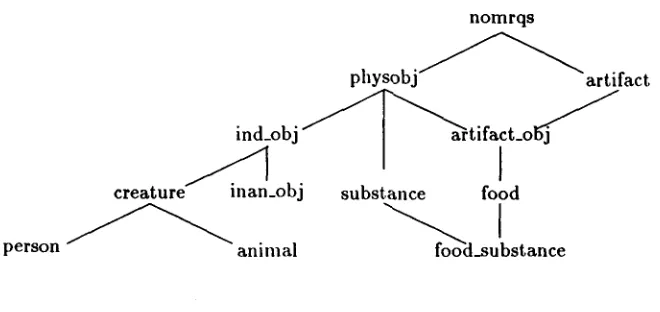
nomrqs
p h y s o b j ~ a r t i f a c t
creature" inan_obj substance food
person ~ animal ~ f o o d _ s u ! s t a n c e
Figure 1: A fragment of a type hierarchy
-- two types which are unordered in the hierarchy are assumed to be inconsistent unless
the user explicitly specifies a c o m m o n subtype. Every consistent set of types S C TYPE has a unique greatest lower bound or meet (notation r'lS). This condition allows feature structures to be t y p e d deterministically - - if two feature structures of types a and b are unified the type of the result will be a t-1 b, which must be unique if it exists. If a I-1 b does not exist unification fails. Thus in the fragment of a type hierarchy shown in Figure 1 a r t i f a c t and p h y s o b j are consistent; a r t i f a c t I-1 p h y s o b j = a r t i f a c t _ o b j .
Our system differs somewhat from t h a t described by Carpenter (1990) in t h a t we a d o p t a different notion of well-formedness of typed feature structures. In our system every type must have exactly one associated feature structure which acts as a constraint on all feature structures of t h a t type; by subsuming all well-formed feature structures of t h a t type. T h e constraint also defines which features are appropriate for a particular type; a well formed feature structure m a y only contain appropriate features. Constraints are inherited by all subtypes of a type, but a subtype may introduce new features (which will be inherited as a p p r o p r i a t e features by all its subtypes). A constraint on a type is a well-formed feature structure of t h a t type; all constraints must therefore be mutually consistent. Constraints can be seen as extending the PATR-II notion of templates (eg. Shieber, 1986) in t h a t the inheritance of constraints allows concise definitions of all feature structures, not just lexical entries; b u t in an untyped system, such as PATR.-II, there is no restriction on the features t h a t can occur in a feature structure.
For example the constraints associated with the types a r t i f a c t and p h y s o b j might be:
artifact
'ro,:t,t(:
= formula]
F O I L M = physform P I I Y S I C A I , - S ' I ~ A ' I ~ E = solid
[image:5.596.90.420.75.231.2]TELIC (purpose) feature, f o r m u l a is intended to represent a formula in predicate logic, it therefore has a c o m p l e x constraint itself:
formula
]
tNt} = e n t i t y l
I ' l t l , ) l } =
loglcal-pred|
^ltt;s = arg-list
J
In contrast solid is an atomic type, it has no appropriate features and its constraint is
simply the atomic feature structure [solid].
The constraint on artifact_obj will contain information inherited from both parents,
thus:I artlfact_obj
]
V O t t U =
physform
/I'IIYSICAI,-S'I~A'H,; = solid [
'H.;t,t(: = f o r m u l a J
Further examples of constraints and features which w e will use in examples in this paper
are:
ind_obj
[ physform
]
I"ORM = [SIIAPI': =
individuated
c r e a t u r e
A ( H d = scalar
sr, x = g e n d e r
• a n l m a l
]
i.:mm,t,: = boolean
substance
. [ physform
]
I,'OItM = /SiiAi,i,; =
unindlviduated
'H,:M(:
formula
We shall also make use of tile following types to define syntactic properties etc:
[ Ze,,-sig~
]
lex-sign E top
[olrHi = string
n o u n
n o u n _E lex-sign
/SYN'rAX =
[COUNT
L ILQS = n o n l r ( l s
c o u n t - n o u n E lex-sign
= boolean ] ]
]
noun
mass-noun_C lex-sign
SYNTAX= [COUNT=--1
The feature structure below is well-formed since it contains all the appropriate features and no inappropriate ones, it is subsumed by the constraints on its type and all its substructures are well-formed.
c o u n t - n o u n
o t t ' r . = " h a d d o c k "
SYN'I~AX = [ c o t J n ' , ~ = .-I-]
a n i m a l Sl,~X = g e n d e r
A(iE = scalar
~,~tu.M,~ = boolean
ttQS = IIIIYSI(:AI,-STA'I'I,: = s o l i d
[ physform ]
,.'ouM = [S,,A,.,.: = | n d i v i d u a t e d J
Given the type system introduced above, alexicalentry, suchas:
h a d d o c k 1 c o u n t - n o u n
< r q s > = animal.
would be expanded o u t i n t o such a ~ature structure I .
2 . 2 D e f a u l t i n h e r i t a n c e
To allow default inheritance we introduce the concept of psor~; a feature structure from which another feature structure inherits information, by default. The hierarchical order- ing on psorts (which must be consistent with the type hierarchy) provides an order on defaults. Default inheritance is implemented by a version of default unification. Only orthogonal multiple inheritance (Touretzky 1986) is allowed; information inherited from multiple parents must not be contradictory. (A default inheritance hierarchy which con- nects semantic parts of lexical entries can be derived semi-automatically from taxonomies extracted from conventional dictionaries, see Copestake, 1990a). We refer to this particu- lar case of the psort hierarchy as an IS_A hierarchy. Values of features can be associated either manually or semi-automatically with psorts in the IS_A hierarchy; the more specific word senses then inherit them, by default. (Defaults may also be useful in the represen- tation of syntactic information in the lexicon (e.g. Flickinger, 1987).)
Since the type system constrains the psort system it also constrains multiple default inheritance. If the value of the FOOD-TEMPERATURE feature for "drink 2 (1)" is low then this information would be inherited by the entry for "beer" which is below "drink 2 (1)" in the IS_A hierarchy. However inherited information may be overridden by associating other values with psorts lower in the hierarchy; for example although "tea" is under "drink 2 (1)" in the hierarchy, its F O O D - T E M P E R A T U R E can be specified to be h i g h rather than
low.
Types and features thus provide an organisation on the information which is neces- sary for interaction with lexical and syntactic rules. The IS_A hierarchy is motivated by defining its semantics in terms of the real world entities corresponding to the word senses and demonstrating that default inheritance of attributes in the lexicon correlates with de- fault reasoning about properties of the entities. Copestake (1990a) outlines a preliminary attempt to formalise the relationship between this aspect of lexical semantics and world knowledge.
2.3
L e x i c a l
r u l e sA lexical rule is a feature structure of type lexical-rule. The expanded constraint for the type is:
lexical_rule ] 0 = lex_slgn | I = lex_slgn J
thus all lexical rules have to have the features 0 and I which must both have values which are of type lex_sign.
N e w lexical signs m a y be generated by unifying a copy of the lexical entry with the feature structure at the end of the path <I> in a copy of the lexical rule -- the feature structure at the end of the path <0> is then the new lexical sign. Lexical rules are indexed by the type of their "input" and "output" feature structures, so they will only be applied to entries of the appropriate type and will only create well-typed entries.
A n u m b e r of productive or quasi-productive phenomena, such as deverbal nominali- sation, 'grinding', and so forth, can be represented as lexical rules which generate further lexical entries. A general type for grinding lexical rules could be specified in our system as follows:
grinding
]
c o u n t - n o u n
1 = OILTII = [ ]
g r i n d i n g E lexical_rule I t q S = ind~obj
-
l n ~ : t s s - I | o u n]
0 = O I [ T I I = [ ]
I t Q S = s u b s t a n c e
The effect of the iexical rule is to transform a count noun with the 'relativised qualia structure' (RQS, Calzolari, 1991) properties appropriate to an individuated physical object ind_obj into a mass noun with properties appropriate for a substance s u b s t a n c e . Thus the core component of grinding is a linguistic, syntactic operation which affects syntactic realisation, such as the ability to appear without a determiner, correlated with an abstract and underspecified semantic operation. We would claim that specific predicational and syntactic contexts will result in coercion (application of the lexical rule) and that this much, at least, of the 'grinding' family of sense extensions must be seen as a non-default and essentially linguistic process.
of lexical organisation allows us to make fine distinctions between classes of lexemes, in terms of both syntactic and semantic properties encoded in the type system, we expect that many processes which have been characterised as partially productive or semantic specialisations of productive processes will be characterisable as fully productive rules of sense extension applying to smaller semantically coherent subsets of the lexicon.
For example given the type hierarchy shown in Figure 1 we can give rules which inherit information from g r i n d i n g such as animal_grinding:
grinding
animal_grinding ] = ,tqs = , . : , , , . , . . = + j 0 = [,tqs food_substance]
Thus given the lexical entry for "haddock" shown above we can apply the lexical rule to generate a sense meaning "haddock-flesh" (partially represented as):
" m a s s - n o u n
oa'Ht = haddock
food_substance
ItqS = I.[ formula ]
'l~l';l'l(: = [l'll.l';I} = e a t
(where the specification of tile value e a t for tile relic role arises from the constraint on the type f o o d _ s u b s t a n c e , inherited from f o o d , and the type mass-noun arises from g r i n d i n g . ) It would not be possible to apply this lexical rule to "book" and get a sense denoting "book-flesh" because "book" has the type i n a n i m a t e _ o b j which is incompatible with a n i m a l . It would still be possible to apply the general lexical rule for grinding and to get a mass use of "book" but the denotation of the mass sense would be underspecified. We would expect the context to provide a more specific interpretation of the mass sense in such a (less-conventionalised) case.
We can illustrate the m a n n e r in which this type of semi-productivity might be dealt with if we assume t h a t we are a t t e m p t i n g to construct a lexicon semi-automatically from a conventional dictionary (e.g. Copestake, 1990a). If the result of applying a lexical rule to a sense is notated as sense+rule-name (eg lamb_l+animal_grinding) then the representation of the sense lamb (2) ( " t h e m e a t " , from the
Longman Dictionary off Contemporary English
L D O C E ) might be:l a m b 2 < l a m b _ l + a n i m a l _ g r i n d i n g .
In this case no e x t r a information need be added. In contrast the entry for lamb (3) ( " a young gentle person" L D O C E ) might augment the information inherited from the lexical rule:
l a m b 3 < l a m b _ l + a n i m a l _ m e t a p h o r
< rqs : age > = l o w .
In the case of "haddock", where no L D O C E entry is found, the structure derived from the lexieal rule alone would be used.
We can regard morphological rules as a particular type of lexical rule where the or- thography of the o u t p u t is not equal to that of the input (we assume that the regular spelling changes involved in affixation will be dealt with by a separate system, e.g. Cahill, 1990). In this case we could represent irregular forms as having an orthographic form which overrides that produced by rule application. In principle, multiple lexieal rules m a y be applied in sequence. For example the resultative senses of "replacement" and "pur- chase" mentioned in the introduction would be the result of applying a m e t o n y m i c sense extension rule to the result of the nominalisation process. All o u t p u t s of lexical rules must be potentially valid lexieal entries. In the case of conversion or zero-derivational processes we wish to restrict the set of lexical rules so that application m a y not be circular - - t h a t is if there is a lexical rule which could generate the set of feature structures F2 from the set F1, no other lexieal rule or sequence of lexical rules may be specified which could generate any m e m b e r of F1, or a feature structure subsuming any m e m b e r of F1, starting from any m e m b e r of the set F2, since lexical rule application would not then terminate. (We can check for such potential circularities relatively efficiently by looking at the type of the feature structure that a lexical rule generates rather than the entire feature structure.) However, this condition is overrestrictive in general because some types of derivationai rule can apply to their own o u t p u t iteratively ( " m e t a - m e t a - t h e o r y " , "anti-anti-missile",
"great-great-grandmother",
"re-re-program"). This observation suggests that we need to distinguish types of lexical rule, such as at least derivational rules and processes of conversion, and associate slightly different constraints with them.3
Grinding
In this section we justify our t r e a t m e n t of grinding as a lexical rule and show why relatively complex semantic information is needed to adequately account for this sense extension.
Tile first point to consider is that grinding processes appear to be genuinely productive. Thus we find:
in the L a n c a s t e r - B e r g e n / O s l o (LOB) corpus. We therefore cannot assume t h a t the ground senses are necessarily lexicalised, even ill the relatively conventionalised uses to m e a n m e a t , fur etc.
One a p p r o a c h which allows for this p r o d u c t i v i t y is to t r e a t all nouns as being initially underspecified with respect to the c o u n t / m a s s distinction. T h u s it is possible to produce a g r a m m a r where nouns are initially undefined with respect to a syntactic count feature and where l a m b ~ is, in effect, taken as denoting b o t h a n i m a l s and m e a t and so on (see the " p - t h e o r y " in Pelletier and Schubert 1986 and also Copestake 1990b). In contexts • where one i n t e r p r e t a t i o n is forced ( " a piece of l a m b " vs "two l a m b s " ) the predicate can be restricted to denote either count or the mass senses (in this case either the a n i m a l or the m e a t senses). However this seems to predict t h a t NPs such as "the l a m b " are vague r a t h e r t h a n a m b i g u o u s between count and m a s s readings. T h u s the peculiarity of sentences such as:
? J o h n fed a n d carved the lamb.
is not accounted for (see also the introduction). It is p e r h a p s significant t h a t in m o s t dictionaries the m a s s sense is specified as well as a count sense for the conventionalised grinding e x a m p l e s we have been considering. Lexicographers are s o m e t i m e s aware of the regularity of the extension (Atkins 1990) b u t have no way of representing this in a conventional dictionary. We thus regard a noun like "lamb" as a m b i g u o u s between m a s s and count senses rather t h a n vague, and the mass ( m e a t ) sense as an extension of the count ( a n i m a l ) sense, specified by lexical rule. (There are cases where it is reasonable to claim t h a t a n o m i n a l should be underspecified with respect to the c o u n t / m a s s distinction; it is frequently unclear whether individuation is occurring with nouns like " d a t a " , however in the grinding e x a m p l e s there is a clear change in meaning.)
O u r current t r e a t m e n t thus has similarities to the "s-theory" of Pelletier and Schu- b e r t (1986) where "lexical extension rules" are used to produce mass nouns f r o m count nouns. However these rules merely change the value of the syntactic count feature, a p p l y a predicate o p e r a t o r which is tile s a m e for all cases of grinding, and m a r k the m a s s sense resulting as " + E X T " which is supposed to suggest t h a t it is in some way a b n o r m a l . T h i s is clearly inadequate:
J o h n carved the lamb.
would be m a r k e d " + E X T " for the reading where l a m b was used in a m a s s sense and not for the count sense reading. By having an inheritance ordering on lexical rules we can express the conventionalised processes t h a t apply to semantically specified p a r t s of the lexicon and account for the possibility of multiple distinct m a s s senses being possible; for e x a m p l e " r a b b i t " is given distinct senses in L D O C E for the m e a t and the fur, and (in context) an underspecified sense is available:
After several lorries had run over the body, there was r a b b i t splattered all over the road.
sense. (We can formally specify this relationship between the ground sense G and the base sense B as
Vx, t[G(x, t) ~ 3y, t'[*B(y, t') A t' < t A x Eo y]]
using the formalisation developed in Copestake (1990a) following Krifka (1987) where nominal predicates are taken as being true of quantities of m a t t e r at some time index, where *B denotes a potentially plural entity, and where Eo represents a relationship of material constituency. In the lexicon we actually use a feature ORIGIN which call be taken as an abbreviation for the relationship specified above.)
A good theory of sense extension should give some t r e a t m e n t of blocking, which ap- pears to occur with some cases of regular sense extension in a way t h a t seems similar to derivational morphology. For example the use of "pig" to denote the meat seems to be blocked by the existence of "pork" - - "pig" can be used in the extended sense but such a use is marked, suggesting for example that the meat is distinctly inferior. To account for this we need to be able to recognise that "pork" is equivalent to the sense obtained from "pig" using the lexical rule. Although there are m a n y problems with this (what do we mean by equivalence, why does this apparently not apply to metaphorical sense extension) in order to do it at all we clearly need a rich representation which indicates information such as "origin".
Bauer (1983) distinguishes two types of non-productivity (which he refers to as estab-
lished senses) - lexicalisation and institutionalisation. Lexicalisation is defined as irregular
and unpredictable modification of some or all of the semantic, syntactic or phonological properties of a derived form. Institutionalisation, by contrast, involves restriction, rather than modification along one of these dimensions; thus "telephone box" is institutionalised to mean telephone kiosk unambiguously, although the liberal rules of noun c o m p o u n d i n g predict other possibilities. In our approach, we can treat institutionalisation as a form of blocking in which forms such as "telephone box" would have separate entries equivalent to one productive meaning predicted by a putative lexical rule of compounding. This would predict a strong preference for this interpretation (except in a marked context). Bauer (1983:58) points out that some t r e a t m e n t along these lines will be required since the other meanings are not completely ruled out, and therefore simply listing them as independent entries will be inadequate. T h e more specific rules of grinding (as opposed to the most general rule) are instances of productive institutionalisation within sub-classes in t h a t the specific interpretations they introduce can be overridden in marked contexts.
Similarly, lexicalisation is usually a partial process which affects one aspect of a derived lexical entry, whilst the rest remains productive. Bauer gives the example of "disbelieve" which can be productively derived through a lexical rule which prefixes "dis+" to the verb "believe" with a predictable change of meaning, except that "disbelieve" does not inherit the syntactic properties of "believe" because it cannot take sentential or infinitival complements. T h e productive aspects of the relation between the two verbs can be ex- pressed by a lexical rule for "dis+" prefixation, whilst the non-productive aspects can be captured naturally in this framework by positing an independent entry for "disbelieve" which overrides some of the information provided by the iexical rule.
More than 1,000 union men and their families arrived to play bowls, eat bar- becued chicken and row on his fish-infested lake.
The application of a grinding lexical rule is triggered by a combination of syntactic and ' semantic effects arising from the context (for example the predicate "eat" takes an object denoting food in preference to an animal, the bare NP "mole" in the earlier example must have a negative value for the syntactic feature count). By default, the most spe- cific lexical rule applicable will be used, in this case "animal.grinding" as opposed to the general grinding rule and so the interpretation of "chicken" as "chicken-flesh" and "mole" as "mole-flesh" is possible, by default. More open-ended (non-lexical) reasoning might cause the default interpretation of the mass sense to be overridden ill some marked informationally-rich contexts. For example:
John bit into the lamb. It kicked and struggled.
We assume a similar account of the overriding of default interpretations with these types of example as we offered in the case of logical metonymies (Briscoe et al., 1990).
4
C o n c l u s i o n
We have argued that our notion of lexical rule can capture the productive linguistic element of derivationai morphological processes and metonymic and metaphorical sense extensions. In order to do this adequately we need rich lexical semantic information but we do not need to resort to general deductive or abductive inference on unconstrained world knowledge. By using semantic information to structure the lexicon, by means of types and inheritance, we can represent relationships between lexical rules and view them as essentially fully productive over defined subparts of the lexicon, while providing an initial account of blocking and lexicalisation. Itowever the work described here is at a preliminary stage. We need to provide detailed accounts of a range of derivation and conversion processes to see how adequately we can represent them as lexical rules, while structuring the lexicon and type system appropriately to constrain their operation.
A c k n o w l e d g e m e n t s
This work was supported by Esprit BRA-3030, ACQUILEX 'The Acquisition of lexical knowledge for Natural Language Processing systems'.
R e f e r e n c e s
Atkins B(1990) Lexical Rules: a starter pack, Ms. OUP Bauer L(1983) English Word-formation, CUP
Briscoe E J, Copestake A A and Boguraev B K(1990) 'Enjoy the paper: Lexical semantics via lexicology', Proceedings of the 13th Coling, Helsinki, pp.42-47
Cahill L(1990) 'Syllable based morphology', Proceedings off the 13th Coling, Helsinki, pp.48-54
Calzolari N(1991) Representation of semantic information in a lexical knowledge base,
Carpenter R(1990) 'Typed feature structures: Inheritance, (In)equality and Extensional- ity', Proceedings of the Inheritance in Natural Language Processing, Tilburg, pp.9-18 Copestake A A(1990a) A n approach to building the hierarchical element of a lexical knowl-
edge base from a machine readable dictionary, Workshop on Inheritance in NLP,
Tilburg
Copestake, A.A.(1990b) Some notes on Mass Terms and Plurals, Technical Report 190, Computer Laboratory, University of Cambridge
Copestake A A, de Paiva V C V, Sanfilippo A and Briscoe E 3(1991) Functionality of the
LKB, Ms. Computer Laboratory, University of Cambridge
Flickinger D(1987) Lexical rules in the hierarchical lexicon, PhD dissertation, Stanford University
Itobbs J, Croft W, Davies T, Edwards D and Law K(1987) 'Commonsense metaphysics and lexical semantics', Computational Linguistics, vol.13, 241-250
Krifka, M.(1987) 'Nominal Reference and Temporal Constitution: Towards a Semantics of Quantity', Proceedings of the 6th Amsterdam Colloquium, University of Amsterdam, pp.153-173
Partee B and Rooth M(1983) 'Generalized Conjunction and Type Ambiguity' in Bauerle R, Sehwarze C and yon Stechow A (eds.), Meaning, Use and Interpretation of Lan-
guage, de Gruyter, pp.361-368
Pelletier, F.J., and Schubert, L. K.(1986, forthcoming) 'Mass Expressions.' in Gabbay and Guenthner (eds.), Handbook of Philosophical Logic, Vol 4, Reidel, Dordrecht Pustejovsky .1(1989a) The Generative Lexicon, Ms. Brandeis University
Pustejovsky J(1989b) 'Current issues in computational lexical semantics', Proceedings of
the 4th European ACL, Manchester, pp.xvii-xxv
Pustejovsky .1(1989c) 'Type coercion and selection', Proceedings of the West Coast Con-
ference on Formal Linguistics, Vancouver
Shieber S(1986) An Introduction to Unification-based Approaches to Grammar, University of Chicago Press, Chicago
Touretzky D F(1986) The mathematics of inheritance systems, Morgan Kaufinann, Los Altos