Tectogrammatical Representation: Towards a Minimal
Transfer In Machine Translation
Jan Hajic ·
Charles University, Prague, Czech Republic [email protected]
1. lntroduction
The Prague Dependency Treebank (PDT, as described, e.g., in (Hajic, 1998) or more recently in (Hajic, Pajas and Vidova Hladkä, 2001 )) is a project of linguistic annotation of approx. 1.5 million word corpus of natuially occurring written Czech on three levels ("layers") of complexity and depth: morphological, analytical, and tec-togrammatical. The aim of the project is to have a reference corpus annotated by using the accumulated findings of the Prague School as much as possible, wbile simultaneously showing (by experiments, mainly of statistical nature) that such a framework is not only theoretically interesting but possibly also ofpractical use.
In this contribution we want to show that the deepest (tectogrammatical) layer of representation of sentence structure we use, which represents "linguistic meaning" as described in (Sgall, Hajieova and Panevova, 1986) and which also records certain aspects of discourse structure, has certain properties tbat can be effectively used in ma-chine translation 1 for languages of quite different nature at the transfer stage. We believe that such representation not only minimizes the "distance" between languages at this Iayer, but also delegates individual language phenorn-ena where they belong to - whether it is the analysis, transfer or generation processes, regardless of methods used for perfotming these steps.
2. The Prague Dependency Treebank
The Prague Dependency Treebank is a manually annotated corpus of Czech. The corpus size is approx. 1.5 million words (tokens). Three main groups (" layers") of annotation are used:
• the morphological layer, where lernmas and tags are being annotated based on their context;
• the analytical layer, which roughly corresponds to the surface syntax oftbe sentence,
• the tectogrammatical layer, or linguistic meaning ofthe sentence in its context.
In general, unique annotation for every sentence (and thus within the sentence as weil, i.e. for every token) is used on all three layers. Human judgment is required to interpret the text in question; in case of difficult decisfons, certain "tie-breaking" rules are in effect ( of rather technical nature); no attempt has been made to define what type of disambiguation is "proper" or "improper" at what level.
Technically, the PDT is distributed in text fonn, with an SGML markup throughout. Tools are provided for viewing, searching and editing the corpus, together with some basic Czech analysis tools (tokenization, morphol-ogy, tagging) suitable for various experiments. The data in the PDT are organized in such a way tbat statistical experiments can be easily compared between various systems - the data have been pre-divided into training and two sets oHest data.
In the present section, we describe briefly the Prague Dependency Treebank structure and its history.
2.1. BriefHistory ofthe PDT
The Prague Dependency Treebank project has started in 1996 formally as two projects, one for specification of the annotation scheme, and another one for its immediate "validation" (i.e., the actual treebanking) in the Institute of Fonnal and Applied Linguistics, Faculty of Mathematics and Physics at Charles University, Prague. The annotation part itself bas been carried out in its Linguistic Data Lab. There has been broad cooperation at
Supported by the Ministr)' ofEducation ofthe CR Project LNOOA0063 and by the NSF Grant 0121285.
1. We suppose the "classic" design of an MT system, namely, Analysis - Transfer - Synthesis (Generation). Although we believe that overall, our representation goes further than many other syntactico-sernantic representations of sentence structure, we are far frorn calling it an interlingua, since it can in general have different realization in different languages for the same
sentence . ·
Hajic 217
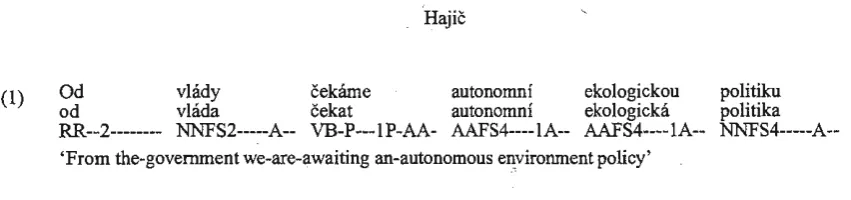
(1) Od vlädy cekäme autonomnf ekologickou politiku
od vläda cekat autonomni ekologickä politika
[image:2.598.78.504.78.178.2]RR--2--- NNFS2---A-- VB-P---lP-AA- AAFS4----1A-- AAFS4----1A-- NNFS4---A--'From the-government we-are-awaiting an-autonomous ・セカゥイッョュ・ョエ@ policy'
Figure 1: Example morphological annotation: form, lemma, tag
the beginning of the project, especiaily with the Institute of the Czech National Corpus which (in a similar vein to the British National Corpus) has been constituted at the time as the primary site for collection of and public access to large amounts of Czech contemporary texts2• A preliminary version of the PDT ( called "PDT 0.5'') has
been released in the summer of 1998, the first version containing the füll volume ofmorphological and analytical annotation has been published by the LDC in the fall of 2001 (HajiC et al., 2001). The funding for the project which currently concentrates on the tectogrammatical layer of annotation as described below is secured through 2004.
2.2. The Morphological Layer
The annotation at the morphological layer is an unstructured classification ofthe individual tokens (words and punctuation) ofthe utterance into morphological classes (morphological tags) and lemmas. The original word form is preserved, too, of course; in fact, every token has gotten its unique ID within the corpus for obvious reference reasons. Sentence boundaries are preserved and/or corrected iffound wrong (as taken from the Czech National Corpus).
There is nothing unexpected at this level of annotation, since it follows closely the design ofthe Brown Corpus and of the tagged WSJ portion of the Penn Treebank. However, since it is a c9rpus of Czech, the tagset size used is 4257, with about 1100 different tags actually appearing in the PDT. The
data
has been double-annotated fully manually, our morphological dictionary of Czech (Hajic, 2001) has been used for generating a possible list of tags for each token from which the annotators selected the correct interpretation.There are 13 categories used for morphological annotation of Czech: Part of speech, Detailed part of speech, Gender, Number, Case, Possessor's Gender and Number, Person, Tense, Voice, Degree of Comparison, Negation and Variant. In accordance with most annotation projects using rich morphological annotation schemes, so-called positional tag system is used, where each position in the actual tag representation corresponds to one category (see
Fig. 1). .
2.3. The Analytical Layer
At the analytical layer, two additional attributes are being annotated:
• (surface) sentence structure,
• analytical function.
A single-rooted dependency tree is being built for every sentence3 as a result ofthe annotation. Every item (token)
from the morphological layer becomes (exactly) one node in the tree, and no nodes (except for the single "tech-nical" root of the tree) are added. The order of nodes in the original sentence is being preserved in an additional attribute, but non-projective constructions are allowed (and handled properly thanks to the original token serial nurnber). Analytical functions, despite being kept at nodes, 。イセ@ in fact names ofthe dependency relations between a dependent ( child) node and its govemor (parent) node. As stated above, only one (manually assigned) analytical annotation ( dependency tree) is allowed per sentence.
According to the pure dependency tradition,' there are no "constituent nodes"4, as opposed e.g. to the mixed representations in the NEGRA corpus (Skut et al., 1997) which contains the head annotation alongside the con-stituent structure; we are convinced the concon-stituent nodes are in general not needed for deeper analysis, even though we found experimentally that for parsing, some of the annotation typically found at the constituent level might help
2. The ICNC has now over 0.5 biilion words ofCzech text available.
218
<\
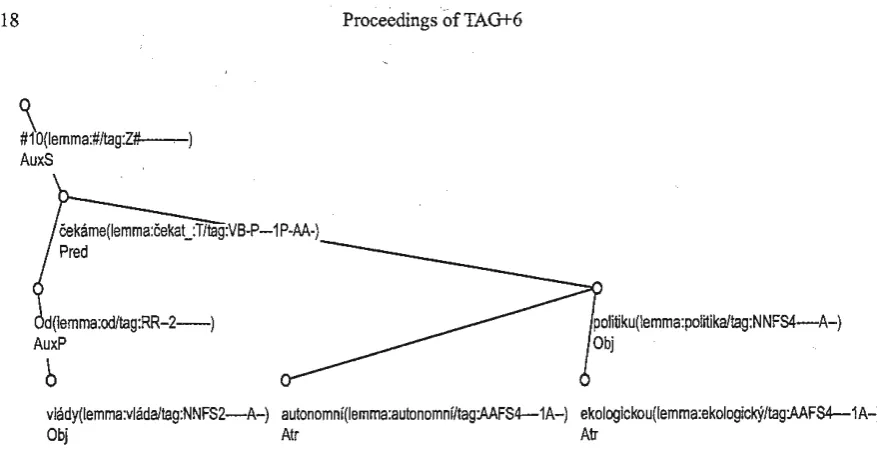
CQPHQ・ュュ。ZCOエ。ァZzCMセI@Aux.S
eekame(lemma:cekat_:T/tag:VB-P-1 P-AA·)
Pred
(lemma:od/tag:RR-2-) AuxP
b
Proceedings .Öf TAG+6
politiku(temma:po!itikaltag:NNFS4-A-) Obj
v!ady(lemma:vlada/tag:NNFS2-A-) autonomni(lemma:autonomnf/tag:AAFS4-1A-) ekologickou(lemma:ekologickY/tag:AAFS4-1A-)
セ@ セ@ セ@
Figure 2: Analytieal annotation (sentence from Fig. 1): fonn, function (+ dependencies, preserved word order)
(such as subordinate clause root markup; for more details, see (Collins
et al.,
1999)). However, there are still many "technical" dependencies Ieft - we are here at the level of the smface syntax, and there is often no Jinguistic reason to create a dependency between e.g. an analytical verb form, or a puncwation and everything eise, etc.Coordination and apposition is handled using such "technical" dep·C;mdencies, too: the conjunction is the head and the members are its "dependent" nodes. Common modifiers of the coordinated structure are also dependents of the coordinating conjunction, but they are not marked as coordinated structure members. This additional "coor-dinated structure member" markup (_eo, .Ap) gives an added flexibility for handling such constructions.
Ellipsis is not annotated at this level (no traces, no empty nodes etc.), but a special analytical function (ExD) is used at nodes that are lacking their govemor, even though they (technically) do have a goveinor node in the annotation 5•
There are 24 analytical functions used6, such as Sb (Subject), Obj (Object, regardless of whether the direct, indirect, etc.), Adv (Adverbial, regardless of type), Pred, Pnom (Predicate I Nominal part of a predicate for the (verbal) root of a sentence), Atr (Attribute in noun phrases), Atv, Atvv (Verbal attribute / Complement), AuxV (auxiliary verb - similarly for many other auxiliary-type words, such as prepositions (AuxP), subordinate conjunctions (AuxC), etc.), Coord, Apos (coordination/apposition "head"), Par (Parenthesis head), etc.
A simple example ofthe analytical Ievel annotation ofthe sentence from Fig. 1 is in Fig. 2.
2.4. The Tectogrammatical Layer
The tectogrammatical layer is the most elaborated, complicated but also the most theoretically based layer of syntactico-semantic ( or "deep syntactic") representation. The tectogrammatical layer armotation scheme is divided into four sublayers:
• dependencies and functional annotation,
• the topic/focus annotation including reordering according to the deep word order,
• coreference,
• the fully specified tectogrammatical annotation (including the necessary grammatical infonnation).
5. lt is the (recursively) closest parent that is physically present in the original sentence.
[image:3.598.82.521.75.308.2]HajiC 219
As an additional data structure we use a syntactic lexicon, mainly capturing the notion ofvalency. The lexicon is not needed for the interpretation of the tectogrammatical representation itself, but it is helpful when working on the annotation since it defines when a particular node should be created that is missing on the surface. In other words, the notion of (valency-based) ellipsis is defined by the dictionary. B.ut before describing the dictionary, let us describe the first ("core") sublayer of annotation.
Dependencies and Functors
The tectogrammatical layer goes beyond the surface structure of the sentence, replacing notions such as "sub-ject" and "ob"sub-ject" by notions like "actor", ''patient", "addressee" etc. The representation itself still relies upon the language structure itselfrather than on world knowledge. The nodes in the tectograrnmatical tree are autosemantic words only. 8• Dependencies between nodes represent the relations between the ( autosemantic) words in a sentence,
for the predicate as well as any other node in the sentence .. The dependencies are labeled by functors9, which de-scribe the dependency relations. Every sentence is thus represented as a dependency tree, the nodes of wbich are autosemantic words, and the (labeled) edges name the dependencies between a dependent and its govemor.
Many nodes found at the morphological and analytical layers disappear10 (such as function words, prepo-sitions, subordinate conjunctions, etc.). Tue information carried by the deleted nodes is not lost, of course: the relevant attributes of the autosemantic nodes they belong to now contain enough information ( at least theoretically) to reconstruct them.
Ellipsis is being resolved at this layer. Insertion of (surface-)deleted nodes is driven by the norion of valency
(see below the section on Dictionary) and completeness (albeit not in its mathematical sense): if a word is deemed tobe used in a context in which some ofits valency frames applies, then all the frame's obligatory slots are "filled" (using regular dependency relations between nodes) by either existing nodes or by newly created nodes, and these nodes are annotated accordingly. Textual ellipsis (often found in coordination, direct speech etc.)11 is resolved by
creating a new node and copying all relevant information from its origin, keeping tj).e reference as well.
Every node of the tree is furthermore annotated by such a set of gramrnatical features that enables to fully capture the meaning of the sentence ( and therefore, to recover - at least in theory - the original sentence or a sentence with synonymous linguistic meaning).
The Dictionary (Syntactic, Valency Lexicon)
The tectogrammatical layer dictionar)i is viewed mainly as a valency dictionary of Czech. By valency (as theoretically defined in (Panevova, 1975); for recent account ofthe computational side and the actual dictionary creation, see (Skoumalova, Straiiak:ova-Lopatkoväand Zabokrtsky, 2001)) we mean the necessity and/or ability of (autosemantic) words to take other words as their dependents, as defined below.
Every dictionary entry is called a lexia, which may contain one or more alternative (valency) frames. A frame consists of a set of (valency) slots. Each slot contains afunction section (the actual functor, and an indication whether the functor is obligatory12), and an associatedfonn section. The form section has no direct relation to the tectogrammatical representation, but it is an irnportant link to the analytical layer of annotation: it contains an (underspecified) analytical tree fragment that conforms to the analytical representation of a possible expression of the particular slot. Often, the form section is as simple as a srnall (analytical) subtree with one (analytical) dependency only, where the dependent node has a particular explicitly specified morphemic case 13; equally often,
it takes the fonn of a two-edge subtree with two analytical dependencies: one for a preposition (together with its case subcategorization) as the dependent for the surface realization of the root of the lexia itself, and one for the preposition's dependent (which is completely underspecified). However, the form section can be a subtree of any complexity, as it might be the case for phrasal verbs with idiomatic expressions etc.
7. Nor for further analysis (say, a logical one) based on it, nor (in the other direction) for generation (synthesis) of surface sentences.
8. By "autosemantic", as usual, we mean words that have lexical meaning, as opposed to just grammatical .function. 9. At two levels of detail; here we ignore so-called syntactic grammatemes, which provide the more detailed subclassification.
10. Based on the principle ofusing only autosemantic words in the representation. .
11. Nominal phrases, as used in headings, sports results, artifact names etc. are not considered incomplete sentences, even though they do not contain a predicate.
12. By "obligatory" we mean that this functor (slot) must be present at the tectogrammatical Iayer of annotation; this has immediate consequences for ellipsis annotation, cf. below.
220 Proceedings ofTAG+6
Moreover, the fonn section might be different for different expressions (surface realizations) ofthe lexia itself. For example, if the lexia is a verb and its surface realization is in the passive voice, the form of the (analytical) nodes corresponding to its (tectogrammatical) valency slots will be different than if realized in the active voice. However, relatively simple rules do exist to "convert" the active fonns into the passive ones that work for most verbs; therefore, for such verbs, only the canonical (active) forms14 are associated with the corresponding valency slots. For irregular passivization problems there is always the possibility to include the two (or more) different
realizations explicitly into the dictionary. .
A similar mechanism is in place for nominalizations. Verbal nouns typically share the function section of the valency frame with their source verbs, but the fonn section might be a regular or an irregular transfonn of the corresponding form section. Again, if the necessary transformation is regular, only the canonical form section need tobe present (or even no frame at all, ifthe verb-to-noun derivation is regular in the function section as well).
Other issues are important in the design of the valency lexicon as well, such as reciprocity, information about verbs of control (Panevova, Reznfökova and Uresova, 2002), etc., but they are outside the scope of this rather brief discussion.
The issue ofword sense(s) is not really addressed in the valency dictionary. Two lexias might have exactly the same set ofvalency frames (as defined above, i.e. including the form section(s) ofthe slot(s)); in such a case, it is assumed that the two words have different lexical meaning (polysemy) 15• lt is rather practical to leave this possibility in the dictionary {however "dirty" this solution is from the purist syntactic viewpoint), since it allows to link the lexias by a single reference to, e.g. the Wordnet senses (Pala and Sevecek, 1999). The lexical (word sense) disambiguation is, however, being solved outside the tectogrammatical level of annotation, even though eventually we plan to link the two, for obvious reasons. Then it will be possible to relate the lexias for one language to another in their respective (valency) dictionaries (at least for the majority of entires). From the point of view of machine translation, this will serve as an additional source セヲ@ syntactically-based information of form
correspondence between the two languages. ·
Topict Focus and Deep Word Order
Topic and focus (Hajifova, Partee and Sgall, 1998) are marked, together with so-called deep word order reflected by the order of nodes in the annotation, is in general different from the surface word order, and all the resulting trees are projective by the definition of deep word order.
By deep word order we mean such (partial) ordering of nodes at the tectogrammatical layer that puts the "newest" information to the right, and the "oldest" information to the left, and all the rest inbetween, in the order corresponding to the notion of "communicative dynamism". Such an ordering is fully defined at each single-level subtree of the tectogrammatical tree; i.e., all sister nodes together with their head are fully ordered lefMo-right. The order is relative to the immediate head only; therefore, there exists such a total ordering of the whole tectogrammatical tree that the tree is projective. We believe that the deep word order is language-universal for every utterance in the same context, unless, roughly speaking, the structural differeoces are "too big" ( or, in other words, the corresponding translation is "too free").
In written Czech, the surface word order roughly corresponds to the deep w6rd order (with the notable system-atic exception of adjectival attributes to nouos, and some others ), whereas the grammar of English syntax dictates in most cases a fixed order, and therefore the deep word order will be more often different ( even though not always; even English has its means to shuffle words around to make the surface word order closer to the deep one, such as extraposition).
Coreference
Grammatical and some textual coreference is resolved and marked. This is subject to future work, despite some ongoing test annotation. Grammatical coreference (such as the antecedent of"which", "whom", etc., control etc.) is simpler and therefore we believe it will be done more easily and sooner that its textual counterpart. (For more on control in PDT, see (Panevova, Reznickova and Uresova, 2002) in this volume.)
14. By "fonn" we mean the analytical tree fragment as defined above.
-Hajic 221
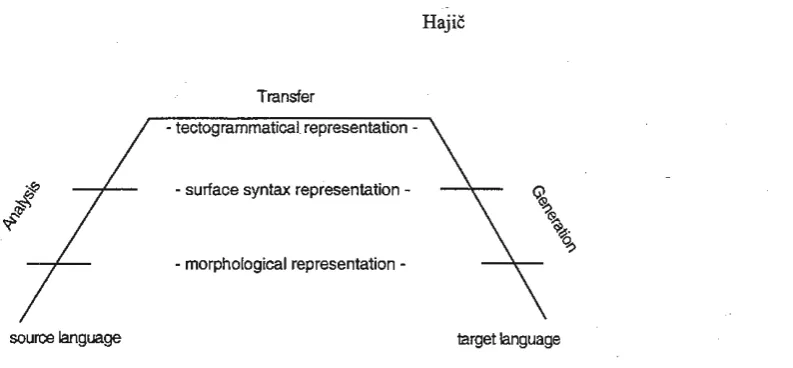
Transfer
tectogrammatical representation
surface syntax representation
morphological representation
[image:6.598.82.479.76.260.2]-souroe language target language
Figure 3: Transfer-based MT scheme with three levels of analysis and generation
3. Machine Translation and the Tectogrammatical Layer
The usual scenario of machine translation is Analysis - Transfer - Synthesis (Generation). lt is commonly accepted wisdom that the deeper the analysis, the smaller the transfer and vice versa. lt is equally clear that the deeper the analysis (and smaller and simpler the transfer), the longer the path from the source to the target Ianguages, and therefore the more errors are likely to creep in. We in principle agree with this, since only careful experiments and variety of evaluations must be run to prove or disprove thiS': We would like to argue at this point, however, that ( even though we have not done such convincing experiments yet), intuitively, there must be an advantage ifthe transfer end points are defined at a locally clean information saddle point with as least "dirt" from the other language as possible. There has been a number of attempts to use syntactic structure of a sentence to do MT; recently, the most succesful one is statistically based (Yamada and Knight, 2001 ). We propose·here, however, to go to a "deeper" level of analysis.
3.1. The Overall Design
Fig. 3 shows the overall scheme of a transfer-based approach to machine translation. This triangle-based scheme16 is currently considered the common scherne of all machine translation systems, whether they are of commercial nature (such as (Flanagan and McClure, 2002)) or of research nature ((Brown et al., 1993), (Knight, 1999)) and regardless oftheir prevailing rnethodology (with the exception ofvery few interlingua-based systems (Cavalli-Sforza et al., 2000)).
As Fig. 3 suggests, we propose three essential analysis steps and three generation steps:
• Morphological processing;
• Analytical (surface syntax) processing;
• Tectogrammatical processing (underlying syntax);
and, of course, transfer at the top ofthe processing "triangle"17•
An output frorn one step is the input to the following step; thus we have here four representations of the data along the "up-leading" as weil as the "down-leading" paths (from bottom to top):
• Tue suifaceform ofthe text (i.e., the actual input and output ofthe whole systern).
• Unstructured morphological representation (cf. Sect. 2.2), i.e., an ordered !ist of Iemmas and morphological tags. The order corresponds to the original word order of the sentence.
16. We should rather call it a ''trapezoid" scheme, since the top is always cut off in it.
222 Pröceedings of TAG+6
• Structuredanalytical representation (cf. Sect. 2.3), in the fonn ofa dependency tree thatcontains all tokens from the morphological Jayer. Let's summarize that every token is annotated by the lemma and tag coming from the morphological layer, and by a pointer to its governing node and an analytical function naming the dependency relation. The left-to-right order of the nodes of the tree is still coming from the surface sentence word order, therefore causing non-projective trees at times.
• Structured tectogrammatical representation (for more details and the four sublayers of annotation, cf. Sect. 2.4) which does not contain the word fonn, lemma, morphological tag, analytical function, nor the surface depen-dency links. Instead, the tectograrnmatical dependepen-dency, lexia 18 and the functor is used as the basic information here, supplemented by grammatemes that contain infonnation about number, tense, degree of comparison only where it cannot be recovered from the lexia and function itself. In the füll tectogrammatical representation, coreference and deep word order together with topic/focus is annotated as well.
Let us now illustrate how the correspondence among quite distant languages (English, Czech and Arabic) becomes more and more apparent (and straightforward) as we move up the translation "triangle". We will use the sentence
The only remaining baker bakes the most famous rolls north of Long River, which translates to Czech as Jediny zb'jvajici pekaf pece nejzname}Sl rohliky na sever od Dlouhe feky and to Arabic as (transcribed) xabbaaz
'al-'axiir 'al-baaqii yasnacu 'ashhar 'al-kruasaanaat ilaa shimaal min Long River.
3.2. Surface Form and Morphological Layer Correspondence
Even though the example sentence is quite straightforward to translate (certainly more easily than many sen-tences in the WSJ), it is clear that there are several unpleasant (non-)correspondences at the surface form, and similarly at the morphological level: articles have no correspondence in the Czech sentence, whereas in the Ara-bic counterpart, articles are in fact part of the AraAra-bic words. Similarly, the superlative is expressed in Czech by circumfixing, whereas in English it is represented by several words and in Arabic there is a specific single word ( 'ashhar). The Arabic word order is different, too: the word for "baker'; ( 'al-xabbaaz) precedes its attributes in the Arabic translation, but follows them in both Czech and English. Therefore methods based on very shallow analysis (i.e., morphological at most) will have trouble (at least) with different word counts, different word order, and, as usual, lexical choice (cf. further below).
3.3. Analytical Layer Correspondence
Fig. 4 shows the corresponding
trees.
The correspondence of the dependencies is more visible, but since the number of nodes is the same as on the morphological layer, the problems mentioned above did not disappear; on the contrary, the surface structure of the Arabic superlative construction ( 'ashhar 'al-kruasaanaat) even reverses the associated dependency relation (compared to both Czech and English, cf. the mostfamous rolls). Since the original ward order is preserved in the analytical dependency tree, the shape of the tree does not correspond even for simple nominal phrases19• Overall, even though many dependencies do correspond to each other, there are still many dependencies that either do not correspond to anything in the other language, or are reversed.3.4. Tectogrammatical Correspondence
Even though there is some similarity between languages at the surface dependency syntax level, the tectogram-matical structure displays often striking similarity, both in the structure andin the functor correspondence (Fig. 5), even though we say again that it is not meant tobe an [artificial] interlingua20•
Analytical Verb Forms
Verbs tend to use various auxiliaries to express person, tense, sometimes number and other morphological properties. We believe, however, that once the person, tense, number etc. is determined (disambiguated), then
18. Recall that "lexia" is the lex.ical unit reference at the tectogrammatical level, and thus it plays here a role similar to the "lemma" at the morphological and analytical layers.
19. Although the direction of dependencies does (remaining depends on baker, similarly in Arabic 'al-baaqii depends on
'al-xabbaaz andin Czech zbfvajic[ depends onpekaf).
mcst
Adv
north
Adv
セ|@
AuxP
ter
tdv Leng Att #1 AuxSj・、ゥョセ@
Atr
Hajic
ekar hlfky na
Pred)
Sb Obj AuxP
·. セ@
zb}'vajfcl ョ・ェコョ。ュセェᄃヲ@ sever
Atr Atr Adv
セ@
AuxP } ky tr DlouM Atr
G。ャセク。「「。。コ@
ケ。セョ。」オ@
Pred
\
.'ashhar 1iaa
Obj\ AuxP
'al-'axiir 'al-baaqii 'al-kruasaanaat
Att Att Att
s imaal Adv
セ@
mmAuxP } lver tr Long Atr 223
Figure 4: Analytical layer correspondence: The only remaining baker bakes the most famous rolls north of Long River in English, Czech and Arabic
to_tiake
pr e dセ@
baker
セ|ョッイエィ@
aイセ@
PAT LOC\only remaining famous/;iver
RSTR RSTR RSTR/ DIR1
d
Long DPHR jediny RSTRpec1'
PREDセ@
housky severPA\ LOC),
zb}lvajici nejznamejs1 feka
RSTR RSTdl DIR1
Dlouhä
DPHR
'C
B "
pセセml@
ACT \:, PAT LOC
: R BQY
セhhr@
tiverRSTR RSTR RSTRlDIR1
Long
DPHR
[image:8.598.76.496.91.388.2] [image:8.598.114.492.427.696.2]224
Proceedings ofTAG+6there is no need to have separate nodes for each ofthe auxiliaries. The auxiliaries are completely determined by the language in question; therefore, we must be able to handle the insertion of appropriate auxiliaries at the generation stage, which is by its nature already monolingual. In the context of machine translation, this is especially useful: we have to take care of the main (autosemantic) verb only during the translation proper (the transfer pbase), but not of the (presence or absence) of auxiliary source words .. For example, the type of auxiliary in German perfect tense (sein/haben) is grammatically (or, lexically) based and has nothing to do with the other language, since that language might use quite different auxiliaries ( or none at all, if it uses infl.ection to express the perfect tense ).
Articles
Articles pose a difficult problem for translation into a language that has articles (such as English) from a lan-guage that does not (such as Czech). The choice of an article is hardly conditioned by words of the other lanlan-guage; rather, it is either detennined grammatically, referentially, or by the topic/focus distinction described earlier. We thus believe that articles, as another class of non-autosemantic words, has no place at the tectogrammatical layer ofrepresentation, since the topic/focus and deep word order should be sufficient (together with the grammar rules ofthe target language) to insert the right articles at the イゥァィセ@ places. For example, the need to use "the" in front of every superlative is purely English-grammar-related and certainly does not stem from the language being translated from or to; the choice of"a" vs. "the" for a general word such as "keyboard" will be determined by the topic/focus annotation: if the word "keyboard" is in the topic, the definite article (" the") typically has to be used, otherwise "a" should be used instead.
Choice of Prepositions (and Morphemic Case)
Prepositions usually do exist across languages, even though they are· not always used as separate words (cf. Hungarian and otber agglutinative languages ), and often a "default" translation can be found for every preposition. However, from the experience with inflective languages such as Czech, we consider prepositions and morphemic cases to be at the same "level" - if not just a form variant - expressing a particular tectogrammatical functor21•
Therefore, when translating into English, we have to select prepositions, when translating e.g. into Czech we have to decide the case or preposition22
•
Even then, the relation between functors and prepositions/cases is not always straightforward, for at least two reasons:
• The choice ofpreposition is driven by usage in the target language (e.g., it depends on the noun used with the preposition or on some similar factor);
• The choice of preposition/case is driven by the governing word and by the functor of the dependent word (i.e. the one that has to get the preposition/case).
In both cases, the source language sentence representation does not help much. In the first case, we simply have to have a language model or similar knowledge of the target language23 that simulates usage. In the second case, a valency dictionary of the target language (as defined in Sect. 2.4) comes in handy: once we are able to determine the correct target word (more precisely, the lexia as the translation ofthe source lexia), a valency dictionary entry gives matching functors and with each of them, its surface expression (by means of an underspecified analytical-level annotated subtree, mostly either just a case or a preposition with its own subcategorization for a morphemic case).
For words not having valency, their dependent nodes (as weil as dependent nodes of all words with non-valency modifier functors) acquire their preposition or case as the default value för each functor.
21. Some regular "transfonnations" notwithstanding, such as in passivization, where the surface syntax expression also plays arole.
22. Prepositions have subcategorization for case, so for subcategorization-ambiguous prepositions the correct subcat frame must be selected together with the preposition.
Hajic
225
Word Order
Word order differs across Ianguages, of course, sometimes wildly. English has its word order mostly gram-matically given (meaning that the grammar dictates that sentences should in the SVO order, that the rules for systemic ordering must be followed, etc.); some exceptions in the grammar do allow for some word shuffiing, such as extraposition. However, Czech woid order is discourse-driven (and thus not so "free" as often mislabeled). The correct solution, in our opinion, to the word order problem is thus not to deal with it at the transfer level, but at the analysis level (detennining the deep word order), and at the generation stage (using the detennined deep word ordet to perhaps generate an extraposition, and using the grammar rules24 of the target language to determine the correct word order).
Agreement (in the Generation Stage)
Grammatical agreement is again detennined by the rules of the target language, and not by the translation itself. Its importance in English is low, obviously, but it is crucial for other languages. E.g., in Czech, every adjective has to agree in gender, number and case with its head noun. We propose to deal with this problem at the analytical Ievel, once the analytical tree is built (which includes solving the word order issue, of course); it is not related to the tectogrammatical Ievel in fact. Thus, for example, only the number is needed tobe preserved (translated) at the tectogrammatical level25, its dependent adjectives will be the populated by the correct morphemic values once also the case is determined by the rules described above, and once the gender of the noun is determined from the lexicon. The formation of the surface text is then easy through any morphological generator of the target language, since the word order has been defined in the preceding stages.
4. Conclusion
We have described the basic ideas and annotation scheme for the Prague Dependency Treebank, a reference coxpus with three-level linguistic annotation for morphology, surface syntax, and so-called tectogrammatical layer representation. We have then argued that the tectogrammatical layer is suitable not only for various Iinguistic experiments, but also for practical use, speci:fically for machine translation systems, since it generalizes (and disambiguates) in such a way that it achieves - to a certain extent limited by "language meaning" - independence ofboth the source and target languages. We believe that our representation has the potential to improve the overall translation quality, and that the additional burden of deeper analysis will not outweight its benefits.
References
Brown, Peter, Stephen Della Pietra, Vincent Della Pietra and Robert Mercer. 1993. The mathematics of statistical machine translation: parameter estimation. Computational Linguistics, 19(2).
Cavalli-Sforza, Violetta, KrzystofCzuba, Teruko Mitamura and Eric Nyberg. 2000. Challenges in Adapting an Interlingua for Bidirectional English-Italian Machine Translation. In AMTA 2000. ·
Collins, Michael, Jan Hajic, Eric Brill, Lance Ramshaw and Christopher Tillmann. 1999. A Statistical Parser for Czech. In
3 7th Meeting of the Association of Ccmputational Linguistics, pages 505-512, University ofMaryland, College Park, MD,
June 22nd-25th.
Flanagan, Mary and Steve McClure. 2002. SYSTRAN and the Reinvention of MT. In electronic form only, at SYSTRAN's web pages (http: //www. systransoft. corn/IC/26459 . html).
Hajic, Jan. I 998. Building a Syntactically Annotated Corpus: The Prague Dependency Treebank. In Festschrift for Jarmila Panevova. Karolinum, Charles University Press, Prague, pages 106-132.
Hajic, Jan. 2001. Disambiguation of Rich ln.flection (Computational Morphology ofCzech). Prague, Czech Republic: Faculty
of Math. and Physics, Charles University. hab. thesis.
Hajic, Jan, Eva Hajföova, Petr Pajas, Jannila Panevovä, Petr Sgall and Barbara Vidovä Hladk.3.. 2001. The Prague Dependency Treebank. CD-ROM Catalog #LDC200 l Tl 0. ISBN 1-58563-212-0.
HajiC, Jan, Petr Pajas and Barbara Vidova Hladka. 200 l. The Prague Dependency Treebank: Annotation Structure and Support.
IRCS Workshop on Linguistic Databases, pages 105--114.
HajiCovä, Eva, Barbara Partee and Petr Sgall. 1998. Topic-Focus Articulation, Tripartite Structures and Semantic Content.
Dordrecht, Amsterdam, Netherlands: Kluwer Academic Publishers.
Knight, Kevin et al. 1999. EGYPT: a statistical machine translation toolkit. Summer Workshop'99, Johns Hopkins University, Baltimore, MD, http : //www. clsp. jhu. edu/ws99/projects/rnt/tool)dt.
24. By grammar rules we mean here any kind of "rules"; it is expected that these rules will be leamed within a statistical modeling frarnework.
226
Proceedings of TAG+6Pala, Kare! and Pavel Sevecek'. 1999. Final Report EuroWordNet-1 ,2, project LE4-8328. Technical report, EU Commission, Amsterdam, Sept. 1999. On the project CD-ROM.
Panevovä, Jarmila. 1975. On Verbal Frames in Functional Generative Description. Prague Bulletin of Mathematical Linguis-tics (PBML), 22 (Part I), 23(Part I1):3-40, 17-52.
Panevovä, Jarmila, Veronika ReznHSkova and Zdenka Urerovä. 2002. The Theory of Control Applied in Tagging of the Prague Dependency Treebank. In Robert Frank, editor, TAG+6 Workshop (this volume), Venice, May 20-23, 2002. Univ. of
Pennsylvannia. ·
Sgall, Petr, Eva Hajifovä and Jannila Panevovä. 1986. The Meaning of a Sentence in its Semantic and Pragmatic Aspects.
Prague - Amsterdam: Academia - North-Holland.
Skoumalovä, Hana, Marketa Strai'täkovä-Lopatkova and z、・ョセォ@ Zabokrts)(y. 2001. Enhancing the Valency Dictionary of Czech Verbs: Tectogrammatical Annotation. In Text, Speech and Dialogue, Lecture Notes on Computer Science LNCS 2166, pages 142-147, Zeleznä Ruda, Czech Rep„ Sept. 2001. Springer-Verlag.
Skut, Wojciech, Brigitte Krenn, Thorsten Brants and Hans Uszkoreit 1997. An Annotataion Scheme for Free Word Order Languages. In the Fifth Conference on Applied Natural Language Processing (ANLP-97), Washington, D.C„ USA, March
1997. Association ofComputational Linguistics.